Corpus-Centered Computation
Eiichiro SUMITA
ATR Spoken Language Translation Research Laboratories 2-2 Hikaridai, Seika, Souraku
Kyoto 619-0288, JAPAN
http://www.atr.co.jp/slt [email protected]
Abstract
To achieve translation technology that is adequate for speech-to-speech translation (S2S), this paper introduces a new attempt named Corpus-Centered Computation, (abbreviated to C3 and pronounced c-cube). As opposed to conventional approaches adopted by machine translation systems for written language, C3 places corpora at the center of the technology. For example, translation knowledge is extracted from corpora, translation quality is gauged by referring to corpora and the corpora themselves are normalized by paraphrasing or filtering. High-quality translation has been demonstrated in the domain of travel conversation, and the prospects of this approach are promising due to the benefits of synergistic effects.
1
Introduction
Text-based MT systems are not suitable for speech-to-speech translation (S2S) partly because they have not been designed to cope with the deviations from conventional grammar that characterize spoken language input and partly because they have been designed to be as general as possible to cover as many domains as possible. Consequently, the translation quality is not good1 enough for S2S purposes. Furthermore, since such systems have been constructed by human experts, the development of machine translation
2
1 For our travel domain, a famous translation system
on the WEB between Japanese and English produced a good translation for only about 10~20% of our test sentences.
systems and porting them to different domains are expensive and snail-paced processes.
This paper introduces a new attempt named Corpus-Centered Computation, (abbreviated to C3 and pronounced c-cube). C3 places corpora at the center of the technology, where, for example, translation knowledge is extracted from corpora, translation quality is gauged by referring to corpora, and the corpora themselves are normalized by paraphrasing or filtering.
C3 has demonstrated its ability to provide high-quality translation. The construction is done by machine, allowing quick and low-cost development.
Section 2 introduces the corpus we are currently dealing with, Section 3 briefly explains our three corpus-based machine translation systems, Section 4 demonstrates the first round of competition between the three systems on the same corpus, Section 5 touches on the automatic selection of the best translation, Section 6 introduces a combination of corpus-based processes, such as translation and paraphrasing, Section 7 discusses the implications of our approach, and finally Section 8 concludes the paper.
The Corpus
We are aiming at the development of a S2S system to be used in place of a phrasebook by foreign tourists. Table 1 shows the English part of some sample translation pairs from our Japanese and English corpus.
Table 2 compares our corpus with two
other spoken language corpora developed by ATR (Takezawa, T. et al., 2002) and Verbmobil (Ney, H. et al., 2000).2 Our corpus has the shortest
2 J, E, and G stand for Japanese, English, and German.
average sentence length. On the other hand, it is rich in topics and thus has the largest vocabulary and volumes.
Table 1. Sample English sentences in our corpus
I want to buy a roll of film. I’d like to reserve a table for eight. Do you have some tea?
I’d like to return the car.
[image:2.595.72.285.283.385.2]You need to cross the bridge to go there. My friend was hit by a car and badly injured.
Table 2. Comparison with other bilingual spoken language corpora
ATR/ dialogue
Our corpus Verbmobil
#Sent. 16,110 204,108 58,332
#Word (J) 231,267 (J) 1,689,449 (G) 519,523 (E) 181,263 (E) 1,235,747 (E) 549,921
Voc. (J) 4,895 (J) 19,640 (G) 7,940 (E) 4,032 (E) 15,374 (E) 4,673
Length (J) 14.3 (J) 8.3 (G) 8.9
(E) 11.3 (E) 6.1 (E) 9.4
Three Corpus-based Machine
Translation Systems
3
3.1
Research on corpus-based translation is a growing trend and has become indispensable to the MT industry.
There are two main strategies used in corpus-based translation:
1. Example-Based Machine Translation (EBMT): EBMT uses the corpus directly. EBMT retrieves the translation examples that are best matched to an input expression and adjusts the examples to obtain the translation (Nagao, 1984; Somers, 1999).
2. Statistical Machine Translation (SMT): SMT learns models for translation from corpora and dictionaries and searches at run-time for the best translation according to the models (Brown et al., 1993; Knight, 1997; Ney et al., 2000).
We have developed two EBMT systems and one SMT system.
An EBMT, D3
Sumita (2001) proposed D3 (Dp-match Driven transDucer). The characteristics of D3 are different from previous EBMT approaches: a) Most EBMT proposals assume syntactic parsing and bilingual tree-banks, but D3 does not; b) Most EBMT proposals divide the translation process in two, i.e. learning of translation patterns in advance and application of the translation patterns, but D3 generates translation patterns on the fly according to the input and the retrieved translation examples as needed.
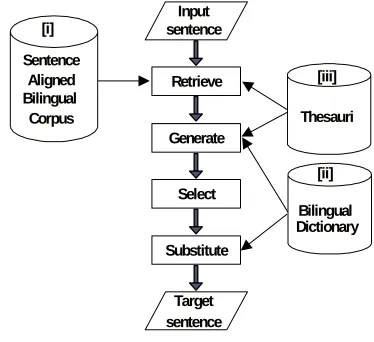
As shown in Figure 1, our language resources are [i] a bilingual corpus, in which sentences are aligned beforehand; [ii] a bilingual dictionary, which is used for generating target sentences; and [iii] thesauri of both languages, which are used for incorporating the semantic distance between words into the distance between word sequences. Furthermore, [ii] and [iii] are also used for word alignment.
Generate
Select
Substitute
Retrieve Aligned
Bilingual Corpus
[i] Sentence
[ii]
Bilingual Dictionary [iii]
Thesauri Input
sentence
Target sentence
Figure 1. Configuration
Suppose we are translating a Japanese sentence into English. Let’s review the process with a simple sample below. The Japanese input (1-j) is translated into English (1-e) by utilizing (2-e), whose source (2-j) is similar to (1-j). The common parts are unchanged, and the different portions are substituted by consulting a bilingual dictionary.
;;;A Japanese input (1-j) iro/ga/ki/ni/iri/masen
;;; Japanese part of an example in corpus [i] (2-j) dezain/ga/ki/ni/iri/masen
[image:2.595.321.508.342.513.2];;; the English output (1-e) I do not like the color.
We retrieve the most similar source sentence of examples from a bilingual corpus. For this, we use DP-matching, which tells us the distance between word sequences, dist while giving us the matched portions between the input and the example. According to equation [1], dist, is calculated. The counts of the Insertion (I), Deletion (D), and substitution operations are summed. Then, this total is normalized by the sum of the lengths of the source and example sequences. According to equation [2], substitution considers the semantic distance, SEMDIST, between two substituted words.
[1]
example input
L
L
SEMDIST
D
I
dist
+
+
+
=
2
å
[2]
N K
[image:3.595.318.523.343.509.2]SEMDIST =
Figure 2 illustrates the SEMDIST calculation
between “potato” and “beef.” The most specific common abstraction of the two words is “ingredients,” as shown in boldface. The SEMDIST is K divided by N in the figure. K is the level of the most specific common abstraction of two words, and N is the height of the thesaurus.
fruit
apple carrot potato beef chicken orange
vegetable meat
ingredients
food TOP
K N
most specific common abstraction
Figure 2. SEMDIST calculated using thesaurus
Let us show the latest performance of D3. The translation speed is sufficiently fast in that the average translation time is 0.04 seconds per sentence with the 200 K corpus shown in Section 2. The translation quality is so high that the method can achieve a TOEIC score3 of 750. This
is equivalent to the average score of a Japanese businessperson in overseas department of Japanese corporations.
3.2
3 The TOEIC (Test of English for International
Communcation) test is an English language proficiency test for people whose native language is not English (http://www.chauncey.com/). The Total score ranges from 10 to 990. ATR has developed a method to measure the TOEIC score of a machine translation system. (Sugaya et al., 2000)
In brief, D3 uses DP-matching, which features the semantic distance between words. D3 has demonstrated good quality and short turnaround in travel conversations such as those in a phrasebook.
EBMT and SMT based on Hierarchical Phrase Alignment (HPA)
Here we intoroduce Hierarchical Phrase Alignment (HPA) and its application to EBMT and SMT.
3.2.1
Hierarchical Phrase Alignment (HPA)This subsection introduces a new phrase alignment approach (Imamura, 2001) called Hierarchical Phrase Alignment (HPA).
I have jus arrive in New York
ni desu
NewYork tsui ta bakari
VP
VP (3)
(3)
VP AUXVP S
VP AUXVP
S
(4) (5) (6)
(4) (5)
(6)
NP VMP
NP
(1) (2)
[image:3.595.73.283.515.600.2](1) (2)VMP
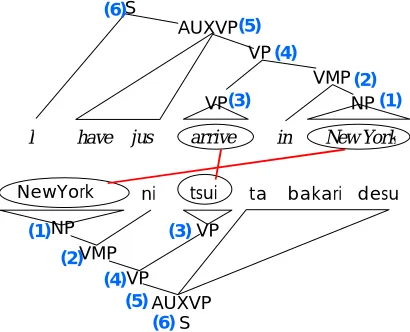
Figure 3. Bilingual trees and alignment
First, two sentences are tagged and parsed independently. This operation obtains two syntactic trees. Next, words are linked by the word alignment program. Then, HPA retrieves equivalent phrases that satisfy two conditions: 1) words in the pair correspond with no deficiency and no excess; 2) the phrases are of the same syntactic category.
Let’s look at a sample pair of a Japanese
tree and the corresponding English tree (Figure 3). The retrieval of equivalent phrases is done in a bottom-up fashion. First, the syntactic node pair that consists of only the ‘New York’ and ‘NewYork’ link, having the same syntactic category, is retrieved. Then, NP(1) and VMP(2) are found. Next, the syntactic node pair that consists of only the ‘arrived’ and ‘tsui’ link, having the same syntactic category, is retrieved. Then, VP(3) is found. Finally, the syntactic node pairs that include two word links having the same syntactic category are retrieved. Then VP(4), AUXVP(5), and S(6) are found. Accordingly, six equivalent phrases are hierarchically extracted.
3.2.2
EBMT based on HPAImamura (2002) proposed an application of HPA in EBMT called HPA-based translation (HPAT). HPAed bilingual trees include all information necessary to automatically generate transfer patterns. Translation is done according to transfer patterns using the TDMT engine (Sumita et al., 1999), our previous EBMT system. First, the source part of transfer patterns are utilized, and source structure is obtained. Second, structural changes are performed by mapping source patterns to target patterns. Finally, lexical items are inserted by referring to a bilingual dictionary, and then a conventional generation is performed. HPAT achieved about 70% accuracy.
3.2.3
SMT based on HPAStatistical machine translation (SMT) represents a translation process as a noisy channel model that consists of a source-channel model and a language model of the target language.
The translation model is based on word-for-word translation and limited to allow only one channel source word to be aligned from a channel target word. Although phrasal correspondence is implicitly implemented in some translation models by means of distortion, careful parameter training is required.
In addition, the training procedure relies on the EM algorithm, which can converge to an optimal solution but does not assure the global maximum parameter assignment. Furthermore, the numbers of parameters represent the translation models, so that easily suffered from the over-fitting problem. In order to overcome these problems, simpler models, such as word-for-word translation models (Brown et al.,
1993) or HMM models (Och et al., 2000), have been introduced to determine the initial parameters and to bootstrap the training.
We have proposed two methods to overcome the above problems by using HPA. (1) The first method converts the hierarchically aligned phrasal texts into a pair of sequences of chunks of words, treating the word-for-word translation model as a chunk-for-chunk translation model. (2) The second method computes the parameters for the translation model from the computed phrase alignments and uses the parameters as a starting point for training iterations.
The experimental results on Japanese-to-English translation indicated that the model trained from the parameters derived from the HPA could improve the quality of translation (Watanabe et al., 2002a).
4
4.1
4.2
Competition between the Three
MTs on Same Corpus
Competition Conditions
We used the corpus shown in Section 2, which is a collection of Japanese sentences and their English translations, typically found in phrasebooks for foreign tourists. We lemmatized and POS-tagged both the Japanese and English sentences.A quality evaluation was done for the test set consisting of 510 sentences selected randomly from the above corpus, and the remaining sentences were used for learning and verification.
We also used a bilingual dictionary previously developed for TDMT. The size of the dictionary is 24,658 words. We used thesauri whose hierarchies are based on the Kadokawa Ruigo-shin-jiten (Ohno and Hamanishi, 1984). The size of the Japanese thesaurus is 21,608 and that of the English thesaurus is 11,359.
Results
Fair: easy-to-understand, with either some unimportant information missing or flawed grammar; (C) Acceptable: broken, but understandable with effort; (D) Nonsense: important information has been translated incorrectly. It worked in both J-to-E and E-to-J directions4 in spite of the negative opinions previously expressed.
Table 3. SMT worked for J and E
Rank(s) A A+B A+B+C
SMT(JE) 25% 46% 64% SMT(EJ) 41% 48% 57%
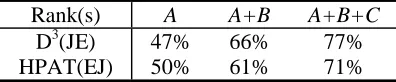
[image:5.595.79.277.342.383.2]We implemented two EBMT systems, D3 and HPAT, using the same corpus. D3 and HPAT surpassed SMT in the travel conversation task (Tables 3 and 4).
Table 4. EBMTs on the same corpus
Rank(s) A A+B A+B+C
D3(JE) 47% 66% 77%
HPAT(EJ) 50% 61% 71%
Finally, it became clear that word-based SMT, a revival of the direct method of the ’50s, is suitable for pairs of European languages but not for Japanese and English. This is because word-based SMT cannot capture the major differences such as word order between Japanese and English.
Several organizations (Yamada et al., 2001; Alshawi et al., 2000) are pursuing syntax-based SMT. We plan to join the race. Which is suitable for Japanese and English, syntax-based SMT or EBMT?
5
5.1
Combination of Evaluation and
Translation
We are researching automatic evaluation of machine translation outputs and multiple paradigms for machine translation simultaneously. Together, they have synegistic effects as explained below.
Automatic Quality Evaluation Using Corpus
5.2
4 For this test set, the accuarcy of SMT is at least twice as good as that of a famous conventional machine translation system on the WEB.
Translation quality has conventionally been evaluated by hand. Likewise, we have evaluated the outputs of our translation systems subjectively with four ranks from ‘good’ to ‘bad’: A, B, C, and D (Sumita et al., 1999).
Such subjective evaluation by ranking, however, is taxing on both time and resources. If automatic evaluation methods are inexpensive, fast, and sufficiently accurate, then such automatic evaluation methods would prove beneficial.
Conventional approaches to automatic evaluation include methods (Su, 1992; Yasuda et al., 2001) that automatically assign one of several ranks to MT output according to a single edit distance between an MT output and a correct translation example.
To improve performance, we proposed an automatic ranking method that, by using multiple edit distances, encodes machine-translated sentences with a rank assigned by humans into multi-dimensional vectors from which a classifier of ranks is learned in the form of a decision tree. The proposed method assigns a rank to MT output through the learned decision tree (Akiba et al., 2001).
Experimental results show that the proposed method is more accurate than the single-edit-distance-based ranking methods in both closed and open tests. The proposed method has the potential to accurately estimate the quality of outputs of machine translation systems.
Multiple-engine Machine Translation System
Every researcher has his own way of acquiring translation knowledge by generalizing translation instances in a corpus. Our approach is no exception to this rule. Our MTs are based on different paradigms, different development styles, and different development periods. This results in various behaviors for each input sentence, and the translation rank of a given input sentence changes system-by-system.
Table 5. Sample of transaltion variety with quality rank
o-shiharai wa genkin desu ka kurejitto kaado desu ka
We show a sample of different English translations obtained by three systems for a Japanese sentence (Table 5). The brackets show the quality rank judged by a human translator.
Translation systems gain A-ranked translations in different subsets of input sentences as illustrated in Figure 4. Thus, we could obtain a large increase in accuracy by using an “ideal” MT, if it were possible to select the best one of the three different translations for each input sentence.
MT1
MT2 MT3
Figure 4. Subsets of input sentences whose translation is A-ranked
We are investigating methods to utilize techniques of automatic evaluation for selector (Figure 5).
MT1
MT2
MT3
[image:6.595.307.550.360.649.2]Selector
Figure 5. Selector for multi-engine MT
In our pilot experiment, our selectors (Akiba et al., 2002; Yasuda et al., 2002) outperformed not only the component systems but also a conventional selector using N-gram (Callison-Burch et al., 2001).
Combination of Paraphrasing
and Translation
6
6.1
We are automating extraction of paraphrase knowledge from a bilingual corpus. In this section, we introduce its application to improve the performance of corpus-based translation by using SMT as a touchstone.
Extraction of Synonymous Expressions
We propose an automatic paraphrasing method that exploits knowledge from bilingual corpora (Shimohata et al., 2002).
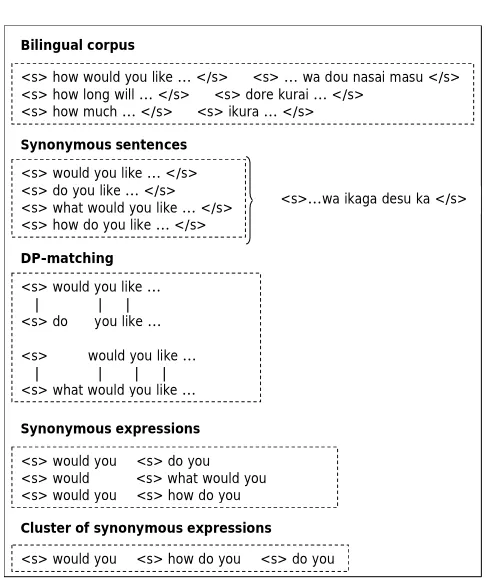
Synonymous expressions are defined as a sequence of variant words with surrounding common words. The expressions are extracted from bilingual corpora by the following procedures (Figure 6):
1. Collect sentences that share the same translation in another language. The accumulated sentences are defined as synonymous sentences.
2. For all pairs of synonymous sentences, apply DP-matching and collect sequences of words, synonymous expressions that consist of variant words preceded/followed by common words.
3. Remove pairs of synonymous expressions with a frequency lower than a given threshold.
4. Cluster the pairs of synonymous expressions by transitive relation.
<s> how would you like …</s> ó <s> … wa dou nasai masu </s>
<s> how long will … </s> ó <s> dore kurai … </s>
<s> how much … </s> ó <s> ikura … </s>
<s> would you like …</s>
<s> do you like … </s>
<s> what would you like …</s>
<s> how do you like …</s>
[image:6.595.103.256.376.483.2]<s> would you like …
| | |
<s> do you like …
<s> would you like …
| | | |
<s> what would you like …
<s> would you ó<s> do you
<s> would ó<s> what would you
<s> would you ó<s> how do you
<s> would you ó<s> how do you ó<s> do you
Cluster of synonymous expressions Synonymous expressions
DP-matching
Synonymous sentences Bilingual corpus
ó <s>…wa ikaga desu ka </s>
Figure 6. Extraction of synonymous expressions
6.2
Corpus Normalizationselected according to their frequency in the corpora. For instance, the cluster obtained consists of the expressions ‘<s> would you,’ ‘<s> how do you’ and ‘<s> do you.’ Suppose that an expression ‘<s> do you’ occurred most frequently in a given corpus, an input ‘how do you like your coffee’ could be normalized into ‘do you like your coffee.’
6.3
7
7.1
7.2
8
SMT on Normalized Corpus
Statistical approach to machine translation demands huge bilingual corpora in good quality and broad coverage. However, such an ideal corpus is not usually available: one may contain a sufficiently large number of samples, for instance, derived from web pages with translations, but these may not be well-aligned or have low translation quality. Others may consist of high-quality translations but have a limited number of examples. In addition, the variety of possible translations makes it even harder to estimate parameters for statistical-based machine translation.
We propose a way to overcome these problems by creating a corpus that consists of normalized expressions, expressions with less variety, through automated paraphrasing (Watanabe et al., 2002b). As described above, by the method of transforming target sentences of a given bilingual corpus into a normalized form is expected to improve the parameter estimation for a statistical machine translation model. The normalization method proposed above locally replaces word sequences, hence will not affect the syntactical coherence. Therefore, normalization will not affect the distortion model, which accounts for reordering of bilingual texts. In addition, reduction of the vocabulary size will greatly help improve the parameter estimation for lexical models.
The experimental results on Japanese-to-English translation indicated that the SMT created on the target normalized sentences reduced word-error-rate from 66% to 58%.
Discussions
Forecasting from the Obtained Performance
As a component of C3, D3 has achieved a high TOEIC score. We foresee much higher scores for
C3 because it features a multi-engine and selector scheme, which is an easy, quick and low-cost method of improving total performance, since there is no need to investigate the messy relationships between resources and processes of the component systems by hand.
Backcasting from the Future S2S System in the Real World
We are aiming to develop technologies for S2S that are usable in real-world environments. No one knows what the real world will be, but there is no doubt that an S2S system should deal with variations in length and expressions beyond our corpus that explained in Section 2. In other words, we divided our “real-world” goal into three sub-goals; (1) translation of short and edited sentences; (2) translation of long sentences; (3) translation of short but non-edited sentences; and (4) combining solutions for these sub-goals seamlessly.
Since we are centering our approaches on corpora, we are developing corpora for achieving sub-goals (1), (2) and (3) as reported in (Takezawa et al., 2002; Sugaya et al., 2002) .
For sub-goal (1), we are using a selector for multiple engines, for sub-goal (2), we have to devise methods to chunk long sentences into appropriate translation units, and for sub-goal (3) we need a powerful automatic paraphraser.
Conclusions
Our attempt called C3 places corpora at the center of S2S technology. All components of C3 are corpus-based as shown in the paper. If we have sufficient volumes of sentence-aligned bilingual corpora, we would be able to build a high-quality MT. Corpus-based processes for such tasks as translation, evaluation, and paraphrasing have synergistic effects. Therefore, we are optimistic about the progress of components and their integration in C3.
Acknowledgements
References
Akiba, Y., Imamura, K. and Sumita, E. 2001 Using multiple Edit Distances to automatically rank machine translation output, Proc. of MT-SUMMIT-VIII
Akiba, Y., Watanabe, T. and Sumita, E. 2002 Using Language and Translation Models to Select the Best among Outputs from Multiple MT systems, Proc. of Coling (to appear)
Alshawi, H., Bangalore, S. and Douglas, S. 2000 Learning Dependency Translation Models as Collections of Finite-State Head Transducers, Computational Linguistics, 26 (1), pp. 45--60.
Brown, P., Cocke, J., Della Pietra, S. A., Della Pietra, V. J., Jelinek, F., Laffetry, J. D., Mercer, R. L. and Roossin, P. S. 1993 A Statistical Approach to Machine Translation, Computational Linguistics 16, pp. 79--85
Callison-Burch, C. and Flournoy, S. 2001 A Program for Automatically Selecting the Best Output from Multiple Machine Translation Engines, Proc. of MT-SUMMIT-VIII
Imamura, K. 2001 Hierarchical phrase alignment harmonized with parsing, Proc. of NLPRS, pp. 377--384
Imamura, K. 2002 Application of Translation Knowledge Acquired by Hierarchical Phrase Alignment, Proc. of TMI
Knight, K. 1997, Automating Knowledge Acquisition for Machine Translation, AI Magazine, 18 (4), pp. 81--96
Nagao, M. 1984 A Framework of a Mechanical Translation between Japanese and English by Analogy Principle, in A. Elithorn and R. Banerji (eds), Artificial and Human Intelligence, Amsterdam: North-Holland, pp. 173--180.
Ney, H., Och, F. J. and Vogel, S. 2000 Statistical Translation of Spoken Dialogues in the Vermobil System, Proc. of MSC2000, pp. 69--74.
Och et al. 2000. Improved statistical alignment models. In Proc. of ACL, pp. 440--447, Hong Kong, China, October
Ohno, S. and Hamanishi, M. 1984. Ruigo-Shin-Jiten, Kadokawa, Tokyo (in Japanese)
Shimohata, M. and Sumita, E. 2002 Automatic paraphrasing based on parallel corpus for normalization, Proc. of LREC
Somers, H. 1999 Review Article: Example-based Machine Translation, Journal of Machine Translation, pp. 113--157
Su, K. -Y, Wu, M. -W. and Chang, J. –S. 1992 A new quantitative quality measure for machine translation systems, Proc. of Coling, pp. 433--439
Sugaya, F., Takezawa, T., Yokoo, A., Sagisaka, Y, and Yamamoto, S. 2000 Evaluation of the ATR-MATRIX Speech Translation System with a Pair Comparison Method Between the System and Humans, Proc. of ICSLP, pp. 1105--1108
Sugaya, F. et al. 2002 Proposal for a very large-corpus acquisition method by registering in tree-structure form, Proc. of LREC
Sumita, E. 2001 Example-based machine translation using DP-matching between word sequences, Proc. of DDMT (ACL), pp. 1--8
Sumita, E., Yamada, S., Yamamoto, K., Paul, M., Kashioka, H., Ishikawa, K. and Shirai, S. 1999 Solutions to Problems Inherent in Spoken-language Translation: The ATR-MATRIX Approach, Proc. of MT Summit VII, pp. 229--235
Takezawa, T. et al. 2002 Toward a Broad-coverage Bilingual Corpus for Speech Translation of Travel Conversations in the Real World, Proc. of LREC
Yamada et al. 2001 A Syntax-Based Statistical Translation Model. Proc. of ACL, France
Yasuda, K., Sugaya, F., Takezawa, T., Yamamoto, S. and Yanagida, M. 2001 An automatic evaluation method of translation quality using translation answer candidates queried from a parallel corpus, Proc. of MT-SUMMIT-VIII
Yasuda, K., Sugaya, F., Takezawa, T., Yamamoto, S. and Yanagida, M. 2002 Automatic Machine Translation Selection Scheme to Output the Best Result, Proc. of LREC
Watanabe, T., Imamura, K. and Sumita, E. 2002a Statistical Machine Translation Based On Hierarchical Phrase Alignment, Proc. of TMI