A Dataset for Inter-Sentence Relation Extraction using Distant Supervision
Angrosh Mandya, Danushka Bollegala, Frans Coenen, Katie Atkinson
Department of Computer Science, University of Liverpool, UK{angrosh,danushka,coenen,katie}@liverpool.ac.uk
Abstract
This paper presents a benchmark dataset for the task of inter-sentence relation extraction. The paper explains the distant supervision method followed for creating the dataset for inter-sentence relation extraction, involving relations previously used for standard intra-sentence relation extraction task. The study evaluates baseline models such as bag-of-words and sequence based recurrent neural network models on the developed dataset and shows that recurrent neural network models are more useful for the task of intra-sentence relation extraction. Comparing the results of the present work on iner-sentence relation extraction with previous work on intra-sentence relation extraction, the study suggests the need for more sophisticated models to handle long-range information between entities across sentences.
Keywords:Inter-sentence Relation Extraction, Relation Extraction, Inter-sentence Relation Extraction Dataset, Distant Supervi-sion for Inter-sentence Relation Extraction
1.
Introduction
In recent times, the field of relation extraction has received significant research attention due to its importance in in-formation retrieval (Culotta and Sorensen, 2004; Mintz et al., 2009; Banko et al., 2007; Etzioni et al., 2011). The key task in relation extraction is to recognise the semantic relation that exist between two given entities. Depending on the scope of the co-occurrences of the two entities, re-lation extraction methods can be broadly categorised into two groups: (a) intra-sentence relation extraction meth-ods (Brin, 1998; Banko et al., 2007; Mintz et al., 2009; Riedel et al., 2010), and (b)inter-sentence relation extrac-tionmethods (Swampillai and Stevenson, 2010; Gu et al., 2017; Quirk and Poon, 2016; Peng et al., 2017). While intra-sentence relation extraction attempts to extract rela-tions between two entities that co-occur within the same sentence, inter-sentence relation extraction methods con-sider entities that might not necessarily co-occur in the same sentence.
In more detail, the distinction between intra and inter-sentence relation extraction tasks can be illustrated as fol-lows. Let us assume that a relationrtakese1 as the first argument and e2 as the second argument. Further, let us also assume that e1is included in a sentencesi ande2 is included in a sentencesj. Then, we define intra-sentence
relation extraction as the task of extracting relationrfrom
si andsj, wheni = j. We define inter-sentence relation
extraction as the task of extracting relation rfromsi and
sj, wheni 6= j. In this work, we limitiandj such that
|i−j|= 1. Examples of intra-sentence and inter-sentence relation extraction are provided below in Listings 1 and 2, respectively.
LISTING 1: EXAMPLE OF INTRA-SENTENCE RELATION EX -TRACTION
S1: In 1957,<e1>Ayn Rand</e1>published her best-known work, the novel<e2>Atlas Shrugged</e2>.
LISTING 2: EXAMPLE OF INTER-SENTENCE RELATION EX -TRACTION
S1: <e1>Ayn Rand</e1> (born <e1>Alisa
Zi-novyevna Rosenbaum</e1>, March 6, 1982) was a Russian-born American novelist, philosopher, playwright, and screenwriter.
S2: She is known for her two best-selling novels,<e2>The Fountainhead</e2> and <e2>Atlas Shrugged</e2> and for developing a philosophical system she called Ob-jectivism.
As seen in Listing 1, intra-sentence relation extrac-tion attempts to extract related entities (Ayn Rand, At-las Shrugged) for the relation book/author/works written (Freebase relation) appearing in the same sentence. How-ever, as seen in Listing 2, the related entities appear in dif-ferent sentences, with the author name present in S1 and the published novels inS2. Traditional relation extraction methods focussing on intra-sentence relation extraction will fail to extract the relation book/author/works written, be-tween the entities (Ayan Rand, The Fountainhead), (Ayn Rand, Atlas Shrugged), (Alisa Zinovyevna Rosenbaum, The Fountainhead), (Alisa Zinovyevna Rosenbaum, Atlas Shrugged)from these two sentences. Thus, in order to ex-tract these relationships, both sentences must be considered collectively.
extraction.
The main contributions of this paper are as follows:
a. A large (benchmark) dataset for inter-sentence rela-tion extracrela-tion generated following distant supervision method. The approach employed the resource used by Mintz et al. (2009) to develop a balanced dataset com-prising 31,970 sentence pairs with inter-sentence re-lation mentions involving 17 different rere-lations. The test set for evaluation purposes is created manually by choosing 100 sentence pairs with explicit relation mentions for each of the 17 relations.
b. Present performance of baseline models such as the bag-of-words model and sequence-based neural net-work models on the developed dataset.
2.
Related Work
The related work for the present study can be grouped into the following three strands:
Intra-sentence relation extraction. Mintz et al. (2009) identify atleast three paradigms applied for the task of intra-sentence relation extraction. These are: (a) supervised learning approaches focussing on creating hand-labeled data and experimenting with a variety of lexical, syntac-tic and sematnic features (GuoDong et al., 2005; Surdeanu and Ciaramita, 2007); (b)unsupervised learningmethods aiming to cluster strings of words exracted from large col-lections of text (Shinyama and Sekine, 2006; Banko et al., 2007); and (c)bootstrapping methodsemploying small seed sets that focus on pattern-based relation extraction (Brin, 1998; Riloff et al., 1999). Recently, deep learning models such as CNN (Zeng et al., 2014; Santos et al., 2015; Xu et al., 2015a), Recurrent neural networks based models such as LSTM model (Miwa and Bansal, 2016; Xu et al., 2015b) and BiLSTM model (Wu et al., 2017) are shown to be quite useful for intra-sentence relation extraction. Inter-sentence relation extraction. As explained in the previous section, several studies have focussed on rela-tion extracrela-tion across sentences due to its contriburela-tion to th eoverall task of relation extraction. Further, comparing intra-sentence and inter-sentence features for clinical re-search relationship extraction, Roberts et al. (2008) show that intra-sentence features are not very useful for inter-sentence relation extraction. Swampillai and Stevenson (2010) employed features drawn from combining parse trees of sentences for extracting relations across sentences in the MUC6 dataset. Targeting inter-sentence time-event relation extraction, Moschitti et al. (2013) proposed an SVM-model using tree kernels, whichwere evaluated on Machine Reading Program (MRP) and TimeBank datasets. Tree kernels are also shown to be useful for inter-sentence relation extraction in the Chemical-Induced-Disease do-main (Nagesh, 2016). More recently, Quirk and Poon (2016) and Peng et al. (2017) developed a large dataset for drug-gene interactions and experimented with graphLSTM models to extract cross-sentencen-ary relation extraction. Distant supervision for relation extraction. While sev-eral methods are employed for dataset creation for relation extraction across entities in a single sentence, distant super-vision method has been shown as an useful method for such
intra-sentence relation extraction tasks (Mintz et al., 2009; Riedel et al., 2010). The approach of distant supervision facilitates creation of large datasets using seed instances. Although, distant supervision follows a strong assumption that sentences with any two entity mentions for a particu-lar relation, qualify as a candidate for relation extraction, it combines the usefulness of supervised learning approaches, unsupervised learning methods and bootstrapping systems for relation extraction, and is particularly useful in creating large datasets, without manual annotation.
Given the above three strands of research related to the field of relation extraction, it can be clearly noticed that signif-icantly a large number of studies have focused on intra-sentence relation extraction in comparison to the research work on inter-sentence relation extraction. Further, it can also be seen that most of the work in the context of inter-sentence relation extraction have employed smaller datasets (Swampillai and Stevenson, 2010; Gu et al., 2017). Fur-thermore, more recent works (Quirk and Poon, 2016; Peng et al., 2017) have focused on specialized domains such as Bioinfomatics. Thus, given the absence of a large dataset to investigate inter-sentence relation extraction, particulary involving generic relations, this study proposes to develop a dataset of reasonable size, involving generic relations to facilitate research in the field of inter-sentence relation ex-traction. Without doubt, the availability of such a dataset can help to explore novel ways of relation extraction across sentences. With this motivation, this study looks at devel-oping a dataset for inter-sentence relation extraction, in-volving generic relations. Further, although distant super-vision method suffers from the “strict assumption” (Riedel et al., 2010), given the usefulness of distant supervision for relation extraction, we propose to follow the distant super-vision method for developing dataset for inter-sentence re-lation extraction. This could serve as a starting point to examine the task of inter-sentence relation extraction. Fur-ther, given the recent success of deep learning models for relation extraction (Zeng et al., 2014; Santos et al., 2015; Xu et al., 2015a; Xu et al., 2015b), we propose to evaluate some of these techniques on the developed dataset.
3.
Inter-sentence Relation Extraction
Dataset
The process of creating inter-sentence relation extraction dataset is described in this section.
3.1.
Approach
Relation SI
Table 1: Sample set of Freebase relations from Mintz et al.(2009) dataset. SI - seed instances.
which is previously examined for intra-sentence relation extraction for developing dataset for inter-sentence relation extraction will facilitate generation of a corpus for generic relations and also help in understanding the scope of inter-sentence relation extraction in the context of intra-inter-sentence relation extraction. As defined previously in§1., this study focuses on extracting sentence pairs with inter-sentence re-lation mentions. An example of candidate sentence pair for inter-sentence relation extraction was previously seen in Listing 2, where entitiese1ande2are present in the first and the second sentence, respectively. The different statis-tics of extracted sentence pairs with inter-sentence relation mentions are explained in the following section.
3.2.
Dataset Statistics
The process of extracting sentence pairs using the 102 Freebase relations resulted in obtaining nearly 101042 sen-tence pairs with relation mentions between them, i.e., entity
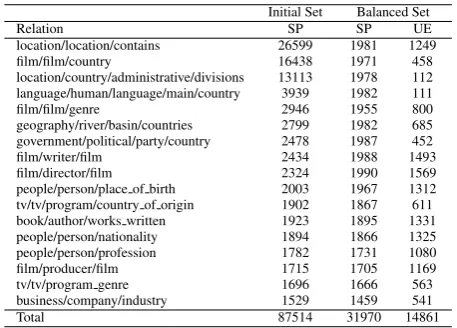
e1 being present in the first sentence and entity e2 being present in the second sentence. Table 2 provides the list of 17 Freebase relations with the largest number of sentence pairs with inter-sentence relation mentions.
As can be seen in Table 2, a varied number of sentence pairs are obtained for different relations. For example, while the relation “location/location/contains” obtains a large number of 26599 sentence pairs, the relation “busi-ness/company/industry” obtains a lower number of 1529 sentence pairs. There were also other relations that had lesser than 1500 sentence pairs, which are not listed in Ta-ble 2, as we do not include those relations in the dataset. Given this varied set of sentence pairs for Freebase re-lations, in order to develop a balanced dataset for inter-sentence relation extraction, we randomly selected 2000 sentence pairs for all those relations that had more than 2000 sentence pairs and retained all the available sentence pairs for those relations that had less than 2000 sentence pairs. Further, a filtering process was carried out to remove problem sentence pairs, containing reference and hyperlink tags. This resulted in a balanced dataset comprising 35895 sentences for 17 different Freebase relations as shown in Table 2. Table 2 also shows the unique entities used for each relation. The various characteristics of the developed dataset are explained below. people/person/place of birth 2003 1967 1312 tv/tv/program/country of origin 1902 1867 611 book/author/works written 1923 1895 1331 people/person/nationality 1894 1866 1325 people/person/profession 1782 1731 1080 film/producer/film 1715 1705 1169 tv/tv/program genre 1696 1666 563 business/company/industry 1529 1459 541
Total 87514 31970 14861
Table 2: List of 19 Freebase relations with initial set of inter-sentence relation instances and balanced set created using the initial set. SP - Sentence Pairs, UE - Unique En-tities.
3.3.
Characteristics of the Dataset
The following are some of the aspects of the developed dataset:
1. Distant supervision assumption. The distant super-vision assumption (mentioned in previous section) is pserved while developing the dataset for inter-sentence re-lation extraction. This results in obtaining a number stences pairs, where the relation between the related en-tity pairs is not evident directly. For instance, as seen in Listing 3, the sample sentence pair for the relation busi-ness/company/industry does not provide an explicitly vis-ible relationship between the entities for the said relation. However, the seed instances used identifies “Google” as a “Search” industry, resulting in obtaining this sentence pair as a suitable candidate for inter-sentence relation extrac-tion.
LISTING 3: EXAMPLE OF SENTENCE PAIR FOR BUSI -NESS/COMPANY/INDUSTRY RELATION
S1:<e1>Search</e1>engines also frequently make web pages they have indexed available from their cache.
S2: For example,<e2>Google</e2>provides a ”Cached” link next to each search result”
2. Filter instances with multiple entity mentions. Fur-ther, instances with multiple entity mentions were con-sidered only once in order to remove duplicates across the training and test set. For instance, the example shown in Listing 2, qualify as two instances for the re-lation book/author/works written(Ayan Rand, The Foun-tainhead) and book/author/works written(Ayan Rand, At-las Shrugged). However, we retain only one instance of such relations, by randomly selecting between multiple in-stances.
Christie’ ins1. Such instances are included in the dataset without resolving coreferences, as a suitable candidate for inter-sentence relation extraction, between the entities (Agatha Christie, The Murder of Roger Ackroyd) for the re-lation book/author/works written.
LISTING 4: EXAMPLE OF SENTENCE PAIR FOR BOOK/AUTHOR/WORKS WRITTEN RELATION
S1:<e1>Agatha Christie</e1>attributed the inspiration for the character of Miss Marple to a number of sources.
S2: Christie also used material from her fictional creation,
spinster Caroline Sheppard, who appeared in <e2>The
Murder of Roger Ackroyd</e2>.
4. Dataset split. To evaluate the dataset, we manu-ally selected 100 instances for each relation resulting in a test dataset comprising about 1900 instances for 17 re-lations. The remaining corpus i.e., dataset excluding sen-tences manually selected for test dataset, was randomly split into two sets in the ratio 80:20 to create the train-ing and validation set, respectively. The mode was de-veloped using the validation set, which was tested on the manually created test dataset. Our dataset is created fol-lowing the distant supervision approach. Therefore, it re-mains unclear how accurate the annotations produced by following distant supervision. To empirically evaluate the validity of the distant supervision assumption, we ran-domly select 50 sentence pairs for each of the four re-lation types book/author/works written, film/director/film, film/producer/film/ film/writer/film separately, and manu-ally verify whether the relation holds between the two enti-ties in each pair of sentences. This analysis reveals that on average 79% of the sentence pairs annotated using distant supervision are indeed correct. Therefore, we believe that our dataset is sufficiently accurate for training and testing purposes.
4.
Experiments
The different baselines models, evaluation metrics and the results of this study are presented here.
4.1.
Models
The following models are evaluated for inter-sentence rela-tion extracrela-tion.
4.1.1. Bag-of-Words Model
The bag-of-words model provides a simple baseline to eval-uate inter-sentence relation extraction by simply concate-nating the two sentences with inter-sentence relation men-tions. While the bag-of-words model simply combines words in the sentence pair without differentiating between them, it would be interesting to investigate whether differ-entiating between the words in the sentence pair would help in classification. Accordingly, the following two bag-of-words model, using different feature sets are examined:
1. BOW-WITHOUT-SB: bag-of-words model without sentence boundary;
2. BOW-WITH-SB: bag-of-words model with sentence boundary.
4.1.2. Sequence based Deep Learning Models
Although recurrent neural networks (RNNs) are useful models for relation extraction through sequential learn-ing, the difficulty in training RNNs using backpropaga-tion through time (Rumelhart et al., 1988), usually re-sults in the vanishing gradient problem (Bengio et al., 1994), wherein the gradient propagated through the net-work over time either decays or grows exponentially. The Long Short-Term Memory (LSTM) model was proposed to overcome the vanishing gradient by regulating the infor-mation in a cell state using input, output and forget gates and thereby learn long-term dependencies (Hochreiter and Schmidhuber, 1997). Recently, LSTM and Bidirectional-LSTM (BiBidirectional-LSTM) models have also been successfully ap-plied for the task of intra-sentence relation extraction (Ma and Hovy, 2016). Inter-sentence relation classification can be considered as a sequence classification problem, with the task to predict the relation given the sequence of words across the sentences. Theoretically, LSTM should be help-ful for inter-sentence relation extraction, with its capability of handling long-term dependencies from long sequences of words. Further, while LSTM model captures the con-text only in the forward direction, BiLSTM models process the data in both directions with two separate hidden lay-ers, which are then provided to the output layer. Accord-ingly, the following LSTM-based models are evaluated for the task of inter-sentence relation extraction:
1. LSTM-MODEL LSTM model for inter sentence rela-tion extracrela-tion which uses the words between the two entities across sentences and also learns embeddings for entities in different sentences;
2. BILSTM-MODEL: Bidirectional LSTM model for in-ter sentence relation extraction which uses the words between the two entities across sentences and also learns embeddings for entities in different sentences
4.2.
Evaluation Metrics
The PrecisionP, RecallRand F-ScoreF, as defined be-low are measured in order to evaluate the performance of different models.
P =Number of correctly extracted entity relations
Total number of extracted entity relations
R=Number of correctly extracted entity relations
Actual number of extracted entity relations F=
2P R P+R
4.3.
Results and Discussion
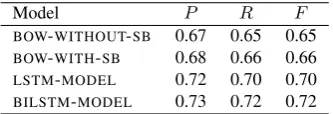
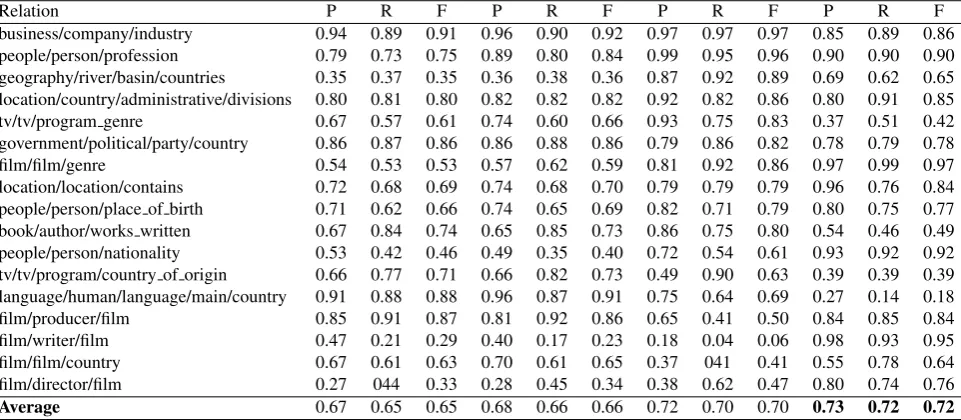
The performance of different models for inter-sentence re-lation on the proposed dataset is shown in Table 3. The precision, recall and F-scores scored by different models for individual relations is provided in Table 4. The follow-ing explains the results of this study.
4.4.
Best performing model
As seen in Table 3, the LSTM-based models (LSTM
-MODEL and BILSTM-MODEL) achieve a comparatively higher F-score of (0.70 and 0.72 respectively) against the bag-of-words models (BOW-WITHOUT-SBandBOW-WITH
Model P R F BOW-WITHOUT-SB 0.67 0.65 0.65 BOW-WITH-SB 0.68 0.66 0.66 LSTM-MODEL 0.72 0.70 0.70 BILSTM-MODEL 0.73 0.72 0.72
Table 3: Performance ofBAG-OF-WORDS,LSTMandBIL
-STMmodels for Inter-sentence Relation Extraction on test dataset,P - Precision,R- Recall,F- F-score
on the test set. This shows that sequence based recur-rent neural network models are more useful for the task of inter-sentence relation extraction, in comparison to simple bag-of-words models due to their ability in learning from long range sequential information between entities across sentences. The inclusion of information to distinguish be-tween information obtained from different sentences does not seem to help much in increasing the performance since theBOW-WITH-SBachieved a mere improvement of 1 point in terms of F-score obtained against theBOW-WITHOUT-SB
model.
Among the different evaluated models, theBILSTMmodel achieved the highest F-score of 0.72 in comparison to other models. However, the performance obtained using BIL
-STM does not provide a statistically significant improve-ment against the other examined models. In comparison to the regular LSTM model which achieves an F-score of 0.70, the BILSTMmodel achieves a little improvement by obtaining an F-score of 0.72. Although the difference be-tween these two models is not statistically significant, the results indicate that it would be useful to use models such as
BILSTMfor the task of inter-sentence relation extraction, as these models learn from sequential information from both directions.
4.5.
Poor performing relations
The precision, recall and F-scores obtained for individual relations (shown in Table 4) shows that the models per-form significantly better for certain relations and poor for some relations1. For example, almost all models achieve significantly higher F-scores for the following relations ‘business/company/industry’, ‘people/person/profession’, ‘location/country/administrative/divisions’, ‘tv/tv/program genre’ and ‘government/political/party/country’. These re-sults shows that these models are able to easily learn from the available features (words) for these relations.
However, as seen in Table 4, there are a number of relations, where the models achieve a significantly lower F-score. For example, for the following relations ‘film/director/film’, ‘film/film/country’, ‘film/writer/film’, and ‘film/producer/film’, the models achieve a significantly poor F-score. The confusion matrix for these relations indicates that a large number of instances for these rela-tions are wrongly classified as other relarela-tions. For ex-ample, instances for the ‘film/film/country’ relation are wrongly classified as ‘tv/tv/program/country of origin’ re-lation. This indicates that the features between these
1The relations are sorted in decreasing order according to their
performancew.r.tBILSTMmodel
two relations are so common that the classifier fails to differentiate between the two relations. For instance, consider instances in Listings 5 and 6 for the rela-tion film/film/country. Though these instances are an-notated for ‘film/film/country’ relation, features such as ‘television’ can render the instance to be classified as ‘tv/tv/program/country’.
LISTING5: EXAMPLE FOR FILM/FILM/COUNTRY RELATION
S1: Victoria Schmidt is a< e1>New Zealand< /e1> the-ater, film and television actress.
S2: She is most known for her role as Aaliyah in <
e2>Siones Wedding< /e2>(2006).
LISTING6: EXAMPLE FOR FILM/FILM/COUNTRY RELATION
S1: The Legendary Fok is a< e1>Hong Kong< /e1> tele-vision series.
S2: It includes a subplot based on the protagonist of the 1972 film< e2>Fist of Fury< /e2>.
Similarly, a number of instances for the relation ‘film/writer/film’ are classified as ‘film/director/film’ and vice-versa. The reason for this confusion is that many a times, the director himself is the writer of the story or the screenplay for the film. For example, consider the instance in Listing 7. The writer of the movie has different roles in terms of actor, writer and director of the film, making it difficult for the classifier to identify the correct relation.
LISTING7: EXAMPLE FOR FILM/WRITER/FILM RELATION
S1: < e1>Luis Valdez< /e1>is an American playwright, actor, writer and film director.
S2: He is best known for his movie < e2>La Bamba<
/e2>.
4.5.1. Intra-sentence vs. inter-sentence relation extraction
As explained in the preceding sections, the lstm-based models (LSTM and BILSTM) achieve higher performance on the task of inter-sentence relation extraction. How-ever, working in the context of intra-sentence relation ex-traction, Xu et al. (2015b) report an F-score of 0.82 by training an LSTM model using word embeddings. How-ever, instead of using all the words between the entities in the sentence, Xu et al. (2015b) use the words in the shortest dependency path between the two entities in the sentence. The results (F-score of 0.82) achieved by Xu et al. (2015b) is significantly higher in comparison to the F-scores achieved by bothLSTMandBILSTMmodels (F-score of 0.70 and 0.72) for the task of intra-sentence relation ex-traction. The comparison of these results clearly indicate that the task of inter-sentence relation extraction focusing on extracting relations between entities across sentences is more difficult than intra-sentence relation extraction, which focuses on extracting relations between entities in a single sentence. The major challenge is to model the long-range information between the entities across sentences and thus, requires more sophisticated models other than simpleLSTM
Relation P R F P R F P R F P R F
business/company/industry 0.94 0.89 0.91 0.96 0.90 0.92 0.97 0.97 0.97 0.85 0.89 0.86
people/person/profession 0.79 0.73 0.75 0.89 0.80 0.84 0.99 0.95 0.96 0.90 0.90 0.90
geography/river/basin/countries 0.35 0.37 0.35 0.36 0.38 0.36 0.87 0.92 0.89 0.69 0.62 0.65
location/country/administrative/divisions 0.80 0.81 0.80 0.82 0.82 0.82 0.92 0.82 0.86 0.80 0.91 0.85
tv/tv/program genre 0.67 0.57 0.61 0.74 0.60 0.66 0.93 0.75 0.83 0.37 0.51 0.42
government/political/party/country 0.86 0.87 0.86 0.86 0.88 0.86 0.79 0.86 0.82 0.78 0.79 0.78
film/film/genre 0.54 0.53 0.53 0.57 0.62 0.59 0.81 0.92 0.86 0.97 0.99 0.97
location/location/contains 0.72 0.68 0.69 0.74 0.68 0.70 0.79 0.79 0.79 0.96 0.76 0.84
people/person/place of birth 0.71 0.62 0.66 0.74 0.65 0.69 0.82 0.71 0.79 0.80 0.75 0.77
book/author/works written 0.67 0.84 0.74 0.65 0.85 0.73 0.86 0.75 0.80 0.54 0.46 0.49
people/person/nationality 0.53 0.42 0.46 0.49 0.35 0.40 0.72 0.54 0.61 0.93 0.92 0.92
tv/tv/program/country of origin 0.66 0.77 0.71 0.66 0.82 0.73 0.49 0.90 0.63 0.39 0.39 0.39
language/human/language/main/country 0.91 0.88 0.88 0.96 0.87 0.91 0.75 0.64 0.69 0.27 0.14 0.18
film/producer/film 0.85 0.91 0.87 0.81 0.92 0.86 0.65 0.41 0.50 0.84 0.85 0.84
film/writer/film 0.47 0.21 0.29 0.40 0.17 0.23 0.18 0.04 0.06 0.98 0.93 0.95
film/film/country 0.67 0.61 0.63 0.70 0.61 0.65 0.37 041 0.41 0.55 0.78 0.64
film/director/film 0.27 044 0.33 0.28 0.45 0.34 0.38 0.62 0.47 0.80 0.74 0.76
Average 0.67 0.65 0.65 0.68 0.66 0.66 0.72 0.70 0.70 0.73 0.72 0.72
Table 4: Precision (P), Recall (R) and F-scores (F) obtained by different models for individual relations.
5.
Conclusion
To conclude, this study resulted in creating a benchmark dataset for inter-sentence relation extraction. The study fol-lowed distant supervision method for creating the dataset involving relations previously used for creating resources for intra-sentence relation extraction. Accordingly, this study resulted in developing a balanced dataset compris-ing a large number of sentence pairs with inter-sentence relation mentions for 17 different relations. The study also evaluated certain baseline models such as bag-of-words and sequence based recurrent neural network models on the de-veloped dataset. The study shows that recurrent neural net-work models are more useful for the task of intra-sentence relation extraction, in comparison to bag-of-words model. However, the intra-sentence relation extraction results ob-tained in this study in comparison to intra-sentence relation extraction, indicate the need for more sophisticated mod-els for handling the long-range information between enti-ties across sentences.
6.
Bibliographical References
Banko, M., Cafarella, M. J., Soderland, S., Broadhead, M., and Etzioni, O. (2007). Open information extraction from the web. InIJCAI, volume 7, pages 2670–2676. Bengio, Y., Simard, P., and Frasconi, P. (1994). Learning
long-term dependencies with gradient descent is diffi-cult. IEEE transactions on neural networks, 5(2):157– 166.
Bordes, A., Usunier, N., Garcia-Dur´an, A., Weston, J., and Yakhenko, O. (2013). Translating embeddings for mod-eling multi-relational data. InProc. of NIPS.
Brin, S. (1998). Extracting patterns and relations from the world wide web. In International Workshop on The World Wide Web and Databases, pages 172–183. Springer.
Culotta, A. and Sorensen, J. (2004). Dependency tree ker-nels for relation extraction. InProceedings of the 42nd
annual meeting on association for computational lin-guistics, page 423. Association for Computational Lin-guistics.
D’Souza, J. and Ng, V. (2014). Annotating inter-sentence temporal relations in clinical notes. In LREC, pages 2758–2765.
Etzioni, O., Fader, A., Christensen, J., Soderland, S., and Mausam, M. (2011). Open information extraction: The second generation. InIJCAI, volume 11, pages 3–10. Gu, J., Sun, F., Qian, L., and Zhou, G. (2017).
Chemical-induced disease relation extraction via convolutional neural network.Database, 2017.
GuoDong, Z., Jian, S., Jie, Z., and Min, Z. (2005). Ex-ploring various knowledge in relation extraction. In Pro-ceedings of the 43rd annual meeting on association for computational linguistics, pages 427–434. Association for Computational Linguistics.
Hochreiter, S. and Schmidhuber, J. (1997). Long short-term memory.Neural computation, 9(8):1735–1780. Ma, X. and Hovy, E. H. (2016). End-to-end sequence
la-beling via bi-directional lstm-cnns-crf. InProceedings of the 54th Annual Meeting of the Association for Computa-tional Linguistics, ACL 2016, August 7-12, 2016, Berlin, Germany, Volume 1: Long Papers.
Mintz, M., Bills, S., Snow, R., and Jurafsky, D. (2009). Distant supervision for relation extraction without la-beled data. In Proceedings of the Joint Conference of the 47th Annual Meeting of the ACL and the 4th Interna-tional Joint Conference on Natural Language Processing of the AFNLP: Volume 2-Volume 2, pages 1003–1011. Association for Computational Linguistics.
Miwa, M. and Bansal, M. (2016). End-to-end relation ex-traction using lstms on sequences and tree structures. arXiv preprint arXiv:1601.00770.
Moschitti, A., Patwardhan, S., and Welty, C. (2013). Long-distance time-event relation extraction. In IJC-NLP, pages 1330–1338.
perfor-mance chemical induced disease relation extraction. In 4TH ANNUAL DOCTORAL COLLOQUIUM, page 15. Peng, N., Poon, H., Quirk, C., Toutanova, K., and Yih,
W.-t. (2017). Cross-sentence n-ary relation extraction with graph lstms.Transactions of the Association for Compu-tational Linguistics, 5:101–115.
Quirk, C. and Poon, H. (2016). Distant supervision for re-lation extraction beyond the sentence boundary. arXiv preprint arXiv:1609.04873.
Riedel, S., Yao, L., and McCallum, A. (2010). Modeling relations and their mentions without labeled text. InJoint European Conference on Machine Learning and Knowl-edge Discovery in Databases, pages 148–163. Springer. Riloff, E., Jones, R., et al. (1999). Learning dictionaries
for information extraction by multi-level bootstrapping. InAAAI/IAAI, pages 474–479.
Roberts, A., Gaizauskas, R., and Hepple, M. (2008). Ex-tracting clinical relationships from patient narratives. In Proceedings of the Workshop on Current Trends in Biomedical Natural Language Processing, pages 10–18. Association for Computational Linguistics.
Rumelhart, D. E., Hinton, G. E., Williams, R. J., et al. (1988). Learning representations by back-propagating errors.Cognitive modeling, 5(3):1.
Santos, C. N. d., Xiang, B., and Zhou, B. (2015). Classi-fying relations by ranking with convolutional neural net-works. arXiv preprint arXiv:1504.06580.
Shinyama, Y. and Sekine, S. (2006). Preemptive informa-tion extracinforma-tion using unrestricted relainforma-tion discovery. In Proceedings of the main conference on Human Language Technology Conference of the North American Chapter of the Association of Computational Linguistics, pages 304–311. Association for Computational Linguistics. Surdeanu, M. and Ciaramita, M. (2007). Robust
infor-mation extraction with perceptrons. In Proceedings of the NIST 2007 Automatic Content Extraction Workshop (ACE07).
Surdeanu, M., Tibshirani, J., Nallapati, R., and Manning, C. D. (2012). Multi-instance multi-label learning for re-lation extraction. InProceedings of the 2012 Joint Con-ference on Empirical Methods in Natural Language Pro-cessing and Computational Natural Language Learning, pages 455–465. Association for Computational Linguis-tics.
Swampillai, K. and Stevenson, M. (2010). Inter-sentential relations in information extraction corpora. InLREC. Wanf, Z., Zhang, J., Feng, J., and Chen, Z. (2014).
Knowl-edge graph embedding by translating on hyperplanes. In Proc. of AAAI, pages 1112 – 1119.
Wu, M., Liu, L., Yao, W., Yin, C., and Wang, J. (2017). Semantic relation classification by bi-directional lstm ar-chitecture.Advanced Sciences and Technology Letters. Xu, K., Feng, Y., Huang, S., and Zhao, D. (2015a).
Seman-tic relation classification via convolutional neural net-works with simple negative sampling. arXiv preprint arXiv:1506.07650.
Xu, Y., Mou, L., Li, G., Chen, Y., Peng, H., and Jin, Z. (2015b). Classifying relations via long short term
memory networks along shortest dependency paths. In EMNLP, pages 1785–1794.