PyRATA, Python Rule-based feAture sTructure Analysis
Nicolas Hernandez and Amir Hazem
Laboratoire des Sciences du Numérique de Nantes (LS2N)Université de Nantes, 44322 Nantes Cedex 3, France [email protected]
Abstract
In this paper, we present a new Python 3 module namedPyRATA, which stands for "PythonRule-based feAture sTructureAnalysis". The module is released under the Apache V2 license. It aims at supporting rules-based analysis on structured data. PyRATA offers a language expressiveness which covers the functionalities of all the concurrent modules and more. Designed to be intuitive, the pattern syntax and the engine API follow existing standard definitions; Respectively Perl regular expression syntax and Python re module API. Based on simple native Python data structures (i.e. sequence of feature sets), PyRATA is able to deal with various kinds of data (textual or not) at various levels, such as a list of words, a list of sentences, a list of posts in a forum thread, a list of events in a calendar... This specificity makes it free from any (linguistic) process.
Keywords:rules-based analysis, semantic annotations, regular expression, information extraction, Python 3
1.
Introduction
Rules-based approaches must not be set in opposition to
machine-learning-based (ML) approaches. The former
provide the advantages of quickly generating some self-explanatory results with a few rules, even with little expert knowledge and no training data. But they have the pitfalls of becoming difficult to maintain with the number and the complexity of rules increasing. Cleverly trained, ML mod-els are capable of generalizing i.e. they present the ability to perform well on new unseen data and offers so a larger recall performance. But their major drawbacks are to de-pend on large quantity of training data which often results from a costly manual annotation task. In addition, their de-cisions are harder to explain.
Rules are currently unpopular in Natural Language Pro-cessing (NLP) research community, but there are still good reasons to use them: 1) Since they do not require train-ing data, they are often a good first cut to explore the data and define more precisely a problem; 2) In some languages, some problems can be done deterministically with rules pretty well; 3) To prototype a model by using rules and use it to generate training data for a ML system; 4) To de-fine features (feature engineering) and let the ML compo-nent learn how to combine them; 5) To augment ML models with rules in pre- or post-processing stages to achieve an al-gorithm of 100 % performance (Manning, 2011). The rules are so used to tune input/output and handle some specific unwanted system behaviors.
To the best of our knowledge, the NLP community benefits from two software solutions1which allow to define patterns of annotations with some additional actions to perform on the matched annotations, namelyGATE JAPE2 (Cunning-ham et al., 1999) andUIMA RUTA3 (Kluegl et al., 2016).
1
We did not consider here environments such as Nooj (Silberztein, 2005) http://www.nooj4nlp.netor Unitex (Paumier et al., 2009)http://unitexgramlab.orgwhich are deeply rooted in linguistic analysis.
2https://gate.ac.uk/sale/tao/splitch8.
html, Java 8, GNU
3https://uima.apache.org/ruta.html
, Java 8,
Apart from learning the rule languages, the use of these op-tions is not straightforward since both of them are part of a global text analysis framework, and consequently assume a basic understanding of the framework concepts as well as some technical skills (e.g. Eclipse workbench). Acci-dentally the programmer would have to develop in Java to integrate them in their own solution.
Python users do not benefit from the same advanced tools. At least they have some modules to formulate search pat-terns and extract resulting matches namely the Python nltk chunk module (Bird, 2006), the clips pattern.search
(De Smedt and Daelemans, 2012) and thespaCymodule. In this paper, we present a new Python 3 module named
PyRATA, which stands for "Python Rules-based feAture sTructure Analysis". The module is released under the Apache V2 license. It aims at supporting rules-based anal-ysis on structured data. PyRATA offers a language expres-siveness which covers the functionalities of all the concur-rent modules and more. Designed to be intuitive, the pattern syntax and the engine API follow existing standard def-initions; Respectively Perl regular expression syntax and Python re module API. Using a simple native Python data structure (i.e. sequence of feature set) allows it to deal with various kinds of data (textual or not) at various levels, such as a list of words, a list of sentences, a list of posts of a fo-rum thread, a list of events of a calendar... This specificity makes it free from any (linguistic) process.
Section 2. describes the PyRATA pattern language, the module API and its implementation. And Section 3. dis-cusses PyRATA with respect to the other various Python alternatives.
2.
PyRATA module
Regular expressions (RE) are traditionally known to define patterns of possible sequences of characters, which are in turn used by search algorithms on strings for actually find-ing matchfind-ing sequences. In Natural Language Processfind-ing (NLP), RE are the essence of the rules-based approach for text analysis.
1 >>> i m p o r t n l t k
>>> d a t a = ’ Chuck N o r r i s i s c o o l e r t h a n Dolph L u n d g r e n . ’
3 >>> p y r a t a _ d a t a = [ {’ raw ’: word , ’ p o s ’: pos , ’ lem ’: n l t k . W o r d N e t L e m m a t i z e r ( ) . l e m m a t i z e ( word .
l o w e r ( ) ) } f o r ( word , p o s ) i n n l t k . p o s _ t a g ( n l t k . w o r d _ t o k e n i z e ( d a t a ) ) ]
Figure 1: Generating a PyRATA data structure from a String (here used to store a simple sentence) using Python and the nltk module.
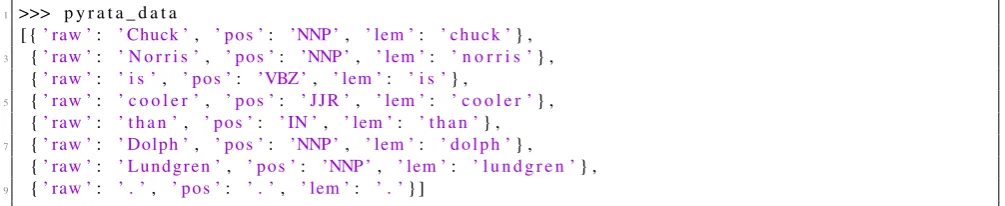
1 >>> p y r a t a _ d a t a
[ {’ raw ’: ’ Chuck ’, ’ p o s ’: ’NNP ’, ’ lem ’: ’ c h u c k ’} ,
3 {’ raw ’: ’ N o r r i s ’, ’ p o s ’: ’NNP ’, ’ lem ’: ’ n o r r i s ’} ,
{’ raw ’: ’ i s ’, ’ p o s ’: ’VBZ ’, ’ lem ’: ’ i s ’} ,
5 {’ raw ’: ’ c o o l e r ’, ’ p o s ’: ’ JJR ’, ’ lem ’: ’ c o o l e r ’} ,
{’ raw ’: ’ t h a n ’, ’ p o s ’: ’ IN ’, ’ lem ’: ’ t h a n ’} ,
7 {’ raw ’: ’ Dolph ’, ’ p o s ’: ’NNP ’, ’ lem ’: ’ d o l p h ’} ,
{’ raw ’: ’ L u n d g r e n ’, ’ p o s ’: ’NNP ’, ’ lem ’: ’ l u n d g r e n ’} ,
9 {’ raw ’: ’ . ’, ’ p o s ’: ’ . ’, ’ lem ’: ’ . ’} ]
Figure 2: Example of a PyRATA Data Structure resulting from the process described in Figure 1.
2.1.
The data structure
A string can be seen as somehow a list of character tokens. But a character string is a poor data structure while in many cases the matter of interest are linguistic phenomena at var-ious text levels (e.g. words, sentences, ...).
The main innovative feature of PyRATA is may be to deal withlistsofassociative arrays(i.e.listofdicts in the Python jargon). The dict data structure is a set of values indexed by unique keys (i.e. a name-value feature set). Figure 2 illustrates the data structure4the PyRATA engine
takes in input. Line 3 Figure 1 shows how to generate it in one simple instruction line in Python; Here thanks to the nltk module. The process takes theStringsentence in line 2, then performs a tokenization, pos tagging and lemmatization, and stores the result in alistwhere each value is adict which represents the various forms of a word of the given sentence. The names, raw,pos, and lem, are freely chosen to mean the feature keys.
2.2.
Pattern syntax
The pattern syntax used by PyRATA is a subset of the PERL regular expression syntax. The subset is also common to the POSIX extended syntax. This subset suffices to de-scribe all regular languages. In some aspects, the syntax looks like the language used to define queries in Corpus Query Processor (CQP) of the IMS Open Corpus Work-bench (CWB) (Christ, 1994)5.
A pattern can be seen as a sequence of elements sep-arated by whitespace characters. In its minimal form, an element specifies a constraint on the value of a fea-ture that a data token should satisfy. For a given fea-ture name, you can specify its required exact value (e.g. raw="Chuck"), a regular expression definition of its value (e.g.pos~"JJ.?"), a list of possible values –a
4
In Python, squared brackets delimit list while curly brackets mark dicts. The feature of a dict are separated by a comma and the feature name and its value are separated by a colon.
5cwb.sourceforge.net
lexicon– (e.g.lemma@"POSITIVE") or if the value cor-respond to a IOB6tag and should match a sequence
conse-quently (e.g.chunk-"NP").
More complex elements are quantified elements, element classes, groups of elements, alternatives or combinations of these various types. Aquantified element allows to spec-ifyoptionalelements (?), elements which should occurat least one(+), orzero or more(*). Anelement classaims at specifying a logical combination of minimal constraints on the data token features. The combination is delimited by squared brackets ([]) and the constraints are combined with usual logical operators namelyparenthesis (()) and logical connectors such as and (&), or(|) andnot (!). A
group of elementsis delimited by parenthesis (()) and can be used to refer to and process subsequently subparts of a match. Analternativedefines expected sets of data token candidates at a specific point of the data stream. The wild-card elementcan be set by a dot character.
Line 1 and 2 of Figure 3 show some concurrent patterns to define noun phrases chunks. They illustrate the use of equal and regular expression constraints as well as element classes and quantifiers. After importing the PyRATA mod-ule (line 3), line 4 shows the search instruction of the latter pattern over the previously defined data structure. Figure 4 shows the result as a list ofMatchobjects, each one made of the matched sequence and its offsets.
2.3.
Finding and editing operations
The API is developed to be familiar for whom who devel-ops with thepython re module7 API. The module defines
several common functions such as search, findall,
or finditer. The functions are also available for com-piled regular expressions. They generally take at least two arguments including the pattern to recognize and the
data to explore (e.g. re.search(pattern, data)
or compiledPattern.search(data)). Depending
6
I for Inside, B for Begin and O for Other
7https://docs.python.org/3/library/re.
1 >>> p y r a t a _ n p _ p a t t e r n = ’ p o s ="DT" ? [ p o s =" J J " | p o s ="NN" ]∗ [ p o s ="NN " | p o s ="NNS " | p o s ="NNP" ] + ’
>>> p y r a t a _ n p _ p a t t e r n = ’ p o s ="DT" ? p o s ~" J J | NN"∗ p o s ~"NN. ? " + ’
3 >>> i m p o r t p y r a t a . r e a s p y r a t a _ r e
>>> f o u n d _ n o u n _ p h r a s e s = p y r a t a _ r e . f i n d i t e r ( p y r a t a _ n p _ p a t t e r n , p y r a t a _ d a t a )
Figure 3: Recognizing simple Noun Phrases patterns with PyRATA (taking the PyRATA data structure of Figure 1 as input).
>>> f o u n d _ n o u n _ p h r a s e s
2 < p y r a t a . r e M a t c h e s L i s t o b j e c t; m a t c h e s l i s t =" [
< p y r a t a . r e Match o b j e c t ; g r o u p s = [ [ [ { ’ raw ’ : ’ Chuck ’ , ’ p o s ’ : ’NNP ’ , ’ lem ’ : ’ c h u c k ’ } , { ’ raw ’ : ’ N o r r i s ’ , ’ p o s ’ : ’NNP ’ , ’ lem ’ : ’ n o r r i s ’ } ] , 0 , 2 ] ] > ,
4 < p y r a t a . r e Match o b j e c t ; g r o u p s = [ [ [ { ’ raw ’ : ’ Dolph ’ , ’ p o s ’ : ’NNP ’ , ’ lem ’ : ’ d o l p h ’ } , { ’ raw
’ : ’ L u n d g r e n ’ , ’ p o s ’ : ’NNP ’ , ’ lem ’ : ’ l u n d g r e n ’ } ] , 5 , 7 ] ] > ] ">
Figure 4: Display of a PyRATAMatchesListobject resulting from thefinditeroperation in Figure 3.
on the selected function, the result can be a featured object which stands for the first match of a given pattern, all the non-overlapping matches of a pattern, or an iterator yield-ing match objects over all non-overlappyield-ing matches of a pattern. Figure 3 and 4 illustrate thefinditermethod returning an iterator yielding match objects.
In addition to the exploration methods, the module offers methods to edit the data structure either by substitution (sub), update (update) or extension (extend) of the data feature structures. These methods are very common in NLP annotation tasks.
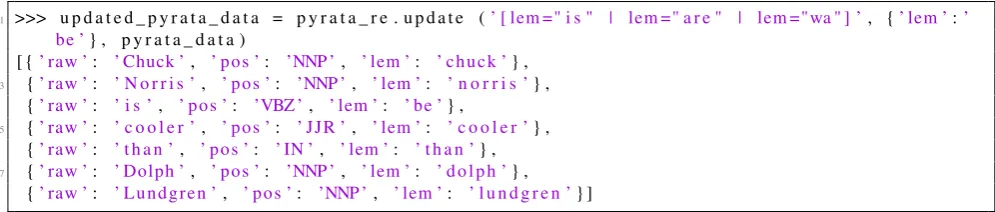
Figure 2 shows that the nltk lemmatizer did not assign the correct lemma to the verbto be. Figure 5 illustrates how to easily fix this hassle thanks to theupdatemethod. Fig-ure 6 illustrates the annotation methodextendto add new features to token in order to create IOB tags correspond-ing to a noun phrase (NP) chunk. It uses the NP pattern defined in Figure 3. Since the resulting data structure is also a PyRATA data structure, such methods can be used to simulate transducers and rewriting rules.
Line 1 Figure 7 defines two lexicons while Line 2 both il-lustrates the combination in one pattern of the lexicons and IOB-chunk constraints, as well as the use of a sequence group. PyRATA assigns a group id to the chunks. Group 0 corresponds to the whole match.
More examples are available in the user documentation8 and the demo directory of PyRATA.
2.4.
Implementation
Since versionv0.4, PyRATA has been based on a simple implementation9 of Thompson’s algorithm which aims at
converting Regular Expressions (RE) to Non-deterministic Finite Automata (NFA) and simulate them in a multiple-state approach which offers a linear time efficiency inO(n) (Thompson, 1968).
8
https://github.com/nicolashernandez/ PyRATA/blob/master/docs/user-guide.rst
9Gui Guan, "A Beautiful Linear Time Python Regex Matcher
via NFA", August 19, 2014,https://www.guiguan.net/
a-beautiful-linear-time-python-regex-matcher-via-nfa/, free to use and modify in any way.
The following description is based on the explanations of Russ Cox10. Every regular expression has an equivalent NFA. The NFA is built up from partial NFAs for each subexpression, with a different construction for each opera-tor. The partial NFAs have no matching states: instead they have one or more dangling arrows, pointing to nothing. The construction process will finish by connecting these arrows to a matching state.
Running an NFA using some data as input requires tracking the current states that the NFA is in, and the next set of states that the NFA will be in, after processing the current token. The pattern is matched if the NFA reaches a final state.
For a regular expression of lengthmrun on text of length n, the Thompson NFA requires O(mn)time. Since we only need to scan the pattern string once in order to build the corresponding NFA, the time efficiency for this step is linearO(n).
3.
Comparison to alternatives
This section deals with the differences between the various Python alternatives to perform regular expressions over an-notations.
Table 1 summarizes the main functionalities of the alterna-tives Python modules. Data structure dependency is set to dependent if the module works on an internal data structure. Concerningclips.patternthere was no successful straight-forward2to3conversion.
The Python nltk chunker11 module (Bird, 2006) offers to define chunk and chink grammars on word POS tags consisting of rules (expressed in regular-expression style) that indicate how sentences should be chunked (e.g. "NP: {<DT>?<JJ>*<NN>}"). By respecting the (Python) data structure, the engine can be applied on
vari-10
Russ Cox, "Regular Expression Matching Can Be Sim-ple And Fast (but is slow in Java, Perl, PHP, Python, Ruby, ...)’, January, 2007,https://swtch.com/~rsc/regexp/ regexp1.html, Last consulted on September 30th, 2017
11http://www.nltk.org/book/ch07.html
and
1 >>> u p d a t e d _ p y r a t a _ d a t a = p y r a t a _ r e . u p d a t e (’ [ lem =" i s " | lem =" a r e " | lem ="wa " ] ’, {’ lem ’:’
be ’} , p y r a t a _ d a t a )
[ {’ raw ’: ’ Chuck ’, ’ p o s ’: ’NNP ’, ’ lem ’: ’ c h u c k ’} ,
3 {’ raw ’: ’ N o r r i s ’, ’ p o s ’: ’NNP ’, ’ lem ’: ’ n o r r i s ’} ,
{’ raw ’: ’ i s ’, ’ p o s ’: ’VBZ ’, ’ lem ’: ’ be ’} ,
5 {’ raw ’: ’ c o o l e r ’, ’ p o s ’: ’ JJR ’, ’ lem ’: ’ c o o l e r ’} ,
{’ raw ’: ’ t h a n ’, ’ p o s ’: ’ IN ’, ’ lem ’: ’ t h a n ’} ,
7 {’ raw ’: ’ Dolph ’, ’ p o s ’: ’NNP ’, ’ lem ’: ’ d o l p h ’} ,
{’ raw ’: ’ L u n d g r e n ’, ’ p o s ’: ’NNP ’, ’ lem ’: ’ l u n d g r e n ’} ]
Figure 5: Updating (edit operation) a PyRATA data structure by modifying a feature value. The PyRATA data structure of Figure 1 is taken as input.
>>> e x t e n d e d _ p y r a t a _ d a t a = p y r a t a _ r e . e x t e n d ( p y r a t a _ n p _ p a t t e r n , {’ c h u n k ’:’NP ’} , u p d a t e d _ p y r a t a _ d a t a , i o b = T r u e )
2 [ {’ raw ’: ’ Chuck ’, ’ c h u n k ’: ’B−NP ’, ’ p o s ’: ’NNP ’, ’ lem ’: ’ c h u c k ’} ,
{’ raw ’: ’ N o r r i s ’, ’ c h u n k ’: ’ I−NP ’, ’ p o s ’: ’NNP ’, ’ lem ’: ’ n o r r i s ’} ,
4 {’ raw ’: ’ i s ’, ’ p o s ’: ’VBZ ’, ’ lem ’: ’ be ’} ,
{’ raw ’: ’ c o o l e r ’, ’ p o s ’: ’ JJR ’, ’ lem ’: ’ c o o l e r ’} ,
6 {’ raw ’: ’ t h a n ’, ’ p o s ’: ’ IN ’, ’ lem ’: ’ t h a n ’} ,
{’ raw ’: ’ Dolph ’, ’ c h u n k ’: ’B−NP ’, ’ p o s ’: ’NNP ’, ’ lem ’: ’ d o l p h ’} ,
8 {’ raw ’: ’ L u n d g r e n ’, ’ c h u n k ’: ’ I−NP ’, ’ p o s ’: ’NNP ’, ’ lem ’: ’ l u n d g r e n ’} ]
Figure 6: Extending (edit operation) a PyRATA data structure by adding a new feature. The PyRATA data structure of Figure 1 is taken as input.
>>> l e x i c o n s = {’ POSITIVE ’: [’ c o o l e r ’, ’ s t r o n g e r ’] , ’NEGATIVE ’: [’ p o o r ’, ’ w o r s t ’] }
2 >>> p y r a t a _ r e . f i n d i t e r (’ chunk−"NP" ( lem =" be " [ raw@ " POSITIVE " & ! raw =" t h a n " ]∗ raw =" t h a n " )
chunk−"NP" ’ , e x t e n d e d _ p y r a t a _ d a t a , l e x i c o n s = l e x i c o n s ) . g r o u p ( ) . g r o u p ( 2 )
[ {’ raw ’: ’ i s ’, ’ p o s ’: ’VBZ ’, ’ lem ’: ’ be ’} , {’ raw ’: ’ c o o l e r ’, ’ p o s ’: ’ JJR ’, ’ lem ’: ’ c o o l e r ’
} , {’ raw ’: ’ t h a n ’, ’ p o s ’: ’ IN ’, ’ lem ’: ’ t h a n ’} ]
Figure 7: Defining groups and lexicons in PyRATA syntax.
ous types of information (one at a time) as well as be cas-caded.
TheCLIPS pattern.search12module (De Smedt and
Daele-mans, 2012) has a pattern matching system similar to regu-lar expressions, that can be used to search a string by syn-tax (word POS and chunk tags) or by lexical (word surface, lemmata and semantical categories) constraints (e.g. "DT? JJ?+ NN"). CLIPS pattern.search is actually the best choice in terms of pattern language expressiveness. Unfor-tunately, the language and the engine are not well separated from the clips internal data structure which prevents from using it with external processing.
The spaCy13 module features a rule-matching engine that
operates over tokens, similar to regular expressions. The rules can refer to token annotations and flags, and matches support callbacks to accept, modify and/or act on the match. spaCy is written in Python and Cython. Despite its aston-ishing performance, the use of the spaCy rule-matching en-gine is not easy out of the box. Indeed, it is strongly
at-12
https://www.clips.uantwerpen.be/pages/ pattern-search and https://github.com/clips/ pattern, python 2.6, BSD-3
13https://spacy.io/docs/usage/
rule-based-matching and https://github. com/explosion/spaCy, Python 3, MIT
tached to the spaCy internal data structure and without en-tering the code, it cannot go further than addressing simple chunk extractions. In addition, the matches cannot serve as input of new patterns.
PyRATA clips.pattern nltk_chunk_regexp spaCy
Python version 3 2 2 and 3 2 and 3
Token type no restriction word/chunk token word/chunk token word token Data structure dependency Python native dependent Python native dependent Feature type no restriction restricted to some
syntax and semantic
no restriction but a single one at a time
some predefined, extensible with code Pattern language declarative declarative declarative declarative + code
Wildcard yes yes yes
Quantifiers yes yes yes yes
Element alternative yes yes yes no
Group yes yes no no
Group alternative yes no no no
Match offsets yes no no yes
Cascade matcher yes no yes no
Find operations search, match, findall search, match, findall findall findall
Edit operations sub, update, extend no extend no
Table 1: Module functionalities comparison.
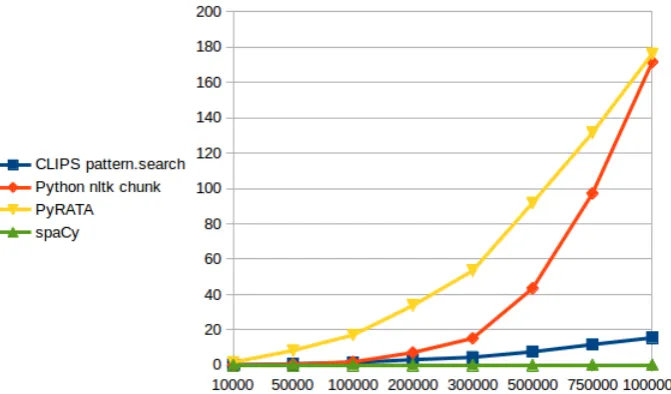
noun phrasepatterns 10k 50k 100k 200k 300k 500k 750k 1,000k
CLIPS pattern.search
DT? JJ?+ NN+ 0.145 0.714 1.510 3.113 4.484 7.585 11.700 15.515
DT? JJ|NN?+ NN|NNS 0.212 1.008 2.110 4.675 6.328 10.825 16.712 22.224
DT? JJ|NN?+ NN|NNS+ 0.220 1.033 2.170 4.493 6.538 11.069 17.929 22.879
nltk chunker
<DT>?<JJ>*<NN>+ 0.037 0.521 1.842 7.146 15.194 43.481 97.216 169.396 <DT>?<JJ|NN>*<NN|NNS> 0.043 0.652 2.386 9.574 20.130 58.745 127.489 228.397 <DT>?<JJ|NN>*<NN.*> 0.062 1.137 4.190 15.502 32.720 89.219 200.388 334.670 PyRATA
pos="DT"? pos="JJ"* pos="NN"+ 1.681 8.350 17.089 33.773 53.506 91.840 131.540 176.272 pos="DT"? [pos="NN" | pos="JJ"]* [pos="NN" | pos="NNS"] 2.132 10.662 21.413 42.731 65.062 114.885 167.478 222.817 pos="DT"? [pos∼ "NN|JJ"]* pos∼"NN.*" 1.854 9.695 18.872 40.288 58.423 101.974 141.782 189.163
spaCy
[{POS:"DET",’OP’:"?"}, {POS:"ADJ",’OP’:"*"},{POS:"NOUN",’OP’:"+"}] 0.002 0.004 0.008 0.020 0.0266 0.048 0.070 0.086
Table 2: Time performance (in seconds) for recognizing various Noun Phrases patterns on the firstnBrown corpus words.
tagging processes offered by these modules. We used the en_core_web_sm-1.2.0model forspaCy. We could have hacked thespaCytokenizer by making it segment only on the whitespaces and consequently format the Brown cor-pus so that spaCy would eventually obtain the same to-kenization as the one already present in nltk. Since the resulting amount of tokens was pretty much the same we did not follow this path. As a result, we observe that there is nothing compare to the time performance of spaCy and right now we can say the same about the PyRATA language expressiveness. Nevertheless, if a few minutes to process one million words can largely be acceptable depending on the use cases it is a fact that the PyRATA holds the worse position in term of time performance. Surprisingly, we also observe that thenltk chunkertime processing increases and converges toward the PyRATA one. We did not experiment with more data.
4.
Conclusion
PyRATA isfun and easy to useto explore data for research or pedagogical motivations, define machine learning fea-tures, pre/post process machine learning based analysis, formulate expert knowledge in a declarative way.
Various directions exist to optimize further the engine code such as parallel programming, or caching the lists of states corresponding to effectively explored and possibly recur-rent DFA (avoiding the cost of future computation repeti-tions). The language can also be extended like for instance the management of back-references.
Acknowledgments
The current work was supported by the ANR 2016 PAS-TEL14. The authors would like to thank the anonymous
re-viewers for their valuable comments.
5.
Bibliographical References
Bird, S. (2006). Nltk: The natural language toolkit. In
Proceedings of the COLING/ACL on Interactive Pre-sentation Sessions, COLING-ACL ’06, pages 69–72, Stroudsburg, PA, USA. Association for Computational Linguistics.
Christ, O. (1994). A modular and flexible architecture for an integrated corpus query system. In Proceedings of COMPLEX’94: 3rd Conference on Computational Lex-icography and Text Research, pages 23–32, Budapest, Hungary. tt cmp-lg: tt 9408005.
Cunningham, H., Cunningham, H., and Tablan, V. (1999). Jape: a java annotation patterns engine.
De Smedt, T. and Daelemans, W. (2012). Pattern
for python. Journal of Machine Learning Research, 13:2063–2067.
Kluegl, P., Toepfer, M., Beck, P.-D., Fette, G., and Puppe, F. (2016). Uima ruta: Rapid development of rule-based information extraction applications. Natural Language Engineering, 22:1–40, 1.
14http://www.agence-nationale-recherche.
fr/?Projet=ANR-16-CE33-0007
Manning, C. D., (2011). Part-of-Speech Tagging from 97% to 100%: Is It Time for Some Linguistics?, pages 171– 189. Springer Berlin Heidelberg, Berlin, Heidelberg. Paumier, S., Nakamura, T., and Voyatzi, S. (2009).
UNI-TEX, a Corpus Processing System with Multi-Lingual Linguistic Resources. In eLexicography in the 21st century: new challenges, new applications (eLEX’09), pages 173–175, October.
Silberztein, M. (2005). Nooj: A linguistic
annota-tion system for corpus processing. In Proceedings
of HLT/EMNLP on Interactive Demonstrations, HLT-Demo ’05, pages 10–11, Stroudsburg, PA, USA. Asso-ciation for Computational Linguistics.
Thompson, K. (1968). Programming techniques:
Reg-ular expression search algorithm. Commun. ACM,