Using Discourse Commitments to Recognize Textual Entailment
Andrew Hickl
Language Computer Corporation 1701 North Collins Boulevard Suite 2000
Richardson, Texas 75080 USA [email protected]
Abstract
In this paper, we introduce a new frame-work for recognizing textual entailment (RTE) which depends on extraction of the set of publicly-held beliefs – known as dis-course commitments– that can be ascribed to the author of a text (t) or a hypothesis (h). We show that once a set of commit-ments have been extracted from at-hpair, the task of recognizing textual entailment is reduced to the identification of the com-mitments from atwhich support the infer-ence of theh. Our system correctly identi-fied entailment relationships in more than 80% oft-hpairs taken from all three of the previous PASCAL RTE Challenges, with-out the need for additional sources of train-ing data.
1 Introduction
Systems participating in the PASCAL Recogniz-ing Textual Entailment (RTE) Challenges (Dagan et al., 2005) have successfully employed a variety of “shallow” techniques in order to recognize in-stances of textual entailment, including methods based on: (1) sets of heuristics (Vanderwende et al., 2006), (2) measures of term overlap (Jijkoun and de Rijke, 2005) (or other measures of seman-tic “relatedness” (Glickman et al., 2005), (3) the alignment of graphs created from syntactic or se-mantic dependencies (Haghighi et al., 2005), or (4) statistical classifiers which leverage a wide range of features, including the output of paraphrase gen-eration (Hickl et al., 2006), inference rule
genera-c
2008. Licensed under the Creative Commons Attribution-Noncommercial-Share Alike 3.0 Unported li-cense (http://creativecommons.org/licenses/by-nc-sa/3.0/). Some rights reserved.
tion (Szpektor et al., 2007), or model building sys-tems (Bos and Markert, 2006).
While these relatively “shallow” approaches have shown much promise in RTE for entailment pairs where the text and hypothesis remain short, we expect that performance of these types of sys-tems will ultimately degrade as longer and more syntactically complex entailment pairs are consid-ered. For example, given a “short”t-hpair (as in (1)), we might expect that a feature-based compar-ison of thetand thehwould be sufficient to iden-tify that thettextually entailed theh.
(1) Shortt-hPair
a. Text: Mack Sennett was involved in the produc-tion of “The Extra Girl”.
b. Hypothesis: “The Extra Girl” was produced by Sennett.
The additional information included in a longer t(like the one in (2)) can make for a much more challenging entailment computation. While the ev-idence supporting theh is included in the t, sys-tems must be able to establish that (1)Mack Sen-nettwas involved in producing aMabel Normand vehicleand (2) that“The Extra Girl”and the Ma-bel Normand vehiclerefer to the same film.
(2) Longt-hPair
a. Text: “The Extra Girl” (1923) is the story of a small-town girl, Sue Graham (played by Ma-bel Normand) who comes to Hollywood to be in the pictures. This Mabel Normand vehicle, pro-duced by Mack Sennett, followed earlier films about the film industry and also paved the way for later films about Hollywood, such as King Vi-dor’s “Show People” (1928).
b. Hypothesis: “The Extra Girl” was produced by Sennett.
In order to remain effective as texts get longer, we believe that RTE systems will need to employ techniques that will enable them to enumerate the
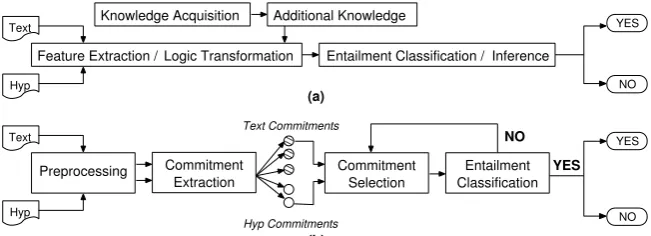
Knowledge Acquisition Additional Knowledge Text
Hyp
Feature Extraction /Logic Transformation Entailment Classification /Inference
NO YES
Preprocessing
Hyp Text
Commitment Selection Commitment
Extraction ClassificationEntailment
NO YES
Text Commitments
Hyp Commitments
YES NO (a)
(b)
Figure 1: Two Architectures of RTE Systems.
set of propositions which are inferable from a text-hypothesis pair.
We introduce a new framework for recognizing textual entailment which depends on extraction of a subset of the publicly-held beliefs – ordiscourse commitments– available from the linguistic mean-ing of a text or hypothesis. We show that once even a small set of discourse commitments have been extracted from a text-hypothesis pair, the task of RTE can be reduced to the identification of the one (or more) commitments from thetwhich are most likely to support the inference of each commitment extracted from theh.
We have found that a commitment-based ap-proach to RTE provides state-of-the-art results on the PASCAL RTE task even when large external knowledge resources are not available. While our approach does depend on a set of specially-tailored heuristics which makes it possible to enumerate some of the commitments from at-hpair, we show that reasonably high levels of performance are pos-sible (as much as 84.9% accuracy), given even a small number of extractors.
The rest of this paper is organized in the fol-lowing way. Section 2 describes the organization of most current statistical systems for RTE, while Sections 3, 4, and 5 describe details of the algo-rithms we have developed for the RTE system we discuss in this paper. Section 6 presents our exper-imental results, and Section 7 presents our conclu-sions.
2 Recognizing Textual Entailment
Recognizing whether the information expressed in ahcan be inferred from the information expressed in atcan be cast either as (1) a classification prob-lem or (2) a formal textual inference probprob-lem, per-formed either by theorem proving or model check-ing. While these approaches apply radically dif-ferent solutions to the same problem, both
meth-ods involve the translation of natural language into some sort of suitable meaning representation, such as real-valued features (in the case of classifica-tion), or axioms or models (in the case of formal methods). We argue that performing this transla-tion necessarily requires systems to acquire forms of (linguistic and/or real-world) knowledge which may not be derivable from the surface form of at orh. (See Figure 1a for an illustration of the archi-tecture of a prototypical RTE system.)
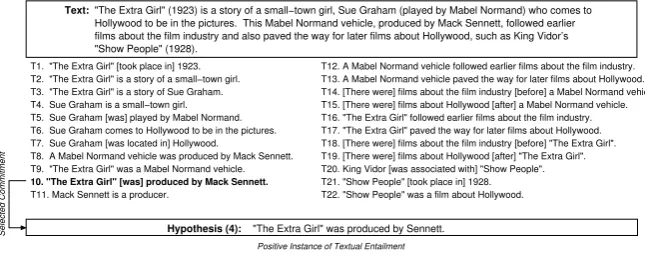
In order to acquire forms of linguistic knowl-edge for RTE, we have developed a novel frame-work which depends on the extraction ofdiscourse commitmentsfrom a text-hypothesis pair. Follow-ing (Gunlogson, 2001; Stalnaker, 1979), we as-sume discourse commitments represent the set of propositions which can necessarily be inferred to be true given a conventional reading of a text. (Fig-ure 2 lists the set of commitments that were ex-tracted from a t-h pair included in the PASCAL RTE-3 Test Set.1)
Formally, we assume that given a commitment set{ct}consisting of the set of discourse
commit-ments inferable from a textt and a hypothesis h, we define the task of RTE as a search for the com-mitmentc∈ {ct}which maximizes the likelihood
thatctextually entailsh.
In our architecture (illustrated in Figure 1b), dis-course commitments are first extracted from both the t and the h using the approach described in Section 3. Once commitment sets have been ex-tracted for the t and the h, we then use a com-mitment selection module (described in Section 4) in order to perform a term-based alignment of each commitment extracted from thetagainst each commitment extracted from theh. The top-ranked pair of commitments (cti, chi) is then sent to an 1Under our approach, commitments are extracted from
Text:"The Extra Girl" (1923) is a story of a small−town girl, Sue Graham (played by Mabel Normand) who comes to Hollywood to be in the pictures. This Mabel Normand vehicle, produced by Mack Sennett, followed earlier films about the film industry and also paved the way for later films about Hollywood, such as King Vidor’s "Show People" (1928).
Selected Commitment
Positive Instance of Textual Entailment Hypothesis (4): "The Extra Girl" was produced by Sennett. T1. "The Extra Girl" [took place in] 1923.
T2. "The Extra Girl" is a story of a small−town girl. T3. "The Extra Girl" is a story of Sue Graham. T4. Sue Graham is a small−town girl. T5. Sue Graham [was] played by Mabel Normand. T6. Sue Graham comes to Hollywood to be in the pictures.
T9. "The Extra Girl" was a Mabel Normand vehicle. 10. "The Extra Girl" [was] produced by Mack Sennett. T11. Mack Sennett is a producer.
T7. Sue Graham [was located in] Hollywood.
T8. A Mabel Normand vehicle was produced by Mack Sennett.
T14. [There were] films about the film industry [before] a Mabel Normand vehicle. T13. A Mabel Normand vehicle paved the way for later films about Hollywood. T12. A Mabel Normand vehicle followed earlier films about the film industry.
T15. [There were] films about Hollywood [after] a Mabel Normand vehicle. T16. "The Extra Girl" followed earlier films about the film industry. T17. "The Extra Girl" paved the way for later films about Hollywood. T18. [There were] films about the film industry [before] "The Extra Girl". T19. [There were] films about Hollywood [after] "The Extra Girl". T20. King Vidor [was associated with] "Show People". T21. "Show People" [took place in] 1928. T22. "Show People" was a film about Hollywood.
Figure 2: Text Commitments Extracted from Example 4 (RTE-3).
entailment computationmodule (described in Sec-tion 5), which estimates the likelihood that the selected cti textually entails the chi (and by
ex-tension, the likelihood that t textually entailsh). Commitment pairs are considered in ranked order until a positive judgment is returned, or until no more commitments above a threshold remain.
3 Extracting Discourse Commitments from Natural Language Texts
Work in semantic parsing (Wong and Mooney, 2007; Zettlemoyer and Collins, 2005) has used sta-tistical and symbolic techniques to convert natural language texts into a logical meaning representa-tion (MR) which can be leveraged by formal rea-soning systems. While this work has explored how output from syntactic parsers can be used to repre-sent the meaning of a text independent of its actual surface form, these approaches have focused on the propositional semantics explicitly encoded by predicates and have not addressed other phenom-ena (such as conversational implicature or linguis-tic presupposition) – which are not encoded overtly in the syntax.
Our work focuses on how an approach based on lightweight extraction rules can be used to enumer-ating a subset of the discourse commitments that are inferable from a t-h pair. While heuristically “unpacking” all of commitments of atorhmay be (nearly) impossible, we believe that our work rep-resents an important first step towards determin-ing the relative value of these additional commit-ments for textual inference applications, such as RTE. Our commitment extraction algorithm is pre-sented in Algorithm 1.
Commitments are extracted from eacht andh using an implementation of the probabilistic finite-state transducer (FST)-based extraction framework described in (Eisner, 2002; Eisner, 2003). Given a
Algorithm 1Extracting Discourse Commitments 1: Input:A setSof sentences from thetorh
2: Output:A set of discourse commitments 3: loop
4: Pre-process the decompositions to identify lexical, syntactic, semantic, and discourse information 5: Produce syntactic decompositions of the sentences in
S
6: Produce commitments of propositional content 7: Produce commitments for supplemental expressions 8: Extract predefined set of relations
9: Perform coreference resolution for each commitment 10: Generate paraphrases of each commitment
11: Generate a natural-language string for each commit-ment
12: ifany of the generated strings is not inSthen
13: Add the generated strings toS
14: else
15: return S
16: end if
17: end loop
syntactically and semantically-parsed input string, our system returns a series of output representa-tions which can be mapped (given a set of gen-eration heuristics) to natural language sentences which represent each of the individual commit-ments which can be extracted from that string. Commitments were extracted using a series of weighted regular expressions (which we present in the form of rules for convenience); weights were learned for each regular expressionr ∈ R using our implementation of (Eisner, 2002). After each candidate commitment was processed by the FST, the natural language form of each returned com-mitment was then resubmitted to the FST for ad-ditional round(s) of extraction until no adad-ditional commitments could be extracted from the input string.
expres-sions, and (6) coreference resolution.2
Pairs are then submitted to a sentence decom-positionmodule, which uses a set of heuristics in order to transform complex sentences containing subordination, relative clauses, lists, and coordina-tion into sets of well-formed simple sentences.
Propositional Content: In order to capture as-sertions encoded by predicates and predicate nom-inals, we used semantic dependency information output by a predicate-based semantic parser to generate “simplified” commitments for each possi-ble combination of their optional and obligatory ar-guments. (Here, arguments assigned a PropBank-style role label of ARGm – or ARG2 or higher –
were considered to be optional arguments.) Supplemental Expressions: Recent work by (Potts, 2005; Huddleston and Pullum, 2002) has demonstrated that the class of supplemental expressions – including appositives, as-clauses, parentheticals, parenthetical adverbs, non-restrictive relative clauses, and epithets – trigger conventional implicatures (CI) whose truth is nec-essarily presupposed, even if the truth conditions of a sentence are not satisfied. Rules to extract supplemental expressions were implemented in our weighted FST framework; generation heuris-tics were then used to create new sentences which specify the CI conveyed by the expression.
(3) “The Extra Girl” (1923) is a story of a small-town girl, Sue Graham (played by Mabel Normand) who comes to Hollywood to be in the pictures.
a. “The Extra Girl” [took place in] 1923.
b. “The Extra Girl” is the story of a small-town girl. c. Sue Graham is a small-town girl.
d. Sue Graham [was] played by Mabel Normand. e. Sue Graham [came] to Hollywood to be in the
pictures.
Relation Extraction: We used an in-house, heuristic-based relation extraction system to rec-ognize six types3 of semantic relations
be-tween named entities, including: (1) artifact (e.g. OWNER-OF), (2) general affiliation (e.g.
2We used publicly-available software when possible to
facilitate comparison with other researchers’ work in this area. We used theC&C Tools(Curran et al., 2007) to per-form part-of-speech tagging and parsing and a version of the alias-iLingPipenamed entity recognizer in conjunction with Language Computer Corporation’s own systems for syntac-tic and semansyntac-tic dependency parsing, named entity recog-nition (CiceroLite), temporal normalization, and coreference resolution.
3These six types were selected because they performed at
better than than 70% F-Measure on a sample oft-hpairs se-lected from the PASCAL RTE datasets. Other relation types with lesser performance were not used in our experiments.
LOCATION-OF), (3) organization affiliation (e.g.
EMPLOYEE-OF), (4)part-whole, (5)social
affilia-tion(e.g.RELATED-TO), and (6)physical location
(e.g.LOCATED-NEAR) relations.
(4) Sue Graham [came] to Hollywood to be in the pic-tures.
a. location-of:Sue Graham [was located in] Holly-wood.
b. location-of: The pictures [were located in] Hol-lywood.
Coreference Resolution: We use our own im-plementation of (Ng, 2005) to resolve instances of pronominal and nominal coreference in order to expand the number of commitments available to the system. After a set of co-referential entity mentions were detected (e.g. “The Extra Girl”, this Mabel Normand vehicle), new commitments were generated from the existing set of commit-ments which incorporated each co-referential men-tion.
(5) Coreference:(“The Extra Girl”,this Mabel Normand vehicle)
a. [“The Extra Girl”] [was] produced by Mack Sen-nett.
b. [“The Extra Girl”] followed earlier films about the film industry.
c. [“The Extra Girl”] also paved the way for later films about Hollywood.
Paraphrasing: We used a lightweight, knowledge-lean paraphrasing approach in or-der to expand the set of commitments consior-dered by our system.
In order to identify other possible linguistic en-codings for each commitment – without generat-ing a large number of spurious paraphrases which could introduce errorful knowledge into a commit-ment set – we focused only on generating para-phrases of two-place predicates (i.e. predicates which encode a semantic dependency between two arguments).
The algorithm we use is presented in Al-gorithm 2. Under this method, a semantic parser (trained on the semantic dependencies in PropBank and NomBank) was used to iden-tify pairs of arguments (hai, aji) (where i, j ∈
{a0, a1, a2, am}) from each c; each pair of
ar-guments identified in c are then used to generate paraphrases from sets of sentences containing both a0 and ai.4 The top 1000 sentences containing
each pair of arguments were then retrieved from
4Arguments in PropBank and NomBank are assigned an
the WWW; sentences containing both arguments were then filtered and clustered into sets that were presumed to be likely paraphrases.
Algorithm 2Paraphrase Clustering
1: Input: Pairs of arguments, hai, aji, where i, j ∈ {a0, a1, a2, am}
2: Output:Sets of paraphrased sentences,{scli...cln}
3: for allpairshai, ajido
4: Retrieve 1000scontaininghai, ajifrom WWW
5: Compute token distance between a0,ai
(span(ai, aj))
6: Filter eachswith 2≤span(ai, aj)≤8 7: Complete-link cluster{s}into clusters{cl} 8: Filterclwith size (size(cl))≤10 9: return All sentences{scli...cln}
10: Add all sentences{scli...cln}to commitment setC
11: end for
Parameters were computed using maximum likelihood estimation (and normalized to sum to 1), based on a linear interpolation of three mea-sures of the “goodness” ofp (as compared to the original input sentence,s).
para(p|s) =λwnpara(p|s)+λfreqpara(p|s)+λdistpara(p|s)
(1)
Each candidate paraphrase was then assigned a paraphrase score as in (Glickman and Dagan, 2005). The likelihood that a wordwpfrom a
para-phrase was a valid parapara-phrase of a word from an original commitmentwc was computed as in (2),
wherep(wp) andp(wo)computed from the
rela-tive frequency of the occurrence ofwp andwo in
the set of clusters generated for c, and p(k) was computed from the frequency of each “overlap-ping” term found in the paraphrase and the orig-inalc. The top 5 paraphrases generated for each cwere then used to generate new versions of each commitment.
ppara(wp|wo) =p(wp)p(wo)Yi=1np(ki) (2)
4 Commitment Selection
Following Commitment Extraction, we used a lex-ical alignment technique first introduced in (Taskar et al., 2005b) in order to select the commitment ex-tracted fromt(henceforth,ct) which represents the
best alignment for each of the individual commit-ments extracted fromh(henceforth,ch).
We assume that the alignment of two discourse commitments can be cast as a maximum weighted matching problem in which each pair of words (ti,hj) in an commitment pair (ct,ch) is assigned
a score sij(t, h) corresponding to the likelihood
that ti is aligned to hj.5 As with (Taskar et al.,
2005b), we use the large-margin structured predic-tion model introduced in (Taskar et al., 2005a) in order to compute a set of parametersw(computed with respect to a set of features f) which maxi-mize the number of correct alignment predictions (y¯i) made given a set of training examples (xi), as
in Equation (3).
yi = arg max¯yi∈Yw>f(xi,y¯i),∀i (3)
We used three sets of features in our model: (1) string features (including Levenshtein edit dis-tance, string equality, and stemmed string equal-ity), (2) lexico-semantic features (including Word-Net Similarity (Pedersen et al., 2004)), and (3) word association features (computed using the Dice coefficient (Dice, 1945)6). Training data
came from hand-annotated token alignments for each of the 800 entailment pairs included in the RTE-3 Development Set
Following alignment, we used the sum of the edge scores (Pi,j=1nsij(ti, hj)) computed for
each of the possible (ct, ch) pairs in order to search
for the ct which represented the reciprocal best
hit(Mushegian and Koonin, 1996) of eachch
ex-tracted from the hypothesis. This was performed by selecting a commitment pair (ct, ch) wherect
was the top-scoring alignment candidate forchand
ch was the top-scoring alignment candidate forct.
If no reciprocal best-hit could be found for any of the commitments extracted from theh, the system automatically returned a TE judgment ofNO.
5 Entailment Classification
We used a decision tree to estimate the likelihood that a commitment pair represented a valid in-stance of textual entailment. Confidence values as-sociated with each leaf node (i.e.YESorNO) were
normalized and used to rank examples for the of-ficial submission. Features were selected manu-ally by performing ten-fold cross validation on the combined development sets from the three previ-ous PASCAL RTE Challenges (2400 examples).
5In order to ensure that content from thehis reflected in
thet, we assume that each word from thehis aligned to ex-actly one or zero words from thet.
6The Dice coefficient was computed as Dice(i) =
2Cth(i)
Ct(i)Ch(i), whereCthis equal to the number of times a word
iwas found in both thetand anhof a single entailment pair, whileCtandCh were equal to the number of times a word was found in anytorh, respectively. A hand-crafted corpus of 100,000 entailment pairs was used to compute values for
Features used in our classifier were selected from a number of sources, including (Hickl et al., 2006; Zanzotto et al., 2006; Glickman and Dagan, 2005). A partial list of the features used in the Entail-ment Classifier used in our system is provided in Figure 3.
ALIGNMENT FEATURES: Derived from the results of the alignment of each pair of commitments performed during Commitment Selec-tion.
1LONGESTCOMMONSTRING: This feature represents the longest contiguous string common to both texts.
2 UNALIGNEDCHUNK: This feature represents the number of
chunks in one text that are not aligned with a chunk from the other
3LEXICALENTAILMENTPROBABILITY: Defined as in (Glickman
and Dagan, 2005).
DEPENDENCY FEATURES: Computed from the semantic depen-dencies identified by the PropBank- and NomBank-based semantic parsers.
1ENTITY-ARGMATCH: This is a boolean feature which fires when aligned entities were assigned the same argument role label.
2ENTITY-NEAR-ARGMATCH: This feature is collapsing the ar-guments Arg1and Arg2(as well as the ArgMsubtypes) into single
categories for the purpose of counting matches.
3PREDICATE-ARGMATCH: This boolean feature is flagged when at least two aligned arguments have the same role.
4PREDICATE-NEAR-ARGMATCH: This feature is collapsing the ar-guments Arg1and Arg2(as well as the ArgMsubtypes) into single
categories for the purpose of counting matches.
SEMANTIC/PRAGMATIC FEATURES: Extracted during prepro-cessing.
1NAMEDENTITYCLASS: This feature has a different value for each of the 150 named entity classes.
2TEMPORALNORMALIZATION: This boolean feature is flagged when the temporal expressions are normalized to the same ISO 8601 equivalents.
3MODALITYMARKER: This boolean feature is flagged when the two texts use the same modal verbs.
4SPEECH-ACT: This boolean feature is flagged when the lexicons indicate the same speech act in both texts.
5FACTIVITYMARKER: This boolean feature is flagged when the factivity markers indicate either TRUE or FALSE in both texts simul-taneously.
6BELIEFMARKER: This boolean feature is set when the belief markers indicate either TRUE or FALSE in both texts simultaneously. Figure 3: Features used in the Entailment Classi-fier
6 Experiments and Results
We evaluated the performance of our commitment-based system for RTE against the 1600 examples found in the PASCAL RTE-2 and RTE-3 datasets.7
Table 1 presents results from our system when trained on the 1600 examples taken from the RTE-2 and RTE-3 Test Sets.
Accuracy varied significantly (p <0.05) across each of the four tasks. Performance (in terms of accuracy and average precision) was highest on the
7Data created for the PASCAL RTE-2 and RTE-3
chal-lenges was organized into four datasets which sought to ap-proximate the kinds of inference required by four different NLP applications: information extraction (IE), information retrieval (IR), question-answering (QA), and summarization (SUM). The RTE-3 Test Sets includes 683 “short” examples and 117 “long” examples; the RTE-2 Test Set includes 800 “short” examples.
Task Length IE IR QA SUM Total
RTE-2 Short 0.753 0.883 0.863 0.855 0.8385 RTE-3 Short 0.784 0.911 0.909 0.869 0.8331 RTE-3 Long 0.789 0.778 0.943 0.778 0.8290 Total – 0.7690 0.8790 0.8890 0.8600 0.8493
Table 1: Performance of Commitment-based RTE.
QA set (88.9% accuracy) and lowest on the IE set (76.9%). The length of the text(either “short” or “long”) did not significantly impact performance, however; in fact, as can be seen in Table 1, average accuracy was nearly the same for examples featur-ing “short” or “long”texts.
In order to quantify the impact that additional sources of training data could have on the perfor-mance an RTE system (and to facilitate compar-isons with top systems like (Hickl et al., 2006), which were trained on tens of thousands of en-tailment pairs), we used the techniques described in (Bensley and Hickl, 2008) to generate a large training set of 100,000 text-hypothesis pairs in or-der to train our entailment classifier. Table 2 sum-marizes the performance of our RTE system on the RTE-2 and RTE-3 Test Sets when trained on in-creasing amounts of training data.8
Training Corpus Accuracy Average Precision 800 pairs (RTE-2 Dev) 0.8493 0.8611
10,000 pairs 0.8550 0.8742 25,000 pairs 0.8489 0.8322 50,000 pairs 0.8575 0.8505 100,000 pairs 0.8850 0.8785
Table 2: Impact of Training Corpus Size. Unlike (Hickl et al., 2006), we experienced only a small increase (3%) in overall accuracy when training on increasingly larger corpora of exam-ples. While large training corpora may provide an important source of knowledge for RTE, these results suggest that our commitment extraction-based approach may nullify the gains in per-formance seen by pure classification-based ap-proaches. We believe that by training an entail-ment classification model based on the output of a commitment extraction module, we can reduce the number of deleterious features included in the model – and thereby, reduce the overall number of training examples needed to achieve the same level of performance.
In a second experiment, we investigated the performance gains that could be attributed to the choice of weighting function used to select com-mitments from a commitment set. In order to
8In the RTE evaluations,accuracyis defined as the
Approach Without Paraphrasing With Paraphrasing ∆
Term overlap (Zanzotto et al., 2006) 0.5950 0.6750 +0.0800
Approximate Tree Edit Distance (Schilder and McInnes, 2006) 0.6550 0.5933 -0.0617
LEP (Glickman et al., 2005) 0.6000 0.6800 +0.0800
Lexical Similarity (Adams, 2006) 0.6200 0.6788 +0.0588
Graph Matching (MacCartney et al., 2006) 0.6433 0.6533 +0.0100
Classification-Based Alignment (Hickl et al., 2006) 0.7650 0.7700 + 0.0050 Structured Prediction-Based Alignment (Taskar et al., 2005a) 0.7900 0.8493 + 0.0593
Table 3: Impact of Commitment Selection Learning.
perform this comparison, we implemented a total of 7 different functions previously investigated by teams participating in the previous PASCAL RTE Challenges, including (1) a simple term-overlap measure introduced as a baseline in (Zanzotto et al., 2006), (2) the approximate tree edit distance metric used by (Schilder and McInnes, 2006), (3) (Glickman et al., 2005)’s measure of lexical en-tailment probability (LEP), (4) the lexical similar-ity measure described in (Adams, 2006), (5) our interpretation of the semantic graph-matching ap-proach described in (MacCartney et al., 2006), (6) the classification-based term alignment approach described in (Hickl et al., 2006), and (7) the struc-tured prediction-based alignment approach intro-duced in this paper. Results from this 7-way com-parison are presented in Table 3.
While we found that the choice of mechanism used to weight commitments did significantly im-pact RTE performance (p < 0.05), the inclusion of generated paraphrases appeared to only have a slight positive impact on overall performance, boosting RTE accuracy by an average of 3.1% (across the 7 methods), and by a total of 5.9% in the approach we describe in this paper. While paraphrasing can be used to enhance the mance of some current RTE systems (see perfor-mance of the Tree Edit Distance-based RTE sys-tem for a case where paraphrasing negatively im-pacted performance), realized gains are still rela-tively modest across most approaches.
In a third experiment, we found that RTE perfor-mance depended on both the type – and the num-ber – of commitments extracted from a t-h pair, regardless of the learning algorithm used in com-mitment selection. Table 4 presents results from experiments when (1) no commitment extraction was conducted, (2) extraction strategies were run in isolation9, (3) combinations of extraction
strate-gies were considered, or (4) all of possible extrac-tion strategies (listed in Secextrac-tion 3) were consid-ered. The best-performing condition for each RTE
9Four strategies were considered: (1) syntactic
decompo-sition (SD), (2) supplemental expression (SE) extraction, (3) coreference resolution (Coref), (4) and paraphrasing (Para).
strategy is presented inbold.
Increasing the amount of linguistic knowledge available from a commitment set did significantly (p <0.05) impact the performance of RTE, regard-less of the actual learning algorithm used to com-pute the likelihood of an entailment relationship. Combining all four extraction strategies proved best for four RTE approaches (Term Overlap, Lex-ical Entailment Probability, Graph Matching, and Structured Prediction-based Alignment). Includ-ing coreference-based commitments reduced the accuracy of two RTE strategies (Lexical Similarity and Classification-based Alignment). This is most likely due to the fact that coreference-based com-mitments reincorporate the antecedent of pronouns and other referring expressions into the generated commitments, thereby adding additional lexical information to the sets of features used in comput-ing entailment.
7 Conclusions
This paper introduced a new framework for rec-ognizing textual entailment which depends on the extraction of the discourse commitments that can be inferred from a conventional interpretation of a text passage. By explicitly enumerating the set of inferences that can be drawn from atorh, our ap-proach is able to reduce the task of RTE to the iden-tification of the set of commitments that support the inference of each corresponding commitment extracted from a hypothesis. This approach cor-rectly classified more than 80% of examples from the PASCAL RTE Test Sets, without the need for additional sources of training data.
Acknowledgments
This material is based upon work funded in whole or in part by the U.S. Government and any opinions, findings, conclusions, or recommendations expressed in this material are those of the authors and do not necessarily reflect the views of the U.S. Government.
References
None SD Individual StrategiesSE Coref Para SD+SE Strategy CombinationsSD,SE,Coref SD,SE,Para All
Term Overlap 0.5708 0.5750 0.5850 0.5758 0.5925 0.5950 0.5925 0.6500 0.6750
Approximate Tree Edit Distance 0.5117 0.6158 0.6175 0.5142 0.5158 0.6592 0.6583 0.6108 0.5930 Lexical Entailment Probability 0.6067 0.6300 0.5950 0.5942 0.6475 0.6292 0.6000 0.6658 0.6800
Lexical Similarity 0.5833 0.5875 0.5817 0.5850 0.5975 0.6100 0.6200 0.6825 0.6800
Graph Matching 0.5850 0.6667 0.6450 0.6483 0.6017 0.6317 0.6430 0.6208 0.6530
Classification-Based Alignment 0.6692 0.6825 0.6700 0.6758 0.6842 0.7508 0.7492 0.7992 0.7700 Structured Prediction-Based Alignment 0.6750 0.7083 0.6875 0.6675 0.6742 0.7492 0.7900 0.7842 0.8493
Table 4: Impact of Commitment Availability.
Bensley, Jeremy and Andrew Hickl. 2008. Unsupervised Resource Creation for Textual Inference Applications. In
LREC 2008, Marrakech.
Bos, Johan and Katya Markert. 2006. When logical infer-ence helps in determining textual entailment (and when it doesn’t). InProceedings of the Second PASCAL Recogniz-ing Textual Entailment Conference, Venice, Italy. Curran, James, Stephen Clark, and Johan Bos. 2007.
Lin-guistically Motivated Large-Scale NLP with C-and-C and Boxer. InACL 2007 (Demonstration Session), Prague. Dagan, Ido, Oren Glickman, and Bernardo Magnini. 2005.
The PASCAL Recognizing Textual Entailment Challenge. InProceedings of the PASCAL Challenges Workshop. Dice, L.R. 1945. Measures of the Amount of Ecologic
As-sociation Between Species. InJournal of Ecology, vol-ume 26, pages 297–302.
Glickman, Oren and Ido Dagan. 2005. A Probabilistic Set-ting and Lexical Co-occurrence Model for Textual Entail-ment. InProceedings of the ACL Workshop on Empirical Modeling of Semantic Equivalence and Entailment, Ann Arbor, USA.
Glickman, Oren, Ido Dagan, and Moshe Koppel. 2005. Web based textual entailment. InProceedings of the First PAS-CAL Recognizing Textual Entailment Work-shop. Gunlogson, Christine. 2001. True to Form: Rising and
Falling Declaratives as Questions in English. Ph.D. thesis, University of California, Santa Cruz.
Haghighi, Aria, Andrew Ng, and Christopher Manning. 2005. Robust textual inference via graph matching. In Pro-ceedings of Human Language Technology Conference and Conference on Empirical Methods in Natural Language Processing, pages 387–394.
Hickl, Andrew, John Williams, Jeremy Bensley, Kirk Roberts, Bryan Rink, and Ying Shi. 2006. Recognizing Textual En-tailment with LCC’s Groundhog System. InProceedings of the Second PASCAL Challenges Workshop.
Huddleston, Rodney and Geoffrey Pullum, editors, 2002.The Cambridge Grammar of the English Language. Cam-bridgeUniversity Press.
Jijkoun, V. and M. de Rijke. 2005. Recognizing Textual En-tailment Using Lexical Similarity. InProceedings of the First PASCAL Challenges Workshop.
MacCartney, Bill, Trond Grenager, Marie-Catherine de Marn-effe, Daniel Cer, and Christopher D. Manning. 2006. Learning to recognize features of valid textual entailments. InProceedings of the Human Language Technology Con-ference of the NAACL, Main ConCon-ference, pages 41–48, New York City, USA, June. Association for Computational Linguistics.
Mushegian, Arcady and Eugene Koonin. 1996. A minimal gene set for cellular life derived by compraison of com-plete bacterial genomes. InProceedings of the National Academies of Science, volume 93, pages 10268–10273. Pedersen, T., S. Patwardhan, and J. Michelizzi. 2004.
Word-Net::Similarity - Measuring the Relatedness of Concepts. InProceedings of the Nineteenth National Conference on Artificial Intelligence (AAAI-04), San Jose, CA.
Potts, Christopher, editor, 2005. The Logic of Conventional Implicatures. Oxford University Press.
Schilder, F. and B. Thomson McInnes. 2006. TLR at DUC 2006: Approximate Tree Similarity and a New Evaluation Regime. InProceedings of HLT-NAACL Document Un-derstanding Workshop (DUC 2006).
Stalnaker, Robert, 1979. Assertion, volume 9, pages 315– 332.
Szpektor, Idan, Eyal Shnarch, and Ido Dagan. 2007. Instance-based evaluation of entailment rule acquisition. InProceedings of the 45th Annual Meeting of the Associa-tion of ComputaAssocia-tional Linguistics, pages 456–463, Prague, Czech Republic, June. Association for Computational Lin-guistics.
Taskar, Ben, Simone Lacoste-Julien, and Michael Jordan. 2005a. Structured prediction via the extragradient method. InProceedings of Neural Information Processing Systems. Taskar, Ben, Simone Lacoste-Julien, and Dan Klein. 2005b. A discriminative matching approach to word alignment. In
Proceedings of Human Language Technology Conference and Empirical Methods in Natural Language Processing (HLT/EMNLP 2005).
Vanderwende, Lucy, Arul Menezes, and Rion Snow. 2006. Microsoft Research at RTE-2: Syntactic Contributions in the Entailment Task: an implementation. InProceedings of the Second PASCAL Challenges Workshop.
Wong, Yuk Wah and Raymond Mooney. 2007. Learning syn-chronous grammars for semantic parsing with lambda cal-culus. InProceedings of the 45th Annual Meeting of the Association of Computational Linguistics, pages 960–967, Prague, Czech Republic, June. Association for Computa-tional Linguistics.
Zanzotto, F., A. Moschitti, M. Pennacchiotti, and M. Pazienza. 2006. Learning textual entailment from examples. InProceedings of the Second PASCAL Challenges Workshop.