All in Strings: a Powerful String-based Automatic MT
Evaluation Metric with Multiple Granularities
Junguo Zhu
1, Muyun Yang
1, Bo Wang
2, Sheng Li
1, Tiejun Zhao
11
School of Computer Science and Technology, Harbin Institute of Technology
{jgzhu; ymy; tjzhao; lish}@mtlab.hit.edu.cn
2
School of Computer Science and Technology, Tianjin University
[email protected]
Abstract
String-based metrics of automatic ma-chine translation (MT) evaluation are widely applied in MT research. Mean-while, some linguistic motivated me-trics have been suggested to improve the string-based metrics in sentence-level evaluation. In this work, we at-tempt to change their original calcula-tion units (granularities) of string-based metrics to generate new features. We then propose a powerful string-based automatic MT evaluation metric, com-bining all the features with various granularities based on SVM rank and regression models. The experimental results show that i) the new features with various granularities can contri-bute to the automatic evaluation of translation quality; ii) our proposed string-based metrics with multiple gra-nularities based on SVM regression model can achieve higher correlations with human assessments than the state-of-art automatic metrics.
1
Introduction
The automatic machine translation (MT) eval-uation has aroused much attention from MT researchers in the recent years, since the auto-matic MT evaluation metrics can be applied to optimize MT systems in place of the expensive and time-consuming human assessments. The state-of-art strategy to automatic MT evalua-tion metrics estimates the system output
quali-ty according to its similariquali-ty to human refer-ences. To capture the language variability ex-hibited by different reference translations, a tendency is to include deeper linguistic infor-mation into machine learning based automatic MT evaluation metrics, such as syntactic and semantic information (Amigò et al., 2005; Al-brecht and Hwa, 2007; Giménez and Màrquez, 2008). Generally, such efforts may achieve higher correlation with human assessments by including more linguistic features. Neverthe-less, the complex and variously presented lin-guistic features often prevents the wide appli-cation of the linguistic motivated metrics.
Essentially, linguistic motivated metrics in-troduce additional restrictions for accepting the outputs of translations (Amigó et al., 2009). With more linguistic features attributed, the model is actually capturing the sentence simi-larity in a finer granusimi-larity. In this sense, the practical effect of employing various linguistic knowledge is changing the calculation units of the matching in the process of the automatic evaluation.
linguis-tic tag sequences on various granularities le-vels.
In this paper, we attempt to change the orig-inal calculation units (granularities) of string-based metrics to generate new features. After that, we propose a powerful string-based au-tomatic MT evaluation metric, combining all the features with various granularities based on SVM rank (Joachims, 2002) and regression (Drucker et al., 1996) models. Our analysis indicates that: i) the new features with various granularities can contribute to the automatic evaluation of translation quality; ii) our pro-posed string-based metrics with multiple gra-nularities based on SVM regression model can achieve higher correlations with human as-sessments than the state-of-art automatic me-trics .
The remainder of this paper is organized as follows: Section 2 reviews the related re-searches on automatic MT evaluation. Section 3 describes some new calculation granularities of string-based metrics on sentence level. In Section 4, we propose string-based metrics with multiple granularities based on SVM rank and regression models. In Section 5, we present our experimental results on different sets of data. And conclusions are drawn in the Section 6.
2
Related Work on Automatic
Ma-chine Translation Evaluation
The research on automatic string-based ma-chine translation (MT) evaluation is targeted at a widely applicable metric of high consistency to the human assessments. WER (Nießen et al., 2000), PER (Tillmann et al., 1997), and TER (Snover et al., 2006) focuses on word error rate of translation output. GTM (Melamed et al., 2003) and the variants of ROUGE (Lin and Och, 2004) concentrate on matched longest common substring and discontinuous substring of translation output according to the human references. BLEU (Papineni et al., 2002) and NIST (Doddington, 2002) are both based on the number of common n-grams between the translation hypothesis and human reference translations of the same sentence. BLEU and NIST are widely adopted in the open MT eval-uation campaigns; however, the NIST MT evaluation in 2005 indicates that they can even
error in the system level (Le and Przybocki, 2005). Callison-Burch et al. (2006) detailed the deficits of the BLEU and other similar metrics, arguing that the simple surface similarity cal-culation between the machines translations and the human translations suffers from morpho-logical issues and fails to capture what are im-portant for human assessments.
In order to attack these problems, some me-trics have been proposed to include more lin-guistic information into the process of match-ing, e.g., Meteor (Banerjee and Lavie, 2005) metric and MaxSim (Chan nad Ng, 2008) me-trics, which improve the lexical level by the synonym dictionary or stemming technique. There are also substantial studies focusing on including deeper linguistic information in the metrics (Liu and Gildea, 2005; Owczarzak et al., 2006; Amigó et al., 2006; Mehay and Brew, 2007; Giménez and Màrquez, 2007; Owczar-zak et al., 2007; Popovic and Ney, 2007; Giménez and Màrquez, 2008b).
A notable trend improving the string-based metric is to combine various deeper linguistic information via machine learning techniques in the metrics (Amigò et al., 2005; Albrecht and Hwa, 2007; Giménez and Màrquez, 2008). Such efforts are practically amount of intro-ducing additional linguistic restrictions into the automatic evaluation metrics (Amigó et al, 2009), achiving a higher performance at the cost of lower adaptability to other languages owing to the language dependent linguistics features.
Previous work shows that including the new features into the evaluation metrics may bene-fit to describe nature language accurately. In this sense, the string-based metrics will be im-proved, if the finer calculation granularities are introduced into the metrics.
3
The New Calculation Granularities
of String-based Metrics on Sentence
Level
The string-based metrics of automatic machine translation evaluation on sentence level adopt a common strategy: taking the sentences of the documents as plain strings. Therefore, when changing the calculation granularities of the string-based metrics we can simplify the in-formation of new granularity with plain strings. In this work, five kinds of available calculation granularities are defined: “Lexicon”, “Letter”, “Pos”, “Constitute” and “Dependency”.
Lexicon: The calculation granularity is common word in the sentences of the docu-ments, which is popular practice at present.
Letter: Split the granularities of “Lexical” into letters. Each letter is taken as a matching unit.
Pos: The Pos tag of each “Lexicon” is taken as a matching unit in this calculation granulari-ty.
Constitute: Syntactic Constitutes in a tree structure are available through the parser tools. We use Stanford Parser (Klein and Manning, 2003a; Klein and Manning, 2003b) in this work. The Constitute tree is changed into plain string, travelling by BFS (Breadth-first search traversal) 1.
Dependency: Dependency relations in a de-pendency structure are also available through the parser tools. The dependency structure can also be formed in a tree, and the same processing of being changed into plain string is adopted as “Constitute”.
The following serves as an example: Sentence:
I have a dog
Pos tag:
I/PRON have/V a/ART dog/N
Constitute tree:
1 We also attempt some other traversal algorithms,
in-cluding preorder, inorder and postorder traversal, the performance are proved to be similar.
Dependency tree:
Then, we can change the sentence into the plain string in multiple calculation granulari-ties as follows:
Lexicon string:
I have a dog
Letter string:
I h a v e a d o g
Pos string:
PRON V ART N
Constitute string:
PRON V ART N NP NP VP S
Dependency string:
a I dog have
The translation hypothesis and human refer-ence translations are both changed into those strings of various calculation granularities. The strings are taken as inputs of the string-based automatic MT evaluation metrics. The outputs of each metric are calculated on different matching units.
4
String-based Metrics with Multiple
Granularities Combined by SVM
Introducing machine learning methods to es-tablished MT evaluation metric is a popular trend. Our study chooses rank and regression support vector machine (SVM) as the learning model. Features are important for the SVM models.
Plenty of scores can be generated from the proposed metrics. In fact, not all these features are needed. Therefore, feature selection should be a necessary step to find a proper feature set and alleviate the language dependency by us-ing fewer lus-inguistic features.
the highest among all new metrics and higher than the previous metric in cross training cor-pus. The cross training corpus is prepared by dividing the training corpus into five parts. Each four parts of the five are for training and the rest one for testing; then, we integrate scores of the five tests as scores of cross train-ing corpus. The five-fold cross traintrain-ing can help to overcome the overfitting. At the end, the feature selection stops, if adding any of the rest features cannot lead to higher correlation with human assessments than the current me-tric.
5
Experiments
5.1 The Impact of the Calculation Granu-larities on String-based Metrics
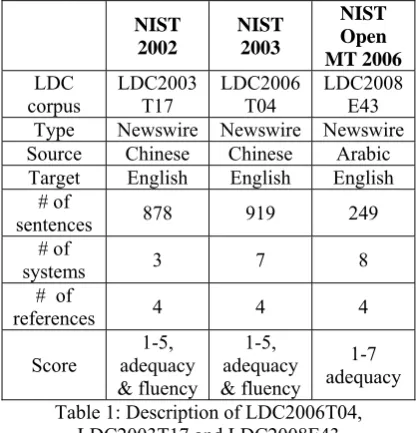
In this section, we use the data from NIST Open MT 2006 evaluation (LDC2008E43), which is described in Table 1. It consists of 249 source sentences that were translated by four human translators as well as 8 MT sys-tems. Each machine translated sentence was evaluated by human judges for their adequacy on a 7-point scale.
NIST 2002
NIST 2003
NIST Open MT 2006
LDC
corpus LDC2003T17 LDC2006T04 LDC2008E43
Type Newswire Newswire Newswire
Source Chinese Chinese Arabic Target English English English
# of
sentences 878 919 249
# of
systems 3 7 8
# of
references 4 4 4
Score adequacy 1-5, & fluency
1-5, adequacy & fluency
1-7 adequacy Table 1: Description of LDC2006T04,
LDC2003T17 and LDC2008E43
To judge the quality of a metric, we com-pute Spearman rank-correlation coefficient, which is a real number ranging from -1 (indi-cating perfect negative correlations) to +1 (in-dicating perfect positive correlations), between
the metric’s scores and the averaged human assessments on test sentences.
We select 21 features in “lexicon” calcula-tion granularity and 11×4 in the other calcula-tion granularities. We analyze the correlacalcula-tion with human assessments of the metrics in mul-tiple calculation granularities. Table 2 lists the optimal calculation granularity of the multiple metrics on sentence level in the data (LDC2008E43).
Metric Granularity
BLEU-opt Letter
NIST-opt Letter
GTM(e=1) Dependency TER Letter PER Lexicon WER Dependency
ROUGE-opt Letter
Table 2 The optimal calculation granularity of the multiple metrics
The most remarkable aspect is that not all the best metrics are based on the “lexicon” cal-culation granularities, such as the “letter” and “dependency”. In other words, the granulari-ties-shifted string-based metrics are promising to contribute to the automatic evaluation of translation quality.
2002; Melamed et al., 2003; Banerjee and La-vie, 2005; Snover et al., 2006; Liu and Gildea, 2005) and two machine learning methods (Al-brecht and Hwa, 2007; Ding Liu and Gildea, 2007) are also included in Table 3. Of the two machine learning methods, both trained on the data LDC2006T04. The “Albrecht, 2007” score reported a result of Spearman correlation with human assessments on the data LDC2003T17 using 53 features, while the “Ding Liu, 2007” score reported that under five-fold cross validation on the data LDC2006T04 using 31 features.
Feature number
LDC 2003 T17
LDC 2006 T04
Rank_All 65 0.323 0.495
Regression_All 65 0.345 0.507
Rank_Select 16 0.338 0.491
Regression_Select 8 0.341 0.510
Albrecht, 2007 53 0.309 --
Ding Liu, 2007 31 -- 0.369
BLEU-opt2 -- 0.301 0.453
NIST-opt -- 0.219 0.417
GTM(e=1) -- 0.270 0.375
METEOR3
-- 0.277 0.463
TER -- -0.250 -0.302
STM-opt -- 0.205 0.226
HWCM-opt -- 0.304 0.377
Table 3: Comparison of Spearman correlations with human assessments of our proposed metrics and some start-of-art metrics and two machine learning
methods
“-opt” stands for the optimum values of the pa-rameters on the metrics
Table 3 shows that the string-based meta-evaluation metrics with multiple granularities based on SVM frame gains the much higher Spearman correlation than other start-of-art metrics on the two test data and, furthermore, our proposed metrics also are higher than the machine learning metrics (Albrecht and Hwa, 2007; Ding Liu and Gildea, 2007).
The underlining is that our proposed metrics are more robust than the aforementioned two
2 The result is computed by mteval11b.pl. 3The result is computed by meteor-v0.7.
machine learning metrics. As shown in Table 1 the heterogeneity between the training and test data in our method is much more significant than that of the other two machine learning based methods.
In addition, the “Regression_Select” metric using only 8 features can achieve a high corre-lation rate which is close to the metric pro-posed in “Albrecht, 2007” using 53 features, “Ding Liu, 2007” using 31 features, “Regres-sion_All” and “Rank_All” metrics using 65 features and “Rank_Select” metric using 16 features. What is more, “Regression_Select” metric is better than “Albrecht, 2007”, and slightly lower than “Regression_All” on the data LDC2003T17; and better than both “Re-gression_All” and “Rank_All” metrics on the data LDC2006T04. That confirms that a small cardinal of feature set can also result in a me-tric having a high correlation with human as-sessments, since some of the features represent the redundant information in different forms. Eliminating the redundant information is bene-fit to reduce complexity of the parameter searching and thus improve the metrics per-formance based on SVM models. Meanwhile, fewer features can relieve the language depen-dency of the machine learning metrics. At last, our experimental results show that regression models perform better than rank models in the string-based metrics with multiple granularities based on SVM frame, since “Regres-sion_Select” and “Regression_All” achieve higher correlations with human assessments than the others.
5.3 Reliability of Feature Selection
The motivation of feature selection is keeping the validity of the feature set and alleviating the language dependency. We also look for-ward to the higher Spearman correlation on the test data with a small and proper feature set.
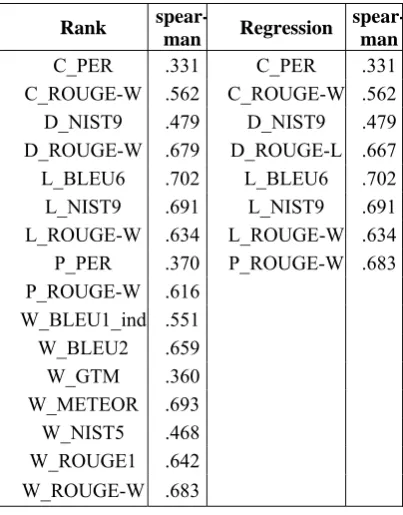
We trace the process of the feature selection. The selected feature set of the metric based on SVM rank includes 16 features and that of the metric based on SVM regression includes 8 features. The selected features are listed in Ta-ble 4. The values in TaTa-ble 4 are absolute Spearman correlations with human assess-ments of each single feature score. The prefix-es “C_”, “D_”, “L_”, “P_”, and “W_” represent “Constitute”, “Dependency”, “Let-ter”, “Pos” and “Lexicon” respectively.
Rank
spear-man Regression
spear-man
C_PER .331 C_PER .331 C_ROUGE-W .562 C_ROUGE-W .562 D_NIST9 .479 D_NIST9 .479 D_ROUGE-W .679 D_ROUGE-L .667
L_BLEU6 .702 L_BLEU6 .702
L_NIST9 .691 L_NIST9 .691 L_ROUGE-W .634 L_ROUGE-W .634
P_PER .370 P_ROUGE-W .683
P_ROUGE-W .616 W_BLEU1_ind .551
W_BLEU2 .659 W_GTM .360 W_METEOR .693
W_NIST5 .468 W_ROUGE1 .642 W_ROUGE-W .683
Table 4: Feature sets of SVM rank and regression
Table 4 shows that 8 features are selected from 65 features in the process of feature se-lection based on SVM regression while 16 fea-tures based on SVM rank. Fewer feafea-tures based on SVM regression are selected than SVM rank. Only one feature in feature set based on SVM regression does not occur in that based on SVM rank. The reason is that there are more complementary advantages be-tween the common selected features.
Next, we will verify the reliability of our feature selection algorithm. Figure 1 and Fig-ure 2 show the Spearman correlation values between our SVM-based metrics (regression and rank) and the human assessments on both training data (LDC2008E43) and test data (LDC2006T04 and LDC2003T17).
Figure 1: The Spearman correlation values between our SVM rank metrics and the human assessments
on both training data and test data with the exten-sion of the feature sets
Figure 2: The Spearman correlation values between our SVM regression metrics and the human
as-sessments on both training data and test data with the extension of the feature sets
From Figure 1 and Figure 2, with the exten-sion of the feature sets, we can find that the tendency of correlation obtained by each me-tric based on SVM rank or regression roughly the same on both the training data and test data. Therefore, the two feature sets of SVM rank and regression models are reliable.
6
Conclusion
much more clarified, and the computation of the similarity is much more simple, since the various linguistic features may express in the uniform strings with multiple calculation gra-nularities. The new features have the same form and are dimensionally homogeneous; therefore, the consistency of the features is enhanced strongly. ii) We integrate the features with machine learning and proposed an effec-tive approach of feature selection. As a result, we can use fewer features but obtain the better performance.
In this framework, on the one hand, string-based metrics with multiple granularities may introduce more potential features into automat-ic evaluation, with no necessarily of new simi-larity measuring method, compared with the other metrics. On the other hand, we succeed in finding a finer and small feature set among the combinations of plentiful features, keeping or improving the performance. Finally, we proposed a simple, effective and robust string-based automatic MT evaluation metric with multiple granularities.
Our proposed metrics improve the flexibility and performance of the metrics based on the multiple features; however, it still has some drawbacks: i) some potential features are not yet considered, e.g. the semantic roles; and ii) the loss of information exists in the process of changing linguistic information into plain strings. For example, the dependency label in the calculation granularity “Dependency” is lost when changing information into string form. Though the final results obtain the better performance than the other linguistic metrics, the performance is promising to be further im-proved if the loss of information can be prop-erly dealt with.
Acknowledgement
This work is supported by Natural Science foundation China (Grant No.60773066 & 60736014) and National Hi-tech Program (Project No.2006AA010108), and the Natural Scientific Reserach Innovation Foundation in Harbin Institute of Technology (Grant No. HIT.NSFIR.20009070).
References
Albrecht S. Joshua and Rebecca Hwa. 2007. A Reexamination of Machine Learning Approaches for Sentence-Level MT Evaluation. In
Proceed-ings of the 45th Annual Meeting of the Associa-tion of ComputaAssocia-tional Linguistics, pages 880-887.
Amigó Enrique, Julio Gonzalo, Anselmo Pènas, and Felisa Verdejo. 2005. QARLA: a Framework for the Evaluation of Automatic Summarization.
In Proceedings of the 43th Annual Meeting of the Association for Computational Linguistics. Amigó Enrique, Jesús Giménez, Julio Gonzalo,
Felisa Verdejo. 2009. The Contribution of Lin-guistic Features to Automatic Machine Transla-tion EvaluaTransla-tion. In proceedings of the Joint
Con-ference of the 47th Annual Meeting of the ACL and the 4th International Joint Conference on Natural Language Processing of the AFNLP. Amigó Enrique, Jesús Giménez, Julio Gonzalo, and
Lluís Màrquez. 2006. MT Evaluation: Human- Like vs. Human Acceptable. In Proceedings of
the Joint 21st International Conference on Com-putational Linguistics and the 44th Annual Meet-ing of the Association for Computational Lin-guistic, pages 17–24.
Banerjee Satanjeev and Alon Lavie. 2005. ME-TEOR: An automatic metric for MT evaluation with improved correlation with human judg-ments. In Proceedings of the ACL Workshop on
Intrinsic and Extrinsic Evaluation Measures. Blatz John, Erin Fitzgerald, George Foster, Simona
Gandrabur, Cyril Goutte, Alex Kulesza, Alberto Sanchis, and Nicola Ueffing. 2003. Confidence estimation for machine translation. In Technical
Report Natural Language Engineering Workshop Final Report, pages 97-100.
Callison-Burch Chris, Miles Osborne, and Philipp Koehn. 2006. Re-evaluating the Role of BLEU in Machine Translation Research. In Proceedings
of 11th Conference of the European Chapter of the Association for Computational Linguistics Chan S. Yee and Hwee T. Ng. 2008. MAXSIM: A
maximum similarity metric for machine transla-tion evaluatransla-tion. In Proceedings of ACL-08: HLT,
pages 55–62.
Doddington George. 2002. Automatic Evaluation of Machine Translation Quality Using N-gram Co- Occurrence Statistics. In Proceedings of the 2nd
Drucker Harris, Chris J. C. Burges, Linda Kaufman, Alex Smola, Vladimir Vapnik. 1996. Support vector regression machines. In NIPS.
Giménez Jesús and Lluís Màrquez. 2007. Linguistic Features for Automatic Evaluation of Heteroge-neous MT Systems. In Proceedings of the ACL
Workshop on Statistical Machine Translation. Giménez Jesús and Lluís Màrquez. 2008a.
Hetero-geneous Automatic MT Evaluation Through Non-Parametric Metric Combinations. In
Pro-ceedings of IJCNLP, pages 319–326.
Giménez Jesús and Lluís Màrquez. 2008b. On the Robustness of Linguistic Features for Automatic MT Evaluation.
Joachims Thorsten. 2002. Optimizing search en-gines using clickthrough data. In KDD.
Klein Dan and Christopher D. Manning. 2003a.
Fast Exact Inference with a Factored Model for Natural Language Parsing. In Advances in
Neural Information Processing Systems 15, pp. 3-10.
Klein Dan and Christopher D. Manning. 2003b.
Accurate Unlexicalized Parsing. Proceedings of
the 41st Meeting of the Association for Compu-tational Linguistics, pp. 423-430.
Le Audrey and Mark Przybocki. 2005. NIST 2005 machine translation evaluation official results.
In Official release of automatic evaluation scores for all submission.
Lin Chin-Yew and Franz Josef Och. 2004. Auto-matic Evaluation of Machine Translation Quali-ty Using Longest Common Subsequence and Skip-Bigram Statistics. Proceedings of the 42nd
Annual Meeting of the Association for Computa-tional Linguistics, pp. 605-612.
Liu Ding and Daniel Gildea. 2005. Syntactic Fea-tures for Evaluation of Machine Translation. In
Proceedings of ACL Workshop on Intrinsic and Extrinsic Evaluation Measures for MT and/or Summarization, pages 25–32.
Liu Ding and Daniel Gildea. 2007. Source Lan-guage Features and Maximum Correlation Training for Machine Translation Evaluation. In
proceedings of NAACL HLT 2007, pages 41–48 Mehay Dennis and Chris Brew. 2007. BLEUATRE:
Flattening Syntactic Dependencies for MT Eval-uation. In Proceedings of the 11th Conference on
Theoretical and Methodological Issues in Ma-chine Translation.
Melamed Dan I., Ryan Green, and Joseph P. Turian. 2003. Precision and Recall of Machine
Transla-tion. In Proceedings of the Joint Conference on
Human Language Technology and the North American Chapter of the Association for Com-putational Linguistics.
Nießen Sonja, Franz Josef Och, Gregor Leusch, and Hermann Ney. 2000. An Evaluation Tool for Machine Translation: Fast Evaluation for MT Research. In Proceedings of the 2nd
Internation-al Conference on Language Resources and EvInternation-al- Eval-uation .
Owczarzak Karolina, Declan Groves, Josef Van Genabith, and Andy Way. 2006. Contextual Bi-text- Derived Paraphrases in Automatic MT Evaluation. In Proceedings of the 7th
Confe-rence of the Association for Machine Translation in the Americas, pages 148–155.
Owczarzak Karolina, Josef van Genabith, and Andy Way. 2007. Labelled Dependencies in Machine Translation Evaluation. In Proceedings of the
ACL Workshop on Statistical Machine Transla-tion, pages 104–111.
Papineni Kishore, Salim Roukos, Todd Ward, and Wei-Jing Zhu. 2002. BLEU: a Method for Auto-matic Evaluation of Machine Translation. In
Proceedings of 40th Annual Meeting of the As-sociation for Computational Linguistics.
Popović Maja and Hermann Ney. 2007. Word Er-ror Rates: Decomposition over POS classes and Applications for Error Analysis. In Proceedings
of the Second Workshop on Statistical Machine Translation, pages 48–55.
Popović Maja and Hermann Ney. 2009. Syntax-oriented evaluation measures for machine trans-lation output. In Proceedings of the 4th EACL
Workshop on Statistical Machine Translation, pages 29–32.
Snover Matthew, Bonnie Dorr, Richard Schwartz, Linnea Micciulla, and John Makhoul. 2006. A study of translation edit rate with targeted hu-man annotation. In Proceedings of AMTA,
pag-es 223–231.
Tillmann Christoph, Stefan Vogel, Hermann Ney, A. Zubiaga, and H. Sawaf. 1997. Accelerated DP based Search for Statistical Translation. In