Heterogeneous Parsing via Collaborative Decoding
Muhua Zhu Jingbo Zhu Tong Xiao
Natural Language Processing Lab. Northeastern University
{zhujingbo, xiaotong}@mail.neu.edu.cn
Abstract
There often exist multiple corpora for the same natural language processing (NLP) tasks. However, such corpora are gen-erally used independently due to distinc-tions in annotation standards. For the pur-pose of full use of readily available hu-man annotations, it is significant to simul-taneously utilize multiple corpora of dif-ferent annotation standards. In this pa-per, we focus on the challenge of con-stituent syntactic parsing with treebanks of different annotations and propose a col-laborative decoding (or co-decoding) ap-proach to improve parsing accuracy by leveraging bracket structure consensus be-tween multiple parsing decoders trained on individual treebanks. Experimental re-sults show the effectiveness of the pro-posed approach, which outperforms state-of-the-art baselines, especially on long sentences.
1 Introduction
Recent years have seen extensive applications of machine learning methods to natural language processing problems. Typically, increase in the scale of training data boosts the performance of machine learning methods, which in turn en-hances the quality of learning-based NLP systems (Banko and Brill, 2001). However, annotating data by human is expensive in time and labor. For this reason, human-annotated corpora are consid-ered as the most valuable resource for NLP.
called heterogeneous treebanks, and correspond-ingly, the problem of syntactic parsing with het-erogeneous treebanks is referred to as heteroge-neous parsing.
Previous work on heterogeneous parsing is of-ten based on treebank transformation (or treebank conversion) (Wang et al., 1994; Niu et al., 2009). The basic idea is to transform annotations of one treebank (source treebank) to fit the standard of another treebank (target treebank). Due to diver-gences of treebank annotations, such transforma-tion is generally achieved in an indirect way by selecting transformation results from the output of a parser trained on the target treebank. A com-mon property of all the work mentioned above is that transformation accuracy is heavily dependent on the performance of parsers trained on the tar-get treebank. Sometimes transformation accuracy is not so satisfactory that techniques like instance pruning are needed in order to refine transforma-tion results (Niu et al., 2009).
We claim there exists another way, interesting but less studied for heterogeneous parsing. The basic idea is that, although there are annotation divergences between heterogenous treebanks, ac-tually we can also find consensus in annotations of bracket structures. Thus we would like to train parsers on individual heterogeneous treebanks and guide the parsers to gain output with consensus in bracket structures as much as possible when they are parsing the same sentences.
To realize this idea, we propose a generic col-laborative decoding (or co-decoding) framework where decoders trained on heterogeneous tree-banks can exchange consensus information be-tween each other during the decoding phase. The-oretically the framework is able to incorporate a large number of treebanks and various functions that formalize consensus statistics.
Our contributions can be summarized: 1) we propose a co-decoding approach to directly uti-lizing heterogeneous treebanks; 2) we propose a novel function to measure parsing consensus be-tween multiple decoders. We also conduct ex-periments on two Chinese treebanks: CTB and TCT. The results show that our approach achieves promising improvements over baseline systems which make no use of consensus information.
np
nS
中国
np
a
传统
n
文化
NP
NR
中国
NN
传统
NN
文化
中国传统文化
(Chinese) (traditional) (culture)
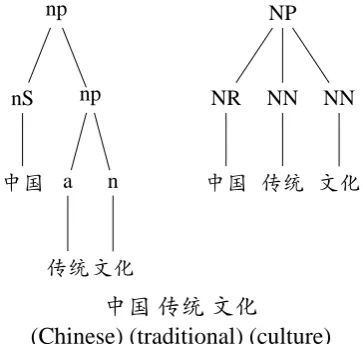
Figure 1: Example tree fragments with TCT (left) and CTB (right) annotations
2 Collaborative Decoding-based Heterogeneous Parsing
2.1 Motivation
This section describes the motivation to use co-decoding for heterogeneous parsing. We first use the example in Fig. 1 to illustrate what con-sensus information exists between heterogenous treebanks and why such information might help to improve parsing accuracy. This figure contains two partial parse trees corresponding to the words “中国 (Chinese) 传统 (traditional) 文化 (culture)”, annotated according to the TCT (left side) and CTB (right side) standards respectively. Despite the distinctions in tag sets and bracket structures, these parse trees actually have partial agreements in bracket structures. That is, not all bracket structures in the parse trees are different. Specifically put, although the internal structures of the parse trees are different, both CTB and TCT agree to take “中国 传统 文化” as a noun phrase. Motivated by this observation, we would like to guide parsers that are trained on CTB and TCT respectively to verify their output interac-tively by using consensus information implicitly contained in these treebanks. Better performance is expected when such information is considered.
to previous work on n-best combination where multiple parsers, say, Collins parser (Collins, 1999) and Berkeley parser (Petrov et al., 2006) are trained on the same training data, n-best combination for heterogeneous parsing is instead allowed to use either a single parser or multiple parsers which are trained on heterogeneous treebanks. Consensus information can be incor-porated during the combination of the output (n-best list of full parse trees following distinct annotation standards) of individual parsers. How-ever, despite the success of n-best combination methods, they suffer from the limited scope of n-best list. Taking this into account, we prefer to apply the co-decoding approach such that consensus information is expected to affect the entire procedure of searching hypothesis space.
2.2 System Overview
The idea of co-decoding is recently extensively studied in the literature of SMT (Li et al., 2009; Liu et al., 2009). As the name shows, co-decoding requires multiple decoders be combined and pro-ceed collaboratively. As with n-best combination, there are at least two ways to build multiple de-coders: we can either use multiple parsers trained on the same training data (use of diversity of mod-els), or use a single parser on different training data (use of diversity of datasets) 1. Both ways can build multiple decoders which are to be inte-grated into co-decoding. For the latter case, one method to get diverse training data is to use dif-ferent portions of the same training set. In this study we extend the case to an extreme situation where heterogeneous treebanks are used to build multiple decoders.
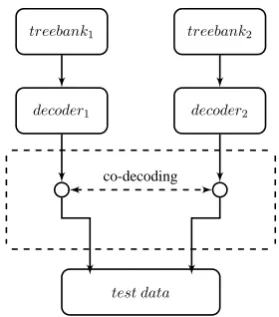
Fig. 2 represents a basic flow chart of heteroge-neous parsing via co-decoding. Note that here we discuss the case of co-decoding with only two de-coders, but the framework is generic enough to in-tegrate more than two decoders. For convenience of reference, we call a decoder without incorpo-rating consensus information as baseline decoder
1To make terminologies clear, we use parser as its regular
sense, including training models (ex. Collins model 2) and parsing algorithms (ex. the CKY algorithm used in Collins parser), and we use decoder to represent parsing algorithms with specified parameter values
treebank1 treebank2
decoder1 decoder2
co-decoding
test data
Figure 2: Basic flow chart of co-decoding
and correspondingly refer to a decoder augmented with consensus information as member decoder. So the basic steps of co-decoding for heteroge-neous parsing is to first build baseline decoders on heterogeneous treebanks and then use the baseline decoders to parse sentences with consensus infor-mation exchanged between each other.
To complete co-decoding for heterogeneous parsing, three key components should be consid-ered in the system:
• Co-decoding model. A co-decoder con-sists of multiple member decoders which are baseline decoders augmented with consen-sus information. Co-decoding model de-fines how baseline decoders and consensus information are correlated to get member de-coders.
• Decoder coordination. Decoders in the co-decoding model cannot proceed indepen-dently but should have interactions between each other in order to exchange consensus in-formation. A decoder coordination strategy decides on when, where, and how the inter-actions happen.
In the following subsections, we first present the generic co-decoding model and then describe in detail how member decoders collaborate. Fi-nally we introduce a novel consensus-based score function which is used to quantify consensus in-formation exchanged between member decoders.
2.3 Generic Co-decoding Model
The generic co-decoding model described here is also used in (Li et al., 2009) for co-decoding of machine translators. For a given sentence S, a parsing algorithm (decoder) seeks a parse treeT∗
which is optimal in the sense that it maximizes some score functionF(T), as shown in Eq. 1.
T∗= arg max T s.t.S=yield(T)
F(T) (1)
where T s.t.S = yield(T) represents the set of parse trees that yield the input sentence S. For baseline decoders, the score function F(T) is generally just the inside probability P(T) 2 of
a tree T, defined as the product of probabili-ties of grammar rules appearing in parse tree T: Q
r∈R(T)P(r). In the co-decoding framework,
F(T) is extended so as to integrate consensus-based score functions which measure consensus information between member decoders, as shown in Eq. 2.
Fm(T) =Pm(T) + n X
k,k6=m
Ψk(Hk(S), T) (2)
We use dk to denote the kth decoder and use
Hk(S) to denote corresponding parsing hypoth-esis space of decoder dk. Moreover, Pm(T) is referred to as baseline score given by baseline decoders and Ψk(Hk(S), T) is consensus score between decoders dm and dk, which is defined as a linear combination of consensus-based score functions, as shown in Eq. 3.
Ψk(Hk(S), T) = X
l
λk,lfk,l(Hk(S), T) (3)
where fk,l(Hk(S), T) represents a consensus-based score function between T and Hk(S), and λk,l is the corresponding weight. Index l
2Actually, the joint probability P(S,T) of sentenceSand
parse treeTis used, but we can prove thatP(S, T) =P(T).
ranges over all consensus-based score functions in Eq. 3. Theoretically we can define a variety of consensus-based score functions.
For the simplest case where there are only two member decoders and one consensus-based score function, Eq. 2 and Eq. 3 can be combined and simplified into the equation
Fi(T) =Pi(T) +λ1−if(H1−i(S), T) (4)
where indexiis set to the value of either 1 or 0. This simplified version is used in the experiments of this study.
2.4 Decoder Coordination
This subsection discusses the problem of decoder coordination. Note that although Eq. 2 is defined at sentence level, the co-decoding model actu-ally should be applied to the parsing procedure of any subsequence (word span) of sentence S. So it is natural to render member decoders col-laborate when they are processing the same word spans. To this end, we would like to adopt best-first CKY-style parsing algorithms as baseline de-coders, since CKY-style decoders have the prop-erty that they process word spans in the ascend-ing order of span sizes. Moreover, the hypothe-ses3 spanning the same range of words are
read-ily stacked together in a chart cell before CKY-style decoders move on to process other spans. Thus, member decoders can process the same word spans collaboratively from small ones to big ones until they finally complete parsing the entire sentence.
A second issue in Eq. 2 is that consensus-based score functions are dependent on hypoth-esis space Hk(S). Unfortunately, the whole hy-pothesis space is not available most of the time. To address this issue, one practical method is to approximateHk(S)with a n-best hypothesis list. For best-first CKY parsing, we actually retain all unpruned partial hypotheses over the same span as the approximation. Hereafter, the approxima-tion is denoted asHˆk(S)
Finally, we notice in Eq. 2 that consensus score
3
Ψk(Hk(S), T)andHk(S)form a circular depen-dency: searching for Hk(S) requires both base-line score and consensus score; on the other hand, calculating consensus score needsHk(S)(its ap-proximation in practice) to be known beforehand. Li et al. (2009) solves this dilemma with a boot-strapping method. It starts with seedy n-best lists generated by baseline decoders and then alter-nates between calculating consensus scores and updating n-best hypothesis lists. Such bootstrap-ping method is a natural choice to break down the circular dependency, but multi-pass re-decoding might dramatically reduce decoding efficiency. Actually, Li et al. (2009) restricts the iteration number to two in their experiments. In this paper, we instead use an alternative to the bootstrapping method. The process is described as follows.
1. In traditional best-first CKY-style parsing al-gorithms, hypotheses over the same word spans are grouped according to some crite-rion of hypothesis equivalence 4. Among equivalent hypotheses, only a single optimal hypothesis is retained. In this paper, we in-stead keep topkof equivalent hypotheses in a data structure called best-first cache.
2. Use hypotheses in best-first caches to ap-proximate Hk(S), and calculate consensus scoreΨk(Hk(S), T)between decoders.
3. Use baseline score and consensus score to lo-cally rerank hypotheses in best-first caches. Then remove hypotheses in caches except the top one hypothesis.
In this study, we choose the best-first CKY-style parsing algorithm used in Collins parser (Collins, 1999). Algorithm 1 extends this algorithm for co-decoding. The first two steps initialize baseline decoders and assign appropriate POS tags to sen-tenceSt. Since baseline decoders are built on het-erogeneous treebanks, POS taggers correspond-ing to each baseline decoder are demanded, unless gold POS tags are provided. The third step is the core of the co-decoding algorithm. Here the plete procedure invokes baseline decoders to
com-4the simplest criterion of equivalence is whether
hypothe-ses have the same grammar labels.
Algorithm 1 CKY-style Co-decoding Argument:dk{the set of baseline decoders}
St{a sentence to be parsed}
Begin Steps:
1. assign POS tags to sentenceSt
2. initialize baseline decodersdk
3. for span from 2 to sentence length do
for start from 1 to (sentence length-span+1) do
end := (start + span - 1)
for each base decoderdkdo complete(dk, start, end)
do co-decoding(start, end) End
Subroutine:
complete(dk, start, end): base decoderdkgenerates hypotheses over the span (begin.end), and fills in best-first caches.
co-decoding(start, end): calculate consensus score
and rerank hypotheses in best-first caches. The top 1 is chosen to be the best-first hypothesis.
plete parsing on the span [start, end]and gener-atesHˆk(s). The co-decoding procedure calculates consensus score and locally reranks hypotheses in best-first caches.
2.5 Consensus-based Score Function
There are at least two feasible ways to mea-sure consensus between constituency parse trees. By viewing parse trees from diverse perspectives, we can either use functions on bracket structures of parse trees, as in (Wang et al., 1994), or use functions on head-dependent relations by first transforming constituency trees into dependency trees, as in (Niu et al., 2009). Although the co-decoding model is generic enough to integrate var-ious consensus-based score functions in a uniform way, this paper only uses a bracket structure-based function.
sub-6
4
1
5
2 3
[1,3],[2,3],[1,1]
[1,1]
[2,3],[2,2],[3,3]
[1,1]
[2,2]
[3,3]
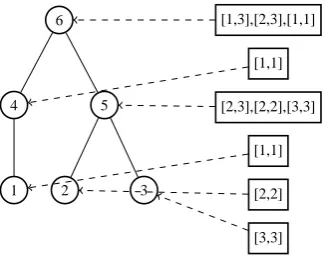
Figure 3: Constituent set of a synthetic parse tree
trees of the tree, as illustrated in Fig. 3. For exam-ple, the constituent set of the tree rooted at node 6has three elements: [1,1], [1,3], and[1,2]. For
ˆ
Hk(S), the constituent set is defined as the union of constituent sets of all elements it contains.
CS( ˆHk(S)) = [
T∈Hˆk(S)
CS(T)
In practice, we need to cut off elements in
CS( ˆHk(S)) in order to retain most confident word spans.
With the concept of constituent set, a consensus-based score function onT and Hˆk(S) can be defined as follows.
f( ˆHk(S), T) = P
c∈CS(T)I(c, CS( ˆHk(S)))
|CS(T)| (5)
where I(c, CS( ˆHk(S))) is an indicator function which returns one if c ∈ CS(T) is compatible with all the elements in CS( ˆHk(S)), zero oth-erwise. Two spans, [a, b] and [i, j] are said to be compatible if they satisfy one of the following conditions: 1)i > b; 2)a > j; 3)a≤i≤band
j ≤ b; 4)i ≤a ≤ jand b ≤j. Fig 4 uses two example to illustrate the concept of compatibility.
3 Experiments
3.1 Data and Performance Metric
The most recent version of the CTB corpus, CTB 6.0 and the CIPS ParsEval data are used as hetero-geneous treebanks in the experiments. Following the split utilized in (Huang et al., 2007), we di-vided the dataset into blocks of 10 files. For each
w1 w2 w3 w4 w1 w2 w3 w4
Figure 4: left) two spans conflict; right) two spans are compatible
block, the first file was added to the CTB develop-ment data, the second file was added to the CTB testing data, and the remaining 8 files were added to the CTB training data. For the sake of parsing efficiency, we randomly sampled 1,000 sentences of no more than 40 words from the CTB test set.
CTB-Partitions Train Dev Test #Sentences 22,724 2,855 1,000 #Words 627,833 78,653 25,100 Ave-Length 30.1 30.0 20.3 TCT-Partitions Train Dev Test #Sentences 32,771 N/A 1,000 #Words 354,767 N/A 10,400 Ave-Length 10.6 N/A 10.4
Table 1: Basic statistics on the CTB and TCT data
CIPS-ParsEval data is publicly available for the first Chinese syntactic parsing competition, CIPS-ParsEval 2009. Compared to CTB, sentences in CIPS-ParsEval data are much shorter in length. We removed sentences which have words less than three. CIPS-ParsEval test set has 7,995 sen-tences after sentence pruning. As with the CTB test set, we randomly sampled 1,000 sentences for evaluating co-decoding performance. Since CIPS-ParsEval data is actually a portion of the TCT corpus, for convenience of reference, we will refer to CIPS-ParsEval data as TCT in the follow-ing sections. Table 1 contains statistics on CTB and TCT.
The two training sets are used individually to build baseline decoders. With regard to the test sets, each sentence in the test sets should have two kinds of POS tags, according to the CTB and TCT standards respectively. To this end, we ap-plied a HMM-based method for POS annotation transformation (Zhu and Zhu, 2009). During the POS transformation, the divergences of word seg-mentation are omitted.
For all experiments, bracketing F1 is used as the performance metric, provided by EVALB5.
3.2 Baseline Decoders
As already mentioned above, we apply Collins parser in this paper. Specifically speaking, two CKY-style baseline decoders to participate co-decoding are built on CTB and TCT respectively with Collins model two. For the CTB-based de-coder, we use the CTB training data with slight modifications: we replaced POS tags of punctua-tions with specific punctuation symbols.
To get the TCT-based decoder, we made follow-ing modifications. Firstly, TCT is available with manually annotated head indices for all the con-stituents in parse trees. For example, a grammar label, say, np-1, means that the constituent is a noun phrase with the second child being its head child. In order to relax context independence as-sumptions made in PCFG, we appended head in-dices to grammar labels to get new labels, for ex-ample np1. Secondly, since Collins parser is a lexicalized parser, head rules specific to the TCT corpus were manually created, which are used to-gether with readily available head indices. Such adaptation is also used in (Chen et al., 2009);
3.3 Parsing Results
We conduct experiments on both CTB and TCT test sets. Two parameters need to be set: the cut-off threshold for constructing constituent set of
ˆ
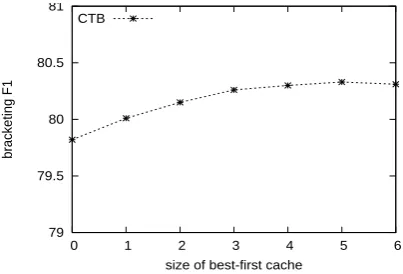
Hk(S) and the weightλ6 of consensus score in Eq. 4. We tuned the parameters on the CTB de-velopment set and finally set them to 5 and 20 respectively in the experiments. Table 2 presents bracketing F1 scores of baseline systems and the co-decoding approach. Here, the row of baseline represents the performance of individual baseline decoders, and the comparison of baseline and co-decoding on a test set, say CTB, demonstrates how much boosting the other side, say TCT, can supply. For the co-decoding approach, the size of best-first cache is set to 5 which achieves the best result among the cache sizes we have experi-mented.
As the results show, co-decoding achieves promising improvements over baseline systems on both test sets. Interestingly, we see that the improvement on the TCT test set is larger than
6We use the sameλfor both member decoders.
Test Set CTB TCT Baseline 79.82 81.02 Co-decoding 80.33 81.77
Table 2: Baseline and Co-decoding on the CTB and TCT test sets
that on the CTB test set. In general, a relatively strong decoder can improve co-decoding perfor-mance more than a relatively weak decoder does. At the first sight, the TCT-based decoder seems to have better performance than the CTB-based de-coder. But if taking sentence length into consid-eration, we can find that the TCT-based decoder is actually relatively weak. Table 3 shows the performance of the CTB-based decoder on short sentences.
3.4 Analysis
Fig. 5 shows the bracketing F1 on the CTB test set at different settings of the best-first cache sizeC. F1 scores reach the peak beforeCincreases to 6. As a result, we setCto 5 in all our experiments.
79 79.5 80 80.5 81
0 1 2 3 4 5 6
bracketing F1
size of best-first cache CTB
Figure 5: Bracketing F1 with varying best-first cache size
ef-Partitions [0,10] (10,20] (20,30] (30,40] # Sentence 276 254 266 204 Ave-Length 6.07 15.64 25.43 35.20
Baseline 92.83 84.34 78.98 76.69 Co-decoding 92.84 84.36 79.43 77.65
Table 3: Effect of sentence length on co-decoding performance
ficiency of co-decoding can be improved. It is worth emphasizing that co-decoding is still help-ful for parsers whose performance on short sen-tences is not satisfactory, as shown in Table 2.
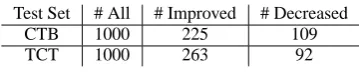
Another interesting analysis is to check how many parsing results are affected by co-decoding, compared to baseline decoders. Table 4 shows the statistics.
Test Set # All # Improved # Decreased CTB 1000 225 109 TCT 1000 263 92
Table 4: Statistics on sentences of test data
As the table shows, although overall accuracy is increased, we find that on some sentences, co-decoding instead worsens parsing accuracy. In order to get insights on error sources, we manu-ally analyzed 20 sentences on which co-decoding achieves negative results. We find a large por-tion (14 of 20) of sentences are short sentences (of words less than 20). Actually, due to high ac-curacy of the CTB-based decoder on short sen-tences, co-decoding is indifferent when this de-coder is processing short sentences. And we also find that some errors are derived from differences in annotation standards. Fortunately, the diver-gence of annotations mainly exists in relatively small spans. So one solution to the problem is to enable co-decoding on relatively big spans. These will be done in our future work.
4 Related Work
4.1 System Combination
In the literature of syntactic parsing, n-best com-bination methods include parse selection, con-stituent recombination, production recombina-tion, and n-best reranking. Henderson and Brill (1999) performs parse selection by maximizing
the expected precision of selected parse with re-spect to the set of parses to be combined. Sagae and Lavie (2006) proposes to recombine con-stituents from the output of individual parsers. More recently, Fossum and Knight (2009) studies a combination method at production level. Zhang et al. (2009) reranks n-best list of one parser with scores derived from another parser.
Compared to n-best combination, co-decoding (Li et al., 2009; Liu et al., 2009) combines tems during decoding phase. Theoretically, sys-tem combination during decoding phase helps de-coders to select better approximation to hypothe-sis space, since pruning is practically unavoidable. To the best of our knowledge, co-decoding meth-ods have not been applied to syntactic parsing.
4.2 Treebank Transformation
The focus of this study is heterogeneous parsing. Previous work on this challenge is generally based on treebank transformation. Wang et al. (1994) describes a method for transformation between constituency treebanks. The basic idea is to train a parser on a target treebank and generate a n-best list for each sentence in source treebank(s). Then, a matching metric which is a function on the num-ber of the same word spans between two trees is defined to select a best parse from each n-best list. Niu et al. (2009) applies a closely similar frame-work as with (Wang et al., 1994) to transform a dependency treebank to a constituency one.
5 Conclusions
This paper proposed a co-decoding approach to the challenge of heterogeneous parsing. Com-pared to previous work on this challenge, co-decoding is able to directly utilize heterogeneous treebanks by incorporating consensus information between partial output of individual parsers dur-ing the decoddur-ing phase. Experiments demonstrate the effectiveness of the co-decoding approach, es-pecially the effectiveness on long sentences.
Acknowledgments
References
Banko, Michele and Eric Brill. 2001. Scaling to very very large corpora for natural language dis-ambiguation. In Proc. of ACL 2001, pages 26-33.
Chen, Xiao, Changning Huang, Mu Li, and Chunyu Kit. 2009. Better Parser Combination. Technique Report of CIPS-ParsEval 2009.
Collins, Michael. 1999. Head-driven statistical mod-els for natural language parsing. Ph.D. thesis, Uni-versity of Pennsylvania.
Charniak, Eugene. 2000. A maximum-entropy-inspired parser. In Proc. of NAACL 2000, pages 132-139.
Fossum, Victoria and Kevin Knight. 2009. Combin-ing constituent parsers. In Proc. of NAACL 2009, pages 253-256.
Henderson, John and Eric Brill. 1999. Exploiting di-versity in natural language processing. In Proc. of SIGDAT-EMNLP 1999, pages 187-194.
Huang, Zhongqiang, Mary P. Harper, and Wen Wang. 2007. Mandarin part-of-speech tagging and dis-criminative reranking. In Proc. of EMNLP-CoNLL 2007, pages 1093-1102.
Li, Mu, Nan Duan, Dongdong Zhang, Chi-Ho Li, and Ming Zhou. 2009. Collaborative decoding: par-tial hypothesis re-ranking using trnaslationconsen-sus between decoders. In Proc. of ACL 2009, pages 585-592.
Liu, Yang, Haitao Mi, Yang Feng, and Qun Liu. 2009. Joint Decoding with Multiple Translation Models. In Proc. of ACL 2009, pages 576-584.
Niu, Zheng-Yu, Haifeng Wang, Hua Wu. 2009. Ex-ploiting heterogeneous treebanks for parsing. In Proc. of ACL 2009, pages 46-54.
Petrov, Slav, Leon Barrett, Romain Thibaux, and Dan Klein. 2006. Learning accurate, compact, and in-terpretable tree annotation. In Proc. of COLING-ACL 2006, pages 433-440.
Sage, Kenji and Alon Lavie. 2006. Parser combina-tion by reparsing. In Proc. of NAACL 2006, pages 129-132.
Xue, Nianwen, Fu dong Chiou, and Martha Palmer. 2002. Building a large-scale Annotated Chinese corpus. In Proc. of COLING 2002, pages 1-8.
Wang, Jong-Nae, Jing-Shin Chang, and Keh-Yih Su. 1994. An automatic treebank conversion algorithm for corpus sharing. In Proc. of ACL 1994, pages 248-254.
Zhang, Hui, Min Zhang, Chew Lim Tan, and Haizhou Li. 2009. K-best combination of syntactic parsers. In Proc. of EMNLP 2009, pages 1552-1560.
Zhou, Qiang. 1996. Phrase bracketing and annotating on Chinese language corpus. (in Chinese) Ph.D. thesis, Beijing University.