COL1NG ~ , Z Horeck: (ed.) Noah.Holland Pub~hi~ Comply © Ac~lem~ 1982
PROCEDURAL MEANING REPRESENTATION BY CONNOTATIVE DEPENDENCY STRUCTURES. AN EMPIRICAL APPROACH TO
WORD SEMANTICS FOR ANALOGICAL INEERENCING
Burgbard B. Rieger
MESY-Group, German Department
Technical University of Aachen Germany
Natural language understanding systems make use of language and/or w o r l d k n o w l e d g e bases. One of the salient problems of meaning representation and knowledge structure is the modelling of its acquisition and modification from natural
language processing. Based upon the statistical analysis of discourse, a formal representation of vague word meanings is derived which constitutes the lexical structure of the voca- bulary employed in the texts as a fragment of the connotative knowledge conveyed in discourse. It consists of a distance-
like data structure of linguistically labeled space points
whose positions give a prototype-representation of conceptual meanings. On the basis of these semantic space data an algo- rithm is presented which transforms prevailing similarities of conceptual meanings as denoted by adjacent space points to establish a binary, non-symmotric, and transitive relation between them. This allows for the hierarchical reorganization of points as nodes dependent on a head in a binary tree c a l l e d connotative dependency structure (CDS]. It offers an empiri- cally founded operational approach to determine relevant port- ions of the space structure constituting semantic dispositions which the priming of a meaning point will trigger with de- creasing criteriality. Thus, the CDS allows for the execution of associatively guided search strategies, contents-oriented retrieval operations, and source-dependent processes of ana- logical inferencing.
INTRODUCTION
In procedural approaches of linguistic semantics, cognitive psycho- logy and artificial intelligence, natural language understanding systems make use of language and/or world knowledge bases. Defined as lexical structures, memory models or semantic networks, they are formatted according to whatever representational, explanatory or inferential purpose a particular simulation of processes and/or of understanding was aiming at (I). ~he language and world knowledge embodied in these systems, however, is restricted under two aspects: most of it is obtained introspectively and as such not warranted by any operational means or, whenever it seems to, these operations are not the permitting condition for, but a performiffg result of simple referencing in clear-cut environments.
Based mainly upon the investigatorS' or the system designers' own or some consulted experts' linguistic competence and/or world knowledge in a subject domain, the data considered semantically relevant to be organized in referential and/or conceptual structures (lists, arrays, networks, topologies, etc.) have a more or less ad hoc character and are confined to representing logically reconstructable propositions.
N e g l e c t a b l e a s t h e s e s h o r t c o m i n g s p r o v e t o b e f o r s t r i c t l y e x - t e n s i o n a l l y d e f i n e d e n v i r o n m e n t s a n d f r a g m e n t s o f k n o w l e d g e s t r u c t u r e i n r e f e r e n t i a l m o d e l s , d a t a c o m p l e x i t y t e n d s t o i n c r e a s e t o m e e t e x - p l o d i n g d i f f i c u l t i e s a n d e s c a l a t i n g p r o b l e m s w h e n e v e r a b s t r a c t c o n c e p t s o r e v e n v a g u e m e a n i n g s a r e t o b e p r o c e s s e d i n a n o t e x c l u s i v e l y d e - n o t a t i v e b u t a l s o c o n n o t a t i v e s e t t i n g o f f o r m a l s e m a n t i c r e p r e s e n t a - t i o n .
As n a t u r a l l a n g u a g e c o m m u n i c a t i o n may b e c h a r a c t e r i z e d b y t h e a p p a r - e n t e a s e a n d e f f i c i e n c ~ , h o w e v e r , w i t h w h i c h i l l - d e f i n e d c o n c e p t s a n d f u z z y m e a n i n g s a r e b e i n g i n t e n d e d a n d e x p r e s s e d b y s p e a k e r s , i d - e n t i f i e d a n d u n d e r s t o o d b y h e a r e r s , a n d s u c c e s s f u l l y u s e d b y s p e a k e r s / h e a r e r s i n p e r f o r m i n g i n f e r e n c e s o f some - n o t n e c e s s a r i l y l o g i c a l - s o r t , i t i s a r g u e d h e r e , t h a t a n y n o n - t r i v i a l s i m u l a t i o n o f p r o c e s s e s o f c o g n i t i o n a n d / o r n a t u r a l l a n g u a g e c o m p r e h e n s i o n w i l l h a v e t o p r o - v i d e some m e a n s o f d y n a m i c k n o w l e d g e r e p r e s e n t a t i o n w h i c h p e r m i t s t o
a c c o u n t m o r e s a t i s f a c t o r i l y f o r one o r t h e o t h e r a s p e c t r a i s e d a b o v e .
The c o n c e p t o f ' r e p r e s e n t a t i o n o f k n o w l e d g e ' s e e m s l u c i d e n o u g h w h e n talking about memories of sentences, n u m b e r s , o r even faces, for one can imagine how to formulate these in terms of p r o p o s i - tions, frames, or semantic networks. But it is much harder to do this for feelings, insights and understandings, with all the atti-
tudes, dispositions, and 'ways of seeing things' that go with them. [The term 'disposition' is used here in its ordinary language sense to mean 'a m o m e n t a r y range of possible behaviours']) Tradi- tionally, such issues are put aside, with the excuse that we should u n d e r s t a n d simpler things first. But what if feelings and view- points a r e the simpler things - the elements of which the others are composed? Then, I assert, we should deal with disposi- tions directly, using a 'structural' approach ... (2)
In the present case this has been developed in two stages: the seman- tic space as a d i s t a n c e - l i k e data structure, and an a l g o r i t h m to trans- form its distance relations to form s o u r c e - o r i e n t e d h i e r a r c h i e s of c o n n o t a t i v e d e p e n d e n c y structures.
SEMANTIC SPACE STRUCTURE
Theoretical approaches in formal semantics tend to deny a dynamic linguistic meaning structure, but assume the existence of an external system structure of a world, o~ possible worlds, whose p r e - f o r m a t t e d entities may r e f e r e n t i a l l y be related to language terms c o n s t i t u t i n g their denotation. Structural approaches in linguistic semantics tend to deny the p o s s i b i l i t y of denotational, but presuppose the knowledge (and comprehension) of language systems whose semantic relations among their items are being d e s c r i b e d intra-lingually by means of syntag- matic and p a r a d i g m a t i c oppositions along certain dimensions in seman- tic fields. Other than these two, our present way of a p p r o a c h strives to presuppose as little and to r e c o n s t r u c t e m p i r i c a l l y as much as possible of the relational (not n e c e s s a r i l y logically reconstructable) structure that in the course of discourse is c o n s t i t u t e d by the regu- lar use of language terms as a system of l i n g u i s t i c a l l y labeled em- pirical objects, called meanings.
We consider the natural language users' ability to intend and compre- hend meanings in verbal i n t e r a c t i o n a p h e n o m e n o l o g i c a l l y u n d o u b t a b l e , e m p i r i c a l l y well established, and t h e o r e t i c a l l y d e f e n s i b l e basis for any semantic study of natural language performance. It is assumed
EMPIRICAL APPROACH TO WORD SEMANTICS FOR ANALOGICAL INFERENCING 321
comitantly conveyed common knowledge or semantic memory structure constituted.
This is achieved by an algorithm that takes lemmatized strings of
natural language disc6urse of a certain domain as input and produces as output a distance-like data structure of linguistically labeled
points whose positions represent their meanings. As the statistical
means for the empirical analysis of prevailing interdependencies bet- ween lexical items in text strings have elsewhere (3) been developed
and discussed to some extent (4) 9 and as the formal representation
of vague word meanings derived from these analyses has previously (5) been outlined and illustrated~ too (6), an informal description will suffice here.
The algorithm applied so far consists of a consecutive mapping of lexical items onto fuzzy subsets of the vocabulary according to the
numerically specified statistical regularities and the differences~
these items have been used with in the discourse analysed. The re- sulting system of sets of fuzzy subsets may be interpreted topologi- cally as a n-dimensional hyperspace with a natural metric. Its n linguistically labeled elements (representing meaning points) and their mutual distances (representing meaning differences) form dis- cernable clouds and clusters (7). These determine the overall struc-
turedness of a domain by measurable semantic (paradigmatic and/or
syntagmatic) properties of the lexical items concerned. CONNOTATIVE DEPENDENCY STRUCTURE
Stimulated by the theory of spreading activation in memory models (8) in conjunction with the psyhhological account of language understand-
ing in procedural semantics (9) a dynamic meaning representation can
be developed of the basis of the prototypical, but static represen-
tations provided by the semantic hyperspace strucure. This is mchiev- ed by a recursively defined algorithm which has formally been intro- duced elsewhere (Io) so that it may verbally be described here as a procedure to generate a potential of latent relations among meaning points in the semantic space.
In a way9 this procedure reconstructs for this model what recent theories of cognition and language comprehension have introduced in
network models of semantic memory: paths of excitation that may be
activated from any primed node and which spread along node relating
links over the whole network with decreasing intensities. Compared
to the execution of spreading activation processes in network models~
however, the present procedure - speaking in model genetical terms -
must be considered of prior status. The semantic hyperspace is not a
transitively related network of nodes, but a symmetrically related data structure of linguistically labeled n-tuples of numerical values.
Therefore, priming of any item would immediately activate every other
item rendering the process of spreading activation undiscriminating
for semantic representation. So, the new procedure, first, has to
establish links between items and evaluate them by processing the data base provided in order to let these links eventually serve as directed paths along which possible activation might spread. Operating on the distance-like data of the semantic space, the al- gorithm's generic procedure will start with any meaning point being primed to determine those two other points, the sum of distances bet- ween which form a triangle of minimum edges' lengths. Repeated success-
meanings as r e p r e s e n t e d by adjacent points ~o establish a binary, non-symmetric, and transitive relation b e t w e e n them~It allows for the hierarchical r e a r r a n g e m e n t of meaning points as nodes under a primed head in the format of a binary tree~ called connotative de- p e n d e n c y structure (CDS) o
The process of d e t e c t i o n and i d e n t i f i c a t i o n w h i c h the algorithm per- formes may be illustrated in view of a t~?o-.dimensionel space confi- guration of 11 points < d { a , b , c ~ d g e ~ f ~ g ~ h ~ i , ~ , k } > (Fig. I).
F i g . ]
e
d b "s
k
J
g
h
F i g . 2 / / / ~ x" ,
a
e b
x c 3
Fig. 3
Submitted to the search procedure of least triangle under initial priming of the point a the a l g o r i t h m will identify the number of triangles in Fig. 2 and produce t h e b i n a r y tree as shown in Fig. 3. For the effective use in procedural meaning r e p r e s e n t a t i o n and son, an- tic Drocessing~ the CDS-trees may a d d i t i o n a l - ly be e v a l u a t e d by connotative c ~ i t e r i a l i t i e s
(1o). The c r i t e r i a i i t y is a numerical express- ion of the degree or intensity by whicb any COS-node is dependent on the head; c % ! c u l a ~ e d as ~ f u n h t i o n both of the involved meaning points ~ topology and their relative distaDc~s in the semantic space° The head's c r i t e r i a l i t y being I.Oo~ this value is splitted among every two d e p e n d e n t nodes~ and c o n s e q u e n t l y decreases from level to level in the tree structure a p p r o x i m a t i n g O.
Examples of connotative d e p e n d e n c y trees are given below where the upper fragments of the COSts of A R B E I T / l a b o u r (Fig.4) and INDUSTRIE/ industry (Fig. 5) are shown as c o m p u t e d from the semantic space shruc- ture derived of a sample of German n e w s p a p e r texts from the 1964 daily editions of 'Die Welt'
[image:4.612.151.498.248.587.2]EMPIRICAL APPROACH TO WORD SEMANTICS FOR ANALOGICAL INFERENCING 323
of INDUSTRIE under t h e aspect of ARBEIT, namely UNTERNEHMEN/business,
STADT/town, ANGEBOT/offer as underlined in Fig. 4.
The priming of INDUSTRIE and the targetting of ARBEIT leads to the
activation of quite a different dependency path mediating ARBEIT un-
der the aspect of INDUSTRIE, namely by KENNTNIS/knowledge, ERFAHR/
experience, LEIT/control, as underlined in Fig. 5.
F i g . 4
I . O O O A R B E I T
.086 I N D U S T R I E
.169 U N T E R N E E M ]
i QO~3 SUCH
.290 STADT J
.062 S C ~ E I B . 1 2 1 W U N S C H
.059 SCHUL .558 A N G E ~
.075 L E H R . 1 4 1 V E R K E H R
.066 G E S C H K F T .268, G E B I E T
.O78 V E R W A L T .127 E I N S A T Z
.049 W I R T S C H A F T
.076 BERUF .151 S T E L L E
.075 E L E K T R O N .276 A U S G A B E
P . . . " I . 0 6 5 U N T E R R I C H T
' ~ . 1 2 5 O R G A N I S A T 1
I .O60 B I T T E
I
~ E _ : . = ~ . _ . ~ o53 H ~ ' ~ R S C ~ T . 0 8 8 A L L G E M E I N
.035 M O D E .166 V E R B A N D
.O40 A U S L A N D .078 V E R A N T W O R T
.038 F O L G E
F i g . 5
T 5o'o- £~66~£E . . . . "
.290 E L E K T R O N
.150 SCHUL
.130 S C H R E I E
.536 S U C H
f . . . !
t
I .137 U N T E R R I C H T
I
! .246 BERUF
' L
p ........... ~
' H . 1 o 9 0 R G ~ X S A T I
.464 L E I T
.283 C O M P U T E R
. 1 5 1 F K H I G
• 1 3 2 S Y S T E M
.115 O IPLOM
• 181 E R F A H R
.066 K E N N T N I S
.075 G E B I E T
.O75: V E R B A N D
.073 U N T E R N E ~ M
.067 STADT
.105 BITTE
.032 T E C H N I K
.058 STELLE
.O51 W U N S C H
.080 AU SGABE
.O71 A L L G E M E IN
.068 P E R S O N
.064 A N G E B O T
.059 V E R K E H R
.056 E I N S A T Z
.035 A R B E I T
~.O31 V E R A N T W O R T
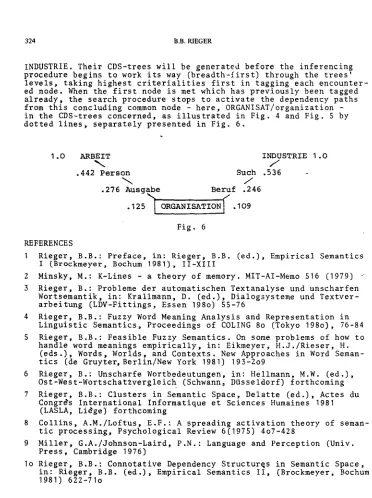
U s i n g t h e s e s o u r c e - o r i e n t e d s e a r c h a n d r e t r i e v a l p r o c e s s e s , an a n a - ,
[image:5.612.114.445.223.617.2]INDUSTRIE. Their CDS-trees will be generated before the inferencing procedure begins to work its way (breadth-first) through the trees' levels, taking highest criterialities first in tagging each encounter- ed node. When the first node is met which has previously been tagged already, the search procedure stops to activate the dependency paths from this concluding common node - here, ORGANISAT/organization - in the CDS-trees concerned, as illustrated in Fig. 4 and Fig. 5 by dotted lines, separately presented in Fig. 6.
1 . 0
REFERENCES
1
8
9
l o
ARBEIT INDUSTRIE 1.O
.442 Person Such .536
.276 Ausgabe Beruf .246
/ .125 [ ORGANISATIONJ .109
F i g . 6
Rieger, B.B.: Preface, in: Rieger, B.B. (ed.), Empirical Semantics I (Brockmeyer, Bochum 1981), II-XIII
Minsky, M.: K-Lines - a theory of memory. MIT-AI-Memo 516 (1979) Rieger, B.: Probleme der automatischen Textanalyse und unscharfen Wortsemantik, in: Krallmann, D. (ed.), Dialogsysteme und Textver- arbeitung (LDV-Fittings, Essen 198o] 55-76
Rieger, B.B.: Fuzzy Word Meaning Analysis and Representation in Linguistic Semantics, Proceedings of COLING 8o (Tokyo 198o), 76-84 Rieger, B.B.: Feasible Fuzzy Semantics. On some problems of how to handle word meanings empirically, in: Eikmeyer, H.J./Rieser, H.
(eds.), Words, Worlds, and Contexts. New Approaches in Word Seman- tics (de Gruyter, Berlin/New York 1981) 193-2o9
Rieger, B.: Unscharfe Wortbedeutungen, in: Hellmann, M.W. (ed.),
Ost-West-WortschatZvergleich
(Schwann~ DUsseldorf) forthcomingRieger, B.B.: Clusters in Semantic Space, Delatte (ed.), Actes du Congr#s International Informatique et Sciences Humaines 1981
(LASLA, Li#ge) forthcoming
Collins, A.M./Loftus, E.F.: A spreading activation theory of seman- tic processing, Psychological Review 6(1975) 4o7-428
Miller, G.A./Johnson-Laird, P.N.: Language and Perception (Univ. Press, Cambridge 1976)
[image:6.612.125.497.105.603.2]![Fig. ] e Fig. 2](https://thumb-us.123doks.com/thumbv2/123dok_us/795461.1093287/4.612.151.498.248.587/fig-e-fig.webp)
![Fig. 4 i .290 STADT .169 UNTERNEEM ] QO~3 SUCH J](https://thumb-us.123doks.com/thumbv2/123dok_us/795461.1093287/5.612.114.445.223.617/fig-i-stadt-unterneem-qo-such-j.webp)