Proceedings of the 27th International Conference on Computational Linguistics, pages 984–996 984
Style Obfuscation by Invariance
Chris Emmery∗ Tilburg University University of Antwerp
Enrique Manjavacas∗ University of Antwerp
enrique.manjavacas @uantwerpen.be
Grzegorz Chrupała Tilburg University
Abstract
The task of obfuscating writing style using sequence models has previously been investigated under the framework of obfuscation-by-transfer, where the input text is explicitly rewritten in another style. A side effect of this framework are the frequent major alterations to the semantic content of the input. In this work, we propose obfuscation-by-invariance, and investigate to what extent models trained to be explicitly style-invariant preserve semantics. We evaluate our archi-tectures in parallel and non-parallel settings, and compare automatic and human evaluations on the obfuscated sentences. Our experiments show that the performance of a style classifier can be reduced to chance level, while the output is evaluated to be of equal quality to models applying style-transfer. Additionally, human evaluation indicates a trade-off between the level of obfusca-tion and the observed quality of the output in terms of meaning preservaobfusca-tion and grammaticality.
1 Introduction
The fact that writing style uniquely characterizes a person, and can be leveraged for automatic author identification (Holmes, 1998; Stamatatos et al., 2000), has been well-studied in the field of (compu-tational) stylometry (Neal et al., 2017). Similarly, work on author profiling (Koppel et al., 2002) has demonstrated that such stylometric features can be used to accurately infer an extensive set of personal information, such as age, gender, education, socio-economic status, and mental health issues (Eisenstein et al., 2011; Alowibdi et al., 2013; Volkova et al., 2014; Plank and Hovy, 2015; Volkova and Bachrach, 2016). Traditionally, these techniques relied on expensive human-labelled examples; however, more recent work has demonstrated near equal accuracy when only relying on self-reports as a distant super-vision signal (Beller et al., 2014; Emmery et al., 2017; Yates et al., 2017). While these efforts have been greatly beneficial to various research fields such as computational sociolinguistics (Daelemans, 2013), they potentially expose users of such media to attacks where this information can be abused unbeknownst to them. This is particularly harmful to individuals in a vulnerable position regarding race, political af-filiation, mental health, or any other personal information made explicitly unavailable.
Adversarial stylometry, or style obfuscation, is one of the proposed methods aimed at protecting users against such attacks. Its objective is to rewrite an input text such that a classifier (the adversary) trained on detecting a particular variable (such as a demographic attribute) is fooled — effectively protecting this variable. The main challenge is to preserve the original meaning of the input, whilst hiding the act of obfuscation (Potthast et al., 2016). Recent work on automatic obfuscation (Shetty et al., 2017; Karadzhov et al., 2017) shows promising results in minimizing performance of the adversary; however, these models (also noted by the authors) struggle with correctly maintaining the semantic content of the
input. To illustrate, while rewritingschooltowedding1effectively fools an age classifier into thinking
the text is written by an adult rather than a teen, the original meaning is not preserved in the output. ∗Equal contribution.
This work is licensed under a Creative Commons Attribution 4.0 International License. License details: http: //creativecommons.org/licenses/by/4.0/.
We propose that this observed shift in meaning is to some extent a by-product of the formulation of the obfuscation task. Content words that are strongly related to a particular attribute often play a significant role in the accuracy of a potential adversary. There is ample evidence for this phenomenon in age and gender classification work (Koppel et al., 2002; Rao et al., 2010; Burger et al., 2011; Sap et al., 2014, inter alia). Taking examples from Sap et al. (2014) specifically, features with strong coefficient
weights for gender include e.g.boxers, shaved, girlfriend, beard, fightinfor males, andpurse, blueberry,
pedicure, hubby, earringsfor females. It is therefore not a surprising result that models explicitly tasked
tominimizethe performance of such classifiers perform what we will refer to as obfuscation-by-transfer.
To illustrate, the adversary is easily fooled when a sentence looks strongly female even though it was written by a male. As such, the easiest route to obfuscation from this perspective is a form of
style-transfer: swapping a few strongly target-associated content words for their contrastive variant (wife to
husband,schooltowedding). When such variants are also close in semantic spaces that sequence models
make use of, any reconstruction metrics—such as BLEU (Papineni et al., 2002), METEOR (Banerjee
and Lavie, 2005), embedding distances, etc.—might become an inaccurate indication of the change in meaning.
Our contributions In this work we propose a different approach to automatic obfuscation that we hypothesize partly overcomes the limitations to preserving meaning of the input:
obfuscation-by-invariance. Here, the objective shifts towards maximizing adversary’suncertainty, implying its accuracy
on the protected variable should be as close to chance level as possible. Fixing the adversary’s perfor-mance around chance involves making the input text devoid of stylistic features that strongly correlate with any of the protected variables, thus producing language that is neutral with respect to these style
differences. We test our hypothesis in several experimental conditions.2 The main component in our
encoder-decoder architecture to achieve a style-invariant encoding of the input is a Gradient Reversal Layer (GRL) (Ganin and Lempitsky, 2015) inserted between the input sentence embedding and the style classifier. We investigate the effect of this module in isolation, as well as in a style-invariant soft trans-fer setting by using a conditioned decoder. First, to gauge if this architecture can successfully decode from the style-invariant encoding—and what the effect on adversary performance would be—we train sequence-to-sequence models on a parallel corpus of English Bible styles. Secondly, given that in a re-alistic obfuscation setting there is no access to such parallel sources, we drop the target pairs to create an autoencoder setting. In our experiments, we demonstrate a trade-off around chance-level performance: obfuscation-by-transfer in a parallel setting works well using a many-to-many translation model, but scores worse in the human evaluation than our style-invariant model. As such, we pose that there is potential in an style-invariant approach to obfuscation, and it deservers further investigation.
2 Related Work
2.1 Adversarial Stylometry
The idea that computational stylometry might be used to compromise anonymity was first explored by Rao et al. (2000). They saw potential in concealing style information using machine translation (MT), but noted that it was not powerful enough at the time. Kacmarcik and Gamon (2006) continued the proposed line of work by informing users regarding characteristic features and deeper linguistic cues in their writing style. Recent related studies can be found in (Caliskan-Islam et al., 2015; Le et al., 2015). Brennan et al. (2012) explicitly frame obfuscation as an adversarial task and use MT (round-trip translation), similar to (Caliskan and Greenstadt, 2012). Rule-based perturbations (Juola and Vescovi, 2011) and mixtures of both (Karadzhov et al., 2017) have also been applied for fully automatic obfuscation. Closest to our approach is recent work by Shetty et al. (2017), who pursue the task of learning obfuscation-by-transfer using a Generative Adversarial Network architecture. In their setup, a generator is trained to produce sentences that maximize the probability assigned by a discriminator that is, in turn, trained to distinguish real from generated sentences. While they incorporate different semantic losses, and demonstrate successful obfuscation on age and gender annotated micro-blog data and political
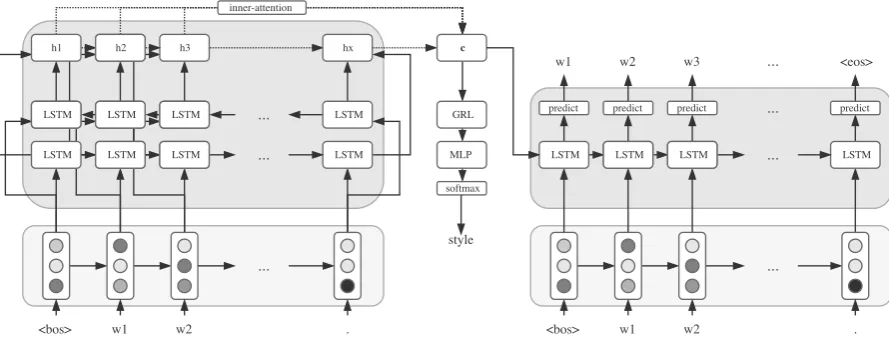
Figure 1: Model architecture with the Gradient Reversal Layer (GRL) module: Left the encoder part,
middle the GRL taking the input sentence embedding (also called context vector)cas input, and right
the decoder part of the architecture. Note that via the GRL working on the context vector, the encoder part of the model tries to minimize the style classification performance of the MLP, whilst still having to produce a useful representation for the decoder.
speeches, their output suffers from the lack of semantic preservation we described before. Finally, a style-transfer approach with potential application to obfuscation is work by Carlson et al. (2017), who investigate textual shot style-transfer using a sequence-to-sequence MT model inspired by zero-shot translation (Johnson et al., 2016). Their work demonstrates successful translation between many different versions of the English Bible.
2.2 Gradient Reversal
The use of a Gradient Reversal Layer (GRL) for learning domain invariant feature representations was proposed by Ganin and Lempitsky (2015), who demonstrated its viability for learning lightning-condition invariance in computer vision. Since then, it has been applied to several language tasks: e.g. textual feature extraction (Pryzant et al., 2017), POS tagging (Kim et al., 2017; Gui et al., 2017), image captioning (Chen et al., 2017), and document classification (Liu et al., 2017; Xu and Yang, 2017). Most importantly, Xie et al. (2017) demonstrate the GRL module can be used to implement an adversarial setting, and to improve performance for a number of language tasks, including generation. These results bode well for its application to obfuscation-by-invariance.
3 Models
Our base architecture is a neural encoder-decoder (Sutskever et al., 2014) model similar to that of Wu et al. (2016), implemented in PyTorch (Paszke et al., 2017). Given an input sequence of one-hot encoded words, the encoder first embeds the words into dense vectors which are then processed by one or more bidirectional (Schuster and Paliwal, 1997) layers with LSTM cells (Hochreiter and Schmidhuber, 1997). The resulting sequence of processed vectors is then merged into a single dense representation using an inner-attention mechanism that will be described below. After encoding, a neural language-model is trained to decode the output sequence conditioned on the sentence embedding (a so called context vector) resulting from the encoder. Training is accomplished by minimizing the locally-normalized per-word cross-entropy of the target sequence.
3.1 Architecture Components
In addition to the architecture described above, we introduce a few extra components:
Gradient Reversal Layer (GRL) The GRL (Sutskever et al., 2014) is applied on top of the context vector. During the forward pass the GRL computes the identity function and feeds its input to a shallow Multi-Layer Perceptron (MLP) style classifier. However, during back-propagation the gradient of the style classifier is flipped in sign. The idea is that the encoder parameters are optimized to generate sentence embeddings that do not contain any stylistic information so that the style of the input cannot be recovered.
Conditional Decoder (C) Previous research on neural language modelling has demonstrated the
effec-tiveness of conditioning a language model on sentential and contextual variables (such as tense, modality or voice). In our experiments, we evaluate a conditional autoencoder in which the decoder is conditioned on the input style label. We implement conditioning following the approach by Ficler et al. (2017), which simply concatenates the corresponding attribute embedding vector (in our case, the corresponding style embedding) to each of the word embeddings input to the decoder. Each style is therefore associated
with an embedding vector c, which is fed into the architecture at each step. In contrast to the simple
autoencoder, the conditional autoencoder allows to choose a desired style at test time. We suspect that by encouraging the decoder to target a certain style, the output would be have more linguistic consistency without fully recovering the targeted style.
Token Transfer (TT) It can be argued that an MT system relying on a parallel corpus of styles (be it attributes or authors) would perform obfuscation-by-transfer. Moreover, it would likely preserve the original meaning as translation is largely a meaning-preserving operation (Ide et al., 2002; Dyvik, 2004). However, such parallel corpora are generally not available and have very high associated compilation costs, as it would require large amounts of identical information (ideally on sentence-level) to be written by e.g. teens and adults. Textual style transfer by MT is therefore not a plausible use-case for obfus-cation. However, it does provide a good indication of the performance of an obfuscation model under the framework of obfuscation-by-transfer. For this, we apply a sequence-to-sequence translation model trained on style as discussed by (Carlson et al., 2017). Following the work of (Johnson et al., 2016), we use a target style token, allowing for a model trained on many-to-many translation that can be used to rewrite an input sentence in a different style simply by prepending a target token. This is the only configuration that uses an attention mechanism as it is not tested in combination with the GRL.
3.2 Architecture Details
All our models use 300-dimensional embeddings. Both the encoder and the decoder are implemented with a single layer of 1000 LSTM cells. The sequence of hidden states from the encoder are merged into
a single representation using a feature-wise inner-attention mechanism. Letwtandhtdenote respectively
the input word embedding and hidden state of the LSTM for steptfor a total ofntotal steps. Theith
feature of the sentence embeddingcis computed by a weighted sum over theith feature of the hidden
states:
ci= n
X
t=1
at
ihti (1)
where each weightat
i is computed by:
ati = exp([W
Tzt] i)
Pn
s=1exp([WTzs]i)
(2)
In Equation 2,ztis the concatenation ofwtandht,W ∈R(D+H)×H is an additional projection matrix
to be learned, andDandH denote the dimensionalities of the word embedding matrix and the LSTM
1 1 1 1 1 0.37 0.66 0.68 0.61 0.32 0.37 0.34 0.58 0.59 0.52
0.37 0.66 0.68 0.61
0.32 0.37 0.34
0.58 0.59
0.52
ASV BBE DBY WEB YLT
A S V B B E D B Y W E B Y LT 0 0.2 0.4 0.6
0.8
1
[image:5.595.73.287.78.233.2]1
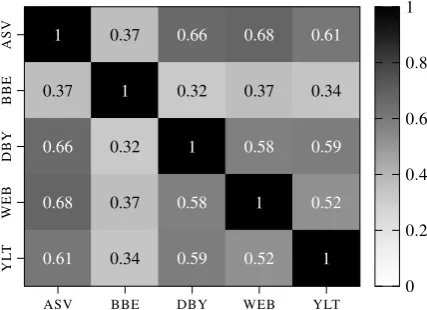
Figure 2: Jaccard index between vocabularies of the different Bible styles.
style types tokens unique punct
ASV 12,5K 3,7M 602 0.13
BBE 6,0K 3,9M 569 0.11
DBY 13,8K 3,7M 1729 0.14
WEB 12,8K 3,6M 1663 0.14
YLT 12,2K 3,9M 1682 0.17
Table 1: (Normalized) corpus descriptives, showing type and token frequencies, amount of unique types, and the punctuation ratio for each Bible style respectively.
the task. This is similar to conventional attention over hidden activation vectors with the main difference being that weighting is done feature-wise and all information flow from the encoder to the decoder is passed through the bottleneck of the single output encoding vector. Note that a traditional alignment-style attention mechanism is not compatible with the application of the GRL, since the latter must have scope over all information being passed from the encoder to the decoder.
The decoder is conditioned on the context vector by concatenating the latter to the input of the decoder at each step. This facilitates learning by increasing the gradient signal to the encoder. All model param-eters are optimized with Adam (Kingma and Ba, 2014) in mini-batches of 50 examples and a learning rate of 0.001 which is decreased by 0.75 after each epoch. To avoid overfitting, dropout (Srivastava et al., 2014) is applied to the input of each LSTM layer with a dropping probability of 0.25 and we stop training when loss stops decreasing for 3 epochs. During test time, we approximate the global best output sequence applying beam search with a beam of size 5. GRL is implemented with a single-layer MLP with same dimensionality as the encoder.
4 Experimental Set-up
Our main goal is investigating the effectiveness of obfuscation-by-invariance, and more specifically to what extent style-invariant representations preserve sentential semantics of the input. To this end, we perform three experiments for different corpora and obfuscation settings, using the components described above. In each of these settings, there is an adversary trained to detect the variable to be obfuscated. We describe our experiments and evaluations below.
4.1 Data
We use a parallel corpus of five different versions of the English Bible (retrieved from GitHub3, originally
collected fromopenbible.info4). These versions are semantically consistent, but vary stylistically
across different aspects; BBE is written in simplified English, YLT follows the syntactic structures of the original Greek and Hebrew, and other versions (DBY, ASV) correspond to older editions reflecting diachronic variations. The sentence-level verse coding (book + chapter + verse ID) is used for almost perfect pairing between the different versions (some missing pairs were removed), forming style
quintu-plets, which were tokenized usingspaCy5(Honnibal and Montani, 2017). The style tuples are divided
amongst train (80%), dev (10%), and test (10%) sets—ensuring all sentences in the development and test splits are unseen, regardless of the style combination that they occur in—and all style combinations
[image:5.595.324.522.102.193.2](excluding a same-style combination) are used to form 620,752 pairs. Further corpus descriptives for the different styles can be found in Figure 2 and Table 1.
4.2 Adversary
The adversary is a sentence-level classifier in the form of fastText6 (Joulin et al., 2017); a simple
linear model with one hidden embedding layer that learns sentence representations using bag of words
orn-gram input, producing a probability distribution over the given styles using the softmax function.
The classifier is trained on the source side of the training split, as these are the instances we intend to obfuscate. It is run for 20 epochs using 100 dimensional embeddings, uni and bi-grams, a learning rate of 0.01, and a bucket size of 1M. It achieves an accuracy of 86.6%, and chance level performance for the adversary is 20% given 5 classes with an even distribution.
4.3 Evaluation
To automatically evaluate the reconstruction and semantic preservation of our generated sentences, we use MT metrics, as well as distance in semantic embedding space. Obfuscation is measured by the difference of the adversary’s accuracy compared to chance level.
MT Metrics (BLEU, METEOR) We calculate BLEU-4 andMETEOR (Papineni et al., 2002; Banerjee
and Lavie, 2005) usingnlg-eval7. Given that this is not a standard MT task, we provide these scores
between the generated sentence and the source sentence (←), as well as the generated sentence and the
target sentence (→). For the sequence-to-sequence models,→ is the primary indicator of successful
obfuscation-by-transfer. However,←gives some indication how much the output is still related to the
original. Introducing the GRL to this models should decrease scores for both ←and →. For the
au-toencoder, evaluation can only be conducted on←, for which scores should generally strongly decrease
when adding the GRL.
Word Mover’s Distance (WMD) To assess the word embedding distance of the obfuscated sentence to the original, we take the Word Mover’s Distance (WMD) (Kusner et al., 2015), based on the English fastTextembeddings for Wikipedia (Bojanowski et al., 2016). WMD takes the distance between two sentences in a weighted point cloud of embedded words as the minimum cumulative distance that this
cloud for sentence A needs to travel to align with that of sentence B, and is shown to capture some
semantic relations.
Adversary Impact (∆acc) We compare the accuracy of the adversary on the generated sentence to
that of the original to assess obfuscation strength. However, as our goal is to keep the adversary’s
performance level close to chance, we define∆accuracy=accuracy−pwherepis majority baseline.
Therefore, if∆accuracy is negative, this means the adversary’s performance has dropped below chance,
and the task is closer to obfuscation-by-transfer rather than by-invariance. Subsequently, a positive score indicates the extent to which obfuscation fails to match both cases.
Gaussian Noise (σ) To enforce a significant change in the decoded output, one can simply add a Gaussian noise mask to the context vector during generation time. We generate this mask as a random
vector from a Gaussian DistributionN(0, σ), where σ = {0.01,0.05,0.10,0.15,0.20}and add this to
the values of the context vector. This noise can be utilized to increase obfuscation (due to more random decoding behaviour) at the cost of quality of the output.
4.4 Experiments
Using all components discussed above, we define three experimental settings to measure the effect of applying a GRL and conditional decoder to achieve obfuscation-by-invariance. (1) We train our archi-tecture on the style pairs from the English Bible corpus in a many-to-many sequence-to-sequence setting. By introducing a GRL here, words that are highly indicative of the target style are not captured by the
model C GRL TT PPL BLEU← MTR← BLEU→ MTR→ WMD ∆ACC
S2S 9.08 22.0 25.3 17.8 23.6 1.50 1.6
S2S x 9.27 21.8 25.2 16.9 22.9 1.50 6.9
S2S x 7.38 34.9 30.5 39.2 29.9 1.24 -12.0
AE 1.51 79.5 52.9 - - 0.25 64.4
AE x 1.99 60.0 41.2 - - 0.65 50.8
AE x x 1.87 51.9 38.1 - - 0.79 18.3
source 100.0 100.0 36.0 34.5 0.00 66.6
Table 2: Results for the Bible experiments. The first column (model) indicates the setting of our base
architecture: either sequence-to-sequence (S2S), or autoencoder (AE). The second column specifies
which modules were incorporated: Cfor the conditioned decoder,GRLfor the Gradient Reversal Layer,
andttfor the prepended style token. The results show perplexity on the dev set (PPL), BLEU-4 and
METEOR between source (←) / target (→) and the obfuscated sentence, the Word Mover’s Distance
score between source and the obfuscated sentence (WMD) and the extent to which the obfuscated sentence
pushes the adversary to chance level performance (∆ACC). In the last row, we note a ‘source’ baseline,
that is achieved by simply copying the source. This shows how overall how much source and target overlap, and the actual above-chance performance of the adversary.
encoder. To achieve an effective many-to-many MT system (and thus style-transfer) setting we prepend the<2{stylename}>token. (2) We train an autoencoder on disconnected pairs. Here we introduce both the GRL, plus the conditioned decoder. We hypothesize that the conditioned decoder allows for soft style-transfer from a neutral encoding, implying it would preserve semantic structure better than the MT
model. (3) We use Gaussian noise to make the sequence-to-sequence and autoencoder models equivalent
in obfuscation performance to allow for direct comparison.
5 Results
5.1 Experimental Results
All results and automatic evaluations are shown in Table 2. As we hypothesized, using style-transfer for obfuscation works well overall, performing either at, or below chance level. Looking at the target
BLEUandMETEOR, the sequence-to-sequence model without the target token generates sentences that
are closer to source than they are to the target; and achieves low scores overall, with the sentences being
quite far off based on WMD. However, note that this is many-to-many translation without any signal
regarding the target, given languages with largely the same vocabulary. As such,TTis a more realistic
reflection of style-transfer success. In terms of translation quality it barely improves over the original baseline, but it does successfully perform obfuscation-by-transfer, as indicated by the 12% accuracy below chance. Assessing the performance of the GRL in this setting, it does not seem improve translation, nor obfuscation — which was largely in line with our expectations.
The autoencoder setting provides a clearer look into the performance of the GRL, in particular in terms of obfuscation-by-invariance. The plain autoencoder to some extent successfully reproduces the target;
looking atBLEU, the adversary performance, andWMD, it is still closely related to the input. Introducing
the GRL does impact the relation to the source sentence, but gains little in comparison on obfuscation performance. However, when the conditioned decoder is added to the architecture, obfuscation
perfor-mance is visibly impacted more than the decrease in BLEUand METEOR. Lastly, the effect of adding
a Gaussian noise mask on the decoder can be found in Table 3. Around0.15, the metrics seem to be
largely comparable in terms ofBLEU, METEORand∆accuracy. We further investigate the three most
AE AE+ GRL AE+C+GRL σ BLEU← MTR← ∆ACC BLEU← MTR← ∆ACC BLEU← MTR← ∆ACC
- 79.5 52.9 64.4 60.0 41.2 50.8 51.9 38.1 18.3
0.01 78.7 52.2 64.1 59.7 41.4 50.5 52.0 38.5 18.5
0.05 52.9 38.9 57.2 54.8 39.1 47.6 49.1 37.2 16.5
0.10 14.7 21.6 36.1 32.8 32.7 36.9 40.7 33.6 11.6
0.15 4.2 14.7 23.3 25.3 26.2 24.3 30.0 29.1 4.6
[image:8.595.73.528.64.182.2]0.20 1.5 11.3 16.4 15.3 21.5 15.5 21.1 24.9 0.0
Table 3: Effect of adding Gaussian Noise (σ) to the autoencoder.
SEMANTICS GRAMMATICALITY CHANGES
1 Semantics are broken; sentence
does not mean the same. Part(s) of, or the complete sen-tence is garbled. Change in special characters orflipping a single word. 2 Slight semantic change, but not
intrusive. Slight word order change that isungrammatical. Multiple words were changed,but they align with the original. 3 Semantics are intact, changes do
[image:8.595.77.528.219.320.2]not alter the meaning. Grammaticality has not been af-fected. New parts have been introduced/ rewritten in the sentence.
Table 4: Explanations per rating for the three dimensions in the human evaluation study.
SEMANTICS GRAMMATICALITY CHANGES
S2S +TT 1.88 2.21 2.43
AE+ GRL+C 2.12 2.32 1.99
AE+ GRL+C+σ= 0.15 1.35 1.66 2.65
Table 5: Average scores per model for the three dimensions in the human evaluation.
5.2 Human Evaluation
For the human evaluation, 20 pairs (original, obfuscated) were sampled from the output of the three models of interest (making 60 pairs in total). Each pair was rated by four participants (all with a linguis-tics background), on three dimensions using a three point scale. These dimensions included semantic consistency between the original and the obfuscated sentence, the syntactical coherence of the latter, and the amount of changes in the output. The participants were made aware of which sentence of the pairs was the original, and were explicitly asked to rate the dimensions with the original as reference. The participants were not aware that there were multiple models, and the pairs were shuffled so that compar-ing between pairs with the same original was impossible. To simplify the comparison to the original, we only sampled from BBE (Basic English Bible). See Table 5 for a sample of the instructions given to the participants, and Table 4 for the results.
According to the evaluation results, AE+ GRL+ Chas the overall preference of the raters in all three
dimensions. Specifically, given that we are interested in semantic preservation, this model is evaluated better than a style-transfer model that has some access to semantic relations between source and target
on the SEMANTICSdimension. Note that based on theCHANGESdimension, the AE + GRL+ Cis the
most conservative, which is in line with theBLEUandMETEORscores in Table 2, and likely propagates
into theGRAMMATICALITYdimension.
5.3 Qualitative Analysis
[image:8.595.87.518.356.421.2]ORIGINAL For the strong town is without men, an unpeopled living - place; and she has become
a waste land: there the young ox will take his rest, and its branches will be food for him.
S2S +TT For the strong city is powerless, an astonishment living and she is become a corrupt
land: a young ox shall rest, and its branches shall be for him.’
AE + GRL + C
For the city is without living men, there is without a waste land; and she makes an dry land: an ox shall take his work, and their branches shall be food for him.
AE + GRL +
C+σ= 0.15
A man dwelleth without an dry land; and, wandering she - place; men shall there become a waste a land: an ox - goat shall take his horses, and his branches shall be prepare for him .
Table 6: Example 1 — Isaiah 27:10
ORIGINAL Then they made the beryl stones, fixed in twisted frames of gold and cut like the
cutting of a stamp, with the names of the children of Israel.’
S2S +TT Then they made the onyx stones as a hundred stones, burning in engraved stones of
gold, and cut as the marks of a seal, with the names of the children of Israel.
AE + GRL + C
Then they wrote the stones, whereupon they bound in the skillfully woven red frames of gold and made like the cutting of a stamp, with the names of the children of Israel.’
AE + GRL +
C+σ= 0.15
Then they presented the pillars that belonged in Henadad. The bottom of fine gold and made like the jewels of a stamp of them, at the dial of the children of Israel.’
Table 7: Example 2 — Exodus 39:6
One of the issues we identified with obfuscation-by-transfer was that of small, localized changes in the input, specifically focussing on words that are most relevant to the adversary. When looking at longer
sentences such as Table 6, some (semi-)correct variants can be found in e.g. town→ city, waste land
→dry land, and in Table 7, beryl→onyx, stamp→seal, but incorrect ones also remain: rest→work.
Overall, the longer the sequence, the more variation can be observed.
A more interesting observation is that some parts of sentences are added to by the models, e.g. there
is without a waste land ; and she makes an dry land — while incorrectly inserting ‘without’, the rest
can be considered is a correct expansion. The same holds for Table 7, wherefixed in twisted frames of
goldis expanded towhereupon they bound in the skillfully woven red frames of gold, partly erroneously,
similar toliving menin Table 6. Contrastively, the autoencoder + GRL in particular also seems to favour
somewhat compressed phrases, removing adjectives such asyoung inyoung ox, strong instrong city,
berylinberyl stonesand not incorporatingan unpeopled livingaltogether.
When directly comparing the sequence-to-sequence and autoencoder + GRL examples, it can be in-ferred that the transfer approach seems (at least in these examples) quite conservative, sticking to an almost exact alignment, and only making small changes. This however also causes the autoencoder to replace words with unrelated variants or insert not directly related ones; the same behaviour can also be observed in the sequence-to-sequence model, however.
The output of the autoencoder shows some evidence that minorrewritesof the sentence are employed,
which could potentially be an interesting path to further pursue. Including different variables in the conditioned decoder such as sentence length, also demonstrated by Fickler et al. (2017), would make experiments in this direction feasible. Rewrites are not restricted to the autoencoder only, as is
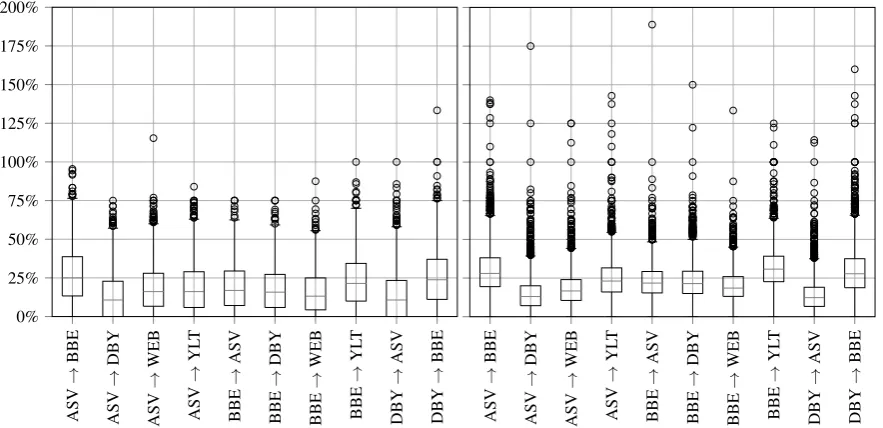
demon-strated in Figure 3. We previously noted in Section 5.2 that theAE +GRL+ Carchitecture seems more
conservative in changing the input, which can also clearly be induced from the generally equal or higher
ex-ASV → BBE ASV → DBY ASV → WEB ASV → YL T BBE → ASV BBE → DBY BBE → WEB BBE → YL T DBY → ASV DBY → BBE 0% 25% 50% 75% 100% 125% 150% 175% 200% 1 ASV → BBE ASV → DBY ASV → WEB ASV → YL T BBE → ASV BBE → DBY BBE → WEB BBE → YL T DBY → ASV DBY → BBE 1
Figure 3: Distributions of the percentage of newly introduced tokens with respect to the original amount
of tokens — shown for both theAE+GRL+Cobfuscation-by-invariance architecture (left), and theS2S
+ TTobfuscation-by-transfer model (right). Three out of five source styles are shown.
ceeding the original amount of tokens). This plot also reveals a tendency to add more tokens for BBE and YLT, which is in line with their larger amount of tokens shown in Table 1. The extreme outliers are
largely attributable to artefacts of recurrence (and Benaiah , the son of Zadok , and Eber , and Eliphelet).
Finally, it must be noted that evidence of style-neutral rewrites is difficult to find in generated output concerning the Bible; not only due to possible archaic constructions (which we attempted to minimize by using BBE), but more so due to the fact that it requires a level of expertise to recognize style shifts. However, most importantly, applying the autoencoder to data that is non-parallel has some viable ground given the current results, and can therefore be extended to other domains in future work.
6 Conclusion
We presented an alternative framing of the task of automatic style obfuscation—obfuscation-by-invariance—and tested several components in a neural encoder-decoder architecture that were hypoth-esized to achieve style-invariant rewrites of the input text. We tested the effect of a Gradient Reversal Layer and a conditioned decoder for obfuscation in parallel and non-parallel settings. Although strong evidence for style-neutral text was difficult to find for the Bible corpus, we demonstrated through human evaluation that our autoencoder architecture trained on non-parallel data obtained a better evaluation than a model trained on parallel data with partial access to semantic relations between source and target. In our qualitative analysis we found evidence for semantically correct local changes of the input, as well as partial rewrites that fit the context of the verses. These results bode well for extending this architecture to other non-parallel corpora to test obfuscation in a practical use-case, e.g. author attributes such as age and gender.
References
Jalal S Alowibdi, Ugo A Buy, and Philip Yu. 2013. Empirical evaluation of profile characteristics for gender classification on twitter. InMachine Learning and Applications (ICMLA), 2013 12th International Conference on, volume 1, pages 365–369. IEEE.
Charley Beller, Rebecca Knowles, Craig Harman, Shane Bergsma, Margaret Mitchell, and Benjamin Van Durme. 2014. Ima belieber: Social roles via self-identification and conceptual attributes. InProceedings of the 52nd Annual Meeting of the Association for Computational Linguistics (Volume 2: Short Papers), volume 2, pages
181–186.
Piotr Bojanowski, Edouard Grave, Armand Joulin, and Tomas Mikolov. 2016. Enriching word vectors with subword information. arXiv preprint arXiv:1607.04606.
Michael Brennan, Sadia Afroz, and Rachel Greenstadt. 2012. Adversarial stylometry: Circumventing author-ship recognition to preserve privacy and anonymity. ACM Transactions on Information and System Security (TISSEC), 15(3):12.
John D Burger, John Henderson, George Kim, and Guido Zarrella. 2011. Discriminating gender on twitter. In Proceedings of the conference on empirical methods in natural language processing, pages 1301–1309.
Association for Computational Linguistics.
Aylin Caliskan and Rachel Greenstadt. 2012. Translate once, translate twice, translate thrice and attribute: Identi-fying authors and machine translation tools in translated text. InSemantic Computing (ICSC), 2012 IEEE Sixth International Conference on, pages 121–125. IEEE.
Aylin Caliskan-Islam, Fabian Yamaguchi, Edwin Dauber, Richard Harang, Konrad Rieck, Rachel Greenstadt, and Arvind Narayanan. 2015. When coding style survives compilation: De-anonymizing programmers from executable binaries. arXiv preprint arXiv:1512.08546.
Keith Carlson, Allen Riddell, and Daniel Rockmore. 2017. Zero-shot style transfer in text using recurrent neural networks. arXiv preprint arXiv:1711.04731.
Tseng-Hung Chen, Yuan-Hong Liao, Ching-Yao Chuang, Wan-Ting Hsu, Jianlong Fu, and Min Sun. 2017. Show, adapt and tell: Adversarial training of cross-domain image captioner. InThe IEEE International Conference on Computer Vision (ICCV), volume 2.
Walter Daelemans. 2013. Explanation in computational stylometry. InInternational Conference on Intelligent Text Processing and Computational Linguistics, pages 451–462. Springer.
Helge Dyvik. 2004. Translations as semantic mirrors: from parallel corpus to wordnet.Language and computers,
49:311–326.
Jacob Eisenstein, Noah A Smith, and Eric P Xing. 2011. Discovering sociolinguistic associations with structured sparsity. InProceedings of the 49th Annual Meeting of the Association for Computational Linguistics: Human Language Technologies-Volume 1, pages 1365–1374. Association for Computational Linguistics.
Chris Emmery, Grzegorz Chrupała, and Walter Daelemans. 2017. Simple queries as distant labels for predicting gender on twitter. InProceedings of the 3rd Workshop on Noisy User-generated Text, pages 50–55.
Jessica Ficler and Yoav Goldberg. 2017. Controlling linguistic style aspects in neural language generation. arXiv preprint arXiv:1707.02633.
Yaroslav Ganin and Victor Lempitsky. 2015. Unsupervised domain adaptation by backpropagation. In Interna-tional Conference on Machine Learning, pages 1180–1189.
Tao Gui, Qi Zhang, Haoran Huang, Minlong Peng, and Xuanjing Huang. 2017. Part-of-speech tagging for twitter with adversarial neural networks. InProceedings of the 2017 Conference on Empirical Methods in Natural Language Processing, pages 2411–2420.
Sepp Hochreiter and J¨urgen Schmidhuber. 1997. Long short-term memory. Neural computation, 9(8):1735–1780.
David I Holmes. 1998. The evolution of stylometry in humanities scholarship.Literary and linguistic computing,
13(3):111–117.
Matthew Honnibal and Ines Montani. 2017. spacy 2: Natural language understanding with bloom embeddings, convolutional neural networks and incremental parsing. To appear.
Nancy Ide, Tomaz Erjavec, and Dan Tufis. 2002. Sense discrimination with parallel corpora. InProceedings of the ACL-02 workshop on Word sense disambiguation: recent successes and future directions-Volume 8, pages
Melvin Johnson, Mike Schuster, Quoc V Le, Maxim Krikun, Yonghui Wu, Zhifeng Chen, Nikhil Thorat, Fer-nanda Vi´egas, Martin Wattenberg, Greg Corrado, et al. 2016. Google’s multilingual neural machine translation system: enabling zero-shot translation.arXiv preprint arXiv:1611.04558.
Armand Joulin, Edouard Grave, Piotr Bojanowski, and Tomas Mikolov. 2017. Bag of tricks for efficient text clas-sification. InProceedings of the 15th Conference of the European Chapter of the Association for Computational Linguistics: Volume 2, Short Papers, pages 427–431. Association for Computational Linguistics, April.
Patrick Juola and Darren Vescovi. 2011. Analyzing stylometric approaches to author obfuscation. InIFIP Inter-national Conference on Digital Forensics, pages 115–125. Springer.
Gary Kacmarcik and Michael Gamon. 2006. Obfuscating document stylometry to preserve author anonymity. In
Proceedings of the COLING/ACL on Main conference poster sessions, pages 444–451. Association for
Compu-tational Linguistics.
Georgi Karadzhov, Tsvetomila Mihaylova, Yasen Kiprov, Georgi Georgiev, Ivan Koychev, and Preslav Nakov. 2017. The case for being average: A mediocrity approach to style masking and author obfuscation. In In-ternational Conference of the Cross-Language Evaluation Forum for European Languages, pages 173–185.
Springer.
Joo-Kyung Kim, Young-Bum Kim, Ruhi Sarikaya, and Eric Fosler-Lussier. 2017. Cross-lingual transfer learning for pos tagging without cross-lingual resources. InProceedings of the 2017 Conference on Empirical Methods in Natural Language Processing, pages 2832–2838.
Diederik Kingma and Jimmy Ba. 2014. Adam: A method for stochastic optimization. arXiv preprint arXiv:1412.6980.
Moshe Koppel, Shlomo Argamon, and Anat Rachel Shimoni. 2002. Automatically categorizing written texts by author gender. Literary and linguistic computing, 17(4):401–412.
Matt Kusner, Yu Sun, Nicholas Kolkin, and Kilian Weinberger. 2015. From word embeddings to document distances. InInternational Conference on Machine Learning, pages 957–966.
Stanislas Lauly, Hugo Larochelle, Mitesh M Khapra, Balaraman Ravindran, Vikas Raykar, Amrita Saha, et al. An autoencoder approach to learning bilingual word representations.
Hoi Le, Reihaneh Safavi-Naini, and Asadullah Galib. 2015. Secure obfuscation of authoring style. In IFIP International Conference on Information Security Theory and Practice, pages 88–103. Springer.
Jiwei Li, Minh-Thang Luong, and Dan Jurafsky. 2015. A hierarchical neural autoencoder for paragraphs and documents. arXiv preprint arXiv:1506.01057.
Pengfei Liu, Xipeng Qiu, and Xuanjing Huang. 2017. Adversarial multi-task learning for text classification.arXiv preprint arXiv:1704.05742.
Tempestt Neal, Kalaivani Sundararajan, Aneez Fatima, Yiming Yan, Yingfei Xiang, and Damon Woodard. 2017. Surveying stylometry techniques and applications. ACM Computing Surveys (CSUR), 50(6):86.
Kishore Papineni, Salim Roukos, Todd Ward, and Wei-Jing Zhu. 2002. Bleu: a method for automatic evaluation of machine translation. InProceedings of the 40th annual meeting on association for computational linguistics,
pages 311–318. Association for Computational Linguistics.
Adam Paszke, Sam Gross, Soumith Chintala, Gregory Chanan, Edward Yang, Zachary DeVito, Zeming Lin, Alban Desmaison, Luca Antiga, and Adam Lerer. 2017. Automatic differentiation in pytorch. InNIPS-W.
Barbara Plank and Dirk Hovy. 2015. Personality traits on twitterorhow to get 1,500 personality tests in a week. InProceedings of the 6th Workshop on Computational Approaches to Subjectivity, Sentiment and Social Media Analysis, pages 92–98.
Martin Potthast, Matthias Hagen, and Benno Stein. 2016. Author obfuscation: Attacking the state of the art in authorship verification. InCLEF (Working Notes), pages 716–749.
Reid Pryzant, Young-joo Chung, and Dan Jurafsky. 2017. Predicting sales from the language of product descrip-tions.
Delip Rao, David Yarowsky, Abhishek Shreevats, and Manaswi Gupta. 2010. Classifying latent user attributes in twitter. InProceedings of the 2nd international workshop on Search and mining user-generated contents, pages
37–44. ACM.
Maarten Sap, Gregory Park, Johannes Eichstaedt, Margaret Kern, David Stillwell, Michal Kosinski, Lyle Ungar, and Hansen Andrew Schwartz. 2014. Developing age and gender predictive lexica over social media. In
Proceedings of the 2014 Conference on Empirical Methods in Natural Language Processing (EMNLP), pages
1146–1151.
Mike Schuster and Kuldip K Paliwal. 1997. Bidirectional recurrent neural networks.IEEE Transactions on Signal Processing, 45(11):2673–2681.
Rakshith Shetty, Bernt Schiele, and Mario Fritz. 2017.A4N T: Author attribute anonymity by adversarial training
of neural machine translation. arXiv preprint arXiv:1711.01921.
Nitish Srivastava, Geoffrey Hinton, Alex Krizhevsky, Ilya Sutskever, and Ruslan Salakhutdinov. 2014. Dropout: A simple way to prevent neural networks from overfitting. The Journal of Machine Learning Research,
15(1):1929–1958.
Efstathios Stamatatos, Nikos Fakotakis, and George Kokkinakis. 2000. Automatic text categorization in terms of genre and author. Computational linguistics, 26(4):471–495.
Ilya Sutskever, Oriol Vinyals, and Quoc V Le. 2014. Sequence to sequence learning with neural networks. In
Advances in neural information processing systems, pages 3104–3112.
Svitlana Volkova and Yoram Bachrach. 2016. Inferring perceived demographics from user emotional tone and user-environment emotional contrast. InProceedings of the 54th Annual Meeting of the Association for Com-putational Linguistics, ACL.
Svitlana Volkova, Glen Coppersmith, and Benjamin Van Durme. 2014. Inferring user political preferences from streaming communications. InACL (1), pages 186–196.
Yonghui Wu, Mike Schuster, Zhifeng Chen, Quoc V Le, Mohammad Norouzi, Wolfgang Macherey, Maxim Krikun, Yuan Cao, Qin Gao, Klaus Macherey, et al. 2016. Google’s neural machine translation system: Bridg-ing the gap between human and machine translation.arXiv preprint arXiv:1609.08144.
Qizhe Xie, Zihang Dai, Yulun Du, Eduard Hovy, and Graham Neubig. 2017. Controllable invariance through adversarial feature learning. InAdvances in Neural Information Processing Systems, pages 585–596.
Ruochen Xu and Yiming Yang. 2017. Cross-lingual distillation for text classification. arXiv preprint arXiv:1705.02073.