OCR Post-Processing Text Correction using Simulated Annealing
(OPTeCA)
Gitansh Khirbat
Computing and Information Systems The University of Melbourne
Australia
Abstract
This paper describes the system details and results of team “EOF” from the Uni-versity of Melbourne for the shared task of ALTA 2017, which addresses the problem of text correction for post-processed Op-tical Character Recognition (OCR) based systems. We developed a two stage sys-tem which first detects errors in the given OCR post-processed text with the help of a support vector machine trained using given training dataset, followed by rectify-ing the errors by employrectify-ing a confidence-based mechanism using simulated anneal-ing to obtain an optimal correction from a pool of candidate corrections. Our system achieved a F1-score of 32.98% on the pri-vate leaderboard1, which is the best score
among all the participating systems.
1 Introduction
The dawn of digital age on mankind has laid the foundation of connectivity, fostering access and exchange of information practically anywhere in the world. Information can be present in any form, the most common being textual and graphical doc-uments. Capturing and curating documents such as magazines, newspapers, journals and scientific articles is the primary requirement for a digitized, inter-connected society. While most of the tex-tual documents can be stored with a decipherable textual component, the story is not the same for graphical documents which can be a collection of images containing scans of a textual document.
Optical Character Recognition (OCR) is the process of identifying typed, handwritten or printed textual characters within a document con-taining scanned images or photographs with the
1
https://www.kaggle.com/c/alta-2017-challenge/leaderboard
help of various image processing and pattern recognition techniques (Tappert et al., 1990), (Gupta et al., 2007). The text obtained by OCR systems often suffers from low accuracy owing to irregularities in images, poor scans or simply the nature of arrangement of letters in a word. For example, reading “lwo” instead of “two”, “ia” in-stead of “is”, “m” inin-stead of ”rn”, to name a few. These erroneous characters severely hamper the quality and readability of a converted document. Identifying and rectifying such erroneous charac-ters in every OCR-processed document manually is a tedious task due to the sheer volume of data. Consequently, a methodology is required to iden-tify such OCR errors and reciden-tify them in order to enforce standards of purity and quality of the archived data. This need has motivated the shared task of ALTA 2017 (Molla and Cassidy, 2017). The task organizers have provided the original out-puts of an OCR system together with their cor-rected version for scanned Australian publications from Trove database2. Using this data, the
par-ticipants are asked to automatically identify and rectify the OCR errors for documents in a separate test dataset.
Considerable research has been conducted pre-viously to automatically correct text obtained by OCR systems using machine learning. (Lund and Ringger, 2009) (Lund et al., 2011) (William B. Lund, 2013) (Lund et al., 2014) introduced var-ious techniques to select the most appropriate cor-rection among a pool of candidates. (Jones and Eisner, 1992), (Kukich, 1992) demonstrated that OCR-generated errors are more diverse than hand-writing errors. (Taghva and Stofsky, 2001) used extensive feature engineering to facilitate a robust candidate selection using a probabilistic model. Motivated by (Mei et al., 2016), we adopt a two stage approach to solve this task. First, our system detects errors in the given OCR post-processed
text with the help of a support vector machine (SVM) trained using given training dataset. This is followed by identifying a set of candidate words as corrections for each of the errors guided by allow-ing a limited number of character modifications. Finally, we rank the candidates by employing a confidence based mechanism using simulated an-nealing to obtain an optimal correction from the set of candidate corrections.
The rest of the paper is organized as follows. Section 2 describes the methodology in detail. Section 3 describes the experiments and results. Section 4 discusses the error analysis of the ob-tained results and Section 5 concludes the paper.
2 Methodology
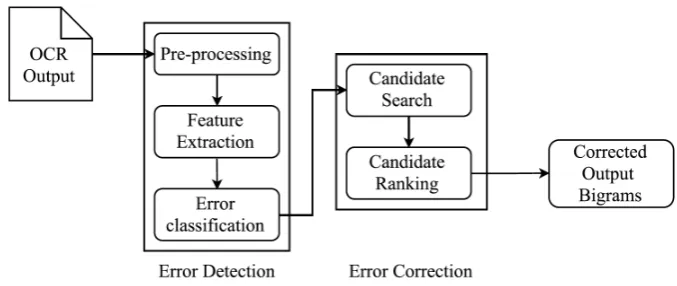
OCR post-processing text correction is a challeng-ing and complex problem. The ever-growchalleng-ing vo-cabulary constrains it further. In order to solve this problem, we break it down into two sub-problems, namely, identification of erroneous terms from the post-processed OCR text, followed by rectification of the identified erroneous terms. The complete pipeline is shown in Figure 1, with the explanation of each stage as follows.
2.1 Error detection
The first stage of our system is to detect the erro-neous terms for a given document. It involves two components as described below.
2.1.1 Pre-processing
The pre-processing module consists of tokeniza-tion of a given textual document, i.e. the original output of the OCR. We defined regular expression patterns which split a textual document on delim-iters such as full-stop (.), comma (,), semi-colon (;), single quotes (‘,’) or double quotes (“,”). The tokens are considered for further processingas-is, i.e. without undergoing lemmatization. The pri-mary reason to abstain from lemmatization is to preserve the original OCR words in order to rule out the scope of any character-based discrepancy. Additionally, care is taken to preserve the token order. The order is important as it dictates one of the features as defined in Section 2.1.2.
2.1.2 Feature Extraction and Classification
The next step is to classify each token in the doc-ument as being erroneous or free of any error. We train a SVM with radial basis function (RBF) ker-nel and made use of the following features:
• Presence of non alpha-numeric text within a
word is one the strongest indicators of an er-roneous word. These mainly include special symbols like ‘$’, ‘#’, ‘%’ and punctuation marks like ‘!’, ‘?’, ’;’, ’:’, etc. For example, “th?” and “Mr. Pat?rsom” contain a punctua-tion mark ‘?’; “***n”, “JM**shopB” contain a special symbol ‘*’. We created a dictionary of such special symbols as observed from the given training data.
• The bigram frequency of a word should be
greater than a frequency threshold that varies with different word length. A common word is less likely to be an error word. We adopted this feature from (Mei et al., 2016).
• A word is likely to be correct if this word with its context occurs in other places. We use a sliding window similar to (Mei et al., 2016) to construct n-gram contexts for a word. The frequency of one of the context in n-gram corpus should be greater than a frequency threshold.
Using these features, we train a binary SVM classifier (Pedregosa et al., 2011) which classifies a word being erroneous (1) or not (0). The experi-mental details are mentioned in Section 3.2.
2.2 Error rectification
The second stage of our system solves the problem of rectifying the erroneous words identified in the first stage. It consists of two major components, namely candidate search and candidate ranking as described below.
2.2.1 Candidate Search
In this module, for each erroneous word, a set of candidate corrections is recommended within a limited number of character modifications based on calculating minimum edit distance between the erroneous word and the candidate correction. We make use of Levenshtein’s edit distance (Leven-shtein, 1966) to calculate the minimum edit dis-tance consisting of the standard three operations, namely, insertion, deletion or substitution. The threshold is chosen heuristically on the basis of ex-periments conducted.
2.2.2 Candidate Ranking
Figure 1: System pipeline
i 2 W) for each erroneous term (we), to assign
a score to each candidate correction using simu-lated annealing (SA) algorithm (Kirkpatrick et al., 1983). SA requires an aperiodic Markov chain de-fined on a certain state space, and a cooling sched-ule to iteratively push the solution towards the op-timum. In this module, the state space is set of all candidate corrections. We calculate a similarity score for each of the candidate corrections (wci)
on the basis of the following three factors:
1. Minimum edit distanced(wci, we) as
calcu-lated by Levenshtein’s edit distance.
2. Normalized longest common subsequence (Allison and Dix, 1986) which takes into ac-count the length of both the shorter and the longer string for normalization.
nlcs(wci, we) = 2⇤len(lcs(wci, we)) 2
len(wci) +len(we)
(1)
3. Normalized maximal consecutive longest common subsequence, which is a modifica-tion of aforemenmodifica-tioned factor by limiting the common subsequences to be consecutive.
nmnlcs(wci, we) = 2⇤len(mclcs(wci, we)) 2
len(wci) +len(we)
(2)
The final score is calculated as a weighted sum of these three factors:
score(wci, we) = ↵1 ⇤ d(wci, we) + ↵2 ⇤
nlcs(wci, we) +↵3⇤nmnlcs(wci, we)
where, ↵1,↵2 and↵3 are chosen heuristically. Next, we perturb the given candidate 26 times, i.e.
for all the characters of English alphabet, in or-der to check which character returns the maximal score. This is followed by validating the pres-ence of that candidate correction by Google Web n-gram corpus3. Finally, the candidates are ranked
on the basis of this optimized score. The candi-date having highest score is returned as the final suggested correction.
3 Experiments and Results
The ALTA shared task is to rectify textual errors in OCR post-processed documents. We first describe the given dataset briefly, followed by experimental setup and results.
3.1 Dataset
The shared task organizers obtained a corpus of approximately 8,000 Australian publications from Trove database. The corpus consists of original output of OCR system for each of the documents, along with their corrected versions. The organiz-ers have provided 6,000 documents and their cor-rected versions as training dataset. 1,941 docu-ments are provided as the test dataset, for which only the original output of the OCR system is pro-vided. The details of data are given by (Molla and Cassidy, 2017).
3.2 Experimental Setup and Results
Stage 1 of our experiment pertains to error detec-tion which classifies each word of the document to be either erroneous (1) or correct (0). In or-der to train a binary SVM classifier, we split the given training data into training and development datasets using 5-fold cross validation. The RBF kernel is employed to train the SVM. The test
Features P R F1
Non-alphanumeric
character presence 63.2 42.1 50.5 +bigram frequency 67.3 43.9 53.1 +n-gram contexts 69.6 44.2 54.1
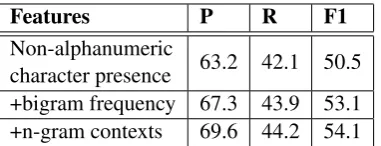
Table 1: Stage 1 - Error detection using SVM
Model F1public F1private
Baseline 22.86 23.09
SA0.80 25.44 25.83
SA0.85 27.52 28.05
SA0.88 29.71 30.14
SA0.92 32.98 33.48
Table 2: Stage 2 results - Error rectification
dataset remains unused since the correct labels for erroneous words are unknown. Table 1 reports the intermediate results obtained by adding the fea-tures defined in Section 2.1.2 incrementally.
For the stage 2 subproblem of error rectification, first we select the threshold for the Levenshtein’s edit distance by measuring the minimum edit dis-tance between the words obtained from corrected and original documents provided in the training dataset. This helps in recommending the candidate corrections by allowing words for which minimum edit distance is less than or equal to the threshold. For candidate ranking, we initialize the score as 0 for each pair of (wci, we) corresponding to an
erroneous word. The value of temperature is ini-tialized to 500 and cooling schedule is iniini-tialized to 0.8. Table 2 shows the five models that were used to render final results. The baseline model corresponds to ranking of candidate corrections on the basis of total score calculated in Section 2.2.2. SA0.80, SA0.85, SA0.88 and SA0.92 correspond to models trained using simulated annealing at the respective cooling schedules.
The trained model is used for predictions corre-sponding to the public leaderboard which contains 50% of the total data. Finally, at the end of the competition, the predictions are measured against the remaining 50% of data which corresponds to the private leaderboard. The results obtained by using the aforementioned features is shown in Ta-ble 2. Standard precision, recall and F1-score met-rics are used to report the prediction results.
4 Discussion
Our system performs almost similarly on both public and private leaderboards, which indicates that the model is not overfitting. Table 1 indi-cates that a collective use of character-level fea-tures and contextual feafea-tures leads to an increase in F1 score, even if it’s a marginal increment. The recall of our error detection module is consistently low, which demonstrates the complexity of this sub-problem. Table 2 demonstrates that simulated annealing has proven to show an improvement of about 5% F1 score over the baseline score-based model.
What worked well: Our system was able to rectify some of the punctuation based errors like “Collision ;” ! “Collision <next-word>”. We
were also able to rectify certain typo-based errors like “ofi”!“of”.
What did not work: Our system does not al-ways return a correction when text containing a number is identified as an erroneous term. For ex-ample, in “October 2fi”, the term “2fi” remains un-detected.
There are many other features which we could have tried like considering erroneous text location in the document, syntactic structure of sentences within the document and non-English text words, to name a few. However, given the limitation of time, it was not possible to incorporate these fea-tures. It would be interesting to expand this system by adding these features in future.
5 Conclusion
OCR post-processed text correction is an impor-tant and challenging problem that needs to be ad-dressed to facilitate digitization. In this paper, we describe our participating system, which was based on a supervised classification method to de-tect erroneous words, followed by suggesting op-timal corrections for each erroneous word with a confidence-based mechanism using simulated an-nealing. Our system was ranked the best with an F1-score of 32.98%.
References
Lloyd Allison and Trevor I Dix. 1986. A bit-string longest-common-subsequence algorithm. Informa-tion Processing Letters, 23(5):305–310.
pre-processing for searching historical documents. Pat-tern Recogn., 40(2):389–397, February.
Mark A Jones and Jason M Eisner. 1992. A probabilis-tic parser and its applications. InAAAI Workshop on Statistically-Based NLP Techniques, pages 20–27. Scott Kirkpatrick, C Daniel Gelatt, Mario P Vecchi,
et al. 1983. Optimization by simulated annealing.
science, 220(4598):671–680.
Karen Kukich. 1992. Techniques for automatically correcting words in text. ACM Comput. Surv., 24(4):377–439, December.
Vladimir I Levenshtein. 1966. Binary codes capable of correcting deletions, insertions, and reversals. In
Soviet physics doklady, volume 10, pages 707–710. William B. Lund and Eric K. Ringger. 2009.
Improv-ing optical character recognition through efficient multiple system alignment. In Proceedings of the 9th ACM/IEEE-CS Joint Conference on Digital Li-braries, JCDL ’09, pages 231–240, New York, NY, USA. ACM.
W. B. Lund, D. D. Walker, and E. K. Ringger. 2011. Progressive alignment and discriminative error cor-rection for multiple ocr engines. In 2011 Inter-national Conference on Document Analysis and Recognition, pages 764–768, Sept.
William B Lund, Eric K Ringger, and Daniel D Walker. 2014. How well does multiple ocr error correction generalize? Society of Photo-Optical Instrumenta-tion Engineers.
Jie Mei, Aminul Islam, Yajing Wu, Abidalrahman Moh’d, and Evangelos E Milios. 2016. Statisti-cal learning for ocr text correction. arXiv preprint arXiv:1611.06950.
Diego Molla and Steve Cassidy. 2017. Overview of the 2017 alta shared task: Correcting ocr errors. In
Proceedings of Australasian Language Technology Association Workshop, Brisbane, Australia.
F. Pedregosa, G. Varoquaux, A. Gramfort, V. Michel, B. Thirion, O. Grisel, M. Blondel, P. Pretten-hofer, R. Weiss, V. Dubourg, J. Vanderplas, A. Pas-sos, D. Cournapeau, M. Brucher, M. Perrot, and E. Duchesnay. 2011. Scikit-learn: Machine learn-ing in Python. Journal of Machine Learning Re-search, 12:2825–2830.
Kazem Taghva and Eric Stofsky. 2001. Ocrspell: an interactive spelling correction system for ocr errors in text. International Journal on Document Analysis and Recognition, 3(3):125–137.
C. C. Tappert, C. Y. Suen, and T. Wakahara. 1990. The state of the art in online handwriting recogni-tion. IEEE Transactions on Pattern Analysis and Machine Intelligence, 12(8):787–808, Aug.