Contrastive Analysis and Native Language Identification
Sze-Meng Jojo Wong
Centre for Language Technology Macquarie University Sydney, NSW, Australia [email protected]
Mark Dras
Centre for Language Technology Macquarie University Sydney, NSW, Australia [email protected]
Abstract
Attempts to profile authors based on their characteristics, including native language, have drawn attention in recent years, via sev-eral approaches using machine learning with simple features. In this paper we investigate the potential usefulness to this task of con-trastive analysis from second language acquis-tion research, which postulates that the (syn-tactic) errors in a text are influenced by an au-thor’s native language. We explore this, first, by conducting an analysis of three syntactic error types, through hypothesis testing and machine learning; and second, through adding in these errors as features to the replication of a previous machine learning approach. This preliminary study provides some support for the use of this kind of syntactic errors as a clue to identifying the native language of an author.
1 Introduction
There is a range of work that attempts to infer, from some textual data, characteristics of the text’s author. This is often described by the termauthorship pro-filing, and may be concerned with determining an author’s gender, age, or some other attributes. This information is often of interest to, for example, gov-ernments or marketing departments; the application that motivates the current work is profiling of phish-ing texts, texts that are designed to deceive a user into giving away confidential details (Fette et al., 2007; Zheng et al., 2003).
The particular characteristic of interest in this pa-per is the native language of an author, where this is not the language that the text is written in. There has been only a relatively small amount of other re-search investigating this question, notably Koppel et
al. (2005), Tsur and Rappoport (2007), Estival et al. (2007), and van Halteren (2008). In general these tackle the problem as a text classification task us-ing machine learnus-ing, with features over characters, words, parts of speech, and document structures. Koppel et al. (2005) also suggest syntactic features, although they do not use them in that work.
The goal of this paper is to make a preliminary in-vestigation into the use of syntactic errors in native language identification. The research drawn on for this work comes from the field ofcontrastive analy-sisin second language acquisition (SLA). According to the contrastive analysis hypothesis formulated by Lado (1957), difficulties in acquiring a new (second) language are derived from the differences between the new language and the native (first) language of a language user. Amongst the frequently observed syntactic error types in non-native English which it has been argued are attributable to language trans-fer are subject-verb disagreement, noun-number dis-agreement, and misuse of determiners. Contrastive analysis was largely displaced in SLA byerror anal-ysis (Corder, 1967), which argued that there are many other types of error in SLA, and that too much emphasis was placed on transfer errors. However, looking at the relationship in the reverse direction and in a probabilistic manner, contrastive analysis could still be useful to predict the native language of an author through errors found in the text.
Secondly, our study intends to investigate whether such syntactic features are useful stylistic markers for native language identification in addition to other features from the work of Koppel et al. (2005).
The rest of the paper is structured as follows. Sec-tion 2 reviews the literature studying native language identification and contrastive analysis. Section 3 de-cribes the methodology adopted in our study. The experimental results obtained are organised into two separate sections: Section 4 presents the results ob-tained merely from syntactic features; Section 5 dis-cusses a replication of the work of Koppel et al. (2005) and details the results from adding in the syn-tactic features. Finally, Section 6 concludes.
2 Literature Review
2.1 Native language identification
Koppel et al. (2005) took a machine learning ap-proach to the task, using as features function words, character n-grams, and part-of-speech (POS) bi-grams; they gained a reasonably high classification accuracy of 80% across five different groups of non-native English authors (Bulgarian, Czech, French, Russian, and Spanish), selected from the first ver-sion of International Corpus of Learner English (ICLE). Koppel et al. (2005) also suggest that syn-tactic errors might be useful features, but these were not explored in their study. Tsur and Rappoport (2007) replicate this work of Koppel et al. (2005) and hypothesise that the choice of words in sec-ond language writing is highly influenced by the fre-quency of native language syllables – thephonology of the native language. Approximating this by char-acter bigrams alone, they achieved a classification accuracy of 66%.
Native language is also among one of the charac-teristics investigated in the authorship profiling task of Estival et al. (2007). Unlike the approach of Koppel et al. (2005), linguistic errors in written texts are not of concern here; rather this study fo-cuses merely on lexical and structural features. The approach deployed yields a relatively good classi-fication accuracy of 84% when the native language alone is used as the profiling criterion. However, it should be noted that a smaller number of native lan-guage groups were examined in this study – namely, Arabic, English, and Spanish. The work was also
carried out on data that is not publicly available. Another relevant piece of research is that of van Halteren (van Halteren, 2008), which has demon-strated the possibility of identifying the source language of medium-length translated texts (be-tween 400 and 2500 words). On the basis of fre-quency counts of word-based n-grams, surprisingly high classification accuracies from 87% to 97% are achievable in identifying the source language of Eu-ropean Parliament (EUROPARL) speeches. Six common European languages were examined – En-glish, German, French, Dutch, Spanish, and Ital-ian. In addition, van Halteren also uncovered salient markers for a particular source language. Many of these were tied to the content and the domain (e.g. the greeting to the European Parliament is always translated a particular way from German to English in comparison with other languages), suggesting a reason for the high classification accuracy rates.
2.2 Contrastive analysis
The goal of contrastive analysis is to predict linguis-tic difficulties experienced during the acquisition of a second language; as formulated by Lado (1957), it suggests that difficulties in acquiring a new (second) language are derived from the differences between the new language and the native (first) language of a language learner. In this regard, errors potentially made by learners of a second language are predicted from interference by the native language. Such a phenomenon is usually known asnegative transfer. In error analysis (Corder, 1967), this was seen as only one kind of error,interlanguageorinterference errors; other types were intralingual and develop-mental errors, which are not specific to the native language (Richards, 1971).
grammatical errors of Chinese learners in English. Among these studies, commonly observed syntactic error types made by non-native English learners in-clude subject-verb disagreement, noun-number dis-agreement, and misuse of determiners.
There are many other studies examining interlan-guage errors, generally restricted in their scope of investigation to a specific grammatical aspect of En-glish in which the native language of the learners might have an influence. To give some examples, Granger and Tyson (1996) examined the usage of connectors in English by a number of different na-tive speakers – French, German, Dutch, and Chi-nese; Vassileva (1998) investigated the employment of first person singular and plural by another differ-ent set of native speakers – German, French, Rus-sian, and Bulgarian; Slabakova (2000) explored the acquisition of telicity marking in English by Span-ish and Bulgarian learners; Yang and Huang (2004) studied the impact of the absence of grammatical tense in Chinese on the acquisition of English tense-aspect system (i.e. telicity marking); Franck et al. (2002) and Vigliocco et al. (1996) specifically ex-amined the usage of subject-verb agreement in En-glish by French and Spanish, respectively.
3 Methodology
3.1 Data
The data used in our study is adopted from the In-ternational Corpus of Learner English(ICLE) com-piled by Granger et al. (2009) for the precise pur-pose of studying the English writings of non-native English learners from diverse countries. All the con-tributors to the corpus are believed to possess similar English proficiency level (ranging from intermedi-ate to advanced English learners) and are of about the same age (all in their twenties). This was also the data used by Koppel et al. (2005) and Tsur and Rappoport (2007), although where they used the first version of the corpus, we use the second.
The first version contains 11 sub-corpora of En-glish essays contributed by students of different na-tive languages – Bulgarian, Czech, Dutch, Finnish, French, German, Italian, Polish, Russian, Spanish, and Swedish; the second has been extended to addi-tional 5 other native languages – Chinese, Japanese, Norwegian, Turkish, and Tswana. In this work, we
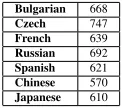
Bulgarian 668 Czech 747 French 639 Russian 692 Spanish 621 Chinese 570 Japanese 610
Table 1: Mean text length of native language (words)
use the five languages of Koppel et al. (2005) – Bul-garian, Czech, French, Russian, Spanish – as well as Chinese and Japanese, based on the work discussed in Section 2.2. For each native language, we ran-domly select from among essays with length of 500-1000 words: 70 essays for training, 25 essays for testing, and another 15 essays for development. By contrast, Koppel et al. (2005) took all 258 texts from their version for each language and evaluated by ten-fold cross validation. We used fewer with a view to reserving more for future work. From our sample, the average text length broken down by native lan-guage is given in Table 1.
3.2 Tools
As in the work discussed in Section 2.1, we use a machine learner. Since its performance in classification problems and its ability in handling high dimensional feature spaces have been well at-tested (Joachims, 1998), the support vector machine (SVM) is chosen as the classifier. We adopt the on-line SVM tool,LIBSVM1 (Version 2.89) by Chang and Lin (2001). All the classifications are first con-ducted under the default settings, where the radial basic function (RBF) kernel is used as it is appro-priate for learning a non-linear relationship between multiple features. The kernel is tuned to find the best pair of parameters (C,γ) for data training.
In addition to the machine learning tool, we re-quire a grammar checker that help in detecting the syntactic errors. Queequeg,2 a very small English grammar checker, detects the three error types that are of concern in our study, namely subject-verb dis-agreement, noun-number disdis-agreement, and misuse of determiners (mostly articles).
4 Syntactic Features
Given that the main focus of this paper is to uncover whether syntactic features are useful in determining
1
http://www.csie.ntu.edu.tw/˜cjlin/libsvm
2
the native language of the authors, syntactic features are first examined separately. Statistical analysis is performed to gain an overview of the distribution of the syntactic errors detected from seven groups of non-native English users. A classification with SVM is then conducted to investigate the degree to which syntactic errors are able to classify the authors ac-cording to their native language.
4.1 Features
For the present study, only the three major syntactic error types named above are explored and are used as the syntactic features for classification learning.
Subject-verb disagreement: refers to a situation in which the subject of a sentence disagrees with the verb of the sentence in terms of number or per-son. An excerpt adopted from the training data that demonstrates such an error: *If the situation become worse . . . /If the situation becomes worse . . ..
Noun-number disagreement: refers to a situa-tion in which a noun is in disagreement with its de-terminer in terms of number. An excerpt adopted from the training data that demonstrates such an er-ror: *They provide many negative image . . . /They provide many negative images . . ..
Misuse of determiners: refers to situations in which the determiners (such as articles, demonstra-tives, as well as possessive pronouns) are improperly used with the nouns they modify. These situations include missing a determiner when required as well as having an extra determiner when not needed. An excerpt adopted from the training data that demon-strates such an error: *Cyber cafes should not be located outside airport. /Cyber cafes should not be located outside an airport.3
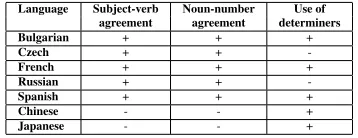
Table 2 provides an overview of which of these grammatical phenomena are present in each native language. All three exist in English; a ‘-’ indicates that generally speaking it does not exists or exists to a much lesser extent in a particular native language (e.g. with Slavic languages and determiners). A ‘+’ indicates that the phenomenon exists, but not that it coincides precisely with the English one. For exam-ple, Spanish and French have much more extensive use of determiners than in English; the presence or
3
Such an error may also be recognised as noun-number dis-agreement in which the grammatical form is. . . outside air-ports; butQueequegidentifies this as misuse of determiners.
Language Subject-verb Noun-number Use of agreement agreement determiners
Bulgarian + + +
Czech + +
-French + + +
Russian + +
-Spanish + + +
Chinese - - +
Japanese - - +
Table 2: Presence or absence of grammatical features
Figure 1: Boxplot: subject-verb disagreement errors
absence of determiners in Bulgarian has no effect on aspectual interpretation, unlike in English; and as for Chinese and Japanese, the usage of determiners is far less frequent than that of the other languages and generally more deictic in nature. Conjugations (and consequently subject-verb agreement), on the other hand, are more extensive in the European languages than in English.
4.2 Data analysis
Boxplots: Figures 1 to 3 depict the distribution of each error type as observed in the training data – 490 essays written by 7 distinct groups of non-native English users. The frequencies of each error type presented in these figures are normalised by the cor-responding text length (i.e. the total number of
Figure 3: Boxplot: determiner misuse errors
Frequency Subject-verb Noun-number Misuse of type disagreement disagreement determiners Absolute 0.038 0.114 5.306E-10
Relative 0.178 0.906 0.006
Table 3: P-value of ANOVA test per error type
words). The boxplots present the median, quartiles and range, to give an initial idea of the distribution of each error type.
These boxplots do show some variability among non-native English users with different native lan-guages with respect to their syntactic errors. This is most obvious in Figure 3, with the distribution of errors concerning misuse of determiners. This could possibly be explained by the interference of native language as indicated in the contrastive anal-ysis. Czech and Chinese seem to have more diffi-culties when dealing with determiners as compared to French and Spanish, since determiners (especially articles) are absent from the language system of Czech and are less frequently used in Chinese, while the usage of determiners in French and Spanish is somewhat different from (and generally more exten-sive than) in English.
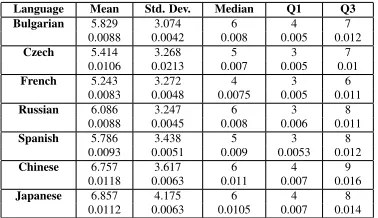
ANOVA tests: The boxplots do not suggest an extremely non-Gaussian distribution, so we use ANOVA tests to determine whether the distributions do in fact differ. A single-factor ANOVA, with the language type being the factor, was carried out for each syntactic error type, for both absolute fre-quency and relative frefre-quency (normalised by text length). The results are presented in Table 3. Ta-bles 4 to 6 present some descriptive statistics for each of the error types in terms of mean, standard deviation, median, first quartile, and third quartile.
The most interesting result is for the case of deter-miner misuse. This is highly statistically significant
Language Mean Std. Dev. Median Q1 Q3 Bulgarian 5.829 3.074 6 4 7
0.0088 0.0042 0.008 0.005 0.012 Czech 5.414 3.268 5 3 7
0.0106 0.0213 0.007 0.005 0.01 French 5.243 3.272 4 3 6
0.0083 0.0048 0.0075 0.005 0.011 Russian 6.086 3.247 6 3 8
0.0088 0.0045 0.008 0.006 0.011 Spanish 5.786 3.438 5 3 8
0.0093 0.0051 0.009 0.0053 0.012 Chinese 6.757 3.617 6 4 9
0.0118 0.0063 0.011 0.007 0.016 Japanese 6.857 4.175 6 4 8
0.0112 0.0063 0.0105 0.007 0.014
Table 4: Descriptive statistics of subject-verb disagree-ment errors (first row – absolute frequency; second row – relative frequency)
Language Mean Std. Dev. Median Q1 Q3 Bulgarian 2.086 1.576 2 1 3
0.0033 0.0025 0.003 0.002 0.005 Czech 2.457 2.250 2 1 4
0.0033 0.0033 0.003 0.001 0.004 French 1.814 1.6 1 1 3
0.003 0.0028 0.002 0.001 0.004 Russian 2.157 1.968 2 1 3
0.003 0.0024 0.0025 0.0013 0.004 Spanish 1.7 1.376 1.5 1 2
0.0027 0.0023 0.002 0.001 0.004 Chinese 1.671 1.791 1 1 2
0.003 0.0032 0.002 0.001 0.004 Japanese 1.971 1.810 1 1 3
0.0033 0.0029 0.002 0.0013 0.0048
Table 5: As Table 4, for noun-number disagreement
for both absolute and relative frequencies (with the p-values of 5.306E-10 and 0.006 respectively). This seems to be in line with our expectation and the ex-planation above.
As for subject-verb disagreement, significant dif-ferences are only observed in absolute frequency (with a p-value of 0.038). The inconsistency in re-sults could be attributed to the differences in text length. We therefore additionally carried out an-other single-factor ANOVA test on the text length from our sample (mean values are given in Table 1), which shows that the text lengths are indeed differ-ent. The lack of a positive result is a little surprising, as Chinese and Japanese do not have subject-verb
Language Mean Std. Dev. Median Q1 Q3 Bulgarian 51.471 16.258 47.5 40.25 63.75
0.0771 0.0169 0.079 0.065 0.089 Czech 61.529 23.766 59.5 44 73
0.082 0.0253 0.08 0.0673 0.096 French 44.286 14.056 45 34 52
0.0689 0.0216 0.069 0.0573 0.086 Russian 49.343 15.480 48.5 40.25 59
0.072 0.0182 0.074 0.063 0.083 Spanish 43.9 15.402 43 31.75 53.75 0.0706 0.0214 0.069 0.056 0.085 Chinese 44.686 15.373 45 33 54.75 0.0782 0.0252 0.078 0.0573 0.0958 Japanese 46.243 16.616 43.5 36.25 55.75
0.0768 0.0271 0.074 0.064 0.0883
agreement, while the other languages do. However, we note that the absolute numbers here are quite low, unlike for the case of determiner misuse.
Noun-number disagreement, however, does not demonstrate significant differences amongst the seven groups of non-native English users (neither for the absolute frequency nor for the relative fre-quency), even though again the native languages dif-fer in whether this phenomenon exists. Again, the absolute numbers are small.
Perhaps noun-number disagreement is just not an interference error. Instead, it may be regarded as a developmental error according to the notion of error analysis (Corder, 1967). Developmental errors are largely due to the complexity of the (second) lan-guage’s grammatical system itself. They will gradu-ally diminish as learners become more competent.
We also note at this point some limitations of the grammar checkerQueequegitself. In particular, the grammar checker suffers from false positives, in many cases because it fails to distinguish between count nouns and mass nouns. As such, the checker tends to generate more false positives when deter-mining if the determiners are in disagreement with the nouns they modify. An example of such false positive generated by the checker is as follows: It could help us to save some money . . ., where some moneyis detected as ungrammatical. A manual eval-uation of a sample of the training data reveals a rela-tively high false positive rate of 48.2% in determiner misuse errors. (The grammar checker also records a false negative rate of 11.1%.) However, there is no evidence to suggest any bias in the errors with re-spect to native language, so it just seems to act as random noise.
4.3 Learning from syntactic errors
Using the machine learner noted in Section 3.2, the result of classification based on merely syntactic fea-tures is shown in Table 7 below. The majority class baseline is 14.29%, given that there are 7 native lan-guages with an equal quantity of test data. Since only three syntactic error types being examined, it is not unreasonable to expect that the accuracy would not improve to too great an extent. Nevertheless, the classification accuracies are somewhat higher than the baseline, approximately 5% (prior tuning) and 10% (after tuning) better when the relative
fre-Baseline Presence/ Relative frequency Relative frequency absence (before tuning) (after tuning) 14.29% 15.43% 19.43% 24.57% (25/175) (27/175) (34/175) (43/175)
Table 7: Classification accuracy for error features
quency of the features is being examined. The im-provement in classification accuracy after tuning is significant at the 95% confidence level, based on a z-test of two proportions.
5 Learning from All Features
The second focus of our study is to investigate the effects of combining syntactic features with lexical features in determining the native language of the authors. To do this, we broadly replicate the work of Koppel et al. (2005) which used a machine learning approach with features commonly used in author-ship analysis – function words, character n-grams, and POS n-grams. Koppel et al. (2005) also used spelling errors as features, although we do not do that here. Spelling errors would undoubtedly im-prove the overall classification performance to some extent but due to time constraints, we keep it for fu-ture work.
5.1 Features
Function words: Koppel et al. (2005) did not spec-ify which set of function words was used, although they noted that there were 400 words in the set. Con-sequently, we explored three sets of function words. Firstly, a short list of 70 function words was exam-ined; these function words were used by Mosteller and Wallace (1964) in their seminal work where they successfully attributed the twelve disputed Federal-ist papers. Secondly, a long lFederal-ist of 363 function words was adopted from Miller et al. (1958) from where the 70 function words used by Mosteller and Wallace (1964) were originally extracted. Consider-ing that Koppel et al.(2005) made use of 400 func-tion words, we then searched for some stop words commonly used in information retrieval to make up a list of close to 400 words – where our third list consists of 398 function words with stop words4.
Character n-grams: As Koppel et al. (2005) did not indicate which sort of character n-grams
4
was used, we examined three different types: un-igram, bi-gram, and tri-gram. The 200 most fre-quently used character bi-grams and tri-grams were extracted from our training data. As for unigrams, only the 100 most frequently used ones were ex-tracted since there were fewer than 200 unique uni-grams. Space and punctuation were considered as tokens when forming n-grams.
POS n-grams: In terms of POS n-grams, Koppel et al. (2005) tested on 250 rare bi-grams extracted from the Brown corpus. In our study, in addition to 250 rare bi-grams from the Brown corpus, we also examined the 200 most frequently used POS bi-grams and tri-grams extracted from our training data. We used the Brill tagger provided by NLTK for our POS tagging (Bird et al., 2009). Having trained on the Brown corpus, the Brill tagger performs at approximately 93% accuracy.
For each of the lexical features, four sets of clas-sification were performed. The data was examined without normalising, with normalising to lowercase, according to their presence, as well as their relative frequency (per text length). (Note that since both the classification results with and without normalis-ing to lowercase are similar, only the results without normalising will be presented.)
5.2 Results
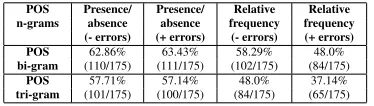
Individual features: The classification results (be-fore tuning) for each lexical feature – function words, character n-grams, and POS n-grams – are presented in Table 8, 9, and 10, respectively. Each table contains results with and without integrating with syntactic features (i.e. the three syntactic er-ror types as identified in Section 4). It is obvious that function words and POS n-grams perform with higher accuracies when their presence is used as the feature value for classification; whereas character n-grams perform better when their relative frequency is considered. Also note that the best performance of character n-grams (i.e. bi-grams) before tuning is far below 60%, as compared with the other two lexi-cal features. It, however, achieves as high as 69.14% after tuning where both function words and POS bi-grams are at 64.57% and 66.29%, respectively.
The classification results for the 250 rare bi-grams from the Brown corpus are not presented here since the results are all at around the baseline (14.29%).
Function Presence/ Presence/ Relative Relative words absence absence frequency frequency
(- errors) (+ errors) (- errors) (+ errors) 70 50.86% 50.86% 40.57% 42.86% words (89/175) (89/175) (71/175) (75/175) 363 60.57% 61.14% 41.71% 43.43% words (106/175) (107/175) (73/175) (76/175) 398 65.14% 65.14% 41.71% 43.43% words (114/175) (114/175) (73/175) (76/175)
Table 8: Classification accuracy for function words
Character Presence/ Presence/ Relative Relative n-grams absence absence frequency frequency
(- errors) (+ errors) (- errors) (+ errors) Character 56.57% 56.57% 50.29% 42.29%
unigram (99/175) (99/175) (88/175) (74/175) Character 22.86% 22.86% 50.29% 41.71% bi-gram (40/175) (40/175) (88/175) (73/175) Character 28.57% 28.57% 43.43% 30.29% tri-gram (50/175) (50/175) (76/175) (53/175)
Table 9: Classification accuracy for character n-grams
Combined features: Table 11 presents both be-fore and after tuning classification results of all com-binations of lexical features (with and without syn-tactic errors). Each lexical feature was chosen for combination based on their best individual result. The combination of all three lexical features results in better classification accuracy than combinations of two features, noting however that character n-grams make no difference. In summary, our best accuracy thus far is at 73.71%. As illustrated in the confusion matrix (Table 12), misclassifications oc-cur largely in Spanish and the Slavic languages.
5.3 Discussion
Comparisons with Koppel et al. (2005): Based on the results presented in Table 8 and 9, our classifica-tion results prior to tuning for both funcclassifica-tion words and character n-grams (without considering the syn-tactic features) appear to be lower than the results obtained by Koppel et al. (2005) (as presented in Table 13). However, character n-grams performs on par with Koppel et al. after tuning. The difference in classification accuracy (function words in partic-ular) can be explained by the corpus size. In our study, we only adopted 110 essays for each native language. Koppel et al. made use of 258 essays for each native language. A simple analysis
(extrapo-POS Presence/ Presence/ Relative Relative n-grams absence absence frequency frequency
(- errors) (+ errors) (- errors) (+ errors) POS 62.86% 63.43% 58.29% 48.0% bi-gram (110/175) (111/175) (102/175) (84/175)
POS 57.71% 57.14% 48.0% 37.14% tri-gram (101/175) (100/175) (84/175) (65/175)
Combinations of features prior prior after after tuning tuning tuning tuning (- errors) (+ errors) (- errors) (+ errors) Function words + 58.29% 58.29% 64.57% 64.57% character n-grams (102/175) (102/175) (113/175) (113/175)
Function words + 73.71% 73.71% 73.71% 73.71% POS n-grams (129/175) (129/175) (129/175) (129/175) Character n-grams + 63.43% 63.43% 66.29% 66.29%
POS n-grams (111/175) (111/175) (116/175) (116/175) Function words + 72.57% 72.57% 73.71% 73.71% char n-grams + POS n-grams (127/175) (127/175) (129/175) (129/175)
Table 11: Classification accuracy for all combinations of lexical features
BL CZ FR RU SP CN JP BL [16] 4 - 5 - - -CZ 3 [18] - 3 1 - -FR 1 - [24] - - - -RU 3 4 3 [14] - - 1 SP 1 2 4 3 [14] - 1 CN 1 1 1 - - [20] 2 JP - - - 4 [21]
Table 12: Confusion matrix based on both lexical and syntactic features (BL:Bulgarian, CZ:Czech, FR:French, RU:Russian, SP:Spanish, CN:Chinese, JP:Japanese)
lating from a curve fitted by a linear regression of the results for variously sized subsets of our data) suggests that our results are consistent with Koppel et al.’s given the sample size. (Note that the results of POS n-grams could not be commented here since Koppel et al. had considered these features as errors and did not provide a separate classification result.)
Usefulness of syntactic features: For the best combinations of features, our classification results of integrating the syntactic features (i.e. syntactic error types) with the lexical features do not demonstrate any improvement in terms of classification accuracy. For the individual feature types with results in Table 8 to Table 10, the syntactic error types sometimes in fact decrease accuracies. This could be due to the small number of syntactic error types being con-sidered at this stage. Such a small number of fea-tures (three in our case) would not be sufficient to add much to the approximately 760 features used in our replication of the Koppel et al.’s work. Further-more, error detection may be flawed as the result of the limitations noted in the grammar checker.
Other issues of note: Character n-grams, as seen in our classification results (see Table 11) do not seem to be contributing to the overall classification.
Types of lexical feature Koppel et al. Our best result Our best result (prior tuning) (after tuning) Function words ~71.0% ~65.0% ~65.0% Character n-grams ~68.0% ~56.0% ~69.0%
Table 13: Comparison of results with Koppel et al.
It is noticeable when character n-grams are com-bined with function words and when comcom-bined with POS n-grams separately. Both combinations do not exhibit any improvement in accuracy. In addition, with character n-grams adding to the other two lexi-cal features, the overall classification accuracy does not seem to be improved either. Nevertheless, as mentioned in Section 5.2 (under individual features), character n-grams alone are able to achieve an accu-racy close to 69%. It seems that character n-grams are somehow a useful marker as argued by Koppel et al. (2005) that such feature may reflect the ortho-graphic conventions of individual native language. Furthermore, this is consistent with the hypothesis put forward by Tsur and Rappoport (2007) in their study. It was claimed that the choice of words in sec-ond language writing is highly influenced by the fre-quency of native language syllabus (i.e. the phonol-ogy of the native language) which can be captured by character n-grams. For example, confusion be-tween phonemes /l/ and /r/ is commonly observed in Japanese learners of English.
6 Conclusion
We have found some modest support for the con-tention that contrastive analysis can help in detect-ing the native language of a text’s author, through a statistical analysis of three syntactic error types and through machine learning using only features based on those error types. However, in combining these with features used in other machine learning approaches to this task, we did not find an improve-ment in classification accuracy.
Acknowledgments
The authors would like to acknowledge the support of ARC Linkage grant LP0776267, and thank the reviewers for useful feedback.
References
Stephen Bird, Ewan Klein, and Edward Loper. 2009.
Natural Language Processing with Python: Analyzing Text with the Natural Language Toolkit. O’Reilly Me-dia, Inc.
Chih-Chung Chang and Chih-Jen Lin, 2001. LIB-SVM: a library for support vector machines. Soft-ware available at http://www.csie.ntu.edu. tw/˜cjlin/libsvm.
Stephen P. Corder. 1967. The significance of learners’ errors. International Review of Applied Linguistics in Language Teaching (IRAL), 5(4):161–170.
Libuˇse Duˇskov´a. 1969. On sources of error in foreign language learning. International Review of Applied Linguistics (IRAL), 7(1):11–36.
Dominique Estival, Tanja Gaustad, Son-Bao Pham, Will Radford, and Ben Hutchinson. 2007. Author profiling for English emails. In Proceedings of the 10th Con-ference of the Pacific Association for Computational Linguistics (PACLING), pages 263–272.
Ian Fette, Norman Sadeh, and Anthony Tomasic. 2007. Learning to detect phishing emails. InProceedings of the 16th International World Wide Web Conference. Julie Franck, Gabriella Vigliocco, and Janet Nicol. 2002.
Subject-verb agreement errors in French and English: The role of syntactic hierarchy. Language and Cogni-tive Processes, 17(4):371–404.
Michael Gamon. 2004. Linguistic correlates of style: Authorship classification with deep linguistic analy-sis features. InProceedings of the 20th International Conference on Computational Linguistics (COLING), pages 611–617.
Sylviane Granger and Stephanie Tyson. 1996. Connec-tor usage in the English essay writing of native and non-native EFL speakers of English. World Englishes, 15(1):17–27.
Sylviane Granger, Estelle Dagneaux, Fanny Meunier, , and Magali Paquot. 2009. International Corpus of Learner English (Version 2). Presses Universitaires de Louvain, Louvain-la-Neuve.
Jonathon Guilford. 1998. English learner interlanguage: What’s wrong with it? Anglophonia French Journal of English Studies, 4:73–100.
Thorsten Joachims. 1998. Text categorization with Sup-port Vector Machines: Learning with many relevant features. In Machine Learning: ECML-98, pages 137–142.
Moshe Koppel, Jonathan Schler, and Kfir Zigdon. 2005. Automatically determining an anonymous author’s na-tive language. InIntelligence and Security Informat-ics, volume 3495 ofLecture Notes in Computer Sci-ence, pages 209–217. Springer-Verlag.
Robert Lado. 1957. Linguistics Across Cultures: Ap-plied Linguistics for Language Teachers. University of Michigan Press, Ann Arbor, MI, US.
Richard L. Light and Diane Warshawsky. 1974. Prelimi-nary error analysis: Russians using English. Technical report, National Institute of Education, USA.
George A. Miller, E. B. Newman, and Elizabeth A. Fried-man. 1958. Length frequency statistics for written English. Information and Control, 1(4):370–389. Abdul R. Mohamed, Li-Lian Goh, and Eliza Wan-Rose.
2004. English errors and Chinese learners. Sunway College Journal, 1:83–97.
Frederick Mosteller and David L. Wallace. 1964. In-ference and Disputed Authorship: The Federalist. Addison-Wesley, Reading, MA, US.
Jack C. Richards. 1971. A non-contrastive approach to error analysis.ELT Journal, 25(3):204–219.
Roumyana Slabakova. 2000. L1 transfer revisited: the L2 acquisition of telicity marking in English by Spanish and Bulgarian native speakers. Linguistics, 38(4):739–770.
Oren Tsur and Ari Rappoport. 2007. Using classifier fea-tures for studying the effect of native language on the choice of written second language words. In Proceed-ings of the Workshop on Cognitive Aspects of Compu-tational Language Acquisition, pages 9–16.
Hans van Halteren. 2008. Source language markers in EUROPARL translations. InProceedings of the 22nd International Conference on Computational Linguis-tics (COLING), pages 937–944.
Irena Vassileva. 1998. Who am I/how are we in aca-demic writing? A contrastive analysis of authorial presence in English, German, French, Russian and Bulgarian. International Journal of Applied Linguis-tics, 8(2):163–185.
Garbriella Vigliocco, Brian Butterworth, and Merrill F. Garrett. 1996. Subject-verb agreement in Spanish and English: Differences in the role of conceptual con-straints.Cognition, 61(3):261–298.
Suying Yang and Yue-Yuan Huang. 2004. The impact of the absence of grammatical tense in L1 on the acqui-sition of the tense-aspect system in L2. International Review of Applied Linguistics in Language Teaching (IRAL), 42(1):49–70.