Generating Chinese Named Entity Data from a Parallel Corpus
Ruiji Fu, Bing Qin, Ting Liu
*Research Center for Social Computing and Information Retrieval
MOE-Microsoft Key Laboratory of Natural Language Processing and Speech
School of Computer Science and Technology
Harbin Institute of Technology, Harbin, China
{rjfu,bqin,tliu}@ir.hit.edu.cn
Abstract
Annotating Named Entity Recognition (NER) training corpora is a costly process but necessary for supervised NER systems. This paper presents an ap-proach to generate large-scale Chinese NER training data from an English-Chinese discourse level aligned parallel corpus. Difficulty of NER is different among languages due to their unique fea-tures. For example, the performance of English NER systems is usually higher than the Chinese ones on average. In our method, we first employ a high perfor-mance NER system on one side of a bi-lingual corpus. And then, we project the NE labels to the other side according to the word level alignment. At last, we se-lect high-quality labeled sentences using different strategies and generate an NER training corpus. In our experiments, we generate a Chinese NER corpus with 167,100 sentences through an English-Chinese parallel corpus. The system trained on the automatically generated corpus attains a comparable result with the one trained on the manually-annotated corpus. Further experiments show that the NER performance is signif-icantly improved on two different evalua-tion sets by using the generated training data as an additional corpus to the ma-nually-labeled data.
1
Introduction
Named Entity Recognition (NER) is the task of identifying and classifying the names of persons,
*
Correspondence author: [email protected]
locations, organizations and other named entities in text, which plays an important role in many Natural Language Processing (NLP) applications such as information extraction, information re-trieval, machine translation, and so on.
Supervised machine learning systems have proved successful for NER (Zhou and Su, 2002; Chieu and Ng, 2002; Takeuchi and Collier, 2002; Settles, 2004). They usually need manually-annotated high performance textual corpora. These corpora are considered as gold standards for training statistical models. However, corpora manually-annotating is so costly and time-consuming that the existing corpora are limited in both scale and scope for Chinese NER.
More seriously, the domain overfitting prob-lem even worsens the corpora-shortage probprob-lem. Supervised NER approaches can often achieve high accuracy when a large annotated training set similar to the test data is available (Zhou and Su, 2002; Florian et al., 2003; Klein et al., 2003; Finkel et al., 2005). Unfortunately, if the test data has some difference from the training data, these approaches tend to not perform well. For in-stance, Ciaramita and Altun (2005) reported that the F1-score of a named entity recognizer trained on CoNLL 2003 Reuters corpus dropped from 90.8% (when tested on a similar Reuters set) to 64.3% (when tested on a Wall Street Journal set). A similar phenomenon of performance degrada-tion in Chinese NER will be presented later in this paper (see Table 3).
Therefore, we try to solve the problems for Chinese mentioned above by automatically con-structing large scale and scope training corpora.
Chinese NER is more difficult than English NER because of the lack of capitalization and the uncertainty in word segmentation. Our motiva-tion is to collect large-scale training data and improve Chinese NER with the help of an
ing high performance English NER system and a bilingual corpus.
In this paper, we employ a high performance NER system on the English side of a bilingual corpus. And then, the NE labels are projected to the Chinese side according to the word level alignment. At last, we select high-quality labeled sentences using different strategies and generate an NER training corpus.
In our experiments, statistical models are trained on the generated corpora, and compared with the model trained on a manually annotated corpus. The results show that our corpus is com-parable to the manually-labeled corpus. Further-more, the model trained on the combined corpus (generated and manually-labeled corpora) ob-tains an F1-score of 67.89% on 863-Evaluation corpus and 73.20% on OntoNotes corpus, which significantly outperforms the one trained on the manually-labeled corpus.
The contributions of this paper are as follows. First, we present a method to generate large-scale Chinese NER training data from a bilingual corpus automatically. Our method trades off ma-nual effort to annotate named entities in docu-ments for effort to identify pairs of parallel documents, which is easier than NE manual an-notation. For example, large scale of parallel documents can be extracted from the web auto-matically (Resnik and Smith, 2003; Zhang et al., 2006).
Second, we propose some strategies to select high-quality training data, which are very effec-tive and important as the experiments show.
And third, we prove that our generated train-ing data can be used as an additional corpus to improve the NER performance.
This paper is organized as follows. Section 2 discusses the related work. Section 3 describes our approach in detail. Section 4 presents and discusses the results of our experiments. Finally, we present our conclusions and future work in section 5.
2
Related Work
In this section, we introduce some previous work about NER training data generation.
The most closed related work to our approach is Yarowsky et al. (2001). They used word alignment on parallel corpora to induce several text analysis tools from English to other lan-guages for which such resources are scarce. An NE tagger was transferred from English to French and achieved good classification accura-cy. However, Chinese NER is more difficult than
French and word alignment between Chinese and English is also more complex because of the tremendous difference between the two languag-es.
Huang and Vogel (2002) presented an inte-grated approach to extract an NE translation dic-tionary from an English-Chinese parallel corpus while improving the monolingual NE annotation quality for both languages. They started with low-quality NE tagging for both languages and improved the annotation result using alignment information. But they did not filter the annotated data and evaluate its impact for NER as training data.
Besides, some other resources have been used to generate NE tagged corpus.
An et al. (2003) and Whitelaw et al. (2008) used seed sets of entities and search engines to collect NER training data from the web. Howev-er, constructing of a high-quality seed list is also a time-consuming work.
Richman and Schone (2008) and Nothman et al. (2008) used similar methods to create NE training data. They transformed Wikipedia’s links into named entity annotations by classify-ing the target articles into common entity types. But the article classification seeds also had to be hand-labeled in advance.
In the biomedical domain, Vlachos and Gaspe-rin (2006) automatically created training material for the task of gene name recognition from the broader raw corpus using existing domain re-sources.
In our work, we generate a large scale Chinese NER training data from a bilingual corpus with-out any NE seed lists and filter it by using effec-tive strategies. And we prove that it can improve the performance of Chinese NER as additional training data.
3
Our Approach
In this section we describe our approach of gene-rating NER training data from a parallel corpus. The framework of our system consists of four components as shown in Figure 1.
Alignment: Sentence alignment and word alignment is performed on a dis-course-level aligned bilingual corpus.
English NER: We identify NEs on the English side of the parallel corpus, mak-ing use of an existmak-ing high performance English NER system.
Sentence Alignment Alignment
Word Alignment Parallel Corpus
English NER
Chinese NE Candidates Generation
Training Data Selection
Chinese NER Training Data Chinese NER
Training Data Candidate
Chinese NE List
Figure 1. System Framework
project the English NE labels to the Chi-nese side and generate training data can-didates. At the same time, we extract a Chinese NE list, which can be used as a dictionary resource.
Training Data Selection: According to the different filtering strategies, we se-lect high-quality labeled sentences from the candidates to form Chinese NER training data.
3.1
Alignment and Automatic English NERFirst, we perform sentence level alignment by using Champollion toolkit1.
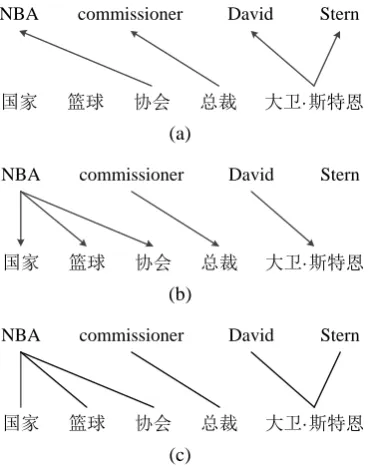
国家 篮球 协会 总裁 大卫·斯特恩
NBA commissioner David Stern
(a)
国家 篮球 协会 总裁 大卫·斯特恩
NBA commissioner David Stern
(b)
国家 篮球 协会 总裁 大卫·斯特恩
NBA commissioner David Stern
(c)
Figure 2. (a) Word Alignment from Chinese to Eng-lish. (b) Word Alignment from English to Chinese. (c) The Merged Result of Both Directions. In (a), 国家 and 篮球 are aligned to NULL, the same to Stern in (b).
1
http://champollion.sourceforge.net/
And then, GIZA++ toolkit2 is used for word alignment. This toolkit can generate one-to-many word alignments in a certain direction (Chinese to English or English to Chinese). However, we need many-to-many alignments. Hence, we need GIZA++ to run on the bilingual corpus in both directions and merge the results, as shown in Figure 2.
English NER is easier than Chinese because of the capitalization information and the needless-ness of word segmentation. So the performance of English NER systems is usually higher than the Chinese ones on average. Hence a widely used open-source NER system, Stanford Named Entity Recognizer3 is employed to label NEs on the English side of the parallel corpus. The sys-tem is based on linear chain Conditional Random Field (CRF) (J.Lafferty et al., 2001) sequence models and can recognize three kinds of named entities (PERSON, LOCATION and ORGANIZATION).
To evaluate the robustness of Stanford NER system, we manually labeled 1000 English sen-tences from our bilingual corpus as a test set where the system achieves an F1-score of 89.32%. It is close to the result of 87.94%4 on CoNLL 2003 NER test set.
3.2
Chinese NE Candidates GenerationAfter the English NER, we map the English NE labels to the Chinese side to discover Chinese NEs candidates, according to the result of word alignment.
We consider all related alignment pairs of every word within an English NE. For example, in Figure 3, the index of the organization name NBA is 1 and the related word alignment pairs
2
http://www-i6.informatik.rwth-aachen.de/Colleagues/och/software/GIZA++.html
3
http://nlp.stanford.edu/software/CRF-NER.shtml
4
1
Figure 3. An Example of Chinese NE Candidates Generation
include 1-1, 1-2 and 1-3. Therefore, we can find the boundaries (from 1 to 3) of the corresponding Chinese translation 国家 篮球 协会. There are also some English words connecting with NULL at Chinese side. We ignore these word alignment pairs.
According to the alignment, we project the NE labels from English to Chinese and generate the named entity candidates on the Chinese side.
3.3
Training Data SelectionHowever, the generated NER training data can-didates are noisy because of the errors in English NER or word alignment. In this section, we present the strategies of selecting training data.
3.3.1 Filtering Based on Rules
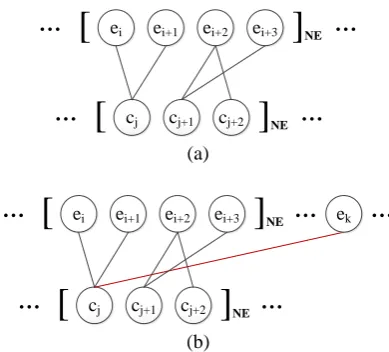
As the common definition, a named entity is a continuous string, whether it is in English or in Chinese. So we assume that every named entity alignment pair is a closed alignment pair of two continuous strings, as shown in Figure 4 (a).
ei+1 ei+2 ei+3
Figure 4. (a) An eligible case; (b) An ineligible case. In (b), the word alignment pair ek - cj is against the
rule, while k > i+3 or k < i.
Based on this assumption, we make two alter-native rules to filter the training data candidates. One is a soft filtering rule to retain training in-stances as many as possible. Another is a hard filtering rule to guarantee the quality of the
gen-erated corpus. These two rules are shown as fol-lows: whole sentence where there is a case sa-tisfying Rule 1.
Rule 1 prefers to keep training instances as many as possible. But it may make some NEs be labeled as non-NE mistakingly on the Chinese side for incorrect word alignments, which are the noises in the generated training data. Rule 2 pre-fers to guarantee the quality of the generated data but may make useful training instances be dis-carded and the data scale shrinking.
Based on the rules, we can filter lots of ill conditioned named entity candidates, such as overlapped entities, nested entities and so on.
3.3.2 Filtering Based on Scores
named entity . denotes the probabili-ty of alignment , which is obtained from GIZA++.
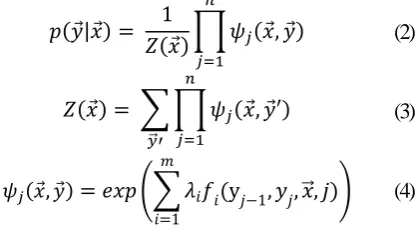
As mentioned in section 3.1, Stanford NER is based on CRF. The inference of CRF is that giv-en an observable sequgiv-ence , we want to find the most likely set of labels for . The probability of given is calculated as follows (J.Lafferty et al., 2001):
(2)
(3)
(4)
In formulae 2, 3 and 4, j denotes the index of the jth word in sequence . n denotes the length of . m denotes the number of the features.
Now the substring in is
la-beled as an NE . The label sequence of is
which is denoted as . We
compute the marginal probability as fol-lows:
(5)
(6)
The factor of every English NE is used to measure the confidence of NER. We apply the forward-backward algorithm to compute them.
For , we use the probabilities of alignment pairs which are computed by GIZA++. GIZA++ outputs the probability of trans-lating source word s as target word t. There are two kinds of probabilities of alignment in two directions. Since our alignment is bidirectional, we merge the probabilities in two directions to come up with formula 7.
(7)
Particularly we set zero while the trans-lation pair “s → t” does not exist in the transla-tion table given by GIZA++.
We set experiential thresholds for every cate-gory to filter the Chinese NE candidates.
3.3.3 Recalling by a Chinese NE List
During the time of filtering the NE candidates, we can also extract the high-quality candidates as an NE list. We calculate the frequencies and the average scores of the candidates. We set thre-sholds of frequency and average score for every kind of NE candidate, and select the candidates with the highest frequency and score to compose a list. Table 1 shows some samples of the list.
An NE may be found correctly in some sen-tences where word alignment is easy, while the same one may be missed in others. Hence we use the extracted NE list to recall the missed NEs in the result of the former two steps.
NEs Label Average Score Freq.
北京 (Beijing) LOC 0.637 4615
克林顿 (Clinton) PER 0.853 969
联合国 (UN) ORG 0.471 436
台湾海峡 (Taiwan Strait) LOC 0.244 82
Table 1. Samples of the Chinese NE List
4
Experiments
We carried out experiments to investigate the quality and practical applicability of our NER training corpora generated from the bilingual corpus.
4.1
Data Set
We selected the LDC2003E14 multilanguage corpus and several bilingual parallel corpora5 as the source corpus to generate NER training data. LDC2003E14 was derived from news of Foreign Broadcast Information Service (FBIS). We used the English-Chinese parallel news composed of 11,645 document pairs. The other bilingual pa-rallel corpora contain 11,750 sentence pairs in all.
A manually annotated Chinese NER gold-standard data from People’s Daily corpus was prepared as the contrasting data. The corpus was annotated with 7 tags: person, location, organiza-tion, date, time, number and miscellany. For the evaluation, the last 4 tags were removed. The corpus, composed of 47,426 sentences, was
5
vided into two parts: 37,426 for training and 10,000 for evaluation.
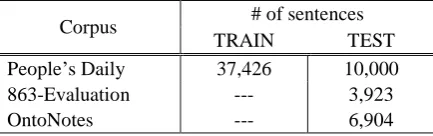
We also use other two corpora for the evalua-tion. One is the Chinese NER evaluation corpus from the National High Technology Develop-ment 863 Program of China in 2004. The other is OntoNotes Release 2.0 corpus. The tags except person, location and organization were removed in the 863-Evaluation corpus. The OntoNotes corpus was annotated with 18 fine-grained tags: 11 for named entities and 7 for numerical and time terms. We reduced the tags NORP and LOCATION into location, FACILITY, GPE and ORGANIZATION into organization, and PERSON into person. After this preprocessing, 14,547 NEs remained in the 863-Evaluation cor-pus and 13,658 NEs remained in the OntoNotes corpus. See Table 2 for a summary of the corpora used.
Corpus # of sentences TRAIN TEST People’s Daily 37,426 10,000 863-Evaluation --- 3,923
OntoNotes --- 6,904
Table 2. Corpora Used for Evaluation
In addition, we manually labeled 1,000 sen-tences randomly extracted from FBIS corpus for the direct evaluation about the quality of our generated corpus.
4.2
The Baseline SystemWe trained a Maximum Entropy Markov Model (MEMM) on People’s Daily training set as our baseline. State-of-the-art features (Wu et al., 2005) are used, which contain word features, POS features, position features, and labeled NE tag features. The model was evaluated on the People’s Daily test set, 863-Evaluation corpus and OntoNotes corpus. The result is shown in Table 3.
P R F1
People’s Daily 90.77% 88.90% 89.82% 863-Evaluation 74.55% 59.13% 65.87% OntoNotes 78.32% 64.28% 70.56%
Table 3. Evaluation Result of the Baseline System
From the evaluation result, we can see that the F1-score drops from 89.82% on People’s Daily corpus to 65.87% on 863-Evaluation corpus and to 70.56% on OntoNotes corpus. It’s similar to
the report of Ciaramita and Altun (2005). The reason for this problem is that the model is over-fitted to the training data and fails to fit the test data with different distribution. To ease the prob-lem, we attempt to improve the coverage of the model by generating large scale and scope train-ing corpora.
4.3
The Quality of the Generated DataWe evaluated the training data generated by us-ing different strategies on the 1000 manually an-notated sentences.
Size P R F1
Rule1 only 1,000 76.16% 48.56% 59.30% Rule1+Score 1,000 76.36% 48.49% 59.32% Rule1+List 1,000 73.99% 67.71% 70.71% Rule1+Score
+ List 1,000 74.28% 67.65% 70.81% Rule2 only 661 78.61% 74.76% 76.64% Rule2+Score 661 78.77% 74.76% 76.72% Rule2+List 661 78.06% 86.44% 82.04% Rule2+Score
+List 661 78.19% 86.44% 82.11%
Table 4. The Quality of Generated Corpora
Comparing the upper and lower parts of Table 4, we get a larger corpus based on Rule 1, but the recall rate is low. Rule 2 requires removing whole sentences with ineligible cases, so that we can get a higher quality but smaller corpus. The result is reasonable. If an ineligible case as shown in Figure 4 (b) occurs in a pair of English and Chinese sentences, it is possible that a named entity is labeled in the English sentence, but is not mapped to the correct Chinese string due to the errors of word alignment. For example, if National Basketball Association is recognized as an organization name in an English sentence, it is very possible that the translated organization name 国家篮球协会 exists in the Chinese sen-tence. But if National Basketball Association is not aligned to 国家篮球协会, the Chinese NE will be missed. We should remove the whole sentences from the corpus, or they will be noises in the training data. The results show that Rule 2 outperforms Rule 1. In the remainder of our ex-periment, we use Rule 2 instead of Rule 1.
Table 5. Test Results for the Generated Training Data
We extract a Chinese NE list containing 824 NEs with the highest frequency and scores from the corpus. Based on the NE list, we can recall many NEs missed by other strategies with only a little expense of precision. The recall rates are substantially improved from 48.56% to 67.71% based on Rule 1 and from 74.76% to 86.44% based on Rule 2.
Here, we chose the best-performing thresholds of the strategies in our experiments. The results show that our strategies are effective for improve the quality of the training data.
As mentioned in section 3.1, the F1-score of Stanford NER on our parallel corpus is 89.32%. The best F1-score of the generated training data in Table 4 is 82.11%. Thus, we roughly infer that about 8.07% (= 1 - 82.11% / 89.32%) correct NE information is lost in the process of the Chinese NER training data generation.
4.4
Comparison between the Manually-labeled Data and the Generated DataWe trained MEMMs on the generated corpora using the same features as the baseline. As shown in Table 5, we get a basic result by using Rule 2. On 863-Evaluation corpus for example, we get a marginal raise (0.72%) of precision but a drop (0.20%) of recall by using Rule 2 and Score strategy, and get a substantial raise (16.35%) of recall with a drop (0.30%) of the precision by using Rule 2 and List strategy. The situation is similar on OntoNotes corpus. The results are consistent with the quality of the train-ing data shown in Table 4. And it is reasonable that better training data leads to higher NER per-formance. The model trained on our corpus gen-erated by using all of the strategies gets a comparable result with the baseline system.
We also use the generated corpus as additional training data to the gold-standard data. The last row in Table 5 shows that this approach leads to an improvement of the NER performance. We
also perform a paired significance test6, which shows that the improvement is significant.
Our generated corpus contains 167,100 sen-tences, which are much more than sentences in the baseline corpus. Furthermore, it is generated without any manual annotation. The size could be limitless as long as there are plenty of parallel corpora available.
4.5
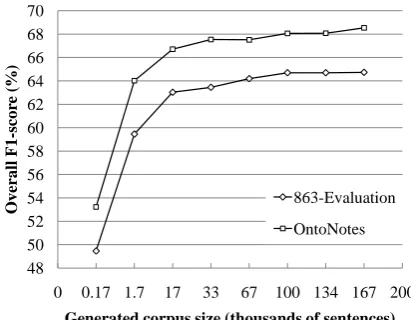
The Effect of the Generated Data SizeFigure 5 illustrates the effect of varying the size of the generated training data set. Increased train-ing data tends to improve performance until the size reaches about 67k sentences for 863-Evaluation corpus and 33k for OntoNotes corpus. But after that, improvements are marginal.
We believe that there are two reasons causing this result. On the one hand, the noises increase when more training data is used. And the training data gets a balance between the noises and the correct training instances when the size reaches a certain point. On the other hand, a subset of the training data can represent the whole data, espe-cially for the data from a simplex source. So we should collect data from a wider range of sources.
Figure 5. The Effect of Varying the Generated Corpus Size
6
We used Zhang’s significance tester (Zhang et al., 2004).
Training data 863-Evaluation corpus OntoNotes corpus
P R F1 P R F1
People’s Daily (PD) 74.55% 59.13% 65.87% 78.32% 64.28% 70.56% Rule2 only 72.94% 41.73% 53.09% 77.79% 46.90% 58.52% Rule2+Score 73.66% 41.53% 53.11% 78.42% 46.72% 58.56% Rule2+List 72.64% 58.08% 64.55% 76.84% 61.80% 68.50% Rule2+Score+List 73.04% 58.12% 64.73% 76.90% 61.82% 68.54% Rule2+Score+List+PD 75.95% 61.38% 67.89% 80.35% 67.22% 73.20%
48 50 52 54 56 58 60 62 64 66 68 70
0 0.17 1.7 17 33 67 100 134 167 200
Over
a
ll
F
1
-s
co
re
(%
)
Generated corpus size (thousands of sentences) 863-Evaluation
Table 6. Test Results for Each NE Category
4.6
The Performance of Each NE CategoryTo analyze overall error, our per-class F1-score is shown in Table 6. Training on the combined corpus could improve the performance of each NE category. The improvements are substantial in all categories except LOC on 863-Evaluation.
In general, the results of ORG entities are lower than the results of PER and LOC. The possible reason may be that ORG names are more complex than PER and LOC names. They usually consist of more words, which may result in more word alignment errors and then lead to more training instances filtered out. Fewer train-ing instances might lead to a poorer performance. In addition, English ORG entity recognition is also more difficulty, which also results in more noises among the ORG name training instances.
5
Conclusion and Future Work
To solve the data-shortage and domain overfit-ting problems, we attempt to enlarge the Chinese NE training data automatically.
In this paper, we present a method of generat-ing NER traingenerat-ing data automatically from a bi-lingual parallel corpus. We employ an existing high-performance English NER system to recog-nized NEs at the English side, and then project the labels to the Chinese side according to the word alignment. To guarantee the quality of the training data, we propose effective filtering strat-egies. The results show that our training data is comparable with the manually-labeled data and can improve the performance of NER as an addi-tional corpus.
Besides, the training data could be expanded easily as long as there are plenty of parallel cor-pora available. And identifying pairs of parallel documents is much easier than NE training data annotation. Generating training data from paral-lel corpora thus provides an alternative way of collecting data required for Chinese NER. Our method can be easily adapted to other languages. In the future, we will try to improve the entity alignment and propose other better filtering strat-egies. Moreover, we will try to make use of more
parallel corpora from a wider range of sources, because more parallel corpora may improve the accuracy of word alignment and widen the cov-erage of the generated NE corpus.
Acknowledgments
This work was supported by National Natural Science Foundation of China (NSFC) via grant 60975055 and 61073126. Special thanks to Wanxiang Che, Yanyan Zhao, Fikadu Gemechu, Yuhang Guo, Zhenghua Li, Meishan Zhang and the anonymous reviewers for insightful com-ments and suggestions.
References
Joohui An, Seungwoo Lee, and Gary Geunbae Lee. 2003. Automatic acquisition of named entity tagged corpus from world wide web. In Proceed-ings of the 41st Annual Meeting of the Association for Computational Linguistics (ACL), pages 165-168.
Hai Leong Chieu and Hwee Tou Ng. 2002. Named Entity Recognition: A Maximum Entropy Ap-proach Using Global Information. In Proceedings of the 19th International Conference on Computa-tional Linguistics (COLING), pages 190-196.
Massimiliano Ciaramita and Yasemin Altun. 2005. Named-entity recognition in novel domains with external lexical knowledge. In Workshop on Ad-vances in Structured Learning for Text and Speech Processing (NIPS-2005).
Jenny Finkel, Shipra Dingare, Christopher D. Man-ning, Malvina Nissim, Beatrice Alex, and Claire Grover. 2005. Exploring the boundaries: Gene and protein identification in biomedical text. BMC Bio-informatics, 6(Suppl 1):S5.
Radu Florian, Abe Ittycheriah, Hongyan Jing, and Tong Zhang. 2003. Named entity recognition through classifier combination. In Proceedings of the 7th Conference on Natural Language Learning (CoNLL), pages 168-171.
Fei Huang and Stephan Vogel. 2002. Improved Named Entity Translation and Bilingual Named Entity Extraction. In Proceedings of the 4th IEEE International Conference on Multimodal Interface, pages 253-258. Pittsburgh, PA, October.
Training data 863-Evaluation corpus OntoNotes corpus
PER LOC ORG PER LOC ORG
Dan Klein, Joseph Smarr, Huy Nguyen, and Christo-pher D. Manning. 2003. Named entity recognition with character-level models. In Proceedings of the 7th Conference on Natural Language Learning (CoNLL), pages 188-191.
John Lafferty, Andrew McCallum and Fernando Pe-reira. 2001. Conditional random fields: Probabilis-tic models for segmenting and labeling sequence data. In International Conference on Machine Learning (ICML), pages 282-289.
Joel Nothman, James R. Curran, and Tara Murphy. 2008. Transforming Wikipedia into named entity training data. In Proceedings of the Australian Language Technology Workshop, pages 124-132, Hobart, Australia.
Philip Resnik and Noah A. Smith, 2003. The Web as a Parallel Corpus. Computational Linguistics, v.29 n.3, pages 349-380,
Alexander E. Richman and Patrick Schone. 2008. Mining wiki resources for multilingual named enti-ty recognition. In Proceedings of the 46th Annual Meeting of the Association for Computational Lin-guistics: Human Language Technologies, pages 1-9, Columbus, Ohio, USA.
Burr Settles. 2004. Biomedical Named Entity Recog-nition Using Conditional Random Fields and Rich Feature Sets. In Proceedings of COLING 2004, the International Joint Workshop on Natural Language Processing in Biomedicine and its Applications (NLPBA), Geneva, Switzerland.
Koichi Takeuchi and Nigel Collier. 2002. Use of Sup-port Vector Machines in Extended Named Entity Recognition. In Proceedings of the 6th Conference on Natural Language Learning (CoNLL), pages 119-125.
Andreas Vlachos and Caroline Gasperin. 2006. Boot-strapping and evaluating named entity recognition in the biomedical domain. In Proceedings of the Workshop on Linking Natural Language Processing and Biology: Towards Deeper Biologi-cal Literature Analysis, pages 138-145. New York City, New York, USA.
Casey Whitelaw , Alex Kehlenbeck , Nemanja Pe-trovic and Lyle Ungar. 2008. Web-scale named entity recognition. In Proceedings of the 17th ACM Conference on Information and Knowledge Man-agement, October 26-30, Napa Valley, California, USA.
Youzheng Wu, Jun Zhao, Bo Xu, Chinese Named Entity Recognition Model Based on Multiple Fea-tures. In Proceedings of HLT/EMNLP 2005, pages: 427-434, October 6-8, Vancouver, B.C., Canada.
David Yarowsky, Grace Ngai and Richard Wicen-towski. 2001. Inducing multilingual text analysis tools via robust projection across aligned corpora.
In Human Language Technology Conference, pag-es 109-116, San Diego, California, March.
Ying Zhang, Ke Wu, Jianfeng Gao, and Phil Vines. 2006. Automatic Acquisition of Chinese–English Parallel Corpus from the Web. In Proceedings of ECIR-06, 28th European Conference on Informa-tion Retrieval.
Ying Zhang, Stephan Vogel, and Alex Waibel. 2004. Interpreting BLEU/NIST scores: How much im-provement do we need to have a better system? In Proceedings of the Fourth International Confe-rence on Language Resources and Evaluation (LREC), pages 2051-2054.