Abstract
Existing work shows that lexical dependen-cies are helpful for constituent tree parsing. However, only first-order lexical dependen-cies have been employed and investigated in previous work. In this paper, we propose a method to employing higher-order1 lexical dependencies for constituent tree evaluation. Our method is based on a parse reranking framework, which provides a constrained search space (via N-best lists or parse forests) and enables our parser to employ relatively complicated dependency features. We eva-luate our models on the Penn Chinese Tree-bank. The highest F1
1
Introduction
score reaches 85.74%, thus outperforming all previously reported state-of-the-art systems. The dependency ac-curacy of constituent trees generated by our parser has been significantly improved as well.
The most commonly used grammar for constitu-ent structure parsing is probabilistic context-free grammar (PCFG). However, as demonstrated in Klein and Manning (2003a), PCFG estimated straightforwardly from Treebank does not per-form well. The reason is that the basic PCFG has certain recognized drawbacks: its independence assumption is too strong, and it lacks of lexical conditioning (Jurafsky and Martin, 2008). To address these drawbacks, several variants of PCFG-based models have been proposed (Klein and Manning, 2003a; Matsuzaki et al., 2005; Petrov et al., 2006; Petrov and Klein, 2007).
Lex-icalized PCFG (LPCFG) (Collins, 1999;
Charniak, 2000; Bikel, 2004) is a representative work that tries to ameliorate the deficiency of lexical conditioning. In LPCFG, non-terminals are annotated with lexical heads and the probabil-ities of CFG rules are estimated conditioned upon these lexical heads. Thus LPCFG becomes sensi-tive to lexical heads, and its performance is im-proved. However, the information provided by lexical heads is limited. To obtain higher parsing performance, we must seek additional
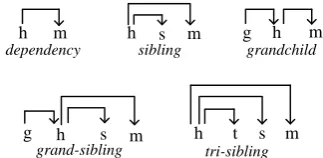
informa-tion. We believe that dependency trees are good candidates because they encode grammatical re-lations between words and provide much more lexical conditioning than lexical heads for PCFG. Dependency trees are usually factored into sets of lexical dependency parts for evaluation. The order of a lexical dependency part can be defined according to the number of dependency arcs it contains. For example, in Figure 1, dependency is first-order, sibling and grandchild are second-order and grand-sibling and tri-sibling are third-order. During the past few years, higher-order1 lexical dependencies have been successfully used for dependency parsing (McDonald et al., 2005; McDonald and Pereira, 2006; Koo and Collins, 2010). But for constituent tree evaluation, only first-order (bigram) lexical dependencies have been used (Collins, 1996; Klein and Manning, 2003a; Collins and Koo, 2005). However, first-order lexical dependency parts are quite limited and thus lose much of the contextual information within the dependency tree. To improve parsing performance, we propose to evaluate constituent trees with higher-order lexical dependencies.
In this paper, we propose a method for evaluat-ing constituent trees usevaluat-ing higher-order lexical dependencies within a parse reranking frame-work. We evaluate our method on the Penn Chi-nese Treebank (CTB). The F1
1
Lexical dependency part which contains more than one dependency arcs is called higher-order, e.g., sibling, grand-child and grand-sibling in Figure 1.
score reaches 85.74%, thus outperforming the best previously reported systems. Thanks to the lexical depen-dencies, the dependency accuracy of the generat-ed constituent trees is improvgenerat-ed as well. These experimental results show that higher-order
lexi-Parse Reranking Based on Higher-Order Lexical Dependencies
Zhiguo Wang
andChengqing Zong
National Laboratory of Pattern RecognitionInstitute of Automation, Chinese Academy of Sciences, Beijing, China, 100190
{zgwang, cqzong}@nlpr.ia.ac.cn
h m h s m g h m
g h s m h t s m
dependency sibling grandchild
[image:1.595.317.479.489.568.2]grand-sibling tri-sibling
Figure 1. Lexical dependency types. The lower-case letters h, m, s, g are words in a sentence.
cal dependencies are highly beneficial for consti-tuent tree evaluation.
The remainder of this paper is organized as fol-lows: Section 2 briefly reviews related work and proposes our ideas. Section 3 describes our pars-ing approach. Section 4 describes our parse re-ranking algorithms based on higher-order lexical dependencies. In Section 5, we describe our training algorithms. We discuss and analyze our experiments in Section 6. Finally, we conclude and mention future work in Section 7.
2
Related Work and Our Ideas
Over the past few years, two kinds of parse re-ranking methods have been proposed. The first is N-best reranking (Charniak and Johnson, 2005; Collins and Koo, 2005). In this method, an exist-ing generative parser is used to enumerate N-best parse trees for an input sentence, and then a re-ranking model is used to rescore the N-best lists with the help of various sorts of features. How-ever, the N-best reranking method suffers from the limited scope of the N-best list in that poten-tially good alternatives may have been ruled out. The second method, called the forest reranking model, was proposed by Huang (2008). In Huang’s method, a forest, instead of an N-best list, is generated first. Then a beam search algo-rithm is used to generate N-best sub-trees for each node in bottom-up order and the best-first sub-tree of the root node is chosen as the final parse tree.
In recent years, there have been many attempts to use dependency trees for constituent parsing. All these approaches can be classified into three types. The first type is dependency-driven consti-tuent parsing (Hall et al., 2007; Hall and Nivre, 2008). Given an input sentence, this approach first parses it into a labeled dependency tree (with complex arc labels, which makes it possible to recover the constituent tree) and then transforms the dependency tree into a constituent tree. The second approach is dependency-constrained con-stituent parsing (Xia and Palmer, 2001; Xia et al., 2008; Wang and Zhang, 2010; Wang and Zong, 2010). In this approach, dependency trees, once generated, are used to constrain the search space of a constituent parser. The third approach is de-pendency-based constituent parsing (Collins, 1996; Klein and Manning, 2003b). In this ap-proach, the constituent tree is evaluated with the help of its corresponding lexical dependencies.
All three existing approaches have certain li-mitations. In the first approach, the
dependency-driven constituent parser is not constrained by the Treebank grammar, so a constituent tree trans-formed from its corresponding dependency tree may contain context-free productions not seen in the Treebank grammar. Although this limitation may not affect the parsing F1
To overcome the drawbacks of the existing approaches, we propose to evaluate constituent trees using higher-order lexical dependencies within a parse reranking framework. Our ap-proach has the following advantages: 1) It utiliz-es the higher-order lexical dependenciutiliz-es, which provide more contextual information within the dependency tree for constituent tree evaluation; 2) the parse reranking method provides high-quality candidates (N-best list or parse forest) which yields a small search space, enabling the use of relatively complicated features.
score, it often has undesirable effects on applications. For the second approach, if the generated dependency tree includes some erroneous parts, the correct constituent tree may be pruned out directly, leav-ing no way to recover the correct tree again. The third approach parses sentences making use of first-order lexical dependencies only. As men-tioned, first-order lexical dependencies are quite limited, and thus may lose much information about the grammatical relations between words. Consequently, the performance improvement of this approach is limited as well.
3
Our Approach
For a sentence x, we define constituent parsing as a search for the highest-scoring parse c* of x:
( )
* arg max ( , )
c GEN x
c Score x c
∈
= (1)
Where, GEN(x) is a set of candidate parsers for x, andScore x c( , ) evaluates the event that tree c is the parse of sentence x.
In order to evaluate c with higher-order lexical dependencies, we define:
( , ) ( , ) i i( , )
i
Score x c = Φ x c ⋅ =α
∑
αΦ x c (2) Where, Φ maps each ( , )x c ∈ ×X C to lexical dependency feature vectorΦ
(
x
,
y
)
∈
ℜ
d , andd ℜ ∈
α
is the corresponding weight vector.3.1
Representation of Constituent Tree with Labeled Dependency Treewith associated dependency trees. Our method includes the following two steps:
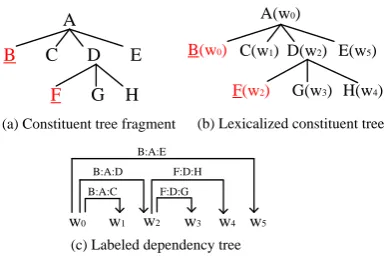
Step 1: Lexicalize the constituent tree, i.e. anno-tate each node in the constituent tree with its head-word. First, find the head-child of each non-terminal node using a head percolation table (Yamada and Matsumoto, 2003). For example, in Figure 2(a), node B is identified as the head-child of rule A→B C D E. Then the head-words prop-agate up through the leaf nodes and each parent receives its head-word from its head-child. For example, in Figure 2(b), w0
Step 2: Transform the lexicalized tree into a labeled dependency tree. First, let the head-word of each non-head-child depend on the head-word of the head-child for each rule. For example, in Figure 2(b) for rule A
is propagated up from node B to A. According to this procedure, we can get the lexicalized constituent tree (shown in Figure 2(b)) for the constituent fragment shown in Figure 2(a).
→B C D E, the head words of non-head-child (node C, D and E) which are w1, w2 and w5 should depend on w0
: :
h m
N P N
which is the head word of head-child (node B). In order to encoding the syntactic symbols in the constituent tree into dependency tree, we annotate each
de-pendency arc with a label , whereNhis
the head-child’s syntactic category, P is the parent’s syntactic category and Nmis the non-head-child’s syntactic category. For example, in Figure 2(c), the dependency arc between w1 and
w0 is built through rule A→B C D E, where w0
associates with B, w1
3.2
Mapping Higher-Order Lexical Depen-dencies into Feature Vectorsassociates with C and the parent node is A, so we can annotate the de-pendency arc with B:A:C. According to the procedure, the lexicalized tree in Figure 2(b) can be transformed into the labeled dependency tree shown in Figure 2(c).
To map lexical dependencies into feature vectors,
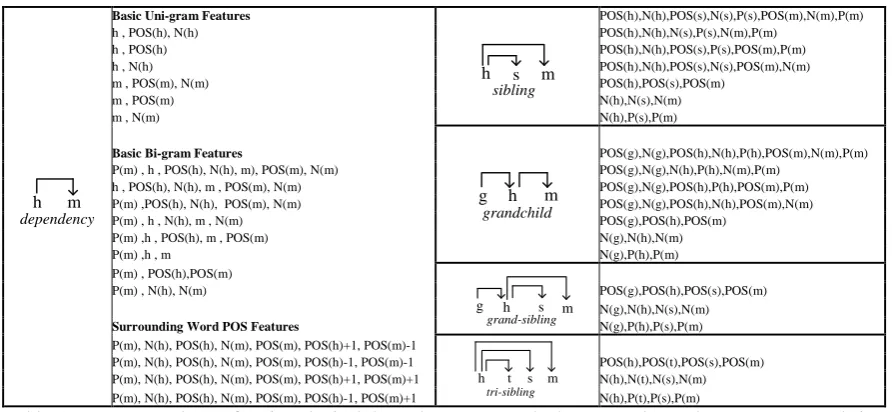
we define certain feature templates, as shown in Table 1. We work with binary indicator features2
( , )x C Φ
for each lexical dependency. The feature vector of constituent tree C can be calculated through the dependency tree D transformed from C using the follow formula:
( )
( , ) ( )
d S D
x C φ d
∈
Φ =
∑
(3)In this formula ( )S D is a set of all the lexical dependencies extracted from D, and d is a lexical dependency in ( )S D . The function
φ
is used to map each lexical dependency d into feature vec-tor according to the templates in Table 1.4
Parse Reranking Algorithms
A critical problem when training the discrimina-tive model in Eq. (1) is the extensive training time required, in which we must parse all the sen-tences in the training set repeatedly. In this paper, we adopt an approximate method: parse rerank-ing. In parse reranking, GEN S( ) in Eq. (1) is an N-best list or a parse forest which provides a small and well-formed search space for constitu-ent parsing. Given this small space, we can
ex-ploit higher-order lexical dependencies
efficiently.
2
Binary indicator features are defined as follows: if a certain feature is observed in an instance, the value of that feature is 1; otherwise, the value is 0.
Algorithm 1: Constituent Tree Evaluating 1: function Eval(C)
2: for P∈Cin bottom up topological order do 3: EvalSubTree (CP)
4: return Score C( )
5:
6: procedure EvalSubTree (CP)
7:
Assume the constituent is P→N1Nn8: Find the head-childNhfor P
9: WP← h N W
10:
BuildingDP11: forNi∈{N1,...,Nn} \Nhdo
12: Link h N D and
i N
D with a dependency arc
13: Annotate the arc with labelNh:P N: i
14: Make the root of h N
D as DP’s root
15: Extract all lexical dependencies for P and map them into feature vector Φ( )P
16:
1
( ) ( ) ( )
i n
P N
i
Score C P α Score C
= = Φ ⋅ +
∑
(a) Constituent tree fragment (b) Lexicalized constituent tree
(c) Labeled dependency tree
B C D E
F G H A
B(w0) C(w1) D(w2) E(w5)
F(w2) G(w3) H(w4) A(w0)
w0 w1 w2 w3 w4 w5
B:A:C B:A:D
[image:3.595.85.279.74.202.2]F:D:G F:D:H B:A:E
[image:3.595.307.514.75.355.2]4.1
N-best Reranking Based onHigher-Order Lexical Dependencies
The method of sub-section 3.1 determines that each constituent sub-tree must have a corres-ponding dependency sub-tree. Accordingly, we now describe an efficient algorithm for evaluat-ing constituent trees with higher-order lexical
dependencies. We define a quadruple
, , ( ),
N N N N
C D score C W
< > for each non-terminal
node N, in which CNis the constituent sub-tree rooted at N; DNis the dependency sub-tree
trans-formed from CN ; score C( N) is the score of
N
C evaluated using Eq. (2); and WN is the
head-word of N in the tree.
Our algorithm (Algorithm 1) works bottom-up to fill <CN,DN,score C( N),WN > for each node N.
For a constituent P in the parse tree, we first find the head-childNhfor P (line 8), then propa-gate the head-word of Nh to P (line 9). To buildDP, we simply build dependency arcs for current constituent P ; then link
1 N
D , …,
n N
D with these dependency arcs; and then let the root of
h N
D be DP’s root (line 11 to line 14). We
extract all the lexical dependencies rooted at P’s head-word WP throughDP. For example, in
Fig-ure 2(b), all the lexical dependencies rooted at node A’s head-word w0
( )P Φ
can be extracted from the dependency tree in Figure 2(c); and all the lexical dependencies have been shown in
Figure 3. Then we map the lexical dependencies into feature vectors and sum over them as the feature vector for P. Finally, we evaluate the score of CP using formula (4) below:
1
( ) ( ) ( )
i n
P N
i
Score C P α Score C
=
= Φ ⋅ +
∑
(4)4.2
Forest Reranking Based on Higher-Order Lexical DependenciesAs mentioned, N-best reranking suffers from the limited scope of N-best list. Forest reranking, by contrast, can rerank a packed forest of exponen-tially many parses, and thus provides a good way to overcome these limitations. Thus we also use the forest reranking method, based on higher-order lexical dependencies.
w0 w1
B:A:C
w0 w2
B:A:D
w0 w5
B:A:E
w0 w2 w5
B:A:D B:A:E
w0 w1 w5
B:A:C B:A:E
w0 w1 w2
B:A:C B:A:D
w0 w2 w4
B:A:D F:D:H
w0 w2 w3
B:A:D F:D:G
w0 w2 w3 w4
B:A:D F:D:G F:D:H
w0 w1 w2 w5
B:A:C B:A:D
B:A:E
dependency
sibling
grand-sibling grandchild
[image:4.595.77.524.76.282.2]tri-sibling
Figure 3. Lexical dependencies for w0 in Figure 2(c).
h m
dependency
Basic Uni-gram Features
h s m
sibling
POS(h),N(h),POS(s),N(s),P(s),POS(m),N(m),P(m) h , POS(h), N(h) POS(h),N(h),N(s),P(s),N(m),P(m)
h , POS(h) POS(h),N(h),POS(s),P(s),POS(m),P(m) h , N(h) POS(h),N(h),POS(s),N(s),POS(m),N(m)
m , POS(m), N(m) POS(h),POS(s),POS(m)
m , POS(m) N(h),N(s),N(m)
m , N(m) N(h),P(s),P(m)
g h m
grandchild
Basic Bi-gram Features POS(g),N(g),POS(h),N(h),P(h),POS(m),N(m),P(m) P(m) , h , POS(h), N(h), m), POS(m), N(m) POS(g),N(g),N(h),P(h),N(m),P(m)
h , POS(h), N(h), m , POS(m), N(m) POS(g),N(g),POS(h),P(h),POS(m),P(m) P(m) ,POS(h), N(h), POS(m), N(m) POS(g),N(g),POS(h),N(h),POS(m),N(m) P(m) , h , N(h), m , N(m) POS(g),POS(h),POS(m)
P(m) ,h , POS(h), m , POS(m) N(g),N(h),N(m)
P(m) ,h , m N(g),P(h),P(m)
P(m) , POS(h),POS(m)
g h s m grand-sibling
P(m) , N(h), N(m) POS(g),POS(h),POS(s),POS(m)
N(g),N(h),N(s),N(m)
Surrounding Word POS Features N(g),P(h),P(s),P(m)
P(m), N(h), POS(h), N(m), POS(m), POS(h)+1, POS(m)-1
h t s m tri-sibling
[image:4.595.313.515.349.531.2]
P(m), N(h), POS(h), N(m), POS(m), POS(h)-1, POS(m)-1 POS(h),POS(t),POS(s),POS(m) P(m), N(h), POS(h), N(m), POS(m), POS(h)+1, POS(m)+1 N(h),N(t),N(s),N(m) P(m), N(h), POS(h), N(m), POS(m), POS(h)-1, POS(m)+1 N(h),P(t),P(s),P(m)
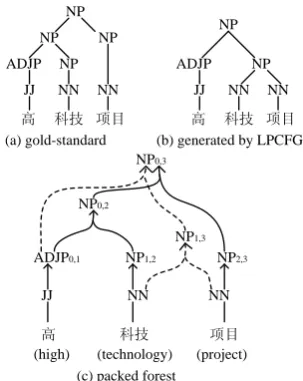
A forest is a compact representation of many parse trees. Figure 4(c) is a sample forest which is the compact representation of the constituent trees shown in Figures 4(a) and 4(b). To obtain forests, Huang (2008) tried to modify the Char-niak parser to output forest directly. Inspired by parser combination methods (Sagae and Lavie, 2006; Fossum and Knight, 2009), we have de-signed a simple method of building forests start-ing from N-best lists. First, we convert each parse tree in an N-best list into context-free productions and label each constituent in each production with its span and syntactic category. Then these converted context-free productions are used to build the forest. For example, in Figure 4, given two candidates (Figure 4(a) and Figure 4(b)), we first convert them into context-free productions, e.g. NP0,3ADJP0,1 NP1,3, NP0,3 NP0,2 NP2,3 and so on. Then we combine these productions into the forest shown in Figure 4(c). The recom-bined forest probably contains some parse trees that are not included in the N-best list, as will be shown in sub-section 6.1.
Our algorithm for forest reranking is similar to Algorithm 1. The only difference is that there may be more than one hyperedge for each node in a forest. So we make use of a beam search al-gorithm (Huang and Chiang, 2005) and store N-best sub-trees for each internal node. Finally, we choose the best-first sub-tree of the root node as the result.
5
Training Algorithm
The training task is to tune the parameter weights α in Eq. (1) using the training examples as evi-dence. We employ the online-learning algorithm shown in Algorithm 2 because it has been proven
to be effective and efficient in many studies (Collins, 2002; Collins and Roark, 2004; McDonald et al., 2005). For Algorithm 2, we de-fine two parameter update strategies (line 5 in Algorithm 2) as follows.
The first strategy is perceptron updating. We first obtain the oracle tree ct+that has the highest F1 score according to the gold-standard tree , ct
1 ( )
arg max ( , )
t
t t
c GEN x
c+ F c c
∈
= (5)
Then we get the highest scoring tree ˆct with cur-rent weights α( )i ,
( ) ( )
ˆ arg max ( , ) t
i
t t
c GEN x
c x c α
∈
= Φ ⋅ (6)
If ˆct is not equal to ct+, the weights will be up-dated through
( 1) ( ) ˆ
( ) ( )
i i
t t
c c
α + ←α + Φ + − Φ (7)
Otherwise, the current weights are kept.
Although the perceptron updating strategy works well, parameter updating must wait until the entire tree has been built. We believe that this strategy probably misses the best opportunity for parameter updating and introduces some noise into the updating procedure. So, inspired by Col-lins and Roark (2004), we propose an early up-dating strategy for forest reranking. The key idea is to insert the parameter updating procedure into the forest reranking procedure. We parse a forest bottom up with the current parameterα( )i . When the best-first sub-tree ˆsNfor internal node N is different from oracle sub-tree sN+, we stop the parsing procedure and update the parameters immediately using the following formula:
( 1) ( ) ˆ
( ) ( )
i i
t t
s s
α + ←α + Φ + − Φ .
Then we continue to parse the current forest with the newer parametersα(i+1). Unlike the percep-tron updating strategy, this strategy updates pa-rameters at the moment that an error sub-tree is built, and this is why we call it the early updating strategy.
Algorithm 2:Generic online learning algorithm 1:Input: training data ( , )x ct t fort=1T
2:α(0)←0; v←0; i←0
initial weights 3: forn in 1…Ndo
N iterations 4: fort in 1…Tdo
T training instances5: α( 1)i+ ←update α( )i according to ( , )x ct t
6: v←v +α( 1)i+ 7: i←i + 1
8:α ←v/(N*T)
averaging weights 9: returnαNP
NP NP
NP ADJP
JJ NN NN
高 科技 项目
NP
NP ADJP
JJ NN NN
高 科技 项目
(a) gold-standard (b) generated by LPCFG
(c) packed forest NP0,3
NP0,2
ADJP0,1 NP1,2
NP1,3
NP2,3
高 科技 项目
JJ NN NN
[image:5.595.92.244.74.265.2](high) (technology) (project)
6
Experiments and Analysis
We evaluate our method on the Penn Chinese Treebank Version 5.0 with the standard division: Art.301-325 as the development set, Art. 271-300 as the test set and others as the training set. All the F1 scores are evaluated with EVALB
3
6.1
To Obtain N-best Lists and Forests.
We first employ existing parsers to generate N-best lists and then recombine the N-N-best lists into forests according to the method described in sub-section 4.2. We split the training set into 20 folds averagely and generate 50-best lists for one fold with both the Berkeley parser4 and the Charniak parser5 (trained on the remaining 19 folds) indi-vidually. The development set and the test set are parsed with models trained on the entire training set.
The oracle F1 scores of N-best lists and forests
on test set are listed in Table 2, where ‘Berke-ley(50)’ means the performance of 50-best lists from Berkeley parser; ‘Charniak(50)’ means the performance of 50-best list from Charniak parser; ‘Comb(100)’ means the performance of 100-best lists by combining the two 50-best lists; “Nbest” means the oracle F1 of N-best lists; and “Forest”
means the oracle F1 of forests which are
eva-luated through the Forest Oracle Algorithm pro-posed in Huang (2008). In Table 2, we can see that the oracle F1
6.2
Parameter Tuning on Development Setscores of forests are much bet-ter than associated N-best lists. This result clearly demonstrates that the approach of obtaining fo-rests by recombining N-best lists is effective.
We tuned some parameters manually for our models in the sub-section, including the number of iterations in the training algorithm, and the beam size k in the forest reranking algorithm. Models are trained with training set’s 100-best lists and evaluated on development set’s 100-best lists.
The F1 score curves varying with iteration
times are shown in Figure 5. Although there are some fluctuations, we can see that the F1
3 http://nlp.cs.nyu.edu/evalb/
score
4
http://code.google.com/p/berkeleyparser/
5
http://bllip.cs.brown.edu/download/reranking-parserAug06.tar.gz
tends to improve with the incremental iteration times, and that the average model yields addi-tional improvement. To avoid the problem of overfitting to the training set, we fix the iteration times at 10 in the following experiments. Figure 6 shows F1
6.3
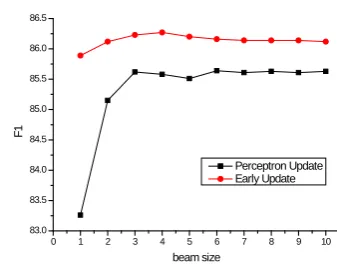
Evaluation on Test Setscore curves varying with beam size. We see that when the beam size exceeds 5, the performance fluctuates slightly, so we fix the beam size at 5 in our experiments. In Figure 6, we can also see that the model trained with the early updating strategy can obtain better perfor-mance than with the perceptron updating strategy.
In this sub-section, we build three parsing sys-tems using the methods described in the previous sections. For brevity, we annotate the N-best re-ranking system trained with the perceptron updat-ing strategy as “NbestRerank”; the forest reranking system trained with the perceptron up-dating strategy as “ForestRerank”; and the forest reranking system trained with the early updating strategy as “EarlyUpdate”. We also employ the Charniak parser (Charniak) and the Berkeley
0 1 2 3 4 5 6 7 8 9 10 83.0
83.5 84.0 84.5 85.0 85.5 86.0 86.5
F
1
beam size
[image:6.595.326.494.87.213.2]Perceptron Update Early Update
Figure 6. The F1 score curves on the development set varying with beam size in forest reranking.
0 1 2 3 4 5 6 7 8 9 10 11 70.0
72.5 75.0 77.5 80.0 82.5 85.0
F
1
Iterator times
Perceptron Update Early Update
[image:6.595.323.492.274.406.2]average
Figure 5. The F1 score curves on the development set varying with iteration times in Algorithm 2.
Berkley(50) Charniak(50) Comb(100)
Nbest 89.13 89.20 91.61
Forest 90.22 90.38 94.05
parser (Berkeley) as our baselines.
Using the parameter configuration tuned on development set, we have evaluated all the sys-tems on test set. The F1 scores are shown in
Ta-ble 3.We can find that the F1 scores are improved
enormously when we make use of higher-order lexical dependencies. No matter which N-best list is used, EarlyUpdate system gets the highest F1
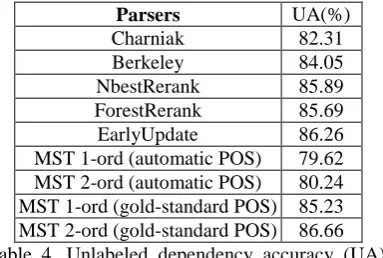
Intuitively, since they benefit from the higher-order lexical dependencies, the generated consti-tuent trees should show better dependency accu-racy as well. So we convert the generated constituent trees into dependency trees and calcu-late their unlabeled dependency accuracy (UA)
. However, the improved ranges vary with N-best list. The improvement is 1.93% for Berkeley parser’s 50-best list, while it is 0.91% for Char-niak parser’s 50-best list. In our opinion, the rea-son is that Charniak parser has made use of head-word information during parsing, so it is less sen-sitive to lexical dependencies than Berkeley pars-er. When we use the combined 100-best lists for training and testing, all the three systems are im-proved. NbestRerank gets 1.55% improvements than Berkeley does, ForestRerank gets 1.04% improvements further than NbestRerank does, and EarlyUpdate makes the final performance up to 85.74%.
6
6
To compare with dependency parsing systems whose
de-.
To demonstrate the effectiveness of our systems, we also train a 1-order MSTPaser7
The figures shown in Table 3 and Table 4 clear-ly reveal that our parsing approach obtains con-stituent trees with both better F
(MST 1-ord) and a 2-order MSTParser (MST 2-ord), and then use them to parse the test set with gold-standard POS tags and automatically annotated POS tags (accuracy is 95.17%). All of the results are shown in Table 4. We see that the UAs of our systems are much better than those of Charniak and Berkeley. Although our systems employ no gold-standard POS tags during parsing, their UAs ex-ceed those of MST 1-ord, which does employ such tags; and the UA of EarlyUpdate is even comparable with those of MST 2-ord, which also employs such tags.
1
6.4
Ablation studiesscores and better UAs.
The experimental results above have shown that reranking parses based on higher-order lexical dependencies is effective. To verify the contribu-tions of different lexical dependency types, we further evaluate the development set using the EarlyUpdate system trained with combined fo-rests. First, we reranked forests with first-order (dependency) lexical dependencies. Then we added the second-order (sibling and grandchild) lexical dependencies into our system. Finally, we added the third-order (grand-sibling and tri-sibling) lexical dependencies. All of the parsing results are shown in Table 5. It is clear that all of the lexical dependency types are helpful for con-stituent tree evaluation.
6.5
Comparison with State-of-the-art Re-sultsTable 6 compares our best results with that of
state-of-the-art parsers. Compared to the
pendency arc labels are different from ours, we simply cal-culate the UAs.
7
http://sourceforge.net/projects/mstparser/
F1(%) Baseline 84.59 +dependency
(first-order) 85.46 +sibling & grandchild
(second-order) 86.20 +grand-sibling & tri-sibling
[image:7.595.343.490.73.172.2](third-order) 86.37
Table 5. F1 (%) score on development set of the EarlyUpdate system using different lexical depen-dency types.
Parsers UA(%) Charniak 82.31 Berkeley 84.05 NbestRerank 85.89 ForestRerank 85.69 EarlyUpdate 86.26 MST 1-ord (automatic POS) 79.62 MST 2-ord (automatic POS) 80.24 MST 1-ord (gold-standard POS) 85.23 MST 2-ord (gold-standard POS) 86.66 Table 4. Unlabeled dependency accuracy (UA). NbestRerank, ForestRerank and EarlyUpdate are trained and tested with combined 100-best lists
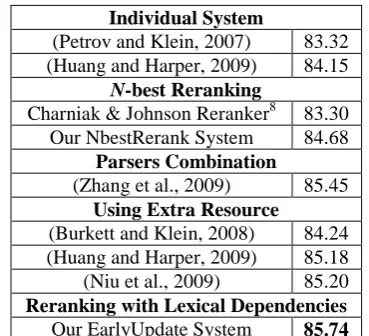
[image:7.595.76.290.76.201.2] [image:7.595.85.277.229.358.2]“Charniak & Johnson Reranker” 8 which is a parse reranking system and exploits various sorts of features including 1-order lexical dependen-cies (Charniak and Johnson, 2005), our NbestRe-rank parser, which uses higher-order lexical dependency features, gets a higher F1
7
Conclusion and Future Work
. Compar-ing with the parsers combination system (Zhang et al., 2009) which combines scores evaluated by Berkeley parser and Charniak parser to evaluate a parse tree, our EarlyUpdate system haven’t used scores evaluated by first stage parsers and still gets a higher F1 score. Although our EarlyUpdate system uses no resources other than CTB, it still obtains better results than other parsers which have employed extra resources (Burkett and Klein, 2008; Huang and Harper, 2009; Niu et al., 2009). These comparisons allow us to confident-ly conclude that exploitation of higher-order lexi-cal dependencies is highly beneficial for constituent parsing.
We have presented a method for evaluating con-stituent trees using higher-order lexical depen-dencies. Within a parse reranking framework, our models rerank N-best lists and forests based on dependency features. Experimental results show that higher-order lexical dependencies can yield greater improvements in constituent parsing per-formance than commonly used first-order lexical dependencies. The best results of our models outperformed all previous results on the CTB, and the dependency accuracy of generated consti-tuent trees is significantly improved as well. All of the results demonstrate that exploitation of
8 The F1 score of Charniak & Johnson Reranker on CTB
was reported in Niu et al. (2009).
higher-order lexical dependencies provides sig-nificant benefits for constituent tree evaluation.
Although all of our experiments were carried out only on the Chinese Treebank, our method is language independent. It can be adapted to any languages which can represent constituent trees with labeled dependency trees. We will apply our methods to other languages in the future.
Acknowledgments
The research work has been funded by the Natu-ral Science Foundation of China under Grant No. 60975053 and 61003160, supported by the Ex-ternal Cooperation Program of the Chinese Academy of Sciences, and also partially sup-ported by the China-Singapore Institute of Digital Media (CSIDM) project under grant No. CSIDM-200804 as well. Sincere thanks to Mark Seligman for his careful revision work.
References
Daniel M. Bikel, 2004. Intricacies of Collins' parsing model. Computational Linguistics, 30 (4). pages 479-511.
David Burkett and Dan Klein, 2008. Two languages are better than one (for syntactic parsing). In EMNLP 2008.
Eugene Charniak, 2000. A maximum-entropy-inspired parser. In NAACL 2000.
Eugene Charniak and Mark Johnson, 2005. Coarse-to-fine n-best parsing and MaxEnt discriminative re-ranking. In ACL 2005.
Michael Collins, 1999. Head-driven statistical models for natural language parsing. University of Penn-sylvania.
Michael Collins, 2002. Discriminative training me-thods for hidden markov models: Theory and expe-riments with perceptron algorithms. In EMNLP 2002.
Michael John Collins, 1996. A new statistical parser based on bigram lexical dependencies. In ACL 1996, pages 184-191.
Michael Collins and Terry Koo, 2005. Discriminative reranking for natural language parsing. Computa-tional Linguistics, 31 (1). pages 25-70.
Michael Collins and Brian Roark, 2004. Incremental parsing with the perceptron algorithm. In ACL 2004.
Victoria Fossum and Kevin Knight, 2009. Combining constituent parsers. In NAACL 2009, pages 253-256.
Individual System
(Petrov and Klein, 2007) 83.32 (Huang and Harper, 2009) 84.15
N-best Reranking
Charniak & Johnson Reranker8 83.30 Our NbestRerank System 84.68
Parsers Combination
(Zhang et al., 2009) 85.45 Using Extra Resource
(Burkett and Klein, 2008) 84.24 (Huang and Harper, 2009) 85.18 (Niu et al., 2009) 85.20 Reranking with Lexical Dependencies
[image:8.595.87.272.72.240.2]Johan Hall and Joakim Nivre, 2008. A dependency-driven parser for German dependency and constitu-ency representations. In PaGe-08, pages 47-54.
Johan Hall, Joakim Nivre and Jens Nilsson, 2007. A Hybrid Constituency-Dependency Parser for Swe-dish. In NODALIDA 2007, pages 284-287.
Liang Huang, 2008. Forest reranking: Discriminative parsing with non-local features. In ACL 2008.
Liang Huang and David Chiang, 2005. Better k-best parsing. In IWPT 2005.
Zhongqiang Huang and Mary Harper, 2009. Self-Training PCFG grammars with latent annotations across languages. In ACL 2009.
Daniel Jurafsky and James H. Martin, 2008. Speech and Language Processing: An introduction to natu-ral language processing, computational linguistics, and speech recognition: Prentice Hall.
Dan Klein and Christopher D. Manning, 2003a. Accu-rate unlexicalized parsing. In ACL2003, pages 423-430.
Dan Klein and Christopher D. Manning, 2003b. Fast exact inference with a factored model for natural language parsing. In NIPS 2003.
Terry Koo and Michael Collins, 2010. Efficient Third-Order Dependency Parsers. In ACL 2010.
Takuya Matsuzaki, Yusuke Miyao and Jun'ichi Tsujii, 2005. Probabilistic CFG with latent annotations. In ACL 2005.
Ryan McDonald, Koby Crammer and Fernando Perei-ra, 2005. Online large-margin training of depen-dency parsers. In ACL 2005.
Ryan McDonald and Fernando Pereira, 2006. Online learning of approximate dependency parsing algo-rithms. In EACL 2006.
Zheng-Yu Niu, Haifeng Wang and Hua Wu, 2009. Exploiting heterogeneous treebanks for parsing. In ACL 2009.
Slav Petrov, Leon Barrett, Romain Thibaux and Dan Klein, 2006. Learning accurate, compact, and in-terpretable tree annotation. In ACL 2006.
Slav Petrov and Dan Klein, 2007. Improved inference for unlexicalized parsing. In ACL 2007.
Kenji Sagae and Alon Lavie, 2006. Parser combina-tion by reparsing. In NAACL 2006, pages 129-132.
Rui Wang and Yi Zhang, 2010. Hybrid Constituent and Dependency Parsing with Tsinghua Chinese Treebank. In LREC 2010.
Zhiguo Wang and Chengqing Zong, 2010. Phrase Structure Parsing with Dependency Structure. In Coling 2010.
Fei Xia and Martha Palmer, 2001. Converting depen-dency structures to phrase structures. In The 1st Human Language Technology Conference (HLT-2001).
Fei Xia, Owen Rambow, Rajesh Bhatt, Martha Palmer and Dipti Misra Sharma, 2008. Towards a multi-representational treebank. Proc. of the 7th Int'lWorkshop on Treebanks and Linguistic Theo-ries (TLT-7). pages.
Hiroyasu Yamada and Yuji Matsumoto, 2003. Statis-tical dependency analysis with support vector ma-chines. In IWPT 2003.
Hui Zhang, Min Zhang, Chew Lim Tan and Haizhou Li, 2009. K-best combination of syntactic parsers. In EMNLP 2009.