Using Syntactic and Shallow Semantic Kernels to Improve Multi-Modality
Manifold-Ranking for Topic-Focused Multi-Document Summarization
Yllias Chali University of Lethbridge Lethbridge, AB, Canada [email protected]
Sadid A. Hasan University of Lethbridge
Lethbridge, AB, Canada [email protected]
Kaisar Imam University of Lethbridge
Lethbridge, AB, Canada [email protected]
Abstract
Multi-modality manifold-ranking is re-cently used successfully in topic-focused multi-document summarization. This ap-proach is based on Bag-Of-Words (BOW) assumption where the pair-wise similar-ity values between sentences are computed using the standard cosine similarity mea-sure (TF*IDF). However, the major lim-itation of the TF*IDF approach is that it only retains the frequency of the words and disregards the syntactic and semantic information. In this paper, we propose the use of syntactic and shallow semantic ker-nels for computing the relevance between the sentences. We argue that the addi-tion of syntactic and semantic informaaddi-tion can improve the performance of the multi-modality manifold-ranking algorithm. Ex-tensive experiments on the DUC bench-mark datasets prove the effectiveness of our approach.
1 Introduction
Text summarization is a good way to compress a huge amount of information into a concise form by selecting the most important information and discarding redundant information. According to Mani (2001), automatic text summarization takes a partially-structured source text from multiple texts written about the same topic, extracts in-formation content from it, and presents the most important content to the user in a manner sensi-tive to the user’s needs. In contrast to summariz-ing one document that is termed as ssummariz-ingle docu-ment summarization, multi-docudocu-ment summariza-tion deals with multiple documents as sources that are related to one main topic under consideration. As compared to generic summarization that must contain the core information central to the source
documents, the main goal of topic-focused document summarization (i.e. query-based multi-document summarization) is to create from the documents a summary that can answer the need for information expressed in the topic or explain the topic (Wan et al., 2007). In this paper, we con-sider the problem of producing extraction-based1 topic-focused multi-document summaries given a collection of documents.
In recent years, a variety of manifold-ranking based methods are applied successfully to topic-focused multi-document summarization. The ba-sic manifold-ranking method is a typical graph-based summarization method that makes uni-form use of the sentence-to-sentence relation-ships and the sentence-to-topic relationrelation-ships in a manifold-ranking process (Wan et al., 2007). In the multi-modality manifold-ranking algorithm, sentence relationships are classified into within-document relationships and cross-within-document re-lationships, and each kind of relationships are considered as a separate modality (graph) (Wan and Xiao, 2009). These methods are based on Bag-Of-Words (BOW) assumption where the pair-wise similarity values between the sentences are computed using the standard cosine measure (TF*IDF). The major limitation of the TF*IDF ap-proach is that it only retains the frequency of the words and does not take into account the sequence of them (word ordering). It ignores the syntactic and semantic structure of the sentences and thus, cannot distinguish between “The police shot the gunman” and “The gunman shot the police”. Tra-ditionally, information extraction techniques are based on the BOW approach augmented by lan-guage modeling. But when the task like multi-document summarizationrequires the use of more
1An extract summary consists of sentences extracted from
the document while an abstract summary employs words and phrases not appearing in the original document (Mani and Maybury, 1999).
complex semantics, the approaches based on only BOW are often inadequate to perform fine-level textual analysis. Although some improvements on BOW are given by the use of dependency trees and syntactic parse trees (Hirao et al., 2004), (Pun-yakanok et al., 2004), (Zhang and Lee, 2003b), but these too are not adequate in terms of docu-ments having very long and articulated sentences or even paragraphs. Shallow semantic representa-tions could prevent the sparseness of deep struc-tural approaches and the weakness of BOW mod-els (Moschitti et al., 2007). Thus, attempting an application of syntactic and semantic information in measuring the relevance between the sentences seems natural and hardly controversial.
In this paper, we extensively study the impact of syntactic and semantic information in computing the similarity between the sentences in the multi-modality manifold learning framework for topic-focused multi-document summarization. We be-lieve that the augmentation of the similarity mea-sures based on the syntactic and semantic infor-mation could be helpful to characterize the re-lation between the sentences in a more effective way than the traditional TF*IDF based similarity measures alone. To include syntactic and seman-tic information into the multi-modality manifold-ranking framework, we apply the tree kernel func-tions (Collins and Duffy, 2001) and re-implement the syntactic and shallow semantic tree kernel model according to Moschitti et al. (2007). We run our experiments on the DUC2-2006 bench-mark dataset, and the results show that the ad-dition of syntactic and semantic information im-proves the performance of the BOW-based multi-modality manifold-ranking approach. The rest of this paper is organized as follows: Section 2 fo-cuses on the related work, Section 3 describes the multi-modality manifold ranking model, Section 4 discusses the syntactic and shallow semantic ker-nels, Section 5 presents the experimental details with evaluation results and finally, Section 6 con-cludes the paper.
2 Related Work
In recent years, researchers have become more interested in topic-focused summarization and hence, different methods have been proposed ranging from heuristic extensions of generic summarization schemes (by incorporating
topic-2http://duc.nist.gov/
biased information) to novel ones. For instance, Nastase (2008) expands the query by using ency-clopedic knowledge in Wikipedia and use the topic expanded words with activated nodes in the graph to produce an extractive summary. Hal Daum´e and Marcu (2006) present BAYESUM (“Bayesian summarization”), a sentence extraction model for query-focused summarization.
Wan et al. (2007) propose a manifold-ranking method to make uniform use of sentence-to-sentence and sentence-to-sentence-to-topic relationships whereas the use of multi-modality manifold-ranking algorithm is shown in Wan and Xiao (2009). However, these methods use the standard cosine similarity measure to compute the relatedness between the sentences ignoring the syntactic and semantic information. The importance of syntactic and semantic features in finding textual similarity is described by Zhang and Lee (2003a), Moschitti et al. (2007), and Moschitti and Basili (2006). An effective way to integrate syntactic and semantic structures in machine learning algorithms is the use of tree kernel functions (Collins and Duffy, 2001) which has been successfully applied to question classification (Zhang and Lee, 2003a; Moschitti and Basili, 2006). In this paper, we use the tree kernel functions and to the best of our knowledge, no study has used tree kernel functions before to encode syntactic/semantic information for more complex tasks such as computing the relatedness between the sentences in the multi-modality manifold ranking algorithm for topic-focused multi-document summarization.
3 Multi-Modality Manifold-Ranking Model
In this section, we present the theoretical de-tails of the manifold-ranking method (Zhou et al., 2003a; Zhou et al., 2003b), a universal rank-ing algorithm. This method is employed to rank data points and has been successfully applied in topic-focused document summarization in Wan et al. (2007) where the data points refer to the topic description and all the sentences in the documents. The manifold-ranking process for the summariza-tion task can be formalized as follows (Wan and Xiao, 2009):
Given a set of data points 𝜒 = {𝑥0, 𝑥1,⋅ ⋅ ⋅, 𝑥𝑛} ⊂ 𝑅𝑚, the first point 𝑥0
the rest𝑛points represent all the sentences in the documents (data points to be ranked). The basic manifold-ranking algorithm treats the sentence relationships in a single modality (Wan et al., 2007) whereas, in Wan and Xiao (2009), the relationships between the sentences in a document set are classified as either within-document relationship or cross-document relationship to form two separate modalities to reflect the local information channel and the global information channel between the sentences, respectively. The two modalities are applied in the multi-modality manifold-ranking algorithm for ranking the sentences effectively. Based on each kind of modality, an undirected graph is built to reflect each kind of sentence relationships. Let
𝑊𝑎=[𝑊𝑖𝑗𝑎]
(𝑛+1)×(𝑛+1)be the within-document
affinity matrix containing only the within-document links for the𝑛+ 1data points, where
𝑊𝑖𝑗𝑎 is the cosine similarity3 value between 𝑥𝑖 and𝑥𝑗 if𝑥𝑖 and𝑥𝑗 belong to the same document or one of 𝑥𝑖 and𝑥𝑗 is 𝑥0; Otherwise, 𝑊𝑖𝑗𝑎 is set to 0. Similarly, let 𝑊𝑏 = [𝑊𝑖𝑗𝑏]
(𝑛+1)×(𝑛+1) be
the cross-document affinity matrix containing the cross-document links, where 𝑊𝑖𝑗𝑏 is the
cosine similarity value between 𝑥𝑖 and 𝑥𝑗 if 𝑥𝑖 and 𝑥𝑗 belong to different documents or one of 𝑥𝑖 and 𝑥𝑗 is 𝑥0; Otherwise, 𝑊𝑖𝑗𝑏 is set to 0. All the relationships between the topic, 𝑥0 and
any document sentence 𝑥𝑖(𝑖≥1) are included and 𝑊𝑏, respectively. Then the multi-modality
learning task for topic-focused summarization is to infer the ranking function𝑓 from𝑊𝑎,𝑊𝑏 and
𝑦:{(𝑊𝑎, 𝐷𝑎, 𝑆𝑎) ;(𝑊𝑏, 𝐷𝑏, 𝑆𝑏);𝑦}→𝑓.
Linear Fusion: For fusing the two modalities, we use the linear fusion scheme as this was shown to perform the best in Wan and Xiao (2009). This scheme fuses the constraints from 𝑆𝑎, 𝑆𝑏 and 𝑦 simultaneously by a weighted sum. The cost func-tion associated with𝑓 is defined as:
3We augment syntactic and/or semantic information with
this measure in our proposed model using the syntactic and/or shallow semantic kernels described in Section 4 and argue that the combined measure performs better.
𝑄(𝑓) =𝜇⋅
where𝜇,𝜂, and𝜃capture the trade-off between the constraints4.
As discussed previously, the basic multi-modality manifold-ranking model lacks sensitiv-ity to the context in which the words appear since it is solely based on the BOW assumption. It ignores the internal structure of the sentences and does not consider word orders. Our aim in this paper is to propose a similarity measure in which syntactic and/or semantic information can be added to enhance the multi-modality manifold-ranking model by encoding the relational informa-tion between the words in sentences. We claim that for a complex task like topic-focused multi-document summarization where the relatedness between the document sentences is an important factor, the multi-modality manifold algorithm for ranking sentences would perform more effectively if we could incorporate the syntactic and seman-tic information with the standard cosine measure (i.e. TF*IDF) in calculating the similarity between sentences. In the next section, we describe how we can encode syntactic and semantic structures in calculating the similarity between sentences.
4 Syntactic and Shallow Semantic Structures
Given a sentence (or query5), we first parse it into a syntactic tree using a parser like (Charniak, 1999) and then, calculate the similarity between the two trees using the tree kernel (discussed in Section 4.1). However, syntactic information is often not adequate when dealing with long and articulated sentences or paragraphs. Shallow se-mantic representations, bearing a more compact information, could prevent the sparseness of deep structural approaches (Moschitti et al., 2007). Ini-tiatives such as PropBank (PB) (Kingsbury and Palmer, 2002) have made possible the design of accurate automatic Semantic Role Labeling (SRL) systems like ASSERT (Hacioglu et al., 2003).
4The first two terms of the right-hand side in the cost
func-tion are the smoothness constraints for the two modalities while the last term denotes the fitting constraint.
5The query is denoted as the first point in the data space
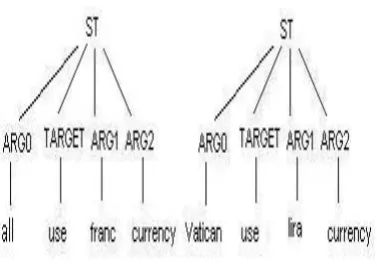
Figure 1: Example of semantic trees
For example, consider the PB annotation:
[ARG0 all][TARGET use][ARG1 the french franc][ARG2 as their currency]
Such annotation can be used to design a shal-low semantic representation that can be matched against other semantically similar sentences, e.g.
[ARG0 the Vatican][TARGET use] [ARG1 the Italian lira][ARG2 as their currency]
In order to calculate the semantic similarity be-tween the sentences, we first represent the anno-tated sentence (or query) using the tree structures like Figure 1 which we call Semantic Tree (ST). In the semantic tree, arguments are replaced with the most important word-often referred to as the se-mantic head. We look for noun first, then verb, then adjective, then adverb to find the semantic head in the argument. If none of these is present, we take the first word of the argument as the se-mantic head. This reduces the data sparseness with respect to a typical cosine measure represen-tation used in the basic multi-modality manifold-ranking model.
4.1 Tree Kernels
Once we build the trees (syntactic or semantic), our next task is to measure the similarity be-tween the trees. For this, every tree 𝑇 is
rep-resented by an 𝑚 dimensional vector 𝑣(𝑇) = (𝑣1(𝑇), 𝑣2(𝑇),⋅ ⋅ ⋅𝑣𝑚(𝑇)), where the i-th element
𝑣𝑖(𝑇)is the number of occurrences of the i-th tree fragment in tree𝑇. The tree fragments of a tree
are all of its sub-trees which include at least one production with the restriction that no production
Figure 2: (a) An example tree (b) The sub-trees of the NP covering “the press”.
rules can be broken into incomplete parts. Fig-ure 2 shows an example tree and a portion of its subtrees.
Implicitly we enumerate all the possible tree fragments 1,2,⋅ ⋅ ⋅ , 𝑚. These fragments are the
axis of this m-dimensional space. Note that this needs to be done only implicitly, since the num-ber𝑚is extremely large. Because of this, (Collins
and Duffy, 2001) defines the tree kernel algorithm whose computational complexity does not depend on𝑚.
The tree kernel of two trees𝑇1and𝑇2is actually
the inner product of𝑣(𝑇1)and𝑣(𝑇2):
𝑇 𝐾(𝑇1, 𝑇2) =𝑣(𝑇1).𝑣(𝑇2) (2)
We define the indicator function 𝐼𝑖(𝑛) to be 1 if the sub-tree 𝑖 is seen rooted at node 𝑛 and 0
otherwise. It follows:
𝑣𝑖(𝑇1) =
∑
𝑛1∈𝑁1
𝐼𝑖(𝑛1)
𝑣𝑖(𝑇2) =
∑
𝑛2∈𝑁2
𝐼𝑖(𝑛2)
where,𝑁1and𝑁2are the set of nodes in𝑇1and
𝑇 𝐾(𝑇1, 𝑇2) = 𝑣(𝑇1).𝑣(𝑇2)
= ∑
𝑖
𝑣𝑖(𝑇1)𝑣𝑖(𝑇2)
= ∑
𝑛1∈𝑁1 ∑
𝑛2∈𝑁2 ∑
𝑖
𝐼𝑖(𝑛1)𝐼𝑖(𝑛2)
= ∑
𝑛1∈𝑁1 ∑
𝑛2∈𝑁2
𝐶(𝑛1, 𝑛2) (3)
where, we define𝐶(𝑛1, 𝑛2)=∑𝑖𝐼𝑖(𝑛1)𝐼𝑖(𝑛2).
Next, we note that𝐶(𝑛1, 𝑛2)can be computed in
polynomial time, due to the following recursive definition:
1. If the productions at𝑛1 and𝑛2 are different
then𝐶(𝑛1, 𝑛2) = 0
2. If the productions at 𝑛1 and 𝑛2 are the
same, and𝑛1 and𝑛2 are pre-terminals, then
𝐶(𝑛1, 𝑛2) = 1
3. Else if the productions at𝑛1 and𝑛2 are not
pre-terminals,
𝐶(𝑛1, 𝑛2) =
𝑛𝑐(𝑛1)
∏
𝑗=1
(1 +𝐶(𝑐ℎ(𝑛1, 𝑗), 𝑐ℎ(𝑛2, 𝑗))) (4)
where, 𝑛𝑐(𝑛1) is the number of children of𝑛1
in the tree; because the productions at 𝑛1 and𝑛2
are the same, we have𝑛𝑐(𝑛1) =𝑛𝑐(𝑛2). The i-th
child-node of𝑛1is𝑐ℎ(𝑛1, 𝑖). TK is the similarity
value (tree kernel) between the sentences𝑠(and/or
the query sentence𝑞) based on the syntactic
struc-ture. For example, for the following sentence 𝑠
and query𝑞we get the following score:
Query (q): Describe steps taken and worldwide reaction prior to introduction of the Euro on January 1, 1999. Include predictions and ex-pectations reported in the press.
Sentence (s): Europe’s new currency, the euro, will rival the U.S. dollar as an international currency over the long term, Der Spiegel magazine reported Sunday.
Score: 65.5
4.2 Shallow Semantic Tree Kernel (SSTK)
The tree kernel (TK) function computes the num-ber of common subtrees between two trees. Such subtrees are subject to the constraint that their nodes are taken with all or none of the children
they have in the original tree. Though, this defini-tion of subtrees makes the TK funcdefini-tion appropriate for syntactic trees but at the same time makes it not well suited for the semantic trees (ST). The criti-cal aspect of steps (1), (2) and (3) of the TK func-tion is that the producfunc-tions of two evaluated nodes have to be identical to allow the match of further descendants. This means that common substruc-tures cannot be composed by a node with only some of its children as an effective ST representa-tion would require. (Moschitti et al., 2007) solve this problem by designing the Shallow Semantic Tree Kernel (SSTK) which allows to match por-tions of a ST. The SSTK is based on two ideas: first, it changes the ST by adding SLOT nodes. These accommodate argument labels in a specific order i.e. it provides a fixed number of slots, possi-bly filled withnullarguments, that encode all pos-sible predicate arguments. Leaf nodes are filled with the wildcard character * but they may alterna-tively accommodate additional information. The slot nodes are used in such a way that the adopted TK function can generate fragments containing one or more children. As previously pointed out, if the arguments were directly attached to the root node, the kernel function would only generate the structure with all children (or the structure with no children, i.e. empty). Second, as the original tree kernel would generate many matches with slots filled with the null label, we have set a new step 0 in the TK calculation:
(0) if𝑛1(or𝑛2) is a pre-terminal node and its child
label isnull,𝐶(𝑛1, 𝑛2) = 0;
and subtract one unit to𝐶(𝑛1, 𝑛2), in step 3:
(3)𝐶(𝑛1, 𝑛2) =
𝑛𝑐∏(𝑛1)
𝑗=1
(1+𝐶(𝑐ℎ(𝑛1, 𝑗), 𝑐ℎ(𝑛2, 𝑗)))−1
The above changes generate a new C which, when substituted (in place of originalC) in Eq. 3, gives the new SSTK. For example, for the follow-ing sentence 𝑠 and query 𝑞 we get the semantic
score:
Query (q): Describe steps taken and worldwide reaction prior to introduction of the Euro on January 1, 1999. Include predictions and ex-pectations reported in the press.
history of European civilization and abstract or concrete paintings.
Score: 9
5 Experiments and Results
5.1 Task Description
In this paper, we re-implement the multi-modality manifold ranking algorithm for topic-focused multi-document summarization by encoding the syntactic and semantic information to measure sentence relationships. We use the linear approach for fusing the modalities as this was shown to per-form the best (Wan and Xiao, 2009). The purpose of our experiments is to study the impact of the syntactic and semantic representation in the multi-modality manifold-ranking framework.
Over the past three years, complex ques-tions have been the focus of much attention in both the automatic question-answering and multi-document summarization (MDS) communities. While most current complex QA evaluations (in-cluding the 2004 AQUAINT Relationship QA Pi-lot, the 2005 Text Retrieval Conference (TREC) Relationship QA Task, and the 2006 GALE Dis-tillation Effort) require systems to return unstruc-tured lists of candidate answers in response to a complex question, recent MDS evaluations (in-cluding the 2005, 2006 and 2007 Document Un-derstanding Conferences (DUC)) have tasked sys-tems with returning paragraph-length answers to complex questions that are responsive, relevant, and coherent. The DUC conference series is run by the National Institute of Standards and Tech-nology (NIST) to further progress in summariza-tion and enable researchers to participate in large-scale experiments. We use the main task of DUC 2006 for evaluation. The task was: “Given a complex question (topic description) and a collec-tion of relevant documents, the task is to synthe-size a fluent, well-organized 250-word summary of the documents that answers the question(s) in the topic”. To accomplish this task, we generate summaries for a subset of 10 topics of DUC 2006 dataset by each of our six systems as defined be-low:
(1) COSINE: This system is the original multi-modality manifold ranking method described in Section 3 that uses the standard cosine similarity measure based on TF*IDF and does not consider the syntactic/semantic information.
(2) SYN:This system measures the similarity be-tween the sentences using the syntactic tree and the general tree kernel function defined in Sec-tion 4.1.
(3) SEM:This system measures the similarity be-tween the sentences using the shallow semantic treeand theshallow semantic tree kernelfunction defined in Section 4.2.
(4) COSINE+SYN: This system measures the similarity between the sentences using both stan-dard cosine similarity measure and the syntactic tree kernel.
(5) COSINE+SEM: This system measures the similarity between the sentences using both stan-dard cosine similarity measure and the shallow se-mantic tree kernel.
(6) COSINE+SYN+SEM:This system measures the similarity between the sentences using stan-dard cosine similarity measure, syntactic tree ker-nel, and shallow semantic tree kernel.
5.2 Automatic Evaluation
We carried out automatic evaluation of our candi-date summaries using ROUGE (Lin, 2004) toolkit, which has been widely adopted for automatic summarization evaluation. ROUGE stands for “Recall-Oriented Understudy for Gisting Evalua-tion”. It is a collection of measures that determines the quality of a summary by comparing it to ref-erence summaries created by humans. The mea-sures count the number of overlapping units such as n-gram, word-sequences, and word-pairs be-tween the system-generated summary to be eval-uated and the ideal summaries created by humans. For all our systems, we report the widely accepted important metrics: ROUGE-2 and ROUGE-SU. We also present the ROUGE-1 scores since this has a high correlation with the human judgement. All the ROUGE measures were calculated by run-ning ROUGE-1.5.5 with stemming but no removal of stopwords. ROUGE run-time parameters were set as the same as DUC 2007 evaluation setup. They are:
ROUGE-1.5.5.pl -2 -1 -u -r 1000 -t 0 -n 4 -w 1.2 -m -l 250 -a
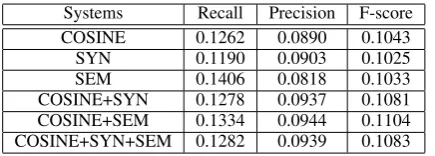
Table 1 to Table 3 show the ROUGE-1, ROUGE-2, and ROUGE-SU scores of our six dif-ferent systems. In the experiments, the regularized parameter for the fitting constraint is fixed at 0.4, as in Wan et al. (2007). We kept𝜇=𝜂= 0.3as it
linear fusion scheme in Wan and Xiao (2009).
Systems Recall Precision F-score COSINE 0.3619 0.3043 0.3305
SYN 0.3571 0.3105 0.3320
SEM 0.3814 0.2909 0.3299
COSINE+SYN 0.3627 0.3105 0.3346 COSINE+SEM 0.3737 0.3140 0.3412 COSINE+SYN+SEM 0.3648 0.3117 0.3360
Table 1: ROUGE-1 measures
Systems Recall Precision F-score COSINE 0.0584 0.0488 0.0532
SYN 0.0638 0.0558 0.0595
SEM 0.0732 0.0555 0.0631
COSINE+SYN 0.0611 0.0522 0.0563 COSINE+SEM 0.0691 0.0581 0.0631 COSINE+SYN+SEM 0.0658 0.0560 0.0605
Table 2: ROUGE-2 measures
Systems Recall Precision F-score COSINE 0.1262 0.0890 0.1043
SYN 0.1190 0.0903 0.1025
SEM 0.1406 0.0818 0.1033
COSINE+SYN 0.1278 0.0937 0.1081 COSINE+SEM 0.1334 0.0944 0.1104 COSINE+SYN+SEM 0.1282 0.0939 0.1083
Table 3: ROUGE-SU measures
For all the systems, Table 4 shows the F-scores of the reported ROUGE measures. From these re-sults, we clearly see the positive impact of syntac-tic and semansyntac-tic information in the multi-modality manifold ranking method for topic-focused multi-document summarization. The SYN system im-proves the ROUGE-1 and ROUGE-2 scores over the COSINE system by 0.45%, and 11.84% while underperforms the ROUGE-SU score by 1.75% respectively. The SEM system improves the ROUGE-2 scores over the COSINE system by 18.60% while underperforms the ROUGE-1 and ROUGE-SU scores by 0.18%, and 0.96% respec-tively. The COSINE+SYN system improves the ROUGE-1, ROUGE-2, and ROUGE-SU scores over the COSINE system by 1.24%, 5.82%, and 3.64% respectively. The COSINE+SEM sys-tem improves the ROUGE-1, ROUGE-2, and ROUGE-SU scores over the COSINE system by 3.23%, 18.60%, and 5.84% respectively. Lastly, the COSINE+SYN+SEM system improves the ROUGE-1, ROUGE-2, and ROUGE-SU scores over the COSINE system by 1.66%, 13.72%, and 3.83% respectively. Deep analysis of all these
re-sults yields that the proposed systems (that encode the syntactic and/or semantic information in the multi-modality manifold ranking framework) con-siderablely outperform the standard cosine simi-larity based manifold approach. The results also denote that encoding the syntactic and/or seman-tic information on top of the standard cosine sim-ilarity measure often outperform the systems that consider only syntactic and/or semantic informa-tion. From all our six systems, we can see that the SEM and COSINE+SEM are the best per-forming systems on average while performance of theCOSINE+SYN+SEM decreases a bit indi-cating the fact that encoding both syntactic and semantic information on top of the standard co-sine similarity measure has a negative impact on the multi-modality manifold ranking method. This may be due to the fact that the SYN system does not perform too well as seen from the results and thus deteriorates the performance of the CO-SINE+SYN+SEM system.
Systems R-1 R-2 R-SU
COSINE 0.3305 0.0532 0.1043 SYN 0.3320 0.0595 0.1025 SEM 0.3299 0.0631 0.1033 COSINE+SYN 0.3346 0.0563 0.1081 COSINE+SEM 0.3412 0.0631 0.1104 COSINE+SYN+SEM 0.3360 0.0605 0.1083
Table 4: ROUGE F-scores for different systems
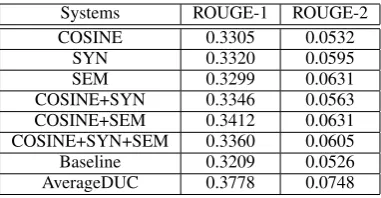
In Table 5, the proposed methods are compared with the NIST baseline. The NIST baseline is the official baseline system established by NIST that generated the summaries by returning all the lead-ing sentences (up to 250 words) in the⟨𝑇 𝐸𝑋𝑇⟩
field of the most recent document(s). We also list the average ROUGE scores of all the participating systems for DUC-2006 (i.e. AverageDUC). From the tables, we can see that the proposed multi-modality manifold ranking methods based on the syntactic and semantic measures mostly outper-form the NIST baseline system. They can also achieve higher ROUGE scores as comparable to the average scores of all the participating systems of DUC-2006.
com-Systems ROUGE-1 ROUGE-2
COSINE 0.3305 0.0532
SYN 0.3320 0.0595
SEM 0.3299 0.0631
COSINE+SYN 0.3346 0.0563 COSINE+SEM 0.3412 0.0631 COSINE+SYN+SEM 0.3360 0.0605 Baseline 0.3209 0.0526 AverageDUC 0.3778 0.0748
Table 5: System comparison (F-scores)
pute the confidence interval. Bootstrap resam-pling has a long tradition in the field of statistics (Efron and Tibshirani, 1994). We use 1000 sam-pling points in the bootstrap resamsam-pling. Table 6 reports the 95% confidence intervals of the impor-tant ROUGE measures.
Systems R-2 R-SU
COSINE 0.0401 - 0.0682 0.0854 - 0.1207 SYN 0.0439 - 0.0802 0.0845 - 0.1313 SEM 0.0530 - 0.0753 0.0928 - 0.1128 COSINE+SYN 0.0366 - 0.0805 0.0918 - 0.1286 COSINE+SEM 0.0499 - 0.0799 0.0873 - 0.1328 COSINE+SYN+SEM 0.0436 - 0.0795 0.0949 - 0.1205
Table 6: 95% confidence intervals for different systems
5.3 Manual Evaluation
Even if the ROUGE scores had significant im-provement, it is possible to make bad summaries that get state-of-the-art ROUGE scores (Sj¨obergh, 2007). So, we conduct an extensive manual eval-uation in order to analyze the effectiveness of our systems. Two university graduate students judged the summaries for linguistic quality and overall re-sponsiveness according to the DUC-2007 evalu-ation guidelines6. The given score is an integer between 1 (very poor) and 5 (very good) and is guided by consideration of the following factors: 1. Grammaticality, 2. Non-redundancy, 3. Refer-ential clarity, 4. Focus and 5. Structure and Coher-ence. They also assigned a content responsiveness score to each of the automatic summaries. The content score is an integer between 1 (very poor) and 5 (very good) and is based on the amount of information in the summary that helps to satisfy the information need expressed in the topic. Ta-ble 7 presents the average linguistic quality and overall responsive scores of all our systems. These 6
http://www-nlpir.nist.gov/projects/duc/duc2007/quality-questions.txt
results also justify our claim by showing positive impacts of encoding syntactic and/or semantic in-formation in the multi-modality manifold ranking framework. From these results, we can see that the proposed syntactic and/or semantic measure based systems outperform the COSINE system by a con-siderable margin.
Systems Lin. Quality Responsiveness
COSINE 2.50 3.60
SYN 3.40 3.80
SEM 4.10 4.40
COSINE+SYN 3.50 4.00
COSINE+SEM 2.60 3.40
COSINE+SYN+SEM 4.00 4.30
Table 7: Linguistic quality and responsiveness scores
6 Conclusion
In this paper, we proposed to encode the syntactic and semantic information for measuring sentence relationships in the multi-modality manifold rank-ing algorithm for topic-focused multi-document summarization and reported that adding syntactic and/or semantic information on top of the stan-dard cosine measure improves the performance over the cosine measure alone. We parsed the sen-tences into the syntactic trees using the Charniak parser and applied the general tree kernel func-tions to measure the similarity between sentences. We used the shallow semantic tree kernel to mea-sure the semantic similarity between two seman-tic trees. To the best of our knowledge, no other study has used syntactic and semantic information in the multi-modality manifold ranking model to improve its performance. We evaluated our sys-tems automatically using ROUGE and conducted an extensive manual evaluation. Experimental re-sults proved our claim by showing the effective-ness of the proposed methods.
Acknowledgments
References
E. Charniak. 1999. A Maximum-Entropy-Inspired Parser. InTechnical Report CS-99-12, Brown Uni-versity, Computer Science Department.
M. Collins and N. Duffy. 2001. Convolution Kernels for Natural Language. InProceedings of Neural In-formation Processing Systems, pages 625–632, Van-couver, Canada.
H. Daum´e III and D. Marcu. 2006. Bayesian query-focused summarization. InProceedings of the 21st International Conference on Computational Lin-guistics and the 44th annual meeting of the Associa-tion for ComputaAssocia-tional Linguistics, pages 305–312.
B. Efron and R. J. Tibshirani. 1994.An Introduction to the Bootstrap. CRC Press.
K. Hacioglu, S. Pradhan, W. Ward, J. H. Martin, and D. Jurafsky. 2003. Shallow Semantic Parsing Using Support Vector Machines. InTechnical Report TR-CSLR-2003-03, University of Colorado.
T. Hirao, , J. Suzuki, H. Isozaki, and E. Maeda. 2004. Dependency-based Sentence Alignment for Multi-ple Document Summarization. In Proceedings of COLING 2004, pages 446–452, Geneva, Switzer-land. COLING.
P. Kingsbury and M. Palmer. 2002. From Treebank to PropBank. In Proceedings of the International Conference on Language Resources and Evaluation, Las Palmas, Spain.
C. Y. Lin. 2004. ROUGE: A Package for Automatic Evaluation of Summaries. InProceedings of Work-shop on Text Summarization Branches Out, Post-Conference Workshop of Association for Computa-tional Linguistics, pages 74–81, Barcelona, Spain.
I. Mani and M. Maybury, 1999.Advances in Automatic Text Summarization. MIT Press.
I. Mani, 2001. Automatic Summarization. John Ben-jamins Co, Amsterdam/Philadelphia.
A. Moschitti and R. Basili. 2006. A Tree Kernel Approach to Question and Answer Classification in Question Answering Systems. In Proceedings of the 5th International Conference on Language Re-sources and Evaluation, Genoa, Italy.
A. Moschitti, S. Quarteroni, R. Basili, and S. Manand-har. 2007. Exploiting Syntactic and Shallow Se-mantic Kernels for Question/Answer Classificaion. InProceedings of the 45th Annual Meeting of the As-sociation of Computational Linguistics, pages 776– 783, Prague, Czech Republic. ACL.
V. Nastase. 2008. Topic-driven multi-document summarization with encyclopedic knowledge and spreading activation. In Proceedings of the Con-ference on Empirical Methods in Natural Language Processing (EMNLP-08), pages 763–772.
V. Punyakanok, D. Roth, and W. Yih. 2004. Mapping Dependencies Trees: An Application to Question Answering. InProceedings of AI & Math, Florida, USA.
J. Sj¨obergh. 2007. Older Versions of the ROUGEe-val Summarization EROUGEe-valuation System Were Easier to Fool. Information Processing and Management, 43:1500–1505.
X. Wan and J. Xiao. 2009. Graph-based multi-modality learning for topic-focused multi-document summarization. In Proceedings of the 21st inter-national jont conference on Artifical intelligence (IJCAI-09), pages 1586–1591.
X. Wan, J. Yang, and J. Xiao. 2007. Manifold-ranking based topic-focused multi-document sum-marization. InProceedings of the 20th international joint conference on Artifical intelligence (IJCAI-07), pages 2903–2908.
A. Zhang and W. Lee. 2003a. Question Classification using Support Vector Machines. InProceedings of the Special Interest Group on Information Retrieval, pages 26–32, Toronto, Canada. ACM.
D. Zhang and W. S. Lee. 2003b. A Language Model-ing Approach to Passage Question AnswerModel-ing. In
Proceedings of the Twelfth Text REtreival Confer-ence, pages 489–495, Gaithersburg, Maryland.
D. Zhou, O. Bousquet, T. Navin Lal, J. Weston, and B. Sch¨olkopf. 2003a. Learning with local and global consistency. InProceedings of NIPS-03.