Building Underlying Structures for Multiparagraph Texts Robert Granville
BBN 1. Introduction
Our experience with MACH-III [Kurland et al 1992] showed us that there is more to multiparagraph text than stringing together isolated well-formed paragraphs, not surprising since the same is true of m u l t i s e n t e n t i a l p a r a g r a p h s and m u l t i w o r d sentences. The underlying structure of the entire text, depicting interparagraph relationships and emphases, must also be determined for successful generation. Th~ of course implies that we need a formalism for representing interparagraph structure. Fortunately, RST [Mann & Thompson 1987] is capable of representing the needed interparagraph structure as well as intraparagraph structure, giving us the framework for exploring how paragraph structure and total text structure interact and how these structures affect the surface text. However, RST does not specify how to build large structures representing multiparagraph text, or even smaller structures retYresenting sentences. This paper p r e s e n t s an a l g o r i t h m to c o n s t r u c t such multiparagraph structures in the context of a critique by the MACH-III system of a student's performance in troubleshooting the HAWK radar. This critique is based on the functional hierarchy tree (FH tree), which is the heart of the expert system component of MACH-III [Kurland et aI 1989]. First we describe functional hierarchy as a paradigm for organizing expert system knowledge. Then the algorithm for generating text structures based on this functional hierarchy organization is presented in two parts. The first describes how the higher level RST structure defining the overall organization of the paragraphs and their contents is built. This is an elaboration of the algorithm first presented in [Granville 1993]. The second part describes how the individual paragraph RST structures are filled out, resulting in a complete representation of the desired text. This algorithm was developed as part of the George system, on- going work extending MACH-III to improve explanation capabilities. The first part of the algorithm, that which builds the high-level RST structures, has been implemented. The second part is the current subject of the George effort.
2. Functional Hierarchy and Explanations
Since our algorithm relies heavily upon the functional hierarchy tree structured organization of the MACH-III expert system, we should begin with a brief description. Functional hierarchy (FH) is a new paradigm for organizing expert system
k n o w l e d g e bases, based on the p r o c e d u r a l abstraction principles of Liskov and Guttag [Liskov & Guttag 1986]. Functional hierarchy differs greatly from production rules (the customary basis for an expert system) in that functional hierarchy rules define the actions a system can take, rather than the conditions under which actions may take place. The concept of "action" is expanded to include all actions the system takes, including control decisions, rather than just changes to the database, thereby eliminating the need for a separate control structure. These rules are arranged in a hierarchy, where the action of a rule is defined as a combination of other actions. A complete description of the FH paradigm can be found in [Kurland et a11992].
A student action is deemed either to be GOOD, when the action continues in the current branch of the FH tree, SKIPPING, when an action jumps to another branch of the tree before the current branch is completed, OUT OF TREE, w h e n the action has nothing to do with the problem at hand, and t h e r e f o r e isn't r e p r e s e n t e d in the tree, or REDUNDANT, when an action had already been taken by the student, since none of the various actions in this domain ought to be repeated in one session. There is also RETURN for when a student returns to a branch he skipped from, which is the equivalent of GOOD, and SKIPPING-RETURN, which is a return to a skipped branch at the price of leaving the current branch unfinished, equivalent to SKIPPING. MACH-III i n c l u d e s n a v i g a t i o n a l milestones in its output. These milestones do not represent direct actions the student has taken, but mark the entering, returning to, and completion of branches in the FH tree by the actions the student does take.
7th International Generation Workshop • Kennebunkport, Maine * June 21-24, 1994
A c o m m o n component of generation systems is a database containing assumptions of the reader's knowledge k n o w n as the reader model (or listener model for systems that simulate participants in spoken dialogue). In our system, the required text is not a m o d e l of interactive dialogue, but rather a written monologue. This m e a n s that our r e a d e r model does not have to be subject to testing and correcting, since such testing a n d correcting are b y nature interactive. Therefore, the system doesn't have to be careful about maintaining a history of how the RST was built, and which assumptions were brought into play w h e n decisions in building the RST were made.
This is in direct contrast w i t h Moore's s y s t e m [Moore 1989]. In her work, Moore addressed the problem of a listener not understanding a computer g e n e r a t e d response in an interactive dialogue, usually d u e to a m i s t a k e n a s s u m p t i o n in the system's listener model. It w a s i m p e r a t i v e for Moore's system to be able to identify w h e r e in its plan the system failed to make itself understood and the a s s u m p t i o n s that c a u s e d it to m a k e the erroneous decisions that resulted in the faulty plan. This w a y it could correct the assumptions and revise the plan, resulting in clearer text for the listener. In order to do this, Moore's system must build its plan to achieve identified goals, and keep careful records of h o w the plan was built, w h a t decisions w e r e made, and the factors that went into those decisions. The George system does not n e e d an elaborate component to build a plan for two reasons. The first, as mentioned above, is that the desired output text of George is a non-interactive monologue of written text, r a t h e r than text that m o d e l s interactive dialogue, and therefore doesn't need information for r e v i s i n g its text in r e a c t i o n to a l i s t e n e r ' s misunderstanding. The second is that the database from w h i c h George has to g e n e r a t e text is the MACH-III functional hierarchy trees. These FH trees are structured purposely to explicitly reflect the very organization we want George to explain. Because of these FH trees, we don't have to build plans to determine text structure, and the job of organizing the text, that is, building RST structures, is greatly simplified.
An observant reader will note that a great deal of structure is being imposed on the knowledge base, significantly more than is usual. This raises the question, can we reasonably expect expert systems
to have such carefully structured knowledge bases? Clearly, there has to be an intrinsic organization to e x p e r t k n o w l e d g e ; t h e r e h a v e to be basic relationships a b o u t h o w pieces of information combine to form larger pieces. Knowing y o u need to test the local oscillator subsystem of a radar unit, but not k n o w i n g the subcomponents that m a k e up the local oscillator subsystem will not be sufficient to accomplish the task. Even if y o u k n o w h o w to test each basic c o m p o n e n t in the radar, not k n o w i n g h o w they combine to form larger subsystems would preclude testing these larger subsystems.
If there has to be an organization to knowledge, the next question is w h e n should that organizing be done. Traditionally, no organizational structure for the facts has been required of the expert system. Responsibility for the structure is usually placed on the generation system. Either the generation system builds the structure to p r o d u c e a coherent text (e.g. [ H o v y 1988]), or plausible s t r u c t u r e s (such as McKeown's schemas [McKeown 1982]) are built a h e a d of time, a n d the s y s t e m selects one that defines the desired structure.
But we have agreed that to be useful, knowledge has to be organized. Obviously, the expert system is m a k i n g use of that knowledge, so there has to be some organization to it. And, if the experts system d e s i r e s to e x p l a i n its k n o w l e d g e , a n d the organization is an integral part of that knowledge, t h e n the e x p e r t s y s t e m m u s t e x p l a i n this organization, too. But a s y s t e m cannot explain something it doesn't explicitly represent ([Swartout 1983] [Clancey 1983]), so w e m u s t s o m e h o w explicitly represent the organization of the system. The t r a d i t i o n a l e x p e r t s y s t e m p a r a d i g m of a production rule knowledge base doesn't represent this organization well, as m a n y researchers have p o i n t e d out over the years ([Clancey, Shortliffe, Buchanan 1979], [Swartout 1983], [Clancey 1983], [ K u r l a n d et al 1992] to n a m e a few. The chief p r o b l e m is that the i n d e p e n d e n t production rules are the result of a careful o r g a n i z a t i o n of the knowledge on the part of the h u m a n designers, but t h e s e r u l e s d o n ' t e x p l i c i t l y r e p r e s e n t that organization. All the organization is lost to the system.
7th International Generation Workshop • Kennebunkport, Maine ° June 21-24, 1994
available for explanation purposes. This knowledge structure is itself s o m e t h i n g that differentiates experts from novices. Therefore, rather than being a nicety, such organization s h o u l d be explicitly represented and available in any expert system as a fundamental part of the knowledge base.
Finally, a few words should be said about our use of RST in
George. As w a s d i s c u s s e d above, m o s t
generation systems impose little or no organizational requirements on the facts they take as input, and instead build t h e text structure or select the text structure from a pool of schemas. Those that build their structures, and use RST as the representation of that resulting structure, have extended RST from its original concept to include the mechanisms for the construction of text s t r u c t u r e as well as the representation of text structure (see e.g. [ H o v y 1988]).George
uses only the representation originally introduced in [Mann & T h o m p s o n 1987], without any of the mechanisms used for building structure that are commonly thought of as part of RST. 3. High-Level Text OrganizationAn examination of the desired text m a y yield some hints about the underlying structure. As w e stated above, the p u r p o s e of the this text is to describe student actions in the course of a troubleshooting session, and h o w these actions relate to the organization in the FH trees. The only relationships b e t w e e n these actions are h o w they combine in order to contribute to or detract from an orderly attempt to isolate a problem in the H A W K radar. In themselves, t h e y are c o m p l e t e l y i n d e p e n d e n t . Testing one c o m p o n e n t has nothing to do with t e s t i n g a n o t h e r o u t s i d e t h e c o n t e x t of troubleshooting the entire radar. The w a y RST organizes events, such as student actions, that have no relationship b e t w e e n t h e m other than they occurred in a specific order is with the SEQUENCE relation.
Because we're assuming o u r audience is conversant with troubleshooting H A W K radars, we don't have to explain the function of c o m p o n e n t s or h o w the basic actions are performed. Instead, we m u s t tell the student the system's j u d g m e n t on each specffic action, and h o w that judgment w a s made. When an action is deemed good, w e must explain w h y it was good; when it is deemed a mistake, we must explain w h y it was a mistake. In MACH-III, an action is determined to be good or bad b a s e d on h o w it m a n e u v e r s the s t u d e n t t h r o u g h the F H tree. Therefore the navigational milestones generated by
MACH-III can serve to help explain the critique of each action. Since the text isn't interactive and we don't have to verify and modify our reader model, we can assume that once we explain the validity of a branch in the F H tree or w h y a problem violates the FH tree organization, the student understands the concept, and it doesn't have to be explained again. Th~ leaves the problem of the higher organization of the text, that is, w h e r e to break paragraphs in the RST structure. It was argued in [Granville 1990] that the structural organization of a text is as important to the message to b e c o n v e y e d as is its factual c o n t e n t . T h e r e f o r e a n y artificial m e t r i c for paragraphs, such as limiting them to a specific n u m b e r of sentences, must be unsatisfactory.
H o w e v e r , the p r o b l e m is not so daunting when we consider the p u r p o s e of the paragraph, which is to describe one idea or topic. One o b v i o u s topic category for o u r text consists of p r o b l e m s and navigational milestones that m u s t be explained because they are being encountered for the first time. The p r o b l e m or m i l e s t o n e being e x p l a i n e d is obviously the topic of the explanation, and therefore deserves its o w n paragraph. Since p r o b l e m s and milestones that have already been explained do not get full explanations with subsequent encounters, these further references don't merit p a r a g r a p h treatment.
This d o e s n o t c o m p l e t e l y solve the problem, however. D e p e n d i n g on h o w the FH tree is set up and previous student actions, we may be presented with a set of actions without problems or milestones to explain, and therefore apparently no natural points to break paragraphs. Nevertheless, the set of actions m a y b e too large to describe in a single paragraph.
.. 7th International Generation Workshop • Kennebunkport, Maine • June 21-24, 1994
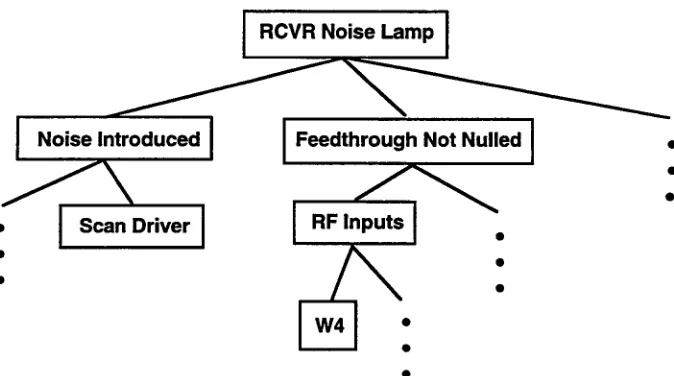
I RCVR Noise Lamp I
•
I soaoDr,ver I
LRF'
Figure 1. FH Tree for Receviver Noise
one action item that doesn't require elaboration. O t h e r w i s e , w e c o u l d g e n e r a t e a p a r a g r a p h consisting of one simple sentence.
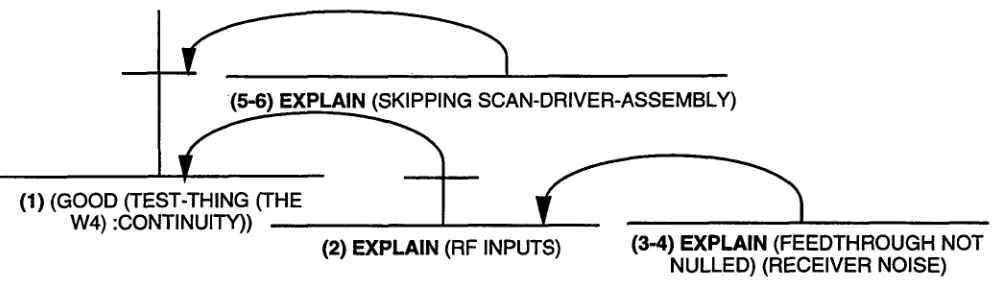
Finally, there m a y be circumstances where we don't want a p a r a g r a p h break, even though w e have the conditions we've described. When an FH node has to be explained, w e ' v e o b s e r v e d that this requires a central topic and thus its o w n paragraph. However, w e can have two consecutive actions, each requiring explanations on topics that are closely related. For instance, if a s t u d e n t skips to a n e w branch w h e n neither the skipping p r o b l e m nor the n e w branch has yet b e e n explained, w e ' d have to explain both the milestone of entering the n e w branch and the skipping problem, and since they both relate to the same action, w e w a n t them in the same paragraph. Another example is an action requiring explanation because of a milestone followed immediately b y a r e d u n d a n t occurrence of the same action. In both these cases, the central topic is the action, and the two explanations should be in the same paragraph. From these observations, building a multiparagraph RST structure is straightforward. Let's look at a concrete example. The following is a portion of the o u t p u t of an actual MACH-III session (run b y the author). The test indications (which are not part of the critique o u t p u t ) h a d indicated a fault with Receiver Noise. A possible text description of these actions is the following. (Phrases are n u m b e r e d for d i s c u s s i o n p u r p o s e s to c o r r e s p o n d w i t h later diagrams.)
(1) The next action y o u took was to check the W4, (2) one of the RF input cables. (3) If these cables are faulty, f e e d t h r o u g h nulling w o n ' t occur properly, (4) resulting in noise in the Receiver, so checking the W4 is c e r t a i n l y a v a l i d step. (5) However, an organized approach to t r o u b l e s h o o t i n g the R e c e i v e r is s t r o n g l y r e c o m m e n d e d , a n d checking the W4 at this point left your investigation of w h e t h e r noise is being introduced unfinished. (6) (You h a d n ' t yet checked the Scan Driver Assembly, w h i c h can also i n t r o d u c e n o i s e if n o t w o r k i n g properly.)
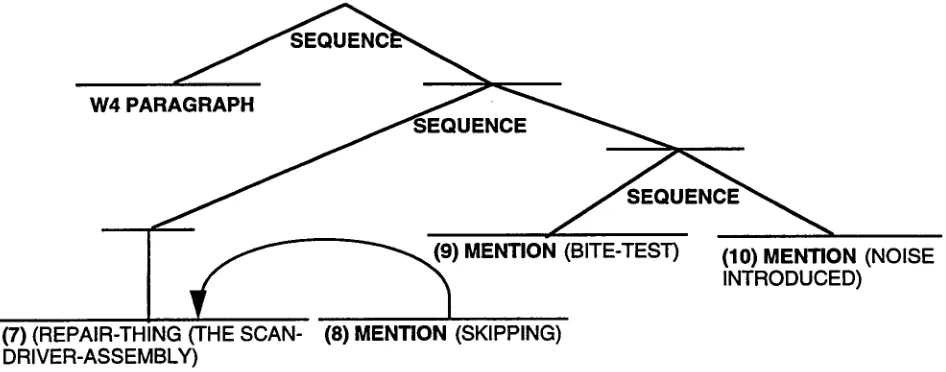
(7) You followed the W4 check b y replacing the Scan Driver, (8) further skipping around. (9) By executing a BITE Test, y o u d e m o n s t r a t e d that the fault w a s n ' t w i t h the S c a n Driver, (10) and the problem wasn't noise being introduced.
[image:4.612.143.480.84.272.2]7th International Generation Workshop • Kennebunkport, Maine • June 21-24, 1994
(5-6) EXPLAIN
(SKIPPING SCAN-DRIVER-ASSEMBLY)
(1) (GOOD (
T
E
S
T
~
I
~
I
~
W4) :CONTINUITY))
(2) EXPLAIN
(RF INPUTS)
(3-4) EXPLAIN
(FEEDTHROUGH NOT
NULLED) (RECEIVER NOISE)
Figure 2. Generated RST Structure (Part 1)
The actual MACH-III output is
(START #< NODE FEEDTHROUGH
NOT HULLED >)
(START #< NODE RF INPUTS>)
(SKIPPING (TEST-THING (THE W4)
:CONTINUITY) (#<NODE NOISE
INTRODUCED>))
(RETURNING #<NODE NOISE
INTRODUCED>)
(SKIPPING-RETURN (REPLACE-
THING (THE SCAN-DRIVER-
ASSEMBLY))
(#<NODE RF INPUTS>
#<NODE FEEDTHROUGH NOT
HULLED>))
(GOOD (PUSH BITE-TEST-AFTER-
REPLACE #<DEVICE SCAN-
DRIVER -ASS EMBLY >))
(FINISHED #<NODE NOISE
INTRODUCED>)
Recall that M A C H - I I I critiques are basically c o n c e r n e d w i t h s t u d e n t actions. T h e r e f o r e navigational milestones (outputs that begin with START, FINISHED, or RETURNING) are p u t aside until w e have an action with which they can be associated. In our example, the first student action is the testing of the W4, which left the investigation of w h e t h e r noise is being introduced unfinished. We start a n e w paragraph with a n o d e for the W4 (the node labeled 1 in Figure 2 below, corresponding to clause 1 in the above sample text). N o w w e can associate the two START milestones by making RST satellite nodes of the W4 node nucleus (nodes 2 and 3-4 in the diagram). Since neither the concept of feedthrough not being hulled nor that of RF inputs has been described yet, w e m a r k these n o d e s as
[image:5.612.50.548.84.226.2]7th International Generation Workshop • Kennebunkport, Maine • June 21-24, 1994
W4
J ~ "
"~
INTRODUCED)
(7) (REPAIR-THING (THE SCAN- (8) MENTION (SKIPPING)
DRIVER-ASSEMBLY)
Figure 3. Generated RST Structure (Part 2)
being introduced has been exhausted. Since theconcept has b e e n fully described, it doesn't need further explanation here, and node 10 is marked as merely requiring mention.
3. Low-Level Text Organization
We n o w have a general outline of the p a r a g r a p h structure in an RST representation, b u t our w o r k isn't finished yet. W e ' v e liberally created a fair n u m b e r of n o d e s m a r k e d as either MENTION or EXPLAIN, without any discussion about h o w to act on these marked nodes, or whether they'll have an impact on the final RST structure. It's time to turn our attention to these intraparagraph concerns. We'll first look at the easiest problem, h o w to handle nodes marked for MENTION. Recall that these are nodes for problems or milestones that have already been discussed in the generated text, and we're assuming they don't require further elaboration. Each such node can be realiTed as a simple sentence, or even a phrase. Therefore, they have no impact on the RST structure because the single n o d e s that represent them are sufficient.
Let's look at an example. Figure 4 is an RST structure that might be generated.
At this point of the RST construction, mixer crystal pairs and the Receiver A s s e m b l y h a v e b e e n discussed. A plausible surface realization for this RST might be, "You tested the Reference Mixer Pair,
one of the Mixer Crystal Pairs of the Receiver Assembly."
While the realization of this RST pattern is simple enough, the pattern itself deserves a closer look. All the milestone n o d e s are a r r a n g e d in the general structure s h o w n in Figure 5. We call this structure the expository chain. It represents a statement, A, with a second statement, B, in elaboration of A. Then statement B is elaborated on b y statement C. This chain is continued as long as is necessary.
The e x p o s i t o r y chain is a s t a n d a r d m e t h o d of presenting arguments, since it represents building a case step b y step. As an experiment, the first section of [Bateman 1992] w a s analyzed. Of the twelve paragraphs in it, all but three are straight expository chains., a n d those p r o v e d to be conjunctions or sequences of expository chains.
4. Conclusion
[image:6.612.77.550.73.259.2]7th International Generation Workshop • Kennebunkport, Maine • June 21-24, 1994
(REPAIR-THING (THE REFERENCE-
CHANNEL-MIXER-PAIR))
MENTION
(MIXER XTAL PAIRS)
MENTION (RCVR ASSEMBLY)Figure 4. Sample RST Structure for Reference Channel Mixer Pairs
B C...
Figure 5. Expository Chain
5. ReferencesBateman 1992: Bateman, j o h n A., "Towards Meaning-Based Machine Translation: Using Abstractions from Text Generation for Preserving Meaning," in Machine Translation, Vol. 7, 1992
Clancey 1983: Clancey, W i l l i a m J., "The Epistemology of a Rule-Based Expert System --- a Framework for Explanation," in Artificial Intelligence,
No. 20, 1983
Clancey, Shortliffe, Buchanan 1979: Clancey, William J., Edward H. Shortliffe, and Bruce G. Buchanan, "Intelligent Computer-Aided Instruction for Medical Diagnosis," in Proceedings of the Third Annual Symposium on Computer Applications in Medical Computing, 1979
Granville 1990: Granville, Robert A., "The Role of Underlying Structure in Text Generation," in
Proceedings of the Fifth International Workshop on Natural Language Generation, 1990
Granville 1993: Granville, Robert, "An Algorithm for High-Level Organization of Multi-Paragraph Texts,"
in Intentionality and Structure in Discourse Relations, Proceedings of a Workshop Sponsored by the Special Interest Group on Generation of the Association for Computational Linguistics, 1993
Hovy 1988: Hovy, Eduard H., "Planning Coherent Multisentential Text," in Proceedings of the 26th ACL Conference, Buffalo, New York 1988
Kurland et al 1989: Kurland, Laura C., Robert Granville, Dawn MacLaughlin, HAWK MACH-III Explanations of the Receiver Troubleshooting Tree,
Technical Report, BBN Systems and Technologies, Cambridge, Massachusetts, 1989
Kurland et al 1992: Kurland, Laura C., Robert Alan Granville, and Dawn MacLaughlin, "Design, Development and Implementation of an Intelligent Tutoring System (ITS) for Training Radar Mechanics to Troubleshoot," in Intelligent Instruction by Computer, edited by Marshall J. Farr and Joseph Psotka, Taylor & Francis, Washington, DC, 1992
Liskov & Guttag 1986: Liskov, Barbara, and John Guttag, Abstraction and Specification in Program Development, MIT Press, Cambridge, Massachusetts, 1986
Mann & Thompson 1987: Mann, William C., and Sandra A. Thompson, Rhetorical Structure Theory: A Theory of Text Organization, I S I / R S - 8 7 - 1 9 0 , Information Sciences Institute, Marina del Rey, California, 1987
McKeown 1982: McKeown, Kathleen R., Generating Natural Language Responses to Questions about Database Structure, PhD thesis, University of Pennsylvania, Philadelphia, Pennsylvania, 1982
Moore 1989: Moore, Johanna Doris, A Reactive Approach to Explanation in Expert and Advice-Giving Systems, PhD
thesis, University of California, Los Angeles, California, 1989