T o w a r d a
M u l t i d i m e n s i o n a l F r a m e w o r k t o G u i d e
t h e A u t o m a t e d G e n e r a t i o n o f T e x t T y p e s
Eduard Hovy
Information~ Sciences Institute
of the Umverslty of Southern California " ~ " 4676 Admiralty Way
Marina del Rey, CA 90292-6695 U.S.A.
tel: +1-310-822-1511 x 731 fax: +1-310.823-6714 email: [email protected]
Julia Lavid
Departzmento de Filolog~a Inglesa Facultad de Filolog~a
Universidad Comphtense de Madrid 280040 Madrid
Spain
tel: -I-34-1-394-5862 fax: +34-1-394-5396 emaih lavid~dit.upm.es
1
I n t r o d u c t i o n
A central concern limiting the sophistication of text generation systems today is the ability to make appropriate choices given the bewildering number of options present during the plan- ning and realisation processes. As illustrated in several systems [Hovy 88, Bateman & Paris 89, Paris 93], the same core communication may be realised in numerous different ways, depending (among other factors) on the nature and relation of the interlocutors, the context of the commu- nication, the media employed, etc. The combinatoric number of possibilities of all such factors is extremely large. Since most of them are not well understood at this time, automated text generation may appear to be a hopeless endeavour.
Fortunately, t h e picture is not altogether bleak. Given that certain types of communicative situations consistently give rise to characteristic recognisable genres or text types, one can attempt to characterise each genre or text type in terms of the set of generator decisions or rules responsible for producing those characteristics, and then create prespecified, genre-specific, collections of features, formulated as decision rule criteria, for subsequent use (this point has been made before, in [Patten 88] and [Bateman & Paris 89]). With this aim in mind, two major questions arise:
1. Is there a regular categorisation of genres or text types?
7th International G e n e r a t i o n W o r k s h o p * Kennebunkport, Maine • June 21-24, 1994
produce texts whose communicative function has to be interpreted in terms of the concrete situation in which they were produced. The knowledge of the meaning potential associated with a generic situation is called
register.
Register has been the subject of much research in Linguistics [Ferguson 83, Brown & Fraser 79, Hymes 74],especially in Systemic-Functional Linguistics [Halliday ~ Hasan 89, Ure 71, Gregory 88, Ghadessy 88, Caiferel 1991], etc. With.in SFL, various perspectives have been taken: I-Ialllday views register from the lexicogrammatical perspective, while [Martin 92] sees it operating at the semiotic level. With a phenomenon as complicated as register, it is inevitable t h a t conflicting pictures exist; however, in this paper we do not devote too much time to any specific view, but rather take a slightly more general approach to make our points relevant to all. We view reg- isters simply as stable configurations of features at all levels u semiotic, grammatical, lexical, phonological m linked together. In the first part of the paper, then, we outline several high-level and somewhat more general than usually provided register networks, drawn from a variety of sources and organized according to communicative metafunction.
With regard to the second half of the paper, we describe a semi-automatic method to deter- mine genre-defining features for a given text, and show how the degree of genre-specificity can be measured quantitatively. This follows on register-oriented work in computational research on lan- guage generation, in particular that of [Patten 88, Bateman & Paris 89, Bateman ~ Paris 91]. Our work in some ways follows upon that of Bateman and Paris, who outline an ambitious 5-step met-hod for the definition of register and the control of a generator program, using three variations of a sentence as illustration: 1. text analysis; 2. classification of features according to user; 3. classification of features with respect to register type; 4. creation of register networks; and 5. specification of generator control. We take a less ambitious and somewhat different ap- proach to some of the same issues (steps 1, 3, and 4), and develop a semi-automated feature collection technique using as illustration 10 clauses from the instruction stage of a recipe. The contribution of this paper is twofold:
1. somewhat more high-level and comprehensive register networks, drawn from several sources and organized according to communicative metafunction (in contrast to steps 3 and 4); 2. a semi-automated abductive method for identifying grammatical features t h a t are register-
defining (in contrast to step 1).
2
T h e c o m p o n e n t s o f t h e c o m m u n i c a t i v e s i t u a t i o n
According to Halliday, language performs threeprincipal functions simultaneously: the
ideational
function
(to understand the interlocutors' physical, mental, and emotional environment), thein-
terpersonal.function
(to act on other people in it); and theteztual .function
(to employ the mediaand situation at hand for optimal communication) [Halliday 85]. In a each instantiated com- munication, the speaker performs a series of linguistic choices from these three metafunctions of language: in Systemic terms, he or she selects features from language-based system networks assigned to the three different functions.
7th International Generation Workshop * Kennebunkport, Maine * June 21-24, 1994
Fleld (Ideation~ function
E.xpeu'iemial Dom'~n
l
S~MOLOGY ~ r-.EAqCOCP, AMM.AR ~ PHONVGRAPH
.-...---process type " ~ , Transitivitty
participmar..5
circumstantial rol~ "~Adjuutivization ~ime ",~ Tease pcrspectiv¢ "~"Aspeet
subj~,na~.r "~'7.2.~deal ~ouomJcs
comras~v~ ~r~cuh~on
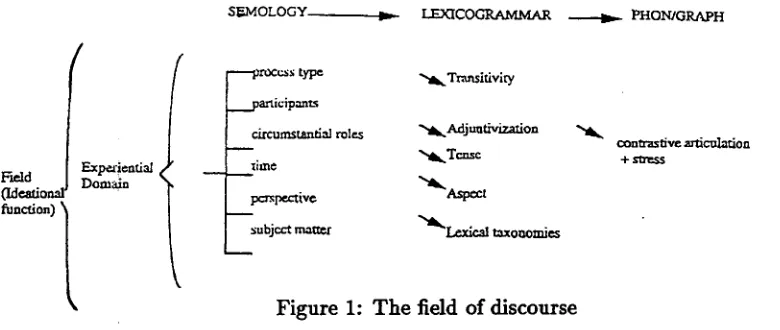
Figure 1: T h e field of discourse
meanings reflect the M O D E of the discourse. We can say t h a t field, tenor, a n d mode are the actual selections (from t h e ideational, t h e interpersonal, and t h e textual components of the language code respectively) taken in a particular event surrounding a n d including the language act.
In the remainder of this section we briefly describe t h e three aspects of communication. More details are provided in t h e longer version of this paper, available from the authors.
T h e f i e l d O f d i s c o u r s e . According t o Halllday, t h e field of discourse refers to "what is happening, to the nature of the social action t h a t is taking place: w h a t is it t h a t the participants are engaged in, in which t h e language figures as an essential component" [Halliday & Hasan 89]. T h e field of discourse can also be called t h e text's experiential domain which includes t h e text's subject m a t t e r , t h a t is, its ideational or propositional content. T h e network in Figure 1 illustrates these aspects.
T h e t e n o r o f d i s c o u r s e . Where field predicts the range of meaning potentials in t h e expe- riential component of t h e language code, t h e tenor of discourse predicts the selection of options in t h e interpersonal c o m p o n e n t . According to Haniday a n d Hasan, "the tenor of discourse refers to who is taking part, to the nature of the participants, their statuses and roles: what kinds of role relationships obtain aanong t h e p a r t i c i p a n t s . . . , b o t h the types of SPEECH ROLE t h a t they are taking on in the dialogue and the whole cluster of socially significant relationships in which they are involvdd" ([Halliday & Ha.san 89], p. 27). The tenor of discourse involves the selection of a n u m b e r of options in t h e subsystems t h a t configure the participants' speech roles. A m o n g these speech roles we distinguish two principal types: one set of systems is concerned with the NEGOTIATION OF SPEECH ROLES, t h e other is concerned with the SPEECH MODALITIES. Figure 2 contains some of these options in a systemic network.
[image:3.612.83.473.59.224.2]TENOR
(Int~:apex,so~ f~etio.)
7th International Generation W o r k s h o p • Kennebunkport, Maine • June 21-24, 1994
comment ~,,,mood
/
/ initiating tone sel~in~a
/ ~ n ~"_.~ on.initiating "~,,stattas
- - Role I social distance I-.- " " "--l~marked u~jwal addmxs terms f i /
l~eg0t:atmn [social rnl~ r--.hit.rarc.hie t_.. -"--t--n cm -hi rx:we.hi e
~ c h ~ k c d
i n t e t l o c u t o r l [ asscs.~nent "L_ unchecked
$
Speech _J " A . m
- - ~ sodies of irony
• M o d a l i d ~ [ unmediated alag~, affeelioa, t..._l~ediado~| ~ FlJkelihood ~ modali L
t ~ ~ . . . . ~,-t---eapaeity
t.._.m~xatea ~ l o ~ n ~ i b i l i t y
_ ~ . ~ e n o T o i discourse
-Public
tuna ~.ee c~tn~llcd
q~t~i- ~.,lf
..~i-~atc .p_ a i a l ~
C
Figure 3: Mode systems: speaking and writing focus; Martin (1992)
and adopt more abstract characterizations as suggested by [Martin 92]. This is also necessary given the range of substantial empirical work (e.g., [Redeker 84, Biber 89] and others) showing that the spoken/written distinction p e r s e is not a simple parameter. The lexicogrammatical consequences of the features shown in Figure 3 are discussed in [Martin 92].
3
U s i n g t h e m u l t i d i m e n s i o n a l analysis of t e x t s for g e n e r a t i o n
As discussed in [Matthiessen 94], register can be interpreted (and therefore implemented in a sentence generator) in three ways:
• Probability variations of choices within systems: Each register imposes its idiosyncratic probability distribution upon the choice preferences within appropriate systems, so that while the grammar remains the same throughout, the generator's traversal of the grammar will vary according to registerial probabilities;
• Core system with extensions for variation: Each register adds some idiosyncratic systems at appropriate points of the grammar while leaving the remainder unchanged;
7th International Generation Workshop • Kennebunkport, Maine • June 21-24, 1994
We follow the first approach. In this section, we outline a m e t h o d of semi-automatically determining probability distributions for each register, taking as example the instruction stage of a recipe:
Remove fruit and 2tbs of juice from the can, then discard the rest. Put all ingredients into a saucepan and slowl~t bring to the boil. When hot, pour into a food processor and process to a smooth sauce. For eztra texture reserve 1-2 pieces of fruit, mash,
then add this to the finished sauce. ( S H E Magazine, June 1993)
W h a t are the lexicogrammatical features that express the features of field, tenor, and mode? For fully worked out systems, tracing them through the labyrinthine networks is tedious at best. For partially worked out systems, the connections between t h e higher level networks such as field and the lower level networks of the grammar often do not exist, and so another method is required for determining the registerially determinating features at the lower levels.
One such method, suggested in [Bateman & Paris 91], is to perform grammatical (and pre- sumably lexical) analyses of sample texts by hand. While (as they nicely illustrate) this is possible for small samples, the problem of ensuring coverage and consistency for larger samples can quickly become daunting. For this reason, we propose a "bottom-up" abductive method, using the generator as a tool, that is considerably easier, since it is semi-automatic. The method involves the fonowing steps:
1. For each sentence in the sample text type under consideration, create an input specification for the generator.
2. Run the generator on each input specification and check that the output sentences are correct. Collect the lexicogrammatical features for each sentence.
3. Classify the features for each sentence according to register type (field, tenor, or mode) and constituent type (clause complex, clause, noun phrase, lexical, etc.).
4. Count the number of times each feature appears in the whole test sample as a percentage of the number of times its constituent type appeared. For example, if the NP feature DETERMINED appears 9 times for 10 noun phrases in a sample, then we say the involvement
of this feature is 90%. Graph or tabulate the distribution of feature involvement as number of features vs. percentile.
5. Through inspection of the resulting table, determine the register-determinate cutoff point the point after which features appear too seldom to be indicative of the text type. This point will appear at the 'knee' at which the curve begins to rise rapidly for small increases of involvement.
7th International Generation Workshop - Kennebunkport, Maine * June 21-24, 1994
the middle range between 80% and 30% involvement contained significantly fewer features than either of the extremes. This we interpret as follows: when features appear often, they appear very often, and thus specify the genre characteristics. On the other hand, if features do not appear often, they appear seldom, only as needed to produce the particular clause(s) in which they appear. The degree to which features with high involvements appear can be thought of as the degree to which they co-specify the genre, and thus the "strength" of their propensity for selection during the text and sentence planning processes.
The following tables summarize (full information appears in the long version of this paper). C l a u s e - c o m p l e x l e v e l C l a u s e l e v e l ! N P l e v e l
% feature number of % of total number of % of total ! number of % of total involvement features features features features I features features
100% 10 62.5% 19 15.4% I 19 21.3%
> =80% 10 62.5% 34 27.6% 43 48.3%
mid-range 6 37.5% 24 19.5% 12 13.5%
<=30% 0 0% 65 52.8% 34 38.2%
A look at the genre-defining clause level features may prove instructive; as expected from looking a t the text, features such as IMPERATIVE, IMPERATIVE-INTERACTANT, and N O N F I N I T I V E - V 0 I C E
appear frequently:
19 a t 1 0 0 ~
START CLAUSES CLAUSE FULL MOOD-UNIT NONCONJUNCTED NO-k~t-SUBJECTPOSITIVE TRANSITIVITY-UNIT NONACCOMPANIMF2|T NONMATTER NONROLE NO-SPATIAL-EXTF~T NO-TF~IPORAL-EXTENT NO-TEMPORAL-LOCATION ACTIVE-PROCESS NOT-PHASE VOICE-LEXVERB LEXICAL-VERB-TEEM-RESOLUTION
15 at 90~
CLAUSE-SIMPLEX INDEPENDENT-CLAUSE INDEPENDENT-CLAUSE-SIMPLEX JUSSIVE
NONINTERNAL-SUBJECT-MATTER IMPERATIVE IMPEP~TIVE-INTERACTANT MATERIAL
IMPERATIVE-SUBJECT-IMPLICITUNMARKED-POSITIVEDO-NEEDING-VERBS
NONFINITIVE-VOICE NONCAUSE NONMANNER IMPERATIVE-UNTAGGED
0 at 80~
4
C o n c l u s i o n
7th International Generation Workshop * Kennebunkport, Maine • June 21-24, 1994
R e f e r e n c e s
[Bateman & Paris 89] Bateman, J.A. and Paris, C.L. (1989) Phrasing a Text in Terms the User Can Understand. In Proceedings of the Eleventh International Joint Conference on Artificial Intelligence
IJCAI-8g, Detroit, Michigan.
[Bateman & Paris 91] Bateman, J.A. and Paris, C.L. (1991) Constraining the development oflexicograrn- matical resources during text generation: towards a computational instantiation of register theory. In Ventola, E. (ed), Recent Systemic and Other Views on Language, Amsterdam: Mouton.
[Biber 89] Biber, D. (1989) A typology of English tez4s. Linguistics 27 (3-43).
[Brown & Fraser 79] Brown, P. and Fraser, C. (1979) Speech as a marker of situation. In Scherer, K.A. and Giles, H. (eds), Social markers in Speech (33-62). Cambridge: Cambridge University Press. [Cafferel 1991] Catferel, A. (1991) Context Projected onto Semantics and Consequences for Grammatical
Selection. Written version of paper presented at International Systemics Congress XVIII, International Christian University, Tokyo.
[Ferguson 83] Ferguson, C. A. (1983) Sports announcer talk: Syntactic aspects of register variation. In
Language in Society 12 (153-172).
[Gregory & Carroll 78] Gregory, M. and Carrol, S. (1978) Language and Situation: Language varieties
and their social contezts. London: Routledge and Kegan Paul.
[Gregory 88] Gregory, M. (1988) Generic Situation and Register: a Functional View of Communication. In Benson, J.D,, Cummings, M.J. and Greaves, W. (eds) Linguistics in a Systemic Perspective. London: John Benjamins Publishing Company.
[Ghadessy 88] Ghadessy, M. (1988) Registers of Written English: Situational Factors and Linguistic
Features. London: Frances Pinter.
[Halliday 85] Ha]!iday, M.A.K. (1985) An Introduction to Functional Grammar. London: Edward Arnold. [Halliday & Hasan 89] Halliday, M.A.K. and Hasan, R. (1989) Language, Contezt and Tert: A Social
Semiotic Perspective. Oxford: Oxford University Press.
[Hovy 88] Hovy, E.H. (1988). Generating Natural Language under Pragmatic Constraints. Hillsdale, N.J.: Lawrence Erlbaum Associates Publishers.
[Hymes 74] Hymes, D.H. (1974) Foundations in Sociolingnistics. Philadelphia: University of Pennsylva- nia Press.
[Kittredge & Lehrberger 81] Kittredge, R. & Lchrberger, J. (1981) Snblanguage: Studies of Language in
Restricted Semantic Domains. Berlin: De Gruyter.
[Martin 92] Martin, J.R. (1992) English Tezt: System and Structure. Amsterdam: Benjamins.
[Matthiessen 94] Matthiessen, C.M.I.M. (1994) Register in the Round. In Register Analysis: Theory and
Practise, Ghadessy, M. (ed), London: Pinter (221-292).
[Paris 93] Paris, C.L. 1993. The Use of E~plicit Models in Tezt Generation. London: Francis Pinter. [Patten 88] Patten, T. (1988) Systemic Tezt Generation as Problem Solving. Cambridge: Cambridge
University Press.
[Redeker 84] Redeker, G. (1984) On differences between spoken and written language. In Discourse
Processes 7 (43-55).
[Ure 71] Ure, J. (11971) Lexical density and register differentiation. In Perren, J.L. and Trim, J.L.M. (eds) Applications of Linguistics: Selected Papers of the ~nd International Congress of Linguistics.