Tagging Experiments Using
Neural Networks
M artin E in eb o rg and B jorn G am bacR l Stockholm
A bstract
The paper outlines a method for automatic part-of-speech tagging using artificial neural networks. Several experiments have been carried out where the performance of different network architectures have been compared to each other on two tasks: classification by overall part-of-speech (noun, adjective or verb) and by a set of 13 possible output categories. The best classification rates were 93.6% for the simple and 96.4% for the complex task. These results are rather promising and the paper compares them to the performance reported by other methods; a comparison that shows the neural network completely compatible with pure statistical approaches.
1. Introduction
Rayner et al (1988) experimented with using a formal grammar along with example-sentences to deduce a lexicon. Unfortunately, the exponential explosion that followed from ambiguities in the grammar caused the system to be very slow. The project described in this paper builds on the assumption that one way to attack this problem would be to let a neural network suggest restrictions on the possible word-classes of the unknown word derived from its word-ending and context.
Another motivation for our project is that within the language area connectionist models have so far proved discouragingly unsuccessful compared to other methods. Even though they have been tried out for several applications, such as semantic clustering, preposition choice, etc., the only language area where artificial neural networks have been successfully applied on a larger scale has been speech; however, all currently leading speech recognition systems (the ones in the US DARPA race) have discarded neural nets for Hidden Markov Models, a statistical method. The current state of affairs should however hardly be taken to be the permanent truth. The need for different machine learning methods within the language area should be evident; in this paper we will single out the topic of part-of-speech tagging for special attention, but the last
words for other areas such as disambiguation, document matching, information retrieval, grammar and transfer-rule induction, etc., have certainly not been said.
The experiments we have carried out have used different back- propagation network architectures in order to assign part-of-speech tags to unknown words. A brief background to artificial neural networks and the back-propagation algorithm is given in the rest of this section. Section
2 then goes on to describe the different network architectures used in our
experiments. The networks were trained on both morphological and (local) context information extracted from a tagged text corpus and then evaluated on previously unseen data from the same corpus. The results of the different experiments are given in Section 3. Section 4 compares these results to other possible methods of solving the problem, i.e., pure statistical and rule-based approaches; finally Section 5 sums up the previous discussions and points to possible future extensions.
A rtiH cial N eural N etw orks
Several researchers around 1940 suggested that a more brain-like machine should be created. A first step in this direction was taken when McCulloch and Pitts (1943) proposed a model of a neuron, which, just like the biological neuron, takes several inputs and produces one output. The changes in synapses are simulated by weight variables. Modification of the weights is handled by a learning rule. A weight has two features: the sign of the weight determines if the incoming impulse is excitatory or inhibitory and the absolute value of the weight determines to what degree notice should be taken to the incoming impulse. When the incoming values are above a certain level (the threshold) the neuron fires according to a firing rule. In the McCulloch & Pitts model the firing rule can be expressed by the following simple mathematical formula:
the neuron fires iff Zk xk Wk > 0
where xk is the value received from neuron k
wk is the weight associated with input from neuron k
0 is the threshold
This model uses only a two-valued output indicating firing, or not. It is still the basis of many neural networks, but has been improved upon several times, in particular when Widrow and Hoff came up with a learning rule called the Widrow-Hoff rule or the delta rule (Widrow
It can be expressed as:
wk(t+l) = wk(t) + a 5k(t)xk(t)
where a is a constant (gain term) typically 0.01 < a < 10
wk(t) is the value of weight k at time t 5k(t) is the error of neuron k at time t
xk(t) is the incoming value from neuron k at time t.
It was shown by Rosenblatt (1962) that the delta rule causes the weights to converge. He also developed the perceptron, a neuron able to classify binary or continuous valued input into one of two classes; however, a serious blow against neural science came when Minsky and Paper! (1969) showed that a perceptron neural network consisting of only one layer is unable to handle nonlinear functions; to do so a hidden layer has to be included in the net. A hidden neuron receives input from other neurons and transmits output to other neurons. A hidden layer consists only of hidden neurons. In 1986 Rumelhart, Hinton, and Williams came up with a network that could handle hidden layers. The method is called backpropagation and will be further described below.
Another model was created by Kohonen (1984/88). It differs from the previous in that it organizes the input data by itself without the correct output pattern being presented, i.e., it uses unsupervised learning. A Kohonen net consists of a number of neurons organized in a two- dimensional plane called a map. The input pattern is given to all neurons at the same time. The neuron for which the Euclidean distance between the input-vector and the weight-vector is a minimum is selected as being the response of the given pattern.
The B ackpropagation A lgorithm
Om = 1 / (1 + exp{ai})
where ai = Zj (wij*xij) + Gj is the activation of the i:th neuron, and wij is the j:th weight of neuron i
Xij is the j;th input to neuron i 9i is the threshold of neuron i.
There are two weight adjustment rules:
for output neurons the error: 5pj = (Gpj - Opj) Opj (1 - Opj) for hidden neurons the error: 6pj = (Zk SpjWkj) Opj (1 - Opj)
2. T est Set-ups
A large number of backpropagation network architectures were tested. This section will describe how the net-input was encoded and the actual architectures of the different networks used in the experiments.
E ncoding o f N etw ork Input
In the text below we will need to use several character sets, e.g., Alphabet 1 and Alphabet2 respectively defining the Swedish and ASCII
alphabets, sets for Swedish vowels and consonants, and some morphologically and phonologically motivated subsets of these. When defining the mappings of the network inputs, we will also need to discuss a particular type of vectors, namely binary vectors of different length with only one 1. These will be referred to as Binn where n is the number of digits in the vector. Strings of characters, lexemes, will be subindexed according to what alphabet the included characters belong to.
To represent the encoding of letters, we will introduce five functions which informally can be said to map the character sets above onto the binary vectors Binn and perform the following tasks: fi simply divides Alphabet 1 into vowels and consonants; f2 further subdivides the
consonants by phonetic category, that is into plosives, fricatives, laterals, trills, and nasals; fs is like f2, but the vowels A and E are singled out
from the others, since they behave rather in a special way when inflection is performed; while f4 and fs encode the entire Swedish and ASCII
alphabets, respectively.
determiners, adverbs, prepositions, conjunctions, and infinitival markers; h2 adds two more categories, one for auxiliaries and one for sentence
delimiters; I13 is like hi, but with special categories for auxiliaries,
idiomatic expressions, and present and past participles. It also splits the conjunctions into subordinating and coordinating ones; h4 further
subdivides the adjectives by comparative form (i.e., positive, comparative, and superlative) and the adverbs by type (normal, comparative, superlative, and comparison); finally, hs does for Lexeme2
what hi does for Lexeme 1, but with extra categories for names, numbers,
characters, and sentence delimiters.
N etw ork A rchitectures
All backpropagation networks were three layer architectures consisting of an input layer, a hidden layer, and an output layer. Information was given in localized form. In order to examine the feasibility of the approach, the sizes of the networks were initially kept at moderate levels to increase only gradually. Two information sources were used: the internal structure of the lexeme and N-grams. An N-gram refers to the grammatical categories of N-1 neighbouring words, so we will use 1- gram to refer to the word itself, a 2-gram (here) denotes the word itself
and the word to the left, a 3-gram denotes a 2-gram and the word to the right, and so on. When combining the two information sources the vectors were simply appended. The resulting vector was then fed to the network.
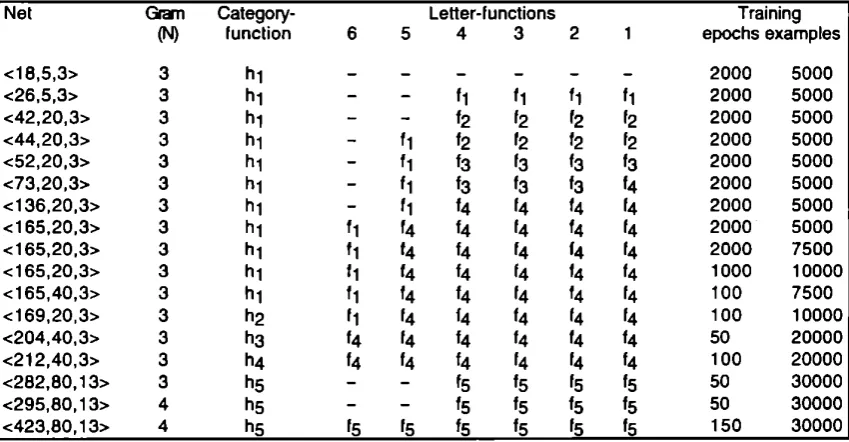
Table 1: Summary of the network setups for the experiments
Net Gram
(N) Category-function 6 5 Letter-functions 4 3 2 1 epochs examplesTraining
<10,5,3> 3 hi _ _ _ - _ _ 2000 5000
<26,5,3> 3 hi - - fl (1 f l fl 2000 5000
<42,20,3> 3 hi - - <2 >2 >2 f2 2000 5000
<44,20,3> 3 hi - u <2 >2 >2 I2 2000 5000
<52,20,3> 3 hi - u <3 >3 <3 <3 2000 5000
<73,20,3> 3 hi - 6 <3 <3 I3 f4 2000 5000
<136,20,3> 3 hi - fi k k k f4 2000 5000
<165,20,3> 3 hi u f4 k k k (4 2000 5000
<165,20,3> 3 hi h »4 k k k (4 2000 7500
<165,20,3> 3 hi ii »4 k k k k 1000 10000
<165,40,3> 3 hi (1 (4 k k k k 100 7500
<169,20,3> 3 h2 M (4 k k k k 100 10000
<204,40,3> 3 h3 '4 (4 k k k k 50 20000
<212,40,3> 3 h4 >4 (4 k k k k 100 20000
<282,80,13> 3 h5 - - fs *5 15 Is 50 30000
<295,80,13> 4 h5 - - k »5 fs fs 50 30000
<423,00,13> 4 hs l5 l5 fs «5 Is fs 150 30000
Table 1 describes each network in some detail. The number of neurons of a specific network is indicated by a triple <I,H,0> where I is the number of neurons in the input layer, H the same for the hidden layer, and O for the output layer. The other columns of the table define mapping functions, indicate the number of training epochs, etc. Thus the first net, for example, is called <18,5,3>, since it had 26 neurons in total. It used 3-grams only, so its single source of information was that of the context. The grammatical category mapping used, hi, was very simple distinguishing only between nouns, adjectives, verbs, pronouns, determiners, adverbs, prepositions, conjunctions, and the infinitival marker. Note that no information at all was extracted from the unknown word. As shown in the table, it was trained for 2000 epochs on a text consisting of 5000 examples.
The other nets combined the two information sources available by also inspecting the letters of the unknown word. In order not to make the networks unnecessarily large the mapping between the actual letter and its representation was kept as simple as possible. At first letters mapped onto one of only three classes: vowels, consonants, or 0 , the latter indicating
the lack of any input character in a specific position. This letter- classification was refined first by subdividing the consonants (plosives, fricatives, laterals, trills, and nasals) and later on by separating the letters A and E from the other vowels. Some nets (like <165,40,3>) were included in order to examine if the result would improve with a larger hidden layer, while other nets (as <169,20,3>) mapped the 3-grams differently, for example with the h2 function which separates the
[image:6.595.86.511.76.297.2]0)
&
Figure 1: Peak performance of the nets on the simple task
3. R esults
423x60x13. Ik 423x60x13, 10k
262x60x13 295x80x13
Network Epoch
[image:8.595.108.451.51.241.2]Performance
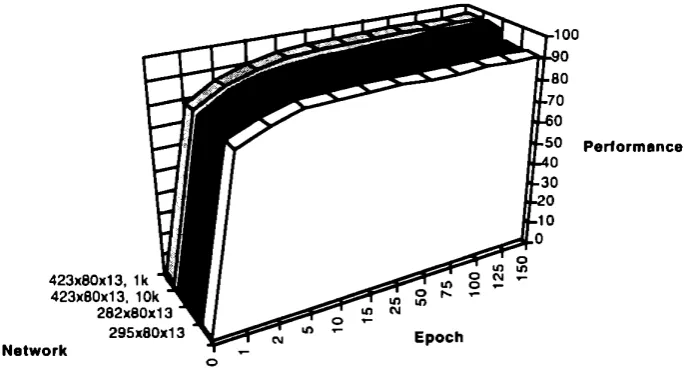
FIGURE 2: Performance of the nets on the complex task
The best result for a network which could classify more than nouns, adjectives, and verbs was 96.4% as shown in Figure 2. This was achieved by the <423,80,13> network, when trained using 30000 examples and tested (like all the other nets) on 1000 unseen examples. To evaluate the consistency of these figures, this net was also tested on an uncommonly large set of 10000 unseen examples. As could be expected when comparing the sizes of the training versus the test sets, this gave a slight decrease in performance, with a top result of 95.80%, as shown by the graph called “<423,80,13>, 10k”.
Table 2 shows an example of network outputs. The clause “(.) i södra
Asien (har)” [“(.) in Southern Asia (have)”] was fed to the <295,80,13>
net together with the tags (following the “>“ sign). As can be seen from the name “Asien”, it had a difficult time separating names from ordinary nouns.
Table 2: Example of network output
Categories: noun adjective verb preposition adverb determiner
pronoun character conjunction number name sent. del. inf. mark
Output (right): 0.000000 0.000000 0.000000 0.999984 0.000000 0.000001
0.000014 0.001059 0.000121 0.000000 0.000009 0.000042 0.000000
Right answer. 0.000000 0.000000 0.000000 1.000000 0.000000 0.000000
0.000000Pattern: 0.000000 0.000000 0.000000 0.000000 0.000000 0.000000.>IP l>PR S6DRA>P0SU
Output (right): 0.000000 0.939394 0.000104 0.000000 0.000000 0.000000
0.000000 0.000000 0.000000 0.000000 0.000138 0.000002 0.000000
Right answer 0.000000 1.000000 0.000000 0.000000 0.000000 0.000000
0.000000Pattern: 0.000000 0.000000 0.000000 0.000000 0.000000 0.000000l>PR SODRA>POSU ASIEN>PN
Output (wrong): 0.999468 0.000000 0.000000 0.000000 0.000000 0.325023
0.000000 0.000031 0.000001 0.000000 0.000000 0.000000 0.000000
Right answer 0.000000 0.000000 0.000000 0.000000 0.000000 0.000000
0.000000Pattern: 0.000000 0.000000 0.000000 1.000000 0.000000 0.000000SODRA>POSU ASIEN>PN HAR>HVPS
4. D iscussion
In this section we will try to compare the results of the previous section with those that have been obtained using statistical and rule-based methods. First, however, we note that Veronis & Ide (1990) used an approach akin to a neural network in extracting lexical information from a machine readable dictionary. Their results were rather discouraging, in that they managed to identify the correct sense of a word (that already occurred in the dictionary) in only 71.74% of the cases. Nakamura et al (1990) investigated word category prediction using a neural network architecture called NETgram, a four layer architecture based on backpropagation. The grammatical categories of the preceding words were used to predict the category of the next word. They reported a word recognition rate of about 6 8%.
Samuelsson (1994) suggests a method based purely on statistical evidence. With a success rate of 95.38%, it does not do as well as the method Voutilainen et al use, but on the other hand no external lexicon is needed and no language specifics are assumed. The best result was reported using a 4-gram, inspection of 6 letters, and syllable information. The test
setting closely resembles that of the <423,80,13> net above, which reached a classification rate of 96.4%. For the same task the Xerox Parc system “Tagger” (Cutting et al 1992) based on a Hidden Markov Model (HMM) method also was able to classify 95% of the words correctly (Cutting 1994). Even though this comparison thus shows the neural net approach ahead by a margin, it indicates that the methods are virtually equivalent for the task at hand.
5. C onclusions and Future W ork
We have described a series of experiments where different three-layered back-propagation network architectures were used for the task of recognizing unknown words for a natural language system. Two main tasks were performed: in the first the nets were to classify words by overall part-of-speech (noun, adjective or verb) only, while the second task involved a larger set of 13 possible output categories. The best results for the simple task were obtained by networks consisting of 204- 212 input neurons and 40 hidden-layer neurons, reaching a classification rate of 93.6%. The best result for the more complex task was 96.4%, which was achieved by a net with 423 input neurons and 80 hidden-layer neurons. The results are overall rather promising and they are completely compatible with those achieved by purely statistical methods; however, they are still inferior to those reported by a rule-based approach, albeit on a somewhat different task.
R eferen ces
Cutting, D. 1994. Porting a Stochastic Part-of-Speech Tagger to Swedish. In Eklund
(ed), Nodalida'93 - Proceedings of '9:e Nordiska Datalingvistikdagarna', Stockholm 3-5 June 1993. Stockholm.
Cutting, D., J. Kupiec, J. Pedersen and P. Shibun. 1992. A Practical Part-of-Speech
Tagger pp 133-140, Proceedings of the 3’’’^ Conference on Applied Natural Language Processing, Trento, Italy.
Eklund, Robert. 1994. (ed) Nodalida'93 - Proceedings of '9:e Nordiska Datalingvistik-
dagama’, Stockholm 3-5 June 1993. Stockholm.
Ide, N.M. and J. Veronis. 1990. Very Large Neural Networks Word Sense
Disambiguation, pp 366-368, Proceedings of the 9'^ European Conference on Artificial Intelligence, Stockholm, Sweden (also as pp 389-394, Proc. 13‘^ International Conference on Computational Linguistics, Helsinki, Finland, Vol. 2).
Kohonen, T. 1984/1988. Self-Organization and Associative Memory. Springer-Verlag, Heidelberg, Germany.
McCulloch, W. S. and W. H. Pitts. 1943. A Logical Calculus of the Ideas Imminent in
Nervous Activity, pp 115-133,BULLETIN OF MATHEMATICALBIOPHYSICS, Vol. 5.
Minsky, M. and S. Papert. 1969. Perceptrons: an Introduction to Computational
Geometry. MIT Press, Massachusetts.
Nakamura, M., K. Maruyama, T. Kawabata and K. Shikano. 1990. Neural Network
Approach to Word Category Prediction for English Texts, pp 213-218, Proceedings of the 13‘^ International Conference on Computational Linguistics, Helsinki, Finland,
Volume 3.
Rayner, M., Å. Hugosson and G. Hagert. 1988. Using a Logic Grammar to Learn a
Lexicon, pp 524-529, Proceedings of the 12'^ International Conference on Computational Linguistics, Budapest, Hungary. Also available as SICS Research Report - R8800I, Stockholm, Sweden.
Rosenblatt, F. 1962. Principles of Neurodynamics: Perceptrons and the Theory of Brain
Mechanism. Spartan Books, New York.
Rumelhart, D.E., G.E. Hinton and R.J. Williams. 1986. Learning internal
representations by error propagation. PARALLEL DISTRIBUTED PROCESSING, Vols. 1
and 2, The MIT Press, Cambridge, Massachusetts.
Samuelsson, C. 1994. Morphological Tagging Based Entirely on Bayesian Inference. In Eklund (ed): Nodalida'93 - Proceedings of '9:e Nordiska Datalingvistikdagarna',
Stockholm 3-5 June 1993. Stockholm.
Teleman, U. 1974. Manual för grammatisk beskrivning av talad och skriven svenska (in Swedish). Studentlitteratur, Lund, Sweden.
Widrow, B. 1962. Generalization and information storage in networks of AD ALINE
neurons. SELF-ORGANIZING SYSTEMS, Spartan Books, New York.