M a x i m u m
Entropy Model Learning
of Subcategorization Preference*
I
t-
Takehito Utsuro
Takashi Miyata
Yuji M a t s u m o t o
Graduate School of Information Science,
Nara Institute of Science and Technology
8916-5, Takayama-cho, Ikoma-shi, Nara, 630-01,
J A P A N
E-ma~l: {utsuro, ~akashi ,matsu}@is. aist-nara, ac. jpU ~ : http ://cactus. aist-nara, ac.
jp/staff/utsuro/home-e,
htmlA b s t r a c t
This paper proposes a novel method for learning probabilistic models of subcategorization preference of verbs. Especially, we propose to consider the issues of case dependencie~ and noun class generalization in a uniform way. We adopt the maximum entropy model learn~,g method and apply it to the task of model learning of subcategorization preference. Case dependencies and noun class generalization are represented as featura~ in the maximum entropy approach. The feature selection facility of the maximum entropy model learning makes it possible to find optimal case dependencies and optimal noun c ! ~ generalization levels. We describe the results of the experiment on learning probabilistic models of subcategorization preference f~om the EDR Japanese bracketed corpus. We also evaluated the performance of the selected features and their estimated parameters in the subcategorization preference task.
1
I n t r o d u c t i o n
In corpus-based NLP, extraction of linguistic knowledge such as lexical/semantic collocation is one of t h e most important issues and has been intensively studied in recent years. I n those research, extracted lexical/semantic collocation is especially useful in terms of ranking parses in syntactic analysis as well as automatic construction of lexicon for NLP.
For example, in the context of syntactic disambiguation, Black (1993) and Magerman (1995) proposed statistical parsing models based-on decision-tree learning techniques, which incorporated not only syntactic but also lexical/semantic information in the decision-trees. As lexical/semantic information, Black (1993) used about 50 semantic categories, while Magerman (1995) used lexi- cal forms of words. Collins (1996) proposed a statistical parser which is based on probabilities of dependencies between head-words in the parse tree. In those works, lexical/semantic collocation are used for ranking parses in syntactic analysis. They put an assumption t h a t syntactic and lexi- cal/semantic features are dependent on each other. In their models, syntactic and lexical/semantic features are combined together, and this causes each parameter to depend on both syntactic and lexical/semantic features.
On the other hand, in the context of automatic lexicon construction, the emphasis is mainly on the extraction of lexical/semantic collocational knowledge of specific words rather t h a n its use in sentence parsing. For example, Haruno (1995) applied an information-theoretic d a t a compression technique to corpus-based case frame learning, and proposed a m e t h o d of finding case frames of verbs as compressed representation of verb-noun collocational d a t a in corpus. The work concen- t r a t e d on the extraction of declarative representation of case frames and did not consider their performance in sentence parsing.
"The authors would like to thank Dr. Kentaro Inui and Mr. Kiyoaki Shirai of Tokyo Institute of Technology for valuable information on implementing maximum entropy model learning. This research was partially supported By the Ministry of Education, Science, Sports and Culture, Japan, Grant-in-Aid for Encouragement of Young Scientists,
09780338, 1997.
I
I
I
,!
I'
i
I
I
I
!
i
I
,|
i
i
!
I
It
i
iJ
I
!
!
!
B
,!
!
!
I
I
!
As in the case of the models of Black (1993), Magerman (1995), and Collins (1996), this paper proposes a method of utilizing lexical/semantic features for the purpose of applying t h e m to ranking parses in syntactic analysis. However, unlike the models of Black (1993), Magerman (1995), and Collins (1996), we put an assumption t h a t syntactic and lexical/semantie features are independent. Then, we focus on extracting lexical/semantic collocational knowledge of verbs which is useful in syntactic analysis.
More specifically, we propose a novel method for learning a probabilistic model of subcatego- rization preference of verbs. In general, when learning lexical/semantic eollocational knowledge of verbs from corpus, it is necessary to consider the following two issues:
1) Case dependencies
2) Noun class generalization
W h e n considering 1), we have to decide which cases are dependent on each other and which cases are optional and independent of other cases. When considering 2), we have to decide which super- ordinate class generates each observed leaf class in the verb.noun collocation.
So far, there exist several researches which worked on these two issues in learning eollocational knowledge of verbs and also evaluated the results in terms of syntactic disambiguation. Resnik (1993) and Li and Abe (1995) studied how to find an optimal abstraction level of an argnment noun in a tree-structured thesaurus. Although they evaluated the obtained abstraction level of the argument noun by its performance in syntactic disambiguation, their works are limited to only one argument. Li and Abe (1996) also studied a method for learning dependencies between case slots and evaluated the discovered dependencies in the syntactic disambiguation task. They first obtained optimal abstraction levels of the argument nouns by the method in Li and Abe (1995), and then tried to discover dependencies between the class-based case slots. They reported that dependencies were discovered only at the slot-level and not at the class-level.
Compared with those previous works, this paper proposes to consider the above two issues in a uniform way. First, we introduce a model of generating a collocation of a verb and argu- m e n t / a d j u n c t nouns and then view the model as a probabilistic model. As a model learning method, we adopt the maximum entropy model learning method (Della Pietra, Della Pietra, and Lafferty, 1997; Berger, Della Pietra, and Della Pietra, 1996) and apply it to the task of model learning of subcategorization preference. Case dependencies and noun class generalization axe rep- resented as features in the maximum entropy approach. In the maximum entropy approach, features are allowed to have overlap and this is quite advantageous when we consider case dependencies and noun class generalization in parameter estimation. The feature selection facility of the maximum entropy model learning method also makes it possible to find optimal set of features, i.e, optimal case dependencies and optimal noun class generalization levels. We introduce several different mod- els according to the difference of case dependencies. We describe the results of the experiment on learning models of subcategorization preference from the E D R Japanese bracketed corpus (EDR, 1995). We also evaluate the performance of the selected features and their estimated parameters in the subcategorization preference task.
2
A M o d e l of G e n e r a t i n g a V e r b - N o u n C o l l o c a t i o n f r o m Sub-
c a t e g o r i z a t i o n F r a m e ( s )
This section introduces a model of generating a verb-noun collocation from subcategorization
frame(s).
2 . 1 D a t a S t r u c t u r e
2 . 1 . 1 V e r b - N o u n Collocation
Verb-noun collocation is a d a t a s t r u c t u r e for t h e collocation of a verb a n d all of its a r g u m e n t / a d j u n c t nouns. A v e r b - n o u n collocation e is represented by a feature s t r u c t u r e w h i c h consists o f t h e verb v a n d all t h e pairs of co-occurring case-markers p a n d t h e s a u r u s classes c o f c a s e - m a r k e d nouns:
Fred : v Pz :cz
e = : (1)
Pk : ck
We assume t h a t a thesaurus is a t r e e - s t r u c t u r e d t y p e hierarchy in w h i c h each n o d e represents a s e m a n t i c class, a n d each t h e s a u r u s class c x , . . . , c~ in a v e r b - n o u n collocation is a leaf class. We also i n t r o d u c e ..~c as t h e superorcUnate-subordinate relation of classes in a thesaurus: cz ~ c c2 m e a n s t h a t cz is s u b o r d i n a t e to c2. 1
2 . 1 . 2 S u b c a t e g o r i z a t i o n F r a m e
A subcategorization frame s is represented by a f e a t u r e s t r u c t u r e which consists of a v e r b v a n d t h e pairs of case-markers p a n d sense restriction c of case-marked a r g u m e n t / a d j u n c t nouns:
F r e d :
P l : c l
s = . (2)
Pl :cl
Sense restriction c 1 , . . . , cz of case-marked a r g u m e n t / a d j u n c t n o u n s are r e p r e s e n t e d b y classes at a r b i t r a r y levels of t h e thesaurus. A subcategorization frame s c a n be divided into t w o parts: one is t h e verbal p a r t s= c o n t a i - l u g t h e verb v while t h e o t h e r is t h e n o m i n a l p a r t sp c o n t a i n i n g all t h e pairs of case-markers p a n d sense restriction c of case-marked nouns.
s = S, A s , = [ p r e d : v ] A : (3)
pz : ct
2.1.3 Subsumption Relation
We i n t r o d u c e subsumption relatiozL ~ s I of a verb-noun collocation e a n d a subcategorization.frame s:
e --~sl s i.ft. for each case-marker pi in s a n d its n o u n class c8/, t h e r e exists t h e s a m e case- m a r k e r Pi in e a n d its n o u n class cce/is s u b o r d i n a t e to c~/, i.e. cce/~c cs/
T h e subsnmption relation _~sf is applicable also as a subsumption relation of two subcategorization
fraInes.
2.2 G e n e r a t i n g a V e r b - N o u n C o l l o c a t i o n f r o m S u b c a t e g o r i z a t i o n F r a m e ( s ) Next, let us consider modeling the generation of a verb-noun collocation from a subcategorization frame. Especially, w e describe the basic idea of incorporating case dependencies a n d n o u n class
generalization into the m o d e l of generating a verb-noun collocation from a subcategorization frame.
Suppose a verb-noun collocation e is given as: Fred: v
Pl :cez
e =
Pk : c¢i¢
x Although we ignore sense ambiguities of case-marked nouns in the definitions of this section, in the cttrrent implementation, we deal with sense ambiguities of case-marked nouns by deciding that a class c is superordinate to an ambiguous leaf class Cz if c is superordinate to at least one of the possible unambiguous classes of Cl.
;
I
I
!
I
!
i
]
!
I
I
t
!
!
!
1
I
248WF'
!
I
I
Ii
1
I
i
!
I
I
I
i
Then, we consider a subcategorization frame s which can generate e a n d assume t h a t s subsumes e:
e ~ f s
We denote t h e generation of the verb-noun collocation e from t h e subcategorization frame s as:
s , e ( 4 )
2 . 2 . 1 C a s e D e p e n d e n c i e s
W h e n considering a subcategorization frame which can generate a verb-noun collocation e, there are several possibilities of t h e case dependencies in t h e subcategorization frame.
For example, consider the following example:
E x a m p l e 1
Kodomo-ga kouen-de juusu-wo nomu.
ehild-NOM park-at juice-A CC drirJc
(A child drinks juice at the park.)
T h e verb-noun collocation is represented as a feature s t r u c t u r e e below:
pred : n~rmu
e = g a : c~ ( 5 )
wo : c~
de :%
In this feature structure e, cc, c~, a n d cj represent the leaf classes (in t h e thesau_us) of t h e nouns
~odomo(child) ", Rotten(park)", and "juus~(fldce) ".
Next, we assume t h a t the concepts "human", "place", and "beverege" are superordinate to
~odorao(ckild)", ~ot~en(park)", and "juusu(juice)", respectively, a n d introduce t h e corresponding classes ch=,n, c~c, and cb~. Then, t h e following superordinate-subordinate relations hold:
Allowing these superordinate classes as sense restriction in subcategorization frames, let us consider several p a t t e r n s of subcategorization frames each of which can generate t h e verb-noun collocation e. Those p a t t e r n s of subcategorization frames vary according to t h e dependencies of cases within t h e m .
If the three cases "ga(NOM)", "~vo(ACC)", and ade(at)" are d e p e n d e n t on each other and it is not possible to find any division into several i n d e p e n d e n t subcategorization frames, e can be regarded as generated from a subcategorization frame contaiuing all of t h e three cases:
pred : nomu
ga : chum , e ( 6 )
'WO : C..bev
de :~==
Otherwise, if only t h e two cases "ga(NOM)" and ~'wo(ACC)" are dependent o n each other a n d the "de(at)" case is independent of those two cases, e can be regarded as generated from the following two subcategorization frames independently:
Oa : c h ~ ~ , e , d e : ~ l ~ , e ( 7 )
It/)O : Cbe v
Othe~'.se, i f all the three cases
"ga(NOM') ~, ~wo(ACC)", and "de(al,~)" are
independent ofeach other, e can be regarded as generated from t h e following three subcategorization frames independently, each of which contains only one case:
- - - ~ e , , e . . . . • e ( 8 )
L g a : c h ~ L w o : Cb~ ' d e : %z~
!
2 . 2 . 2 N o u n C l a s s G e n e r a l i z a t i o n
In the similar way, when considering a subcategorization frame which can generate a verb-noun co]location e, there are several possibilities of the noun class generalization levels as the sense restrictions of the case-marked nouns.
For example, let us again consider Example 1. We assume t h a t the concepts "animal" and ~liq-
uid" are superordinate to ~ u m a n " and "beverage", respectively, and introduce the corresponding
classes ca,~i and ct~q. Then, the fonowing superordinate-subordinate relations hold:
Chum .~c Cani, Cbev ~ e Cliq
H we additionally allow these superordinate classes as sense restriction in subcategorization frames, we can consider several additional patterns of subcategorization frames which can generate the verb-noun collocation e, along with those patterns described in the previous section.
Suppose that only the two cases "ga(NOM)" and Uwo(ACC)" are dependent on each other and
the "de(at)" case is independent of those two cases as in the formula (7). Since the leaf class cc
("child") can be generated from either chum or ~ n i , and also the leaf class cj ("juice") can be generated from either Cbez, or ~iq, e can be regarded as generated according to either of the four formulas (the left-side formula of) (7) and (9):
g a : c 6 n i " ~ e , g a : Chum " ') e , g a : Can ~ > e
~!30 : Cbe ~ ~130 : Qiq ~J10 : Cliq
C9)
2 . 3 C a s e D e p e n d e n c i e s a n d t h e D e s i g n o f t h e G e n e r a t i o n M o d e l s
As we described in the previous section, there are several possibilities of the case dependencies in a verb-noun collocation, and this results in the differences of the subcategorization frames which can generate the given verb-noun collocation. According to the different assumptions on the case dependencies, we can design several different models of generating a verb-noun collocation from subcategorization frame(s).
2.3.1 P a r t i a l - F r a m e M o d e l
First, we put no assumption on the case dependencies in the given verb-noun collocation e, and assume that any subcategorization frame s which subsumes e can generate e.
e ~ . f s
0
!
t,
!
EJ
|
\
1
W i t h this requirement, the subcategorization frame s does not have to have all the cases in e, but has to have only some part of the cases in e. We call the model satisfying this requirement the
partial-frame model. All the examples of the formulas (6) and (9) satisfy this requirement and can
be regarded as examples of the partial-frame model.
2 . 3 . 2 O n e - F r a m e M o d e l
Next, in addition to the requirement t h a t s subsumes e, we put another assumption t h a t all the cases in the given verb-noun collocation e are dependent on each other and t h a t a subcategorization frame s which can generate e should have exactly the same cases as e has:
e
F r e d : v
Px : cl
Pk : ck
p r e d : ~ Pl : a l l
p~ :dk
(lo)
We call the model satisfying this requirement as the one-frame model. For example, supposing that the verb-noun collocation e in the equation (5) is given, the example in the formula (6) satisfies this requirement.
I.
!
!
I
!
250
m .
!
• i
!
I
!
!
!
i
i
i|
i
I
i
i
I
T 2.3.3 I n d e p e n d e n t - C a s e M o d e l
In addition to the requirement that s subsumes e, we can also put an assumption that all the cases in the given verb-noun collocation e are independent of each other and that a subcategorization frame s which has only one case of e can generate e:
[ pred:v ] ( l < i < k )
8 ~ Ct --
Pi : i
W e call the model satisfying this requirement as
the independent-cause model.
For example, sup-posing that the verb-noun collocation e in the equation (5) is given, the examples in the formula
(8) satisfy this requirement.
2.3.4 I n d e p e n d e n t - F r a m e M o d e l
As can be seen in the definitions of the above three models, the basic idea of defining the model
of generating a verb-noun collocation from subcategorization frame(s) lies in identifying the de-
pendencies of the cases in the given verb-noun collocation and expressing the dependencies within
a subcategorization frame. Here, we briefly show a method of statistically identifying the depen-
dencies of the cases in verb-noun collocations from corpus. 2 Then, by incorporating the identified
case dependencies into the generation model, we introduce a model of generating a verb-noun col-
location from a tuple of
independent
partial subcategorization frames. W e call this model asthe
independent-frame model.
P a r t i a l S u b c a t e g o r 2 a t i o n F r a m e
Suppose a verb-noun collocation e is given as in t h e formula (10) a n d a subcategorization frame s satisfies t h e requirement of t h e one-frame m o d e l in section 2.3.2, i.e., as in the formula (10), s has e x a c t l y t h e same case-markers as e has, a n d s subsumes e.
T h e n , we define a part~l subeate~orization frame si of s as a subcategorization frame w h i c h has t h e s a m e verb v as s as well as some of t h e case-markers of s a n d their semantic classes. T h e n , we c a n find a division of s into a tuple (sl, . . . , s , ) of partial subcategorization frames of s, w h e r e a n y pair si a n d si, (i ~ i') do n o t have c o m m o n case-markers and t h e unification sl A - - . A s n of all t h e p a r t i a l subcategorization frames equals to s:
pred : v
: vjvf p~# ~ pey (11)
s = s i A - - - A S , , Si =
Pij:~j
' ( i , i ' = l , . . . , n ~i ~ i ' )
I n d e p e n d e n c e o f P a r t i a l S u b c a t e g o r i z a t i o n F r a m e s
T h e conditional joint probability p ( s l ~ . . . , sn
I
v) is e s t i m a t e d by s v m m l u g up p(e I v) w h e r e e is s u b s u m e d by all of S l , . . . , sn (e -~sl S l , . . . , s , ) :rCsl,...,s~l~) ~
~
p(~l~)
(12)
e.~o l al ,...,$,
Then, we introduce a parameter c~ (0 < c~ < 1) for relaxing the constraint of independence. Partial subcategorization frames sl, ..., s, are judged as
independent if,
for every subset sil, ---, si# of j ofthese partial subcategorization frames ~ = 2,..., z~), the following inequalities hold:
<_ p C s ~ , , . . . , ~ , l ~ ) < _1 (13)
p ( ~ I ~ ) ' " p ( ~ I~) - o~
This definition of i n d e p e n d e n c e j u d g m e n t m e a n s t h a t t h e condition on independence j u d g m e n t b e c o m e s weaker as ce decreases, while it becomes more strict as cz increases.
2Details of the m e t h o d of statistically identifying the dependencies of the cases in verb.noun collocations are ~ v e n in Utsuro and Matsumoto (1997).
G e n e r a t i o n f r o m I n d e p e n d e n t P a r t i a l S u b c a t e g o r i z a t i o n F r a m e s
Now, we denote the generation of e from a tuple (Sl, . . . ,
sn)
of independent partial subcategoriza- tion frames of s as below:( s l , . . . , s , ) e (14)
E x a m p l e
For example, suppose that a verb-noun collocation e is given as in the formula (5) in section 2.2.1. I f the three cases in e are dependent on each other as in the generation of e in the formula (6), the generation of e is denoted as below in the case of the independent-frame model:
pred : nomu
g a : Chum
"11.70 : Cbe v
: cpz~
~ e (15)
!
i
|
i
i
*~'k,
I
the
generation of e is denoted as below:
Otherwise, if only the two cases "ga(NOM)" and "wo(ACG) ~ are dependent on each other and
Ude(at)" case is independent of those two cases as in the generation of e in the formula (7), the
!
( ----* e (16)
~ 0 : Obey
3 M a x i m u m Entropy Modeling
This section gives a formal description of maximum entropy modeling (Della Pietra, Dena Pietra, and Lafferty, 1997; Berger, Della Pietra, and Della Pietra, 1996).
3.1 T h e M a x i m u m E n t r o p y P r i n c i p l e
We consider a r a n d o m process that produces an
output
value y, a member of a finite set y . In generating y, the process may be influenced by someconteztual information
z, a member of a finite set t~'. Our task is to construct a stochastic model that accurately represents the behavior of the r a n d o m process. Such a model is a method of estimating the conditional probability that, given a context x, the process will output y. We denote byp(y I z)
the probability t h a t the model assigns to y in context x. We also denote by ~ the set of all conditional probability distributions. Thus a modelp(y
Ix) is an element of ~P.To study the process, we observe the behavior of the random process by collecting a large number of samples of the
event
(z, y). We can summarize the training sample in terms of itsempirical probsbility distribution ~,
defined by:(17)
X,y
where
freq(z, y)
is the number of time.s that the pair (x, y) occurs in the s a m p l e .Next, in order to express certain features of the whole event (z, y), a binary-valued indicator function is introduced and called a
feature function.
Usually, we suppose t h a t there exists a large collection .T of candidate features, and include in the model only a subset S of the full set of candidate features ~ . We call S the set ofactive
features. The choice of S must capture as much information about the random process as possible, yet only include features whose expected values can be reliably estimated. In this section and the next section, we assume t h a t the set 8 of active features can be found in some way. How to find 8 will be described in section 3.3.1
I
i
11
!
!
i
I
252
!
!
|,
|
. °
g !
i
' i "
|
I
I
|:
!
Now, we assume that S contains n feature functions. For each feature fi(E S), the sets V~ and
Vyi will
be given for indicating the sets of the values of z and y for that feature. According to those sets, each feature functionfi
will be defined as follows:1 i f z • V z , a n d y • V ~ i
fi(z,y)
= 0 otherwise(18)
W h e n we discover a feature that we feel is useful, we can acknowledge its importance by requiring t h a t our model accord with the feature's empirical distribution. In ma~dmum entropy modeling approach, this is done by constraining t h a t the expected value of each
fi
with respect to the modelp(y
] x) (left-hand side) be the same as that of fi in the training sample (right-hand side):I = v f, • s (19)
This requirement is called a
constraint equation.
This requirement means that we would like p to lie in the subset of ~ .Then, among the possible models p, the philosophy of the maximum entropy modeling approach is that we should select the most uniform distribution. A mathematical measure of the uniformity of a conditional distribution p(y I z) is provided by the conditional entropy:
Hb,)
:fC )pCu I )logpCy Ix)
(20)
Now, we present the principle of maximum entropy:M a x i m u m E n t r o p y P r i n c i p l e
To select a model from a set of allowed probability distributions, choose the model p . with ma~irmm~ entropy H(p):
p. = argmaxH(p) (21)
P 3 . 2 P a r a m e t e r E s t i m a t i o n
It can be shown t h a t there always exists a unique model p. with maximum entropy in any con- strained set. According to Della Pietra, Della Pietra, and Lafferty (1997) and Berger, Della Pietra, and Della Pietra (1996), the solution can be found as the following
px(y [ z)
of the form of the exponential family:p~(y [ =)
= ~ ( 2 2 )y i
where a
parameter Ai
is introduced for each feature fi.Della Pietra, Della Pietra, and Lafferty (1997) and Berger, Della Pietra, and Della Pietra (1996) also presented an optimization method of estimating the parameter values ~*i that max~rn~.e the entropy, which is called
Improved Iterative Scaling
(IIS.) algorithm.3 . 3 F e a t u r e S e l e c t i o n
Given the full set .T of candidate features, this section outlines how to select an appropriate subset S of active features. The feature selection process is an incremental procedure that builds up S by successively adding features. At each step, we select the candidate feature which, when adjoined to the set of active features S, produces the greatest increase in log-likelihood of the training sample: 3
sit is shown in Della Pietra, Della Pietra, and La/ferty (1997) and Berger, Della Pietra~ and Della Pietra (1996) that the model p. with maximum entropy H(p) is the model in the parametric f~m~ly Px (Y I z) of the .formula (22) that maximizes the likelihood of the tr~inlug sample i~.
!
4
Maximum Entropy Model Learning of Subcategorization Prefo
!
erence
I l lThis section describes how to apply the m a x i m u m entropy modeling approach to the task of model r !
learning of subcategorization preference• IIW
4 . 1 E v e n t s I
I n our task of model learning of subcategorization preference, each e v e n t (x, y) in the training sample ~ is a verb-noun collocation e, which is defined as in the formula (1). As well as a subcategorization
frame, a verb-noun collocation e can be divided into two parts: one is the verbal part ~ containing the verb v while the other is the nominal part ep containing all the pairs of case-markers p and thesaurus leaf classes c of case-marked nouns:
e = e , A e p = [ t r r e d : v ]A
"1
Pl : Cl /
J
Pk :ckThen, we define the c o n t e z t x of an event (z, y) as the verb v and the o u t p u t 9 a s the nominal part ep of e, and each event in the training sample is denoted as (v, ep):
!
!
i
4 . 2 F e a t u r e s z ~ _ v , ~ -= % ' !
i
E a c h (partial) subcategorisation frame is represented as a f e a t u r e in the maximum entropy modeling approach. I n the case of the partial-frame/one-frame/independent-case models in the sections 2.3.1 ,,~ 2.3.3, a binary-valued feature function fs(v, ep) is defined for each subcategorization frame s. In the case of the independent-frame model in section 2.3.4, a binary-valued feature function fs~ (v, ~ )
is defined for each partial subcategorization frames s i in the tuple of the formula (14). Each feature ' B
function f has its own parameter A, which is also the parameter of the corresponding (partial) subcategorization frame. According to the possible variations of case dependencies and n o u n class generalization, we consider every possible patterns of subcategorization frames which can generate a verb-noun collocation, and then construct the full set j r of candidate features.
In the following, we give formal definitions of the features in each of the partial-frame/one-
frame/independent-case/independent-frame models which we introduced in section 2.3. I
4.2.1 P a r t i a l - F r a m e M o d e l
w
E a c h feature function corresponds to a subcategorization frame s. For each subcategorization frame s, a binary-valued feature function fs(v, ep) is defined to be true if and only if the given verb-noun
collocation e is subsumed by s:
'lg
f3(v, ep) = 0 otherwise
4 . 2 . 2 O n e - F r a m e M o d e l
E a c h feature function corresponds~to a subcategorization frame s which has exactly the same cases
|
as the given verb-noun collocation e has. For each subcategorization frame s, a binary-valuedfeature function fs(v, ep) is defined to be true if and only if the given verb-noun collocation e has
exactly the same cases as s has and is also subsumed by s: ~l
Pl :Cl Pl :Ctl 1 g e=([~rex~: ~]Aep) ~$f 8
e = . , s = . , j,(v, ep) = 0 otherwise
pk : c k pk : d k
!
4 . 2 . 3 I n d e p e n d e n t - C a s e M o d e l
E a c h feature function corresponds to a subcategorization f r a m e s which has only one case of t h e given verb-noun collocation e. For each s u b c a t e g o r i z a t i o n frame s which has only one case, a b i n a r y - v a l u e d f e a t u r e function
fs(v, ~)
is defined to be t r u e if a n d only if t h e given verb-noun collocation e has t h e s a m e case and is also s u b s u m e d b y s:~,red : v
[
]
{ l
if e=(~red:v]Ae,)~__.$f$
Pa : ca
pred : v
(1< i < k),
fs(v, ep) =
e = . , s = p~:c'i -- -- 0 otherwise
p~ : ck
4 . 2 . 4 I n d e p e n d e n t - F r a . m e 1V~odel
E a c h feature function corresponds to a partial subcategorization frames s~ in t h e tuple of indepen- d e n t ,partial subcategorization frames which can g e n e r a t e t h e given v e r b - n o u n collocation. First, for t h e given verb-noun collocation e, tuples of i n d e p e n d e n t partial subcategorization frames which can g e n e r a t e e are collected into t h e set
SF(e) as
below: 4 sSF(e)
T h e n , for each p a r t i a l subcategorization f r a m e s, a binary-valued f e a t u r e function
fs(v, e~)
is defined to be true if a n d only if at least one element of t h e setSF(e)
is a tuple ( s l , . . . , s , . . . , s , ) t h a t contains s:{ z if 3(s~,...,s,...,s,~) • SF(~=C~ea:
H Aep))
(2~)
fs(v, ep)
= 0 otherwise4 . 3 P a r a m e t e r E s t i m a t i o n
Let £ be t h e t r a i n i n g corpus consisting of traln~ng events of t h e f o r m (v, ep). Let Jr be t h e full set o f candidate features each element of w h i c h corresponds to a possible subcategorization frame. T h e n , given t h e empirical distribution i~(v, e~) of t h e training sample, t h e set 5(C_ ~') o f active features is found according to the feature selection a l g o r i t h m in section 3.3, a n d t h e p a r a m e t e r s of subcategorization frames are estimated according to HS Algorithm(Della P i e t r a , Della Pietra, and Lafferty, 1997; Berger, Della Pietra, a n d Della Pietra~ 1996). Finally, t h e conditional probability distribution
p$(e~
I v ) is estimated.p s ( ~
I~)
= f,~s (25)ep Y, E8
4 . 4 S u b c a t e g o r i z a t i o n P r e f e r e n c e i n P a r s i n g a S e n t e n c e
Suppose t h a t , after estimating p a r a m e t e r s o f subcategorization preference from t h e training corpus £ of verb-noun collocations, we obtain t h e set ,5 of active features a n d t h e model p s ( e p ] v) i n c o r p o r a t i n g these features. Now, we describe how to r a n k parse trees of a given input sentence according to t h e e s t i m a t e d p a r a m e t e r s of subcategorization preference of verbs.
4More precisely, for a tuple (sl,... ,s.) of independent partial subcategorization frames to be included in the set SF(e), the following requirement has to be satisfied: it is not possible to divide any of the partial frames s ; , . . . , s, into more than one frame and to construct a finer-grained tuple ' ' . . . , s,+~) of independent partial subcategorization frames.
SWhen applying the learned probabilistic model to the he]d-out test event e ~', independence of the partial subcat- egorization frames are judged using the probabilities of partial subcategorization frames estimated from the
truini~g
da~ (as described in section 2.3.4), then the setSF(e is)
is constructed.4.4.1 B a s i c M o d e l
Let w be the given input sentence, T(w) be the set of parse trees of w, t be a parse tree in T(w),
E(t)
be the set of verb-noun collocations contained in t. Then, each parse tree is assigned the product of all the conditk,nal probabilities ps(e~ s I v) of verb-noun collocations (v, e~ s) within it, which is denoted by ¢(t):(,,,e~')eE(O
A parse tree t ( 6 T(~u)) with the greatest value of ¢(t) is chosen as the best parse tree { of w.
i = ~gmax~(O
~er(~) 4.4.2 H e u r i s t i c s o f C a s e C o v e r i n g
Along with the estimated conditional probabilities
ps(e~ s
I
v) and the basic model above, we consider a heuristics concerning covering of the cases of verb-noun collocations as below and evaluate their effectiveness in the experiments of the next section.Let (v,e~) be a test event which is not included in the training corpus E (i.e., (v,e~) ~ £). Subcategorization preference of test events is determined according to whether each case p (and the leaf class marked by p) of e~ is covered by at least one feature in S.
More formally, we introduce case cover/ng
relation -<~
of a verb-noun collocation (v, e~) and a feature set S:(v, ~ ) -<_~ S iff. for each casep (and the leaf class ct marked b y p ) o f ~ , at least one subcategorization frame corresponding to a feature in S has the same case p and its sense restriction cs subsumes c~, i.e. cl _-de cs According to this factor, (vl, e~i) is preferred to (v2, %2) if and only if the following condition holds:
R a n k i n g P a r s e T r e e s
This heuristics can be also incorporated into ranking parse trees of a given input sentence.
Let z~ be the given input sentence, T(zv) be the set of parse trees of zv, t be a parse tree in T(zv), E(t) be the set of verb-noun collocations contained in t. Let ~-~(t) (C_ E(t)) be the set of verb-noun collocations (% e~) for which (% ~ ) ~co ,q holds, and
Esnco(t) (C E(t))
be the set of verb-noun collocations (v, e~) for which (v, e~) ___co ,~ does not hold. Then, subcategorization preference of parse trees is determined as follows, tt is preferred to t2 if and only if one of the following conditions (i) ,-, (iii) holds:(i) I~,,(',.)1 > IEf.,,(t2)l
(a) IE~(',.)I = IE~C':~)I,
(~) I.~--~,(h)l = IE~C'~)I,
5
5.1
I~ ps(ep Iv) > l-I ps(eplv)
psCe,,l~)
= I-[psCe,
I"'1,
i~
ps(e, l~) >E x p e r i m e n t s a n d E v a l u a t i o n
C o r p u s ~*,d T h e s a u r u s
I~
ps(ep I~)
(~,,p)eE.so.~As the training and test corpus, we used the EDR Japanese bracketed corpus (EDR, 1995), which contains about 210,000 sentences collected from newspaper and magazine articles. From the EDR corpus, we extracted 153,014 verb-noun collocations of 835 verbs which appear more than 50 times
Table 1: Examples of Selected Features for
ukau(buy, incur)"
(Independent-Frame Model(a = 0.9))FOrder [[
Feature[
Noun Class/Ezample NounsI'
# of events1 Fh-st 10 Selected Features
1 wo(ACC):1404 kippu(tickets), shouken(bills) 22
2 wo(ACC):1524 tochi(land) 16
3 " wo(ACC):1553 kabu(stoc.k) 23
4 wo(ACC):14 Products 158
5 wo(ACC):l196 Currency, Unit 32
i 6 wo(ACC):1301 ikari(anger ) 9
i
7~oo(ACC):n51
ha.p..~u(,.ep,~io.)ZZ
I 8 wo(ACC):1462 Electronic Products 9
9 wo(ACC):1451 Container 2
i,' , 10 wo(ACC):1302 hankan(enrnityJ 8 :
] ~ , First 5 Selected Features with More Than One Cases
30 ga(NOM):1259' wo(ACC):13 ga(NOM):Country, wo(ACC):kol~uaai(go~ernment loan) 2
53 ni(for~.1200, wo(ACC):14 ni(for):watashi(I), wo(ACC):Products 1
54 ni(for):121, wo(ACC):145 .~[~:~: t ~ .,~.~ .~. ,m ~ l ~ ~ . . w'~ ~ 1
el
.i(for):12,
w.o(ACC):1404.i(for):.Human,
~oo_.'ACC_):~ppu(t~keS) 162 hi(for):1205, wo(A.CC):140 ni(for):kodomo(child), wo(ACC):Products 1
in the corpus. These verb-noun collocations contain about 270 case-markers. We constructed the training set ~ from these 153,014 verb-noun collocations.
We used 'Bunrui Goi Hyou'(BGH) (NLRI, 1993) as the Japanese thesaurus. BGH has a s~x- layered abstraction hierarchy and more than 60,000 words are assigned at the leaves and its nominal part contains about 45,000 words. Five classes are allocated at the next level from the root node. 5.2 F e a t u r e S e l e c t i o n a n d P a r a m e t e r E s t i m a t i o n
We conduct the feature selection procedure in section 3.3 and the parameter estimation procedure in section 3.2 under the following conditions: i) we limit the noun class generalization level of each feature to those which are above the level 5 from the root node in the thesaurus, ii) since verbs are independent of each other in our model learning framework, we collect verb-noun collocations of one verb into a training data set and conduct the model learning procedure for each verb separately. For each verb, the size of the training data set is about 200 --, 500. The size of the set of candidate features varies according to the models: 200 ~ 400 for independent-case model, 500 -,, 1,300 for one-frame/independent-frame(independence parameter a = 0.5/0.9) models, and 650
,~ 1,550 for partial-frame model. In the independent-case model, each feature corresponds to a subcategorization frame with only one case, while in the one-frame/independent/frame/partial- frame models, each feature corresponds to a subcategorization frame with any number of cases. This is why the size of the set of candidate features is much smaller in the independent-case model than in other models. In the one-frame/independent-frame models, more restrictions are put on the definition of features t h a n in the partial-frame model, and t h e sizes of the sets of candidate features are relatively smaller.
E x a m p l e s o f S e l e c t e d F e a t u r e s
For a Japanese verb ~au(buy, incur)", Table 1 shows examples of the selected features for the independent-frame model (independence parameter ~ = 0.9). In the table, first 10 selected features, as well as first 5 selected features corresponding to (partial) subcategorization frames with more t h a n one cases, are shown. In the tables, each feature is represented as the corresponding (partial) subcategorization frame which consists of pairs of a case-marking particle and the noun class restriction of the case. Each noun class restriction is represented as a Japanese noun class of BGH thesaurus. Noun classes of BGH thesaurus are represented as numerical codes, in which each
[image:12.612.80.542.94.313.2], . , ,
digit denotes the choice of t h e branch in the thesaurus. The classes starting with '11', '12', '13', '14', and '15' are subordin~,te to abstract-relations, agents-of-human-activities, human-activities, products and natural-objects-and-natural-phenomena, respectively. Each table consists of the order of the feature, the feature itself (which is represented as a (partial) subcategorization frame), noun class descriptions or example no-n~ in the (partial) subcategorization frames, and the number of the training verb-noun collocations for which the feature function returns true.
Since about 75% of the verb-noun collocations in the training set have only one case-n~rked noun, all of the first 10 selected features have only one cases in both of the independent-frame/partial- frame models. However, the two models are different in the orders of the first 5 selected features with more than one cases. In the partial-frame model, those 5 features have much superior orders than in the independent-frame model. In the partial-frame model, less restrictions axe put on the definitions of features t h a n in the independent-frame model. Therefore, in the partial-frame model, the feature functions corresponding to (pextial) subcategorization frames with more t h a n one cases tend to return true for more verb-noun collocations than in the independent-frame model.
5.3
Evaluation of Subcategorization Preference
5.3.1 E v a l u a t i o n M e t h o d
We evaluate the performance of the selected features and their estimated parameters in the following subcategorization preference task. Suppose that the following word sequence represents a verb-final Japanese sentence with a subordinate clause, where N = , . . . , N2k are nouns, P z , . . . ,P2~ are case- marking post-positional particles, and vl, v2 are verbs, and the first verb vi is the head verb of the subordinate clause.
N f -p=- NI I-pi l . . . N1z-~ z-r1- N m - ~ 1 . . . . N~.k-1~k-z~
We consider the subcategorization ambiguity of the post-positional phrase Nf-p=: i.e, whether N z - p z is subcategorized for by vl or v2.
We use held-out verb-noun collocations of the verbs vl and v2 which are not used in the training. They are like those verb-noun collocations in the left side below. Next, we generate erroneous verb- noun collocations of vl and v2 as those in the right side below, by choosing a case element Px: N= at random and moving it from vl to v2.
[Co~
im'e~ : vl ~1 : N l I
Pal : Nil
I pred : v2 /~1 : N21
/~l : N2k
L i
pred : r~ pred : vl
I~1 : Nix P21 : N21
plz : Nat t~k : N2~
pf:N=
Then, we compare the products ¢(t) (in the equation (26)) of the conditional probabilities of the constituent verb-noun collocations between the correct and the erroneous pairs, and calculate the rate of selecting the correct pair. We measure the following three types of precisions: i) the precision rb of the basic m o d e l i n section 4.4.1, ii) the precision rh when incorporating the heuristics in section 4.4.2, iii) the precision rc of those verb-noun collocations which satisfy the ease covering relation ___~ with the set S of active features, i.e., this means that we collect verb-noun collocations (vl, epl) and (v2, ep2) of the verbs vl and v2 which satisfy the case corering relation (vl, ep1), (v2, e~2) _~c~ S, and calculate the precision re.
5.3.2 R e s u l t s
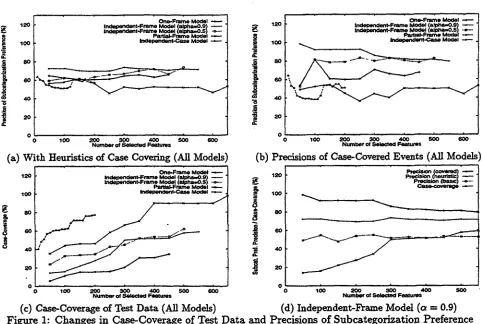
Figure I (a)-~(c) compares the precisions re and rh among the one-frame/independent-fr~me/partial- frame/independent-case models. We also compare the changes of the rate of the verb-noun collo- cations in the test set which satisfy the case covering relation ~_co with the set ,q of active features.
|
"5
|
&
!
i
O n e - F r a m e MOdel
0 i m
o ,~o ~ ~ ~ o ~ ~o
N u m b e r o / S e l e c t e d F e a t u r e s
(a) With Heuristics of Case Covering (An Models
" " On----el;raiN) M o d e l " 1 2 0 I n d e p e n d e ~ - I = r a r n e M o d e l ( a l p h a . O . 9 )
° 0 1 ; , ~o 3 0 0 ' ' ~ o 50o ' 6 o 0 '
Number o / S e l e c t e d Features
(c) Case-Coverage of Test Data (All Models)
1
J
o
|
Oo lOO
. r
One-Frame Model
in~pendeetndent-Frame Model ( a ~ u ~ 0 . 9 )
4OO S00 6O0 Number of Sele~ed Features
&
8
(b) Precisions of Case-Covered Events (All Models
Pm(:ismn (covered)
1 2 0 P r e c i s i o n ( h e u r i s t i c )
precision (ba~c) --,~-
100
80
60
40
20
0 , I
0 100 2 0 0 ~00 4 0 o s o o Number o~ Selected Features
(d) Independent-Frame Model (a = 0.9)
Figure 1: C h a n g e s in Case-Coverage of Test D a t a and Precisions o f S u b c a t e g o r i z a t i o n Preference
For t h e i n d e p e n d e n t - f r a m e model, we examined two different values o f t h e independence p a r a m e t e r a , i.e., c~ - 0.5 as a weak condition on independence j u d g m e n t a n d ~ - 0.9 as a strict condition on i n d e p e n d e n c e j u d g m e n t . Figure 1 (d) shows t h e changes of t h e precisions r~, rh, a n d re as well as t h e case-coverage of the test d a t a during t h e training for t h e i n d e p e n d e n t - f r a m e model (the i n d e p e n d e n c e p a r a m e t e r ~ - 0.9). B o t h of the precisions re a n d rh of the i n d e p e n d e n t - f r a m e model are higher t h a n those of any other models. O n t h e o t h e r h a n d , the case-coverage of the i n d e p e n d e n t - f r a m e m o d e l (as well as t h e t h a t of one-frame model) is much lower t h a n t h a t of the p a r t i a l - f r a m e / i n d e p e n d e n t - c a s e models. T h e decrease o f the case-coverage in t h e i n d e p e n d e n t - f r a m e / o n e - f r a m e models is caused b y the overfitting to the training d a t a . s
In t h e case of t h e i n d e p e n d e n t - f r a m e model, precisions decrease in the order of re, rh, and r~. This m e a n s t h a t t h e independent-frame model p e r f o r m s well in t h e t a s k o f s u b c a t e g o r i z a t i o n preference w h e n the v e r b - n o u n collocations satisfy t h e case covering relation "<cr w i t h t h e set S of active features. W h e n t h e v e r b - n o u n collocations do not satisfy t h e case covering relation, we have to use the heuristics of case covering in section 4.4.2 and t h e n t h e precision of s u b c a t e g o r i z a t i o n preference decreases. If we do not care w h e t h e r the v e r b - n o u n collocations satisfy t h e case covering relation a n d d o not use t h e heuristics of case covering, this means t h a t we use t h e basic m o d e l in
6The reason why the overfitting to the training data occurs in the independent-frame/one-frame models can be explained by comparing the effects of the two values of the independence parameter ~ in the independent model. When c~ equals to 0.9, both rc and rh are slightly h/gher than when a equals to 0.5. Especially, when the number of selected features are less than 300, rc is much higher when ~ equals to 0.9 than when ~ equals to 0.5, although the case-coverage of the test data is much lower. When the condition on independence judgment becomes more strict, the cases in the t r i g data are judged as dependent on each other more often and then this causes the estimated model to overfit to the training data. In the case of the independent-frame model, overfit to the training data seems to result in higher performance in subcategor/zation preference task, although the ease-coverage of the test data is caused to become lower.
[image:14.612.69.551.65.389.2]section 4.4.1 and it p e r f o r ~ worst as indicated b y t h e precision rb.
6
C o n c l u s i o n
This p a p e r p r o p o s e d a novel m e t h o d for learning probabilistic models o f s u b c a t e g o r i z a t i o n prefer- ence of verbs. W e p r o p o s e d to consider t h e issues o f case dependencies a n d n o u n class generalization in a uniform way. W e a d o p t e d the m a x l m u m e n t r o p y m o d e l learning m e t h o d and applied it t o t h e t a s k of m o d e l learning of s u b c a t e g o r i z a t i o n preference. 7 W e d e s c r i b e d the results o f t h e exper- i m e n t on learning t h e models of s u b c a t e g o r i z a t i o n preference from t h e E D R J a p a n e s e b r a c k e t e d corpus. We e v a l u a t e d the p e r f o r m a n c e of t h e selected features a n d their e s t i m a t e d p a r a m e t e r s in the s u b c a t e g o r i z a t i o n preference task. I n this evaluation task, t h e i n d e p e n d e n t - f r a m e m o d e l w i t h t h e i n d e p e n d e n c e p a r a m e t e r c~ = 0.9 p e r f o r m e d b e s t in t h e precision w h e n i n c o r p o r a t i n g t h e heuris- tics of case-covering, as well as in t h e precision o f case-covered test events. As for f u r t h e r issues, it i s i m p o r t a n t t o improve t h e case-coverage of t h e i n d e p e n d e n t - f r a m e m o d e l w i t h o u t decreasing the precision of s u b c a t e g o r i z a t i o n preference. For this purpose, we have already i n v e n t e d a new feature selection algorithm which m e e t s t h e a b o v e requirement o n preserving high case-coverage w i t h a relatively small n u m b e r of active features, s We will r e p o r t t h e details of applying this new algorithm to the t a s k of m o d e l learning of s u b c a t e g o r i z a t i o n preference in the near f u t u r e .
R e f e r e n c e s
Berger, A. L., S. A. Della Pietra, and V. J. Della Pietra. 1998. A maximum entropy approach to natural language processing. Computational Lingu~tics,
22(1):39-71.
Black, E. 1993. Towards history-based grammars: Using 1~cher models for probab~stic parsing. In Proceedings of the 31st Annual Meeting of A CL, pages 31-37.
Collins, M. 1996. A new statistical parser based on bigram lexical dependencies. In Proceedings of the 34th Annual
Meeting of A CL, pages 184-191.
Della Pietra~ S., V. Dells Pietra, and J. Lafferty. 1997. Inducing features of random fields. IEEE Transaction.~ on
Pattern Analpsis and Machine Intelligence, 19(4):380-393.
EDI~ (Japan Electronic Dictionary Research Institute, Ltd.), 1995. EDIt Electronic Dictionary Technical Guide.
Haruno, M. 1995. Verbal case frame acquisition as data compression. In Proceedings of the 5th International Workshop on Nature~ Language Understanding and Logic Programming, pages 45-50.
Li, H. and N. Abe. 1995. Generalizing case frames using a thesaurus and the MDL principle. In Proceedings of International Conference on Recent Advances in Natural Language Processing, pages 239-248.
Li, H. and N. Abe. 1996. Learning dependencies between case frame slots. In Proceedings of the 16th COLING,
pages 10-15.
Mngerman, D. M. 1995. Statistical decision-tree models for parsing. In Proceedings of the 33rd Annual Meeting of A CL, pages 276-283.
NLRI, (National Language Research Institute), 1993. Word List by Semantic Principles. Syuei Syuppan. (in Japanese).
Resnik, P. 1993. Semantic classes and syntactic ambiguity. In Proceedings of the Human Language Technology Workshop, pages 278-283.
Rissanen, J. 1989. Stochastic Compleafly in Statistical Inquiry, volume 15. World Scientific Publishing Company. Utsttro, T. and Y. Matsumoto. 1997. Learning probabilistic subcategorization preference by identifying.case depen-
dencies and optimal noun class generalization level. In Proceedings of the 5th ANLP, pages 364-371.
~Previously, in Utsuro and Matsumoto (1997), we have proposed a method of learning probabilistic subcatego- rization preference, which is not based-on any probab'distic model learning techniques. Compared with this previous paper, one of the underlying motivations of the work in this paper is that, by applying general probabi]istic model learning techniques such as the maximum entropy model learning method, it becomes easier to incorporate various kinds of linguistic information into the model of subcategorization preference. For example, as such linguistic informa- tion, we are pJ~-nlng to incorporate syntactic features concerning idiomatic expression as well as voice of the verb.
SThe basic idea of the new algorithm is as follows: first, it starts from the independent-case model with relatively general sense restrictions which correspond to higher classes in the thesaurus. This starting model satisfies the requirement on high case-coverage. Then, the algorithm gradually ex~rnlues the case dependencies as well as more specific sense restrictions which correspond to lower classes in the thesaurus. The model search process is controlled according to some information-theoretic model evaluation criteria such as the MDL principle (l~sanen, 1989).
f "