A M a x i m u m - E n t r o p y Partial Parser for U n r e s t r i c t e d T e x t
W o j c i e c h S k u t and T h o r s t e n B r a n t s Universit~t des Saarlandes
C o m p u t a t i o n a l Linguistics D-66041 Saarbrficken, G e r m a n y
{
skut,
brant
s}
@coli.
uni-sb, de
A b s t r a c t
This paper describes a partial parser that as- signs syntactic structures to sequences of part- of-speech tags. The program uses the
maximum
entropy parameter estimation method, which M-
lows a flexible combination of different know- ledge sources: the hierarchical structure, parts of speech and phrasal categories. In effect, the parser goes beyond simple bracketing and recog- nises even fairly complex structures. We give accuracy figures for different applications of the parser.1 I n t r o d u c t i o n
The maximum entropy framework has proved to be a powerful modelling tool in many ar- eas of natural language processing. Its ap- plications range from sentence boundary dis- ambiguation (Reynar and Ratnaparkhi, 1997) to part-of-speech tagging (Ratnaparkhi, 1996), parsing (Ratnaparkhi, 1997) and machine trans- lation (Berger et al., 1996).
In the present paper, we describe a
partial
parser
based on the maximum entropy mod- elling method. After a synopsis of the maximum entropy framework in section 2, we present the motivation for our approach and the techniques it exploits (sections 3 and 4). Applications and results are the subject of the sections 5 and 6. 2 M a x i m u m E n t r o p y M o d e l l i n g The expressiveness and modelling power of the maximum entropy approach arise from its abil- ity to combine information coming from differ- ent knowledge sources. Given a set X of possi- ble histories and a set Y of futures, ~ e can char- acterise events from the joint event space X, Y by defining a number offeatures,
i.e., equiva- lence relations over X x Y. By defining thesefeatures, we express our insights about informa- tion relevant to modelling.
In such a formalisation, the maximum en- tropy technique consists in finding a model that (a) fits the empirical expectations of the pre- defined features, and (b) does not assume any- thing specific about events that are not sub- ject to constraints imposed by the features. In other words, we search for the maximum en- tropy probability distribution p*:
p" = argmax g (p)
pEPwhere P =
{p:p
meets the empirical feature ex- pectations} andH(p)
denotes the entropy of p. For parameter estimation, we can use the Im- proved Iterative Scaling (IIS) algorithm (Berger et all., 1996), which assumes p to have the form:p(x, y) =
where fi : X x Y ~ {0, 1} is the indicator func- tion of the i-th feature, Ai the weight assigned to this feature, and Z a normalisation constant. IIS iteratively adjusts the weights (Ai) of the features; the model converges to the maximum entropy distribution.
One of the most attractive properties of the maximum entropy approach is its ability to cope with feature decomposition and overlapping fea- tures. In the following sections, we will show how these advantages can be exploited for
par-
tial parsing,
i.e., the recognition of syntactic structures of limited depth.contexts. Regardless of whether or n o t abstrac- tions such as phrases occur in the model, most of the relevant information is contained directly in the sequence of words and part-of-speech tags to be processed.
An archetypal representative of this approach is the m e t h o d described by Church (1988), w h o used corpus frequencies to determine t h e b o u n d - aries of simple non, recursive NPs. For each pair
of part-of-speech tags ti, tj, the probability of an
N P b o u n d a r y (' [' or ']') occurring between ti and tj is computed. On the basis of these context probabilities, the program inserts t h e symbols '[' and ']' into sequences of part-of-speech tags.
Information about lexical contexts also sig- nificantly improves t h e performance of deep
parsers. For instance, Joshi and Srinivas
(1994) encode partial structures in the Tree Ad- joining G r a m m a r framework and use tagging techniques to restrict a potentially very large a m o u n t of alternative structures. Here, t h e con- text incorporates information a b o u t b o t h t h e terminal yield and the syntactic s t r u c t u r e built so far.
Local configurations of words and p~irts of speech are a particularly i m p o r t a n t knowledge source for lexicalised grammars. In t h e Link G r a m m a r framework (Lagerty et al., 1992; Della Pietra et al., 1994), strictly local contexts are naturally combined with long-distance in-
formation coming from long-range trigrams.
Since modelling syntactic context is a very knowledge-intensive problem, the m a x i m u m en- tropy framework seems to be a particularly ap- propriate approach. R a t n a p a r k h i (1997) intro-
duces several conteztual predicates which pro-
vide rich information about the syntactic con- text of nodes in a tree (basically, t h e s t r u c t u r e and category of nodes d o m i n a t e d by or dom- inating the current phrase). T h e s e predicates are used to guide t h e actions of a parser.
T h e use of a rich set of contextual features is also the basic idea of t h e approach taken by Her- mjakob and Mooney (1997), who employ predi- cates capturing syntactic and semantic context in their parsing and machine translation system.
4 A P a r t i a l P a r s e r f o r G e r m a n
T h e basic idea underlying our appr*oach to par- tial parsing can be characterised as follows:
• An appropriate encoding format makes it
possible to express all relevant lexical, cat- egorial and structural information in a fi-
nite alphabet of structural tags assigned to
words (section 4.1).
• Given a sequence of words tagged with part-of-speech labels, a Markov m o d e l is used to determine t h e most probable se- quence of structural tags (section 4.2).
• Parameter estimation is based on t h e max- imum entropy technique, which takes full advantage of the multi-dimensional charac-
ter of the structural tags (section 4.3).
T h e details of the m e t h o d employed are ex- plained in the remainder of this section.
4 . 1 R e l e v a n t C o n t e x t u a l I n f o r m a t i o n
Three pieces of information associated with a
word wi are considered relevant to t h e parser:
• the part-of-speech tag ti assigned to wi
• the structural relation ri between wi and its predecessor wi-1
• the syntactic category ca of parent(wi)
O n the basis of these three dimensions, struc-
tural tags are defined as triples of t h e form Si = (ti,ri,ca). For b e t t e r readability, we will sometimes use attribute-value matrices to de- note such tags.
=
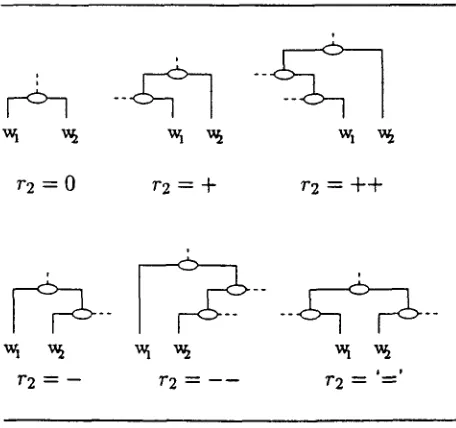
Since we consider s t r u c t u r e s of limited d e p t h , only seven values of the R E L a t t r i b u t e are dis- tinguished.
r / =
0 if parent(wi) = parent(wi_l)
+ if parent(wi) = parent2(wi_l)
+ + if parent(wi) = parent3(wi_l)
- if parent2(wi) = parent(wi_l)
- - if parent3(wi) = parent(wi_l)
= if parent2(wi) = parent2(wi_t)
1 else
list is assigned. Figure 1 exemplifies the encod- ing format.
r 2 = 0 7 . 2 = + r 2 = + +
7"2 = - -
-_
7" 2 = - - - -
° - ~ ° "
v~
m
r 2 - -
Figure 1: Tags r 2 assigned to word w2 These seven values of the
ri
attribute are mostly sufficient to represent the structure of even fairly complex NPs, PPs and APs, involv- ing P P and genitive NP attachment as well as complex prenominal modifiers. The only NP components that are not treated here are rela- tive clauses and infinitival complements. A Ger- man prepositional phrase and its encoding are shown in figure 2.etwa 50 000 ADV CARD CARD
-- ".OatR." ".O=tSg
approx. 50 000
mit D M
APPR NN
- - " . D l J t R
1 ++
with DM
pro J a h r
APPR NN
- - " . O . t ~
- 0
per year
4.2 A M a r k o v i a n P a r s e r
The task of the parser is to determine the best sequence of triples
(ti, ri,
Ci ) for a given sequence of part-of-speech tags(to, tl,...tn).
Since the attributes TAG, REL and CAT can take only a finite number of values, the number of such triples will also be finite, and they can be used to construct a 2-nd order Markov model. The triplesSi = (ti,ri,ci) are
states of the model, which emits POS tags (tj) as signals.In this respect, our approach does not much differ from standard part-of-speech tagging techniques. We simply assign the most probable sequence of structural tags S = (So, & , . . . , & ) to a sequence of part-of-speech tags T =
(to, tt,...,tn).
Assuming the Markov property, we obtain:argmax P( SIT)
(1)S
= argmax P ( S ) . P ( T I S )
R k
= argmax r I
P(SilSi-2, S i - t ) P ( t i l S i )
R i = 1
The part-of-speech tags are encoded in the structural tag (the ti dimension), so S uniquely determines T. Therefore, we have
P(ti[Si) = 1
if Si = (ti, ri, ci) and 0 otherwise, which simpli- • ties calculations.4.3 P a r a m e t e r E s t i m a t i o n
The more interesting aspect of our parser is the estimation of contextual probabilities, i.e., cal- culating the probability of a structural tag
Si
(the "future") conditional on its immediate pre- decessors Si- 1 andSi-2
(the "history").history future
CAT: c/-2] ti-2J
"CAT:
~_ I]
R E L : r i - 1
/
TAG:
t i - l J
"CAT: ci] REL: ri TAG: ti
Figure 2: A sample structure. explained in Appendix B.
[image:3.596.43.271.99.313.2] [image:3.596.47.274.472.671.2]4.3.1 L i n e a r I n t e r p o l a t i o n
One possible way of parameter estimation is to use standard HMM techniques while treating
the triples
Si
=(ti, ci,ri} as
atoms. Trigramprobabilities are estimated from an a n n o t a t e d corpus by using relative frequencies r:
= / ( & - 2 , & - l , & )
/ ( S i - 2 , Si-1)
A s t a n d a r d m e t h o d of handling sparse d a t a is to use a linear combination of unigrams, bigrams, and trigrams/5:
/5(&l&-2,&-,)
=Air(&)
+ X 2 r ( S / l & - 1 ) + A a r ( & l & - 2 , & - l )T h e Ai denote weights for different context sizes and s u m up to 1. T h e y are c o m m o n l y estimated by deleted interpolation (Brown et hi., 1992).
4 . 3 . 2 F e a t u r e s
A disadvantage of the traditional m e t h o d is t h a t
it considers only full n-grams S i - n + l , ...,
Si
andignores a lot of contextual information, such as regular behaviour of t h e single attributes TAG, REL and CAT. T h e m a x i m u m entropy approach offers an attractive alternative in this respect since we are now free to define fea- tures accessing different constellations of the at- tributes. For instance, we can abstract over one or more dimensions, like in the context descrip- tion in figure 1.
history future
[REL: 0
REL:!TAG:
NNJ
Table 1: A partial trigram feature
Such "partial n-grams" p e r m i t a b e t t e r ex- ploitation of information coming from con-
texts observed in the training data. We
say t h a t a feature fk defined by t h e triple
(Mi-2, Mi-1,
Mi) of attribute-value matrices isactive
on a trigram context (S~_2, S~_i, S~) (i.e.,fk(S~_ 2,
S~_1, S~) = 1) iffMj
unifies with the attribute-value matrix /t'I~ encoding t h e infor- mation contained in S~ for j = i - 2, i - 1, i. Anovel context w o u l d o n average activate m o r e features than in the s t a n d a r d H M M approach, w h i c h treats the (ti, ri, c~> triples as atoms.
T h e actual features are extracted f r o m the training corpus in the following w a y : w e first de- fine a number
of feature patterns
t h a t say which attributes of a trigram context are relevant. All feature p a t t e r n instantiations t h a t occur in the training corpus are stored; this p r o c e d u r e yields several thousands of features for each pattern.After c o m p u t i n g the weights Ai of the fea- tures occurring in the training sample, we can calculate the contextual probability of a multi-
dimensional structural tag
Si
following t h e twotags
Si-2 and Si-l:
1
.e~,'~i'Ii(Si-2'&-"sd
p(&l&-2, &-,) = E
We achieved the best results with 22 empir- ically determined feature p a t t e r n s comprising
full and partial
n-grams,
n _< 3. These p a t t e r n sare listed in A p p e n d i x A.
5 A p p l i c a t i o n s
Below, we discuss two applications of o u r max- imum entropy parser: t r e e b a n k a n n o t a t i o n and chunk parsing of unrestricted text. For precise results, see section 6.
5.1 T r e e b a n k A n n o t a t i o n
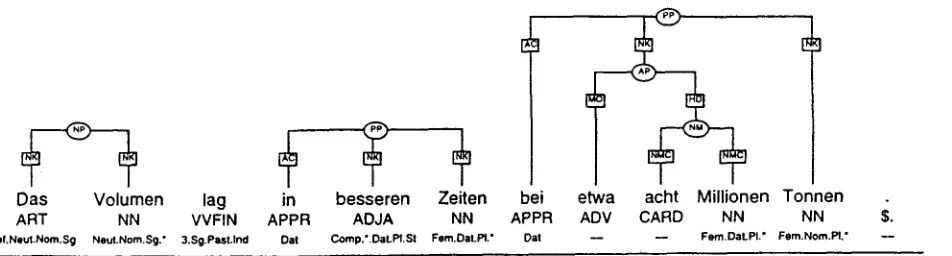
T h e partial parser described here is used for cor- p u s annotation in a treebank project, cf. (Skut et hi., 1997). T h e a n n o t a t i o n process is more in- teractive than in the P e n n Treebank approach (Marcus et hi., 1994), where a sentence is first preprocessed by a partial parser and t h e n edited by a h u m a n annotator. In our m e t h o d , man- ual and automatic a n n o t a t i o n steps are closely interleaved. Figure 3 exemplifies the human- computer interaction d u r i n g annotation.
T h e annotations encode four kinds of linguis- tic information: 1) parts of speech and inflec- tion, 2) structure, 3) phrasal categories (node labels), 4) grammatical functions (edge labels). Part-of-speech tags are assigned in a prepro- cessing step. T h e a u t o m a t i c instantiation of la- bels is integrated into the assignment of struc-
tures. T h e a n n o t a t o r m a r k s t h e words and
Das Volumen lag in besseren Zeiten bei etwa
ART NN VVFIN APPR ADJA NN APPR ADV
Oef.Ne~.Norn.Sg Neut.Nom.Sg." 3.Sg.Past.lnd Oat Comp.'.DaLP1.SI Fem.Dat.Pt" Dat - -
acht Millionen Tonnen
CARD NN NN
Fern.DatPl." Fem.Nom.P1."
$.
N
Figure 3: A chunked sentence (in better times, the volume was around eight million tons). Gram-
matical function labels: NK nominal kernel component, AC adposition, NMC n u m b e r component, MO modifier.
Initially, such annotation increments were just local trees of depth one. In this mode, the
annotation of the P P bei etwa acht Millionen
Tonnen ([at] around eight million tons) involves three annotation steps (first the n u m b e r phrase
acht Millionen, then the AP, and t h e PP). Each time, the annotator highlights the immediate constituents of the phrase being constructed.
T h e use of the partial parser described in this paper makes it possible to construct the whole P P in only one step: T h e a n n o t a t o r marks the words dominated by the P P node, and the inter- nal structure of the new phrase is assigned auto- matically. This significantly reduces the a m o u n t of manual annotation work. T h e m e t h o d yields reliable results in the case of phrases that ex- hibit a fairly rigid internal structure. More t h a n 88% of all NPs, PPs and APs are assigned the correct structure, including P P a t t a c h m e n t and complex prenominal modifiers.
Further examples of structures recognised by the parser are shown in figure 4. A more de- tailed description of the annotation mode can be found in (Brants and Skut, 1998).
5.2 N P C h u n k e r
Apart from treebank annotation, our partial parser can be used to chunk part-of-speech tagged text into major phrases. Unlike in the previous application, the tool now has to deter- mine not only the internal structure, but also the external boundaries of phrases. This makes the task more difficult; especially for determin- ing F P attachment.
However, if we restrict the coverage of the parser to the prenominal part of the N P / P P , it
performs quite well, correctly assigning almost 95% of all structural tags, which corresponds to a bracketing precision of ca. 87%.
6 R e s u l t s
In this section, we report the results of a cross- validation of the parser carried out on the Ne- Gra Treebank (Skut et al., 1997). T h e corpus was converted into structural tags and parti- tioned into a training and a testing part (90% and 10%, respectively). We repeated this proce- dure ten times with different p a r t i t i o n i n g s ; t h e results of these test runs were averaged.
T h e weights of the features used by the maximum entropy parser were determined with the help of the M a x i m u m E n t r o p y Modelling Toolkit, cf. (Ristad, 1996). T h e number of fea- tures reached 120,000 for the full training cor- pus (12,000 sentences). Interestingly, tagging accuracy decreased after after 4-5 iterations of Improved Iterative Scaling, so only 3 iterations were carried o u t in each of the test runs.
T h e accuracy measures employed are ex- plained as follows.
t a g s : the percentage of structural tags with the correct value r~ of the REL attribute,
b r a c k e t i n g : the percentage of correctly recog- nised nodes,
l a b e l l e d b r a c k e t i n g : like bracketing, b u t in- cluding the syntactic category of the nodes,
[image:5.596.47.523.67.195.2]D
'3 (
°
I
°
Ein geradezu pathetischer Aufruf zum
ART ADV ADJA NN APPRART
An almost pathetic call for a
gemeinsamen Kampf
ADJA NN
joint fight
+
for einen gerechten Frieden
APPR ART ADJA NN
for a just peace
®
t0r Oklob4r geplsnlen APF'f~ N N AJDJA
for Oclob,~. ptan:,',ed
Eine Kostprobe l u l l emem Progrsmm
ART N N APtPR ART N N A samc~e ol • ~ o g t = m
T
~ J e r ell>l~',memellen A ~ ART M3JA
Vedo,~'~,duf~l z w , l c h e n R o c k - ~ Chormu~k
N N AP'PR T R U N C KON N N
betweert rock and ¢ho~ m u t ¢
E'3
®
irn Nachtragshaushalt vorgesehene
APPRART NN AOJA
in the additional budget planned
Ober die Stellenverteilung
APPR ART NN
about the allocation of jobs
in der Verwaltung
APPR ART NN
in the administration
Figure 4: Examples of complex NPs and PPs correctly recognised by the parser. In the treebank application, such phrases are part of larger structures. The external boundaries (the first and the last word of the examples) are highlighted by an annotator, the parser recognises the internal boundaries and assigns labels.
6.1 T r e e b a n k A p p l i c a t i o n
In the treebank application, information about the external boundaries of a phrase is supplied by an annotator. To imitate this situation, we extracted from the NeGra corpus all sequences of part-of-speech tags spanned by NPs PPs, APs and complex adverbials. Other tags were left out since they do not appear in chunks recognised by the parser. Thus, the sentence
shown in figure 3 contributed three substrings to the chunk corpus: ART NN, APPR ADJA NN and APPR ADV CARD NN NN, which would also be typical annotator input. A designated sepa- rator character was used to mark chunk bound- aries.
Table 2: Recall and precision results for the in- teractive annotation mode.
measure
tags bracketing lab. brack. struct, match
total correct 129822 123435
56715 49715 56715 47415 37942 33450
recall I prec. 95.1% 87.7% 89.1% 83.6% 84.8%
88.2% 88.0%
6.2 C h u n k i n g A p p l i c a t i o n
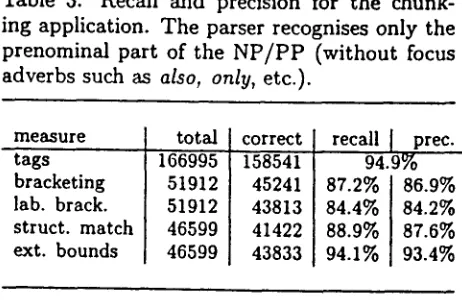
Table 3 shows precision and recall for the chunk- ing application, i.e., the recognition of kernel NPs and PPs in part-of-speech tagged text. Post-nominal P P attachment is ignored. Un- like in the treebank application, there is no pre- editing by a human expert. The absolute num- bers differ from those in table 2 because cer- tain structures are ignored. The total number of structural tags is higher since we now parse whole sentences rather then separate chunks.
In addition to the four accuracy measures defined above, we also give the percentage of chunks with correctly recognised external boundaries (irrespective of whether or not there are errors concerning their internal structure). Table 3: Recall and precision for the chunk- ing application. The parser recognises only the prenominal part of the N P / P P (without focus adverbs such as
also, only,
etc.).measure
tags
bracketing lab. brack. struct, match ext. bounds
total 166995 51912 51912 46599 46599
correct
158541 45241 43813 41422 43833
recall I prec. 94.9% 87.2% 86.9% 84.4% 84.2% 88.9% 87.6% 94.1% 93.4%
6.3 C o m p a r i s o n t o a S t a n d a r d T a g g e r In the following, we compare the performance of the maximum-entropy parser with the precision of a standard HMM-based approach trained on the same data, but using only the frequencies of complete trigrams, bigrams and unigrams, whose probabilities are smoothed by linear in- terpolation, as described in section 4.3.1.
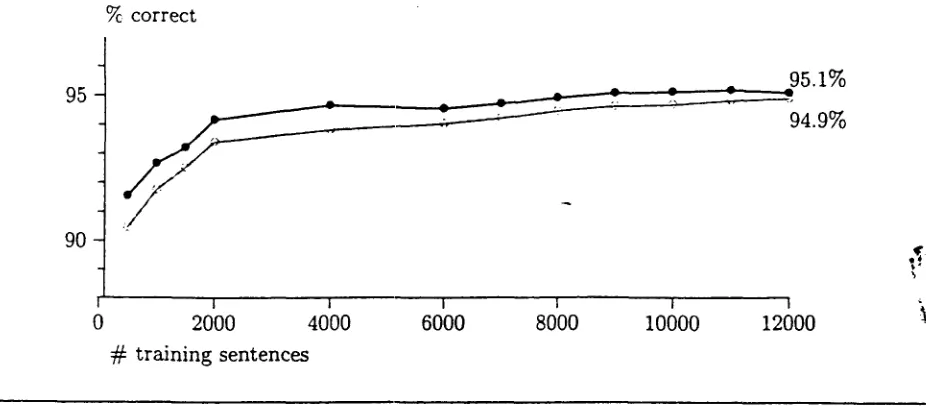
Figure 5 shows the percentage of correctly as- signed values ri of the R.EL attribute depending
on the size of the training corpus. Generally, the maximum entropy approach outperforms the linear extrapolation technique by about 0.5% -
1.5%, which corresponds to a 1% - 3% difference in structural match. The difference decreases as the size of the training sample grows. For the full corpus consisting of 12,000 sentences, the linear interpolation tagger is still inferior to the maximum entropy one, but the difference in pre- cision becomes insignificant (0.2%). Thus, the maximum entropy technique seems to particu- larly advantageous in the case of sparse data.
7 C o n c l u s i o n
We have demonstrated a partial parser capa- ble of recognising simple and complex NPs, PPs and APs in unrestricted German text. The maximum entropy parameter estimation method allows us to optimally use the con- text information contained in the training sam- ple. On the other hand, the parser can still be viewed as a Markov model, which guarantees high efficiency (processing in linear time). The program can be trained even with a relatively small amount of treebank data; then it can be J used for parsing unrestricted pre-tagged text.
As far as coverage is concerned, our parser can handle recursive structures, which is an ad- vantage compared to simpler techniques such as that described by Church (1988). On the other hand, the Markov assumption underlying our approach means that only strictly local de- pendencies are recognised. For full parsing, one would probably need non-local contextual infor- mation, such as the
long-range trigrams
in Link Grammar (Della Pietra et al., 1994).Our future research will focus on exploiting morphological and lexical knowledge for partial parsing. Lexical context is particularly relevant for the recognition of genitive NP and P P at- tachment, as well as complex proper names. We hope that our approach will benefit from re- lated work on this subject, cf. (Ratnaparkhi et al., 1994). Further precision gain can also be achieved by enriching the structural context, e.g. with information about the category of the grandparent node.
8 A c k n o w l e d g e m e n t s
[image:7.596.38.270.118.191.2] [image:7.596.38.269.440.590.2]9~ correct
95
90
95.1% 94.9%
I i I I I
0 2000 4000 6000 8000 10000 12000
# training sentences
Figure 5: Tagging precision achieved by the maximum entropy parser (-t-) and a tagger using linear interpolation (--e--). Precision is shown for different numbers of training sentences.
rive Processes,
Project C3Concurrent Gram-
mar Processing.
Many thanks go to Eric S. Ristad. We used his freely available Maximum Entropy. Mod- elling Toolkit to estimate context probabilities. R e f e r e n c e s
Adam L. Berger, Stephen A. Della Pietra, and Vincent J. Della Pietra. 1996. A maxim-m entropy approach to natural language pro- cessing.
Computational Linguistics Vol. 22
No. 1,
22(1):39-71.Thorsten Brants and Wojciech Skut. 1998. Au- tomation of treebank annotation. In
Proceed-
ings of NeMLaP-3,
Sydney, Australia. Thorsten Brants, Wojciech Skut, and BrigitteKrenn. 1997. Tagging grammatical func- tions. In
Proceedings of EMNLP-97,
Provi- dence, RI, USA.P. F. Brown, V. 3. Della Pietra, Peter V: de Souza, Jenifer C. Lai, and Robert L. Mer- cer. 1992. Class-based n-gram models of natural language.
Computational Linguistics,
18(4):467-479.Kenneth Ward Church. 1988. A stochastic parts program and noun phrase parser for unrestricted text. In
Proc. Second Confer-
ence on Applied Natural Language Process-
ing,
pages 136-143, Austin, Texas, USA. S. Della Pietra, V. Della Pietra, J. Gillett,J. Lafferty, H. Printz, and L. Ures. 1994.
Inference and estimation of a long-range tri- gram model. In
Proceedings of the Second In-
ternational Colloquium on Grammatical In-
ference and Applications, Lecture Notes in
Artificial Intelligence.
Springer Verlag. Ulf Hermjakob and Raymond J. Mooney. 1997.Learning parse and translation decisions from examples with rich contexts. In
Proceedings
of A CL-97,
pages 482 - 489, Madrid, Spain. Aravind K. Joshi and B. Srinivas. 1994. Dis-ambiguation of super parts of speech (or su- pertags). In Proceedings COLING 9~, Kyoto, Japan.
John Lafferty, Daniel Sleator, and Davy Tem- perley. 1992. Grammatical trigrams: A prob- abilistic model of link grammar. In
Proceed-
ings of the A A A I Conference on Probabilistic
Approaches to Natural Language.
Mitchell Marcus, Beatrice Santorini, and Mary Ann Marcinkiewicz. 1994. Building a large annotated corpus of English: the Penn Treebank. In Susan Armstrong, editor,
Using
Large Corpora.
MIT Press.Adwait Ratnaparkhi, Jeff Reynar, and Salim Roukos. 1994. A maximum entropy model for prepositional phrase attachment. In
Pro-
ceedings of the ARPA Human Language Tech-
nology Workshop,
pages 250--255. [image:8.596.100.563.66.269.2]USA.
Adwait Ratnaparkhi. 1997. A linear observed time statistical parser based on m a x i m u m en-
tropy models. In
Proceedings of EMNLP-97,
Providence, RI, USA.
Jeffrey Reynar and Adwait Ratnaparkhi. 1997. A m a x i m u m entropy approach to identify-
ing sentence boundaries. In
Proceedings of
ANLP-97,
Washington, DC, USA.Eric Sven Ristad, 1996.
Maximum Entropy
Modelling Toolkit, User's Manual.
Prince-ton University, Princeton. Available at
cmp-lg/9612005.
Wojciech Skut, Brigitte Krenn, T h o r s t e n
Brants, and Hans Uszkoreit. 1997. An anno- tation scheme for free word order languages. In
Proceedings of ANLP-97,
Washington, DC.Christine Thielen and Anne Schiller. 1995.
Ein kleines u n d erweitertes Tagset fiirs
Deutsche. In
Tagungsberichte des Arbeitstr-
effens Lexikon + Text 17./18. Februar 199~,
Schlofl Hohentiibingen. Lexicographica Series
Mawr,
Tiibingen. Niemeyer.A p p e n d i x A : F e a t u r e P a t t e r n s
Below, we give the 22 n-gram feature patterns used in our experiments.
tad
¢2 ht~
. M
history
r, t, c r, t, c r sibl , t, c r, t, c r, C r, C
t r sibl , C r sibl , t r, t
r , t r t , c r , c r t , c r r t , c
r , t , c r t,C
r , t , c r t,C t r t , C
r t , c r t , c r t , C r sibl, t r , t
c
t
r
future
r , t , C
r, t, C
r, t, C r, t, C
r, t r, t r, c r r, t r~ c r, c
r , t , C r , t r , c r , t r , t r~ c r , t .
r
r , t , C r , t
r sibl , t
The symbols r (REL), t (TAG), and c (CAT) indicate which attributes are taken into account when generating a feature according to a partic-
ular pattern, r sibl is a binary-valued attribute
saying whether the word u n d e r consideration and its immediate predecessor are siblings (i.e., whether or not r = 0).
A p p e n d i x B : T a g s e t s
This section contains descriptions of tags used
i n this paper. These are
not
complete lists.B.1 P a r t - o f - S p e e c h T a g s
We use the Stuttgart-T/.ibingen-Tagset. T h e
complete set is described in (Thielen and Schiller, 1995).
A D J A attributive adjective
ADV adverb
APPR preposition
APPRART preposition with determiner
ART article
C A R D cardinal number
KON Conjunction
NE proper noun
NN common noun
PROAV pronominal adverb
TRUNC first part of truncated noun
VAFIN finite auxiliary
VAINF infinite auxiliary
VMFIN finite modal verb
W F I N finite verb
W P P past participle of main verb
B . 2 P h r a s a l C a t e g o r i e s
AP adjective phrase
MPN multi-word proper noun
N M multi token numeral
NP noun phrase
PP prepositional phrase
S sentence
VP verb phrase
B . 3 G r a m m a t i c a l F u n c t i o n s
AC adpositional case marker
HD head
MO modifier
MNR post-nominal modifier
NG negation
NK noun kernel
NMC numerical component
OA accusative object
OC clausal object
PNC proper noun component