“I/We hereby declare that I/We have read this master project report and in my/our
opinion this master project report is sufficient in terms of scope and quality for the award of the degree of Masters of Software Engineering.
Signature :
Academic Supervisor : Dr. Mohd. Naz’ri Mahrin.
Date : 07/08/2012
Signature :
Industrial Supervisor : Siti Sarah Binti Zainal Abidin
TESTING AND BUG FIXING OF
THE INFORMATION SECURITY MANAGEMENT SYSTEM
OMID VAHDANI
A master project report submitted in fulfilment of the requirements for the award of the degree of
Master of Software Engineering
Advanced Informatics School
Universiti Teknologi Malaysia
ii
DECLARATION
I declare that this master project report entitled “Testing and Bug fixing of the Information Security Management System” is the result of my own work and
research except as cited in the references. The master project report has not been accepted for any degree and is not concurrently submitted in candidature of any other degree.
Signature :
Name : OMID VAHDANI
iii
DEDICATION
This master project report is dedicated to my beloved parent, wife and the rest of family,
iv
ACKNOWLEDGMENT
Praise to the Most Gracious and Most Merciful, I am grateful to God for blessing me with a successful life and giving me strength to increase my academic knowledge to reach this point.
Having this opportunity I would like to express my special gratitude to my academic supervisor Dr. Mohd. Naz’ri Mahrin for his guidance in writing this thesis,
prompt respond to my messages and requests and helping me in understanding the software engineering concepts. Thanks to all lecturers in Advanced Informatics School for their effort in helping me to complete the study in Master of Software Engineering.
Besides, I would like to appreciate my industrial mentor Mrs. Siti Sarah Binti Zainal Abidin and Mr. Farhang for their patience in helping me learning new software engineering technique during the industrial attachment.
My great appreciation to my parents, wife and all my family members for their encouragement and continues support and also to my dear classmates mse-ft-04
group, Atabak, Olfat, Lalitha, Jalal, Abubakr, Ghazal, Sajjad and Abdulrahman who
have been working together as a family during this course.
v
ABSTRACT
The increasing complexity of today's software applications has created a need to do more testing and fixing the problems in the software in order to deliver the final release of the software with an acceptable level of quality. Testing and fixing the problems in software never ends and developing a software application without conducting a sufficient amount of testing and in a systematic way is likely to cause failure of the released product. The aims of this project are to test the Information
vi
ABSTRAKT
Penggunaan perisian yang makin kompleks telah mewujudkan keperluan untuk menguji dan membetulkan perisian supaya perisian yang berkualiti boleh
vii
TABLE OF CONTENTS
CHAPTER PAGE
DECLARATION ii
DEDICATION iii
ACKNOWLEDGMENT iv
ABSTRACT v
TABLE OF CONTENTS vii
LIST OF TABLES xi
LIST OF FIGURES xii
LIST OF ACRONYMS xiv
LIST OF APPENDICES xv
1 PROJECT OVERVIEW 1
1.1 Introduction 1
1.2 Company Background 1
1.3 Background of the problem 2
1.4 Project Background 3
1.4.1 Introduction to ISO27001: ISMS 3
viii
1.4.3 ISMS Background in SCAN 5
1.5 Project Objectives 7
1.6 Project Scope 7
1.7 Project Plan 9
1.8 Chapter summary 11
2 LITERATURE REVIEW 12
2.1 Introduction 12
2.2 Existing ISMS tool 12
2.2.1 The Current ISMS features 13
2.3 Other ISMS tools 14
2.4 Web Application Developing Techniques 16
2.4.1 PHP 16
2.4.2 Java Script 18
2.4.3 MySQL Database 20
2.5 Web-based Testing Techniques 21
2.5.1 State Chart Model 22
2.5.2 A Frame Work for Web Application Testing 25
2.6 Chapter summary 28
3 PROJECT METHODOLOGY 30
3.1 Introduction 30
3.2 Processes 31
3.2.1 Plan the test 31
3.2.2 Design the test cases 33
3.2.3 Test implementation 34
3.2.4 Test evaluation and report 35
3.2.5 Fix the problems 36
ix
3.3 Tools and Techniques 38
3.3.1 WAMP server 38
3.3.2 Web browser 39
3.3.3 Adobe Dreamweaver 39
3.3.4 JIRA 39
3.3.5 Firebug 40
3.3.6 TortoiseSVN 40
3.3.7 MySQL 41
3.3.8 PHP 41
3.4 Chapter summary 42
4 PROJECT DISSCUSSION 43
4.1 Testing the ISMS software 43
4.1.1 Plan the test 43
4.1.2 Test case design 48
4.1.3 Test implementation 61
4.2 Evaluate the test and report the detected problems 63
4.2.1 Test evaluation 63
4.2.2 Report the detected problems 67
4.3 Fix the detected problems 71
4.3.1 Locate the problems in the source code 71
4.3.2 Fix the detected problems 76
4.4 Regression testing 79
4.5 Recommendation to improve the testing process 81
5 CONCLUSION 83
5.1 Summary of the project 83
5.2 Experience gained 84
x
Appendices A-E 89 - 108
xi
LIST OF TABLES
TABLE NO TITLE PAGE
2.1 Different ISMS tools key features 15
4.1 Valid/Invalid classes for each element 52
4.2 Test case description 53
4.3 Equivalence partitioning valid/ invalid classes 55
4.4 Test cases for function space_to_underscore 55
4.5 Equivalence partitioning valid/ invalid classes 56
4.6 Test cases for function changePassword 57
4.7 Some possible values for the elements 58
4.8 Deducted input values for the elements 59
xii
LIST OF FIGURES
FIGURE NO TITLE PAGE
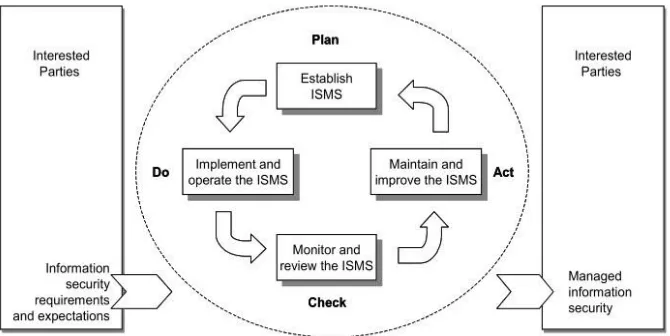
1.1 PDCA model applied to ISMS processes 3
1.2 Project Gantt chart 10
2.1 ISMS establishment process 13
2.2 Risk assessment approach 14
2.3 Simple web page illustrating how a State Charts is drawn for an HTML form 23
2.4 Relations for web application testing model 26
2.5 Workflow of testing execution 28
3.1 Overview of the project activities 31
3.2 Workflow for an issue lifecycle 40
4.1 An example that shows how State Chart identifies a state in a web page 50
4.2 When the admin wants to add a new user 51
4.3 One possible state to add a new user 53
4.4 Screenshot of test case ISMS-208 54
4.5 Function space_to_underscore 54
4.6 Function changePassword 56
4.7 Add a new document to the system 60
4.8 Screenshot of a system test case 62
4.9 Test case ISMS-IT-109 64
4.10 Test case ISMS-IT-112 65
4.11 Passed, failed and areas of the test cases 66
4.12 Creating an issue in JIRA 68
4.13 Reported issues for ISMS 2.1.1 70
xiii
4.15 Issue “ISMS-57” when it is created 74
4.16 Inspection the elements of a web page using firebug 75
4.17 Red icon on the modified folder 76
4.18 Committing the changes using TortoiseSVN 77
4.19 Reported, fixed and unresolved issues 78
xiv
LIST OF ACRONYMS
AIS : Advanced Informatics School
CMMI : Capability Maturity Model Integration CMS : Content Management System
DMS : Document Management System
HR : Human Resource
ICT : Information and Communication Technology IIS : Internet Information Service
ISMS : Information Security Management System LAN : Local Area Network
STP : Software Test Plan
xv
LIST OF APPENDICES
APPENDIX TITLE PAGE
A Test case reciew checklist 89
B Test case form 90
C Traceability table for test cases and requirement 91
D Reports of the issues from JIRA 95
CHAPTER 1
PROJECT OVERVIEW
1.1 Introduction
This chapter provides an overview of the project “A Methodology for Testing and Bug Fixing of the Information Security Management System”. This chapter shall
describe the background of the company as well as the project background (history and previous versions) during eight months of industrial attachment in the SCAN company. Also, this chapter describes a brief description of the existing problem, and identifies the project objectives and scopes.
1.2 Company Background
SCAN was co-founded by Professor Dato’ Dr. Norbik Bashah Idris and nine
other co-founders. The Company originated from a research group at Universiti
Teknologi Malaysia, which had been conducting research in information security and
cryptography since 1996 (SCAN, 2010)
2
The company currently operates from five different countries, i.e. Malaysia, Indonesia, Saudi Arabia, Syrian Arab Republic and the United Arab Emirates. SCAN has implemented more than RM200 million worth of ICT security projects in
Malaysia and overseas. Clients are from various sectors such as the government,
banking and finance, telecommunications and oil and gas sectors. In addition, SCAN
currently houses the highest concentration of internationally certified ICT security
professionals in Malaysia. Moreover, having CMMI level 3 certificate, the company
must deliver appropriate services and supports to the clients with the latest edition
based on the standard.
1.3 Background of the problem
Development of the Information Security Management System (ISMS software) has been started since 2008 at SCAN. Because, ISMS had initially been
developed for governmental organization, therefore delivering a quality product has been important for the company. Moreover, as one of its obligations the company should service its clients according to the CMMI level 3 standard. In addition to the above, SCAN should support the ISMS client (the government) with the newer versions. Therefore, in order to maintain the quality of the software, the ISMS must be delivered with the least possible problems. One of the solutions to this problem is to frequently test the software and fix the problems for every new version that is going to be released.
3
1.4 Project Background
1.4.1 Introduction to ISO27001: ISMS
The ISO27001 international standard has been prepared to provide a model for establishing, operating, monitoring, reviewing, maintaining and improving an Information Security Management System (ISMS) (ATSEC, 2011).The adoption of the ISMS is the strategic decision for the organization. The design and implementation of an organization’s ISMS is influenced by their needs and
objectives, security requirements, the processes employed and the size and structure of the organization (ISO/IEC27001, 2005).
1.4.2 Process Approach
The ISO27001 standard adopts the Plan-Do-Check-Act (PDCA) model which is applied to structure of all ISMS processes. Figure 1.1 shows how an ISMS takes
input as the information security requirements and expectations of the interested parties and perform the necessary actions to produce a managed information security (ISO/IEC27001, 2005).
4
i. Plan (establish the ISMS), establish ISMS policy, objectives, processes and procedures relevant to managing risk and improving information security to deliver results in accordance with an organization’s overall
policies and objectives.
ii. Do (implement and operate the ISMS), implement and operate the ISMS policies, controls, processes and procedures.
iii. Check (monitor and review the ISMS), assess and, where applicable, measure process performance against ISMS policy, objectives and practical experience and report the results to management for review.
iv. Act (maintain and improve the ISMS), take corrective and preventive actions based on the result of the internal ISMS audit and management review or other relevant information, to achieve continual improvement of the ISMS (ISO/IEC27001, 2005).
As the market gets more competitive and customers become more demanding and sophisticated, it is important for local ICT organisation to implement an organisation-wide information security management framework to give their customers and users greater confidence and assurance.
Consequently, it provides an assurance that the certified organisation has implemented a system for the management of information security in line with an international standard. The organisation is seen to be more credible and serious about information security management, although may not be perfect but demonstrates
continues and managed improvement.
5
monitors and controls its security and minimises risks to ensure that it fulfils the requirements of clients, users and partners to deliver products and services in a
secure environment.
As a part of SCAN’s “ICT” services, ISMS plays a significant role for the
company. So SCAN has always endeavoured to improve and release a new update of the tool frequently (SCAN, 2010).
1.4.3 ISMS Background in SCAN
SCAN’s ISMS project has begun since 2008. Malaysian government as a
client delivers the software to some of its related organisation.
As one of the premier ICT security solution provider, SCAN gives comprehensive consultation in information and communication security based on ISO27001:2005 and ISO27002:2005. To accomplish this objective the company decided to establish a framework by developing an ISMS tools in order to improve the services given to its client. The organisation consulting to SCAN for ICT security solution will now benefit from the ISMS tools to monitor, control and audit the important and valuable property of their organisation.
SCAN’s ISMS tool is developed based on the specified ISO27001
6
The ISMS project initially aimed to establish a framework to support the management of organisation’s areas, processes, assets and risks. The first version of
the ISMS software consists of risk management, user and department management and ISMS audit. Being released as the first version of ISMS, it had some deficiencies and poor functionality. Therefore, it could not be considered as a thorough ISMS tool. For example navigation through different parts of the software was difficult and not user friendly, and there was not any dashboard to have a general control over the different parts of the system. So, as a part of company’s commitment the ISMS
functionality and usability had to be improved.
ISMS Version 2.0 released by SCAN on 2009 with some new features added to the tools. The main features consist of the following:
i. User can now navigate from different parts of the system such as area, process, asset and risk.
ii. Controls over risk management, user management, and department management are now enhanced.
iii. Dashboard added to the system which provides easier access to different part of the ISMS.
iv. ISMS is now integrated with MyRAM (Risk Management software). A link to MyRAM added to the ISMS so that the administrator can import information from MyRAM database.
In 2010 the company released ISMS version 2.1 to keep updating and improving the software. Some new features were added to the new version such as tree view on the dashboard to navigate through risks, areas, processes and assets.
The current version of the project which is now under development has some new functionalities such as:
i. Document Management System (DMS). ii. Threat Catalogue was added to the system.
7
Since the beginning of the ISMS establishment, SCAN has attempted to update the ISMS framework by adding new features, fulfilling more requirements
and minimizing bugs according to the ISO27001-27002 standard.
1.5 Project Objectives
Based on some problems and weaknesses discussed on current version of
ISMS in previous section, this project will focus on testing and bug fixing of
Information Security Management System (ISMS) software. To ensure achieving the
goal, the following objectives are aimed to be gained:
To test the ISMS software.
To evaluate the test results and report the problems.
To fix the detected problems.
To conduct the regression testing.
Each step and activity related to that objective will be defined in project scopes and project methodology.
1.6 Project Scope
Testing is conducted in an integrated environment consists of a Linux based main server and four testing machines. Software Test Plan (STP) and Test Description and Report are prepared based on the company’s test case form, and
requirements stated in the ISO/IEC 27001 standard.
Scopes of testing are including “Document Management System”(DMS) and ISMS under admin view which is “Admin Dashboard”. Black box testing will be
8
Regression testing will also be conducted after correction. Test cases are implemented based on the test case form prepared by the company. In addition,
ISMS features will be compared to the similar ISMS tools from other companies in order to find and suggest new features to the project manager, but if it complies with ISO/IEC 27001 standard.
For evaluation of the testing activities, we will evaluate the test procedure according to the test plan review checklist and test case form. Scope of the test evaluation and measurement will be based on the set of criteria which are test completeness, test correctness, test traceability, test resources and schedule and regression test. These criteria are described in detail in test plan review checklist (See Appendix A). For analysis of the test result, we will do it based on expected result in the test case form and the testing coverage rate (Traceability table).
To fix the problems defects, bugs and errors will be logged in the test case form. Locating issues will be applied in the source code and tracing issues from source code to design and requirement documents will be done by other project members. Results will be logged through an issue tracking tool integrated with a configuration management tool.
Regression test will be conducted at unit and system level to ensure that system functionalities are sustained and other parts of the system are not affected in result of fixing one part.
Other than the new version of ISMS software as the main deliverable, the following must be provided to the company:
Software Test Plan (STP)
Test case description (test case form)
9
Content of the STP is based on the company’s test plan guideline. Test case
description and report will be prepared in the test case form. Reports of the reported
and fixed problems will be generated from the issue tracking and subversion tools.
1.7 Project Plan
Software Test Plan (STP) document is used as the planning document to describe the step by step guidance to the project goal. The project Gantt chart shown in Figure 1.2 on the next page illustrates the project activities to be performed in this project. Detailed activities of the project plan such as identification of scope, environment, schedule, risk and test execution, reporting, monitoring and completion will be defined in software test plan document. Moreover, the amount, level of detail, structure and templates for the test documentation and test procedures will be
10
11
1.8 Chapter Summary
This chapter discussed the overview of the project. Background of the company, fields of activities, structures and software engineering experiences were also introduced. As described, the main problem that this project is going to solve is to test and fix the problem for the ISMS system. Objectives that were identified are, to perform testing the ISMS software, to evaluate the testing and report the detected problems, to fix the detected problems and to conduct regression testing.
Testing will be performed in an integrated environment consists of Linux server and four Microsoft Windows clients as testing stations. Scope of the testing is “DMS” and “Admin Dashboard”, black box will be conducted in system level and
86
REFERENCES
Anupam.V, F. J. k. L. D., 2000. "Automating Web Navigation with the
WebVCR", s.l.: Bell Laboratories, 600 Mountain Ave., Murray Hill, NJ
07974, USA.
ATSEC, 2011. Information Security, ISMS, and ISO/IEC 27001. [Online] Available at: http://www.atsec.com/us/iso-iec-27001-faq.html#2 [Accessed 12 2 2012].
Avedos, 2012. Information Security Management System. [Online] Available at:
http://www.avedos.com/en/grc+solutions/information+security+ management+system+isms+/information+security+management+ system+isms+.html [Accessed 28 2 2012].
Buckler and Craig, 2009. MySQL: the Pros and Cons of MyISAM Tables.
[Online] Available at: http://www.sitepoint.com/mysql-myisam-table-
pros-con/ [Accessed 26 2 2012].
ECC, 2012. Assessment. [Online] Available at: http://eccinternational.com/ [Accessed 14 2 2012].
E-COP, 2010. ISMS-toolkit. [Online] Available at:
http://www.e-cop.net/ISMS-toolkit.html [Accessed 14 2 2012]. Hope Paco and Walther Ben, 2008. Web Security Testing Cookbook.
s.l.:O'Reilly Media, Inc..
Iftikhar and Javed , 2010. Performance Testing and Analysis of Modern Web
Technologies, Västerås, Sweden: Mälardalen University.
87
ISO, 2012. No 3 Comprehensive ISO 27001 ISMS Toolkit. [Online] Available at: http://www.27001.com/products/20 [Accessed 14 2 2012].
JScripters, 2012. Javascript: advantages and disadvantages. [Online] Available at: http://www.jscripters.com/javascript-advantages-and- disadvantages/ [Accessed 25 2 2012].
L.Xu and Baowen.Xu, 2007. Applying Agent into Intelligent Web Application
Testing. s.l., IEEE, pp. 61-65.
L.Xu, B. Z., 2003. Website Evaluation Based on Statistic Data. s.l., IEEE, pp. 301-306.
Lei.Xu, X. B., 2004. A Framework for Web Application Testing. s.l., IEEE. Michael Widenius and David Axmark, 2002. MySQL reference manual:
documentation from the source. Helsingfors, Finland: O'REILLY
COMMUNITY FREE.
Microsoft, 2012. Regression Testing. [Online] Available at:
http://msdn.microsoft.com/en-us/library/aa292167(v=vs.71).aspx [Accessed 28 2 2012].
MySQL, 2012. www.mysql.com/why-mysql/marketshare/. [Online] Available at: http://www.mysql.com/why-mysql/marketshare/ [Accessed 26 2 2012].
Newman and Chris, 2005. Sams Teach Yourself PHP. s.l.:Sams Publishing.
Nixon and Robin, 2009. Learning PHP, MySQL, and JavaScript. s.l.:O'Reilly Media, Inc..
Oracle, 2012. Internal Locking Methods. [Online] Available at: http://dev.mysql.com/doc/refman/5.6/en/internal-locking.html [Accessed 24 2 2012].
PrivaTech, 2012. Information Security Audit. [Online] Available at:
http://www.privatech.ca/privacy-consulting/information-security-audit/ [Accessed 14 2 2012].
Reza Hassan, O. K. M. A., 2008. A Model Based Testing Technique to Test
Web Applications. s.l., IEEE, pp. 184,185.
SCAN, 2011. ISO/IEC 27001 Compliance. [Online] Available at: http://www.scan-associates.net/services_isms.htm
88
SCAN, 2010. Scan Brief History. [Online] Available at: http://www.scan- associates.net/corp_history.html [Accessed 11 2 2012].
SoftwareTestingHelp, 2007. Regression Testing with Regression Testing
Tools and methods. [Online] Available at:
http://www.softwaretestinghelp.com/regression-testing-tools-and- methods/ [Accessed 25 2 2012].
TortoiseSVN, 2011. TortoiseSVN's Features. [Online] Available at: http://tortoisesvn.net/docs/release/TortoiseSVN_en/tsvn-intro- features.html [Accessed 2 3 2012].
verinice, 2012. Features. [Online] Available at: http://www.verinice.org [Accessed 16 2 2012].
Wircken, J., 2011. Facts About Php Programming Language. [Online] Available at: http://www.phpdc.org/Facts-About-Php-Programming- Language.html [Accessed 3 3 2012].