ABSTRACT
XU, YINGZI. Binormal Precision-Recall and ROC Classification and Variable Selection. (Under the direction of Dr. Howard D. Bondell.)
Methods for classification and for variable selection within classification problems
have become increasingly important in the area of statistics and machine learning.
Clas-sification is widely used in medical diagnosis, anomaly detection, information retrieval
and various other areas. Variable selection, also known as feature selection, identifies
and removes redundant or irrelevant variables, in order to avoid the overfitting
prob-lems and thus construct a model with better performance. To evaluate the classification
performance, both Receiver Operating Characteristic (ROC) curve and Precision-Recall
(PR) curve are highly informative, and the areas under these curves are used as popular
measurement for comparing different classifiers.
In Chapter 2, we propose a novel approach for binary classification based on
max-imizing the area under the ROC curve and the PR curve under the assumption that
the decision values for the two groups follow a binormal distribution. The key idea is
to estimate the optimal classifier by either maximizing the area under ROC curve with
a closed form derived, or maximizing the area under PR curve with a threshold
gradi-ent descgradi-ent algorithm. Both methods utilize nonparametric functions, e.g. radial basis
functions and b-splines to approximate the true decision value function which overcome
the fully parametric assumption used in linear classifiers. Simulation studies and real
data application show that the proposed methods outperform random forest and linear
classifier regardless of whether the assumption is correct or mis-specified.
In Chapter 3, we consider the problem of variable selection in the classification process
the binormal assumption. The first one is estimated through minimizing the euclidean
distance of between the sparse coefficients and the dense binormal AUCROC maximizer
with l1 constraint on the coefficients. The second approach is a modification of the first
one which is based on least square approximation. The third one utilizes
minorization-maximization (MM) algorithm with coordinate descent to solve a reformulated problem
which is related to the eigenvalue problem. Numerical studies and real data application
show that two of the proposed methods are very useful and achieve superior performance
©Copyright 2016 by Yingzi Xu
Binormal Precision-Recall and ROC Classification and Variable Selection
by Yingzi Xu
A dissertation submitted to the Graduate Faculty of North Carolina State University
in partial fulfillment of the requirements for the Degree of
Doctor of Philosophy
Statistics
Raleigh, North Carolina
2016
APPROVED BY:
Dr. Yichao Wu Dr. Ana-Maria Staicu
Dr. Donald E. K. Martin Dr. Howard D. Bondell
DEDICATION
BIOGRAPHY
The author was born in Hangzhou, China in January, 1990. She attended Zhejiang
Uni-versity (ZJU) for her undergraduate study, majoring in Applied Biology and minoring in
Finance from 2008 to 2012. At the fourth year of her undergraduate, she discovered her
interest in statistics and joined the Department of Statistics at North Carolina State
Uni-versity (NCSU) through the 3 +X program between ZJU and NCSU. 2011-2012 school year is an overlap year where she worked on both her undergraduate and her master
degree. In 2013, she was granted M.S. degree in Statistics en route and she continued to
ACKNOWLEDGEMENTS
First, I would like to express my deepest gratitude to my advisor, Dr. Howard Bondell
for his enormous help during my graduate study at North Carolina State University. I
really appreciate his insightful guidance, generous support and unending encouragement
throughout these years. He has always been patient and encouraging whenever I
encoun-tered difficulties during my research. I feel so lucky to have him as my advisor. Without
his guidance and constant feedback this PhD would not have been achievable.
I would also like to thank all my committee members, Dr. Yichao Wu, Dr. Donald
Martin and Dr. Ana-Maria Staicu for their valuable suggestions and comments on the
dissertation work. They have always been generous for their precious time during the
whole process. I thank Dr. Praveen Kolar for serving on my committee as the graduate
school representative. I also thank Dr. John Monahan for being my academic advisor
during my master’s degree, for caring me about my study and life, for guiding me into
the world of statistics.
I appreciate the excellent academic support and industry opportunities provided by
the Department of Statistics at North Carolina State University. I am grateful to all the
faculty members for offering a comprehensive collection of lectures which gets my
grad-uate career started on the right foot and provides me with the indispensable foundation
for becoming a statistician. I would also like to thank all the staff members for their
great service to the department. I also owe my gratitude to my mentors, Jeffery Painter
from GlaxoSmithKline, John Schneider and Yolanda Ingram from SAS Institute where I
worked as a Graduate Industrial Trainee; and Jack Vance from Maxpoint where I worked
as a summer intern.
been by my side all these years, and without whom, I would not have had the courage to
start this journey in the first place. I thank my Mom and Dad for always believing in me
and encouraging me along the way and for all those things of life beyond doing a PhD.
TABLE OF CONTENTS
LIST OF TABLES . . . viii
LIST OF FIGURES . . . ix
Chapter 1 Introduction . . . 1
Chapter 2 Binormal ROC and Precision-Recall Classification . . . 7
2.1 Introduction . . . 7
2.2 Methods . . . 10
2.2.1 Review of ROC and Precision-Recall Curves . . . 10
2.2.2 Binormal Assumption . . . 12
2.2.3 Area under the ROC curve and the PR curve . . . 14
2.2.4 Non-parametric Approximation . . . 15
2.3 Estimation . . . 17
2.3.1 Estimation using AUCROC . . . 18
2.3.2 Estimation using AUCPR . . . 19
2.3.3 Tuning Parameter Selection . . . 23
2.4 Simulation Study . . . 23
2.4.1 Setting 1: Binormal Additive Data . . . 24
2.4.2 Setting 2: Binormal Interactive Data . . . 26
2.4.3 Setting 3: Non-normal Interactive Data . . . 27
2.5 Application to Vertebral Column Data . . . 28
2.6 Conclusion . . . 33
Chapter 3 Binormal ROC Classification and Variable Selection . . . 35
3.1 Introduction . . . 35
3.2 Preliminaries . . . 37
3.2.1 Binormal Assumption . . . 37
3.2.2 Area under the ROC curve . . . 37
3.3 Classification and Variable Selection Methods . . . 38
3.3.1 Method 1: IdenInv . . . 39
3.3.2 Method 2: LsInv . . . 40
3.3.3 Method 3: MM . . . 41
3.4 Simulation . . . 43
3.4.1 Simulation Setting 1: Equal AR(1) Variance Model . . . 45
3.4.2 Simulation Setting 2: Equal Block Variance Model . . . 49
3.4.3 Simulation Setting 3: Unequal Block Variance Model . . . 53
BIBLIOGRAPHY . . . 60
Appendix . . . 66
Appendix A Appendix . . . 67
LIST OF TABLES
Table 2.1 Confusion Matrix . . . 11
Table 3.1 Equal AR(1) Variance Simulation Performance . . . 48
Table 3.2 Equal Block Variance Simulation Performance . . . 51
Table 3.3 Unequal Block Variance Simulation Performance . . . 55
Table 3.4 Summary of Datasets . . . 57
LIST OF FIGURES
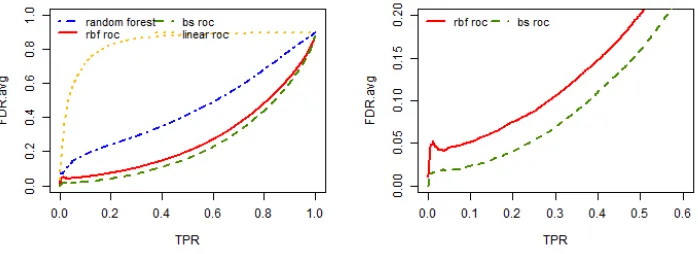
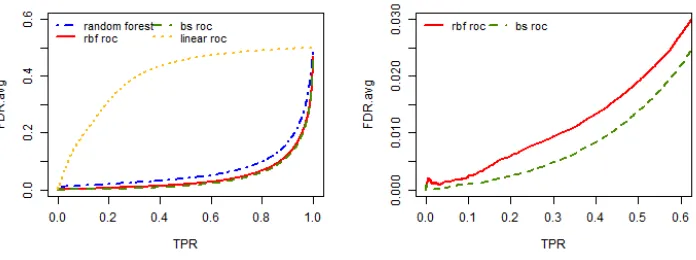
Figure 2.1 Average false discovery rate against the true positive rate out of 200 replicates for all the three simulation settings when the sample size is 400 and the positive example proportion isq= 0.1. The left panels are true positive rate (TPR) on the full range (0,1) while the right panels zoom in to the TPR range of (0, 0.6). . . 29 Figure 2.2 Average false discovery rate against the true positive rate out of 200
replicates for all the three simulation settings when the sample size is 400 and the positive example proportion isq= 0.5. The left panels are true positive rate (TPR) on the full range (0,1) while the right panels zoom in to the TPR range of (0, 0.6). . . 30 Figure 2.3 Average false discovery rate against the true positive rate out of 200
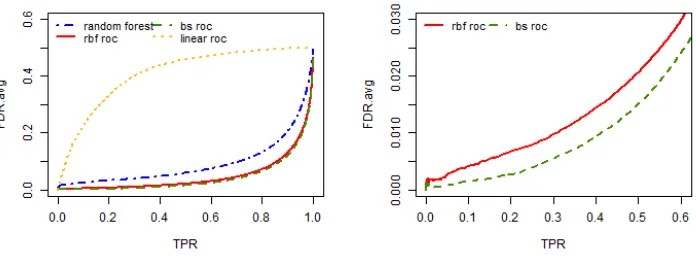
replicates for all the three simulation settings when the sample size is 1000 and the positive example proportion is q = 0.1. The left panels are true positive rate (TPR) on the full range (0,1) while the right panels zoom in to the TPR range of (0, 0.6). . . 31 Figure 2.4 Average false discovery rate against the true positive rate out of 200
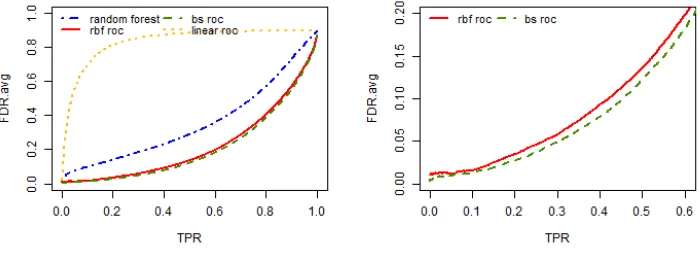
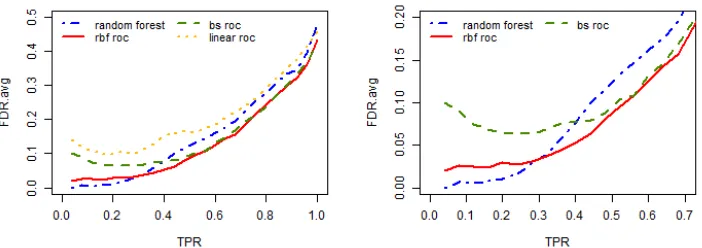
replicates for all the three simulation settings when the sample size is 1000 and the positive example proportion is q = 0.5. The left panels are true positive rate (TPR) on the full range (0,1) while the right panels zoom in to the TPR range of (0, 0.6). . . 32 Figure 2.5 Average false discovery rate against the true positive rate for vertebral
column data set from UCI data repository (Lichman, 2013). The left panel is true positive rate (TPR) on the full range (0,1) while the right panel zooms in to the TPR range of (0, 0.7). . . 33
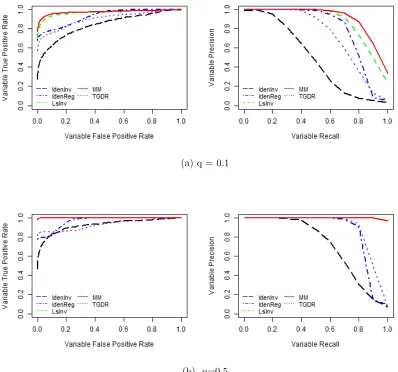
Figure 3.1 Equal AR(1) Variance Simulation ROC Curve and Precision-Recall Curve for Variable Path . . . 49 Figure 3.2 Equal Block Variance Simulation ROC Curve and Precision-Recall
Curve for Variable Path . . . 52 Figure 3.3 Unequal Block Variance Simulation ROC Curve and Precision-Recall
CHAPTER
1
INTRODUCTION
Methods for classification and for variable selection within classification problems have
become increasingly important in the area of statistics and machine learning. The goal
of classification is to predict the category for each unseen object. It usually include two
main phrases. In the training phrase, we have a training set of data, in which we observe
the class and the features for a bunch of objects. Based on the training set with known
classes, classification algorithms seek a model for the class attribute as a function of the
the previously estimated classifier on the new and unseen datasets to determine the class
of each object (Friedman et al., 2001). It is widely used in medical diagnosis, anomaly
detection, information retrieval and various other areas. Variable selection, also known
as feature selection, is the process of identifying and removing redundant or irrelevant
variables, in order to avoid the overfitting problems and thus construct a model with
better performance.
There are many classification algorithms, mainly in five categories summarized by
Kotsiantis et al. (2007). The first group of methods are logic based algorithms, like
deci-sion trees that use a tree-structure graph of decideci-sions to classify the instances (Quinlan,
1986). The second groups are perceptron based algorithms (Rosenblatt, 1962), like
Artifi-cial Neural Networks (ANN) which is composed of many highly interconnected processing
neurones working together to solve the problem (Rumelhart et al., 1985; Zhang, 2000).
The third is statistical learning algorithm which provides a probability that an instance
belongs to a class. Some examples are Linear Discriminant Analysis (LDA) (Friedman,
1989), logistic regression (Cox, 1958), Naive Bayes (Nilsson, 1965), Bayesian Networks
(Jensen, 1996), etc. The fourth is instance-based learning, like k nearest neighbor (kNN)
where an instance is classified by a majority vote of its neighbors (Cover and Hart, 1967).
The last group is the Support Vector Machine (SVM) that tries to find a hyperplane that
separate the two classes with the maximum margin (Burges, 1998). There are also
ensem-ble methods that combine individual classifiers together to achieve a more accurate and
precise system with the cost of increased computation and comprehensibility. Random
Forest is one of the examples that combines many decision trees using an idea of bagging
With all these classifiers described above, one important thing is to measure their
per-formance after the modeling process. A common practice is to use the receiver operating
characteristic (ROC) curve which is highly informative about the classifier performance.
The ROC curve plots the true positive rate (TPR, sensitivity) against the false
posi-tive rate (FPR, 1- specificity ) as the cutoff value is varied. The area under the ROC
curve (AUCROC) is a popular measure of classification accuracy (Hanley and McNeil,
1982). A classifier with a larger area under the ROC curve is often considered to be a
better classifier under the ROC criteria. To calculate the area under the ROC curve
(AU-CROC), there are two main approaches. One is to calculate the area under a parametric
assumption, most common being the binormal assumption. A binormal assumption is to
assume that the decision values of the positive group and the negative group follow two
independent Gaussian distributions (Dorfman and Alf Jr, 1968). The other approach is
to calculate the AUCROC empirically without any distribution assumption.
Instead of using the area under the ROC curve (AUCROC) as a measurement tool
to compare the performance of various classifiers, some have proposed to use the area as
an objective function to obtain a classifier in the first place (Su and Liu, 1993; Liu et al.,
2005; Pepe and Thompson, 2000; Pepe et al., 2006). The problem with these methods
lies in that they either assume a normality for the linear combination of the covariates for
the two groups, which may generate unsatisfactory result for non-normal data, or they
utilize empirical AUCROC which might be unstable and computational intensive.
Although the ROC curve is very useful to measure the classification performance,
when encountering imbalanced data, it might be overly optimistic (Davis and Goadrich,
the ROC curve when facing imbalanced data (Davis et al., 2005; He and Garcia, 2009). It
plots the precision (true discovery rate, TDR) against the recall (true positive rate, TPR)
for various thresholds. Davis and Goadrich (2006) discussed the relationship between the
ROC curve and the Precision-Recall curve. Liu and Bondell (2016) proposed a linear
classifier that maximizes the binormal area under the Precision-Recall curve (AUCPR)
for highly imbalanced data. However, it may perform unsatisfactorily for non-normal
data.
In Chapter 2, we relax the fully parametric assumption, while avoiding the pitfalls
of using the empirical curves. We assume that there exists a transformation function of
the original covariates that makes it follow a binormal distribution. With this relaxed
as-sumption, the classifier no longer needs to be linear, it could take any form of the original
covariates. We then construct the classifier that either maximizes the binormal AUCROC
or maximizes the binormal AUCPR without specifying the form of the transformation
function. Non-parametric functions are employed to approximate the true transformation
function, e.g. B-spline functions and radial basis functions are explored. Empirical
per-formance of the proposed methods is evaluated through several simulation studies and a
real data application.
The classifiers based on maximizing the area under the ROC curve (AUCROC) or the
area under the Precision-Recall curve (AUCPR) discussed above use all of the predictors
to construct the classifiers. However, when redundant or irrelevant variables are used for
constructing the classifier, several problems arise. Firstly, they would cause overfitting
problems and may lead to a worse classifier. Secondly, in some areas like medical diagnosis,
the exact relevant variables helps to get insight into the nature of the problem and makes
the classification model much easier to interpret. Therefore, variable selection within the
classification domain becomes a very important and inevitable task. There exists a lot
of techniques for variable selection, mainly classified in three categories. First is the best
subset selection which compares models with all possible set of predictors and uses criteria
such as cross-validation (Stone, 1974), AIC (Akaike, 1974), and BIC (Schwarz et al., 1978)
to determine the best model. Exhaustive search of all the subsets is very computationally
expensive since the number of subsets to be considered grows rapidly with the number
of predictors. Another group of methods based on forward or backward stepwise variable
selection comes to the rescue. It adds or removes individual predictors in each step, based
on their statistical significance (Hocking, 1976). Tibshirani (1996) pointed out that since
the predictors are either retained or dropped in the model, the model selected can be
very unstable. In other words, small changes in the data may lead to a very different
model being selected. To overcome the limitation inherited in stepwise variable selection,
the third group of methods are developed using regularization techniques to shrink the
coefficients estimates towards zero. Examples include lasso (Tibshirani, 1996) which uses
an l1 penalty to achieve a sparse solution, grouped lasso (Yuan and Lin, 2006; Meier
et al., 2008) where variables are selected in groups, elastic net (Zou and Hastie, 2005)
which uses a combination of l1 and l2 penalty, Dantzig selector (Candes and Tao, 2007)
which is a modification of the lasso, SCAD (Fan and Li, 2001) which is a non-concave
penalty, etc.
In Chapter 3, we incorporate variable selection based on the binormal AUCROC. We
linear or nonlinear transformation (discussed in Chapter 2) of the original covariates in
both groups follow a binormal distribution. We propose three classification and variable
selection methods based on the binormal AUCROC. The first one is estimated through
minimizing the euclidean distance between the sparse coefficients and the dense binormal
AUCROC maximizer with anl1 constraint on the coefficients. The second approach is a
modification of the first one which is based on least square approximation. The third one
utilizes a minorization-maximization (MM) algorithm with coordinate descent to solve a
reformulated problem which is related to the eigenvalue problem. Simulation studies are
conducted in order to evaluate the finite sample performance of the proposed methods.
CHAPTER
2
BINORMAL ROC AND
PRECISION-RECALL CLASSIFICATION
2.1
Introduction
Let Y ∈ {0,1} denote the binary outcome and X = (X1, X2, . . . , Xp)T denote the p
-dimensional vector of covariates. We classify Y = 1 if f(X) ≥ c for some threshold c
estimate the decision function f(X).
Since the area under the ROC curve (AUCROC) can be used as a measurement tool
to compare the performance of various classifiers (Hanley and McNeil, 1982), a very
intuitive way is to use the area as an objective function to obtain a classifier. Many
approaches were proposed for constructing a classifier to improve diagnostic accuracy by
maximizing binormal AUCROC. Su and Liu (1993) proposed to maximize the area under
the ROC curve (AUCROC) so that the best classifier could be achieved under the ROC
criteria. Under the multivariate normality assumption on the original covariates, they
derived the optimal linear combination of these covariates that maximizes the AUCROC.
Liu et al. (2005) derived a linear combination that achieves higher sensitivity over a
certain range of specificity. Hsu and Hsueh (2013) derived a linear combination that
maximizes the binormal partial area under the ROC curve given a pre-specified range.
Ma et al. (2006) proposed a threshold gradient descent algorithm to perform parameter
estimation and variable selection of the linear classifier simultaneously that maximizes the
binormal AUCROC. These methods assume the decision value to be a linear combination
of the original covariates and that they follow the binormal assumption. The binormal
assumption on the linear combination of the covariates are sometimes too strong and
may perform unsatisfactorily when the data follow non-normal distributions.
To relax the parametric distribution assumption, Pepe and Thompson (2000), Pepe
et al. (2006), Ma and Huang (2005) proposed to find the best linear combination for
clas-sification by using the empirical AUCROC as the objective function. While this method
is robust due to its distribution-free assumption, it has two limitations. Firstly, for small
ex-pected AUCROC because of small perturbations. Secondly, for high-dimensional or large
datasets, this empirical optimization process would be quite computationally intensive
(Ma et al., 2006).
Although the ROC curve is a popular tool for measuring classification performance,
the precision recall (PR) curve can expose more differences between classifiers that are not
obvious in ROC space when dealing with highly imbalanced data (Davis and Goadrich,
2006). Davis and Goadrich (2006) studied the relationship between these two curves by
showing that a curve dominates in ROC space if and only if it dominates in PR space.
However, algorithms that optimize the area under the ROC curve do not necessarily
optimize the area under the PR curve (AUCPR). Binormal assumptions on PR curves
were discussed by Brodersen et al. (2010). They showed that the binormal PR curve
outperforms the empirical PR estimates since the latter would be highly imprecise for
the true curve when the sample size is small and data is imbalanced, which ironically is
the situation in which the curve is most useful. Liu and Bondell (2016) proposed a linear
classifier that maximizes the binormal AUCPR for highly imbalanced data. However, it
may perform unsatisfactorily for non-normal data.
In this chapter, we relax the fully parametric assumption, while avoiding the pitfalls
of using the empirical curves. We assume that there exists a transformationT :Rp →R
of the original covariates such that T(X) now obeys the binormal assumption. With this relaxed assumption, the classifier no longer needs to be linear, it could take any
form of the original covariates. We then construct the classifier that either maximizes
the binormal AUCROC or maximizes the binormal AUCPR without specifying the form
the true transformation function, e.g. B-spline functions and radial basis functions are
explored in this chapter.
The rest of the chapter is organized as follows. Section 2.2 first reviews the ROC and
the precision-recall curves. Then we describe the details of the binormal model
assump-tion and provide a review of B-splines and radial basis funcassump-tions to be used in fitting.
Section 2.3 provides the estimation details of the proposed methods. Section 2.4 shows
the simulation results for different settings, it also shows the performance of the classifier
when the model assumption is mis-specified. Section 2.5 demonstrates the approach on
vertebral column data and Section 2.6 concludes.
2.2
Methods
2.2.1
Review of ROC and Precision-Recall Curves
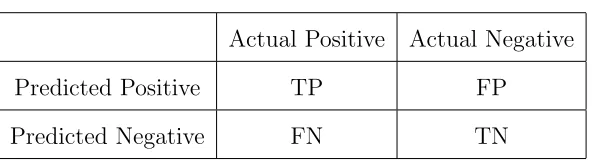
Based on the decision function, for every fixed threshold, the confusion matrix can be
constructed as shown in Table 1. True positives (TP) denote instances correctly classified
as positives. False positives (FP) refer to negative instances incorrectly classified as
pos-itive. True negatives (TN) associate with negatives correctly classified as negative. False
Table 2.1: Confusion Matrix
Actual Positive Actual Negative
Predicted Positive TP FP
Predicted Negative FN TN
In particular, the following threshold-dependent metrics are commonly used.
TPR = T P
T P +F N,
FPR = F P
F P +T N,
Precision = T P
T P +F P,
Recall = T P
T P +F N.
(2.1)
The population versions of the above metrics (2.1) can be written as
TPR(c) =P(f(X)≥c|Y = 1),
FPR(c) =P(f(X)≥c|Y = 0),
Precision(c) =P(Y = 1|f(X)≥c),
Recall(c) =P(f(X)≥c|Y = 1),
(2.2)
for any threshold c.
Given the above quantities, the ROC curve plots the TPR against the FPR as the
(AUCROC) and it is equal to the probability that a classifier will rank a randomly chosen
positive instance higher than a randomly chosen negative one (Bamber, 1975). DefineX0
as a random draw from X|Y = 0, X1 as a random draw from X|Y = 1, then the area
under the ROC curve can be calculated as
AUCROC =P
f(X1)> f(X0)
. (2.3)
Another way to derive the area under the ROC curve is through the integration as
AUCROC =
Z
TPR(c)d{FPR(c)}. (2.4)
However, the derivation is simplified via the representation in (2.3). The Precision-Recall
(PR) curve is a plot of the precision against the recall across different thresholds. A
useful summary of the PR curve is the area under the PR curve (AUCPR) which could
be calculated as
AUCPR =
Z
Precision(c)d{Recall(c)}. (2.5)
2.2.2
Binormal Assumption
We assume that the true decision values are a function of the covariates and follow two
independent Gaussian distributions for the positive and the negative group, which is also
known as the binormal model (Dorfman and Alf Jr, 1968) as follows,
f(X)|Y = 0∼N(ν0, σ20), (2.6)
wheref(·) is a functionRp →
R1. The same functionf(·) is applied on both the positive
and the negative groups. Here, the specific form of the functionf(·) does not need to be known and it could take any form of the original covariates. The only assumption is that
there exists such a function that can transform the data into binormal decision values
for the two groups. As long as such function exists, the best classifier can be constructed
by maximizing either the binormal AUCROC or the binormal AUCPR. This assumption
overcomes the strict case of the linear classifier, since the actual decision value may be
2.2.3
Area under the ROC curve and the PR curve
Under the binormal assumption, at any threshold c, we further derive the threshold dependent metrics (2.2) based on the model given in (2.6) and (2.7) as follows,
TPR(c) = P(f(X)≥c|Y = 1)
=P(f(X)−ν1
σ1
≥ c−ν1 σ1
|Y = 1)
= Φ(ν1−c
σ1
),
FPR(c) = P(f(X)≥c|Y = 0)
=P(f(X)−ν0
σ0
≥ c−ν0 σ0
|Y = 0)
= Φ(ν0−c
σ0
),
Precision(c) = P(Y = 1|f(X)≥c)
= P(f(X)≥c|Y = 1)P(Y = 1)
P(f(X)≥c|Y = 1)P(Y = 1) +P(f(X)≥c|Y = 0)P(Y = 0)
=
qΦ(ν1−c
σ1
)
qΦ(ν1−c
σ1
) + (1−q)Φ(ν0 −c
σ0
)
,
Recall(c) = TPR(c) = Φ(ν1−c
σ1
),
(2.8)
where q = P(Y = 1) is the probability of an instance belong to the positive class and Φ(·) denotes the cumulative distribution function of the standard normal distribution.
further derived as
AUCROC = Φ pν1−ν0
σ2 0 +σ21
!
, (2.9)
AUCPR =
Z
10
qt
qt+ (1−q)Φ
ν0−ν1
σ0
+ σ1
σ0
Φ−1(t)
dt. (2.10)
In order to compute the AUCROC or the AUCPR under the binormal assumption, we
need to find the values ν0, ν1, σ0, σ1 which are constants that depend on the function,
f(·).
2.2.4
Non-parametric Approximation
To find the unknown function f(X), nonparametric functions are utilized to approxi-mate the true function. This chapter will focus on two types of basis functions, b-spline
functions and radial basis functions, but other choices are possible.
2.2.4.1 B-Spline Functions
In this section, we assume that the true function can be approximated by a combination
of arbitrary functions of the covariates and the contribution of each covariate is additive.
This is the so-called additive model first suggest by Buja et al. (1989). The function of
each covariate is further specified to be a combination of b-splines where a b-spline is a
f(X)≈ p
X
i=1
gi(Xi), (2.11)
where gi(Xi) =
PK
j=1βijBj,m(Xi). Here,Bj,m is the jth b-spline function of order m. For
simplicity, we set the order for the basis expansion to m = 4 which leads to the cubic spline functions. For simplicity, the number of basis functions is assumed to be the same
for each variable. The number of basis functions K for each variable is then the only tuning parameter in this model.
2.2.4.2 Radial Basis Functions
An alternative approach to approximate a given function is to use a set of radial basis
functions (RBF). Since the RBF approach is based on the distance from a covariate
vector to a given knot location, it implicitly includes the interactions between the full set
of covariates, rather than an additive model. The approximation function is represented
as a sum ofK radial basis functions with form
f(X)≈ K
X
i=1
βihi(X), (2.12)
wherehi(X) = exp
||X−Xc(i)||2
ρ is thei
thradial basis function associated with theithcenter
Xc(i). Each of the radial basis functions is weighted by an appropriate coefficientβi. Each
covariate is normalized to have mean 0 and variance 1 before performing the radial basis
function transformation. A k-means clustering method is used to find the clusters and
the center points with a pre-specified number of centers based on the normalized data.
2.3
Estimation
Under the binormal assumption, the best classifier in terms of ROC criteria is obtained
by maximizing the area under the ROC curve, the best classifier regards to PR criteria
is obtained by maximizing the area under the PR curve.
After the nonparametric approximation, we get a set of transformed variables Z =
(Z1(X), . . . , ZL(X))T where Z are (Bj,m(Xi))i=1,...,p,j=1,...,K for the b-spline
transfor-mation and (hj(X))j=1,...,K for the radial basis function transformation. The binormal
assumption could then be rewritten as
ZTβ|Y = 0∼N(ν0, σ20), (2.13)
ZTβ|Y = 1∼N(ν1, σ21), (2.14)
where β ∈ RL denotes the corresponding coefficients which need to be estimated. Note
that L=K for the radial basis functions, andL=pK for the B-splines.
We further assume that Z has mean µ0 and variance Σ0 for group Y = 0, and has
meanµ1 and varianceΣ1 for groupY = 1. Defineµ0 with entriesµ0j =E[Zj(X)|Y = 0]
andµ1with entriesµ1j =E[Zj(X)|Y = 1]. DefineΣ0such that Σ0jk = Cov [Zj(X), Zk(X)|Y = 0],
define Σ1 such that Σ0jk = Cov [Zj(X), Zk(X)|Y = 1].
The binormal AUCROC and AUCPR would then be calculated based onµ0,µ1,Σ0,Σ1,β
so that ν0 =µ0β, ν1 =µ1β,σ02 =β
TΣ
0β, and σ12 =β
TΣ
2.3.1
Estimation using AUCROC
After the nonparametric approximation, the binormal AUCROC in (2.9) is then given
by
AUCROC(β) = Φ
(µ1−µ0)Tβ
q
βT(Σ0+Σ1)β
, (2.15)
where Φ is the standard normal cumulative distribution function and β, µ0,µ1,Σ0,Σ1
are specified previously.
To maximize (2.15) , it is equivalent to maximizing (µ1−µ0)
Tβ
q
βT(Σ0+Σ1)β
, since Φ is a
monotone increasing function. Furthermore, up to a change in sign, it is the same as
maximizing the squared form β
T
(µ1−µ0)(µ1−µ0)Tβ
βT(Σ0+Σ1)β
, which is a generalized
eigen-value problem and could be solved directly with the closed-form solution as
βROC = argmax β
{AUCROC(β)} ∝(Σ0+Σ1)−1(µ1−µ0). (2.16)
We then estimate βROC by plugging in the sample version, to obtain
ˆ
βROC = argmax β
{AUCROC(\ β)} ∝( ˆΣ0+ ˆΣ1)−1( ˆµ1−µˆ0), (2.17)
where ˆµ0,µˆ1,Σˆ0,Σˆ1 are the sample mean and the sample covariance of the transformed
2.3.2
Estimation using AUCPR
After the nonparametric approximation, the binormal AUCPR in (2.10) can be rewritten
as
AUCPR(β) =
Z
10
qt
qt+ (1−q)Φ
"
(µ0−µ1)Tβ
p
βTΣ0β
+
p
βTΣ1β
p
βTΣ0β
Φ−1(t)
#dt,(2.18)
where Φ is the standard normal cumulative distribution function, Φ−1is the inverse of the
standard normal cumulative distribution function,q =P(Y = 1) is the probability of an instance belonging to the positive class. We plug in the sample versions, ˆµ0,µˆ1,Σˆ0,Σˆ1,
and would like to construct a classifier that maximizes this area, which is
ˆ
βPR = argmax β
{AUCPR(\ β)}. (2.19)
Note that, if we had assumedΣ0 andΣ1 to be equal or proportional, then maximizing
AUCPR would be equivalent to minimizing (µ0 −µ1)
Tβ
p
βTΣ0β
, which leads to the optimal
classifier with the form ˆΣ−01( ˆµ1−µˆ0). So under this assumption, the solution would be
proportional to the maximizer for AUCROC. However, this assumption is too strong and
it is difficult to even envision to be true in reality since Σ0,Σ1 are the variances for the
transformed variablesZ. Therefore, we seek the solution without the assumption of equal
variance via a numerical method.
A gradient descent algorithm with backtracking line search is applied to this problem.
less computational cost than choosing an infinitesimal step size , e.g. s = 1× 10⁻⁴.
Instead of only moving an infinitesimal amount along the search direction, performing
the line search allows us to start moving a relatively large step size along the direction
and if needed it will iteratively shrink the step sizes until the criterion is met. It is more efficient since one can move a larger amount without worry about moving too far to miss
the local optimum by iteratively shrinking the step size. The full algorithm is given by
Algorithm 1.
We compute the derivative of AUCPR with respect to β as follows,
dAU CP R
dβ =
Z
10
−qt
qt+ (1−q)Φ
"
(µ0−µ1)Tβ p
βTΣ0β
+
p
βTΣ1β p
βTΣ0β
Φ−1(t)
#!2 ×(1−q)
×φ
"
(µ0−µ1)Tβ p
βTΣ0β
+
p
βTΣ1β p
βTΣ0β
Φ−1(t)
#
×
µ0−µ1 p
βTΣ0β
+ Φ
−1(t)Σ1β p
βTΣ0β p
βTΣ1β
−(µ0−µ1)
TβΣ0β
q
(βTΣ0β)3
−Φ
−1(t)p
βTΣ1βΣ0β q
(βTΣ0β)3
dt
(2.20)
Algorithm 1 describes the details about the implementation of the gradient descent
algorithm. For classification purpose, both the AUCROC and the AUCPR estimators are
only identifiable up to a scale constant. That is, instead of the absolute magnitude of β,
only the direction of β, which represent the relative effects, can be estimated from the
AUCROC and AUCPR objective function. For identifiability, we introduce an anchor
variable whose estimated coefficient is set to a constant. Without loss of generosity, for
for the radial basis function transformation, we assume the feature associated with the
center surrounded by the largest number of observations as the anchor; for the linear
classifier, we assume the first variable to be the anchor. Since the objective AUCPR is
not a convex function, only a local maximum would be achieved with a specific starting
value. Thus, different initial values need to be tried and the one with the largest AUCPR
would be the final solution. In our method, we use three initial values as βinitial, (1) all
zeros but the anchor are set to 1, (2) all zeros but the anchor are set to -1, (3) the
Algorithm 1 Gradient Descent for Maximizing AUCPR
1: β(0) ←βinitial
2: while iter < maxiterdo
3: Compute the gradient gd= dAU CP Rdβ . Denote the jth component of gd asgdj.
4: Make gdanchor= 0, then if maxj{|gdj|}= 0, stop the iterations.
5: begin backtracking line search with initial step size s
6: while siter < smaxiter do
7: βtemp ←β(iter)+s×gd
8: Compute AUCPRtemp based on βtemp
9: if AUCPRtemp ≤ AUCPR(iter) then
10: s←s/2
11: siter ← siter+1
12: else
13: break
14: end if
15: end while
16: end line search
17:
18: β(iter)←βtemp
19: AUCPR(iter)←AUCPRtemp
20: if |AUCPR(iter)−AUCPR(iter-1)|<tol×AUCPR(iter-1) then
21: break
22: end if
23: iter ← iter+1 24: end while
25: return βˆ =β(iter)
26:
27: Use a differentβinitial, repeat steps 1-24.
2.3.3
Tuning Parameter Selection
For b-spline approximation, the number of basis functions K for each variable is the tuning parameter. For radial basis function approximation, the number of centersK and the scale parameter ρ are the tuning parameters. In our numerical studies, we propose using theV-fold cross validation (CV) to choose the tuning parameters. For a pre-defined integer V, we randomly partition the data into V complementary subsets of equal sizes. For estimation using AUCROC, we select the tuning parameters that maximize the ROC
CV score as
ROC CV Score = 1
V V
X
i=1
\
AUCROC(i)
ˆ
β(ROC−i)
, (2.21)
where ˆβ(ROC−i) is the estimated coefficient without the samples in thei-th fold andAUCROC\ (i)
is the binormal AUCROC estimator with the data in the i-th fold. For estimation using AUCPR, we choose the tuning parameters to maximize the PR CV score given by
PR CV Score = 1
V V
X
i=1
\
AUCPR(i)βˆ(PR−i), (2.22)
where ˆβ(PR−i) is the estimated coefficient without the data in the i-th fold and AUCPR\ (i)
is the binormal AUCPR estimator with the data in thei-th fold.
2.4
Simulation Study
In this section, we conduct several simulations with 200 replicates each to assess the
the AUCPR. In each simulation, we generate a training sample to fit the model and
a separate test set of size 10000 to compare the performance for different classifiers.
For methods utilizing radial basis functions and b-spline functions, we conduct a 5-fold
cross validation as described in Section 2.3.3 on the training sample to determine the
best tuning parameters. The coefficients would then be estimated on the whole training
data using the best tuning parameters. For other methods, we estimate the coefficients
directly on the whole training data. Three benchmark methods are used for comparison
purposes. Two are linear classifiers maximizing the binormal AUCROC, and the binormal
AUCPR, respectively. The third is Random Forests, a very popular ensemble method for
classification.
We experiment different combinations of the training sample size and the proportion of
positive examples. Training sample size of 400 and 1000 are considered. Both imbalanced
case with q = 0.1 and balanced case withq = 0.5 are considered. For each combination, we consider three different settings such that the true function f(x) includes some of the four following pieces, 10x2
1, 5 log(x2), exp(x3), 10 log(x2) exp(x3) in each setting. The
first three pieces represent the main effect and the last piece represents the interaction
between variables.
2.4.1
Setting 1: Binormal Additive Data
Given y= 0, we generate f(x)∼N(46,22). Given y= 1, we generate f(x)∼N(51,22).
Letf(x) = 10x21+5 log(x2)+exp(x3). First we generatex3so that exp(x3)∼Uniform(10,15),
then we generate x2 so that log(x2)∼ Uniform
0,f(x)−exp(x3)
5 + exp(x3)
, lastly we generate
x1 such thatx21 =
f(x)−5 log(x2)−exp(x3)
classi-fiers will not depend on variablex3 much sincex3is generated from the same distribution
for both the positive and the negative group.
The average false discovery rate (FDR) against the true positive rate (TPR) out of
200 replicates are shown in Figure 2.1(b), Figure 2.2(b), Figure 2.3(b), Figure 2.4(b).
Each represents training sample size of 400 and positive example proportion of 10%,
training sample size of 400 and positive example proportion of 50%, training sample size
of 1000 and positive example proportion of 10%, training sample size of 1000 and positive
example proportion of 50%, respectively.
For each TPR, a lower false discovery rate is desired. The results of the AUCPR
classifier is similar to the AUCROC classifier and are not shown here. In all the different
combinations of the sample size and the positive example proportions, our proposed
classifiers, both the AUCROC classifier and the AUCPR classifier are able to find the
optimal classifier close to the truth and they outperform both the linear classifiers and the
random forest method in terms of false discovery rate (FDR). The linear classifiers have
the worst performance, since they reach high FDR very quickly and have higher FDR
than all the other methods. This is expected, since the simulation data are nonlinear, so
that the fully parametric linear classifiers fail to capture the true decision value function.
The random forest classifier performs better than the linear classifier since it does not
make any distribution assumption for the data. Nevertheless, it does not capture the
nonlinear decision boundary well and is still worse than our proposed methods.
When changing from an imbalanced case (q = 0.1) to a balanced case (q = 0.5), or the sample size becomes larger, the classification problem becomes easier. Hence all
superiority of our proposed method upon others becomes less severe.
The b-spline approximation is slightly better than the radial basis function here in
terms of FDR. In this setting, the true function is an additive model, and the b-spline
ap-proximation is good enough to capture this while the radial basis function apap-proximation
is more complex and not necessary.
For either of the nonparametric approximation, the performance of the AUCROC
maximizer and the AUCPR maximizer are very similar. Although in theory, when data
are highly imbalanced, the PR curve is better than the ROC curve and can show much
more differences when comparing various classifiers, the AUCPR maximizer has very
sim-ilar performance with the AUCROC maximizer since the AUCPR maximizer is achieved
by numerical algorithm after nonparametric approximation and would have more
uncer-tainty introduced.
2.4.2
Setting 2: Binormal Interactive Data
We consider the same binormal distribution as in the setting 1. Given y = 0, we generate f(x) ∼ N(46,22). Given y = 1, we generate f(x) ∼ N(51,22). Here, a different transformation function f(·) is considered. Let f(x) = 10x2
1 + 5 log(x2) +
exp(x3) + 10 log(x2) exp(x3) which includes interaction between x2 and x3. We first
gen-erate x3 such that exp(x3) ∼ Uniform(10,15), then generate x2 such that log(x2) ∼
Uniform
0,f(x)−exp(x3)
5 + 10 exp(x3)
, lastly we generatex1 such that x21 =
f(x)−5 log(x2)−
exp(x3)−10 log(x2) exp(x3)
/10. Compared to setting 1, setting 2 considers the case where variables have interaction with each other rather than a simple additive model.
10 log(x2) exp(x3) is significantly different for the two groups.
The performance of the proposed classifiers and the other underlying classifiers are
shown in Figure 2.1(b), Figure 2.2(b), Figure 2.3(b), Figure 2.4(b). Each represents
train-ing sample size of 400 and positive example proportion of 10%, traintrain-ing sample size of
400 and positive example proportion of 50%, training sample size of 1000 and positive
example proportion of 10%, training sample size of 1000 and positive example proportion
of 50%, respectively.
The results are mostly similar as setting 1 with our proposed classifiers being the
best. The difference lies in that the radial basis function approximation is better than
the b-spline approximation. This is due to the fact that the true model has interaction
between variables, and radial basis functions are designed to capture this while the
b-spline approximation is not.
2.4.3
Setting 3: Non-normal Interactive Data
Setting 1 and setting 2 both consider the situations where the binormal assumption is
correct. However, the performance of the proposed method under the cases where the
model is mis-specified is also of interest. In setting 3, we let the true function follow
two different shifted Gamma distribution for the two groups. Given y = 0, we generate
f(x) ∼ Gamma(2,1) + 30. Given y = 1, we generate f(x) ∼ Gamma(8,1) + 30. We consider the same transformation function f(·) which includes interaction between the variables as in setting 2 and uses the same generation scheme forx1,x2, x3 as in setting
2.
3. Each represents training sample size of 400 and positive example proportion of 10%,
training sample size of 400 and positive example proportion of 50%, training sample size
of 1000 and positive example proportion of 10%, training sample size of 1000 and positive
example proportion of 50%, respectively. We can see that when the binormal assumption
is seriously violated as in setting 3, the proposed methods still give very satisfactory
performance which is better than the random forest method and the linear classifiers.
2.5
Application to Vertebral Column Data
We applied our methods on the vertebral column data from the UCI data repository
(Lichman, 2013). The data consists of 310 records with 210 abnormal patients and 100
normal patients. Each patient has six biomechanical attributes derived from the shape
and orientation of the pelvis and lumbar spine which are pelvic incidence, pelvic tilt,
lumbar lordosis angle, sacral slope, pelvic radius and grade of spondylolisthesis.
The data are randomly split into two parts, 75% training and 25% testing. A
5-fold cross validation is conducted on the training set for the methods using radial basis
functions and b-spline approximation. The partition process is repeated 50 times. Average
false discovery rate out of the 50 testing data sets is plotted in Figure 2.5. The AUCPR
classifiers have very similar performance with the AUCROC classifiers and are not shown
in the plot. It can be seen that the AUCROC maximizer with the radial basis function
approximation is the best among the methods in terms of FDR. Although random forest
is a bit better when TPR is smaller than 0.3, the improvement is very little and we could
always choose a cutoff value with a lot higher TPR without much sacrifice in the FDR,
(a) Setting 1: Binormal non-interactive data
(b) Setting 2: Binormal interactive data
(a) Setting 1: Binormal non-interactive data
(b) Setting 2: Binormal interactive data
(c) Setting 3: Non-normal interactive data
(a) Setting 1: Binormal non-interactive data
(b) Setting 2: Binormal interactive data
(a) Setting 1: Binormal non-interactive data
(b) Setting 2: Binormal interactive data
(c) Setting 3: Non-normal interactive data
better than the b-spline approximation likely due to strong interactions between these
covariates.
Figure 2.5: Average false discovery rate against the true positive rate for vertebral col-umn data set from UCI data repository (Lichman, 2013). The left panel is true positive rate (TPR) on the full range (0,1) while the right panel zooms in to the TPR range of (0, 0.7).
2.6
Conclusion
In this chapter, we propose using the binormal AUCROC and the binormal AUCPR as
the objective function for binary classification using a nonparametric approximation of
the true decision value function. Both simulation studies and real data application show
that the proposed methods outperform linear classifiers and random forest classifiers.
The proposed methods have a very flexible assumption that only assumes the existence
than the fully parametric assumption in the linear classifier. When this assumption is
seriously violated, the proposed methods still give very satisfactory performance which
is better than the random forest method and the linear classifier.
When there is a strong interaction, the radial basis function approximation would
lead to better results. When the truth is an additive model, the b-spline approximation
would be suggested. Other nonparametric approximations can also be explored according
CHAPTER
3
BINORMAL ROC CLASSIFICATION
AND VARIABLE SELECTION
3.1
Introduction
Variable selection, also known as feature selection, is the process of identifying and
remov-ing redundant or irrelevant variables. When redundant or irrelevant variables are used
overfit-ting problems and may lead to a worse classifier. Secondly, in some areas like medical
diagnosis, which variables are import for the disease diagnosis is of big interest. Thirdly,
knowing the exact relevant variables helps to get insight into the nature of the problem
and makes the classification model much easier to interpret. Therefore, variable selection
within the classification domain becomes a very important task.
Recall that the classification problem consists of a binary response Y ∈ {0,1} and a p-dimensional vector of covariates X = (X1, X2, . . . , Xp)T. In this chapter, rather
than making a binormal assumption on any general transformation f(X) as discussed in Chapter 2, we consider a specific case where f(X) being βTX follows the binormal distribution where β is the corresponding coefficients that need to be estimated. In
ad-dition, we consider the decision function f(X) to be “linear risk scores” βTX. The goal here is to estimateβ.
To incorporate variable selection based on binormal AUCROC, Ma et al. (2006)
pro-posed a threshold gradient descent algorithm to perform parameter estimation and
vari-able selection of the linear classifier simultaneously that maximizes the binormal
AU-CROC. Yu and Park (2014) proposed a l1 penalized regression estimator based on the
binormal AUCROC.
In this chapter, we propose three classification and variable selection methods that
are based on the binormal AUCROC. The first one is estimated through minimizing
the euclidean distance between the sparse coefficients and the dense binormal AUCROC
maximizer with an l1 constraint on the coefficients. The second approach is a
modifi-cation of the first one which is based on least squares approximation. The third one
a reformulated problem which is related to the eigenvalue problem.
The rest of the chapter is organized as follows. Section 3.2 provides the details of
the binormal model assumption and the binormal AUCROC. Section 3.3 illustrates the
proposed classification and variable selection methods. Simulation results for different
settings are provided in Section 3.4 and real data application results are shown in Section
3.5. Section 3.6 concludes.
3.2
Preliminaries
3.2.1
Binormal Assumption
Use the binormal assumption on f(X) given in (2.6) and (2.7), we consider a specific case with f(X) =βTX. We have
βTX|Y = 0∼N(ν0, σ20), (3.1)
βTX|Y = 1∼N(ν1, σ21). (3.2)
Notice that the normality of X itself is not necessary, we only require the linear
combi-nation of X to be normal, which is more likely to hold.
3.2.2
Area under the ROC curve
Define X|Y = j to have mean µj = E(X|Y = j) and variance Σj = Var(X|Y = j)
under the ROC curve in (2.9) can be further derived as
AUCROC(β) = Φ
βT(µ1−µ0)
q
βT(Σ0+Σ1)β
, (3.3)
where Φ is the standard normal cumulative distribution function.
3.3
Classification and Variable Selection Methods
Xu and Bondell (2016) proved that maximizing (3.3), up to a change in sign, is the same
as maximizing the squared form,
βT(µ1 −µ0)(µ1−µ0)Tβ βT(Σ0+Σ1)β
, (3.4)
which is a generalized eigenvalue problem and that can be solved directly with closed-form
solution
βROC = argmax β
{AUCROC(β)} ∝(Σ0+Σ1)−1(µ1−µ0), (3.5)
up to a change in sign. We then estimate βROC by plugging in the sample version, to
obtain
ˆ
βROC = argmax β
{AUCROC(\ β)} ∝( ˆΣ0+ ˆΣ1)−1( ˆµ1−µˆ0), (3.6)
where ˆµ0,µˆ1,Σˆ0,Σˆ1 are the sample mean and the sample covariance of the predictors
X for the two groups.
The dense solution ˆβROCutilizes all the covariates available without doing any variable
variables are used. Therefore, we study to perform the variable selection and classification
simultaneously by optimizing the binormal AUCROC.
Throughout the chapter, for a vector q = (q1, ..., qp)T ∈ Rp, define the l1 norm as
kqk1 =
Pp
i=1|qi|,l2norm askqk2 =
pPp
i=1qi2. We propose several approaches to achieve
the variable selection goal.
3.3.1
Method 1: IdenInv
The intuitive way of getting a sparse solution but as accurate as the dense solution ˆβROC
is to minimize the euclidean norm between these two solutions with a lasso penalty given
by
β= argmin β
n
kβ−( ˆΣ0+ ˆΣ1)−1( ˆµ1−µˆ0)k 2
2+λkβk1
o
, (3.7)
where λ ≥ 0 is the tuning parameter that controls the sparseness of the coefficients. When λ= 0, the solution is exactly the same as the dense solution ˆβROC. If λ increases, some elements of β are exactly zero, thus we get a more sparse solution. To solve (3.7),
one can use a trick, that is to treat ( ˆΣ0+ ˆΣ1)−1( ˆµ1−µˆ0) as the response, and create an
identity matrix Ip ∈Rp×p as the design matrix for the independent variables. Then the
LARS algorithm (Efron et al., 2004) can be utilized to get the whole solution path with
3.3.2
Method 2: LsInv
The IdenInv method does not account for the variance of ˆβROC. However, using the
variance of ˆβROC would lead to a more efficient estimator. Therefore, we would like to
take care of the variance of ˆβROC. Since the direct variance of ˆβROC is hard to
com-pute, we consider ˆβ∗ROC = (Σ0 +Σ1)−1( ˆµ1 −µˆ0), whose variance can be calculated as
V = Var( ˆβ∗ROC) = (Σ0+Σ1)−T(
Σ0
n0
+ Σ1
n1
)(Σ0 +Σ1)−1. Now utilizing the least square
approximation, we have
β = argmin β
n V
−1/2βˆ∗
ROC−V
−1/2β
2 2
+λkβk1
o
. (3.8)
where V−1 is the inverse of V that can be decomposed into V−1 = V−1/2V−1/2, and
λ≥0 is the tuning parameter that controls the sparseness of the coefficients β. We call this method “LsInv’ since it utilizes the idea of least squares approximation and ˆβ∗ROC,
which requires an inverse step.
The LsInv method uses a more accurate objective to solve, which leads to a more
accurate sparse solution β than the IdenInv method. When solving (3.8), we use ˆV =
( ˆΣ0+ ˆΣ1)−T(
ˆ Σ0 n0 + ˆ Σ1 n1
)( ˆΣ0+ ˆΣ1)−1 to estimateV and use a similar trick as in IdenInv.
We treat ˆV−1/2βˆ∗ROC as the response and ˆV−1/2 as the design matrix, then employ the
LARS algorithm (Efron et al., 2004) to get the whole solution path with different λ
3.3.3
Method 3: MM
Now instead of dealing with ˆβROC in various ways, we take a step back and consider the
generalized eigenvalue problem (3.4) directly, which is equivalent to
MaximizenβTAβo subject toβTW β ≤1, (3.9) where A= (µ1−µ0)(µ1−µ0)T and W = (Σ
0+Σ1). We define the penalized problem
as
β = argmax
β
n
βTAβ−λkβk1
o
subject to βTW β ≤1 (3.10)
whereA= (µ1−µ0)(µ1−µ0)T , W = (Σ
0+Σ1) and λ≥0 is a tuning parameter. We
can utilize the minorize-maximization (MM) algorithm to solve the problem (Lange et al.,
2000; Hunter and Lange, 2004; Lange, 2004). It tries to find a surrogate function that
minorizes the objective function and then optimizes the surrogate function iteratively to
drive the objective function upward towards the maximum. In each iteration, we consider
two scenarios. When W is a diagonal matrix, the problem is easier and each coefficient
can be updated separately in each iteration (Gaynanova et al., 2016). When W is a
symmetric but not diagonal matrix, a coordinate descent algorithm is employed in each
iteration. A detailed proof is provided in the Appendix. The Algorithm details are shown
Algorithm 2
1: β(1) ←βinitial
2: repeat
3: m ←1
4: if W is diagonal matrix then
5: for i= 1,2, . . . , p do
6: di ← ST
(Aβ(m))i
wii , λ
2wii
where wii is the ith is diagonal element of W
and
7: (Aβ(m))i is the ith element of Aβ(m).
8: end for
9: else if W is symmetric but not diagonal matrix then
10: repeat
11: d(1) ←dinitial
12: k ←1
13: for i= 1,2, . . . , p do
14: d(ik+1) ←ST(Aβ
(m)
)i−(d(k))T−iW−i
wii ,
λ
2wii
15: where d(−ki)= (d1(k+1),· · · , d(i−k+1)1 , d(ik+1),· · ·d(pk)),
16: and W−i = (w1i,· · · , wi−1,i, wi+1,i,· · · , wpi).
17: end for
18: g(d(k+1))←(d(k+1))TW d(k+1)−2(d(k+1))TAβ(m)+λkd(k+1)k1
19: k ←k+ 1
20: untilk =kmax or|g(d(k+1))−g(d(k))|< |g(d(k))|
21: end if
22: if d6=0 then
23: β(m+1) ←d/(dTW d)12
24: else
25: β(m+1) ←0
26: end if
27: h(β(m+1))←(β(m+1))TAβ(m+1)−λk
β(m+1)k1
3.4
Simulation
In this section, we conduct several simulations to assess the finite sample performance of
the proposed classification and variable selection methods. In each setting, we generate
a training sample of size 1000 to fit the model, a separate validation set of size 1000 to
find the optimal tuning parameters and finally a test set of size 1000 to compare the
performance for different methods. The process is repeated 100 times for each simulation
setting.
Three benchmark methods are used for comparison purposes. The first method by
Yu and Park (2014) has objective argminβ{k( ˆΣ0 + ˆΣ1)β − ( ˆµ1 − µˆ0)k2 + λ
P
|βj|}.
We denote it as “IdenReg”. The second is the threshold gradient descent regularization
(TGDR) method discussed in Ma et al. (2006). For all the ROC related methods, e.g.
our proposed methods and TGDR, we choose the tuning parameters that maximize the
AUCROC in the validation set.
In these simulations, we will generate predictorsX|Y =j from a multivariate normal distribution with mean µj and covariance Σj in all settings. Following the proof from
Liu and Bondell (2016) using Neyman-Pearson lemma, we can show that the optimal
risk score function is
XT(Σ−01 −Σ−11)X+ 2(Σ1−1µ1−Σ−01µ0)TX. (3.11)
If we assume Σ0 and Σ1 are equal or proportional to each other, then the optimal risk
score function is linear in X, with coefficients β ∝(Σ0 +Σ1)−1(µ1−µ0). Otherwise, if
be quadratic.
Let q = P(Y = 1) be the probability of an instance belonging to the positive class. For each simulation setting, we consider both q = 0.1 representing the imbalanced data case and q = 0.5 representing the balanced case. Define 0k ∈ Rk as a vector of length k
with all elements equal to 0. Similarly, define 1k ∈ Rk as a vector of length k with all
elements equal to 1. Define 0k×l ∈Rk×l as a matrix with k rows and l columns with all
elements equal to 0.
When assessing the performance of the variable selection process, we will use the
fol-lowing quantities and plots. For a model with a specific number of variables, the variable
true positive rate (Variable TPR, Variable Recall) measures the proportion of important
variables that are correctly identified. The variable false positive rate (Variable FPR)
measures the proportion of unimportant variables that are incorrectly identified as
im-portant. The Variable Precision represents the proportion of detected important variables
that are truly important. Knowing the order of the variables that come into the model, we
can construct the ROC curve for the variable path which plots the Variable TPR against
the Variable FPR as the number of variables in the model is varied. The Precision-Recall
curve for the variable path plots the Variable Precision versus the Variable Recall when
3.4.1
Simulation Setting 1: Equal AR(1) Variance Model
For a vector of pvariables, an AR (1) covariance matrix Σ∈Rp×p has the structure of
Σ=σ2(ρ|i−j|) = σ2
1 ρ ρ2 . . . ρp−1
ρ 1 ρ . . . ρp−2
ρ2 ρ 1 . . . ρp−3
..
. ... ... . .. ...
ρp−1 ρp−2 ρp−3 . . . 1
p×p
, (3.12)
whereρ is the AR(1) correlation parameter andσ2 is the variance. Kac et al. (1953) has
shown that the inverse of the AR(1) covariance is given by
Σ−1 = 1
σ2(1−ρ2)
1 −ρ
−ρ 1 +ρ2 −ρ
−ρ . .. ...
. .. ... . ..
. .. 1 +ρ2 −ρ
−ρ 1
p×p
. (3.13)
Let µ0 = 0500, µ1 = (0,18,0,0490). Let Σ0 = Σ1 = (0.5|i−j|)500×500. Σ0 and Σ1 are
equal and they follow the AR(1) variance structure withσ2 = 1 andρ= 0.5. Giveny= 0,
we generate X ∼M N(µ0,Σ0). Given y= 1, we generate X ∼M N(µ1,Σ1). According
to the best risk score function (3.11), the optimal linear risk score function is linear inX1
equal variance. Hence, we have 10 true important variablesX1 throughX10and the other
490 unimportant variables do not contribute to the classifier in any way. Notice that the
mean for the positive group and the negative group only differ in X2 through X8. In
other words, if one performs variable screening marginally by t-tests, one would fail to
detectX1 andX10as important variables. This leads to an interesting thing to see about
our proposed methods.
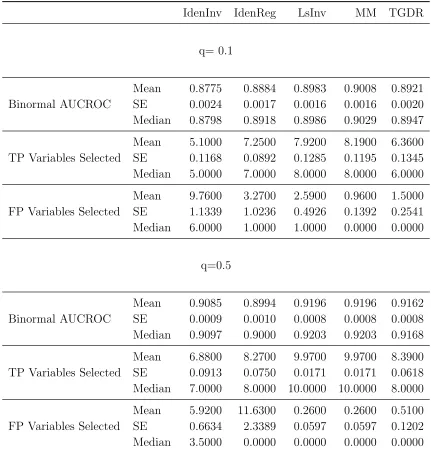
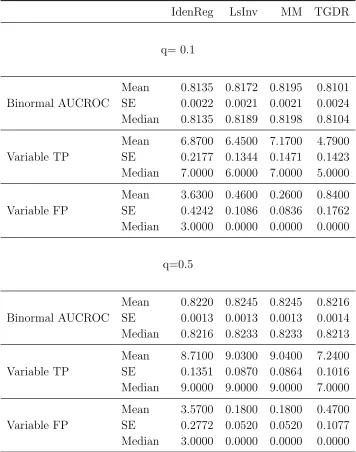
For both the imbalanced case (q = 0.1) and the balanced case (q = 0.5), Table 3.1 summarizes the AUCROC on the test data sets across 100 replicates. It also summarizes
the number of important variables selected (Variable TP) and the number of unimportant
variables selected (Variable FP) when using the best tuning parameter. On the other
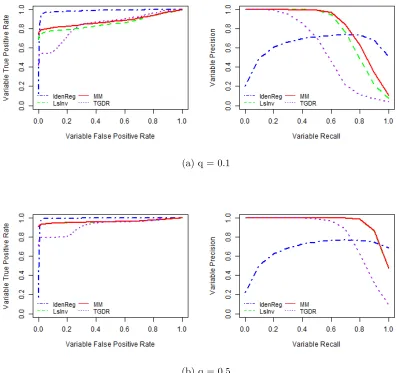
hand, Figure 3.1 plots the ROC curve and the Precision-Recall curve for the variable
selection paths. When data are imbalanced and q = 0.1, our proposed method MM achieves the highest average binormal AUCROC on the test set across 100 replicates
and it is significantly better than TGDR, IdenReg, IdenInv. The other proposed method
LsInv is comparable to MM in terms of the AUCROC but is worse than MM in variable
selection. It can be seen that MM selects a significantly larger number of true important
variables and significantly smaller number of unimportant variables when compared with
LsInv. Figure 3.1(a) shows that MM has the best variable selection path, following by
LsInv, IdenReg, TGDR, IdenInv, sequentially. When q = 0.5, our proposed methods LsInv and MM have very similar outcomes and they both outperform other methods.
LsInv and MM are able to select all of the important variables including marginally
undetectable variables X1 and X10 with nearly no unimportant variables selected. In
other methods like IdenInv, IdenReg and TGDR. The IdenInv estimator always performs
the worst and thus we will not show its results in the later simulations and real data
Table 3.1: Equal AR(1) Variance Simulation Performance
IdenInv IdenReg LsInv MM TGDR
q= 0.1
Binormal AUCROC
Mean 0.8775 0.8884 0.8983 0.9008 0.8921
SE 0.0024 0.0017 0.0016 0.0016 0.0020
Median 0.8798 0.8918 0.8986 0.9029 0.8947
TP Variables Selected
Mean 5.1000 7.2500 7.9200 8.1900 6.3600
SE 0.1168 0.0892 0.1285 0.1195 0.1345
Median 5.0000 7.0000 8.0000 8.0000 6.0000
FP Variables Selected
Mean 9.7600 3.2700 2.5900 0.9600 1.5000
SE 1.1339 1.0236 0.4926 0.1392 0.2541
Median 6.0000 1.0000 1.0000 0.0000 0.0000
q=0.5
Binormal AUCROC
Mean 0.9085 0.8994 0.9196 0.9196 0.9162
SE 0.0009 0.0010 0.0008 0.0008 0.0008
Median 0.9097 0.9000 0.9203 0.9203 0.9168
TP Variables Selected
Mean 6.8800 8.2700 9.9700 9.9700 8.3900
SE 0.0913 0.0750 0.0171 0.0171 0.0618
Median 7.0000 8.0000 10.0000 10.0000 8.0000
FP Variables Selected
Mean 5.9200 11.6300 0.2600 0.2600 0.5100
SE 0.6634 2.3389 0.0597 0.0597 0.1202
Median 3.5000 0.0000 0.0000 0.0000 0.0000
(a) q = 0.1
(b) q=0.5
Figure 3.1: Equal AR(1) Variance Simulation ROC Curve and Precision-Recall Curve for Variable Path