ABSTRACT
XING, JIE. Commitment-Based Interoperation for E-Commerce. (Under the direction of Dr. Munindar P. Singh.)
Successful e-commerce presupposes techniques by which autonomous trading entities can interoperate. Although much progress has been made on data exchange and payment protocols, interoperation in the face of autonomy is still inadequately understood. Current techniques, designed for closed environments, support only the simplest interactions.
main contributions of this dissertation are in developing some theoretical aspects of agent interaction with an emphasis on e-commerce.
COMMITMENT-BASED INTEROPERATION FOR E-COMMERCE
BY
JIE XING
A DISSERTATION SUBMITTED TO THE GRADUATE FACULTY OF NORTH CAROLINA STATE UNIVERSITY
IN PARTIAL FULFILLMENT OF THE REQUIREMENTS FOR THE DEGREE OF
DOCTOR OF PHILOSOPHY
OPERATIONS RESEARCH
RALEIGH
JULY2001
APPROVED BY:
BIOGRAPHY
Jie Xing was born on December 14, 1966 in Yantai city, People’s Republic of China. He got his
Bachelor of Science degree in Applied Mathematics from Shanghai JiaoTong University, Shanghai, People’s Republic of China in 1989. He received his Master of Engineering degree in Computer
Aided Design from Beijing Institute of Technology, Beijing, People’s Republic of China. After his graduation, he worked as a system engineer in China Academy of Railway Science, Beijing,
People’s Republic of China. He focused on multi-platform and multi-protocol computer system research. He joined in Hong Kong VANDA Group in 1994 and worked as network specialist and
project manager. His responsibilities are network design, network implementation, and network troubleshooting. He was a Ph.D. student in the program of Operations Research of North Carolina
State University from August 1997 to May 2001. In his Ph.D. study, Jie Xing focuses on
ACKNOWLEDGEMENTS
Many thanks to my adviser, Dr. Munindar P. Singh for his advice and support in my study and life;
special thanks to Dr. William J. Stewart for his encouragement and support; thanks to my Ph.D. committee members, Dr. Mladen A. Vouk and Dr. Peter R. Wurman for their time and valuable
comments; many thanks to Feng Wan, Sudhir K. Rustogi and Zhenggang Cheng for extensive dis-cussion and collaboration on our prototype systems; thanks to Bin Yu and Pinar Yolum for some
Table of Contents
List of Figures vii
1 Introduction 1
1.1 Motivation . . . 3
1.2 E-commerce Reference Architecture . . . 7
1.3 Database Transactions and Groupware . . . 8
1.4 Agents . . . 10
1.4.1 Communication . . . 12
1.4.2 Interaction . . . 14
1.4.3 Coordination . . . 14
1.5 Our Approach . . . 15
1.6 Contributions . . . 17
1.7 Organization . . . 18
2 Commitments 19 2.1 Social Commitments . . . 20
2.2 Two-Phase Commit Protocol . . . 22
2.3 Commitment in CSCW . . . 24
2.4 Commitment and its Operations . . . 26
2.4.1 Commitment Creation . . . 28
2.4.2 Commitment Resolution . . . 30
2.4.3 Commitment Observation . . . 30
2.4.4 Revisions . . . 31
3 Metamodel 32 3.1 Metamodel for Process Interoperation . . . 33
3.2 Agent Knowledge Representation Language . . . 35
3.3 Metacommitment Patterns . . . 37
3.4 Example Models . . . 38
4 Formalization of Metacommitment Patterns 44
4.1 Computation Tree Logic . . . 44
4.1.1 CTL Syntax . . . 44
4.1.2 CTL Semantics . . . 45
4.2 Conversation-Oriented Metacommitment Patterns . . . 48
4.2.1 Communication Primitives . . . 49
4.2.2 Specification Language . . . 50
4.2.3 Formalization . . . 51
4.3 Task-Oriented Metacommitment Patterns . . . 52
4.3.1 Task-Related Events and Operations . . . 53
4.3.2 Specification Language . . . 53
4.3.3 Formalization . . . 53
5 Operational Semantics 56 5.1 Statecharts . . . 56
5.1.1 Hierarchy in Statecharts . . . 57
5.1.2 Concurrency in Statecharts . . . 57
5.1.3 Communication in Statecharts . . . 58
5.2 Agent Behavior Models . . . 58
5.2.1 Basic Agent Behavior Model . . . 60
5.2.2 Reactive Agent Behavior Model . . . 61
5.2.3 Monitor Agent Behavior Model . . . 63
5.2.4 Agent Request and Informed Behavior Models . . . 64
5.3 Push and Pull Models . . . 66
5.4 Tasks . . . 69
5.5 Control Connectors . . . 70
6 Soundness of Operational Semantics 73 6.1 Definition of a Statechart . . . 73
6.2 Pattern Composition . . . 76
6.2.1 Annotation and Translation . . . 77
6.2.2 Merging and Hierarchy . . . 78
6.3 CTL Structure Derivation . . . 81
6.4 CTL Model Checker . . . 83
6.5 Soundness . . . 87
6.5.1 Soundness for Monitor Agent Behavior Model . . . 87
6.5.2 Soundness for Reactive Agent Behavior Model . . . 89
6.5.3 Soundness for Basic Agent Behavior Model . . . 91
6.6 Intra-agent and Inter-agent Pattern Operational Sequences . . . 93
7 Architecture, Implementation, and Application 100
7.1 Architecture and Implementation . . . 100
7.1.1 Specification . . . 101
7.1.2 Commitment Data Interface . . . 101
7.1.3 Execution . . . 102
7.2 Applications . . . 102
7.2.1 Travel Planning . . . 102
7.2.2 Contract Net Protocol . . . 105
7.2.3 Distributed Database Interoperability . . . 106
8 Related Work 109 8.1 Interoperability Standards . . . 109
8.1.1 Existing Workflow Interoperability . . . 109
8.1.2 Interoperation with Existing Systems . . . 112
8.1.3 Existing Languages and Protocols . . . 113
8.1.4 Discussion . . . 116
8.2 Software Agents . . . 117
8.2.1 Commitments . . . 118
8.2.2 Negotiations . . . 119
8.2.3 Process Coordination and Agent Cooperation. . . 121
8.2.4 Process Management . . . 123
8.2.5 Discussion . . . 124
8.3 Transactions . . . 125
8.3.1 Advanced Transaction Model Workflow . . . 125
8.3.2 Exception Handling . . . 127
8.3.3 Atomic Transaction Extension . . . 127
8.3.4 Transactions as Actions . . . 128
8.3.5 Discussion . . . 129
9 Conclusions and Future Research 130 9.1 Conclusions . . . 130
List of Figures
1.1 Order fulfillment process . . . 2
1.2 Contract net protocol . . . 5
1.3 An e-commerce scenario that does not follow a simple nesting of requests and re-sponses. Here an exception at the customer causes revisions to be sent between vendors. . . 6
1.4 Layered reference architecture for e-commerce . . . 7
2.1 Finite state automata illustrating the 2-phase commit protocol (cited from [60]) . . 22
2.2 Phases of the customer-performer model . . . 25
2.3 Establishing commitments for a reactive system . . . 29
2.4 Establishing commitments for some other situations . . . 30
2.5 Revision situations . . . 31
3.1 Commitment-based metamodel for interoperation . . . 33
3.2 Applying metacommitment patterns to the contract net protocol . . . 39
3.3 Interoperating to plan a trip . . . 40
4.1 A CTL structure . . . 46
4.2 The corresponding tree for start point . . . 46
4.3 (a)AG : is invariant, (b)AF : is inevitable, (c)EF : potentially holds. (Here, ) . . . 48
5.1 A statechart example . . . 57
5.2 Basic agent behavior model . . . 60
5.3 Reactive agent behavior model . . . 62
5.4 Monitor agent behavior model . . . 63
5.5 Agent request behavior model . . . 65
5.6 Agent infomed behavior model . . . 66
5.7 Push model, (a) producer, (b) consumer . . . 67
5.8 Pull model, (a) producer, (b) consumer . . . 68
5.9 Combinations of pull and push models for a consumer . . . 69
5.11 Statechart representation of typical connectors, (a) linear, (b) and-join, (c) and-fork 71
5.12 Statechart representation of typical connectors, (d) condition, (e) or-join . . . 72
6.1 Statecharts generated from metacommitment patterns . . . 78
6.2 Merge two statecharts . . . 80
6.3 CTL structure derived from the statechart . . . 84
6.4 The CTL structure derived from the statechart . . . 87
6.5 The CTL structure derived from the statechart . . . 90
6.6 Inter-agent interaction cases . . . 96
7.1 System architecture . . . 100
7.2 A snippet of our XML file for Example 3 . . . 104
7.3 Architecture for distributed database interoperation . . . 107
7.4 Example for an agent approach of distributed database interoperability . . . 108
Chapter 1
Introduction
The study of autonomous, decentralized systems gains importance with the expansion of
business-to-business (B2B) electronic commerce. We would like autonomous businesses to be able to operate together logically without being subject to central control. This means we should be able to specify
and obtain the correct interoperation of their processes.
XML-based standards for data exchange, payment protocols, and e-commerce transactions are
being proposed. These provide an important basis for achieving flexible multiparty supply chains and virtual businesses. However, as we show below, current approaches do not fully accommodate
the subtleties of interoperation in e-commerce. The key challenge is not in merely producing an XML-based notation, but in ensuring its expressiveness for real-life situations and in providing a
formal operational semantics to it.
Current software technology, based on distributed computing and databases and dealing
exclu-sively with low-level abstractions, is inadequate for the proper treatment of interoperation. This is because the associated abstractions—remote methods and distributed transactions—address only
the simpler challenges in integrating heterogeneous systems. Remote methods offer no conceptual abstractions for composing activities, whereas transactions require a tighter coupling of activities
PlaceOrder ScheduleDelivery
Retailer
ConfirmOrder
Manufacturer
ConfirmDelivery
Transport
Internal workflow Internal workflow Internal workflow
Figure 1.1: Order fulfillment process
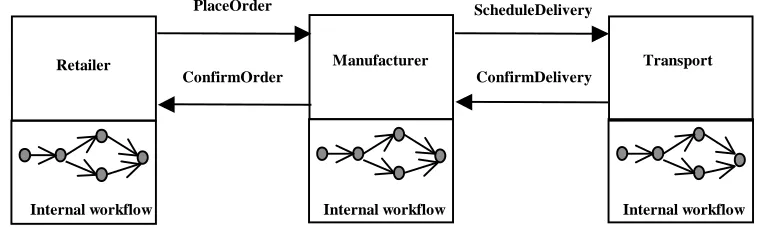
Example 1 Figure 1.1 shows an order fulfillment process example at a high level. This commerce
process involves three organizations, a retailer, a manufacturer and a transport company. The retailer starts an order fulfillment process by placing orders with the manufacturer. The retailer makes an
arrangement to produce goods with the manufacturer. The manufacturer schedules to deliver the goods to the customer. Each participant uses a workflow engine to manage its business process.
The workflow engine interoperations achieve the commerce process automation.
Major technical challenges are not properly addressed by existing approaches:
Autonomy. In e-commerce, the interacting parties must retain their autonomy, limited
only by their contracts. They can make decision based on their own beliefs. However, in
order to form and participate in business processes, they must be able to compromise on their autonomy so that they can cooperate with others. For example, the retailer doesn’t
want to disclose details of its process definition models to the manufacturer. It wouldn’t like to grant access to its internal information about its ongoing process. Similarly, the
manufacturer doesn’t want to disclose its information on its process definition models and its organization database to the retailer. Each makes its decision independently.
Heterogeneity. In e-commerce, the interacting software may be of any internal design
and construction, may be upgraded at different rates, and may run on different
plat-forms. We call this heterogeneity construction autonomy. For example, the retailer,
different operating systems. This may imply a sea of non-automated processes.
Exceptions. Because e-commerce presupposes heterogeneity, interoperation frequently
runs into exceptions. These exceptions are not only low level such as about communi-cation or software, but also high level such as “the goods the consumer wants to buy is
not produced by the deadline in manufacturer organization.” In particular, the excep-tions across organizational boundaries can have significant effects. For example, if the
goods is delivered to a wrong address, the whole business process could be canceled.
Revisions. Because e-commerce interactions can be long-lived, potentially lasting
for-ever, they must release their results prematurely. This means that results ought to be able to be revised. For example, a customer orders some computer products from a
retailer. The customer may want to change the order configurations after purchasing, but before delivery. The retailer has to check with its manufacturer. If these
prod-ucts are still being assembled, the retailer can inform the manufacturer to modify the configurations.
1.1
Motivation
Business-to-Business electronic commerce places certain demands on interoperation of different autonomous trading partners, especially for dynamically creating and running virtual businesses.
There are many business models used in electronic commerce like e-procurement, electronic mar-ket places, virtual communities, value chain service provider, value chain integration, collaboration
platforms, and information brokerages. Computationally the models can be represented as a set of tasks or steps. It is natural that workflow techniques be used to address the above problems.
Current workflow management systems are widely used within enterprises. These workflow man-agement systems are implemented in different languages, on different platforms, and especially, use
(e.g. electronic data interchange (EDI)) standards and online payments. Interoperation of business processes is only now beginning to emerge. E-commerce business processes are complicated and
involve multiple organizations. Business relationships between the involved organizations are es-tablished in a dynamic competitive environment. The competition also puts increasing pressure on
companies to connect their business processes to the processes of other organizations to provide services to customers.
A workflow is the implementation and automation of a particular business process. A work-flow management system is the software that automates the coordination and control of tasks during
business process execution [14]. Workflow management systems have been used in many different applications such as banking loan processing, telecommunication management, product
procure-ment, software development and proposal evaluation. This has led to different approaches for speci-fying workflow systems. A wide range of languages, such as script-based, net-based, rule-based and
logic-based, are suggested that differ in their expressiveness, formal foundations, and ease of use. The Workflow Management Coalition (WfMC), an industry consortium, aims at a unified
termi-nology and a standardization interface between key components of workflow management systems. WfMC interface 4 is such an interface to provide workflow engine-to-engine interoperation [14].
Object Management Group’s (OMG) jointFlow [51], SWAP [6] and Wf-XML [15] address the sim-ilar concerns. These interfaces help interoperation across workflow vendor’s boundaries, but not
organizational boundaries.
Below are two examples. The first illustrates a traditional contract net protocol. The second
introduces a business process for travel planning. The two examples describe the regular interaction scenarios as well as some revision and exception scenarios. These scenarios can be expressed as
sequence diagrams in UML. A sequence diagram shows the interaction between agents over time.
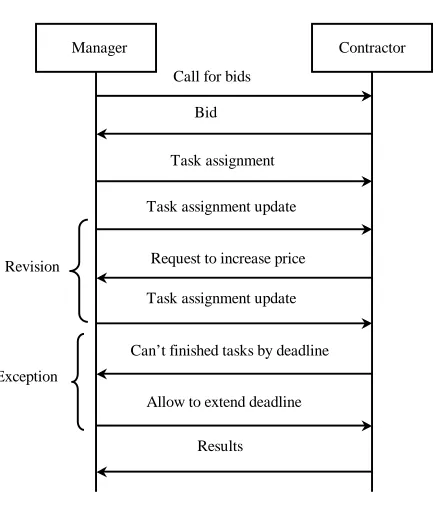
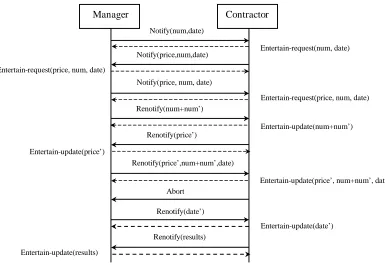
Example 2 The Contract Net Protocol (CNP) is among the most well known protocols in
Dis-tributed Artificial Intelligence (DAI) [17]. CNP involves one manager agent and several contractor
Manager Contractor
Call for bids
Bid
Task assignment
Results Task assignment update
Request to increase price
Task assignment update Revision
Can’t finished tasks by deadline
Allow to extend deadline Exception
Figure 1.2: Contract net protocol
of the contractors propose bids. The manager chooses a bid and assigns a task to the selected
con-tractor. When the contractor finishes its assigned task, the manager evaluates the results. Figure 1.2 shows the information exchange between the manager and the winning contractor. Traditional CNP
specifications cannot handle the following revisions and exceptions.
The manager may change its task assignment requesting additional widgets with the
same price and deadline after it has awarded the task to the contractor. The contractor has to perform the revised task again and send the revised results to the manager.
The contractor may send requests to increase the price if the manager changes the task assignment.
The contractor may be unable to finish its task by the specified deadline. The manager may then cancel the task assignment or grant an extension.
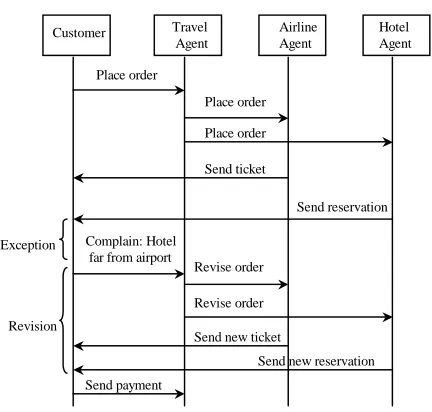
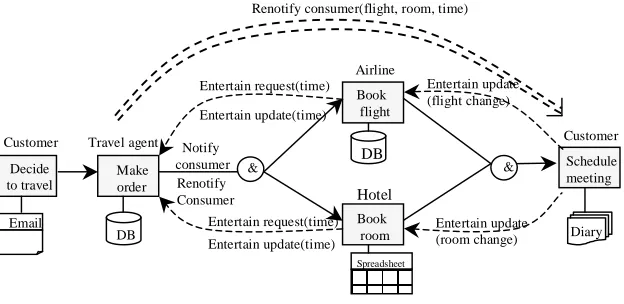
Example 3 A customer comes up with a need to travel to a certain city (with multiple hotels and
Customer Travel Agent
Airline Agent
Hotel Agent
Place order
Revise order Place order
Place order
Revise order Send ticket
Send reservation
Complain: Hotel far from airport
Send new ticket
Send new reservation
Send payment Exception
Revision
Figure 1.3: An e-commerce scenario that does not follow a simple nesting of requests and
re-sponses. Here an exception at the customer causes revisions to be sent between vendors.
clerk to make appropriate reservations. The clerks are to send confirmations to the traveler. The
customer may have some additional requirements that are not initially brought out. For example,
the hotel may not be close to the airport chosen by the airline clerk and, say, for a flight that arrives late in the evening. The hotel location is an important constraint of the customer. If the customer’s
requirements are not met, she complains to her travel agent. He would then make a revised request to the clerks, let’s say by trying for an earlier flight.
Although small, Example 3 is not trivial. It combines the B2B and B2C aspects of e-commerce. Four autonomous parties are involved, and communication among them does not follow a simple nesting of requests and responses. Even a task that executes successfully may need to be revisited as
shown in Figure 1.3. Current situations work well for the simpler situations up to the first travel plan. However, because they offer no conceptual or operational support for exceptions, programmers are
left to fend for themselves. Typically, they are forced to employ ad hoc techniques that lead to
1.2
E-commerce Reference Architecture
We propose a layered reference architecture for e-commerce as shown in Figure 1.4. This
architec-ture consists of e-commerce workflow applications, business process, business transactions, com-mon business components and related middleware and tools. Each upper layer is constructed based
on the lower layer. The layered reference architecture gives us a clear picture to specify and analyze e-commerce applications. It also shows the components of process interoperation.
Workflows and other systems such as Notes, SAP R/3, legacy applications
Negotiation, procurement, order entry, inventory, payment
Funds transfer, invoicing, billing, order request, deliver confirm
Customers, products, bills, and forms
HTTP, XML, EDI, e-mail, CBL, RDF, ACL
E-commerce workflow applications
Common business objects
Middleware and tools Business transactions
Business process
Figure 1.4: Layered reference architecture for e-commerce
1. The layer of e-commerce workflow applications provides a means for developing inter-organization applications. The workflow systems are used to connect these applications to
process-oriented applications. It automates business processes across organization bound-aries.
2. The business process layer specifies business execution sequences and business logic. It con-sists of generic business services such as negotiation, procurement, order entry, inventory,
payment and special services on special business domains.
obligations and sanctions.
4. The common business objects layer uses CBL and RDF to represent common business objects
such as customers, products, bills, and all kinds of forms.
5. The middle-ware and tools layer provides runtime environment for business process instances and tools are used to describe business objects.
1.3
Database Transactions and Groupware
Most current approaches for process interoperation offer ways of structuring activities through
means reminiscent of flowcharts. These approaches neglect the organizational relationships among the interoperating components. Some approaches consider the relationship among the components,
but fail to provide rigorous semantics for the relationships. Three requirements for process interop-eration are:
1. Data integrity: correctness of data despite concurrent access and failures.
2. Control and data flow: how triggering or control information and data flows through the systems.
3. Organization structure: how the various components relate to each other in achieving coherent
behavior, e.g., whether a control signal is expected and would not be ignored depends on the organizational structure of the components.
Traditional transactions are traditional computations that satisfy a number of useful proprieties, in particular the so-called ACID properties [25]:
Atomicity: all or none of a transaction happens.
Consistency: a transaction preserves the consistency of the database.
If the individual transactions are programmed correctly, the database management system guar-antees consistency for any arbitrary concurrent mix of transactions. Atomicity is essential to ensure
that the integrity of distributed data is preserved. Consequently, the actions or sub-transactions that constitute a transaction must either (a) all happen, thereby transforming the database from a
consis-tent state to a new consisconsis-tent state, or (b) each fails to happen, thereby leaving the database in its original (consistent) state.
To realize the above transactional properties requires a mutual commit protocol, e.g., two-phase commit protocol, to be executed. However, that might be impossible, for example, hotel and airline
are independent enterprises and their databases may not even have visual pre-commitment states, essential to execute a mutual commitment protocol. Even if the pre-commit states are visual, it
is seldom acceptable to lock resources while communicating with a remote site. Thus traditional transactions are unacceptable in heterogeneous environments.
Traditional nested transactions provide integrity, but restrict the other aspects. Extended trans-action models (ETMs) also focus on integrity, but allow freer control and data flow as the cost of
relaxing the integrity requirements. A number of extended transaction models have been proposed, e.g., [8]. The extended transaction models allow partial results to be released, and then attempt to
restore consistency through actions to compensate for the effects of erroneously completed actions. Database workflow approaches ignore the integrity aspects, but deliver the control and data flow
requirements by specific applications. Some workflow scheduling approaches exist that provide functionality to capture control flow among aspects. For example, they ignore social commitments
altogether.
Workflows in groupware also provide application-specific control and data flow without regard
to integrity. Some groupware approaches, which study organizational structure, do not consider
The notion of commitments finds applicability in some groupware tools. For example, [42] shows how the flow of work in an organization is expressed through commitments in the
action-Workflow tool. The tool comes with a fixed set of specifications from which the developer can choose. Although the participants can decide whether a given task is successfully performed, there
is no notion of failure recovery, of commitments being canceled, or other operations on commit-ments. Still, we believe this is an interesting system that shows how much can be achieved through
the careful use of commitments. We will discuss it in Section 2.3.
1.4
Agents
Software agents are currently the subject of much research in many interrelated fields. While much of the agent community has concentrated on building exemplar agent systems, defining theories
of agent behavior and inter-agent communications, there has been less emphasis on defining the techniques required to build practical interoperating agents.
Traditionally, communication protocols are specified by defining the orders in which
commu-nicative acts may take place. This holds for protocol formalisms such as finite state machines, push-down automata, formal grammars, Petri nets, and temporal logic. Thus the practitioners are
forced into protocols with no content at all. In general, our research has focused on developing the methodology and techniques for building practical interoperational agents. We consider not only the
agent interaction sequence, but also the interaction information. The information is the commitment among agents. The main problem is to structure activities in a manner that can respect the
auton-omy of the information resources. The database approaches are restrictive. The agent approaches are flexible, but there is a need for tools and formal approaches for designing them. In particular,
there is a need for a notation of commitment that flexibly reflects the organizational structure of how agents interact. Data integrity can be maintained by agent interaction. A set of control
interoperation. The following rules are used to instruct us to build that agent.
Formal. Formal semantics yields (1) clarity of specifications to guide implementers and
(2) assurance of software. Clarity and assurance are significant for agent interoperation,
because agent interoperation is meant to be realized in different agents implemented by different vendors.
Declarative. The semantics should describe what rather than how. A declarative
se-mantics can be applied to a variety of settings, not just those that satisfy some low-level
operational criteria.
Operational. This is necessary to provide syntax to represent the agent behavior.
Verifiable. We should be able to determine whether an agent acts according to the given
semantics. Otherwise, the semantics are not of much use, especially in an open setting.
Meaningful. The semantics should be intuitive and relate the content of the
commu-nications to some substantive feature of the context in which commucommu-nications occur.
Meaningless tokens provide no guidance about how to design and improve protocols.
Interaction is a super set of all different kinds of communication and interoperation.
In order to foster interoperability and reusability of agents, FIPA suggests the abstract agent
architecture. We considered agent interoperation as the following three parts, which are agent man-agement and transport, messaging transport and communication protocols. These parts focus on
different issues to deal with agent interoperation.
Agent management: it establishes the logical reference model for the creation,
registra-tion, locaregistra-tion, communicaregistra-tion, migration and retirement of agents. It provides white
pages, such as agent location, naming and control access services; yellow pages, such as service location and registration services; agent message transport services.
Agent message transport: it deals with the delivery and representation of messages
(MTPs), such as IIOP, HTTP and WAP, message envelope representations that are suit-able for each MTP, such as an XML encoding for HTTP and a bit-efficient encoding
for WAP, FIPA ACL representations, such as a string encoding, an XML encoding and a bit-efficient encoding.
Agent communication: communication between agents in FIPA is based on a model
of semantically grounded communication. The basis of communication between FIPA
agents is through the use of communicative acts (also called performatives) that are based on speech act theory. It consists of a set of FIPA interaction protocols, which
describe entire conversations between agents for the purpose of achieving some inter-action or effect, such as, auctioning, issuing a call for proposals, negotiating brokering
services and the registration and deregistrations of subscriptions.
We will focus on some issues in details.
1.4.1 Communication
Communication enables the agents in a multiagent system to exchange information on the basis of which they coordinate their actions and cooperate with each other. This raises the important
questions of what communication protocols and mechanisms enhance cooperation between com-municating agents. One popular approach used to enable agents to intercommunicate is through a
shared data repository in which information can be posted and retrieved. Agents don’t know each other. That means that one agent doesn’t know other agents’ identities. For example, blackboard
systems [12] are an often used model of shared memory in AI. This approach is suitable to the communication that doesn’t cross organization boundaries. There is another kind communication.
Each agent needs to have an identifier. Agents can directly exchange messages, or they can organize themselves into a group and communicate through special facilitator agents, or they can broadcast
Directed Message Exchange. Directed communication involves establishing direct physical links with other agents using a protocol such as TCP/IP. There is a centralized server (such as conversation
manager in COOL [3] and AgentNameServer in JATLite [31]). The centralized server is like a directory server where one agent can join the server by register and leave the server by unregister.
FIPA 1997 specification suggests such an agent directory that contains information about all agents in a particular environment provides the facilities for an agent to identify and access other agents.
Group with Facilitator. When the number of agents in a system becomes very large, the cost and processing involved in directed message exchange are very large for the centralized agent server.
A popular alternative approach that eliminates these difficulties to directed message exchange is to organize the set of agents into different groups. Each group has a facilitator. Agents don’t
commu-nicate with each other directly. Instead, they commucommu-nicate through a special facilitator agent. These facilitators ack like routers to transform application-level messages and route them to appropriate
places. They are kept to inform about their individuals’ needs and abilities.
Broadcast Communication. In the situation, where a message has to be sent to all the agents in
the environment, or a sender agent doesn’t know who the recipient will be. Broadcast communi-cation is necessary. On the one hand, if there are a large number of agents in the system, then the
network bandwidth used to transmit the message is significant when the message length is substan-tial. On the other hand, broadcast prevents networks from overloading by doing away with the need
of making multiple copies of the same message and transmitting them to other agents. For example, in the CNP approach to interoperation, the manager agent in need for service distributes requests for
proposals (broadcast message) to other agents. In a specification-sharing approach, agents broadcast their specifications and capabilities to other agents.
single category. The three communication mechanisms can be used for different application scenar-ios.
1.4.2 Interaction
Interaction means a type of collective action where one agent takes an action or makes decision that
has been influenced by the presence or knowledge of another agent [7]. The inherently heteroge-neous and distributed nature of a multiagent system makes the implementation of the interaction
among agents a difficult process. Thus, it is important to design an expressive common language for communication where agents can communicate with their peers by exchanging messages and
interact together through explicit linguistic actions. In the multiagent community Speech Act
The-ory [55] is one of the most common methods used to construct and formalize agent communication
language. Speech act theory originates in the observation that utterances by agents are not simply propositions that are true or false, but attempts on the part of the agent to convey some knowledge.
Speech act theory uses the concept of performatives to allow an agent to convey its knowledge to another agent. A speech act language that is commonly used in the multiagent community is KQML
[21]. It helps high-level cooperation and interoperation among agents. The FIPA 1997 specifica-tion [22] defines an interacspecifica-tion protocol as an explicitly shared multiagent plan, which contains
communicative acts (like speech acts).
Another question here is how to represent the exchanged information. XML is such a means
of representation to the problem. XML can encode information and services with a meaningful structure that computers can readily understand. XML allows agents to access different information
resources.
1.4.3 Coordination
problem-solving vanish and the community may quickly degenerate into a collection of chaotic and incoherent individuals [44]. In order to bring about a coherent solution, the objective of a
coordina-tion process should be to ensure that all the necessary porcoordina-tions of the overall problem are included in the activities of at least a agent, that agents interact in a manner that permits their activities to
be developed and integrated into an overall solution, the team members act in a purposeful and consistent manner, and that all of these are achievable with the available computational resources.
The three main arguments proposed by Jennings as to why actions of multiagents need to be coordinated are as follows.
There are dependencies between agents’ actions, which can occur when the individual
goals of the agents are related.
There is a need to meet global constraints. These constraints exist when the solution
being developed by the system must satisfy certain conditions if it is to be deemed successful.
No individual agent has sufficient competence, resources, or information to solve the entire problem. Many problems cannot be solved by a agent who works in an
iso-lated environment because the agent does not possess necessary expertise, resource, or information.
Speech act theory’s power has been exploited to formalize the agent plans within conversations,
or groups of utterance. A conversation is an agent’s plan to achieve some goal based on interactions with other agents. In order to specify agent coordination, agent conversations can be visualized
in term of automata models. An agent’s action produce different states and the current state of a plan(conversation) influences how the agent will act/react in the next moment.
1.5
Our Approach
interoperation in a way that naturally addresses the above challenges. We rely on two crucial proper-ties of agents. First, the agents must interact at a high level by forming and managing commitments
to one another. These commitments are about the information they exchange, about changes to that information, and about each other’s needs. For example, an agent would not only send results to
others, but may commit to notify its consumers if it modifies those results or to satisfy its consumers with respect to some requests. Second, the agents must be persistent. This is essential so the agents
may form, manage, and act according to their commitments. For example, an agent may retry a task until it obtains results acceptable to it and to its peers. The agent would receive updates and
send updated results to its consumers. If the agents didn’t outlast their tasks, such actions would be impossible.
The agents reason about the formation and manipulation(including revocation) of social com-mitments. The manipulation of commitments is constrained through specified metacomcom-mitments.
Our metamodel includes a small set of carefully engineered metacommitment patterns through which a given interaction can be structured. The metacommitment patterns are given a formal
op-erational semantics based on statecharts [28] and translated into a set of rules that can be executed by different agents.
The interoperation is specified generically in terms of roles played by different components. Agents volunteer to play different roles—thus the agents’ autonomy is respected. However, agents
may play a role only if (1) they have the capabilities to perform the tasks required of that role and (2) are willing to adopt the metacommitments specified for that role. The assignment of agents to
roles happens dynamically. An agent may play more than one role. The roles can be nested when the agents form a team that plays a role.
Conventional software engineering lacks the abstractions necessary to model multiagent
sys-tems. We consider the problem of creating specifications for agent behavior and interaction to achieve the necessary coordination to support various kinds of communicative or “conversational”
applied in modeling and operationalizing commitments.
We model interactions as a set of composable metacommitment patterns. We formalize the
patterns in temporal logic. Each pattern invokes commitment operations. These patterns cover different requirements for the interaction. We develop agent behavior models in statecharts. An
executable behavior model generated by a statechart satisfies these commitment patterns. Whereas current approaches include only simple request-response interactions, our approach incorporates
more flexible interactions that need accommodate exceptions and revisions. Statecharts provide an operational semantics. Importantly, we show how the operational semantics relates to the declarative
semantics for agent interaction.
We develop a simple metamodel that supports interoperating business processes. Like
tional metamodels, our metamodel captures the structuring of activities. However, unlike tradi-tional metamodels, our metamodel includes concepts dealing with persistence and commitments to
support exceptions and revisions. The metamodel is represented by UML.
Object-oriented UML provides some methodology to represent collaboration among objects
such as sequence diagrams, interaction diagrams, Petri nets, and state diagrams. UML is gaining wide acceptance for representation of engineering artifacts in object-oriented software. Agents
will be the next step beyond objects. Researchers are exploring extensions to UML to represent agent interaction. Here we borrow these means to specify agent coordination. However current
approaches only represent the interaction sequence. Instead our approach not only considers the interaction sequence, but also uses commitment patterns to store the interaction knowledge to ensure
the consistency of their interactions.
1.6
Contributions
First, we develop agent behavior models that support agent coordination. We propose commitment
models of agents who follow our commitment patterns. The statecharts provide an operational se-mantics, which can be used as a rigorous basis for agent coordination. We propose agent behavior
models and prove that they operationally support our temporal logic semantics. In this manner, we provide the basis for formally designing coordinated multiagent systems. Second, we apply agent
behavior models for interoperation in e-commerce. This approach consists of (1) behavioral mod-els to specify autonomous, heterogeneous agents representing different trading entities (businesses,
consumers, brokers), (2) a metamodel that provides a language (based on XML) for specifying a variety of service agreements and accommodating exceptions and revisions, and (3) an execution
architecture that supports persistent and dynamic (re)execution. Our implementation uses an exist-ing Java tool kits for parsexist-ing XML and buildexist-ing communicatexist-ing agents. The main contributions of
this dissertation are in
Developing some theoretical aspects of agent interaction.
Developing some approaches for process interoperation.
Applying the theory to e-commerce scenarios.
In addition, it can also provide a rigorous basis for future interoperation standards in e-commerce.
1.7
Organization
The dissertation is organized as follows. Chapter 2 introduces the social commitments and com-municative primitives, which are related to the commitment. Chapter 3 introduces a metamodel
for agent interaction and process interoperation and describes metacommitment patterns. Chapter 4 formalizes the metacommitment patterns. Chapter 5 introduces operational semantics and several
agent behavior models. Chapter 6 gives the soundness of operational semantics. Chapter 7 intro-duces architecture, implementation, and application. Chapter 8 introintro-duces the related work. Section
Chapter 2
Commitments
In the contract net protocol example 2, a contractor promises to produce some widgets for a manager
by a specified date. That is a commitment that the contractor promises the manager to perform the task. For a commitment to be meaningful, one agent making the commitment must intend to perform
the task as committed. That is, when the contractor agrees to complete the task on a date, he must really intend to do so. To responsibly do this, he must think through the task, estimate the work
involved, and then set the completion date.
The necessary elements of a commitment between two parties are then:
One party wants a task performed.
Another party promises to perform the task.
There exist some constraints for the task.
A commitment often occurs when one party requests something to be done and another party
promises to get it done. Neither one wants an unrealistic task. In our example, the manager wants an earlier date, which may be agreed to by the contractor. He is interested in getting his task
completed as soon as possible. The contractor would also like to complete the task as soon as possible. However he is not sure how big the task really is and whether there is any other urgent
task to do. He would like to have a later schedule. With these opposing objectives, it is clear that commitments should be changed to accommodate the interaction. The contractor wants the longest
In Section 2.1, we briefly introduce social commitments. In Section 2.2 and 2.3, we show two commitment applied examples. In Section 2.4, we give the social commitment definition, its
operations, and some interaction scenarios.
2.1
Social Commitments
There are three kinds of commitments: internal, social, and collective. Internal commitment corre-sponds to the commitment defined by Cohen and Levesque [16]. It refers to a relation between an
agent and an action. An agent decides to do something by executing an action based on its persis-tent goals. The agent stops executing the action only when the agent has achieved the goal, or it is
impossible to achieve, or it is no longer motivated. The collective commitment is just an internal commitment of a collective agent or group. In other words, a set of agents is internally committed
to a certain intention and there is mutual knowledge about that. We follow [10, 58] to discuss the social commitment. Castelfranchi [10] thinks that a social commitment is seen as the glue of group,
of collective activity, it links the agent with the joint goal and the common solution, it links the
members with each other. A social commitment is not an individual commitment shared by many agents. The social is already collective to characterize a goal or intention shared by many agents
and unachievable independent of each other.
A social commitment is a form of goal adoption. For example, is committed to to do action
. and share a goal: does
. wants to do
and adopts the goal of . If the is socially committed to , then can:
Control if does what he promises.
Require that does it.
Complain/protest with if he doesn’t do
.
Make good his losses (pledges, compensations).
can:
Acknowledge to be in debt to and ’s rights.
If is socially committed to , he has a duty, an obligation, and he ought to do what he is committed to. Thus when is committed,
is more than an intention of , it is a special kind of goal, more cogent.
The definition of a social commitment is the following: and mutually know that intends to do
and that this is ’s goal, and with
, has specific rights on .
Singh[58] thinks of commitments as being toward conditions to be achieved rather than actions. Using the conditions facilitates nesting commitments and constructing high-order commitments
easily. An agent’s commitments typically constrain him to act in accordance with them. A commit-ment is discharged when the desired condition is obtained. This condition might be a plain physical
requirement, or a requirement that some other agent recognizes that some physical requirement is satisfied. This is more general because performing an action is the same as satisfying a condition.
Although agents normally act in accordance with their commitments, they sometimes cannot or would not do so. Thus, some commitments must be canceled. Indeed, in most settings and
applications where the agent and multiagent systems are useful, inflexibility is undesirable and the agents must retain some autonomy beyond their commitments. However, commitments should not
be canceled arbitrarily, because that would subvert their very purpose.
Although social commitments can be established implicitly, here we emphasize the commitment
established through an explicit communication act. Singh [58] introduced the notion that commu-nication acts are related to a commitment between speaker and hearer. Directives presuppose a
commitment by hearer to do as told; in order to succeed, they lead to a specific commitment by hearer. Assertives commit the speaker to the statement expressed. Permissives make the speaker
committed to allowing the relevant assertion to hold or to specifically release a prior commitment
2.2
Two-Phase Commit Protocol
The goal of commit protocol in database area is to have all sites agree either to commit or to abort
a transaction. A commit is an unconditional guarantee that the transaction will be completed. In other words, the effects of its actions on the database will be permanent. An abort is unconditional
to back out of the transaction, and none of the effects of its actions will persist.
Social commitments can be considered as general commitments to enforce interaction between
organizations. Database commitments can be considered as a special case of a social commitment. It hasn’t the notions of commitment cancellation and nesting commitments. Two-phase commitment
protocol is an application of a database commitment. Because two-phase commit protocol is widely used in the distributed database management system, we investigate it as a reference to specify the
interaction between organizations.
In a successful two-phase commit [25, 60], the protocol assumes that one of the cooperating
process acts a coordinator. Other processes are referred to as cohorts. This protocol assumes that a stable storage is available at each site and the write-ahead log protocol is active. At the beginning
of the transaction, the coordinator sends a start transaction message to every cohort.
q1
w1
a1 c1
qi
wi ai
ci
Coordinator Cohort i (i = 2,3,…n)
Commit_Request msg sent to all cohorts
One or more cohort(s) Replies abort
Abort msg sent to all cohorts
All cohorts agreed Send Commit msg To all cohorts
Commit_Request Msg received Agreed msg sent To Coordinator
Commit msg received from Coordinator
Abort msg received From Coordinator
Commit_Request Msg received
Abort msg sent to Coordinator
Figure 2.1: Finite state automata illustrating the 2-phase commit protocol (cited from [60])
Phase I
The coordinator sends a COMMIT-REQUEST message to every cohort requesting the cohorts to commit.
The coordinator waits for replies from all the cohorts.
At cohorts:
On receiving the COMMIT-REQUEST message, a cohort takes the following actions. If the
transaction executing at the cohort is successful, it writes UNDO and REDO log on the stable storage and sends an AGREED message to the coordinator. Otherwise it sends an ABORT message
to the coordinator.
Phase II
At the coordinator
If all the cohorts reply AGREED and the coordinator also agrees, then the coordina-tor writes a COMMIT record into log. Then it sends a COMMIT message to all the
cohorts. Otherwise, the coordinator sends an ABORT message to all the cohorts. The coordinator then waits for acknowledgements from each cohort.
If an acknowledgement is not received from any cohort within a timeout, the coordina-tor resends the commit/abort message to that cohort.
If all the acknowledgements are received, the coordinator writes a COMPLETE record to log (to indicate the completion of the transaction).
At cohorts:
On receiving a COMMIT message, a cohort releases all the resources and locks held
by it for executing the transaction, and sends an acknowledgement.
On receiving an ABORT message, a cohort undoes the transaction using the UNDO log
record, releases all the resources and locks held by it for performing the transaction, then sends an acknowledgement.
The phase I is also called the prepare phase of commit protocol, and phase II is called the commit
called (abort). If all votes COMMIT, the commit step writes a record in the log saying that the transaction is committed. Each cohort will be invoked in phase 2. When the record appears in
durable memory, the transaction is logically committed. If the system fails prior to that instant, the commit step will have failed. If the system fails after that instant, the commit step will be carried
forward by the restart logic.
The two-phase commit protocol can be represented by the finite state automata (see Figure 2.1).
The protocol that enforces global atomicity is referred to as a commit protocol. In distributed database systems, the transactions must be processed at every site, or none of sites maintains the
integrity of the database. The commit protocols also fall into the fault-tolerant design techniques in that they help the system behave in a certain way in the presence of failures.
Here the commit protocol is taking a well-proved algorithm for controlling inter-dependencies among the cohorts. Although widely used in X/OPEN and OTS from OMG, and several commercial
database systems, 2PC is considered quite inefficient because it introduces a substantial delay in transaction processing. It is a blocking protocol. This couldn’t be accepted with the long-lived tasks
found in an e-commerce application.
2.3
Commitment in CSCW
Commitment in CSCW is another commitment application. It is a customer-oriented approach.
Cus-tomer satisfaction, response time and cusCus-tomer request are the main focus of attention. It abstracts the interaction scenarios with pair-wise commitments. Thus it is thought to apply the commitments
between the organizations to model the business processes. The approach is similar as ours. Thus we introduce it as a reference as ours.
In current CSCW systems, the customer-performer model [41] is based on a conversation-oriented approach. A business process is interpreted as a sequence of customer relationships. During
customer-performer model as a basic element for modeling workflows; it is referred to as a workflow loop.
Customer Performer
Preparation proposal
Negotiation agreement
Satisfaction Performance
Conditions of satisfaction
Figure 2.2: Phases of the customer-performer model
A workflow loop incorporates all interactions between customer and performer. It consists of four generic phases (see Figure 2.2). In each of the four-phases, speech acts are applied to specify
activity alternatives of all involved parties.
Preparation/Proposal: an initial contact is established. The customer requests the com-pletion of a service. The customer advertises a certain service.
Negotiation/Agreement: the customer and the performer negotiate about what is ex-pected of the performer. The result of this phase is a mutual agreement between the
two parties on the condition of satisfaction.
Performance: the performer executes the activities associated with the requested
ser-vice and subsequently informs the customer about the results. This phase can trigger
additional customer-performer relationships, usually involving other parties.
Satisfaction: the customer evaluates the service results according to the agreed
condi-tions of satisfaction and informs the performer about the evaluation. If the service is not accepted as delivered, further actions may be required by the performer.
In the customer-performer model, there is a commitment established in the first two phases.
the commitment in high level. However there is no notation of failure recovery in the model. The commitment couldn’t be canceled.
2.4
Commitment and its Operations
A social commitmentC(x, y, G, p) relates a debtor role x, a creditor role y, and a condition p, in
the scope of a context group G. The condition p may involve relevant predicates and commitments, allowing the commitments to be nested or conditional. The context group is the organization within which the commitment exists. Making the context explicitly enables us to specify which roles exist in it and what kinds of commitments exist among them.
For example, in Figure 1.2 of the contract net protocol, a contractor denoted as promises a bid to the manager denoted as ! . CNP is denoted as the context group of the contract net protocol and"#%$& is denoted as combination of predicates about the number, price and date of the widgets the manager wants to order. A commitment that the manager commits to order some widgets from
the contractor is denoted asC(' , ! , CNP,"#%$( ).
Definition 1 A commitment can be viewed as an abstract data type. The following operations are
relevant in the thesis. Here, and denote roles, and denotes a commitment of the formC(x, y,
G, p) if commits about in the context group .
Create(x, c) establishes the commitment . The create operation can only be per-formed by the debtor of the commitment.
Cancel(x, c) cancels the commitment . Generally, cancellation of a commitment is followed by the creation of another commitment to compensate for the former one.
Release(y, c) or Release(G, c) releases the debtor from the commitment . It can be performed either by the creditor or the context group, to mean that the debtor is no longer obliged to carry out its commitment.
phenomenon. Here we emphasize that a commitment is a social commitment, which describes inter-agent relationships. We use the commitment as an agent’s social properties to construct agent
interaction in a multiagent system. We have given social commitment notions and related opera-tions. Commitments in fault-tolerant design and distributed database have given us some light to
how multiple parties interact to guarantee the property: either all commit, or none of them commit. The commitment in CSCW has shown that business process can be represented by some
trigger-able loops of commitments. For the purpose of manipulating our social commitment, we consider commitment creation, resolution, observation, and some revisions.
Each commitment has an identifier that is generated by the commitment debtor. A commit-ment can be represented by commitcommit-ment identifier, debtor, creditor, context group and commitcommit-ment
conditions. Each agent stores its commitments. If the commitment that the agent participates is established, the commitment can be queried. If some resolution conditions are satisfied, the
com-mitment has to be removed. A comcom-mitment can be considered as some information, which is stored in a file, or a database, etc. We can check whether a new commitment is consistent with the current
commitments of an agent.
Commitments can be used to record the interaction information. Both creditor and debtor share
the information. This avoids some fraud. For example, an agent promises to fulfill something for another agent by the agreed deadline. If it doesn’t finish the fulfillment by the deadline, the agent
has to make some compensation for another agent because they have the commitment records. Each of commitment operation, create, release, cancel, can be performed by one message [63].
In order to make an operation by using one message, some assumptions need to be considered so that we can focus on the commitment itself, which is independent of the communications.
Communication is reliable and effective. That means that the message cannot be lost
and the message will reach the desired parties.
The participants are persistent. That means that the participants are alive to reply or
communicate with other parts.
However in an open, e-commerce environment, the assumptions are often relaxed. First one participant may be busy on its tasks and may not reply quickly. One participant may
ignore some requests because it isn’t willing to reply other participants. A business partner may reply late, or won’t reply any more in some time.
In this paper, we will use the above assumptions for commitment operations. Some communi-cation primitives can be used to perform these operations. The other primitives are related to the
commitment operations directly. We use:
Inform: a role tells another role something and the commitment (exchange information)
between the two roles is established.
Request: a role asks another role for some information.
Correct: a role asks another role for some updated information, which is a special
request.
Reject: a role doesn’t accept the information (a commitment), which is supplied by
another role.
Withdraw: a role retracts the information (a commitment), which the role supplied for
another role.
Refuse: a role doesn’t accept the request to provide any information for another role.
2.4.1 Commitment Creation
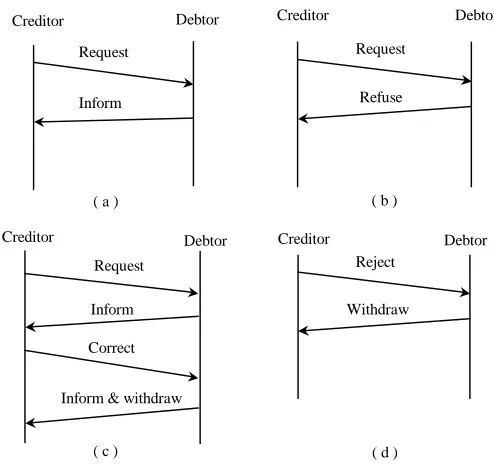
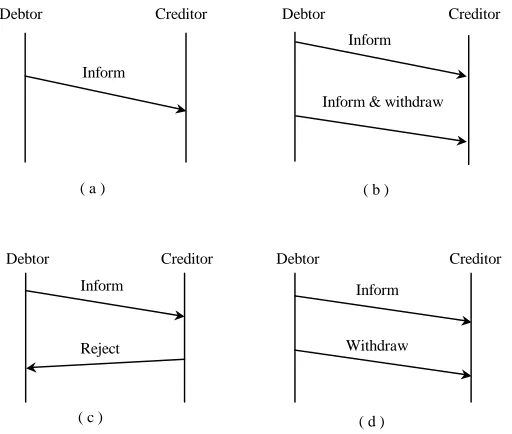
In many scenarios, we can construct agents as reactive systems (see Figure 2.3). A creditor sends
a request to a debtor. The debtor may make the following decisions: (a) the debtor may accept the request and he can establish a commitment by sending a inform message; (b) the debtor may
refuse the request from the creditor. In case (a), a commitment has been established. In case (b), the
debtor may not satisfy the creditor’s current request instead he may refuse the request by sending a
refuse message. If a creditor doesn’t satisfy the information the debtor supplies, it can continue their
Debtor Creditor
Request
Inform
( a )
Debtor Creditor
Request
Inform
Correct
Inform & withdraw
( c )
Debtor Creditor
Request
Refuse
( b )
Creditor Reject
Withdraw
( d )
Debtor
Figure 2.3: Establishing commitments for a reactive system
information by sending a reject message (shown in (d)). When a creditor sends a request or correct
request to its debtor, it sets a timer. If the debtor doesn’t reply the request by the time, a timeout is generated and the creditor sends a reject message to its debtor (shown in case (d)).
Figure 2.4 shows some other situations for commitment establishment. In case (a), the com-mitment is established when the debtor sends an inform message. In case (b), the debtor informs
the creditor of the latest information and withdraws the old information if there is new information available and previous commitment is invalid. The creditor reasons whether it can accept the
com-mitment at the time. If it would not accept the information, it would send a reject message (shown in (c)). After sending an inform information, the debtor may retreat the previous information by
( b )
Debtor Creditor
Inform
Inform & withdraw
Debtor Creditor
Inform
Reject
( c )
Debtor Creditor
Inform
( a )
( d )
Debtor Creditor
Withdraw Inform
Figure 2.4: Establishing commitments for some other situations
2.4.2 Commitment Resolution
There are three ways to resolve a commitment: (a) normal discharge, (b) debtor cancels the
com-mitment, or (c) creditor releases the commitment.
In case (a), the commitment will be discharged when the commitment conditions (for example,
time condition) are satisfied.
In case (b), the debtor may cancel the commitment. It can send a withdraw message to a creditor
and remove the commitment with the creditor.
In case (c), the creditor may release a commitment. It can send a reject message to the debtor.
2.4.3 Commitment Observation
We also provide two messages for an agent to query/answer questions about a commitment. The
query is used for one agent to send other agents query messages to query the related commitments
It may also allow some observers to query the commitments of other agents in their observation domain.
2.4.4 Revisions
Creditor
( a )
Creditor
( b ) Debtor
Inform
Inform & withdraw
( c ) Debtor
Inform
Inform & withdraw
Debtor Creditor
Inform
Inform & withdraw Request
Figure 2.5: Revision situations
Although we may assume that communication is reliable and effective, there are still some
revi-sion situations, such as the messages go out of order, or an inform message isn’t for responding the request. There are two inform messages from the same agent with the same commitment identifier
Chapter 3
Metamodel
A metamodel is a language for specifying models. Our metamodels are a language for specifying
agent interactions and specifically the desired process interoperation.
A commitment is the core of our metamodel. There are two kinds of commitment applications.
One is conversation-oriented. Another is task-oriented. For the conversation-oriented commitment application between agents in e-commerce scenarios, we need to consider the commitment as what
one party promises another party. It often results in an agreement. We say that a party promises another party to do something, while another party promises the party to do other thing. The
com-mitment here is used to enforce their interactions. For the task-oriented comcom-mitment application, we consider the commitment as what one party agrees to perform for another party. The commitment
is often propagated down the control flow. Thus we have to distinguish them, but we can use the same metacommitment patterns with different formalizations.
We introduce a metamodel for process interoperation in Section 3.1. We present agent knowl-edge representation language, which can be used to represent agent interaction information in
Sec-tion 3.2. We propose agent metacommitment patterns in SecSec-tion 3.3. We apply the metamodel to two examples in Section 3.4. We give the specification language for metacommitment patterns in
Metacommitment Pattern
Notify Satisfy Renotify
Entertain Request Entertain
Update Event Action Condition
Role Task
Capability
DataContainer Resource
Connector debtor
creditor
1..*
0..*
0..* 1..* 1..*
1..*
0..1
source
target input
output 0..*
0..* 0..*
0..* 1..1
1..1 1..* 1..*
1..*
Abort
Figure 3.1: Commitment-based metamodel for interoperation
3.1
Metamodel for Process Interoperation
Traditional metamodels for process interoperation are based on flowcharts or activity diagrams,
which are of limited help in handling complex situations. Coding the associated procedures or scripts is tedious work. While some of the complexity of the scripts arises from accessing legacy
data, much of it is because of the ad hoc manner in which exceptions are handled.
We develop a simple metamodel that supports interoperating businesses represented by
au-tonomous agents. Like traditional metamodels, our metamodel captures the structure of activities. However, unlike traditional metamodels, our metamodel includes concepts dealing with persistence
and commitments to support exceptions and revisions. Figure 3.1 presents class diagram of our metamodel in UML [23]. We now discuss the main concepts of this metamodel.
A task identifies a definite piece of work. Tasks may be atomic or compound. We model a task as taking inputs and producing results, both of which map to resources (such as
databases). A task is executed only if it is triggered; upon completion it produces an event, which (through the connectors introduced below) may trigger other tasks.
Capabilities implement tasks by defining the primary processing required of a task.
They are handlers to procedural code that would do the bulk of the computation in an
Connectors capture the control flow among the tasks. They also capture the data flow
among tasks by binding the outputs and inputs of successive tasks. On the surface, these
connectors are traditional and include linear, and-fork, condition, or-join, and and-join. However, their operational semantics are nontraditional and support reentrance, which
is essential for managing commitments properly, especially to enable revisions.
Data dependency captures the data flow along tasks. Each task has its data container,
which can be input, or output. One task output can be another task input. Thus we say that there exists data dependency between the two tasks. The data dependency could
be along control connectors. It may be across two or more control connectors.
A role provides the capabilities required of any task assigned to it. During execution, a
specific agent with matching capabilities is bound to each role. Importantly, roles are used to specify the applicable commitments. Thus, roles capture the underlying
orga-nizational structure. Agents can volunteer to assume certain roles that would require them to perform certain tasks by executing their capabilities. Thus, an agent playing
a role must implement all the capabilities that the role provides and must honor the metacommitments of that role.
A commitment relates a debtor role, a creditor role, and a condition, in the scope of a context group [58]. This means that the debtor is obliged to the creditor to satisfying the
given condition. The context group is the virtual organization that provides the scope of the interoperation. The condition of the commitment involves the relevant predicates
from the domain. In our example, the airline can commit to the given traveler that she is confirmed on a particular flight.
Importantly, commitments are flexible, and can be revoked or modified. For
exam-ple, even a confirmed flight booking or an entire flight can be canceled. However, the revocation or modification of commitments is constrained through metacommitments,