COMPILER-BASED PREFETCHING ALGORITHM FOR RECURSIVE DATA STRUCTURE
NURULHAINI BINTI ANUAR
ystem
APRIL 2007
A project report submitted in partial fulfillment of the requirements for the award of the degree of
Master of Science (Computer Science)
ACKNOWLEDGEMENT
“In the name of Allah, Most Gracious, Most Merciful”
Alhamdulillah, praise to Allah S.W.T in preparing this thesis, I was in contact with many people, researchers, academicians, and practitioners. They have contributed towards my understanding and thoughts. In particular, I wish to express my sincere appreciation to my main thesis supervisor, Dr. Norafida binti Ithnin, for advices, motivation, encouragement, guidance, critics and friendship. Without her continued support and interest, this thesis would not have been the same as presented here.
ABST ACT
Memory latency becoming an increasing important performance bottleneck as the gap bet
R
ABST
Kelambatan masa capaian ingatan utama menjadikan kelambatan prestasi pemproses
g at tinggi disebabkan j a kelajuan pemproses dan a.
gatan engatasi m alah i i tetap bukan
lengka Terd pat p bagai eknik telah diselidik untuk
nnya
tu tek ik pen ngan
tung
da engatu l ntuk emasu kod
aplikasi untuk rujukan kepada ingatan
Pre-ambilan ini telah enunjukkan
memory stall di dalam aplikasi y
keberkesanan di dalam untuk
menyelidik pengkompi askan
kepada penudin ert gkan.
Untuk merekab a teknik
perbandingan d spe l untuk secara
uantitatif dengan eksperimen makmal. Terdapat tiga teknik yang dicadangkan oleh penyelidik
dikaji untuk tek efetch
Array. Hasil daripada teknik perbandingan dan eksperimen telah memberikan algoritma terbaik
untuk dijadikan gai merekabentuk algoritma cadangan. Algoritma terbaik ini
terdiri daripada e tch Array a cadangan telah
diimplementasikan dan diuji dengan situasi y erti algoritma yang sedia ada. Hasil
daripada ujian tersebut encapai prestasi keb yang
lebik baik berbanding teknik seb h p i dan
memberikan prestasi yang lebih baik.
RAK
semakin menin k urang diantar ingatan utam
In cache merupakan satu langkah untuk m as n i ianya
merupakan satu penyelesaian p. a el t
mengurangkan masalah ini yang telah dicadangkan oleh penyelidik dan dinilai keberkesana
terhadap kehilangan cache. Merujuk kepada masalah ini, adalah perlu untuk kita mempunyai
sa n goptimum pengkompil. Salah satu teknik yang telah digunakan ialah de
menggunakan Perisian Pre-ambilan arahan atau Software Prefetching. Perisian ini bergan
kepa p rcara atau pengkompi u m kkan arahan pre-ambil ke dalam
yang kebiasaannya hilang di dalam cache. Perisian
m keberkesannanya mengurangkan penghentian ingatan atau
ang berasaskan kepada tatasusunan tetapi tidak menunjukkan
aplikasi berasaskan kepada penuding. Projek ini dijalankan
l yang berasaskan kepada penuding untuk aplikasi yang beras
g sep i struktur data rekursif dan merekabentuk algoritma yang dicadan
entuk lgoritma ini, terdapat dua metodologi yang digunakan iaitu
an ek rimen makma menjanakan hipotesis dan menilai prestasi
k
nik perbandingan iaitu Greedy Prefetching, Jump History Pointer dan Pr
seba panduan untuk
Gre dy Prefetching dan Prefe . Algoritm
ang sama sep
mendapati algoritma cadangan m erkesanan
TABLE OF CONTENTS
CHAPTER
ACKNOWLEDGEM
ABSTRACT v
LIST OF TABLES xi
LIST OF FIG 1 INTRO T 1.1 1.2 1.3 1.5 1.6 1.7 2 2.1 Introduction 9
2.2.1 Types of Superscalar 11
tatica Sche uled S persca r s r lly S hedule Supe calar r elism LP) TITLE PAGE ENT iv
TABLE OF CONTENTS vii
URES xii
LIST OF APPENDICES xv
DUC ION 1
Introduction 1
Problem Background 4
Problem Statement 5
1.4 Project Objectives 6
Project Scopes 7
Project Contributions 7
Conclusion 8
LITERATURE REVIEW 9
2.2 Superscalar Architecture 9
2.2.1.1S lly d u la 11
Proces o 2.2.1.2Dynamica c d rs 11
2.2.2.1Limitations of ILP by ardwa e ModH r el 12
2.3 r Cach Misse ss ate R ductio refe hing 2.4 Improving Mem .1 refetc ng 2.5 Software Prefetching 20
21
2.5.3 Pointer-chasing Problem 24
iler 2.6.2 Prefetching 30
2.8 2.9 3 H Architecture 40
r ework Memo y Hierarchy 13
2.3.1 Cache Memory 14
2.3.1.1Classification of e s 16
2.3.1.2Miss Penalty and Mi R e n 17
by Compiler-Controlled P tc Technique ory Performance 18
2.4.1 Tolerating Latency 19
2.4.1 P hi 19
2.5.1 Recursive Data Structure (RDS) 2.5.2 Pointer-Chasing Memory Access Patterns 23
2.5.4 Comp 25
2.6 Existing Prefetching-based Pointer Techniques 27
2.6.1 Greedy Prefetching 28
Jump History 2.6.3 Prefetch Array 33
2.7 Simics Version 3.0 36
Olden Benchmarks 38
Conclusion 39
MET ODOLOGY 40
3.1 Introduction 40
3.2 System 3.3 Operational F am 41
3.4 Project Methodology 44
3.4.1 Qualitative Approach 45
3.4.3 3.4.4 3.4.5
Process
3.4.6.3 Implementations of the Algorithm 56
ents 56
3.6 Conclusion 57
4 -A 4.2 The Pre-Algorithm Comparative Study Findings 58
Techniques 4.3 The Pre-Algorithm Lab Experimental Findings 63
4.3.1 Types of RDS programs 64
4.3.2 Performance Metrics 65
4.3.3 Pre-Algorithm Lab Experiment Findings 68
4.4 Conclusion 74
DESIGN, IMPLEMENTATION AND TESTING 76
5.1 Introduction 76
5.2 Design GPA Algorithm 76
5.3 The GPA Algorithm 77
5.3.1 Analysis Phase 79
5.3.1.1 Identifying RDS Types 79
Comparative Study Method 48
Experimental Method 50
Pre-Algorithm Process 53
3.4.6 Propose Algorithm 54
3.4.6.1 Design the Algorithm 54
3.4.6.2 Tests and Experiments the Algorithm 55
3.5 Hardware and Software Requirem PRE LGORITHM COMPARATIVE STUDY AND LAB EXPERIMENTS 58
4.1 Introduction 58
4.2.1 The Strengths and Weaknesses of Existing 59
4.2.2 Critical Latency Variables 61
5.3.1.2 Recognizes RDS Accesses 80
5.3.1.3 Recurrent Pointer Updates 84
5.3.2 Scheduling Phase 88
5.4 Results of GPA Algorithm 90
5.5 Conclusion 95
6 DISCUSSIONS AND CONCLUSION 96
102
104-107 6.1 Introduction 96
6.2 Results and Achievements 96
6.3 Limitations of Project 101
6.4 Future Works 6.5 Conclusion 102
REFERENCES
LIST OF TABLES
ABLE TITTLE PAGE
2.1 Summary of Olden benchmark programs 38
62
65
70
87
88
99
6.4 100
T 3.1 The comparative of two cases 49
4.1 The Strengths and Weaknesses of Existing Techniques 60
4.2 Comparative of Critical Latency Variables of Existing Techniques 4.3 Details descriptions each type of RDS input programs in benchmark library 4.4 The performance metric for prefetching techniques 66
4.5 Scale of Metrics 67
4.6 Metric1 –Full Coverage 68
4.7 Metric2 –Partial Coverage 69
4.8 Metric3 –Execution Time 4.9 Summary of all metrics performance 74
5.1 Metric1 –Full Coverage 86
5.2 Metric2 –Partial Coverage 5.3 Metric3 –Execution Time 6.1 Percent Improvement of the GPA algorithm 97
6.2 Percent Improvement for full coverage metric for the GPA algorithm versus best algorithm 98
6.3 Percent Improvement for partial coverage metric
for the GPA algorithm versus best algorithm Percent Improvement for execution time metric
LIST OF FIGURES
FIGURE NO. TITLE PAGE
1.1 Processor-DRAM Memory Gap (latency) by Moore’s Law 2 2.1 A superscalar processor with five functional units 10 2.2 A system with two levels of cache 15 2.3 Examples of whether type declarations are recognized
as being RDS types 21 2.4 Example of list traversals, both with and
without temporal data locality 22 rns 23 24
27 28
d
29 31
ing
uses a history pointer array to set the prefetch pointers 34 2.5 Examples of pointer-chasing memory access patte
2.6 Code example of creating and traversing a singly-linked list
2.7 Illustration of the pointer-chasing problem 25 2.8 Compiler Overview (source: Structures Computer
Organization by Andrew S. Tanenbaum)
2.9 Illustration of greedy prefetching 2.10 The implementation of the software approaches using
Greedy Prefetching Technique in an example of a tree an a list traversal
2.11 Example showing the update of history-pointers
2.12 Traversal codes with Jump-pointer prefetching 31 2.13 The implementation of the software approaches us
Jump History Prefetching Technique in an example of a tree
and a list traversal 32 2.14 Illustrates the addition of a prologue loop that performs
2.16 The implementation of the software approaches using
a tree and a list traversal 35
2.17 2.18 A booted window 37
3.1 System Architecture 41
42
3.3 Overall Project Methodology 44
3 g ph ing, 71 g, 72 73 77
5.2 Phases and sub functions 78
A pseudo code for identifying RDS types 80
.6 Algorithm for recognizing RDS accesses 83
5.7 A pseudo code algorithm for propagating RDS pointer values 84
Prefetch Array Prefetching Technique in an example of The initial simics window 37
3.2 Operational Framework 3.4 Pre-Algorithm process 5
4.1 Metric1 –Full Coverage performance graph 69
4.2 Metric2 –Partial Coverage performance ra 70
4.3 The execution time of the MST benchmark normalized to the execution time without prefetching. ’B’ is the base case without prefetching, ’G’ is greedy prefetch ’J’ is jump pointer prefetching, PA is the prefetch array 4.4 The execution time of the Health benchmark normalized to the execution time without prefetching. ’B’ is the base case without prefetching, ’G’ is greedy prefetchin ’J’ is jump pointer prefetching, PA is the prefetch array 4.5 The execution time of the MST benchmark normalized to the execution time without prefetching. ’B’ is the base case without prefetching, ’G’ is greedy prefetching, ’J’ is jump pointer prefetching, PA is the prefetch array 5.1 The process of designing the proposed algorithm 5.3 5.4 Algorithm for identifying RDS types 80
5.5 A pseudo code for recognizing RDS accesses 82
5.8 A pseudo code algorithm for assigning new values
to RDS pointer 85
5.9 Algorithm for propagating RDS pointer values 86 5.10 Algorithm for assigning new values to RDS pointer 87
5.11 Schedule pref n RDS object is being
88 5.12 A pseudo code for generate prefetch instructions 89
Generate pre etch in
5.14 The creation of artificial jump pointers 90
5.15
graph 92 5.17
to the execution time without prefetching. ’Base’ is the base case without prefetching, ’Best’ is the best algorithm,
and ’GPA’ is the proposed algorithm. 95 6.1 Percent Improvement graph for full coverage metric 98 6.2 Percent Improvement graph for partial coverage metric 99 6.3 Percent Improvement graph for execution time metric 100
etches were invoked when a traversed
5.13 f structions in scheduling prefetches 89
Metric1 –Full Coverage performance graph 91 5.16 Metric2 –Partial Coverage performance
The execution time of the MST benchmark normalized to the execution time without prefetching. ’Base’ is the base case without prefetching, ’Best’ is the best algorithm,
and ’GPA’ is the proposed algorithm. 93 5.18 The execution time of the Health benchmark normalized
to the execution time without prefetching. ’Base’ is the base case without prefetching, ’Best’ is the best algorithm,
and ’GPA’ is the proposed algorithm. 94 5.19 The execution time of the Perimeter benchmark normalized
LIST OF APPENDICES
APPENDIX TITLE PAGE
A1 Example of prefetching types address 109
A2 Possible extension to the ISA and the CPU pipelines for instruction prefetches 110
enchmark program 112
2 Mst benchmark program 120
B3 B1 Health b B Perimeter benchmark program 122
C1 Flow chart for identifying RDS types 128
C2 Flow chart for recognizing RDS accesses 129
C3 Flow chart for propagating RDS pointer values 130
C4 Flow chart for assigning new values to RDS pointer values 132
CHAPTER 1
INTRODUCTION
1.1 Introduction
The performance of modern microprocessors is increasingly dependent on their ability to execute multiple instructions per cycle. Such rapid, dramatic increases in hardware parallelism have placed tremendous pressure on compiler technology. For years, a steadily growing clock speed has been relied upon to consistently deliver increased performance for a wide range of applications. Recently, however, this trend has changed, as the microprocessor industry can no longer increase clock speed because of difficulties related to power consumption, heat dissipation, and other factors.
Meanwhile, the exponential growth in transi ajor
icroprocessor companies to add value by producing chips that incorporate multiple stor count remains strong, causing m m
processors.[4] To achieve very high-performance of processors the computer architects must concern on cost, time, speed variables to follow the micro-processors trends. Thus to achieve low time computation with high speed performance and with low cost processor, the computer architects need to deal with cache memory hierarchies and exploit instruction level parallelism.[5]
to use the memory, not just how the individual load/store operations in the program behave. [3] Current microprocessors spend a large percentage of execution time on memory access stalls, even with large on-chip caches. Since processor speeds are rowing at a greater rate than memory speeds, the expectation of memory access costs to ecome
g
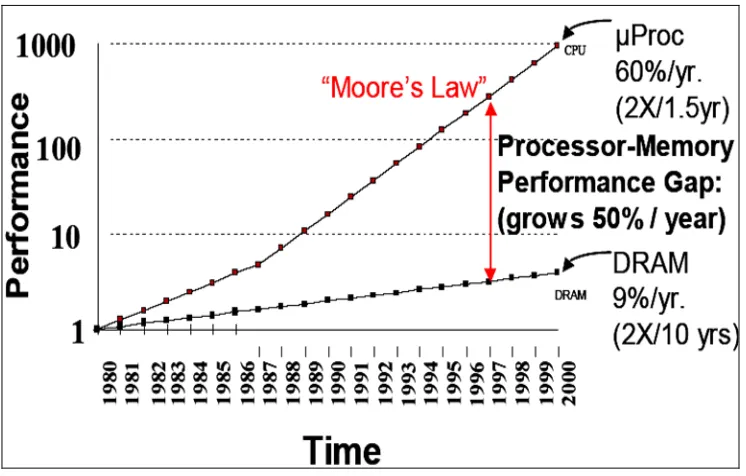
b even more important in the future. Figure 1.1 shows the graph performance vs. time of Processor and DRAM by Moore’s Law and the gap between processor-memory speeds grows 50% per year from year 1980 until 2000.
Figure 1.1: Processor-DRAM Memory Gap (latency) by Moore’s Law
Refer to the graph, the microprocessor performance increase 60% per year while memory performance increase only 9% per year. Computer architects have been battling this memory latency problem by designing ever larger and more sophisticated caches. Although caches are extremely effective, they are not the complete solution. Other techniques are required to fully address the memory latency problem. [2] Memory latency problem is a problem due to the gap between CPU speed and memory speed, where CPU speed continue to growth while memory doesn’t. This problem happens hen CPU access to the main memory, where CPU speed is high contrast with memory peed is slow. Then CPU need to deals with cache memory, but it is still have a problem at will cause cache-miss problem. This is why cache memory is not a complete w
solution for tolerating memory latency problems. As the performance difference etween the CPU and the main memory increases, reduction of the cache misses and penalti
or a cache miss initiate a memory fetch, data prefetching anticipates such misses and issues a fetch to e memory system in advance of the actual memory reference. To be effective, prefetc
b
es become more severe.
One of the techniques to reduce cache misses is to prefetch data or instruction. Prefetch by definition is to fetch data or instruction before they are requested by the processor. This prefetch can be done by prefetching techniques. Prefetching techniques can be performed either by hardware and/or by software. Hardware can be designed to prefetch instructions and data, either directly into the cache or into an external buffer that can be more quickly accessed than main memory. On the other hand, software prefetching is implemented by including fetch instructions in processor instruction set. Fetch instructions can be coded explicitly by the programmer or added by the compiler during the optimization. [6] In both software and hardware prefetching, the mechanisms is based on overlapping execution by the prefetching of instructions or data.
Instruction prefetching speculatively brings the instructions needed in the future close to the microprocessor and, hence, reduces the transfer delay due to the relatively slow memory system. If instruction prefetching can predict future instructions accurately and bring them in advance, most of the delay due to the memory system can be eliminated. [1] Data prefetching is a technique for hiding the access latency of data referencing patterns that defeat caching strategies. Rather than waiting f
to th
1.2 Problem Background
Memory latency becoming an increasing important performance bottleneck as the gap between processor and memory speeds continues to grow. While cache hierarchies are an important step toward addressing the latency problem but they are not a comp
ntific programs making regular memory ccesses. This make prefetching has enjoyed considerable success for array-based pplications but its potential in pointer-based applications has remained largely unexpl
Recursive Data Structures (RDSs) include familiar objects such as linked lists, ees, graphs, etc., where individual nodes are dynamically allocated from the heap, and odes are linked together through pointers to form the overall structure. Recursive data tu rpreted to include most pointer-linked data structures (e.g., utually-recursive data structures, or even a graph of heterogeneous objects). Recursive data str
performance perspective, these pointer-based data structures are lete solution. To further reduce or tolerate memory latency problem, several techniques have been proposed and evaluated which is responsible to reducing memory latency by cache-misses. Regarding to this problem, it has become necessary for us to have a better compiler optimization techniques. One of the techniques has recently used was Software Prefetching. Software prefetching relies on the programmer or compiler to insert explicit prefetch instructions into the application code for memory references that are likely to miss in the cache. At run time, the inserted prefetch instructions bring the data into the processor’s cache in advance of its use, thus overlapping the cost of the memory access with useful work in the processor. Software prefetching has been shown to be effective in reducing memory stalls in array-based applications for both sequential and parallel applications, particularly for scie
a a
ored [7]. Most of the commercial applications, such as database engines, of-ten use hash tables and to trees represents and store data. These structures used pointer-based such as linked-list data structure that are often traversed in loops or by recursion. This linked-list data structure also known as Recursive Data Structures.
tr n
struc res can be broadly inte m
expected to be suffer a large memory penalty due to data replacement misses, temporal lity consecutively-accessed nodes in an RDS. Therefore, techniques for coping with e latency of accessing these pointer-based data structures are essential. [3,7,9,10]
y lements can be referenced independently. At worst, pairs of array references are erialized in the case of indexed array traversal. But even in that case, separate indexed array r ence
for pointer traversal must dereference a series of pointers sequentially. [2,7] The memor rial
from o app
effectiveness. associated memory references to be sequentialized, nd is known as the pointer-chasing problem.
ons usually exist in programs solving complex problems here the amount and organization of data is unknown at compile time, requiring the
use of storage and linkage. They may also arise from
igh-le pro Because memo
very irregular and lack locality, resulting in poor cache performance. [2]
1.3
Previous techniques of software prefetching for pointer based codes influence the rocessor performance and accuracy of prediction prefetch instructions. This project xamines the question
locality may be poor when traversal a large RDS and little inherent spatial loca between
th
Prefetching for pointer-based data structures is challenging due to the memory serialization effects associated with traversing pointer structures. The memory operations performed for array traversal can issue in parallel because individual arra e
s
efer s can perform in parallel. In contrast, the memory operations performed
y se ization in pointer chasing prevents conventional prefetching techniques verl ing cache misses suffered along a pointer chain, thus limiting their
This property forces a
Pointer-chasing applicati w
pointers to manage both dynamic
h vel gramming language constructs such as object-oriented programming. ry is allocated and accessed dynamically, the access pattern tends to be
Problem Statement
How to reduce or tolerate memory latency by using L1-cache-miss in pointer-based
odes?
Today’ ry to
achieve highes ost of today’s applications are very complex
and the oces to the pointer-based data
structu ed ns that are:
prefetch
ii. critical?
iii. s of pointer-based codes that makes memory performance
1.4 Project Objectives
ject are:
i. To investigate, experiment, compare and choose the best critical latency c
s microprocessor performance deals with ILP and cache memo t performance. However, m
pr sor performance becomes slow. This may due
re us in the applications. This project also explores the sub questio
i. How to exploit parallelism in processor? Is that by fetch all the
instructions?
What are the latency variables that make prefetching algorithms
What type
becomes very slow?
The objectives of the pro
variables from the existing software prefetching techniques of pointer based codes.
ii. To design and develop the propose pointer prefetching algorithm using the chosen critical latency variables.
1.5 Project Scopes
rent types of Recursive Data Structure.
vi. Simulation of these compiler techniques will be simulate on dynamically-scheduled, superscalar processor similar to SPARC using Simics version 3.0.
1.6 Project Contributions
This project will give better insights and idea or solution to expand the compiler’s scope to include another important class of applications: those containing pointer-based data structures also known as Recursive Data Structures. Proposing a better algorithm for pointer-based codes will give another opportunity for compiler technology to develop an effective and optimize for today compiler. The comparative study on previous techniques will help the understanding on the compiler improvements and problems.
The scopes of the project are:
i. The comparative study of previous Prefetching techniques only for Greedy Prefetching technique, Jump History Pointer technique and Prefetch Array technique.
ii. Focus only the cache misses in Level-1 cache.
iii. Develop the prefetching algorithm using C programming.
iv. Using data library from benchmark suite those containing pointer-based data structures also known as Recursive Data Structures.
v. Using three Olden benchmark programs that are mst, health and
1.7 Conclusion
Nowadays, the applications becomes larger compared than recent years where only consists of small programs and execute lly is necessary. Compared than larger applications such as B-trees in database applications, oc-trees in graphic applications where it suffered for large mem ry penalty due to data replacement misses and consecutive elements is not at contiguous address. One of the most common and
convenient methods of buildin cursive Data Structures. Due
to these large applications, the execution speed is low because of pointer-chased oblem and the disparity gap between the CPU speed and memory speed. To overcome
ea roject will propose new algorithm for compiler-based Prefetching chnique and compare with previous technique to give the best result for improvement executi
sequentia
o
g large data structures is Re
pr
the r d latency, this p te