Impromptu Speech: EFL learners’ Problems in Collocation and L1 Interference
Seyedhamed Sadoughvanini, Sarimah Binti Shamsudin, Dr.
ABSTRACT
Collocation is considered to be an important element for advanced ESL or EFL learners to lead them on the way toward an accurate and natural production of the second or foreign language. This study focuses on the role of collocation in some aspects. Firstly, it defines collocation in detail to show how different collocation is from the other types of fixed phrases. Secondly, this study discusses how collocation can reduce interference of the learners’ first language during language production of the target language and help them to transfer the intended meaning they have in mind through correct and appropriate chunks of words. Thirdly, the role of collocation in production of a natural an accurate language is highlighted. Finally it will present analysis of a group of the EFL learners’ impromptu speech problems in collocation and the cases of L1 interference.
ABSTRAK
Kolokasi dianggap menjadi elemen penting bagi pelajar yang mempunyai penguasaan yang tinggi dalam Bahasa Inggeris sebagai bahasa kedua atau asing bagi memimpin mereka dalam usaha menghasilkan produksi yang tepat dalam asli dalam bahasa tersebut. Penyelidikan ini memfokuskan pada peranan kolokasi dalam beberapa aspek. Pertama, ia mendefinisikan kaedah kolokasi secara terperinci untuk menunjukkan betapa berbezanya kaedah kolokasi dari jenis frasa tetap yang lain. Kedua, kajian ini membahas bagaimana kaedah kolokasi dapat mengurangkan gangguan dari bahasa ibunda pelajar semasa penghasilan bahasa sasaran dan membantu mereka untuk memindahkan maksud sebenar yang ada dalam minda melalui potongan kata-kata yang betul dan tepat. Ketiga, peranan kolokasi dalam pengeluaran bahasa asli yang tepat akan diserlahkan. Akhirnya ianya akan membentangkan analisis permasaalahan kolokasi dan kes gangguan bahasa ibunda sekumpulan pelajar yang mempelajari Bahasa Inggeris sebagai bahasa asing dalam pengucapan tanpa persediaan awal.
Introduction
Vocabulary and vocabulary teaching has been taken into consideration in different teaching
methods through the history of language teaching. In some phases and methods it has
become more prominent whereas in other ones it is replaced by more prominent role of
grammar. Schmitt (2000:32-39) explain role of vocabulary in the history of language
teaching. However, the focus was on individual words or in an optimum view, on grouping
words and vocabularies under one topic. The focus on co-occurrence of words to make
chunks and collocations has increased in recent years. What we consider is chunk of words
or prefabricated chunks. These chunks have different subcategories such as collocation,
idioms, lexical phrases which have different definitions respectively. Definition of each
category of chunks is very important for studies. If we are not meticulously aware of these
definition of them that make a precise distinction among them. In the recent years, more
attention has been paid to vocabulary teaching and learning. The lexical approach to
second language teaching, which was coined by Lewis (1993:95), has turned to be of higher
interest in recent years as an alternative to grammar-based approaches. Among the
scholars who have worked on the role of chunks, he is the scholar who brought using and
teaching chunks into high prominence. The lexical approach focuses on developing learners'
proficiency with lexis, or words and chunks of words. The foundation of this approach has
been laid on importance of the fact that language acquisition is the ability to comprehend
and produce lexical phrases as pre-assembled wholes, or "chunks," and that these chunks
become the base for perception of patterns of language grammar (Lewis 1993:95). He
focuses on important role of vocabulary as a central role in communication. He also does not
deny the equally important role of grammar and does not intend to belittle significance of
grammar.
Collocations are fundamentally the prolific result of the trend started by studying and
working on corpuses or corpora. Corpora collect discourses varying in length. Corpora
facilitates use of real data in study of language. Schmitt(2000) believes that corpus has
drastically changed our view towards language and words. Corpus helps us to find the
relationship among words. According to Schmitt corpus can provide us with three types of
information: 1)“how frequently various words occur” 2)“which words tend to co-occur” 3)“how the structure of language is organized”. Collocation is also highlighted in Lexical Approach
as a subcategory of chunks. Collocations have different definitions and classifications.
Lewis(2000:132) defines collocation as “the way in which words co-occur in natural text instatistically significant ways”.
Schmitt(2000:76) defines collocation as “tendency of two or more words to co-occur in discourse”. He continues with the fact that J.R. Firth is the first scholar who made this
notion noticeable in 1957. Since then, this notion has got ascendingly significant.
Collocations are also defined as “the co-occurrence of two items in a text within a specified environment”(Sinclair et al. 2004). For Nattinger and DeCarrico (1992:36) collocations are defined as ”strings of specific lexical items that co-occur with a mutual expectancy greater than chance,such as rancid butter and curry favor”. While for James(1998:152), collocations are “the other words any particular word normally keeps company with”.
Scholars have considered different angles to define the term Collocation and the
concept it carries. Hunston (2002) focuses on biasedness in co-occurrence of the words and
and unmotivated. The logicality of the relationship among co-occurrent items decides
whether the collocation is motivated or unmotivated. She continues with the example of
co-occurrence of the word toy with children, rather than adults, which is an example of a
motivated category due to presence logicality. Motivated collocations has been implied by
other scholars. As Firth (1957) puts it, dog and bark can create a significant co-occurrence,
whereas cat and bark are not likely to be collocated . On the other hand, co-occurrence of
the word tea with the adjective strong is considered an example of unmotivated collocation,
since it is arbitrary and unjustifiable due to absence of logicality. This arbitrariness is one of
the factors that make collocations hard to learn and recall. However, from the view point of
Newmark (1988) the motivated category is not considered collocation, since it does not
exclude the initial sense of the word. Newmark (1988:114) has the idea that, "the collocates
within a collocation define and delimit each other by eliminating at least some other possible
meaning; the defining may be mutual and equally balanced, but more often it is closer for
one collocate than for the other". Thus to pay attention is a collocation, since it excludes pay
in the sense of monetary. To buy a hat is not a collocation, since it does not limit the
Newmark (1988:114) suggests different categories for collocations which are "syntagmatic
or horizontal, therefore consisting of common structure; or paradigmatic or vertical,
consisting of words belonging to the same semantic field which may substitute for each other
or be semantic opposite”.
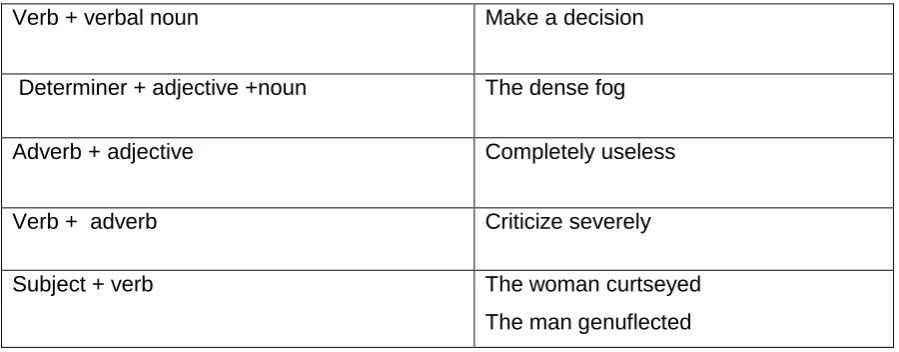
According to Newmark (1988:114-115), syntagmatic collocations are divided into seven main
groups as shown in Table 1.
Table 1: Seven Main Groups of Syntagmatic Collocations Verb + verbal noun Make a decision
Determiner + adjective +noun The dense fog
Adverb + adjective Completely useless
Verb + adverb Criticize severely
Subject + verb The woman curtseyed
So far, it makes a general view that combination of a word with other words forms the
meaning of that word. Firth (1935) focuses on the fact that the meaning of a word is function
of the ways it may combine with other words. The word closet can be illustrative enough to
shed light on this idea. The word closet, as a noun and according to dictionary definition
means an area that you keep clothes and other things in, built behind the wall of a room with
a door on the front. To our surprise, when this word combines with the word drinker to form
the chunk closet drinker, which means heavy drinker, the meaning and the part of speech
changes. We can clearly notice that how combination of the word closet with the word
drinker exerts a different meaning on the former due to co-occurrence with the latter. So far
another point of view can also be deduced: absoluteness and probability in collocations.
Absoluteness occurs when presence of a collocate brings about absolute co-occurrence of
that collocate with only one other collocate and prohibits other ones. We say fresh water, but
we cannot say sweet water. Probability occurs when presence of a collocate brings about
probable co-occurrence of that collocate with one other collocate and also other ones. We
say strongly disagree, but we can also say completely disagree. This case is matter of
convention and replacing strongly with completely does not change the meaning, and as a
result of daily repetitions we say strongly disagree. In all of these definitions, what is
noticeable is the relationship and regular co-occurrence between lexical items(Carter 1988).
Following collocations is a shift of attitude towards words from shortsightedness to
broadmindedness; you shift from isolated words to unified chunks. Collocations are no
longer considered a peripheral issue in second or foreign language learning, since it is
essential even when you are using simple words in daily and routine conversations(O'keeffe
et al. 2007).
MeticulousDistinction:
So far different definitions of the term collocation have been explored through the definitions
mentioned by different scholars. By taking a quick look at all the above mentioned definitions
again, finding a common point among all of them will be easy. The definitions are as follow: Count noun + of + mass noun Bar of soap
1) “the way in which words co-occur in natural text in statistically significant ways”(Lewis
2000:132) .
2) “tendency of two or more words to co-occur in discourse” (Schmitt 2000:76).
3) “the co-occurrence of two items in a text within a specified environment”(Sinclair et
al. 2004).
4) collocations are defined as ”strings of specific lexical items that co-occur with a
mutual expectancy greater than chance,such as rancid butter and curry favor”
(Nattinger and Decarrico 1992:36).
5) “the other words any particular word normally keeps company with” (James
1998:152).
The term occurrence is the common point included in the definitions. This
co-occurrence converts two or more words into a chain, string or a chunk of words.
Based on the definitions, the question that is inspired into mind is that if all chunks, strings or
chain of words made by co-occurrence of two or more words are called collocation? As we
know there are different string of words and prefabricated chunks in which the notion of
co-occurrence is obvious in them such as polywords, idioms, clichés, lexical phrases and
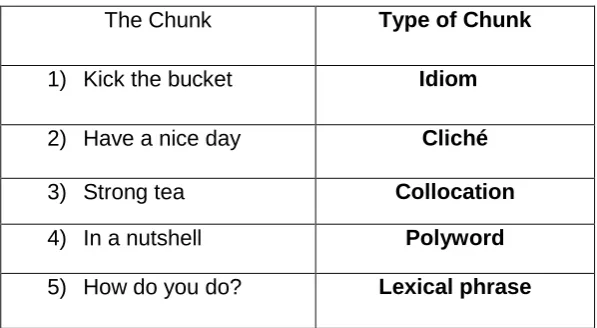
collocation. Look at the following examples.
1) Kick the bucket
2) Have a nice day
3) Strong tea
4) In a nutshell
5) How do you do?
How can we distinguish collocation among the above mentioned chunks or string of words?
Can we say which is idiom, cliché, polyword, lexical phrase or collocation? In order to avoid
any mistaken use of other chunks instead of collocation in this study, it is required to make a
distinction among all these string of words that enables us to distinguish collocations
accurately.
Nattinger and Decarrico (1992:32-39) have the following definitions for these terms.
Idioms: “bits of frozen syntax whose meaning cannot be derived from the meaning of its constituents”.
Cliché: they share frozenness with idioms, but the meaning can be understood from the components.
Collocation: “strings of specific lexical items that co-occur with a mutual expectancy greater than chance. These strings are not assigned particular pragmatic functions”.
Lexical phrase: Collocations with pragmatic functions.
According to these definitions the following table will be the answer to the question can we
say which is idiom, cliché, polyword, lexical phrase or collocation as proposed earlier.
Table 2: Types of Chunks
The Chunk Type of Chunk 1) Kick the bucket Idiom 2) Have a nice day Cliché 3) Strong tea Collocation 4) In a nutshell Polyword 5) How do you do? Lexical phrase
Interference
Brown (1984) mentions that the interference of the first language with the second language
is the paramount obstacle on the way of second language learning and makes it hard for the
learner to learn L2. However, Brown (1984) points out the fact that, what make learning a
second language intricate and complicated are the differences between two linguistic
systems. Solving the problem of differences is a basic assumption in second language
learning. The difficulties in second language learning are yielded by these differences.
However, not all difficulties yielded as the result of the differences between two linguistic
systems, have an identical degree. In other word, one difference can contain a higher
degree of difficulty in second language learning as compared to other ones and vice versa.
Difficulties in learning a second language can be categorized in an ascending order.
ZiahosseinY (1999:pp14-15) suggests the following degrees of difficulty:
Level 0: transfer
No difficulty is noticed to transfer an item from L1 t L2. This is due to the fact that there is no
difference between the two languages in this case. It is called zero level because of absence
of difficulty for the learner to transfer, so it is not challenging or problematic for the learner.
Some phonemes and words such as table, television and house are among the examples.
Level 1: Coalescence
One item in target language is used for two or more ones in the native language. The
distinction among items in the native language is disregarded by the learner. The word
Level 2: Underdifferentiation
An item in the native language is deprived of equivalence in the foreign language. This item
must be erased from the learner’s mind.
Level 3: reinterpretation
An item is present in the first and second language, but sometimes they are not equivalent.
So this similarity will result in overgeneralization. The sentence we have visited Paris has
also the form of present perfect in Persian language as it is in English. The sentence we are
sitting in the class is present continuous in English whereas it has the form of present perfect
in Persian and this is the case in which overgeneralization is subject to happen due to the
mentioned similarity.
Level 4: Overdifferentiation
This is the opposite side of level 2. An item in the target language is deprived of equivalence
in the native language. They are the new items to be learned. The sounds [θ] and [ð] are
among the examples.
Level 5: Split
This is the opposite side of level 1. Presence of two or more items in the foreign language is
noticeable for an item in the first language. The words rancid, corrupt, decayed, rotten and
faulty have one equivalence in the first language (Persian) as well as the words handcuff
and bracelet and also the words monkey and auspicious. If each of these equivalences are
used interchangeably, the meaning is distorted and the communication is deviated. As
mentioned before, this is the case in which absoluteness is involved. In the other word,
interchangeable use of on equivalence for the other is absolutely forbidden.
Importance of collocations
"Students with good ideas often lose marks because they don't know the four or five most
important collocations of a key word that is central to what they are writing about" Hill
(1999:5) As a result, they will inevitably produce longer structures which increase probability
of errors. He cites the example: "His disability will continue until he dies" rather than "He has
a permanent disability”.
The concept of collocation is difficult for learners. “The essentially simple idea that word
choice is seriously limited by what comes before and after is perhaps the single most elusive
aspect of the lexical system and the hardest, therefore, for learner to acquire” (Thornbury
1997).
Once grasped, however, this new focus can re-awaken their interest and enthusiasm in the
comparing written texts with earlier output and authentic material.
“Explicit instruction” or “consciousness-raising" (Ellis, 1997:133) by the teachers can be
significantly advantageous to arouse noticing in students. In other words, the teacher
becomes more of a facilitator and guideline provider for the learners, by the strategies he
recommends to be used outside the classroom.
Nattinger (1980:341) suggests that teaching should be on the idea that language production
is the piecing together of ready-made units appropriate for a particular situation.
Comprehension of such units is dependent on knowing the patterns to predict in different
situations. Instruction, therefore, should center on these patterns and the ways they can be
pieced together, along with the ways they vary and the situations in which they occur.
Activities used to boost learners' knowledge of lexical chunks include the following:
High exposure to second language through audio-visually recorded and written
materials.
Taking advantage of learners’ L1 in some translation activities which aim at raising
awareness of learners toward finding appropriate equivalents for chunks in second
language
Creating an analytical eye in the learner to single out and store collocations and fixed
chunks.
Fluency
Learning collocations, apart from increasing the mental lexicon, leads to an increase in
written and spoken fluency (the brain has more time to focus on its message if many of the
nuts and bolts are already in place in the form of collocations of varying length). As Lewis
(1997:15) says, "fluency is based on the acquisition of a large store of fixed or semi-fixed
prefabricated items, which are available as the foundation for any linguistic novelty or
creativity." Moreover, stress and intonation also improve if language is met, learnt and
acquired in chunks. Quality input should lead to quality output.
In seeing real advances in their spoken and written fluency highlighted, and understanding
the importance of collocation in aiding these advances, students will, hopefully, be
stimulated to increase their own, informed exposure to English. As a result, they will begin to
Methodology
To explore the problem of collocation and L1 interference in impromptu speech of Iranian
IEC students in UTM, a class of Iranian IEC students was selected. The impromptu speech
test was administered on the five following topics:
1) What are the differences between your opinions and your grandfather’s?
2) Why do you continue your education?
3) What kind of job do you like? Why?
4) What are the important factors to choose a life partner?
5) Why do people need to get a job?
Twenty Iranian students were waiting in a laboratory to be called for the impromptu speech
test. They were called one by one to attend in another laboratory. In this way the students
did not get familiar with the topics and could not practice by listening to other students’
speeches.
Randomly, one of the five topics which had been typed on a piece of paper was given to the
students. After one minute the student started to speak about the topic for about five
minutes.
Data Analysis
Analyzing the twenty records, it was figured out that lack of knowledge and use of collocation
will result in the following problems:
1) Long sentences due to lack of knowledge of collocation:
When a student did not know the exact collocation, he tried to explain the word to make the
sentence meaningful. For example, the sentence “those people who do not have a job” could be said as “jobless people”
2) Due to the lack of knowledge of collocation, the meaning of the sentence was distorted,
since the students resorted to L1-L2 translation. In this case the student looks for the word in
his mind and does not know the exact collocation. He tries to find the word that best fit the
sentence semantically, so he tries to pick up the word which is closest in meaning. However,
this choice could not be undoubtedly correct, since the student has randomly selected the
word. If the choice of word is not correct the whole meaning of the word may be distorted.
Tell the truth and earn money are two correct collocational chunks. Some students produced
the chunks “say the truth” and “gain money”. This incorrect use of collocation has not
However there are cases in which such errors will distort the meaning entirely. ( e.g.
compressed course instead of intensive course)
3) Some incorrect choices of collocations, especially in grammatical ones, are originated from degree of difficulty 3 (Underdifferentiation). Due to L1-L2 translation, the learner
believes that there must be equivalence in the target language for all items of the native
language. Therefore, the learner sometimes adds an additional item in the target language
which is incorrect. This case is mostly noticeable in prepositions. “Using from”, “thank from”, “regarding to”, “different together” and “reach to” are among the examples produced by the
students in which additional use of the prepositions is eye-catching.
4) Degree of difficulty 5 (split) is considered to be a significant reason for collocational errors.
Since some items in the first language have more than one or two equivalences in the
second language, the students may not be aware of this fact and use the equivalences
interchangeably. The chunk sweet water which is wrong translation of fresh water is
categorized under this degree
Conclusion
Firstly, acquisition of skills related to the correct use of collocations can be hastened “as a result of explicit instruction or consciousness-raising” (Ellis 1997). Therefore, the most useful
role for the teacher is to engage in consciousness-raising in encouraging learners to notice
the correct use of collocations. In other words, consciousness of learners regarding the
importance of collocations should be raised during the process of acquiring the skills to use
collocations. Just as Hill (2000) stated, possibly up to 70% of everything we say, hear, read,
or write can be found in some form of fixed expression. A student with a vocabulary of 2,000
words will be able to function in a fairly limited way. A different student with a 2,000 word
vocabulary who is collocationally competent with those words will thus be far more
communicatively competent.
Secondly, what non-English teachers need most in their classes is appropriate
workbooks that contain a selection of collocations geared to the specific difficulties of
learners with a particular L1 background. Such teaching materials should allow the teachers
to actually teach collocations, thus shortening the long and laborious process of acquiring
collocational competence through years of studying, reading, and observing the language
Last but not least, this study focused on the role of teaching correct choices of words
to prevent the problem of interference. When the students do not have the correct and exact
choice of word or collocation they resort to translation and random choice of words that may
lead to a semantically incorrect chunk of words.
References
Brown, D. (1984). Principles of Language Learning and Teaching: New Jersey: hall, Inc.,
Englewood Cliffs.
Carter, R. (1988). "Vocabulary, Cloze and Discourse ", in R. Carter and M. McCarthy, (eds.),
Vocabulary and Language teaching. London: Longman, pp. 161-180.
Ellis, N. C. (1997). "Vocabulary acquisition: Word structure, collocation, word-class, and
meaning", in N. Schmitt and M. McCarthy, (eds.), Vocabulary: Description,
acquisition and pedagogy. Cambridge: Cambridge University Press.
Firth, J. R. (1935). "The Tecniques of semantics." Transaction of the Philological Society,
36-72.
Firth, J. R. (1957). Papers in Linguistics, Oxford: Oxford University Press.
Hill, J. (1999). "Collocational competence " ETP(11).
Hill, J. (2000). "Revising priorities: From grammatical failure to collocational success", in M.
Lewis, (ed.), Teaching collocation. Hove: Language Teaching Publications, pp.
47-70.
Hunston, S. (2002). Corpora in applied Linguistics, Cambridge: Cambridge University
Presss.
James, C. (1998). Errors in language learning and use :Exploring error analysis. , New York:
Addison Wesley Longman Limited.
Lewis, M. (1993). The lexical approach: The state of ELT and the way forward, Hove,
Lewis, M. (1997). "Implementing the Lexical Approach." LTP.
Lewis, M. (2000). "Learning in a lexical approach", in M. Lewis, (ed.), Teaching collocation :
Furtherdevelopment in the lexical approach. Oxford: Oxford University Press.
Mackin, R. (1978). "On collocations: Words shall be known by the company they keep", in
Strevens, (ed.), Honour of A. S. Hornby. Oxford: Oxford University Press, pp.
149-165.
Nattinger, J. (1980). "A lexical phrase grammar for ESL." TESOL Quarterly(14), 337-344.
Nattinger, J., and Decarrico, J. (1992). Lexical phrases and language teaching, Oxford:
Oxford University Press.
Newmark, P. (1988). Approaches to translation, London: Prentice Hall International.
O'keeffe, A., McCarthy, M., and carter, R. (2007). from Corpus to Classroom,
Cambridge: Cambridge University press.
Schmitt, N. (2000). Vocabulary in Language Teaching, Cambridge: Cambridge University
Press.
Sinclair, J., M., Jones, S., and Daley, R. (2004). English Collocation Studies: The OSTI
Report, London: Continuum.
Thornbury, S. (1997). "Reformation and Reconstruction : Tasks that Promote Noticing." ELT,
15.
Ziahosseiny, S. M. (1999). A Contrastive Analysis of Persian and English and error analysis,