THE DEVELOPMENT OF MACHINE LEARNING BASED SOFTWARE FOR PREDICTING PROTEIN-PROTEIN INTERACTIONS AND PROTEIN
FUNCTION FROM PROTEIN PRIMARY STRUCTURE
(PEMBANGUNAN PERISIAN BERASASKAN PEMBELAJARAN MESIN UNTUK MERAMAL INTERAKSI PROTEIN-PROTEIN DAN FUNGSI
PROTEIN DARIPADA STRUKTUR PRIMARI PROTEIN)
MUHAMAD RAZIB BIN OTHMAN SAFAAI BIN DERIS
HANY TAHER AHMED ALASHWAL ROSLI BIN MD. ILLIAS
SAFIE BIN MAT YATIM
RESEARCH VOT NO: 74288
Jabatan Kejuruteraan Perisian
Fakulti Sains Komputer Dan Sistem Maklumat Univerisit Teknologi Malaysia
ABSTRACT
ABSTRAK
TABLE OF CONTENTS
CHAPTER TITLE PAGE
ABSTRACT ii
ABSTRAK iii
TABLE OF CONTENTS iv
LIST OF TABLES vii
LIST OF FIGURES ix
LIST OF ABBREVIATIONS xii
CHAPTER 1 INTRODUCTION 1
1.1 Background of the Problem 1
1.2 Problem Statement 3
1.3 The Research Question 3
1.4 The Goal and Objectives 4
1.5 Importance of the Study 4
1.6 Scope of the study 6
1.7 Thesis Outline 7
1.8 Summary 9
CHAPTER 2 BASIC CONCEPTS IN MOLECULAR
BIOLOGY 10
2.1 The Central Dogma of Molecular Biology 10
2.2 The DNA 12
2.3 The Proteins 13
2.4 The Genetic Code 16
2.5 Proteins Functions 17
2.6 Protein-Protein Interactions 20
CHAPTER 3 LITERATURE REVIEW 25
3.1 Protein Function Prediction 25
3.2 Methods to study protein-protein interactions 30 3.3 Predicting Protein-Protein Interactions 32
3.4 Support Vector Machines 41
3.5 Bayesian Networks 43
3.6 Summary 46
CHAPTER 4 RESEARCH METHODOLGY 47
4.1 Research Design 47
4.2 General Research Framework 48
4.3 Protein Data Sets 51
4.4 Evaluation Measures of the System
Performance 54
4.5 Summary 56
CHAPTER 5
COMPARISON OF PROTEIN SEQUENC FEATURES FOR THE PREDICTION OF PROTEIN-PROTEIN INTERACTIONS USING
SUPPORT VECTOR MACHINES 57
5.1 Related Work 57
5.2 Comparison Experiment Framework 60
5.3 The Support Vector Mahines 62
5.4 Features Representation 70
5.5 Materials and Implementation 72
5.5.1 Data Sets 72
5.5.2 Data Preprocessing 75
5.6 Results and Discussion 78
5.7 Summary 84
CHAPTER 6 ONE-CLASS SUPPORT VECTOR MACHINES FOR PROTEIN-PROTEIN INTERACTIONS
PREDICTION 85
6.1 Related Work 85
6.3 One-Class Support Vector Machines 90
6.4 Datasets and Implementation 95
6.5 Results using Domain Feature 97
6.6 Results using Hydrophobicity Feature 101
6.7 Discussion 105
6.8 Summary 106
CHAPTER 7 REACTIVE CONSTRAINTS PROCESSING 107
ALGORITHMS
7.1 Related Work 107
7.2 Bayesian Approach 109
7.2.1 Bayesian Probability 109
7.2.2 Bayesian Networks 110
7.3 Kernel Methods 111
7.4 Bayesian Kernels 117
7.5 Bayesian Kernel for Protein-Protein
Interactions Prediction 119
7.6 Results and Discussion 121
7.7 Summary 127
CHAPTER 8 CONCLUSION AND FUTURE WORK 128
8.1 Conclusion 128
8.2 Research Contributions 131
8.3 Future Work 132
8.4 Closing 133
RELATED PUBLICATIONS 134
LIST OF TABLES
TABLE NO. TITLE PAGE
2.1 The amino acids. 14
2.2 The standard genetic code 17
2.3 Proteins functions 18
3.1 Computational methods for protein function prediction 30 3.2 High-throughput experimental approaches to the
determination of protein-protein interactions.
33
3.3 Computational methods for protein-protein interactions prediction
36
4.1 The protein interactions of yeast Saccharomyces cerevisiae identified by wet lab experiments.
51
4.2 The contingency table. 54
5.1 The classifier performance on domain structure feature using 10-fold cross validation with variant threshold.
80
5.2 The classifier performance on domain structure with scores feature using 10-fold cross validation with variant threshold.
80
5.3 The classifier performance on hydrophobicity feature using 10-fold cross validation with variant threshold.
81
5.4 The classifier performance on hydrophobicity with scale feature using 10-fold cross validation with variant threshold.
5.5 The overall performance of SVM for predicting PPI using domain and hydrophobicity features.
82
6.1 One-Class performance using different kernel with the domain feature
101
6.2 One-Class performance using different kernel with the domain feature.
104
7.1 Bayesian Kernel performance with varied threshold using domain feature.
123
7.2 Bayesian Kernel performance compared to the standard kernels using domain feature.
124
LIST OF FIGURES
FIGURE NO. TITLE PAGE
2.1 The central dogma of molecular biology (Korf et al., 2003).
11
2.2 Schematic drawing of protein secondary structure (Punta and Rost, 2005).
15
2.3 The protein-protein interaction network in yeast (Uetz, 2000).
21
2.4 (a) Large protein complex and its protein-protein interactions.
(b) The schematic interaction (Cramer et al., 2001).
22
3.1 Different methods for inferring protein function. 26 3.2 The overlap between different high-throughput
experiments.
34
4.1 The general research operational framework. 50 4.2 A simplified entity-relationship diagram of the DIP
database (Xenarios et al., 2002).
53
5.1 The framework of comparing protein sequence features. threshold.
61
5.2 (a) A separating hyperplane with small margin. (b)A separating hyperplane with larger margin.
5.3 (a) Hard margin solution when data contain noise. (b) Soft margin solution when data contain noise.
68
5.4 Part of the protein-protein interactions list from DIP. 73 5.5 Part of the protein-protein interactions list with
sequences name only.
74
5.6 Part of the protein sequence file. 75
5.7 Part of the protein domains file. 76
5.8 Part of the protein domains structure for the yeast genome.
77
5.9 Part of the training data file. 77
5.10 The ROC curves and scores for predicting protein-protein interactions.
83
6.1 Target and outlier classes in the one-class classification problem.
89
6.2 Classification in the one-class SVM. 93
6.3 The implementation framework for the one-class SVM.
96
6.4 The one-class SVM performance using domain feature with the linear kernel.
99
6.5 The one-class SVM performance using domain feature with the polynomial kernel.
99
6.6 The one-class SVM performance using domain feature with the RBF kernel.
100
6.7 The one-class SVM performance using domain feature with the sigmoid kernel.
6.8 The one-class SVM performance using hydrophobicity feature with the linear kernel.
102
6.9 The one-class SVM performance using
hydrophobicity feature with the polynomial kernel.
103
6.10 The one-class SVM performance using hydrophobicity feature with the RBF kernel.
103
6.11 The one-class SVM performance using
hydrophobicity feature with the sigmoid kernel.
104
7.1 Illustration of mapping input data to a feature space. 113 7.2 The ROC curve for the Bayesian kernel and the
standards kernel.
124
7.3 The distribution of the probabilistic output for the Bayesian kernel
LIST OF ABBREVIATIONS
BN – Bayesian Networks
DIP – The Database of Interacting Proteins DNA – Deoxyribonucleic Acid
DPEA – Domain Pair Exclusion Analysis DPI – Dual Polarisation Interferometry
FNR – False Negative Rate
FPR – False Positive Rate
GO – Gene Ontology
HGP – Human Genome Project
InterDom – The Database of Interacting Domains
KBM – Kernel Based Methods
KM – Kernel Matrix
LIBSVM – Library for Support Vector Machine
MIPS – Munich Information Center for Protein Sequences
mRNA – Messenger Ribonucleic Acid
MSSC – Maximum Specificity Set Cover
ncRNA – Non-coding Ribonucleic Acid
PDB – Protein Data Bank
PFAM – Protein Families Database
PID – Potentially Interacting Domain
PIE – Probabilistic Interactome Experimental
PPI – Protein-Protein Interactions
QP – Quadratic Programming
RBF – Radial Basis Function
RNA – Ribonucleic Acid
ROC – Receiver Operating Characteristic
RVM – Relevance Vector Machine
SGD – Saccharomyces Genome Database
SVM – Support Vector Machines
TAP – Tandem Affinity Purification
TPR – True Positive Rate
CHAPTER 1
INTRODUCTION
Bioinformatics or computational biology is broadly defined as the application of computational techniques to solve biological problems. This field has arisen in parallel with the development of automated high throughput methods of biological and biochemical discovery that yield a huge and variety forms of experimental data, such as DNA and protein sequences, gene expression patterns, and chemical
structures. Major research efforts in bioinformatics include sequence alignment, gene finding, genome assembly, protein structure alignment, protein structure prediction and prediction of protein interactions. In this thesis, the prediction of protein-protein interactions from sequences data using machine learning techniques is presented. The background of the problem, objectives, importance of the study, and the scope of this research is presented and discussed in this chapter.
1.1 Background of the Problem
The majority of functions in cells are accomplished by proteins. Therefore, assigning functions to the proteins encoded by a genome is one of the crucial steps in gaining understanding of the organism. Because the function of half of all proteins in newly sequenced genomes often is completely unknown, complete genome
utilise sequence homology to proteins of experimentally known function, such a homology-based annotation transfer is problematic and limited in scope. Therefore, alternative approaches have begun to develop. These approaches include methods based on phylogenetic patterns, gene expression, and protein-protein interactions data.
The sequencing of entire genomes has moved the attention from the study of single proteins or small complexes to that of the entire proteome. Most proteins do not function in isolation, but collaborate with other proteins. In this context, identifying protein-protein interactions (PPI) is an important goal of proteomics. Protein-protein interactions data can help researchers to infer protein's functions based on the information available about its partner. Usually, laboratory experiments are used such as yeast two-hybrid analysis, protein microarrays and immunoaffinity chromatography followed by mass spectrometry. Recently, computational methods have been introduced because laboratory experiments are costly, time-consuming and suffer from high false positive rates.
Part of the reason why it is difficult to relate the chemical function of a protein to its biological purpose using homology-based annotation is that proteins do not function alone. To understand the function of a protein, it must be considered in its proper cellular context, for example by appreciating how the cell would behave without it (Attwood and Miller, 2001). Many proteins are parts of larger complexes, which are the functional units that fulfill a role in the cell (Gavin et al., 2002). In this regard it can be argued that knowing proteins partners can give important clue about its function. Therefore it is highly relevant to study the interaction partners of a protein in order to understand its function (Ho et al., 2002) (Deng et al., 2002).
Most protein-protein interactions have been discovered by laboratory
Therefore the aim of this research is to predict protein-protein interactions from protein primary structure data using machine learning techniques. Then the availability of both the experimental and the predicted protein-protein interactions data can be used to construct more reliable dataset for the prediction of proteins functions.
1.2 Problem Statement
The research problem that we are trying to solve in this research can be described as following. Given the protein-protein interactions data for the budding yeast, Saccharomyces cerevisiae that are listed in the Database of Interacting Proteins (DIP) and its protein sequences data, it is a challenging task to accurately predict new protein-protein interactions based on that data using machine learning techniques.
1.3 The Research Question
The main research question is:
How can the protein-protein interactions be predicted from protein sequences data using machine learning techniques?
Thus, the following issues will arise to answer the main research question stated above:
• How to identify the best protein sequence features that can be used to train the learning algorithm?
• How to incorporate the probabilistic protein-protein interactions information to improve the prediction accuracy?
1.4 The Goal and Objectives
The main goal of this research is to develop a computational technique using the Support Vector Machines (SVM) and Bayesian approach to predict protein-protein interactions form protein-protein sequences data of the budding yeast,
Saccharomyces cerevisiae.
To achieve this goal the following objectives have been set:
• To investigate different protein sequence features for the prediction of protein-protein interactions using the support vector machines.
• To formulate the problem of predicting protein-protein interactions as a one-class classification problem then solve it using the One-Class SVM • To incorporate the probabilistic protein-protein interactions information
using Bayesian kernel.
• To test, evaluate, and enhance the prediction system.
1.5 Importance of the Study
The most common approach to identify protein function is based on sequence similarity. However, about 30% to 40% of the newly discovered proteins can not be assigned function based on sequence homology or similarity because they do not have statistically significant similarity with known protein (Letovsky and Kasif, 2003).
Inferring protein function can be made via protein-protein interaction studies. This is due to the fact that proteins work in a context of other proteins and rarely work alone. Hence, the function of unknown protein may be discovered if
information about its interaction partners of known function is available. For that reason, the study of protein interactions has been fundamental to the understanding of how proteins function within the cell. Characterizing the interactions of proteins in a given cellular proteome will be the next milestone along the road to understanding the biochemistry of the cell. As a result, studying protein-protein interactions to gain insight on protein functions has become a topic of enormous interest in recent years, resulting many efforts devoted to its research.
The interactions between proteins are important for many biological functions. Almost all processes in of molecular biology are affected by protein-protein interactions (Alberts et al. 2002, Lodish et al. 2004). Replication, transcription, translation, signal transduction, protein trafficking, and protein
degradation are all accomplished by protein complexes, often temporally assembled and disassembled to accomplish vital processes. In fact, the importance of protein– protein interactions in the post-genomic era is becoming more noticeable due to the huge volume of data that became available. Hence, studying protein-protein
interactions is crucial to gain insight on protein functions of the newly sequenced genomes.
However, the many discrepancies between the interacting partners identified in high-throughput studies and those identified in small-scale experiments highlight the need for caution when interpreting results from high-throughput studies (Salwinski and Eisenberg 2003).
These discrepancies represent the need for the development of computational methods for data validation. Indeed, the interaction data that have been provided by high throughput technologies like the yeast two-hybrid system are known to suffer from many false positives. In addition, in vivo experiments elucidating protein-protein interactions are still time-consuming and labor-intensive methods. As a result, complementary computationally methods capable of accurately predicting interactions would be of considerable value. Furthermore, computational methods for the prediction of protein interactions will provide more data which will enable
predicting protein function more precisely since the function of proteins with three or more partners can be more accurately predicted.
1.6 Scope of the Study
This study will focus on predicting protein-protein interactions from protein sequence information of the Yeast, Saccharomyces cerevisiae genome. The protein interactions dataset was obtained from the Database of Interacting Proteins (DIP) and the protein sequences data was obtained from Munich Information Center for Protein Sequences (MIPS). The DIP database was developed to store and organize
However, it should be noted that protein-protein interactions are sometimes confused with metabolic pathways. Metabolic Pathway is a series of enzyme-catalyzed reactions. Each reaction produces a product which becomes the substrate for the next reaction. Although the structures of metabolic pathways and protein interaction maps are similar, there are a number of significant differences: While metabolic pathways focus on the conversion of small molecules and the enzymes responsible for these conversions, protein interaction maps concentrate mainly on physical contacts without obvious chemical conversions. Physical interactions are certainly of great utility when one studies single proteins or defined biological processes, but themselves do not reflect the huge amount of knowledge that has been accumulated in the biological literature. In this research we only attempt to predict physical protein-protein interactions.
1.7 Thesis Outline
The outline and the flow of the contents of this thesis can be described as follows:
• The thesis begins with Chapter 1 in which this section is part of it. The chapter explains the key concepts, introducing the problem of this research, list the objectives, and determine the scope of this work.
• Chapter 2 reviews and explains the basic terms and concepts in the molecular biology such as the central dogma of molecular biology, DNA, and proteins. It also examines amino acids and proteins in terms of their nature, formation, structure and their importance.
highlights the need for computational approaches. It also reviews the computational methods that have been developed to predict protein-protein interactions..
• Chapter 4 describes the overall methodology adopted in this research to achieve the objectives of this thesis.
• Chapter 5 presents and discusses the process of using support vector machines (SVM) to predict protein-protein interactions for protein sequence information. Using SVM, different protein sequence features have been studied and examined. These features include protein domain structures, hydrophobicity and amino acid
compositions. At the end of this chapter, the results of studying and comparing these features are presented.
• Chapter 6 shows how the problem of predicting protein-protein interactions can be modeled as a one-class classification problem. It also present the One-Class SVM classifier and its implementation to prediction protein-protein interactions as a one-class classification problem using only positive examples (interacting protein pairs) in training phase. At the end of this chapter, the results of using the One-Class SVM are presented.
• Chapter 7 describes the implementation of Bayesian Kernel for SVM to predict protein-protein interactions. Bayesian Kernel for SVM was implemented to incorporate the probabilistic information about
protein-protein interactions that were compiled from different sources. This chapter also shows that the probabilistic output from the
• Chapter 9 concludes and summarizes this thesis, highlights the contributions and findings of this work, and provides suggestions and recommendations for future research.
1.8 Summary
CHAPTER 2
BASIC CONCEPTS IN MOLECULAR BIOLOGY
For a better understanding of this research, an introductory chapter to the basic concepts and terminology of molecular biology and biological sequence analysis is inevitable. This chapter begins with a brief description of the central dogma of molecular biology which involves the production of proteins from DNA. Then an overview of protein’s definition, nature, structure and its importance is presented. The chapter also explains the composition of proteins and its building blocks, the amino acids. In addition to this chapter, a glossary of biological terms is offered in Appendix A.
2.1 The Central Dogma of Molecular Biology
The central dogma of molecular biology is based on the assumption that each gene in the deoxyribonucleic acid (DNA) molecule carries the information needed to construct one protein. DNA is a nucleic acid that contains the genetic instructions for the development and function of living organisms (Alberts et al., 2002). All known
cellular life and some viruses contain DNA. The main role of DNA in the cell is the long term storage of information. It is often compared to a blueprint, since it contains the instructions to construct other components of the cell, such as proteins and ribonucleic acid (RNA) molecules. The DNA segments that carry genetic
The central dogma involves two steps: transcription and translation.
Transcription produces an mRNA (messenger RNA) sequence using the DNA sequence as a template. The subsequent process, called translation, synthesizes the
protein according to information coded in the mRNA (Korf et al., 2003). This
process is performed by sub cellular elements called ribosomes. Proteins are created
in the nucleus of all cells in a living organism. The DNA in each cell provides a recipe of how and when proteins should be created. The process in which proteins are created is called protein synthesis. This process is illustrated in Figure 2.1.
2.2 The DNA
As mentioned earlier, the hereditary material that carries the blueprint for an organism from one generation to the next is called deoxyribonucleic acid (DNA). Every time cells divide, the DNA is duplicated in a process called DNA replication. The entire DNA of an organism is called its genome. Understanding the various organisms’ genomes is one of the most important challenges in the post-genomic era (Palsson, 2000). Modern medicine, agriculture, and industry will increasingly depend on the knowledge of genomes to develop individualized medicines that select and modify the most desirable traits in plants and animals, and understand the
relationships among species.
The alphabet of the DNA language is simple, consisting of just four nucleotides: adenine, cytosine, guanine, and thymine. For simplicity, they are abbreviated as A, C, G, and T. DNA usually exists as a double-stranded molecule, but generally just one strand at a time is referred. The pairing rule of DNA is that A pairs with T, and C pairs with G. Hence, it is very easy to determine the sequence of the complementary strand of any DNA sequence. Here's an example of a DNA sequence with its complementary sequence:
G A T T A G C T C C A G G A A T C T A A T C G A G G T C C T T A
DNA has polarity with its ends are referred to as 5-prime (5´) and 3-prime (3´). This nomenclature comes from the chemical structure of DNA. While it isn't necessary to understand the chemical structure, the terminology is important. For example, "the 5´ end of the gene," means the beginning of the gene. Usually DNA sequence is displayed left to right, and the convention is that the left side is the 5´ end and the right side is the 3´ end.
produce RNAs that aren't translated into proteins and are therefore called noncoding RNAs (ncRNA) (Korf et al., 2003).
DNA doesn't encode proteins on its own. DNA is copied into RNA by a protein called RNA polymerase in a process called transcription. Chemically, RNA is a lot like DNA except that it uses uracil instead of thymine and it is single stranded instead of double stranded. The RNA alphabet is A, C, G, and U, and an RNA molecule might look like this:
G A A U U G C U C C A G G A A U
If the RNA transcript from a gene is a transfer RNA (tRNA), ribosomal RNA (rRNA), or other ncRNA, it may undergo some chemical modifications, but the gene product remains as an RNA molecule. RNAs corresponding to protein coding genes are called messenger RNAs (mRNA).
2.3 The Proteins
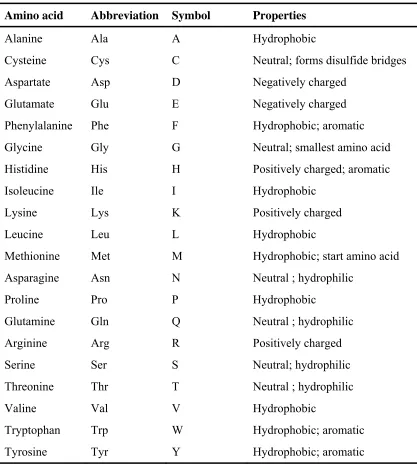
A protein is linear polymer of amino acids linked together by peptide bonds. There are twenty amino acids that compose the standard chemical alphabet used to build proteins. The amino acids are small molecules that share a common motif, of three substitute chemical groups arranged around a central carbon atom. One of the substitute groups is always an amino group; another is always carboxylic acid group. The average protein size is around 200 amino acids long, while large proteins can reach over a thousand amino acids.
Table 2.1: The amino acids. Amino acid Abbreviation Symbol Properties
Alanine Ala A Hydrophobic
Cysteine Cys C Neutral; forms disulfide bridges
Aspartate Asp D Negatively charged
Glutamate Glu E Negatively charged
Phenylalanine Phe F Hydrophobic; aromatic
Glycine Gly G Neutral; smallest amino acid
Histidine His H Positively charged; aromatic
Isoleucine Ile I Hydrophobic
Lysine Lys K Positively charged
Leucine Leu L Hydrophobic
Methionine Met M Hydrophobic; start amino acid
Asparagine Asn N Neutral ; hydrophilic
Proline Pro P Hydrophobic
Glutamine Gln Q Neutral ; hydrophilic
Arginine Arg R Positively charged
Serine Ser S Neutral; hydrophilic
Threonine Thr T Neutral ; hydrophilic
Valine Val V Hydrophobic
Tryptophan Trp W Hydrophobic; aromatic
Tyrosine Tyr Y Hydrophobic; aromatic
Using one-letter symbols, a protein sequence might be written like this:
M L V G S R A
DNA and RNA are largely used to store and send information, proteins carry out almost all processes in the cell. Also, proteins determine the shape and structure of the cell, and also serve as the main instruments of molecular recognition and catalysis.
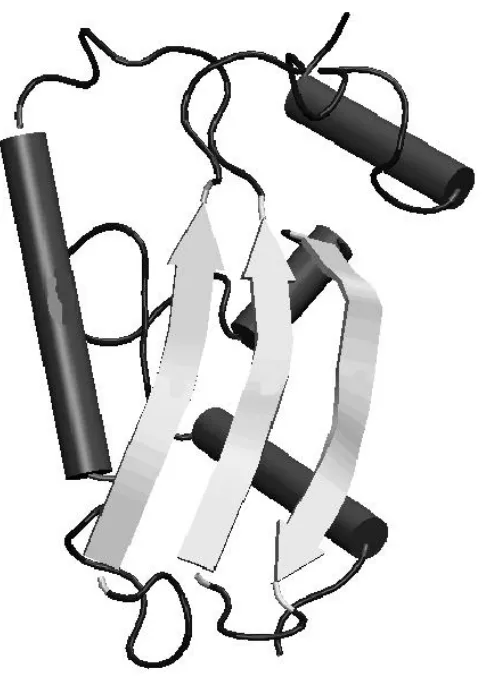
Although proteins have many different shapes and sizes, if we look closely at the structure, we can find recurring structural themes that biologists call secondary structure. The most common themes are the α-helix, β-sheet, and random coil. In Figure 2.2, these themes are represented as cylinders, arrows, and squiggly lines.
Figure 2.2: Schematic drawing of protein secondary structure (Punta et al., 2005).
secondary structure. Secondary structure is subdivided into three parts: alpha-helix, beta-sheet and loop.
Alpha-helix is spiral turns of amino acids while a beta-sheet is flat segments or strands of amino acids formed usually by a series of hydrogen bonds. Beta-strands are the most regular form of extended polypeptide chain in protein structures. Loops usually serve as connection points between alpha-helices and beta-sheets. The do not have patterns like alpha-helices and beta-sheets and they could be any other part of the protein structure. They are sometimes known as random coil.
2.4 The Genetic Code
The information in DNA and RNA is translated to protein sequence using a complex machine composed of proteins and ncRNAs called the ribosome reads an mRNA sequence and writes a protein sequence. The mRNA is read three nucleotides at a time. The nucleotide triplets are called codons. Each codon corresponds to a single amino acid. The mapping from codons to amino acids is called the genetic code. The genetic code is one of the universal laws of molecular biology.
Table2.2: The standard genetic code. Second Position
T C A G
T
TTT Phe (F) TTC Phe (F) TTA Leu (L) TTG Leu (L)
TCT Ser (S) TCC Ser (S) TCA Ser (S) TCG Ser (S)
TAT Tyr (Y) TAC
TAA STOP TAG STOP
TGT Cys (C) TGC
TGA STOP TGG Trp (W)
T C A G
C
CTT Leu (L) CTC Leu (L) CTA Leu (L) CTG Leu (L)
CCT Pro (P) CCC Pro (P) CCA Pro (P) CCG Pro (P)
CAT His (H) CAC His (H) CAA Gln (Q) CAG Gln (Q)
CGT Arg (R) CGC Arg (R) CGA Arg (R) CGG Arg (R)
T C A G
A
ATT Ile (I) ATC Ile (I) ATA Ile (I) ATG Met (M)
ACT Thr (T) ACC Thr (T) ACA Thr (T) ACG Thr (T)
AAT Asn (N) AAC Asn (N) AAA Lys (K) AAG Lys (K)
AGT Ser (S) AGC Ser (S) AGA Arg (R) AGG Arg (R)
T C A G F i r s t P o s i t i o n G
GTT Val (V) GTC Val (V) GTA Val (V) GTG Val (V)
GCT Ala (A) GCC Ala (A) GCA Ala (A) GCG Ala (A)
GAT Asp (D) GAC Asp (D) GAA Glu (E) GAG Glu (E)
GGT Gly (G) GGC Gly (G) GGA Gly (G) GGG Gly (G)
T C A G T h i r d P o s i t i o n
2.5 Proteins Functions
Proteins are the main players within the cell, known to be carrying out the duties specified by the information encoded in genes (Lodish et al., 2004). Proteins
complement of proteins expressed in a particular cell or cell type at a given time point or experimental condition is known as its proteome.
The main characteristic of proteins that enables them to carry out their diverse cellular functions is their ability to bind other molecules specifically and tightly. The region of the protein responsible for binding another molecule is known as the binding site and is often a depression or "pocket" on the molecular surface (Lodish et al., 2004). This binding ability is mediated by the tertiary structure of the
protein, which defines the binding site pocket, and by the chemical properties of the surrounding amino acids' side chains.
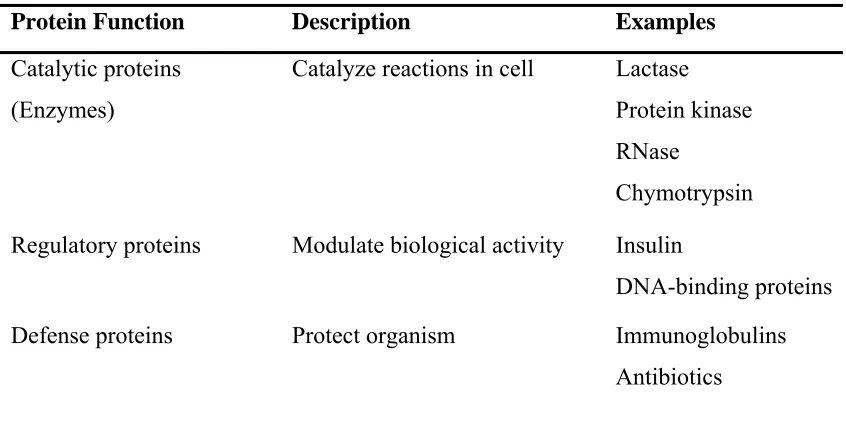
Proteins can bind to other proteins as well as to small-molecule substrates. When proteins bind specifically to other copies of the same molecule, they can oligomerize to form fibrils. Protein-protein interactions also regulate enzymatic activity, control progression through the cell cycle, and allow the assembly of large protein complexes that carry out many closely related reactions with a common biological function. Proteins can also bind to, or even be integrated into, cell membranes. The ability of binding partners to induce conformational changes in proteins allows the construction of enormously complex signaling networks. Table 2.3 summarizes the different proteomic functions. The following paragraphs describe some of these functions briefly.
Table 2.3: Proteins functions.
Protein Function Description Examples
Catalytic proteins (Enzymes)
Catalyze reactions in cell Lactase Protein kinase RNase
Chymotrypsin
Regulatory proteins Modulate biological activity Insulin
DNA-binding proteins
Defense proteins Protect organism Immunoglobulins
Transport proteins Bind and carry specific molecules or ions
Hemoglobin
Structural Proteins Support or strengthen biological structures
Collagen–tendon Cartilage
Leather
Nutrient/Storage proteins Source of amino acids Ovalbumin–egg white Casein–milk
The best-known function or role of proteins in the cell is their duty as enzymes, which catalyze chemical reactions. Enzymes are usually highly specific catalysts that accelerate only one or a few chemical reactions. Enzymes affect most of the reactions involved in metabolism and catabolism as well as DNA replication, DNA repair, and RNA synthesis. Some enzymes act on other proteins to add or remove chemical groups in a process known as post-translational modification. About 4,000 reactions are known to be catalyzed by enzymes (Bairoch, 2000).
Many proteins are involved in the process of cell signaling and signal
transduction. Some proteins, such as insulin, are extra-cellular proteins that transmit a signal from the cell in which they were synthesized to other cells in distant tissues. Others are membrane proteins that act as receptors whose main function is to bind a signaling molecule and induce a biochemical response in the cell.
Many ligand transport proteins bind particular small biomolecules and transport them to other locations in the body of a multicellular organism. These proteins must have a high binding affinity when their ligand is present in high concentrations but must also release the ligand when it is present at low
concentrations in the target tissues. The canonical example of a ligand-binding protein is haemoglobin, which transports oxygen from the lungs to other organs and tissues in all vertebrates and has close homologs in every biological kingdom.
Structural proteins confer stiffness and rigidity to otherwise fluid biological components. Most structural proteins are fibrous proteins; for example, actin and tubulin are globular and soluble as monomers but polymerize to form long, stiff fibers that comprise the cytoskeleton, which allows the cell to maintain its shape and size. Collagen and elastin are critical components of connective tissue such as cartilage, and keratin is found in hard or filamentous structures such as hair, nails, feathers, hooves, and some animal shells.
2.6 Protein-Protein Interactions
Protein-protein interactions refer to the association of protein molecules and the study of these associations from the perspective of biochemistry, signal
transduction and networks. Proteins might interact for a long time to form part of a protein complex or a protein may interact briefly with another protein just to modify it (for example, a protein kinase will add a phosphate to a target protein).
Protein-protein interactions are essential to virtually every cellular process (Phizicky and Fields, 1995). For example, signals from the exterior of a cell are mediated to the inside of that cell by protein-protein interactions of the signaling molecules. This process, called signal transduction, plays a fundamental role in many biological processes and in many diseases (e.g. cancer).
(Bork et al., 2004). An interaction map of the yeast proteome assembled from
published interactions is shown in Figure 2.3. The map contains 1,548 proteins (boxes) and 2,358 interactions (connecting lines) (Schwikowski et al., 2000).
It is also estimated that even simple single-celled organisms such as yeast have their roughly 6000 proteins interact by at least 3 interactions per protein, i.e. a total of 20,000 interactions or more. By extrapolation, there may be on the order of ~100,000 interactions in the human body.
Figure 2.3: The protein-protein interaction network in yeast (Schwikowski et al.,
Any listing of major research topics in biology - for example, DNA replication, transcription, translation, splicing, secretion, cell cycle control, signal transduction, and intermediary metabolism - is also a listing of processes in which protein complexes have been implicated as essential components (Phizicky and Fields, 1995). Figure 2.4 shows Ribosomes or RNA polymerases as an example for protein-protein interactions in a multi-protein complex. The schematic interaction diagram for the 10 subunits in RNA polymerases complex is shown in Figure 2.4 (b).
(a) (b)
Figure 2.4: (a) Large protein complex and its protein-protein interactions.
(b) The schematic interaction (Cramer et al., 2001).
Protein-protein interactions can be classified based on the proteins involved (structural or functional groups) or based on their physical properties (weak and transient vs. strong and permanent). Protein interactions are usually mediated by defined domains. Hence interactions can also be classified based on the underlying domains.
Protein-protein interaction prediction is a field combining computational techniques and structural biology in an attempt to identify and catalog interactions between pairs or groups of proteins.
Forces that mediate protein-protein interactions include electrostatic
interactions, hydrogen bonds, the van der Waals attraction and hydrophobic effects. The average protein-protein interface is not less polar or more hydrophobic than the surface remaining in contact with the solvent. Water is usually excluded from the contact region. Non-obligate complexes tend to be more hydrophilic in comparison, as each component has to exist independently in the cell.
It has been proposed that hydrophobic forces drive protein-protein
interactions and hydrogen bonds and salt bridges confer specificity (Young et al.,
1994). Van der Waals interactions occur between all neighbouring atoms, but these interactions at the interface are no more energetically favorable than those made with the solvent. However, they are more numerous, as the tightly packed interfaces are denser than the solvent and hence they contribute to the binding energy of
association.
Hydrogen bonds between protein molecules are more favourable than those made with water. Interfaces in permanent associations tend to have fewer hydrogen bonds than interfaces in non-obligate associations. Interfaces have been shown to be more hydrophobic than the exterior but less hydrophobic than the interior of a protein. Permanent complexes have interfaces that contain hydrophobic residues, whilst the interfaces in non-obligate complexes favour the more polar residues (Koike and Takagi, 2003).
Most of the interactions data have been identified by high-throughput technologies like the yeast two-hybrid system, which are known to yield many false positives (Kim et al., 2002). In addition, in vivo experiments that identify
2.7 Summary
In this chapter, various concepts in molecular biology have been presented. This is essential to facilitate better understanding of the research discussed in this thesis. In conclusion, protein-protein interactions are of central importance for virtually every process in a living cell. Information about these interactions improves our understanding of diseases and can provide the basis for new therapeutic
CHAPTER 3
LITERATURE REVIEW
Related research in the field of computational prediction of protein-protein interactions is presented in this chapter. This chapter begins by reviewing several approaches to protein function prediction and its relation to protein-protein
interactions. After that it describes the experimental techniques that are being used to determine and identify protein-protein interactions and highlights the need for
computational approaches. Then it reviews the research that has been done to computationally predict protein-protein interactions. At the end, a summary of the literature review is presented.
3.1 Protein Function Prediction
The field of bioinformatics has arisen in parallel with the development of automated high throughput methods of biological and biochemical discovery that yield a variety of forms of experimental data, such as DNA sequences, gene expression patterns, and chemical structures. One of the major challenging tasks in bioinformatics is to infer and predict the function of the newly discovered proteins.
associated with many mutually overlapping levels: biochemical, cellular, organism mediated, developmental, and physiological. Thus, the determination of protein functions is a complex problem in bioinformatics research. The sequencing of entire genomes has moved the attention from the study of single proteins or small
complexes to that of the entire proteome (Hodgman, 2000).
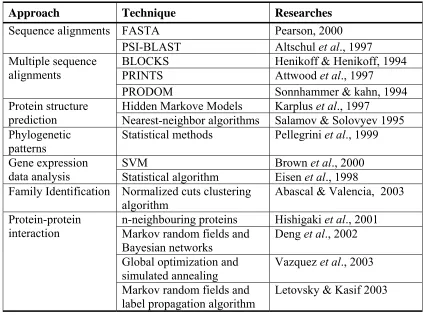
One of the most fundamental tools in the field of bioinformatics is sequence alignment. By aligning sequences to one another, it is possible to evaluate how similar the sequences are and identify conserved regions in sets of related sequences. This is used extensively to assign function to genes in newly sequenced genomes. Although, most methods annotating protein function utilise sequence homology to proteins of experimentally known function, such a homology-based annotation transfer is problematic and limited in scope. Therefore, researchers have begun to develop different methods that predict protein function, including phylogenetic patterns, gene expression, and protein-protein interactions. Figure 3.1 shows different approaches to infer and predict protein function.
Protein Sequence
Protein Structure Wet Lab
Protein Interactions Protein Homology
Protein Function
Phylogenetic patterns
Gene expression
The Yeast Protein Database (YPD) lists 6281 proteins with 3854 being annotated, assigned to some cellular roles, and 2427 being unannotated (Costanzo et al., 2001). A challenging task that lies ahead is to find the functional roles of these unannotated proteins. Several research groups have developed methods for
functional annotation. The classical way is to find homologies between a protein and other proteins in protein databases using programs such as FASTA (Pearson, 2000) and PSI-BLAST (Altschul et al., 1997), and then predict functions based on
sequence homologies. Besides, functional predictions have been modeled as pattern recognition problems based on sequence homologies and structural information (King et al., 2001) as well as phenotype data (Clare and King, 2002).
When function cannot be inferred based on sequences similarity, one must rely on true ab initio prediction methods. It is a generally accepted paradigm that the function of a protein is determined by its three-dimensional structure, and that the structure is determined by the sequence of the protein. Given this paradigm, it would be logical to think that ab initio function prediction could be done by first predicting the structure of the protein, and subsequently predict the function from the structure. However, both steps in this approach are likely to be very difficult to solve.
Knowing the structure of a protein does not mean that it is necessarily possible to figure out what the protein does, even though it is of course a big help (Norin and Sundstrom, 2002). This is because the function of a protein depends on its cellular context. Also, post-translational modifications can profoundly alter the function (and structure) of a protein. Predicting the function of a protein from its structure may therefore very well turn out to be as difficult as the protein folding problem.
However, since proteins collaborate or interact with one another for a
unannotated protein. For a given function, if most of the neighbors of a protein have the function, it is more likely to be believed that the protein have the same function.
It should be noted that the interaction partners for a protein may belong to different functional categories. It is this complex network of within function and cross-function interactions that makes the problem of functional assignments a difficult task. Methods based on frequencies of interaction partners having certain functions of interest (Schwikowski et al., 2000) and on χ2-statistics (Hishigaki et al., 2001) have been applied to assign functions to unannotated proteins.
Schwikowski et al. (2000) proposed to infer the functions of an unannotated protein based on the frequencies of its neighbors having certain functions. They assign k functions to the unannotated protein with the k largest frequencies in its neighbors. This approach will be referred as the neighboring counting method. This approach does not consider the frequency of the proteins having a function among all the proteins. If a function is more common than other functions among all the
proteins, the probability that an unannotated protein has this function should be higher than the probability that it has other functions even if the protein does not have interaction partners.
Hishigaki et al. (2001) developed another method to infer protein functions based on χ2-statistics. For a protein Pi, let ni(j) be the number of proteins interacting
with Piand having function Fj. Let ei(j) = #Nei(i) ×πjbe the expected number of
proteins in Nei(i) having function Fj, where #Nei(i) is the number of proteins in
Nei(i). Define
. ) ( )) ( ) ( ( ) ( 2 j e j e j n j S i i i i − = (3.1)
For a fixed k, they assign an unannotated protein with k functions having the top k χ2-statistics. Although this approach takes the frequency of the proteins having a function into consideration, ni(j) is generally small and the applicability of the χ
Another approach has been developed by Deng et al. (2002) in which they apply the theory of Markov random fields to infer a protein’s functions using protein-protein interaction data and the functional annotations of its interaction protein-protein partners. For each function of interest and a protein, they predict the probability that the protein has that function using Bayesian approaches. Unlike in other available approaches for protein annotation where a protein has or does not have a function of interest, they give a probability for having the function. This probability indicates how certain it can be believed about the prediction.
Recently, Letovsky and Kasif (2003) applied a method of assigning functions based on a probabilistic analysis of graph neighborhoods in a protein-protein
interaction network. The method exploits the fact that graph neighbors are more likely to share functions than nodes which are not neighbors. A binomial model of local neighbor function labeling probability is combined with a Markov random field propagation algorithm to assign function probabilities for proteins in the network. The method has been applied on a protein-protein interaction dataset for the yeast Saccharomyces cerevisiae using the Gene Ontology (GO) terms as function labels. The method reconstructed known GO term assignments with high precision, and produced putative GO assignments to 320 proteins that currently lack GO annotation, which represents about 10% of the unlabeled proteins in Saccharomyces cerevisiae.
The previous approaches to infer the unknown function of a class of proteins have exploited sequence similarities or clustering of co-regulated genes (Harrington
et al., 2000), phylogenetic profiles (Pellegrini et al.,1999), protein-protein
interactions (Uetz et al., 2000; Ito et al., 2000; Schwikowski et al.,2000; Deng et al., 2002), and protein complexes (Gavin et al., 2002; Ho et al., 2002). Table 3.1
summarizes different approaches and techniques to infer and predict protein function.
Table 3.1: Computational methods for protein function prediction.
Approach Technique Researches
FASTA Pearson, 2000
Sequence alignments
PSI-BLAST Altschul et al., 1997
BLOCKS Henikoff & Henikoff, 1994
PRINTS Attwood et al., 1997
Multiple sequence alignments
PRODOM Sonnhammer & kahn, 1994
Hidden Markove Models Karplus et al., 1997 Protein structure
prediction Nearest-neighbor algorithms Salamov & Solovyev 1995 Phylogenetic
patterns
Statistical methods Pellegrini et al., 1999
SVM Brown et al., 2000
Gene expression
data analysis Statistical algorithm Eisen et al., 1998 Family Identification Normalized cuts clustering
algorithm
Abascal & Valencia, 2003
n-neighbouring proteins Hishigaki et al., 2001 Markov random fields and
Bayesian networks
Deng et al., 2002
Global optimization and simulated annealing
Vazquez et al., 2003 Protein-protein
interaction
Markov random fields and label propagation algorithm
Letovsky & Kasif 2003
3.2 Methods to study protein-protein interactions
implications in a number of neurological disorders such as Creutzfeld-Jacob and Alzheimer's disease.
Because of their importance in cell development and disease, protein-protein interactions have gained a lot of attention among researchers for many years. It has emerged from these studies that there is a strategy of mixing and matching of domains that specify particular classes of protein-protein interactions. There are a large number of methods to detect protein-protein interactions. Each of the approaches has its own strengths and weaknesses, especially with regard to the sensitivity and specificity of the method. A high sensitivity means that many of the interactions that occur in reality are detected by the method. A high specificity indicates that most of the interactions detected by the screen are also occurring in reality.
Co-immunoprecipitation is considered to be the gold standard assay for protein-protein interactions, especially when it is performed with endogenous (not overexpressed and not tagged) proteins (Gharakhanian et al., 1988). The protein of interest is isolated with a specific antibody. Interaction partners which stick to this protein are subsequently identified by western blotting. Interactions detected by this approach are considered to be real. However, this method can only verify
interactions between suspected interaction partners. Thus, it is not a screening approach to identify unknown protein-protein interactions.
The yeast two-hybrid screen investigates the interaction between artificial fusion proteins inside the nucleus of yeast (Bartel and Fields, 1997). This approach can identify binding partners of a protein in an unbiased manner. However, this method suffers from high false-positive rate which makes it necessary to verify the identified interactions by co-immunoprecipitation.
detect physical protein-protein interactions that exist in different cellular
environment. This is especially important when studying the interaction network in the organism’s genome which becomes very significant in the post-genomic era.
Quantitative immunoprecipitation combined with knock-down (QUICK) relies on co-immunoprecipitation, quantitative mass spectrometry (SILAC) and RNA interference (RNAi). This method detects interactions among endogenous non-tagged proteins (Selbach and Mann, 2006). Thus, it has the same high confidence as co-immunoprecipitation. However, this method also depends on the availability of suitable antibodies.
Dual Polarisation Interferometry (DPI) is a method that can be used to measure protein-protein interactions. DPI provides real-time, high-resolution
measurements of molecular size, density and mass. However this method can not be used to detect new protein-protein interactions.
3.3 Predicting Protein-Protein Interactions
Protein-protein interactions play a crucial role in protein function. Hence, the ability to computationally recognize protein interaction sites and to identify specific interface residues that contribute to the specificity and affinity of protein interactions has important implications in a wide range of clinical and industrial applications.
Table 3.2: High-throughput experimental approaches to the determination of
protein-protein interactions.
Method References Features
Uetz et al., 2000
Ito et al., 2000
Newman et al., 2000
The first comprehensive studies in yeast
Boulton et al., 2002 Yeast two-hybrid
Walhout et al., 2002
Combined analysis of yeast two-hybrid interactions together with phenotype and expression data
Affinity
purification/mass
Ho et al., 2002 Purification of overexpressed, epitope-tagged proteins in yeast
spectrometric identification
Gavin et al., 2002 TAP purification of complexes expressed at physiological levels in yeast
Protein chips Zhu et al., 2001 High-throughput detection of interactions with proteins over-expressed and immobilized on
microscope slides to form a proteome microarray
Synthetic lethals Tong et al., 2001 High-throughput identification of synthetic lethal double mutants. Synthetic lethal mutants often correspond to physically interacting protein pairs.
High-throughput experimental techniques enable the study of protein-protein interactions at the proteome scale through systematic identification of physical interactions among all proteins in an organism. High-throughput protein-protein interaction data, with ever-increasing volume, are becoming the foundation for new biological discoveries.
A great challenge to bioinformatics is to manage, analyze, and model these data. Comparison between experimental techniques shows that each high-throughput technique such as yeast two-hybrid assay or protein complex identification through mass spectrometry has its limitations in detecting certain types of interactions and they are complementary to each other. Moreover the overlap between these high-throughput experiments is very small as shown in Figure 3.2.
Figure 3.2: The overlap between different high-throughput experiments.
the function of proteins with three or more partners can be more accurately predicted than with information about one partner.
It is also important to note that computational methods that use protein sequences, domain and structure information to predict protein-protein interaction can expand the scope of experimental data and increase the confidence of certain protein-protein interaction pairs.
Protein-protein interaction data correlate with other types of data, including protein function, subcellular location, and gene expression profile. Highly connected proteins are more likely to be essential based on the analyses of the global
architecture of large-scale interaction network in yeast. The use of protein-protein interaction networks, preferably in conjunction with other types of data, allows assignment of cellular functions to novel proteins and derivation of new biological pathways.
Table 3.3: Computational methods for protein-protein interactions prediction.
Approach Technique References
Identifying interacting
sequence motif pairs. Statistical Method Wojcik & Schachter, 2001
Co-occurrence of sequence domains.
Probabilistic model Deng et al., 2002
Gene fusion Rosetta stone Marcotte et al., 2000
Threading-based interaction energy evaluation.
Statistical methods Lu et al., 2002
Phylogenetic profile
method. Statistical methods Pellegrini Craig and Liao, 2007 et al., 1999
Gene Ontology Semantic similarity
search
Wu et al., 2006
Ofran & Rost, 2003 SVM
Koike & Takagi, 2003 Identification of Surface
residues
Statistical Method Gallet et al., 2000
Bock & Gough, 2001
Dohkan et al., 2003
Ben-Hur & Noble, 2005 SVM
Dohkan et al., 2006
SVM +
Attraction-repulsion model Gomez et al., 2003 Bayesian Networks Jansen et al., 2003
Lin et al., 2004 Primary structure based
prediction
Prediction of interaction sites in proteins of known structure usually focuses on the location of hydrophobic surface clusters on proteins. In one study, this method predicted the correct interaction site in 25 out of 29 cases (Zhou and Shan, 2001). Other methods include solvation potential, residue interface propensity,
hydrophobicity, planarity, protrusion, and accessible surface area. Among a test set of 28 homodimers, the known interface site was found to be amongst the most planar, protruding, and accessible patches, and amongst the patches with highest interface propensity. Nevertheless, one of the algorithms (PATCH) that uses multiple parameters predicted the location of interface sites in known complexes only for 66% of the structures.
Based on the idea that domains mediate the interactions between proteins, Ng
et al. (2003) collected data from three data sources to develop the database of interacting domains (InterDom). The first one is the experimentally derived protein interaction data from the Database of Interacting Proteins (DIP) (Xenarios et al., 2002). The second source is the intermolecular relationship data from protein
complexes and the last one is the computationally predicted data from Rosetta Stone sequences. Then they infer putative domain-domain interaction based on the
collected data. This is very helpful when inferring protein-protein interactions for proteins partners that have domain structure.
Another approach is to predict protein-protein interactions from genome sequences. Several attempts have been made to achieve that. The major methods are:
• Phylogenetic profiles: Some protein pairs are evolutionarily maintained together in many different organisms. It has been concluded that such “co-evolving” proteins are associated either functionally or even physically, i.e. by a protein-protein interactions (Marcotte et al., 2000). While the latter is not always true, it has been found to be true in a number of cases, such as the yeast proteins Hog1 and Fus3. Also the phylogenetic species tree of the reference genomes can be used as a guide tree for hierarchical clustering of the orthologous proteins (Craig and Liao, 2007). They have shown that the phylogenetic tree can be used as a guide to extract intra-matrix correlations in the distance matrices of orthologous proteins, where these correlations are represented as intermediate distance matrices of the ancestral orthologous proteins.
By measuring the similarity between two Gene Ontology (GO) terms with a relative specificity semantic relation, Wu et al., (2006) proposed a method of
reconstructing a yeast protein–protein interaction map that is solely based on the GO annotations. The method was validated using high-quality interaction datasets for its effectiveness. Based on a Z-score analysis, a positive dataset and a negative dataset for protein–protein interactions were derived. This analysis could be efficient on predicting functional protein-protein interactions based on the GO terms similarity. However, it could suffer from high rate of false positive since many protein share similar function but are not physically interacting.
Deng et al. (2002) proposed a probabilistic prediction model for inferring domain interactions from protein interaction data. The maximum likelihood
estimation technique is mainly used in their method. The PFAM database is used to extract domain information and the MIPS database is used to test their model, but they also take single domain pair as a basic unit of protein interactions. The approach taken by Kim et al. (2002) shares this assumption with Deng et al., but they both suffer from the low sensitivity and specificity of the predictions.
Also looking only at the sequence information of proteins, Goffard et al. (2003) developed IPPRED, a web based server for the inference of proteins interactions. IPPRED infers the possibility of the interaction of the two proteins A and B by looking if there is an interacting protein pair C and D which are
homologous to A and B (or B and A).
It has been suggested that protein domains mediate protein-protein
interactions. Riley et al., (2005) describe domain pair exclusion analysis (DPEA), a method for inferring domain interactions from databases of interacting proteins. DPEA features a log odds score, Eij, reflecting confidence that domains i and j
interact. They analyzed 177,233 potential domain interactions underlying 26,032 protein interactions. In total, 3,005 high-confidence domain interactions were inferred, and were evaluated using known domain interactions in the Protein Data Bank. DPEA could be useful in guiding experiment-based discovery of previously unrecognized domain interactions.
However, DPEA detects only the domain interactions best supported by multiple observed protein interactions. Hence, it is expected to suffer from low sensitivity and high specificity in the prediction results. DPEA's sensitivity may be impaired by the high rate of false negatives in existing interaction datasets,
70%, implying that roughly 2/3 of the high-confidence domain interactions inferred by DPEA are true positives; the remaining 1/3 are likely false positives.
Based on the currently available protein-protein interaction and domain data, (Huang et al., 2007) described Maximum Specificity Set Cover (MSSC) method for the prediction of protein-protein interactions. In this approach, they mapped the relationship between interactions of proteins and their corresponding domain architectures to a generalized weighted set cover problem. The application of a greedy algorithm provides sets of domain interactions which explain the presence of protein interactions to the largest degree of specificity.
Utilizing domain and protein interaction data of S. cerevisiae, MSSC enables prediction of previously unknown protein interactions, links that are well supported by a high tendency of coexpression and functional homogeneity of the corresponding proteins. Focusing on concrete examples, they showed that MSSC reliably predicts protein interactions in well-studied molecular systems, such as the 26S proteasome and RNA polymerase II of S. cerevisiae.
However, MSSC algorithm only allows predictions between proteins with well-known domain structure as well as known interactions among the respective domains. In this approach, other sequence information is not included but only inferring potential domain interactions by counting the occurrence of all possible domain pairs that the domain structure of interacting proteins. This implies a method that risks an elevated level of noise in the determination of potential domain
interactions. Accordingly, the error proneness of protein interactions in the respective training sets is another source of potential noise, impacting the quality of predictions.
al., 2003). The use of SVM for predicting protein-protein interactions will be discussed in the next section.
3.4 Support Vector Machines
The Support Vector Machine (SVM) is a binary classification algorithm. As such it is well suited for the task of discriminating between interacting and non-interacting protein pairs. SVMs have demonstrated high classification ability in the field of prediction of protein-protein interaction, functional classification of proteins, protein fold recognition, and prediction of subcellular location. SVMs have
previously been used in the prediction of protein-protein interaction (Bock and Gough, 2001) (Dohkanet al., 2003) (Koikeet al., 2003) (Chung et al., 2004).
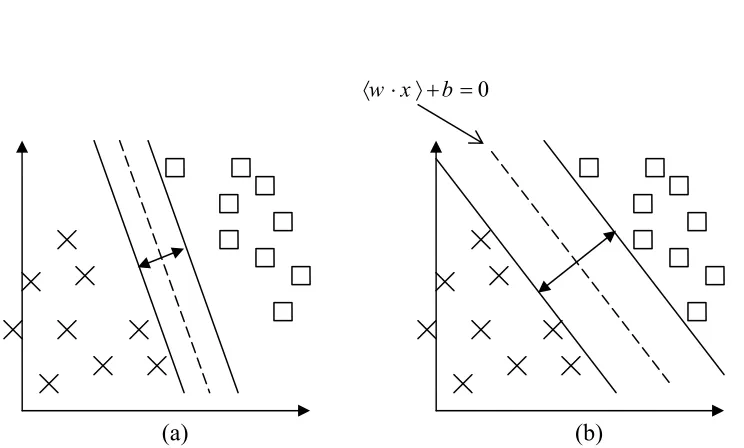
The SVM is based on the idea of constructing the maximal margin
hyperplane in the feature space (Vapnik, 1995). Suppose we have a set of labeled training data {xi, yi}, i = 1,…, n, yi∈{1,-1}, xi∈ Rd, and have the separating
hyperplane (w . x) + b = 0, where feature vector: x∈ Rd, w∈ Rd and b∈ R. In the
linear separable case the SVM simply looks for the separating hyperplane that maximizes the margin by minimizing ||w||2/2 subject to the following constraint:
yi(w .xi + b) ≥ 1 ∀i (2.2)
In the linear non-separable case, the optimal separating hyperplane can be
found by introducing slack variables ξi, i = 1,…, n and user-adjustable parameter C
and then minimizing ||w||2/ 2 + CΣiξi , subject to the following constraints:
yi(w .xi + b) ≥ 1 - ξi
ξi≥ 0 ∀i=1,...,n. (2.3)
The dual optimization is solved here by introducing the Lagrange multipliers
many cases, we can substitute Φ(xi) for each example xiand use the kernel function K(xi,xj) such that Φ(xi).Φ(xj). We thus get the following optimization problem:
) , ( 2 1 max 1 ,
1 j i j i j
n j i i n i i x x K y y α α α
α
∑
= −∑
= (2.4)subject to 0≤αi ≤C, i=1,...,n.
and 0 (2.5)
1 =
∑
= i n i iy αSVM has the following advantages to process biological data (Bock and Gough, 2001): (1) SVM is computationally efficient and it is characterized by fast training which is essential for high-throughput screening of large protein datasets. (2) SVM is readily adaptable to new data, allowing for continuous model updates in parallel with the continuing growth of biological databases. (3) SVM provides a principled means to estimate generalization performance via an analytic upper bound on the generalization error. This means that a confidence level may be assigned to the prediction, and avoids problems with overfitting inherent in neural network function approximation.
candidate proteins to those exceeding a prescribed threshold probability of interaction.
In a recent paper, Dohkan et al. (2003) have proposed a new method to predict protein-protein interactions using Support Vector Machines. In their method, multiple domain effects and the physicochemical features can be considered all at once. They mentioned that the prediction accuracy was clearly improved by adding protein features such as amino acid composition and/or localization. Furthermore, consideration of combined features domain, amino acid composition, and subcellular localization resulted in the best prediction performance: an F-measure of 79%. The present predictions seem to be more accurate than those reported previously.
Moreover they applied their method to the unknown protein pairs, and fount that high scoring protein pairs were likely to have similar GO annotations. These results indicate that the present method is useful inferring likely interactions between unknown protein pairs and/or detect reliable protein interaction from high-throughput data. Further, the similar GO annotation tendencies indicate the possibility of that the biological function may be predicted by the prediction of protein interaction pairs. They also evaluated the effects of using only the physicochemical features on the prediction of protein-protein interactions. They retrained the SVM without using domain information. The results imply that only the use of these physicochemical properties is not sufficient to predict interactions accurately, and domain information is quite informative.
3.5 Bayesian Networks