Research Article
A Biogeography-Based Optimization Algorithm Hybridized with
Tabu Search for the Quadratic Assignment Problem
Wee Loon Lim,
1Antoni Wibowo,
2Mohammad Ishak Desa,
3and Habibollah Haron
11Faculty of Computing, Universiti Teknologi Malaysia (UTM), 81310 Johor Bahru, Johor, Malaysia
2School of Quantitative Sciences, UUM College of Arts and Sciences, Universiti Utara Malaysia, 06010 Sintok, Kedah, Malaysia 3Faculty of Information and Communication Technology, Universiti Teknikal Malaysia Melaka, Hang Tuah Jaya,
76100 Durian Tunggal, Melaka, Malaysia
Correspondence should be addressed to Wee Loon Lim; [email protected]
Received 13 August 2015; Accepted 25 October 2015
Academic Editor: Ezequiel L´opez-Rubio
Copyright © 2016 Wee Loon Lim et al. This is an open access article distributed under the Creative Commons Attribution License, which permits unrestricted use, distribution, and reproduction in any medium, provided the original work is properly cited.
The quadratic assignment problem (QAP) is an NP-hard combinatorial optimization problem with a wide variety of applications. Biogeography-based optimization (BBO), a relatively new optimization technique based on the biogeography concept, uses the idea of migration strategy of species to derive algorithm for solving optimization problems. It has been shown that BBO provides performance on a par with other optimization methods. A classical BBO algorithm employs the mutation operator as its diversification strategy. However, this process will often ruin the quality of solutions in QAP. In this paper, we propose a hybrid technique to overcome the weakness of classical BBO algorithm to solve QAP, by replacing the mutation operator with a tabu search procedure. Our experiments using the benchmark instances from QAPLIB show that the proposed hybrid method is able to find good solutions for them within reasonable computational times. Out of 61 benchmark instances tested, the proposed method is able to obtain the best known solutions for 57 of them.
1. Introduction
The quadratic assignment problem (QAP) belongs to the class of combinatorial optimization. This problem concerns assigning a number of facilities to the same number of locations, with the objective to find a way of assignment such that the total cost involved is minimized. The total cost of the QAP is the product of flow and distances between the facilities.
Sahni and Gonzalez [1] have shown that QAP is NP-hard. Therefore, unless P = NP, it is impossible to find optimal solutions in polynomial time. The complexity of QAP draws the interest of researchers worldwide over the past few decades. More than 300 papers have been published for the theory, applications, and solution techniques for the QAP [2]. Despite the extensive research done, QAP remains one of the most difficult combinatorial optimization problems. Generally, QAP instances with problem size>30 cannot be solved within reasonable computational times. In
the literature, a lot of heuristic approaches to the QAP have been proposed. Some of the common methods are simulated annealing, tabu search (TS), genetic algorithm (GA), and ant colony optimization [3–10].
Among the exact methods for QAP, branch and bound (BB) algorithm is the most efficient [11, 12]. Currently, the largest instance solved by BB algorithm is of size 36 [4]. Solving QAP instances of size 20 was impossible before 1990s. It was until 1994 when Mautor and Roucairol [13] gave the exact solutions for nug16 and els19. The BB algorithm of Brixius and Anstreicher [14] solved the nug25 instance after 13 days of CPU time using sequential processing. The kra30a was solved by Hahn and Krarup [15] after 99 days of work with a sequential workstation. Nystrom [16] provided the exact solutions for the ste36b and ste36c after 200 days of work using a distributed environment. The nug30 remained unsolved until 2002 when Anstreicher et al. [17] reported the exact solution with seven days of work using 650 processors. Basically, the exact methods require much
more computational resources and time than the heuristic algorithms. This is the reason we did not use exact methods in this study.
The QAP has a wide variety in the real-world applications with facility layout problem being the most popular applied area. These include campus planning, backboard wiring, hospital planning, zoning in a forest, and the placement of electronic components. Besides, the QAP is also used for typewriter keyboard design, development of control boards, turbine runner problem, ranking of archaeology data, scheduling of production lines analysis of chemical reactions, data analysis, economic problems, VLSI circuit and system design, website structure, and optimizing of Arabic keyboard design. Comprehensive review of QAP can be referred to in [2, 18].
Biogeography is a study of the geographical distribution of biological organisms. The science of biogeography can be referred to in the work of two naturalists in the nine-teenth century named Wallace [19] and Darwin [20]. In the 1960s, MacArthur and Wilson [21] started to work on mathematical models of biogeography. Their study focused on the distribution of species among neighboring habitats and how species migrate from one habitat to another. How-ever, it was until 2008 when Simon [22] presented a new optimization method based on it, namely, biogeography-based optimization (BBO). In his work, Simon applied BBO to the problem of sensor selection for aircraft engine health estimation and the performance of BBO is at a par with other population-based methods such as ant colony optimization, differential evolution, GA, and particle swarm optimization (PSO). The good performance of BBO on the sensor selection problem proves that it can be successfully applied to practical problems.
In his next paper, Simon [23] showed that BBO outper-forms GA when both of them have a low mutation rate. Furthermore, BBO has shown a good performance when being applied to real-world optimization problems such as classification of satellite images, groundwater detection, and the solving of complex economic load dispatch [24–26].
The good performance of BBO on complex optimization problems inspired us to apply this iterative and population-based method to QAP. A classical BBO algorithm uses migration and mutation operators as its intensification and diversification strategy, respectively. During the iterated pro-cess of BBO algorithm, migration operator tends to improve every solution within the population while mutation operator increases the diversity among them. However, quite often the mutation operator will ruin the quality of solutions.
In order to overcome the weakness of mutation operator, we propose to replace it with a tabu search procedure. TS is a heuristic procedure for solving the optimization problems. A typical TS starts with defining a neighborhood, in which a given solution may move to and produce a new one. TS will evaluate each of the neighboring solutions and choose the move that improves the objective function the most. If there is no improving move, TS will choose one that weakens the objective function the least. The main difference of TS from other local search techniques is that it will use memory to store the recent moves. These moves are then forbidden
and thus avoiding the search procedure to return to the local optimum just visited.
The characteristics of TS described above make it a suitable replacement for the mutation operator of classical BBO. Not only the diversity of the population is maintained but at the same time it prevents the quality of solutions within the population from being ruined. We choose to incorporate the robust tabu search (RTS) of Taillard [27] into our BBO algorithm for QAP because it is efficient and requires fewer parameters in its implementation.
In this paper, we propose a BBO algorithm hybridized with tabu search (BBOTS) for QAP. We apply it to the benchmark instances obtained from QAPLIB [28] with size ranging from 12 to 80. The experimental results demonstrate that the proposed algorithm outperforms the classical BBO algorithm with mutation operator. Our hybrid algorithm is able to solve most of the benchmark instances of QAP tested.
2. Problem Definition
The QAP is an assignment model in which a set of facilities is supposed to be allocated to a set of locations, with each location having exactly one facility. The objective is to find a way of assignment such that the total cost involved is minimized. The total cost is calculated by multiplying the flow and the distances between facilities.
Let𝑛be the number of facilities and locations, given two
𝑛 × 𝑛matrices as follows:
𝐹 = (𝑓𝑖𝑘), where𝑓𝑖𝑘is the flow from facility𝑖to facility
𝑘;
𝐷 = (𝑑𝑗𝑙), where𝑑𝑗𝑙is the distance from location𝑗to
location𝑙.
The Koopmans-Beckmann [29] form of the QAP can be formulated as follows:
min
𝜑∈𝑆𝑛[ 𝑛
∑
𝑖=1 𝑛
∑
𝑘=1
𝑓𝑖𝑘𝑑𝜑(𝑖)𝜑(𝑘)] , (1)
where 𝑆𝑛 is the set of all permutations of the integers
1, 2, . . . , 𝑛. Each product of𝑓𝑖𝑘𝑑𝜑(𝑖)𝜑(𝑘)is the cost for assigning
facility 𝑖 to location 𝜑(𝑖) and facility 𝑘 to location 𝜑(𝑘). There are several ways in mathematics to represent an assignment. Throughout this paper, we use the representation of assignment by permutation.
3. Methods
In this section, we will first introduce BBO as general. This includes explaining the terminology used and its differ-ence with another popular population-based optimization method, the GA. Next, we will explain the proposed algo-rithm in detail. We developed two BBO algoalgo-rithms for QAP:
(i) a classical BBO algorithm with mutation operator,
Computational experiments were carried out to show the difference in performance between them. Note that the implementation of both algorithms is identical, except for the mutation step. Therefore, all the other steps of the algorithms are explained only once.
3.1. Biogeography-Based Optimization. BBO is a new algo-rithm inspired by biogeography, which studies the geograph-ical distribution of biologgeograph-ical organisms. MacArthur and Wilson [21] worked together on the mathematical models of biogeography in the 1960s. They focused primarily on the distribution of species among neighboring habitats and how species migrate from one habitat to another. Since then, biogeography has become a major area of research. However, it was until 2008 when Simon [22] generalized it to obtain a general-purpose optimization algorithm.
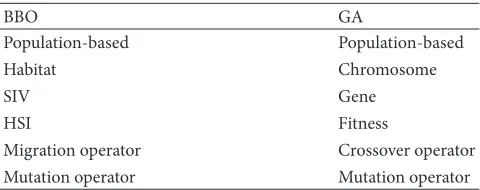
Just like other biology-based algorithms, for example, GA and PSO, BBO is a population-based algorithm in which a population of candidate solutions is used in the searching procedure for global optima. BBO has certain common features with another popular optimization algorithm, the GA. In GA, an individual within the population is called a chromosome and has its own fitness value. Likewise in BBO, each individual is termed as a habitat and has its habitat suitability index (HSI) to evaluate its quality as a solution. Since we are dealing with a minimization problem, a low-HSI habitat represents a good solution and a high-HSI habitat is a poor solution instead. Each chromosome in GA consists of genes, while, for BBO, each habitat is characterized by Suitability Index Variables (SIVs). There are two main oper-ators in GA, which are crossover and mutation. Meanwhile, in BBO, the main operators are migration and mutation. The migration operator consists of emigration and immigration. It is used to improve and evolve the habitats (solutions to the optimization problem) in the population. Solution features (SIVs) emigrate from low-HSI habitats (emigrating habitats) to high-HSI habitats (immigrating habitats). In other words, high-HSI habitats accept new features from low-HSI habitats through the immigration process. There are different alternatives for migration and mutation process of BBO. The way we implement these two operators are explained in detail in the later part. Table 1 compares the characteristics of BBO and GA.
The classical BBO algorithm proposed by Simon [22] can be described with the algorithm in the following.
A Classical BBO Algorithm
(1) Initialize the BBO parameters (this includes deriving a representation scheme for habitats, which is prob-lems dependent, and also initializing the maximum migration rate, maximum mutation rate, and elitism parameter).
(2) Initialize a random set of habitats, corresponding to the potential solutions.
(3) Associate each habitat with immigration and emigra-tion rate based on their HSI.
Table 1: Comparison of characteristics for BBO and GA.
BBO GA
Population-based Population-based
Habitat Chromosome
SIV Gene
HSI Fitness
Migration operator Crossover operator
Mutation operator Mutation operator
(4) Probabilistically perform migration to modify each one-elite habitat. Then, recompute each HSI.
(5) Associate each habitat with mutation rate based on their species count.
(6) Probabilistically perform mutation to modify each nonelite habitat. Then, recompute each HSI.
(7) Go to step (3) for the next iteration. Repeat until a predefined number of generations are reached, or after an acceptable solution is found.
3.2. The Proposed Algorithm
3.2.1. Representing Scheme of Habitats. As mention earlier, a habitat is represented by a permutation of integer1, 2, . . . , 𝑛, in which𝑛is the number of facilities and locations, that is, the problem size. For example, (2, 5, 1, 4, 3) is a possible habitat for an instance of QAP with problem size of 5. In this case, “2” of (2, 5, 1, 4, 3) means facility 1 is placed at location 2, and it is a SIV of this habitat. Likewise, “5” means facility 2 is placed at location 5 and so on.
3.2.2. Initialization of the BBO Algorithm. The BBO algo-rithm starts with a population of randomly generated habi-tats. In our algorithm, a habitat is represented by a permuta-tion of integers. A permutapermuta-tion is randomly generated and will only be inserted if it does not exist in the population yet. This is to avoid having duplicate habitats in the initial population and hence enhancing the diversity.
3.2.3. Selection Strategy for Migration. In BBO, a good habitat (solution) is one with low HSI. Good habitats tend to share their features with poor habitat. This is done by migrating SIVs from emigrating habitats to immigrating habitats. In order to perform migration, we will first use immigration rates (𝜆𝑘) of a habitat to decide whether to modify it, then we use emigration rates (𝜇𝑘) of other habitats to decide which of them should migrate a SIV to the first habitat.
According to the biogeography, the SIVs of a good habitat (with low HSI) tend to emigrate to a poor habitat (with high HSI). Therefore, a good habitat has relatively high𝜇𝑘and low
(1) for𝑖 = 1toℎdo
(2) if rand∈ [0, 1] < 𝜆𝑖then ⊳solution𝐻𝑖is selected
(3) for𝑗 = 1toℎdo
(4) if rand∈ [0, 1] < 𝜇𝑗then ⊳solution𝐻𝑗is selected
(5) randomly select a SIV𝜎from𝐻𝑗 (6) replace a random SIV in𝐻𝑖with𝜎
Algorithm 1: Selection strategy of migration operator.
E = I
Ra
te
Immigration 𝜆
Emigration 𝜇
S1 S2 Smax
Number of species
Figure 1: Model for immigration and emigration rates.
The immigration rate𝜆𝑘and the emigration rates𝜇𝑘are calculated with the following equations, respectively,
𝜆𝑘= 𝐼 (1 − 𝑘
ℎ) , (2)
𝜇𝑘= 𝐸𝑘
ℎ . (3)
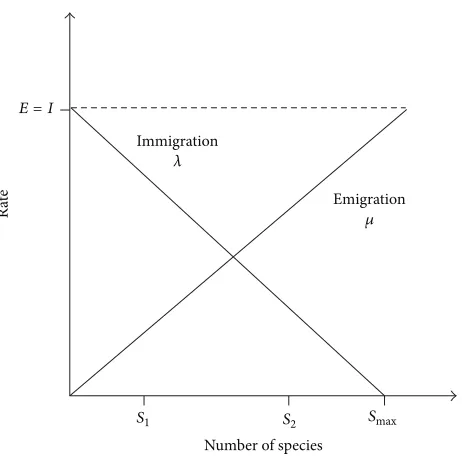
In the equations,𝑘represents the rank of a habitat after sorting them in accordance to their HSI. Habitats with high HSI (a poor solution) have lower rank while habitats with low HSI will have higher rank. In other words, the habitats are sorted from the worst to the best. In the equations,ℎis the number of habitats in the population, while𝐼is the maximum immigration rate and𝐸the maximum emigration rate which are both usually set to 1.
Figure 1 illustrates the model for immigration and emi-gration rates [22]. In the figure,𝑆1is a relatively poor solution, while𝑆2is a relatively good solution. Although in the figure the immigration and emigration rate are considered linear, they can actually be replaced with curves in which better performance might be attained. In fact, Mussetta and Pirinoli
[30] have shown that a variation of BBO with quadratic migration model and restart procedure outperforms the classical BBO when being applied to several benchmark functions. The selection strategy is summarized with the algorithm in Algorithm 1.
3.2.4. Selection Strategy for Mutation. In BBO, each habitat has an associated probability for them to exist as a solution to the given problem. The probability that whether mutation occurs in a habitat is called the mutation rate. To determine the mutation rate for each habitat, we must first evaluate the species count probability with the following equation:
P= k
∑ℎ+1𝑖=1 V𝑖
, (4)
in whichVandV𝑖are evaluated by
k= [V1 V2 ⋅ ⋅ ⋅ Vℎ+1]𝑇,
V𝑖
={{{{
{
ℎ!
(ℎ + 1 − 𝑖)! (𝑖 − 1)! (𝑖 = 1, 2, . . . , 𝑖)
Vℎ+2−𝑖 (𝑖 = 𝑖+ 1, 𝑖+ 2, . . . , ℎ + 1) ,
(5)
where𝑖=ceil((𝑛 + 1)/2). The mutation rate𝑚(𝑆)is inversely proportional to the species count probability; therefore, we have
𝑚 (𝑆) = 𝑚max(1 − 𝑃𝑃 𝑠
max ) , (6)
where 𝑚max is the maximum mutation rate and 𝑃max the largest species count probability. The details on how to derive the above formulae can be referred to in [22].
3.2.5. Migration Operator. As mentioned earlier, the SIVs from a good habitat tend to migrate into a poor habitat. This migration operator is performed probabilistically based on immigration and emigration rates. In this section, we will explain how the migration is implemented in our BBOTS algorithm.
Emigrating habitat,He
Immigrating habitat,Hi
New habitat,Hn
1
1
2 2
3 3
4 4
5
1 2
3 4
5
5
2 5
(1) SIV “2” fromHemigrates intoHiand replaces “5”
(2) SIV “5” then takes the place of SIV “2”
(3) SIVs “3,” “1,” and “4” remain at original locations
Figure 2: Migration operator of BBOTS algorithm.
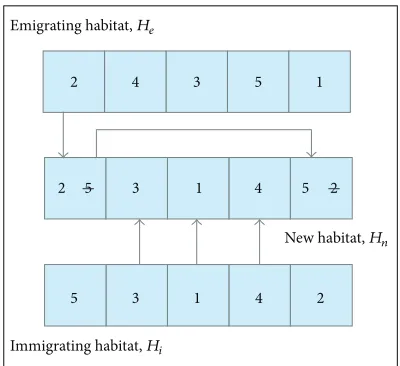
an immigrating habitat, 𝐻𝑖 = (5, 3, 1, 4, 2), are selected. Therefore, a SIV of𝐻𝑒will be randomly selected and replaces a randomly selected SIV of𝐻𝑖.
Assuming the first element of𝐻𝑒, “2” is selected to replace the first SIV of 𝐻𝑖, “5.” Therefore, the new habitat, 𝐻𝑛 =
(2, 3, 1, 4, 2), is produced. However, it is not a feasible solution
for our problem. In order to maintain the feasibility of a solution, once a new SIV migrates into a habitat, the old SIV will replace the SIV with the same value of newly emigrating SIV. Therefore, the new habitat, 𝐻𝑛, will be (2, 3, 1, 4, 5). Figure 2 illustrates this step clearly.
Once a new habitat is produced, it will only be accepted into the population only if it is not the same with any existing habitat. This is to enhance the diversity throughout the population. Besides, we use the concept of elitism to prevent the best solutions from being corrupted by immigration. This is done by setting the immigration rate for best solutions to 0.
3.2.6. Mutation Operator. According to biogeography, cata-clysmic events may happen from time to time, drastically changing the characteristics of a natural habitat. In BBO algorithm, this is imitated through a mutation operator. This process is important to increase the diversity among population.
In classical BBO algorithm, a mutation is performed by simply replacing a selected SIV of a habitat with a randomly generated SIV. Remember, in BBO, migration operator serves as intensification strategy, while mutation operator is used to maintain the diversity. Habitats within the population are improved by migration operator throughout the iteration of BBO algorithm. However, this effort might be ruined by the mutation operator because the quality of the mutated habitats
is not guaranteed. Quite often, the mutation process will result in a poor habitat.
A simple solution for this drawback comes in mind such that after performing the mutation, the mutated habitats are kept in the population only if the quality is better than the original habitats. However, this is not practical when solving a complex optimization problem such as QAP. Most of the time, the resulting habitats from a simple mutation operator are unlikely to be better than the original habitats, especially as the algorithm converges.
To overcome this weakness of classical BBO algorithm, we propose to replace the mutation operator with a tabu search procedure. Proposed by Glover [31], TS is a meta-heuristic which performs local search based on the infor-mation in the memory. TS is both neighborhood-based and iterative. At each iteration, current solution will make a move to the neighborhood solution with the best objective function value. To avoid trapping in local optima, the move that has been made will be stored in a tabu list and a reverse move to previous solutions is forbidden. The performance of tabu search highly depends on the neighborhood type used and tabu list implementation.
The advantages of replacing the mutation operator of classical BBO algorithm with TS come in two points. First, the original aim of mutation process is maintained, which is to increase the diversity of the population. Besides, at the same time, the quality of the resulting habitats is prevented from being ruined.
In order to prove the above statement, we developed two BBO algorithms for QAP:
(i) a classical BBO algorithm with mutation operator,
(ii) a BBO algorithm hybridized with tabu search.
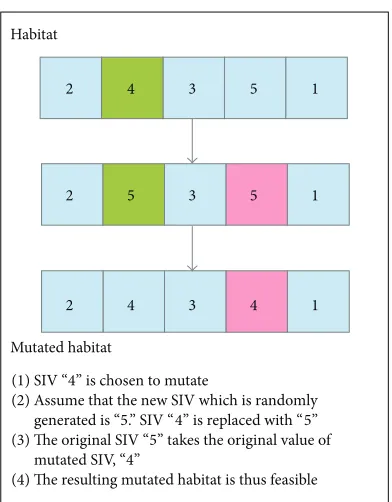
For the classical BBO algorithm, the SIV of a habitat will be chosen to undergo mutation based on the mutation rate. The mutation process is then performed by replacing the old SIV with another randomly generated SIV. After that, SIV of the habitat, which is of the same value with the randomly generated SIV, will inherit the original value of the mutated SIV. Thus, the resulting habitat will remain a feasible solution. Figure 3 illustrates the mutation process of the classical BBO algorithm for QAP.
For the proposed BBOTS algorithm, we chose to replace the mutation operator with robust tabu search (RTS) of Taillard [27]. Despite being developed long time ago (1991), RTS is still one of the best performing algorithms for QAP.
1
2 4 3 5
1
2 4 3 4
1
2 5 3 5
Habitat
Mutated habitat
(1) SIV “4’’ is chosen to mutate
(2) Assume that the new SIV which is randomly
generated is “5.’’ SIV “4’’ is replaced with “5’’
(3) The original SIV “5’’ takes the original value of
mutated SIV, “4’’
(4) The resulting mutated habitat is thus feasible
Figure 3: The mutation process of classical BBO algorithm for QAP.
of RTS changes between 0.9𝑛and 1.1𝑛dynamically during the procedure.
The advantages of RTS as compared to other adaptions of tabu search for QAP are that RTS is both efficient and robust. The robustness of RTS means that it requires less complexity and fewer parameters in its implementation. Therefore as we incorporate RTS into our BBOTS algorithm, we do not have to alter the parameter values for every benchmark instance of QAP tested.
In BBOTS algorithm, the mutation rate is now the probability that a habitat in the population will undergo RTS procedure. The number of iterations of RTS is set to𝑛, which is the size of a problem. As compared to the original RTS, the number of iterations we use is relatively much lower. This is because the use of RTS in our BBOTS algorithm is limited to a quick search only. The resulting habitat after the RTS procedure will replace the original habitat if and only if the population does not contain a same habitat yet.
3.2.7. BBOTS Algorithm for QAP. The BBOTS algorithm for QAP is shown in Algorithm 2.
4. Results and Discussion
Because of the nature of heuristic algorithms, in order to evaluate the performance of a new algorithm, it is a common practice to test it with the benchmark instances of the problem and compare its results with other existing methods. For QAP, there are benchmark instances of various sizes available from the QAPLIB. These instances are used in most
Table 2: Parameter setting of classical BBO and BBOTS algorithms for QAP.
Parameter Value
Population size 100
Number of iterations 300
Maximum immigration rate 1
Maximum emigration rate 1
Maximum mutation rate 0.1
Number of elites 2
of the literature. The benchmark instances of QAP can be classified into four types:
(i) Type I: real-life instances obtained from practical applications of QAP,
(ii) Type II: unstructured, randomly generated instances for which the distance and flow matrices are randomly generated based on a uniform distribution,
(iii) Type III: randomly generated instances with structure that is similar to that of real-life instances,
(iv) Type IV: instances in which distances are based on the Manhattan distance on a grid.
The computational results are reported through 3 stages. First, we compare the results of classical BBO algorithm with mutation operator and the proposed BBOTS by applying them to selected benchmark instances from QAPLIB. After that, we further the experiments of BBOTS algorithm by testing with even more benchmark instances of QAP. Lastly, we compare the BBOTS algorithm with other state-of-the-art methods.
Both the classical BBO algorithm with mutation operator and BBOTS for QAP are programmed in MATLAB, running on the same machine with an Intel Core i3-2120 processor at 3.3 GHz. In order to fairly compare their performance, the parameter setting for both of the algorithms is the same throughout all the instances tested. The values of parameters used are indicated in Table 2.
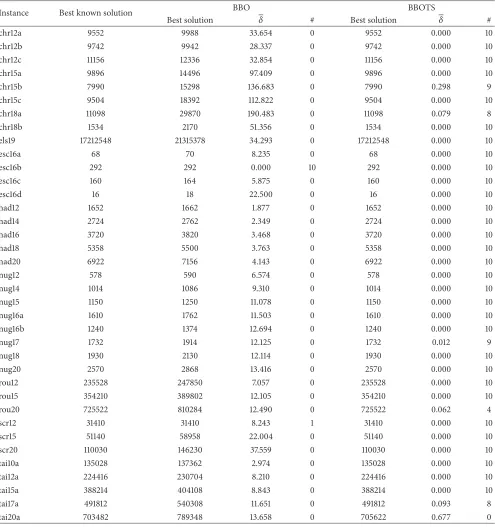
We compare the performance of classical BBO and BBOTS algorithm for QAP by applying them on 37 bench-mark instances. The computational results are shown in Table 3. The performance of the algorithms is evaluated with the following criteria:
(i) the best solution found over 10 runs,
(1) Parameter setting:Pop.size=100,Num.Iteration= 300,𝐸 = 1,𝐼 = 1,𝑚max= 0.1,elite= 2 (2) Initialization:
(3) repeat
(4) generate a habitat
(5) if habitat does not exist yetthen (6) insert it into population
(7) else
(8) discard it
(9) untilpopulation size is reached
(10) calculate immigration, emigration, and mutation rates (11) compute HSI of each habitat
(12) associate each habitat with immigration and emigration rate (13) for𝑡 = 1toNum.Iterationdo
(14) Migration:
(15) for𝑖 = 1toPop.sizedo
(16) generate Rand∈ [0, 1] (17) if Rand< 𝜆𝑖then
(18) for𝑗 = 1toPop.sizedo
(19) generate Rand∈ [0, 1]
(20) if Rand< 𝜇𝑖then
(21) perform migration operator
(22) if new habitat does not exist in the populationthen
(23) new habitat replaces old habitat
(24) else
(25) keeps the old habitat
(26) recompute HSI for each habitat (27) associate each habitat with mutation rate (28) Mutation:
(29) for𝑖 = 1toPop.sizedo
(30) generate Rand∈ [0, 1] (31) if Rand< 𝑚𝑖then
(32) perform tabu search
(33) if new habitat does not exist in the populationthen (34) new habitat replace the old habitat
(35) else
(36) keeps the old habitat
(37) recompute HSI of each habitat
(38) associate each habitat with immigration and emigration rate (39) if best known solution is foundorNum.Iteration is reachedthen (40) terminate the algorithm
Algorithm 2: BBOTS algorithm for QAP.
(iii) the number of times (#) in which the optimal or best known solution is reached.
The benchmark instances used are of different types. Regardless of the types of instances tested, BBOTS algorithm clearly performs much better than the classical BBO with mutation operator. BBOTS algorithm is able to find the optimal or best known solutions for 36 instances out of a total of 37, while the classical BBO algorithm only manages to get 2. The average deviations from the best known solutions of BBOTS are also much lower for all the benchmark instances tested.
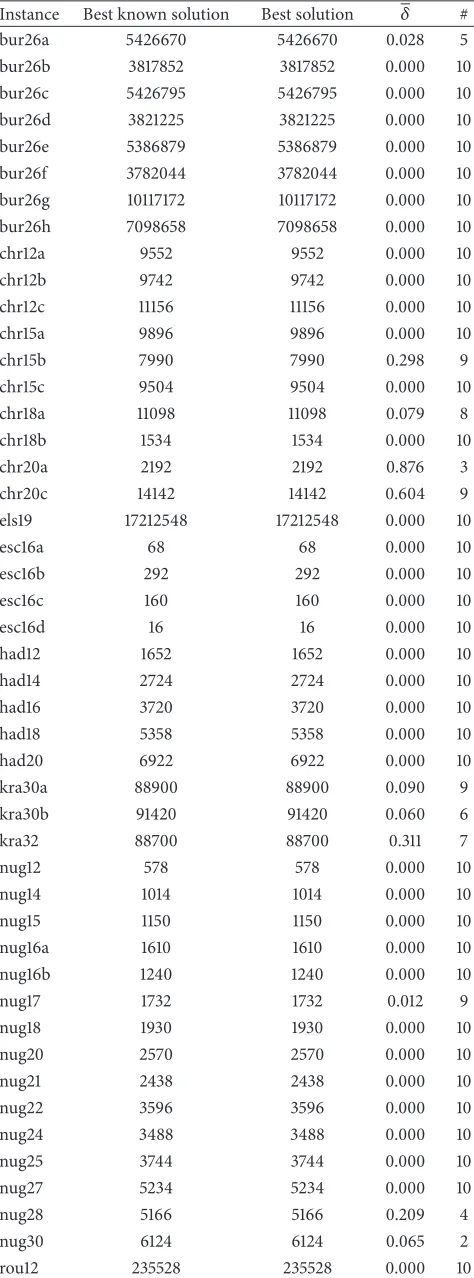
We further the experiments of our BBOTS algorithm by applying it to more benchmark instances of QAP. Table 4 shows the results obtained by BBOTS algorithm for 61 benchmark instances with size ranging from 12 to 80. The parameter values used are the same as those used previously. The BBOTS algorithm is terminated at 300 iterations or when the best known solutions are found, whichever comes first.
Table 3: Comparative results between classical BBO and BBOTS algorithms for QAP.
Instance Best known solution BBO BBOTS
Best solution 𝛿 # Best solution 𝛿 #
chr12a 9552 9988 33.654 0 9552 0.000 10
chr12b 9742 9942 28.337 0 9742 0.000 10
chr12c 11156 12336 32.854 0 11156 0.000 10
chr15a 9896 14496 97.409 0 9896 0.000 10
chr15b 7990 15298 136.683 0 7990 0.298 9
chr15c 9504 18392 112.822 0 9504 0.000 10
chr18a 11098 29870 190.483 0 11098 0.079 8
chr18b 1534 2170 51.356 0 1534 0.000 10
els19 17212548 21315378 34.293 0 17212548 0.000 10
esc16a 68 70 8.235 0 68 0.000 10
esc16b 292 292 0.000 10 292 0.000 10
esc16c 160 164 5.875 0 160 0.000 10
esc16d 16 18 22.500 0 16 0.000 10
had12 1652 1662 1.877 0 1652 0.000 10
had14 2724 2762 2.349 0 2724 0.000 10
had16 3720 3820 3.468 0 3720 0.000 10
had18 5358 5500 3.763 0 5358 0.000 10
had20 6922 7156 4.143 0 6922 0.000 10
nug12 578 590 6.574 0 578 0.000 10
nug14 1014 1086 9.310 0 1014 0.000 10
nug15 1150 1250 11.078 0 1150 0.000 10
nug16a 1610 1762 11.503 0 1610 0.000 10
nug16b 1240 1374 12.694 0 1240 0.000 10
nug17 1732 1914 12.125 0 1732 0.012 9
nug18 1930 2130 12.114 0 1930 0.000 10
nug20 2570 2868 13.416 0 2570 0.000 10
rou12 235528 247850 7.057 0 235528 0.000 10
rou15 354210 389802 12.105 0 354210 0.000 10
rou20 725522 810284 12.490 0 725522 0.062 4
scr12 31410 31410 8.243 1 31410 0.000 10
scr15 51140 58958 22.004 0 51140 0.000 10
scr20 110030 146230 37.559 0 110030 0.000 10
tai10a 135028 137362 2.974 0 135028 0.000 10
tai12a 224416 230704 8.210 0 224416 0.000 10
tai15a 388214 404108 8.843 0 388214 0.000 10
tai17a 491812 540308 11.651 0 491812 0.093 8
tai20a 703482 789348 13.658 0 705622 0.677 0
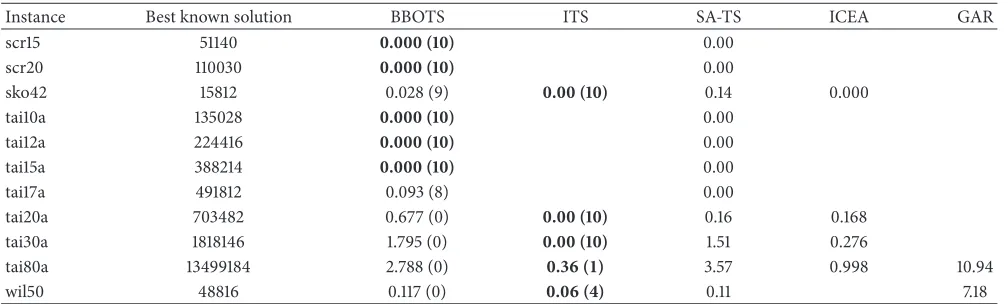
solutions over 10 runs are at most 2.788%. Even on large instance like tai80a, the average deviation is less than 3%.
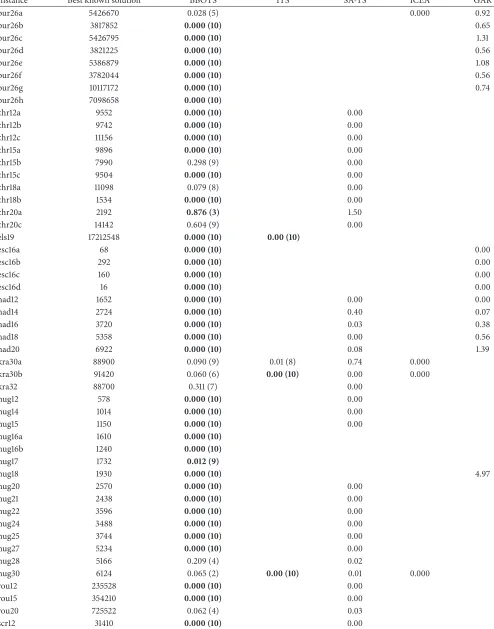
For indicative purpose, we compare the results of our BBOTS algorithm with 4 state-of-the-art QAP approaches in the literature:
(i) Iterated Tabu Search (ITS) algorithm by Misevicius (2012) [6]: the reported results are obtained using an Intel Pentium 900 MHz single-core processor;
(ii) hybrid metaheuristics combining greedy randomized adaptive search procedure and simulated anneal-ing and tabu search (SA-TS) by Gunawan et al. (2014) [32]: the reported results are obtained using a 2.67 GHz Intel Core 2 Duo CPU;
Table 4: Computational results of BBOTS algorithm on benchmark instances of QAP.
Instance Best known solution Best solution 𝛿 #
bur26a 5426670 5426670 0.028 5
bur26b 3817852 3817852 0.000 10
bur26c 5426795 5426795 0.000 10
bur26d 3821225 3821225 0.000 10
bur26e 5386879 5386879 0.000 10
bur26f 3782044 3782044 0.000 10
bur26g 10117172 10117172 0.000 10
bur26h 7098658 7098658 0.000 10
chr12a 9552 9552 0.000 10
chr12b 9742 9742 0.000 10
chr12c 11156 11156 0.000 10
chr15a 9896 9896 0.000 10
chr15b 7990 7990 0.298 9
chr15c 9504 9504 0.000 10
chr18a 11098 11098 0.079 8
chr18b 1534 1534 0.000 10
chr20a 2192 2192 0.876 3
chr20c 14142 14142 0.604 9
els19 17212548 17212548 0.000 10
esc16a 68 68 0.000 10
esc16b 292 292 0.000 10
esc16c 160 160 0.000 10
esc16d 16 16 0.000 10
had12 1652 1652 0.000 10
had14 2724 2724 0.000 10
had16 3720 3720 0.000 10
had18 5358 5358 0.000 10
had20 6922 6922 0.000 10
kra30a 88900 88900 0.090 9
kra30b 91420 91420 0.060 6
kra32 88700 88700 0.311 7
nug12 578 578 0.000 10
nug14 1014 1014 0.000 10
nug15 1150 1150 0.000 10
nug16a 1610 1610 0.000 10
nug16b 1240 1240 0.000 10
nug17 1732 1732 0.012 9
nug18 1930 1930 0.000 10
nug20 2570 2570 0.000 10
nug21 2438 2438 0.000 10
nug22 3596 3596 0.000 10
nug24 3488 3488 0.000 10
nug25 3744 3744 0.000 10
nug27 5234 5234 0.000 10
nug28 5166 5166 0.209 4
nug30 6124 6124 0.065 2
rou12 235528 235528 0.000 10
Table 4: Continued.
Instance Best known solution Best solution 𝛿 #
rou15 354210 354210 0.000 10
rou20 725522 725522 0.062 4
scr12 31410 31410 0.000 10
scr15 51140 51140 0.000 10
scr20 110030 110030 0.000 10
sko42 15812 15812 0.028 9
tai10a 135028 135028 0.000 10
tai12a 224416 224416 0.000 10
tai15a 388214 388214 0.000 10
tai17a 491812 491812 0.093 8
tai20a 703482 705622 0.677 0
tai30a 1818146 1843224 1.795 0
tai80a 13499184 13841214 2.788 0
wil50 48816 48848 0.117 0
(iv) genetic algorithm with a new recombination operator (GAR) by Tosun (2014) [8]: the reported results are obtained using a 2.21 GHz AMD Athlon (TM)64 × 2 dual processor.
Since there are differences in computing hardware, ter-mination criterion, and result reporting method, comparing the results of each algorithm is not a straightforward task. Therefore, the comparison in Table 5 should be interpreted cautiously.
The average deviations from the optimal or best known solutions are over 10 runs except for SA-TS and ICEA, which were executed for 20 and 30 times, respectively. The number of times in which the optimal or best known solutions are reached is indicated in the parentheses, if known. Should the particular authors not report their results on certain benchmark instances, the cells are left empty.
5. Conclusion
In this paper, we presented a biogeography-based optimiza-tion algorithm hybridized with tabu search for QAP. A classical BBO algorithm uses the mutation operator as its diversification strategy. This step often destroys the quality of habitats within the population. In the proposed BBOTS algo-rithm, we replaced the mutation operator with robust tabu search. The diversity among the population is maintained and, at the same time, the quality of habitats is prevented from being ruined.
Table 5: Comparative results between BBOTS algorithm and state-of-the-art QAP approaches.
Instance Best known solution BBOTS ITS SA-TS ICEA GAR
bur26a 5426670 0.028 (5) 0.000 0.92
bur26b 3817852 0.000 (10) 0.65
bur26c 5426795 0.000 (10) 1.31
bur26d 3821225 0.000 (10) 0.56
bur26e 5386879 0.000 (10) 1.08
bur26f 3782044 0.000 (10) 0.56
bur26g 10117172 0.000 (10) 0.74
bur26h 7098658 0.000 (10)
chr12a 9552 0.000 (10) 0.00
chr12b 9742 0.000 (10) 0.00
chr12c 11156 0.000 (10) 0.00
chr15a 9896 0.000 (10) 0.00
chr15b 7990 0.298 (9) 0.00
chr15c 9504 0.000 (10) 0.00
chr18a 11098 0.079 (8) 0.00
chr18b 1534 0.000 (10) 0.00
chr20a 2192 0.876 (3) 1.50
chr20c 14142 0.604 (9) 0.00
els19 17212548 0.000 (10) 0.00 (10)
esc16a 68 0.000 (10) 0.00
esc16b 292 0.000 (10) 0.00
esc16c 160 0.000 (10) 0.00
esc16d 16 0.000 (10) 0.00
had12 1652 0.000 (10) 0.00 0.00
had14 2724 0.000 (10) 0.40 0.07
had16 3720 0.000 (10) 0.03 0.38
had18 5358 0.000 (10) 0.00 0.56
had20 6922 0.000 (10) 0.08 1.39
kra30a 88900 0.090 (9) 0.01 (8) 0.74 0.000
kra30b 91420 0.060 (6) 0.00 (10) 0.00 0.000
kra32 88700 0.311 (7) 0.00
nug12 578 0.000 (10) 0.00
nug14 1014 0.000 (10) 0.00
nug15 1150 0.000 (10) 0.00
nug16a 1610 0.000 (10)
nug16b 1240 0.000 (10)
nug17 1732 0.012 (9)
nug18 1930 0.000 (10) 4.97
nug20 2570 0.000 (10) 0.00
nug21 2438 0.000 (10) 0.00
nug22 3596 0.000 (10) 0.00
nug24 3488 0.000 (10) 0.00
nug25 3744 0.000 (10) 0.00
nug27 5234 0.000 (10) 0.00
nug28 5166 0.209 (4) 0.02
nug30 6124 0.065 (2) 0.00 (10) 0.01 0.000
rou12 235528 0.000 (10) 0.00
rou15 354210 0.000 (10) 0.00
rou20 725522 0.062 (4) 0.03
Table 5: Continued.
Instance Best known solution BBOTS ITS SA-TS ICEA GAR
scr15 51140 0.000 (10) 0.00
scr20 110030 0.000 (10) 0.00
sko42 15812 0.028 (9) 0.00 (10) 0.14 0.000
tai10a 135028 0.000 (10) 0.00
tai12a 224416 0.000 (10) 0.00
tai15a 388214 0.000 (10) 0.00
tai17a 491812 0.093 (8) 0.00
tai20a 703482 0.677 (0) 0.00 (10) 0.16 0.168
tai30a 1818146 1.795 (0) 0.00 (10) 1.51 0.276
tai80a 13499184 2.788 (0) 0.36 (1) 3.57 0.998 10.94
wil50 48816 0.117 (0) 0.06 (4) 0.11 7.18
Conflict of Interests
The authors declare that there is no conflict of interests regarding the publication of this paper.
Acknowledgment
This research is funded by Universiti Teknologi Malaysia under Fundamental Research Grant Scheme (Vote Project no. R.J130000.7828.4F497).
References
[1] S. Sahni and T. Gonzalez, “P-complete approximation prob-lems,”Journal of the Association for Computing Machinery, vol. 23, no. 3, pp. 555–565, 1976.
[2] E. M. Loiola, N. M. M. de Abreu, P. O. Boaventura-Netto, P. Hahn, and T. Querido, “A survey for the quadratic assignment problem,”European Journal of Operational Research, vol. 176, no. 2, pp. 657–690, 2007.
[3] J.-C. Wang, “A multistart simulated annealing algorithm for the quadratic assignment problem,” inProceedings of the 3rd IEEE International Conference on Innovations in Bio-Inspired Computing and Applications (IBICA ’12), pp. 19–23, Kaohsiung, Taiwan, September 2012.
[4] U. Tosun, “On the performance of parallel hybrid algorithms for the solution of the quadratic assignment problem,”Engineering Applications of Artificial Intelligence, vol. 39, pp. 267–278, 2015. [5] M. Czapi´nski, “An effective parallel multistart tabu search for
quadratic assignment problem on CUDA platform,”Journal of Parallel and Distributed Computing, vol. 73, no. 11, pp. 1461–1468, 2013.
[6] A. Misevicius, “An implementation of the iterated tabu search algorithm for the quadratic assignment problem,”OR Spectrum, vol. 34, no. 3, pp. 665–690, 2012.
[7] U. Tosun, T. Dokeroglu, and A. Cosar, “A robust island parallel genetic algorithm for the quadratic assignment problem,” Inter-national Journal of Production Research, vol. 51, no. 14, pp. 4117– 4133, 2013.
[8] U. Tosun, “A new recombination operator for the genetic algo-rithm solution of the quadratic assignment problem,”Procedia Computer Science, vol. 32, pp. 29–36, 2014.
[9] M. Lstib˚urek, J. Stejskal, A. Misevicius, J. Koreck´y, and Y. A. El-Kassaby, “Expansion of the minimum-inbreeding seed orchard
design to operational scale,”Tree Genetics and Genomes, vol. 11, no. 1, pp. 1–8, 2015.
[10] A. S. Ramkumar, S. G. Ponnambalam, and N. Jawahar, “A population-based hybrid ant system for quadratic assignment formulations in facility layout design,”International Journal of Advanced Manufacturing Technology, vol. 44, no. 5-6, pp. 548– 558, 2009.
[11] R. E. Burkard, E. Cela, P. M. Pardalos, and L. Pitsoulis, “The quadratic assignment problem,” inHandbook of Combinatorial Optimization, P. M. Pardalos and D. Z. Du, Eds., pp. 241–338, Kluwer Academic Publishers, 1998.
[12] P. C. Gilmore, “Optimal and suboptimal algorithms for the quadratic assignment problem,”Journal of the Society for Indus-trial and Applied Mathematics, vol. 10, no. 2, pp. 305–313, 1962. [13] T. Mautor and C. Roucairol, “A new exact algorithm for the
solution of quadratic assignment problems,”Discrete Applied Mathematics, vol. 55, no. 3, pp. 281–293, 1994.
[14] N. W. Brixius and K. M. Anstreicher, “Solving quadratic assignment problems using convex quadratic programming relaxations,”Optimization Methods and Software, vol. 16, no. 1– 4, pp. 49–68, 2001.
[15] P. M. Hahn and J. Krarup, “A hospital facility layout problem finally solved,”Journal of Intelligent Manufacturing, vol. 12, no. 5, pp. 487–496, 2001.
[16] M. Nystrom,Solving Certain Large Instances of the Quadratic Assignment Problem: Steinberg’s Examples, California Institute of Technology, Pasadena, Calif, USA, 1999.
[17] K. Anstreicher, N. Brixius, J.-P. Goux, and J. Linderoth, “Solving large quadratic assignment problems on computational grids,” Mathematical Programming, vol. 91, no. 3, pp. 563–588, 2002. [18] Z. Drezner, P. M. Hahn, and ´E. D. Taillard, “Recent advances
for the quadratic assignment problem with special emphasis on instances that are difficult for meta-heuristic methods,”Annals of Operations Research, vol. 139, pp. 65–94, 2005.
[19] A. Wallace, The Geographical Distribution of Animals (Two Volumes), Adamant Media Corporation, Boston, Mass, USA, 2005.
[20] C. Darwin,On the Origin of Species, Gramercy, New York, NY, USA, 1995.
[21] R. MacArthur and E. Wilson, The Theory of Biogeography, Princeton University Press, Princeton, NJ, USA, 1967.
[23] D. Simon, “A probabilistic analysis of a simplified biogeography-based optimization algorithm,”Evolutionary Computation, vol. 19, no. 2, pp. 167–188, 2011.
[24] V. Panchal, P. Singh, N. Kaur, and H. Kundra, “Biogeography based satellite image classification,” International Journal of Information Security, vol. 6, no. 2, pp. 269–274, 2009.
[25] V. Panchal, H. Kundra, and A. Kaur, “An integrated approach to biogeography based optimization with case based reasoning for retrieving groundwater possibility,”International Journal of Computer Applications, vol. 1, no. 8, pp. 975–8887, 2010. [26] A. Bhattacharya and P. K. Chattopadhyay, “Solving complex
economic load dispatch problems using biogeography-based optimization,”Expert Systems with Applications, vol. 37, no. 5, pp. 3605–3615, 2010.
[27] E. Taillard, “Robust taboo search for the quadratic assignment problem,”Parallel Computing. Theory and Applications, vol. 17, no. 4-5, pp. 443–455, 1991.
[28] R. E. Burkard, E. Cela, S. E. Karisch, and F. Rendl, QAPLIB Home Page, 2004, http://anjos.mgi.polymtl.ca/qaplib/. [29] T. C. Koopmans and M. Beckmann, “Assignment problems and
the location of economic activities,”Econometrica, vol. 25, no. 1, pp. 53–76, 1957.
[30] M. Mussetta and P. Pirinoli, “MmCn-BBO schemes for elec-tromagnetic problem optimization,” inProceedings of the 7th European Conference on Antennas and Propagation (EuCAP ’13), pp. 1058–1059, Gothenburg, Sweden, April 2013.
[31] F. Glover, “Future paths for integer programming and links to artificial intelligence,”Computers & Operations Research, vol. 13, no. 5, pp. 533–549, 1986.
[32] A. Gunawan, K. M. Ng, K. L. Poh, and H. C. Lau, “Hybrid metaheuristics for solving the quadratic assignment problem and the generalized quadratic assignment problem,” in Proceed-ings of the IEEE International Conference on Automation Science and Engineering (CASE ’14), pp. 119–124, Taipei, Taiwan, August 2014.
Submit your manuscripts at
http://www.hindawi.com
Computer Games Technology
International Journal of
Hindawi Publishing Corporation
http://www.hindawi.com Volume 2014
Hindawi Publishing Corporation
http://www.hindawi.com Volume 2014 Distributed
Sensor Networks International Journal of
Advances in
Fuzzy
Systems
Hindawi Publishing Corporation
http://www.hindawi.com Volume 2014
International Journal of
Reconfigurable Computing
Hindawi Publishing Corporation
http://www.hindawi.com Volume 2014
Hindawi Publishing Corporation
http://www.hindawi.com Volume 2014
Applied
Computational
Intelligence and Soft
Computing
Advances in
Artificial
Intelligence
Hindawi Publishing Corporation
http://www.hindawi.com Volume 2014
Advances in
Software Engineering Hindawi Publishing Corporation
http://www.hindawi.com Volume 2014
Hindawi Publishing Corporation
http://www.hindawi.com Volume 2014
Electrical and Computer Engineering
Journal of
Journal of
Computer Networks and Communications
Hindawi Publishing Corporation
http://www.hindawi.com Volume 2014
Hindawi Publishing Corporation
http://www.hindawi.com Volume 2014
Multimedia
International Journal of
Biomedical Imaging
Hindawi Publishing Corporation
http://www.hindawi.com Volume 2014
Artificial
Neural Systems
Advances in
Hindawi Publishing Corporation
http://www.hindawi.com Volume 2014
Robotics
Journal of Hindawi Publishing Corporationhttp://www.hindawi.com Volume 2014 Hindawi Publishing Corporationhttp://www.hindawi.com Volume 2014
Computational Intelligence and Neuroscience
Hindawi Publishing Corporation
http://www.hindawi.com Volume 2014
Modelling & Simulation in Engineering
Hindawi Publishing Corporation
http://www.hindawi.com Volume 2014
The Scientific
World Journal
Hindawi Publishing Corporationhttp://www.hindawi.com Volume 2014
Hindawi Publishing Corporation
http://www.hindawi.com Volume 2014 Human-Computer Interaction Advances in
Computer EngineeringAdvances in
Hindawi Publishing Corporation