Supporting and Improving Reflective Practice
Among Pre-service Teachers Through WhatsApp
B. C. Yee
Email: [email protected]
Language Department, Institute of Teacher Education Campus Tun Hussein Onn, Malaysia.
Abdullah Mohd Nawi
Language Academy, Universiti Teknologi, Malaysia.
Tina Abdullah
Language Academy, Universiti Teknologi, Malaysia.
Abstract
The purpose of this study aimed to investigate the use of WhatsApp, an instant messaging application tool, to improve and support pre-service teachers’ reflective practice during their teaching practice. Freeman (2002) suggests that reflective practice must become a central pillar in teacher education. Pre-service teachers should be reflective by thinking of their knowledge and methodology learnt in the college and applying and putting them into practice in the classroom. However, they find it difficult to link theory to practice and they need the support and help from others when they start teaching in school. Therefore, the tool of WhatsApp is used to help these teachers to bridge theory and practice during their teaching practice. This case study involved eight participants who taught English language for twelve months in school. An assessment rubric for classroom observation was analysed descriptively for quantitative data while the weekly reflective journals, responses on the WhatsApp prompts and the focus group interviews were analysed thematically for qualitative data. This paper explores the support given by the supervisor during the teaching practice can help to improve the pre-service teachers’ teaching and learning experiences in the classroom.
Keywords: WhatsApp, Reflective Practice, Practicum
1.0 Introduction
Technology has become increasing essential in teacher education and there is a growing digital communication environment that encourages instructors to use digital tools in their teaching (Alebaikan & Troudi, 2010). It is important for future teachers to be equipped
with 21st century skills to meet the challenges in this information age.
21st century skills consist of 4C, which are critical thinking, creative thinking,
communicate and collaborate outside the classroom, teacher educators need to bring together their knowledge of content, pedagogy and technology to design appropriate and effective instructions for their students. Being creative and critical involves thinking. Dewey (1910) recognised that the „thinking teacher‟ requires three important attributes to be reflective: „open-mindedness‟ to new ideas and thoughts; „wholeheartedness‟ to seek out fresh approaches and fully engage with them; and „responsibility‟ to be aware of the consequences of one‟s own actions. So, in his view, reflections to help develop these characteristics are essential to becoming a successful teacher.
Reflective thinking on context-bound enables the pre-service teachers to have meaningful change in mental structures and in the understanding of self and others (Koutselini, 2008). Reflection focuses on the knowledge being learned (i.e., curriculum) as well as the experiential practice (i.e., pedagogy); both are important aspects of the learning process (Kolb, 1984). Reflective activities have long included journal writing, but technology can facilitate and enhance the skills of reflection as electronic reflections can be readily archived, revisited, updated, and shared in exciting and creative ways (Lambert & Cuper, 2008). This study provides productive ways in which teacher educators can integrate technology such as Whatsapp, an instant messaging tool to support and improve reflective practice besides face-to-face consultation among the pre-service teachers (whom we refer to as “PSTs” in this article) during their teaching practicum.
2.0 Literature Review
In the Malaysian teacher education, all PSTs need to undergo practicum teaching practice before they are qualified to become teachers in school. The purpose of the practicum is to help prepare the PSTs for the realities of teaching pupils by providing them with a clear understanding of the contexts in the classroom. It offers the context for PSTs to develop their personal teaching competence (Smith & Lev-Ari, 2005, p.291) and to acquire and develop the knowledge of teaching and professional content knowledge of teachers (Shulman, 1987).
When these teachers study in the teacher‟s training college, they gain the knowledge of methodology, classroom management, the language skills needed, material design and so on. However, when they start teaching pupils in the classroom, these PSTs find difficulty in bridging theory and practice. Freeman (2002) states the lack of importance given to the concept of context in most ELT teacher education programmes as a reason behind the gap between theory and practice. The knowledge base of campus-based courses cannot always
equip teachers to deal with every aspect of their own particular teaching context. Therefore,
they need support and mentoring from their supervisors and others when they begin teaching at school. Hobson et.al. (2009) have identified some of the benefits of mentoring for these teachers as:
Reduced feelings of isolation
Increased confidence and self-esteem
Professional growth
Improved self-reflection and problem-solving capacities
According to Dewey (1933), reflection is an “active, persistent, and careful consideration of any belief or supposed form of knowledge in light of the grounds supporting it and future conclusions to which it tends” (p.9). When PSTs participate in the actual experience of teaching and reflecting on their experiences, there is likely to be a connection between theory and practice. Learning experiences are structured to follow the learner's zone of proximal development (Vygotsky, 1978) in which knowledge construction and growth are seen as the result of personal interactions in social contexts, i.e. classroom environment.
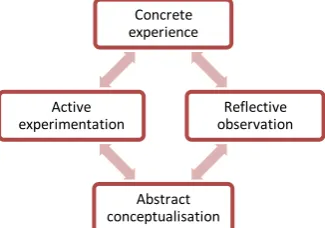
In Kolb‟s (1984) experiential learning model (Figure 1) which is represented by a four- stage learning cycle, „concrete experience‟ relates to something tangible in teaching that has prompted the teachers to reflect. „Reflection‟ moves beyond thinking about something because it involves acting on what has been learned. However, the phrase „abstract conceptualisation‟ provides another layer of reflection. It means that when teachers reflect and observe things, they will also think more broadly about what is happening and try to build new learning onto pre-existing knowledge. They may then use their existing frameworks and ideas to make sense of the situation. Lastly, the phrase „active experimentation‟ denotes the actions that follow.
Figure 1 Kolb‟s (1984) Experiential Learning Model
Reflective practice does not involve thinking only but also action as Schon (1983) explains the meaning of reflective practice as a “kind of knowing through and in the actions of our actual professional practices” in which teachers should be “reflective practitioners” who “think in action”. He is concerned with the relationship between the kind of knowledge teacher learn in the college and the kinds of competence values on professional practice. Therefore, PSTs need to develop the skills of reflective practice to help them optimise their language teaching beliefs and personal knowledge, in addition to putting them into practice in the classroom.
Besides encouraging the PSTs‟ professional development (Calderhead, 1993), reflective practice also strengthens their teaching ability (Vacca, & Bruneau, 1997). However, when these PSTs are in school, they need the help and support from others as they are lack of teaching experience. To support such growth and development, their instructors or supervisors can work with them “to reflect on their practice in meaningful ways, to consider the effect their teaching has on student learning and to develop habits that will stay with them” (Ward & McCotter, as cited in Shoffner, 2009). These habits can be fostered through writing their reflections in journals when the PSTs reflect on their teaching practices.
Journals are a key tool for cultivating and scaffolding reflective practice in pre-service teacher education literature. Bain, Ballantyre, Packer & Mills (1999), together with Brinton, Holten & Goodwin (1993), use dialogue journals as a way to chart novice teachers‟ growth, particularly during the practicum. Reflective journals are helpful in the reflective process as they make explicit the direct link between theory and practice, particularly that the
Concrete experience
Reflective observation
Abstract conceptualisation Active
journal writing is related to the learning experiences gained from their teaching and learning. Through reflective journal writing, the PSTs has the potential to improve their effectiveness as teachers and to substantially decrease problems, concerns or issues in their teaching practicum. The careful and ongoing support and feedback offered also helps PSTs to link theory to practice by drawing repeatedly on the knowledge provided by reflection on their teaching experience. By doing so, they re-assess their pedagogical practices and assumptions, and gradually develop their own practice.
Reflective journals can be done in the forms of pen and paper as well as technology. Web-based materials (Richet, 2007), online discussion (Whipp, 2003) and blogs and blogging (Stiler & Philleo, 2003) are further devices that spur reflection and reflective practice in teacher education. Some studies have explored the impact of technology on influencing PSTs‟ reflective practice. Stiler and Philleo (2003) and Harland and Wondra (2011) found that the use of blogs promoted the depth of reflection among the PSTs. Pedro, Abodeeb-Gentile and Courtney (2012) also found their PSTs‟ comprehension of literacy instruction was deepened and their meta-cognitive awareness of instructional practice was enhanced after they engaged on an online dialogue discussion. These studies show the impact of combining technology and reflective practice by the PSTs when they start teaching in the school.
These technology tools not only promote reflective practice among PSTs, but also build their online communities. Since people nowadays are more digitally fluent and use technology habitually, the behaviours they exhibit are generally collaborative and communicative when they share their ideas, opinions and experiences online. By using technology such as mobile technology, the sense of community can be created through group reinforcement, encouragement and support (English & Duncan-Howell, 2008) in an instant way.
Today‟s mobile technologies and applications offer anywhere, instant on-demand educational information and 24 hour access to student peers around the world (Khaddage, Knezek, & Rosen, 2013). By using their mobile phones and other mobile devices, students can send information and opinions and receive feedback immediately via mobile applications. The specific mobile application that was chosen for study in this research was the WhatsApp application, a free mobile messaging app created for both the Android, iOS, as well as desktop platforms through the use of a windowed browser. This application allows users to exchange messages without having to pay for SMS, and can be used as a channels for forums, or even one to one private communication. In addition to basic messaging WhatsApp, users can create groups, send each images, video and audio media messages. As of September 2015, WhatsApp had a user base of up to 900 million (Guynn, 2015), making it the most globally popular messaging application (Leo, 2015).
3.0 Objectives
The study was aimed to achieve the following two objectives:
i. To investigate the use of WhatsApp to improve the PSTs‟ reflective practice during
their teaching and learning experiences
ii. To investigate the use of WhatsApp to support the PSTs‟ reflective practice during
their teaching and learning experiences
4.0 Methodology
This study adopted a mixed-method approach on using quantitative and qualitative data. Eight PSTs were selected as the participants since they were under the supervision of the researcher during their teaching practicum. They were the undergraduates in one of the teacher education institutes in Malaysia. They were 22 years old in average, with six males and two females taking part.
This was their seventh semester in their degree course, a 4-year long undergraduate programme leading to a bachelor degree. They were offered the option of “Teaching English as a Second Language (TESL)” and they would teach English in school once they graduate. During their course, they had to undergo three practicum phases for different periods of time: four weeks, eight weeks and twelve weeks. This was their last practicum phase that they went to the local primary schools for their practicum and the researcher visited them in the school to provide them the guidance and support when observing their teaching practice in the classroom.
These participants are digital users and they all own a smart phone each. They often send messages to their peers and lecturers asking questions and information by using applications such as WhatsApp. For the purpose of this study, the researcher created a WhatsApp group with the name “TESL SEM 7 Practicum” which was a closed group that consisted of nine members including the researcher and the eight participants.
During the twelve-week practicum session, the researcher who was also their practicum supervisor observed them for three times by visiting them in the school. The researcher observed the eight participants for an hour each time when they taught the pupils in the classroom.
During the classroom observations, the researcher observed the participants‟ teaching and learning activities in the classroom by using an observation checklist based on three criteria: lesson plan, lesson implementation and reflection. The checklist used the following scales: Very Poor (1), Poor (2), Average (3), Good (4) and Very Good (5). Although the scores were quantified, the basis of the observation was very much qualitative in nature. The researcher awarded marks based on her observations of how the students performed against the scales on the checklist. As such, the awarded percentages of the marks in the results section reflect the researcher‟s qualitative observations, but are presented quantitatively. The quantitative data was analysed descriptively using frequency distribution tables. This data provided the information on the participants‟ performance when they applied the knowledge from their lesson planning and practised it through implementation in the classroom and writing their reflection throughout the practicum period.
Additionally, they were also required to write a reflective journal every week. In the journal, they were told orally about the format in writing. They needed to find a problem they faced in the classroom, look up for literature review about the problem, find the solutions and take the necessary actions to overcome the problem.
twelve-week practicum session. Each prompt ran for a 7-day period of time, during which the PSTs could respond at any time. The PSTs were required to respond to the prompts given by the researcher and they were analysed thematically.
Lastly, the eight participants were divided into two groups and they were called for focus group interviews. Focus groups are a group interview to “collect shared understanding from several individuals as well as to get views from specific people” (Creswell, 2015). The focus group interviews were conducted by the researcher using a semi-structured interview format. The interviews were conducted a week after the participants finished their practicum. It was carried out to understand better the process of providing support through WhatsApp during their practicum. All these qualitative data from reflective journals, responses on WhatsApp and focus group interviews were analysed thematically. The data provided better understanding on the support given by the researcher through WhatsApp to help the PSTs in their reflective practice.
5.0 Results
5.1 Quantitative Analysis (Observation Checklist)
During the classroom observations, the participants were observed on three criteria: lesson plan, lesson implementation and reflection. The table below shows the mean scores the participants gained throughout the three observations.
Table 1 The Mean Scores in the Assessment on Classroom Observations
Observation First Second Third
Lesson Plan 57% 77% 87%
Lesson Implementation 60% 73% 75%
Reflection 60% 70% 80%
In the lesson plan, the participants had to write the learning outcomes, contents, teaching and learning strategies, resources, integration of moral values and thinking skills. It can be seen from Table 1 that the participants who went through the three practicum observations had improved in their lesson planning before they started teaching the pupils in the classroom. The mean score increased from 57% in the first time observation, 77% for the second time observation and 87% for the third time observation. This indicates the positive trend of improvement by the participants after they were given guidance and support by their supervisor after each observation. This could be seen when the participants got to discuss their problems in the classroom through WhatsApp, they realised their problems and were able to overcome the problems by choosing achievable learning outcomes and planning activities and strategies that were appropriate for their pupils when they wrote their lesson plans.
was 75%. This suggests that when they improved in their lesson planning, they were able to implement it better in the teaching and learning activities.
As for the reflection after each lesson was carried out, the participants were assessed on their reflective thinking and reflective writing. Based on the results from the Table 1, the participants had shown slight improvement in their reflection as the mean scores for the first and second time observations was 60% and 70% while the third time was 80%. This suggests that the improvement in lesson planning and lesson implementation was resulted when the participants had engaged themselves in reflective practices to identify the problem they faced in the classroom and found solutions to it. Then they were able to improve themselves in the next lesson when they faced the same problem.
5.2 Qualitative Analysis
Based on the reflective journals written by the participants every week and WhatsApp responses given, the coded categories found were teaching and learning, communication and classroom management and these categories fell into the major themes of strengths and weaknesses in teaching ability, problems in teaching and learning, solutions to the teaching and learning problems and support given through WhatsApp.
Strengths and Weaknesses in Teaching Ability
When discussing about the participants‟ strengths through the WhatsApp prompts, two responded that they had patience (P1 & P3), others informed that they were friendly (P8), confident (P5), good in classroom control (P4), had a loud voice (P6), and good use in ICT (P2). One humorously commented that he was tall that he could see the whole class and this contributed to good classroom management too (P7).
As for the participants‟ weaknesses, three of the participants admitted they had weakness in time management (P1, P2 & P5). This might be due to the activities that they had planned were too many in the lesson and they could not finish all the activities or they had to rush in carrying out all the activities by ignoring the pupils‟ ability to learn from the lesson. One commented he had weakness in classroom management (P3), others responded that they were weak in communication (P4), being too lenient to the pupils (P6), had low voice projection (P7) and lack of patience (P8).
Problems in Teaching and Learning
Through their responses, the participants not only identified their own strengths and weaknesses in teaching, but also the problems they face in the classroom. The most found weakness among the participants was time management and it was discussed further as the main problem they found during the teaching and learning activities in the classroom. The reasons given by three participants on this problem were given as below.
P4 : I think the problem is we misjudge our pupils ability to
complete a certain task…it‟s always either too easy or too late… I think only experience can be the solution for this problem.
P2 : In my opinion, I put too high expectations on my pupils.
the cause of this problem.
P1 wrote her reasons for the problem of time management and how it affected her students in her reflective journal.
“I could not finish each stage in the time allocated especially for the presentation stage. I spent time on reciting poem with my pupils once. I was always forced to shorten the activities for practice and production stages and most of the time I did not get the chance to do the closure stage. Sometimes, the activity was fun in the practice stage and my pupils were enjoying themselves in the activity, but I just ended the activity after a few pupils had taken part in it. There were some pupils who get frustrated because they did not get the opportunity to participate in the activity.”
When talking about his communication problem in teaching and learning, P4 gave the following comment on WhatsApp:
“mine has to be communication problem…I find it hard to speak English at a lower and simpler level so that my pupils can understand.”
In his reflective journal, P4 elaborated further on the problem of communication:
“On the sixth week, I was finding myself in a bind when writing reflection and I also noticed that my communication aspects that are not clear. I can properly reflect my teaching process to find out the weakness of my lesson. The students at the back constantly asking me question regarding the information or instructions that I just gave and this shows that my communication with the students are weak mainly because of my voice projection.
This is a problem because my voice is not loud and clear. The activities that I need to implement a clear and loud voice. Here I was rebuked that my voice should be strong again and clear instructions. At that point, I had to make further progression of accentuating the students may or may not the correct behaviour of the learning objectives. Moreover, I need to emphasize how my feelings in writing reflection and put myself in students. Whether or not the students enjoyed activities and how the solution if students do not enjoy doing the activities proposed.”
Through this journal, the participant was able to identify his weakness in the classroom which was voice projection that was not loud and clear that had caused communication problem in the classroom. He agreed that this had caused his students not understand his lesson and they did not enjoy his activities. This example also suggests a strong correlation between what was written through critical reflection in the research journal, and what was shared through WhatsApp.
Solutions to Teaching and Learning Problems
As for the suggestions to the problem of time management above, the responses given in WhatsApp were as below:
P1 : Shorten the activity.
P3 : Not too ambitious.
P4 : The teacher must know the ability of the pupils but for
inexperienced teachers like us, maybe we should always prepare extra activities as a back up.
P5 : Consider our pupils level in creating the suitable activity.
P6 : For me, I should follow the time frame.
P7 : Always look at the watch.
P8 : Give simple activity.
In a solution to her problem of time management, P1 wrote in her reflective journal:
“I should have planned less time-consuming activities in each lesson so that I could finish all the activities on time. This is especially for the writing activity, I should have given fewer sentences for my pupils because most of them are slow in copying and writing. Besides, I should have aimed for fewer behavioural objectives in each lesson. If there are too many objectivities need to be achieved in a lesson, it would be very hard for me to achieve all of them in only an-hour lesson with the weak pupils. I should be satisfied as long as my pupils have mastered something new in each lesson. Never expect them to learn much from me in each lesson.”
To overcome his problem of communication, P4 had found the following solutions:
“According to Tibout (2004), in one of the blogs found in Teacher‟s Aid website, the author talks about the causes for students not responding to teacher‟s instruction when the teacher teaches. It is stated in the web page that when the teacher teaches while sitting, students will not follow the class, will not pay attention, missing instructions and etc. The solution for this problem is also given. The author suggests that teachers should stand up while teaching so that the students will pay attention to the main figure in the classroom and make one‟s voice projection louder. Thus, I made up my mind that if I want to have a better classroom control, I have to always stand up while teaching raise up my voice and always communicate with the students to tackle my problem.
I have to read books related to classroom activities that are interesting. This is to ensure better classroom management and I need to speak firmly and loudly because while my voice is too slow. For writing a reflection, I will learn to access the internet or search for materials in the library, how to write a proper reflection. I‟ll get guidance and advice from mentors and lecturers, as well as talking to friends.”
practice, he is able to acquire the understanding and skills necessary for teaching effectively in the real classroom situations.
Support Given Through WhatsApp
Throughout the practicum session, the supervisor exercised supportive feedback to her students. For example, she gave information on how to write thinking skills and moral values by providing them the websites from internet. Sometimes, informal spoken devices such as emoticons (smileys and icons) were used as a support or encouragement to the students when they gave their responses.
All the eight PSTs revealed positive views on the use of WhatsApp to help them improve their reflective practice. When they were asked “What are your experiences of using WhatsApp during the practicum?” They responded that it helped them to be better teachers, learn from others‟ ideas, share all problems and solve together. A participant commented “We have our strengths and weaknesses. Through WhatsApp, we could share our problems and find the solutions together. Thus we improve our teaching ability.”
The support given by their supervisor also helped them to produce better lessons. They could identify their strengths and weaknesses and support one another through their discussions by giving suggestions on ways to solve their problems in the classroom.
All of the PSTs had shown favour on the use of WhatsApp than traditional journal writing as a way of practising reflective thinking. They agreed that the WhatsApp was fast, cheap, easy to use and save a lot of their time. It also helped to save the earth as they did not need to write their reflection on papers. It brought advantages with its immediate response and availability of the information as they can always find the previous comments which they had discussed earlier to recall some ideas and suggestions.
6.0 Discussions
The PSTs need more support from their peers and lecturers during their teaching practicum. Integrating technology into reflective practice during this period yielded fruitful results. The quantitative results showed that when the PSTs engaged more in reflective practice, they could improve their lesson planning and lesson implementation in the classroom. The qualitative results through WhatsApp discussion also indicated the support given by the supervisors and peers as the PSTs were very concerned with the teaching and learning experiences in the classroom and they constantly engaged in reflective practices to identify their strength, weakness and the problems they found. By taking time regularly to value their personal strength, they can reflect on the many satisfying things that they have achieved in the teaching and learning experiences.
According to Buckingham and Clifton (2001), one should never overlook his or her many positive accomplishments. PSTs should take advantage of their strength so that it can support them to look at ways of improving their effectiveness and thus they become capable and efficient teachers in school. Finding one‟s weakness does not mean they are not fit to become teachers. In some of the literature on reflection (Grant and Greene 2001; Revans 1998), there is a focus on identifying negative aspects of personal behaviour with a view to improving professional competence. Therefore, by identifying their weaknesses, the PSTs were able to engage in reflective practice that support and help them find ways to overcome the weakness and develop their own professional practice.
teach in order to improve their teaching (Loughran, 2002). In a study by Kupara-Spencer (2009), she found that reflective practice involves the cognitive processes of both „problem finding‟ and „problem solving‟ and explained that the initial teacher trainees take time to revisit their experiences and process them from a number of different perspectives before drawing conclusions. This perspective acknowledges Dewey‟s (1933) purpose of reflective practice, which is concerned with the actions taken by the teacher, the process of arriving at these decisions and the various consequences and outcomes of those decisions. This is true that when teachers were able to identify the problems of teaching and learning experiences in the classroom, they gained support from their supervisors or lecturers at the same time, they overcome the problems and improve their teaching practice.
There are various strategies for reflective practice but the PSTs preferred the integration of technology into their reflection. They use technology to reflect often and connect with others to support one another in their reflective practice. Therefore, they were able to share their reflective thoughts with others.
7.0 Conclusion
This study suggests the need for a reform in the practicum through instant messaging application such as WhatsApp. It gleans insight on the positive impact of WhatsApp to provide support and improve the reflective practice among pre-service teachers. The findings from this study may be used as a catalyst for restructuring the TESL practicum to provide pre-service teachers with more support.
The researcher strongly believe that future teachers will greatly benefit from using the reflective strategies of identifying their own strengths, weaknesses, problems faced in the classroom and offering suggestions to promote their teaching practice when teaching pupils. They develop the skills needed for teaching effectively in the classroom through constant use of reflective practice.
Despite the formal reflective journal writing, the instant and constant responses and feedback through Whatsapp enable the PSTs to reflect in ways that are more conducive to professional growth. The results present significant findings for teacher educators of the reflective process of the PSTs of their professional development as they stand at the interface of theory and practice. They develop the knowledge and skills needed to enhance their teaching and learning strategies in the classroom.
The ultimate goal of teacher education is to transform theory into practice. By transferring the new form of online communication to the traditional face-to-face communication, it allows the PSTs to reflect about theories and their practices in the classroom that leads to professional growth and development. This reflection is useful and necessary to make a set of practices work more smoothly and achieve the consequences intended for them but critical reflection is grounded in a set of values concerning what kind of learning and education is (Brookfield, 2010). This, however, is an issue for future research.
REFERENCES
Alamri, J. (2015). (In)formality in Social Media Discourse: The Case of Instructors and
Students in Saudi Higher Education. In Proceedings of Global Learn 2015 (pp.
101-108). Association for the Advancement of Computing in Education
(AACE). Retrieved from http://www.editlib.org/p/150852.
Alebaikan, R. & Troudi, S. (2010). Blended learning in Saudi universities: Challenges and
perspectives. Research in Learning Technology. 18(1), pp. 49-59.
Bain, J.D., Ballantyne, R., Packer, J., & Mills, C. (1999). Using journal writing to enhance
student teachers‟ reflectivity during field experience practicicum. Teachers ad
Brinton, D., Holten, C., & Goodwin, J. (1993). Responding to dialogue journals in teacher
education: What‟s effective. TESOL Journal, 2(4), 15-19.
Brookfield, S. (2010). Critical reflection as an adult learning process. In N. Lyons (Ed.) Handbook of Reflection and Reflective Inquiry: Mapping a way of Knowing for Professional Reflective Inquiry. London: Springer.
Buckingham, M. & Clifton, D.O. (2001) Now, Discover your Strengths. London: Simon and
Schuster.
Creswell, J.W. (2015). Educational research: Planning, conducting, and evaluating
quantitative and qualitative research (5th Ed.). Boston: Pearson.
Dewey, J. (1910). How we think. Boston: DC, Heath.
Dewey, J. (1933). Experience and education. New York: Collier Macmillan.
English, R., & Duncan-Howell, J. (2008). Facebook© goes to college: Using social
networking tools to support students undertaking teaching practicum. MERLOT
Journal of Online Learning and Teaching, 4(4), 596-601.
Freeman, D. (2002). The hidden side of the work: Teacher knowledge and learning to teach. A perspective from North American educational research on teacher education in
English language teaching. LanguageTteaching, 35, 1–13.
Grant, A.M. & Greene, J. (2001) Coach Yourself: Make Real Change in Your Life. London:
Momentum Press.
Guynn, J. (September 4, 2015). "Facebook's WhatsApp hits 900 million users, aims for 1 billion". USA Today.
Harland, D., & Wondra, J. (2011). Preservice teachers‟ reflection on clinical experiences: A
comparison of blog and final paper assignments. Journal of Digital Learning in
Teacher Education, 27(4), 128-133.
Hobson, A., Ashby, P., Malderez, A. & Tomlinson, P. (2009). Mentoring beginning teachers:
What we know and what we don‟t. Teaching and Teacher Education, 25:207-216.
Leo, S. (September 11, 2015). "Facebook Inc.'s WhatsApp hits 900 million users: What now?". The Motley Fool.
Khaddage, F., Knezek, G. & Rosen, D. (2013). The Teacher Education Evolution: The Shift from Online to Mobile Learning in Curriculum, Assessment and Delivery. In R.
McBride & M. Searson (Eds.), Proceedings of Society for Information Technology
& Teacher Education International Conference 2013 (pp. 3936-3942). Chesapeake,
VA: Association for the Advancement of Computing in Education
(AACE). Retrieved from http://www.editlib.org/p/48731.
Kolb, D. A. (1984). Experiential learning: Experience as the source of learning and
development. New Jersey: Prentice-Hall.
Kupara-Specer, C.T.G. (2009). Teacher educators’ perspectives on the meaning and most
effective strategies to develop reflective practice among initial teacher trainees.
Retrieved from
http://www.health.heacademy.ac.uk/lenses/occasionalpapers/col10008/m10237.html Lambert, J. & Cuper, P. (2008). Multimedia technologies and familiar spaces: 21st-century
teaching for 21st-century learners. Contemporary Issues in Technology and Teacher
Education, 8(3), 264-276.
Loughran, J.J. (2002). Effective Reflective Practice: in search of meaning in learning about
teaching, Journal of Teacher Education, 53, 1, 33-43.
McGregor, D. & Cartwright, L. (2011). Developing reflective practice: A guide for beginning teachers. Berkshire: McGraw-Hill.
Pedro, J., Abodeeb-Gentile, T. & Courtney, A. (2012). Reflecting on literacy practices: Using
reflective strategies in online discussion and written reflective summaries. Journal of
Revans, R. (1998) ABC of Action Learning. London: Lemos and Crane.
Richet, A. E. (2007). Inquiring about practice: Using web-based materials to develop teacher
inquiry. Teacher Education, 16(4), 297-310.
Schon, D. (1983). The reflective practitioner: How professionals think in action. New York:
W.W. Norton.
Shoffner, M. (2009). Personal attitudes and technology: Implications for preservice teacher
reflective practice. Teacher Education Quarterly, 36(2), 143-161.
Shulman, L. S. (1987). Knowledge as teaching: Foundations of the new reform. Harvard
Educational Review, 57, 1–22.
Smith, K., & Lev-Ari, L. (2005). The place of the practicum in pre-service teacher education:
The voice of the students. Asia-Pacific Journal of Teacher Education, 33, 3, 289–
302.
Stiler, G.M. & Philleo, T. (2003). Blogging and blogspots: An alternative format for
encouraging reflective practices among preservice teachers. Education, 123(4),
789-797.
Vygotsky, L.S. (1978). Mind in society. Cambridge, MA: Harvard University Press.
Whipp, J. (2003). Scaffolding critical reflection in online discussion: Helping prospective
teachers think deeply about field experiences in urban schools. Journal of Teacher