PARTNER
®
Advanced
Communications System
Release 1.0
Programming and Use
518-456-054
Comcode 107916835 Issue 1
Copyright © 1997 Lucent Technologies Lucent Technologies 518-456-054
All Rights Reserved Issue 1
Printed in U.S.A. January 1997
Notice
Every effort was made to ensure that the information in this book was complete and accurate at the time of printing. However, information is subject to change.
Federal Communications Commission (FCC) Interference Notice
This equipment has been tested and found to comply with the limits of a Class A or a Class B digital device, pursuant to Part 15 of FCC rules. For additional FCC information, see Appendix C of this book.
Canadian Emissions Requirements
This digital apparatus does not exceed the Class A or the Class B limits for radio noise emissions from digital apparatus set out in the Radio Interference Regulations of the Industry Canada (IC). For additional IC information, see Appendix C of this book.
Le present appareil numerique n’emet pas de bruits radioelectriques depassant les limites applicables aux appareils numeriques de la classe A ou de la classe B prescrites dans le Reglement sur le brouillage radioelectrique edicte par le ministere des Industrie Canada. Vous trouverez des renseignements complémitaires à la annexe C de ce manuel.
Security
Toll fraud, the unauthorized use of your telecommunications system by an unauthorized party (for example, persons other than your company’s employees, agents, subcontractors, or persons working on your company’s behalf) can result in substantial additional charges for your
telecommunications services. You are responsible for the security of your system. There may be a risk of toll fraud associated with your telecommunications system. You are responsible for
programming and configuring your equipment to prevent unauthorized use. Your system manager should read all documents provided with this product to fully understand the features that can introduce the risk of toll fraud and the steps that can be taken to reduce that risk. Lucent
Technologies does not warrant that this product is immune from or will prevent unauthorized use of common-carrier telecommunication services or facilities accessed through or connected to it. Lucent Technologies will not be responsible for any charges that result from such unauthorized use. If you suspect you are being victimized by toll fraud and you need technical support or assistance, call the BCS National Service Center at 1 800 628-2888.
Trademarks
Magic on Hold, MERLIN, MLS-34D, MLS-18D, MLS-12D, MLS-12, MLS-6, PARTNER, PARTNER MAIL, PARTNER MAIL VS, PassageWay, and SYSTIMAX are registered trademarks of Lucent Technologies. Lucent Technologies is a trademark of Lucent Technologies. Bellcore is a registered trademark of Bell Communications Research. Microsoft is a registered trademark and Windows is a trademark of Microsoft Corporation. The SoundStation is a registered trademark of Polycom, Inc.
Warranty
Lucent Technologies provides a limited warranty for this product. Refer to “Lucent Technologies Limited Warranty and Limitation of Liability” in Appendix B of this book.
Ordering Information
The order number for this book is 518-456-054. To order additional books, call 1 800 457-1235 or 1 317 361-5353. For information about ordering other system reference materials, replacement parts, accessories, and other compatible equipment, refer to “Product Ordering Information” in Appendix B.
Support Telephone Number
Contents
About This Guide
v1
Overview
1-i Important Safety Instructions 1-ii Features and Capabilities 1-1System Components 1-2
Auxiliary Equipment 1-8
2
Programming
2-i Overview 2-1Hardware Considerations 2-2
Initial System Setup 2-3
Changing Settings after Installation 2-6 Changing Settings to Support
PBX or Centrex Services 2-7
System Programming Options 2-8 Using System Programming 2-15 Telephone Programming Options 2-20 Using Telephone Programming 2-23
3
Learning About Telephones
3-iSystem Telephones 3-1
Standard Telephones 3-8
Combination Extensions 3-12
Contents
4
Using Auxiliary Equipment
4-iOverview 4-1
Answering Machines 4-4
Auto Attendant 4-8
Call Reporting Devices (SMDR) 4-9 Contact Closure Devices 4-12
Credit Card Scanners 4-13
Fax Machines 4-14
Modems 4-20 Night Service with Auxiliary Equipment 4-22 Voice Messaging Systems 4-24
5
Feature Reference
5-i6
Troubleshooting
6-i Customer Self Service Center on the Internet 6-1When You Need Help 6-2
Power Failure Operation 6-2
Battery Replacement 6-3
Clearing a Backup-Failure Alarm 6-6 Problems with System Phones 6-7 Problems with Standard Phones 6-11 Other Problems with Phones 6-13 Problems with Combination Extensions 6-16 Problems with Standard Devices 6-17 Problems with Automatic Backup 6-18 Problems with Manual Backup 6-20 Problems with System Restore 6-22
System Problems 6-24
Contents
A
Specifications
A-1B
Maintenance, Repair, and
Ordering Information
B-1C
FCC and IC Information
C-1D
Speed Dial Form
D-1E
Programming Mixed Telephone Types
E-1GL
Glossary
GL-1IN
Index
IN-1Purpose
This guide is intended for the System Manager. It explains what the PARTNER® Advanced Communications System (ACS) can do, provides
instructions for programming and using the system, and tells how to get the most out of the system’s many features and capabilities.
Terminology
Throughout this guide, the PARTNER Advanced Communications System is referred to simply as the system and Lucent Technologies telephones specifically designed to work with the system are called system phones. You can also use industry-standard telephones with the system, which are referred to as standard phones in this guide. Finally, the PARTNER MAIL VS® or PARTNER MAIL® Voice Messaging System, which you may have connected to the system, is referred to as the voice messaging system.
How to Use This Guide
For information about the following topics, refer to the appropriate chapter:
Getting Acquainted. Chapter 1 provides an overview of system features
and hardware components.
Programming the System. You can change your system’s settings
easily to accommodate new or expanding needs. Chapter 2 provides general programming information, while Chapter 5 provides detailed instructions for programming specific system features.
Training Co-Workers. Chapter 3 explains how system and standard
phones work with the system. To help train co-workers on telephone basics, you can share this information with them.
Using Auxiliary Equipment. The system supports a wide variety of auxiliary equipment, including fax machines, modems, voice messaging systems, and call reporting devices. Chapter 4 provides advice on setting up these devices to work effectively with the system.
Daily Operation. Depending on how your system is set up, you may
need to oversee some of the system’s daily operations. For example, you may need to turn on Night Service at the end of each day before leaving the office. Reference information about all features, including
descriptions and instructions for using each feature, is provided in Chapter 5.
Solving Problems. Chapter 6 provides information about solving
problems if your system or telephones malfunction.
Once you are experienced with the system, use the Table of Contents or Index to locate the information you need.
Throughout this guide, feature names are printed in bold—for example, System
Date (#101). Chapter 5, “Feature Reference,” provides comprehensive
information about each feature, with the features arranged in alphabetical order. For example, if you see a reference to System Date (#101), you can look it up in Chapter 5 for details.
Product Safety Statements
Product safety statements are identified in this guide by a .
CAUTION:
Indicates the presence of a hazard that will or can cause minor personal injury or property damage if the hazard is not avoided.
WARNING:
Indicates the presence of a hazard that can cause severe or fatal personal injury if the hazard is not avoided.
How to Comment on This Guide
A feedback form is located at the end of this guide, after the appendixes. If the form is missing, send your comments and recommendations for changes to Publications Manager, Lucent Technologies, 211 Mount Airy Road (Room 2W-226), Basking Ridge, NJ 07920 (FAX 1 908 953-6912).
!
Contents
Important Safety Instructions
1-iiFeatures and Capabilities
1-1System Components
1-2Configurations 1-4
System Modules 1-4
System Batteries 1-5
PC Card Slots 1-5
System Capacity 1-5
Telephones 1-6
System Telephones 1-6
Intercom Autodialers 1-7
Standard Telephones 1-7
Auxiliary Equipment
1-8Requirements 1-8
Connecting Standard Devices 1-8
Overview
Important Safety Instructions
WARNING:
The following list provides basic safety precautions that should always be followed when using your telephone equipment:
1. Read and understand all instructions.
2. Follow all warnings and instructions marked on the product.
3. Unplug all telephone connections before cleaning. DO NOT use liquid
cleaners or aerosol cleaners. Use a damp cloth for cleaning.
4. This product should be serviced by (or taken to) a qualified repair
center when service or repair work is required.
5. DO NOT use this product near water, for example, in a wet basement
location.
6. DO NOT place this product on an unstable cart, stand, or table.
7. Never push objects of any kind into slots or openings as they may
touch dangerous voltage points or short out parts that could result in a risk of fire or electric shock. Never spill liquid of any kind on the product.
8. Avoid using the telephone during an electrical storm. There may be a
remote risk of electric shock from lightning.
9. DO NOT use the telephone to report a gas leak in the vicinity of the
leak.
10. The product is provided with a three-wire grounding type plug. This is a safety feature. DO NOT defeat the safety purpose of the
grounding type plug. DO NOT staple or otherwise attach the power supply cord to building surfaces.
CAUTION:
DO NOT block or cover the ventilation slots and openings. They prevent the product from overheating. DO NOT place the product in a separate enclosure unless proper ventilation is provided. DO NOT place the product flat on a surface. The control unit must be wall-mounted.
SAVE THESE INSTRUCTIONS
Features and Capabilities
The following list provides an overview of the system’s features:
Full line of system phones, some with displays showing date, time, and programming and feedback messages. All system phones provide access to multiple outside lines and system features.
Programmable buttons on system phones, providing one-touch access to system features simply by pressing the button.
Intuitive operation of basic call handling capabilities including transfer, conference, and hold.
Intercom (inside) calling to other system extensions using an Intercom button and the two-digit number assigned to the extension. Users can either ring or voice signal an idle system phone; use Voice Interrupt On Busy to signal another user who is active on a call; or manually signal to audibly alert another predetermined extension.
Grouping of extensions for flexibility in directing and answering calls. Integrated voice messaging support with the PARTNER MAIL VS system or PARTNER MAIL system, so callers can reach a desired extension or group without operator assistance and leave messages at unanswered or busy extensions.
Caller ID support on system display phones (if Caller ID service is available from your local telephone company and you subscribe to it). Power failure operation with standard phones, allowing you to make and receive calls during a power failure while retaining programmed
equipment settings for up to four days. (An optional Uninterruptible Power Supply, or UPS, is also available to allow full equipment operation during a power failure.)
Centrex or PBX operation support—including one-touch dialing of feature access codes on system phones.
Overview
Flexible dialing restrictions and permissions so you can control telephone activity and phone bills.
Special hospitality features that let Bed-and-Breakfast proprietors, for example, regulate phone use in guest rooms and schedule wake-up calls for guests.
Easy-to-use programming procedures, making it simple for you to manage your system and telephones. System display phones provide messages and prompts during programming.
Two system-programming extensions, allowing you to program the system from one extension without interrupting call activity at the other programming extension—usually the receptionist’s extension.
Modular connections to the control unit, making it easy to reconfigure your system or to add lines and/or extensions as your business grows. Direct connections for industry-standard devices—including most standard phones, fax machines, answering machines, modems, and credit card scanners.
Optional equipment support, including doorphones, Contact Closure Adjunct (for example, to release a door lock), loudspeaker paging systems, music on hold*, call reporting (often referred to as Station Message Detail Recording or SMDR) devices, auto attendants, extra alerts, and PC Cards for Backup/Restore or for software upgrades.
System Components
Modular hardware design makes the system easy to install and expand. The basic system consists of a PARTNER ACS processor module, which supports three lines and eight extensions. Using these lines and extensions, you can add various optional devices and telephones to configure your system to meet your needs. To expand the system to include more lines and extensions, simply attach additional modules and a carrier to contain them. The term control unit is used to refer to the stand-alone PARTNER ACS processor module (or to the carrier and the modules it contains), since this is the heart of the system. Figure 1-1 shows an example of system components.
WARNING:
There are no customer-serviceable components inside the system modules or carrier. There are hazardous voltages within that can cause severe or fatal personal injury. DO NOT OPEN THE MODULES.
*
The performance of music over telephone lines is a public performance under United States Copyright law. Accordingly, in order for the performance of that music to be lawful, it must be licensed annually to the user by the copyright owners or their representatives. One way to obtain permission is to contact ASCAP, BMI, and/or similar performing rights organizations, to obtain a license. Or, you can purchase a Magic on Hold® system, which includes the required license for the first year. This license must be renewed annually.PARTNER3000 PARTNER ACS Processor Module TransTalk™ Wireless Phones PARTNER-6® Phone
PARTNER-34D® Phone
(with optional PARTNER-CA48 Intercom Autodialer)
PARTNER-18D®
Phone SMDR Jack
Contact Closure Jack
5-Slot Carrier 400 Module 206 Module CONTROL UNIT
SYSTEM PHONES Optional Modules
PARTNER-18®
Phone
Optional Devices
(for extension jacks) Serial Printer
Magic on Holddeck
Backup/Restore PC Card
Call Accounting Terminal (Basic or Plus)
Answering Machine Fax Machine Standard Touch-Tone Phone Doorphone PUSH Alert Optional Devices
(for the control unit)
Optional Carriers PARTNER MAIL Voice Messaging System Paging System PAGE Jack PARTNER PARTNER MAIL VS Voice Messaging System TELEPHONE LINE TELEPHONE LINESECONDARY EXT. CU-RAU PULSE ACTIVE POWER R-RAUDTMF PRIMARY EXT. POWER Remote Administration Unit PassageWay Adapter ABC
2DEF3 1 JKL 5 MNO 6 TUV 8WXYZ 9 0 GHI 4 PQRS 7 * # Feature Conf Transfr HFAIMic
Hold Spkr Intercom Intercom Ext. Message ABC 2 DEF 3 1 JKL
5MNO6
TUV 8 WXYZ 9 0 GHI 4 PQRS 7 * # Conf Transfr Mic HFAI Hold Spkr Feature Message Intercom Intercom Ext. ABC
2DEF3 1
JKL
5MNO6
TUV
8WXYZ9 0 GHI 4 PQRS 7 * # Message Intercom IntercomExt. Conf Transfr Mic HFAI Hold Spkr Feature ABC
23DEF
1
JKL
5MNO6
TUV 8 WXYZ 9 0 GHI 4 PQRS 7 * # Conf Transfr Mic HFAI Hold Spkr Feature Message Intercom Intercom Ext. Contact Closure Adjunct PARTNER 3000 Contact Closur e Adjunct
POWER PLAY RECORD PUSH Extension Jacks (8)
PC Card Slots (2) Power LED
Outside Line Jacks (3) MUSIC ON HOLD Jack (for RCA phono plug)
Configurations
The system can have one of three basic configurations, all of which must be wall-mounted:
Stand-alone PARTNER ACS processor module. This configuration does not use a carrier.
2-Slot carrier, which can hold up to two modules. The PARTNER ACS processor module resides in the leftmost slot.
5-Slot carrier, which can hold up to five modules. The PARTNER ACS processor module resides in the center slot. This carrier includes a cover. In either carrier, one and only one of the modules must be a PARTNER ACS processor module. The modules slide into the carrier, which channels power to the system.
System Modules
The following system modules can be installed in your system:
PARTNER ACS Processor Module provides the software intelligence
that controls the system’s features. It has jacks for three outside lines, eight extensions, a music-on-hold audio source, a loudspeaker paging system, a Contact Closure Adjunct, and a call reporting (SMDR) device, such as a printer. It also has two PC Card slots, a bicolor red and green light-emitting diode (LED), and two AAA user-replaceable batteries. The module also provides support for Caller ID information on system display phones. The system requires one PARTNER ACS processor module.
206E Module has jacks to connect a maximum of two outside telephone
lines and six extensions to the system. You can connect telephones and other telecommunications devices (such as fax machines and modems) to the extension jacks (either directly or through your building’s modular wall jacks). Each 206E module has a green power indicator that shows it is receiving power.
400E Module is similar to the 206E module, but without extension jacks.
It has four outside line jacks. This module is an inexpensive way to add lines when you do not need more extensions.
206EC/400EC Modules provide the same capabilities as the 206E and
400E modules, respectively, but add support for Caller ID information on system display phones. To get Caller ID, first you must subscribe to the service from your local phone company (if it is available) on a per-line basis, then connect those lines associated with Caller ID to the line jacks on the 206EC and/or 400EC modules. Any users with system display phones who receive calls on Caller ID lines will get Caller ID. For more information, see “Caller ID” in Chapter 5.
If you are upgrading from a PARTNER or PARTNER Plus system, you can still use its 200E modules, each providing two line jacks.
If you want message-waiting capability on standard phones that are equipped with LED-compatible message-waiting lights, you must connect those phones to extension jacks on a PARTNER ACS processor module or on Release 3.1 (R3.1) or later 206 modules.
Table 1-1. Summary of Module Capacities
Module Lines Extensions
206 2 6
400 4 0
ACS 3 8
System Batteries
The system uses two user-replaceable AAA-size standard alkaline batteries in the PARTNER ACS processor module to ensure that system programming and telephone programming settings are not lost in case of a power failure. See Chapter 6, “Troubleshooting,” for instructions for replacing the batteries.
PC Card Slots
The PARTNER ACS processor module has two PCMCIA (Personal Computer Memory Card International Association) interface slots (hereafter referred to as PC Card slots). You can buy PC Cards to use in these slots for backup and restore, or for future software upgrades.
System Capacity
The carrier you use and the combination of 206 and 400 modules installed determine the number of available lines and extensions. The system allows up to 15 lines and up to 32 extensions; however, these maximums cannot be achieved simultaneously:
Table 1-2. Configurations for Maximum Lines or Maximum Extensions
Configuration Maximum Lines Maximum Extensions
Stand-Alone PARTNER ACS processor module
(Total = 3 lines, 8 extensions)
PARTNER ACS processor module
(Total = 8 extensions, 3 lines)
2-Slot Carrier One PARTNER ACS processor module One 400 module
(Total = 7 lines, 8 extensions)
One PARTNER ACS processor module One 206 module
(Total = 14 extensions, 5 lines)
5-Slot Carrier One PARTNER ACS processor module Two 206 modules
Two 400 modules
(Total = 15 lines, 20 extensions)
One PARTNER ACS processor module Four 206 modules
(Total = 32 extensions, 11 lines)
NOTE
Telephones
System Telephones
This guide refers to Lucent Technologies telephones specifically designed to work with the system as system phones. These include the PARTNER-34D, PARTNER-18D, PARTNER-18, and PARTNER-6 telephones. You can also use MLS-34D, MLS-18D, MLS-12D, MLS-12, MLS-6, MLC-6, and the TransTalkTM 9000-series wireless phones, including MDW 9000, MDW 9010, and MDW 9030P Pocketphone, although they are not discussed in this guide. For information about an MLS-model, MLC-model, or TransTalk 9000-series phone, refer to the documentation that came with the phone.
System phones have several buttons in common: volume control buttons and
the
f
,C
,&
,h
,!
, andS
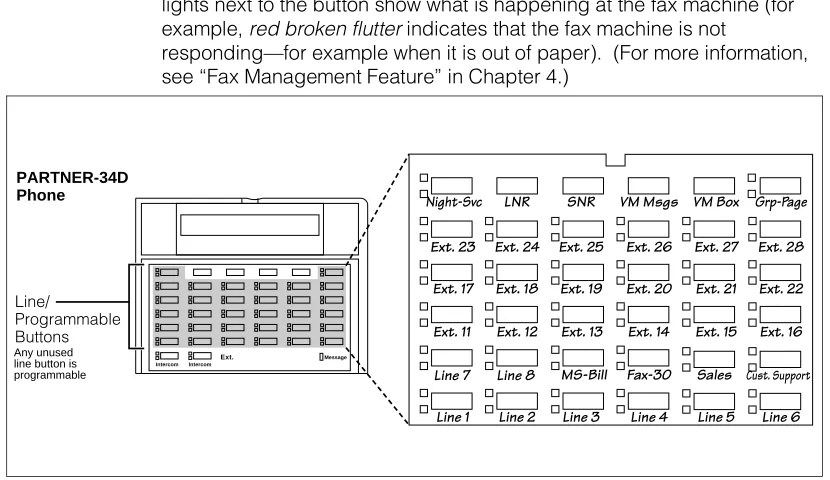
buttons. In addition, eachphone has programmable buttons that can be used for outside lines, extension numbers, outside phone numbers, or system features. Outside lines, as well as some system features, require buttons with status lights. Programmable buttons without lines assigned to them can be programmed with numbers or features, so you can use the feature or dial the number with one touch. The number in each PARTNER-model name indicates the number of programmable buttons with status lights plus two
i
buttons.If the PARTNER-model phone has a display, indicated by a “D” in the model name, users receive messages and prompts when making calls and when programming. (More information about the display is provided in Chapter 5.) A system display phone is required for system programming.
Table 1-3 summarizes PARTNER-model system phone features.
Table 1-3. PARTNER-Model System Phones
PARTNER-34D PARTNER-18D PARTNER-18 PARTNER-6
Total Number of Programmable Buttons with Status Lights
32 16 16 4
Total Number of Programmable Buttons without Status Lights
4 4 0 0
Line Capacity 15* 15* 15* 4
Intercom Buttons 2 2 2 2
Display ✔ ✔ — —
Speakerphone ✔ ✔ ✔ ✔
Intercom Autodialers
PARTNER-model system phones support the PARTNER-CA48 Call Assistant Intercom Autodialer at extensions 10 and 11. The autodialer provides Auto Dial buttons for all of the extensions in your system (up to 32). (The extra 16 buttons on the autodialer are not operational on your system.) The status lights next to each button also indicate calling activity at that extension. Users can program the Auto Dial buttons for either intercom ringing, voice signaling, or manual signaling. (Note that each user can have only one Auto Dial button—either on the system phone or on the autodialer—for another extension in the system.) The Auto Dial buttons allow the user to dial, signal, or transfer calls to system extensions with one touch. For more information about Auto Dial buttons, see “Auto Dialing” in Chapter 5.
Standard Telephones
You can also use industry-standard single-line rotary or touch-tone telephones, including feature phones with built-in feature buttons and lights, with the system. This guide refers to such telephones as standard phones. Lucent
Technologies-certified standard phones are recommended.
The following Lucent Technologies phones can make use of the system’s message-waiting capability:
2500 YMGL Single-Line Analog Telephone Set 8101 Analog Telephone
8101M Analog Telephone (This model is recommended.) 8102 Analog Telephone
8110 Analog Telephone
7102 Plus Analog Voice Terminal
Check with your local Lucent Technologies Representative or local Authorized Dealer to find out whether other standard phones with message-waiting lights will work.
NOTE:
Auxiliary Equipment
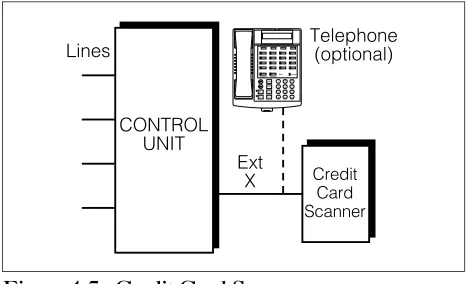
You can connect many types of telecommunications devices to your system without expensive adapters or additional phone lines—for example, answering machines, credit card scanners, and fax machines. Many industry-standard, single-line devices will work with the system regardless of the manufacturer. For more information, refer to the list in Chapter 4 or contact your Lucent
Technologies Representative or local Authorized Dealer. Also, see Chapter 4 for advice on setting up auxiliary equipment to work effectively with the system.
Requirements
An industry-standard device must meet the following conditions:
It must be nonproprietary. That is, it cannot be made specifically for use on a particular telephone system. (For example, you cannot connect a Lucent Technologies MERLIN® system phone, because it is specifically designed for use on a MERLIN system.)
Its Ringer Equivalence Number (REN*) cannot be greater than 2.0. (The REN is shown on a label on the device, usually on the bottom.)
You can connect a standard two-line device to the system, but for best results it should be installed and used as if it were a single-line device.
Connecting Standard Devices
You can connect a standard device so that it is on an extension by itself, or so that it shares an extension with another piece of equipment (either another standard device or a system phone) as long as the REN of the two devices together does not exceed 2.0. (System phones have 0.0 REN.) For example, you can connect a standard phone and an answering machine to the same extension. An extension with two devices connected to it is called a combination extension. You cannot connect two system phones on one extension. The PARTNER Advanced Communications System Installation guide provides installation instructions.
Contents
Overview
2-1Hardware Considerations
2-2Initial System Setup
2-3Setting the System Clock 2-3
Assigning Lines 2-4
Customizing Extensions 2-4
Copy Settings 2-5
Changing Settings after Installation
2-6Changing the System Clock 2-6
Adding New Lines 2-6
Adding New Extensions 2-6
Swapping Extensions 2-6
Changing Settings to Support
PBX or Centrex Services
2-7Recall Setting 2-7
Dialing Restrictions 2-7
Speed Dial and Auto Dial Numbers 2-7
System Programming Options
2-8Speed Dialing 2-8
Dialing Restrictions and Permissions 2-8
Locking an Extension 2-8
Restricting Access to Outside Lines 2-9 Controlling Calls on Outside Lines 2-10 Overriding Dialing Restrictions 2-11 Setting Up Groups of Extensions 2-11 Setting Up Auxiliary Equipment 2-12
Backup and Restore Features 2-14
Hospitality Features 2-14
Programming
Using System Programming
2-15The Programming Overlays 2-15
Button Locations 2-17
Programming Mode 2-17
Changing Programming Type 2-19
Remote Programming 2-19
Telephone Programming Options
2-20Automatic Line Selection 2-20
Extension Name on Display 2-20
Line Ringing 2-20
Personal Speed Dialing 2-20
Programming Telephone Buttons 2-20 Programming a Receptionist’s Extension 2-21
Call Handling Options 2-21
Button Programming 2-21
Using Telephone Programming
2-23Telephone Models 2-23
Using Centralized Telephone Programming 2-24
Changing Programming Type 2-25
Using Extension Programming 2-25
Overview
After the system hardware is installed, you can customize the system and individual telephones. This chapter explains how to use programming to accomplish that.
There are two types of programming:
System Programming allows you to customize the system to meet the
needs of your business. When the system is first installed, it uses factory settings that reflect the most commonly used options. You can change system settings as needed.
You can perform System Programming from either extension 10 or 11. Because an extension cannot be in programming mode and handle calls at the same time, consider using extension 11 for programming. Doing so gives you the ability to program without disrupting call handling by the receptionist at extension 10.
Telephone Programming allows telephones to be customized to meet
individual users’ needs. Individual telephones can be programmed either from extension 10 or 11 (Centralized Telephone Programming), or from a user’s extension using a system phone (Extension Programming). A system display phone is required for System and Centralized Telephone Programming. If you have any 34-button phones in the system, you must use a 34-button display phone to program since an18-button phone cannot be used to program a 34-button phone. Also, if your system has both PARTNER-model and MLS-model phones, it is recommended that you use a PARTNER-model display phone at the programming extension.
The system permits programming from a remote location using a Remote Administration Unit—see “Remote Programming” later in this chapter. This chapter provides general information about programming procedures. When a specific feature name is used, it is printed in bold type. For detailed descriptions and step-by-step instructions, refer to that name in Chapter 5. (A Programming Quick Reference is provided at the end of this book.)
Programming
Hardware Considerations
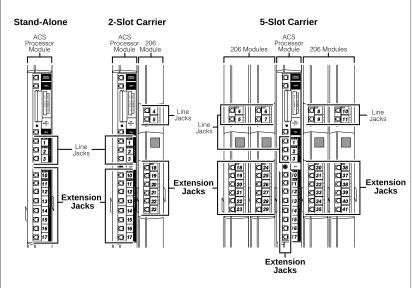
Programming procedures use line and extension numbers. The line number represents the line jack on a 206 or 400 module or an ACS processor module to which the outside line is connected. Similarly, the extension number represents the extension jack on a 206 module or an ACS processor module to which the system phone or standard device is connected.
For each 206 module, the system assigns two lines and six extensions; for the ACS processor module, the system assigns three lines and eight extensions; for each 400 module, the system assigns four lines. The system numbers lines and extensions consecutively from left to right in a 2-Slot carrier, beginning with the ACS processor module in the leftmost slot; in a 5-Slot carrier, the numbering also begins with the ACS processor module (in the center slot), and then moves to the leftmost module and continues consecutively from left to right.
Figure 2-1 shows the numbering scheme for a PARTNER ACS stand-alone configuration, for a 2-Slot carrier, and for a 5-Slot carrier, each with the system configured for maximum lines. Figure 2-2 shows the numbering scheme for a PARTNER ACS stand-alone configuration, for a 2-Slot carrier, and for a 5-Slot carrier, each with the system configured for maximum extensions. However, your system can have any number of lines or extensions up to the maximum.
Figure 2-1. PARTNER ACS Stand-Alone, 2-Slot, and 5-Slot Systems Configured for Maximum Lines (3, 7, or 15)
1 2 3 10 11 12 13 14 15 16 17 1 2 3 10 11 12 13 14 15 16 17 1 2 3 10 11 12 13 14 15 16 17 L I N E S PFT L I N E S PFT L I N E S L I N E S 4 5 6 7 8 9 12 13 E X T E N S I O N S PFT 24 25 26 27 28 29 E X T E N S I O N S PFT 23 18 19 20 21 22 Line Jacks Line Jacks L I N E S L I N E S 10 11 14 15 Line Jacks Extension Jacks Extension Jacks 206 Modules 5-Slot Carrier ACS Processor
Module 400 Modules
L I N E S 4 5 L I N E S 6 7 2-Slot Carrier Stand-Alone ACS Processor Module ACS Processor
Module Module400
Line Jacks
Figure 2-2. PARTNER ACS Stand-Alone, 2-Slot, and 5-Slot Systems Configured for Maximum Extensions (8, 14, or 32)
Initial System Setup
After the control unit is installed, you set up the system using a combination of system and telephone programming procedures. In this guide, System Programming procedures are identified by a code (# and three digits); Telephone Programming procedures are identified by the feature name only. Use the System Planner as a guide when programming. The following sections provide an overview of the procedures you use for initial system setup. Chapter 5 explains how to use the specific procedures. Other programming procedures are optional, but strongly recommended to make the most of your investment. (See “System Programming Options” and “Telephone Programming Options” later in this chapter for details.)
Setting the System Clock
After supplying power to the control unit, use the following procedures:
System Date (#101)to set the month and day.
System Day (#102)to set the day of the week.
System Time (#103) to set the hour and minutes.
1 2 3 10 11 12 13 14 15 16 17 1 2 3 10 11 12 13 14 15 16 17 1 2 3 10 11 12 13 14 15 16 17 2-Slot Carrier ACS Processor Module L I N E S 4 5 E X T E N S I O N S PFT 23 18 19 20 21 22 206 Module 5-Slot Carrier ACS Processor
Module 206 Modules
Assigning Lines
For initial setup only, use Number of Lines (#104) to specify the number of lines that will be assigned to all system extensions. Then use the following
procedures as needed:
Dial Mode (#201) to identify any rotary lines (the default for all lines is
“touch-tone”).
Line Assignment (#301) to assign lines to specific extensions (if the line
was not assigned using the Number of Lines procedure), to remove lines from some extensions, or to change the button used to pick up a line at a specific extension.
Line Access Restriction (#302) to prevent an extension from receiving
and/or making outside calls on specific lines.
Line Ringing(Centralized Telephone Programming) to specify when a
line will start ringing at each extension that has the line. For additional information about line ringing options, see “Programming a Receptionist’s Extension” later in this chapter.
Automatic Line Selection (Centralized Telephone Programming) to
specify the order in which the system selects an available line (intercom or outside), when a user at the extension lifts the handset or presses
S
to make a call without first selecting a specific line button.
For extensions with standard phones, set Automatic Line Selection
to intercom first. This enables standard phones to access system features, including intercom calling. When users lift the handsets on standard phones, they hear intercom dial tone. To access an outside line, they must dial
9
.Customizing Extensions
In addition to line assignments, the following procedures can be used to customize an extension:
Display Language (#303) to specify the language (English, French, or
Spanish) for messages that appear on a system display phone.
Automatic Extension Privacy (#304) to prevent other extensions with
the same line from joining a call at the extension. This feature is also useful for extensions connected to a modem, fax, or any device whose function can be disrupted by someone trying to join it.
Forced Account Code Entry (#307) to prevent the extension from
making an outside call until a required account code is entered. You can also use Forced Account Code List (#409) to create a list of valid account codes; this ensures that only authorized users with valid account codes can make outside calls.
Call Waiting (#316) to identify standard phone extensions that can
receive the system (not the local telephone company) call-waiting tone for a second incoming call when active on a call.
Disallowed List Assignments (#405) to assign one or more Disallowed Phone Number Lists to the extension. Use Disallowed Phone Number
Lists (#404) to create the lists of outside numbers that extensions cannot
dial.
Allowed List Assignments (#408) to assign one or more Allowed Phone
Number Lists to the extension. Use Allowed Phone Number Lists (#407)
to create the lists of outside numbers that otherwise-restricted extensions can dial.
Pickup Group Extensions (#501),Calling Group Extensions (#502),
Night Service Group Extensions (#504), and Hunt Group Extensions
(#505) to place the extension in any of these groups. See “Setting Up
Groups of Extensions” later in this chapter for more information.
Fax Machine Extensions (#601), Doorphone Extension (#604 and
#605), Doorphone Alert Extensions (#606),AA Extensions (#607),
External Hotline (#311), or Hotline (#603) to identify the extension as
one of these equipment types.
“Setting Up Auxiliary Equipment” later in this chapter provides an overview of the procedures you use for setting up devices such as voice messaging systems and call reporting devices. Also, Chapter 4 provides detailed information and example applications for auxiliary equipment.
Copy Settings
The recommended way to set up your system is to program one extension for each type of phone in the system, then use Copy Settings (#399) to program other phones of the same type. For example, you can program one
Changing Settings after Installation
As your business grows or changes, you will probably need to change the way your system was originally programmed. This section provides some examples and lists the procedures you would use to change settings after installation. For specific details on a procedure, refer to the procedure name in Chapter 5.
Changing the System Clock
You may need to change the system clock for daylight saving time, after a prolonged power failure, or after a system reset. Use System Date (#101),
System Day (#102), and System Time (#103) to set the current date, day, and
time.
Adding New Lines
If you add an outside line to your system, you may need to adjust some line settings. In particular, use Dial Mode (#201) if the new line is a rotary line, Line
Assignment (#301) to assign the line to specific extensions, Line Ringing
(Centralized Telephone Programming) to specify when the line will start ringing at each extension that has the line, and Line Access Restriction (#302) to limit an extension’s access to the line. Additionally, the system automatically assigns the new line as the last line in the Automatic Line Selection sequence. If you want to change the order, use Automatic Line Selection (Centralized Telephone Programming).
IMPORTANT:
Do not use Number of Lines (#104) if you add lines to the system after initial setup, because it changes Line Assignment (#301), Line Access Restriction
(#302), Automatic Line Selection, and Line Ringing for existing lines back to
factory settings. To add a new line without affecting other settings, use Line Assignment (#301).
Adding New Extensions
If you add an extension to your system, you can probably use Copy Settings
(#399) to copy the settings of an existing extension. If you wish to further adjust
a new extension’s settings, see “Customizing Extensions” earlier in this chapter.
Swapping Extensions
If a user changes location, but wants to keep the same extension number, you can make the change easily by changing the connection at the control unit. For example, if the users at extensions 29 and 32 switch offices, you can disconnect the modular plugs from those extension jacks in the control unit. Then reconnect the plug from 32 into extension jack 29 and the plug from 29 into extension jack 32. Now the users can take their respective phones to their new locations, keep the same extension numbers, and retain the phones’
Changing Settings to Support
PBX or Centrex Services
This section applies only if you use PBX or Centrex services with your system. If it does not apply, go to the next section, “System Programming Options.”
PBX services are provided by a private telephone switch.
Centrex services are provided by your local telephone company from a Central Office (CO) outside your premises. These services include the Centrex lines connected to your control unit modules and some set of features—such as hold, conference, or transfer—that are available on those lines. Centrex services may be offered in your area under a different name. For specific Centrex features to be available to you, your company must subscribe to those features. For specific information about using Centrex, see the Centrex documentation provided by your local telephone company.
Some of the issues you should consider when setting up your system to work effectively behind a PBX or Centrex system are discussed below. Chapter 5 explains how to use the programming procedures discussed here.
Recall Setting
To set up your equipment to work properly with a PBX or Centrex system, first set
Recall Timer Duration (#107) to match the setting used by your PBX or Centrex
system (usually 800 msec, or “32”). This setting affects the length of a Recall signal sent by the control unit to access PBX or Centrex services.
Dialing Restrictions
Outgoing Call Restriction (#401) is an equipment restriction intended to limit an
extension’s dialing to “inside calls only” (using the
i
buttons on system phones) or to “inside and local calls only” (allowing calls within the PBX or Centrex system and local calls outside the PBX or Centrex system). However, if users in your system use a dial-out code (9 on most PBX or Centrex systems) before dialing numbers outside the PBX or Centrex system, the equipment will not be able to prevent toll calls for extensions restricted to “inside and local calls only” (unless you use Disallowed Phone Number Lists to prevent dialing to specific classes of numbers).If your PBX or Centrex system includes dialing restrictions, use those instead of the equipment restrictions. If you have PBX or Centrex dialing restrictions on a line and also program equipment restrictions, both the PBX or Centrex system and equipment restrictions apply. However, equipment dialing permissions will not override PBX or Centrex system restrictions.
Speed Dial and Auto Dial Numbers
System Programming Options
This section discusses programming options that involve multiple procedures (such as dialing restrictions and auxiliary equipment settings), as well as features that can be used throughout your system (such as Speed Dialing). You can use a combination of programming procedures to set up your system to operate most efficiently, taking into account your company’s telephone service, personnel, and equipment, as well as the special needs of particular
departments. This section lists the procedures you can use; for details on using a particular procedure, refer to the procedure name in Chapter 5.
Speed Dialing
You can program up to 100 frequently dialed phone numbers—such as numbers for suppliers, repair services, customers—so that all users in the system can dial them by pressing four buttons:
f
(or#
on a standard phone) plus a three-digit code. These are called System Speed Dial Numbers.Dialing Restrictions and Permissions
The system has several procedures for restricting telephone use, and several for overriding those restrictions. You can use any combination of these procedures to design a system that meets your needs.
When a user makes a call, the system checks the number dialed against all of the dialing restrictions that apply to the extension making the call. When the number dialed passes a restriction, the system goes to the next restriction, if necessary. If Star Code Dial Delay (#410) is active, star codes are also checked against the restrictions. (Star codes, typically dialed before an
outgoing call, provide special services from the local telephone company Central Office (CO); for example,
*67
enables a dialer to block the sending of Caller ID information to the called party.) When a user dials a star code, the system checks it against the dialing restrictions to determine whether the code is allowed. If the code is allowed, the system resets its checking procedure and checks the remaining digits that the user dialed to make sure the call ispermitted. When a number violates a restriction, the call is stopped and the user hears a reorder tone (fast busy signal).
IMPORTANT:
While procedures that restrict dialing are very effective, absolute protection against misuse cannot be guaranteed. System phones provide more protection than standard phones. Therefore, it is strongly recommended that you install system phones where restricting phone use is important.
Locking an Extension
Restricting Access to Outside Lines
A user can access a line either by lifting the handset, pressing the line button on the phone, or dialing the Direct Line Pickup feature code. If you do not want a user to access a specific outside line, you can use Line Access Restriction
(#302) to control an extension’s access to a certain line (whether the line is
assigned to the extension or not). Table 2-1 provides examples of settings that can be used to restrict an extension’s access to a specific outside line.
NOTE:
If Forced Account Code Entry (#307) is programmed for an extension, that
extension is required to enter an account code before dialing an outside number on all of the lines assigned to that extension—even those on the Emergency
Phone Number List (#406). If the Forced Account Code List (#409) contains
entries, the system checks the account code against the list. If the account code is on the list, line access is allowed; if not, line access is denied.
Table 2-1. Settings that Restrict an Extension’s Access to a Specific Line
Type of Restrictions or Permissions for the Extension
Setting for Line Assignment (#301)
Setting for
Line Access Restriction (#302)
Can receive and place
intercom (inside) calls only All outside lines “notassigned”* “No access” for all lines
Cannot use a specific outside line
Outside line “not assigned”* “No access” for that line
Can only monitor call activity and pick up held calls on a specific line
Outside line “assigned” “No access” for that line
Can only receive calls on a
specific line Outside line “assigned” “Incoming only” for that line
Can only place outgoing calls on a specific line
Outside line may be
“assigned”* “Outgoing only” for that line
Controlling Calls on Outside Lines
When an extension is allowed access to an outside line, you can use the following procedures to control calling:
Outgoing Call Restriction (#401) defines the type of calls (inside only,
local only, or inside, local, and long-distance) that users can make from all lines available at an extension. Outgoing Call Restriction Button
(#114) allows the receptionist at extension 10 to quickly change an
extension’s current Outgoing Call Restriction setting.
Disallowed Phone Number Lists (#404) creates up to eight lists of
numbers that cannot be dialed. After creating Disallowed Phone Number Lists, use Disallowed List Assignments (#405) to assign one or more lists to a specific extension.
Night Service with System Password (#403) restricts users at
extensions in the Night Service group from dialing outside phone numbers (except Emergency numbers and Marked System Speed Dial numbers) unless the password is entered first.
Table 2-2 provides examples of settings that can be used to restrict an extension’s dialing once it gets an outside line.
Table 2-2. Settings that Restrict an Extension’s Dialing Once It Gets an Outside Line
Type of Restrictions or Permissions for the Extension Setting for Line Assignment (#301) Setting for Line Access Restriction (#302) Setting for Outgoing Call Restriction (#401) Setting for Disallowed Phone Number Lists (#404)** Can place intercom and local calls only (and can answer any call)
Outside line*
may be “assigned”
“No restriction” “Local only” Any local numbers the extension should not dial Can place intercom, local and long-distance calls (and can answer any call)
Outside line*
may be “assigned”
“No restriction” “No restriction” Any local and long-distance numbers the extension should not dial
*
If a line is not assigned to the extension, a user can use Direct Line Pickup to access the line. Emergency numbers, Marked System Speed Dial numbers, Allowed Phone numbers, and numbers dialed using the System Password override all dialing restrictions if a user has access to an outside line to place the call. If Forced Account Code Entry is programmed for an extension, the user must enter an account code before accessing an outside line. If there are entries in the Forced Account Code List, the entered account code must match an entry on that list.Overriding Dialing Restrictions
The following programming procedures provide ways to override all dialing restrictions, provided the user has access to an outside line:
Emergency Phone Number List (#406) defines a list of up to ten
numbers that can be dialed from any extension. A typical number is 911. Marked System Speed Dial Numbers are specially identified System Speed Dial numbers, which a user can dial by pressing
f
(or#
on a standard phone) followed by a three-digit code.System Password (#403)creates a password that can be entered at any
PARTNER-model or MLS-model system phone to override dialing restrictions for the duration of a call.
To override all dialing restrictions except Line Access Restriction (#302) and
Night Service with System Password (#403), use Allowed Phone Number
Lists (#407) to create up to eight lists of outside numbers that
otherwise-restricted extensions can dial.Then use Allowed List Assignments
(#408) to assign one or more of the lists to an extension.
Setting Up Groups of Extensions
You can set up four types of extension groups:
Pickup Group Extensions (#501) assigns extensions to one of four
Pickup Groups. A Pickup Group lets any user in the system answer outside calls for any extension in that group.
Calling Group Extensions (#502) assigns extensions to one of four
Calling Groups. A Calling Group lets users ring or page all extensions in that group simultaneously or transfer calls into the group. (Additionally,
Simultaneous Paging lets users make announcements over the
loudspeaker paging system and the speakers of idle system phones belonging to Calling Group 1.)
Night Service Group Extensions (#504) assigns extensions to the Night
Service Group. When Night Service is activated at extension 10, calls ring immediately at Night Service extensions regardless of how they ring at other times (only the lines assigned to an extension will ring).
Hunt Group Extensions (#505) assigns extensions to one of seven Hunt
Setting Up Auxiliary Equipment
The following programming procedures help you manage auxiliary equipment. See Chapter 4 for more information about auxiliary equipment configurations or refer to Chapter 5 for details on using the procedure:
Fax Machine Extensions (#601) identifies extensions to which fax
machines are connected.
The music-on-hold feature uses the following procedures:
— Music on Hold (#602) activates or deactivates the MUSIC ON HOLD
jack on the PARTNER ACS processor module.
— When this jack is activated, an audio source is connected, and Ring
on Transfer (#119) is set to Not Active, callers hear recorded music
or messages while being transferred.
— Music on Hold Volume (#614) controls the volume at which the music
plays when the MUSIC ON HOLD jack is active. Changes to this setting affect the many features that use Music on Hold: Background
Music, Call Park, Call Waiting, Conference, Exclusive Hold, Hold,
Transfer, and Transfer Return.
— Background Music lets users with system phones (other than the
MDC 9000 or TransTalk 9000-series phones) play the recorded material through their phone’s speaker when the phone is not in use.
Hotline (#603)identifies internal hotline extensions, so when a person
lifts the handset of the hotline phone, a predetermined extension number automatically rings. External Hotline (#311)identifies external hotline extensions, so when a person lifts the handset of the hotline phone, a predetermined outside phone number is automatically dialed.
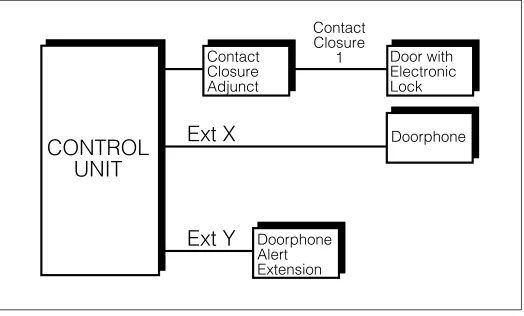
Doorphone Extension (#604 and #605) identifies extensions to which
doorphones are connected. Doorphone Alert Extensions (#606)
identifies extensions that signal when the doorphone button is pressed. The Contact Closure Adjunct, which plugs into a jack on the PARTNER ACS processor module and has two Contact Closures that can be used to control devices such as an electronic door lock or an alert, uses the following procedures:
— Contact Closure Group (#612) specifies which extensions can
activate one or both of the Contact Closures on the Contact Closure Adjunct.
— Contact Closure Operation Type (#613) specifies the length of time
that each Contact Closure remains active.
— Contact Closure F41 and F42 can be programmed on feature
buttons so that the Contact Closures can be activated by pressing the buttons.
AA Extensions (#607) identifies an extension to which an auto attendant
is connected. This lets the system notify users with display phones when they are receiving a call that has been transferred from the auto
The call reporting device uses the following procedures:
— SMDR Record Type (#608) specifies the type of calls that you want to
record for call reporting—either all calls or outgoing calls only.
— SMDR Top of Page (#609) notifies the system that the printer has
been aligned to the top of a new page.
— SMDR Output Format (#610) identifies whether a maximum of 15
digits or 24 digits is printed for dialed numbers on the call report.
— Account Code Entry lets users enter account codes for outside
telephone calls (incoming or outgoing); if used, the account codes are included on the call report.
The voice messaging system uses the following procedures:
— Hunt Group Extensions (#505) assigns the extensions associated
with the voice messaging system hardware to Hunt Group 7—the VMS Hunt Group.
— Group Call Distribution (#206) assigns lines to the VMS Hunt Group
so calls can ring directly into the voice messaging system and receive Automated Attendant Service.
— Line Coverage Extension (#208) identifies an extension as the owner
of a specific outside line so calls on that line can ring directly into the owner’s voice mailbox when either Automatic VMS Cover (#310) or
VMS Cover is on at the owner’s extension.
— VMS Hunt Delay (#506) determines when outside calls should be
answered by the Automated Attendant Service of the voice messaging system. You can set the system for either immediate call handling or delayed call handling. The setting you select is used for both day and night operation.
— VMS Hunt Schedule (#507) determines when outside calls should
ring the VMS Hunt Group (always, day only, or night only) depending on the status of the Night Service Button (#503) at extension 10.
— Automatic VMS Cover (#310) determines whether or not an
extension’s unanswered intercom and transferred calls and outside calls on lines assigned ownership are automatically covered by the voice messaging system.
— VMS Cover Rings (#117) specifies the number of times intercom and
transferred calls or outside calls on lines assigned ownership ring at extensions before they are sent to the voice messaging system.
— Transfer Return Extension (#306) identifies the extension to which a
call transferred by the voice messaging system should be routed if the destination extension does not answer and does not have voice mail coverage active. (The transfer return extension for the voice
Backup and Restore Features
The PARTNER ACS processor module has two PC Card slots. These slots function similarly to a floppy drive on a PC, in that information can be added to the system or copied from the system using a PC Card inserted in one of the slots. To use the optional Backup and Restore features of the system, you must purchase a Backup/Restore PC Card from Lucent Technologies. Only these Lucent Technologies PC Cards can be used in the PARTNER ACS processor module. The same PC Card stores both automatic and manual backups separately.
Backup Programming—Automatic (#123) enables you to specify whether
automatic backups should be performed or not. If you set this feature to
“Active,” your system and telephone programming settings are backed up to the PC Card automatically at 2:00 a.m. on the first day of each month. The PC Card must be present in the PC Card slot for the backup to take place.
Backup Programming—Manual (#124) enables you to initiate a backup of your
system and telephone programming settings whenever you feel that it is
necessary. It is recommended that a backup be performed after any change to the system or telephone programming.
Restore Programming (#125) copies either the manual or the automatic
backup data stored on a PC Card back to the system, thereby enabling you to restore settings to their status at the time of the last automatic or manual backup.
Hospitality Features
The following hospitality features are for special applications, such as the Bed-and-Breakfast and Hotel/Motel industries. With both features, the
receptionist at extension 10 optionally can use the Intercom Autodialer to specify an extension.
Outgoing Call Restriction Button (#114) lets you program a button on
the system phone at extension 10 to change an extension’s current Outgoing Call Restriction setting without entering System Programming mode. For example, after a guest’s departure, a hotel manager can change the No Restriction setting of the guest room phone to Inside Only so outside calls cannot be made from the phone after the guest checks out.
Wake Up Service Button (#115) lets you program a button on the
Using System Programming
System Programming changes settings for the system as a whole, or for individual lines or extensions. You can also use System Programming to set up dialing restrictions, define groups, or set up auxiliary equipment. Refer to the filled-out System Planner when you are changing system settings, and be sure that any changes in programming are recorded there.
The Programming Overlays
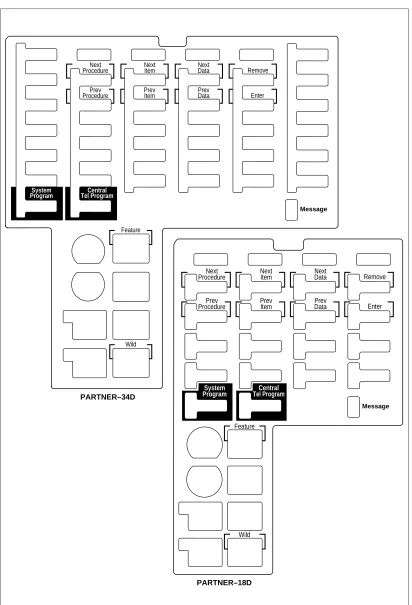
System Programming requires a Programming Overlay placed over the dialpad of the system display phone at extension 10 or 11. (Overlays are provided with the system documentation. Replacements can be ordered from the Lucent Technologies BCS Publications Center. See “Reference Materials” under “Product Ordering Information” in Appendix B.) Figure 2-3 on page 2-16 illustrates the Programming Overlays for the PARTNER-34D and PARTNER-18D phones.
During System Programming, the normal functions of several buttons on the display phone at extension 10 or 11 change. For example, the left
i
button becomess
and the righti
button becomesc
. The Programming Overlay identifies these buttons.You use the following special buttons while programming:
N
andP
cycle forward and backward through the programming procedures. You can use these buttons to select a procedure.(If a procedure instructs you to press
NP
, pressing these buttons one after the other enables you to repeat the current programming procedure.)n
andp
cycle forward and backward through a procedure’s parameters. A parameter is typically an outside line, an extension, or a telephone list entry.D
andd
cycle forward and backward through the valid entries. These buttons work only for fixed data, such as a line orextension number. They do not work for variable data such as date, time, password, telephone numbers, or doorphone assignments.
r
returns the current setting to the factory setting—or, when usingLine Assignment (#301), removes lines from an extension.
e
ends an entry of variable length, such as a telephone number in an Allowed Phone Number List.s
starts the System Programming process.c
starts the Centralized Telephone Programming process (to customize individual telephones centrally from extension 10 or 11).f
when followed by0
0
, enters or exits programming mode.w
enters a “wildcard” (a character that matches any digit dialed) in telephone numbers in Allowed Phone Number Lists (#407), DisallowedFigure 2-3. Programming Overlays for PARTNER-Model Phones
Next Procedure
Feature Prev
Procedure
Next
Item NextData Remove
Prev
Item PrevData Enter
System Program
Wild
Central Tel Program
PARTNER–34D
Next Procedure
Prev
Procedure PrevItem DataPrev Enter
Next Item
Feature
Next
Data Remove
Wild
System
Program Tel ProgramCentral
PARTNER–18D
Button Locations
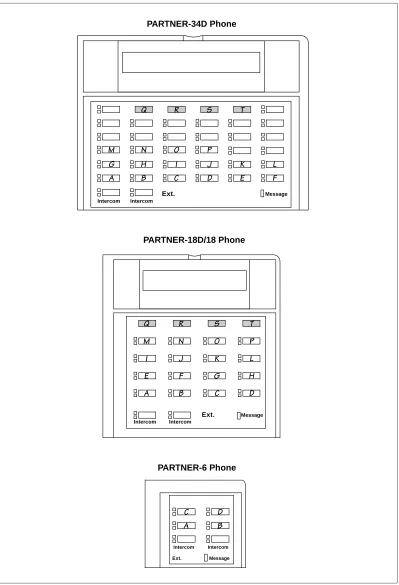
When programming from a PARTNER-model phone at extension 10 or 11, keep in mind that the button you press at the programming extension may be in a different location on the phone to which the programming applies. Figure 2-4 on page 2-18 shows the relative location of buttons on each PARTNER-model phone. For example, the button labeled E on the PARTNER-34D phone in Figure 2-4 is in the bottom row. The equivalent button on the PARTNER-18D phone is in the leftmost position of the second row from the bottom. If your system has a mix of PARTNER- and MLS-model phones, refer to Appendix E for information about programming from a PARTNER-model phone to an MLS-model phone or from an MLS-model phone to a PARTNER-model phone.
Programming Mode
1. Place the Programming Overlay over the dialpad of the system display phone at extension 10 or 11—see “The Programming Overlays” earlier in this
chapter for more information.
2. To enter programming mode, press
f
0
0
. A display similar to the following appears:PROGRAM EXTENSION 10
(If you are programming from extension 11, “11" displays instead of “10.”) 3. Press
s
. A display similar to the following appears:10 Enter Extension Name
This display is for the Extension Name Display feature. When you are entering System Programming mode, skip it by moving on to Step 4. 4. Press
s
again. A display similar to the following appears:SYSTEM PROGRAM
5. Specify a programming procedure in one of two ways:
Direct Method: Dial the code for that procedure. System
Programming procedures in this guide are identified by a # and a three-digit code (for example, System Date is #101). This method is best when you are using only a few procedures during a programming session and you know the codes.
Cycle Method: Cycle through the procedures in numerical order.
Press
N
andP
to cycle forward and backward through the programming procedures. This method is best when you are using multiple procedures during a programming session, or if you do not know the codes.6. To exit programming mode, you can press
f
0
0
or lift the handset off-hook, then place it back in the cradle.NOTE:
You can talk on the phone while you program. This is useful if you call for support while programming. However, you must call before you enter
Figure 2-4. Button Locations on PARTNER-Model Phones
Intercom Intercom
Ext. Message
Intercom Intercom
Message Ext.
Intercom Intercom
Ext. Message
A B C D
M N O P
Q R S T
G H
E F K L I J
M N O P
Q R S T
I J K L
E F G H
A
B D
A C
B C D
PARTNER-34D Phone
PARTNER-18D/18 Phone
Changing Programming Type
When you are in programming mode, you can move between System Programming and Centralized Telephone Programming. To change to Centralized Telephone Programming when you are in System Programming, press
c
. To move back to System Programming when you are in Centralized Telephone Programming, pressc
thens
.Remote Programming
The system permits programming from a remote location using an auxiliary device called the Remote Administration Unit (RAU). Remote programming requires the installation of two RAUs—one at your site and one at the location from which the programming is to be done. For more information about remote programming, see the PARTNER Communications System Remote
Telephone Programming Options
System telephones are ready to use when they are installed, but they can be customized to meet the needs of your business and individual users. This customization is accomplished through Telephone Programming.
Automatic Line Selection
When a user lifts the telephone’s handset or presses
S
, the system chooses an idle line automatically. Automatic Line Selection determines the order in which the system looks for an idle line. You can set the system to look for lines in any desired order. For standard phones or for any phone used mainly to call other extensions, select an inside (intercom) line first.Extension Name on Display
With Extension Name Display, users can assign a name (up to 20 characters long) to their extension. Then, when those users make an intercom call, group call, or transfer a call, their name and extension number appears on the display phone receiving the call. Similarly, users receiving a transfer return call see the name and extension number of the person assigned to the extension that did not answer the transferred call.
Line Ringing
Line Ringing defines when each outside line rings at a phone. For each line at
an extension, you can specify Immediate Ring, Delayed Ring (phone rings after a 20-second delay), or No Ring.
Personal Speed Dialing
Personal Speed Dial numbers are outside phone numbers that a user dials by pressing
f
(or#
on a standard phone) plus a two-digit code. Unlike System Speed Dial numbers, which are available to all users in the system, Personal Speed Dial numbers are available only at the extension for which they are programmed. Users can store up to 20 Personal Speed Dial numbers.Programming Telephone Buttons
Programming a Receptionist’s Extension
Call Handling Options
If you set up a centralized telephone answering position at extension 10, use the following settings to customize it:
Immediate Call Answering. If the receptionist should answer all calls,
use Line Assignment (#301) to assign all lines to extension 10. Set Line
Ringing for all lines at extension 10 to Immediate Ring; set the lines
assigned at each user’s extension to Delayed Ring or No Ring.
Backup Call Answering. If the receptionist should answer some lines
only when a user does not pick up, set Line Ringing for those lines at extension 10 to Delayed Ring; set the lines assigned at each user’s extension to Immediate Ring.
No Answering. If some lines should not be picked up by the receptionist
at all, either set Line Ringin