ABSTRACT
PANDE, RASIKA HEMANT. Automating the Extraction and Evaluation of Comments in Source Code. (Under the direction of Dr. Collin Lynch).
Writing comments serves as the primary way to document source code internally and
improve its readability. In Computer Science education, assignments in introductory
pro-gramming courses may require students to explain the underlying logic and functionality
of their program in the form of comments. This practice has been thought to help students’
reasoning about the code and thus improve their ability to program effectively. Research
has also shown that writing comments can help students organize their code logically
and visually. However, there is no standardized mechanism of automatically providing
feedback to students based on the semantic meaning of their comments. Since comments are written in natural language, such an evaluation would have to be performed manually
by instructors. In this thesis, we present a tool to automate the extraction and evaluation of
comments from code submitted in introductory programming courses. The focus of our
work is on Java source code written by Computer Science undergraduate students at North
Carolina State University. The tool first extracts comments from source code files and then
tags them with the associated code context by traversing the program’s Abstract Syntax
Tree. We then evaluate these comments based on their descriptiveness and similarity with
© Copyright 2019 by Rasika Hemant Pande
Automating the Extraction and Evaluation of Comments in Source Code
by
Rasika Hemant Pande
A thesis submitted to the Graduate Faculty of North Carolina State University
in partial fulfillment of the requirements for the Degree of
Master of Science
Computer Science
Raleigh, North Carolina
2019
APPROVED BY:
Dr. Sarah Heckman Dr. Christopher Parnin
BIOGRAPHY
Rasika Pande received her Bachelor’s in Computer Engineering from College of Engineering
Pune. After graduating in 2016, she worked at Vuclip India Pvt. Ltd. in data analytics. In 2017,
she joined the Master’s program in Computer Science at North Carolina State University to
ACKNOWLEDGEMENTS
I would like to thank my advisor, Dr. Collin Lynch, for his support, encouragement, and
guidance throughout the course of this thesis. I would also like to thank Adam Gaweda for
all his help. Finally, I would like to acknowledge the constant support of my family and my
TABLE OF CONTENTS
LIST OF TABLES . . . v
LIST OF FIGURES. . . vi
Chapter 1 INTRODUCTION. . . 1
1.1 Motivation . . . 1
1.2 Goals . . . 2
1.3 Contribution . . . 2
Chapter 2 LITERATURE SURVEY. . . 3
2.1 Source Code Explanation . . . 3
2.2 Comment Analysis . . . 4
2.3 Automated Grading for Short Answer Responses . . . 6
Chapter 3 METHODOLOGY. . . 8
3.1 Extracting Comment-Code Pairs . . . 8
3.1.1 Comment Extraction . . . 9
3.1.2 Source Code Tagging . . . 9
3.2 Feature Extraction . . . 13
3.2.1 Comment Complexity . . . 14
3.2.2 Comment Similarity with Source Code . . . 15
3.3 Comment Classification through Machine Learning . . . 16
Chapter 4 EXPERIMENTAL RESULTS. . . 17
4.1 Data for Experiments . . . 17
4.1.1 Comment Extraction . . . 18
4.1.2 Dataset Preparation . . . 19
4.2 Model Details . . . 20
4.3 Performance of the Models . . . 21
4.4 Analysis . . . 25
Chapter 5 CONCLUSION . . . 26
LIST OF TABLES
Table 4.1 Extracted comments per assignment. . . 18
Table 4.2 Top six most commented constructs. . . 19
Table 4.3 Datasets for Assignment 1. . . 20
Table 4.4 Datasets for Assignment 2. . . 20
Table 4.5 Performance for Assignment 1. . . 22
Table 4.6 Performance for Assignment 2. . . 23
LIST OF FIGURES
Figure 3.1 Java Inline Comments. . . 10
Figure 3.2 Python Inline Comments. . . 11
Figure 3.3 Java Comment Preceding Code. . . 11
Figure 3.4 Python Comment Preceding Code. . . 12
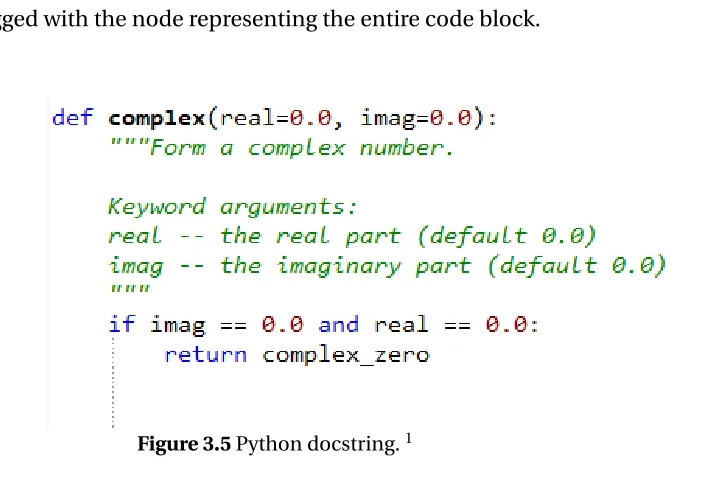
Figure 3.5 Python Docstring. . . 12
CHAPTER
1
INTRODUCTION
1.1
Motivation
Documenting code using comments is often considered as one of the best practices for
understanding program functionality and maintaining software. As a result, programming
assignments in introductory programming courses look to inculcate this habit in students
by requiring them to supplement their code with appropriate comments. It is possible
to automate grading certain aspects of these assignments, like checking their output or
checking if test cases pass or fail. However, evaluating comments based on whether they
effectively describe program logic usually requires manual intervention. We want to reduce
the manual efforts required by instructors and TAs in providing feedback to students based on the quality of their comments. One of the challenges here is automatically interpreting
the language used in comments. Although comments like Javadocs have a certain level of
structure to them, there is significant natural language content that still needs to be parsed.
A comment can also be written in multiple ways to express the same meaning, which can
student comments lacks a standardized approach.
1.2
Goals
Our overall goal is to address this problem of automating the evaluation of comments from
programming assignments written by students. We aim to highlight submissions which
are satisfactorily commented against the ones which are not, using supervised machine
learning techniques. To achieve this goal, we first need to extract individual comments
from programs, associate them with the lines of code they describe, and analyze natural language aspects of the comments.
1.3
Contribution
This thesis presents a preliminary but novel approach to classify student comments based
on their semantic quality using natural language processing and supervised machine
learning techniques. We demonstrate its effectiveness by assessing Java comments from two
different programming assignments based on their descriptiveness and semantic similarity with code. A major contribution of our work also includes a generalized technique for
deriving source code contexts for Java and Python comments. Using Abstract Syntax Tree
CHAPTER
2
LITERATURE SURVEY
2.1
Source Code Explanation
To establish a relationship between students’ ability to write effective code explanations
and their programming skills, Corney et al. studied responses to questions from a CS-2 level
data structures course exam, which asked students to describe the purpose of code snippets
in simple English[Cor14]. Significant correlation was found between students’ scores on
these and on the questions which required code to be written. Based on these results, the
authors recommend a mix of writing and explaining code as a part of the coursework in
order to develop students’ programming ability.
Additionally, research on students’ thinking patterns has demonstrated the value of
describ-ing code in the form of comments. Mohammadi-Aragh et. al analyzed comments written by
novice programmers as part of Writing to Learn (WTL) programming assignments[MA18].
When these were compared to traditional assignments (which did not require comments
and divided the code into logical sections, displaying a better organizational strategy.
Both these studies try to improve the process of learning to program by establishing a need
for writing comments and effective code explanations. We aim to analyze these comments
written by students and determine if they are indeed effective and well-written.
2.2
Comment Analysis
Haouari et al. analyzed the commenting patterns of Java developers, who had experience with programming in Java[Hao11]. In the three-open source Java projects that they studied,
the authors observed that developers usually explain the functionality of program
con-structs using instruction keywords rather than abstract terms. Khamis et al.[Kha10]and
Schreck et al.[Sch07]developed several heuristics and metrics to measure aspects like
readability and completeness of Javadoc comments to ensure that they serve as clear and
understandable documentation for developers. Khamis et al., for example, developed an
automated approach to measure the quality of the Javadoc language by calculating the
number of nouns, verbs, abbreviations, and the average number of words per comment [Kha10]. They also checked if the correct names, types and descriptions were present while writing Javadoc tags for return values, method parameters and exceptions in the code. This
check for comment-code consistency is restricted to the analysis of Javadoc tags. While we
also aim to analyze the similarity between code and comments, we do a deeper,
semantic-based comparison between them. Steidl et al. have presented a scheme to judge the quality
of comments with an aim to identify the ones that can be refactored[Ste13]. This evaluation
was based on four criteria — coherence between the comment and code, the completeness,
consistency, and usefulness of comments in understanding the purpose of the code. The
coherence metric uses Levenshtein distance to measure the relevancy between the text in
the comment and its associated method name. However, it does not perform an analysis of their semantic similarity, which we aim to do. In case of method comments, we also
compare the comment with the entire body of the method and not just the method name.
Other researchers have also studied the consistency between comments and code by
em-ploying Natural Language Processing (NLP) techniques. Liu et al. computed program
and their return parameters[Liu15]. While we use WordNet to check for synonyms, our
analysis is not restricted to method comments. Along with semantic similarity, we also use
descriptiveness as a feature for evaluating comments. Chen et al. developed a Skip-gram
model to check similarity between comments and individual statements of code[Che18].
They use this similarity as one of the features of determining scopes of comments, whereas
our main aim is evaluating the quality of the comment. Deep sequence-to-sequence
learn-ing has been used to find redundant comments which are highly similar to the code and
can be directly inferred from it[Lou18]. However, the tool developed in that study currently
works only for method-level comments, while we aim to evaluate statement-level
com-ments as well. Tan et al. have developed a tool called iComment to detect discrepancies between comments and the associated code using a combination of NLP, mixture model
clustering, and rule extraction[Tan07]. According to Tan, Yuan, Krishna, and Zhou, such a
discrepancy may either denote a software bug or a bad comment. The scope of this study is
limited to checking the comment-code consistency, and it does not evaluate the quality or
comprehensiveness of the comment. Additionally, the focus is on comments stating the
developer’s assumptions and requirements, while comments providing explanations of
code segments are ignored.
The research discussed above focuses on code written by relatively experienced developers. On the other hand, there are limited studies which evaluate comments written by novice
programmers. A preliminary analysis of student-written comments has been the focus
of[DeP12], where the authors have developed a tool to report the commenting practices
of undergraduate students and professional open-source developers. According to the
authors, analyzing the differences between the two can help students assess and improve
their own commenting style. The tool does not evaluate any natural language aspects
of the comments, instead extracting only basic Javadoc metrics like (i) checking for the
presence of Javadoc tags wherever applicable (ii) calculating the percentage of methods in
a class that have Javadocs (iii) calculating the average number of words found in method documentation (iv) checking for correct spellings (v) checking for offensive words (vi)
checking for pre and post conditions. Currently, the system simply reports the values of
these metrics. For instance, the authors observed that students rarely used Javadoc-style
tags for method-level documentation and barely commented 50% of all methods. The tool
our work. Instead, the differences between the commenting styles found in coursework
assignments and open-source projects are only meant to serve as guidelines to students
about the general best practices adopted by professional developers.
2.3
Automated Grading for Short Answer Responses
Grading short answer responses has traditionally been a manual task performed by
instruc-tors, given the unstructured nature of the answers. Automating this process would require
understanding the semantic meaning of responses, and similar grades would need to be assigned to answers similar in meaning[Kle11].
We believe there is considerable similarity between automating the grading of short answer
responses and that of source code comments. Both involve parsing and evaluating concise
explanations written in natural language. In many cases, there may not always be a model
answer which can be used as a grading rubric. Additionally, their unstructured nature
also means that short answers and comments can be written in a variety of different ways
to express the same meaning. These similarities motivated us to also survey research in
NLP techniques for automatically assessing short answer responses. However, the key distinction between short answers and comments is that the short answers addressone,
single topic withmanypossible answers from different students. By contrast, our scenario
hasmanyways of writing comments for the corresponding code, which itself maydiffer
every time.
Pulman et al. have compared pattern-based Information Extraction approaches with
ma-chine learning methods like Inductive Logic Programming, Naïve Bayes classifier, and
Decision Trees to grade questions on Science exams[PS05]. Out of all approaches,
Informa-tion ExtracInforma-tion achieved the best performance though it involved manual efforts in creating customized patterns. In[Kle11], a set of manually graded short answers to questions on
Computer Science exams was used to automatically grade other responses that were
simi-lar in meaning. The simisimi-larity of the text was determined using Latent Semantic Analysis
and a combination of cosine similarity and Euclidean distance. Cutrone et al. have also
auto-graded single sentence responses with respect to a correct answer submitted by the
CHAPTER
3
METHODOLOGY
Our approach to evaluating comments consists of three major steps – First, we extract all
comments and tag them with the code they document. Next, we use this data to create
features related to the descriptiveness of comments and their similarity with source code. Fi-nally, based on the extracted features, we classify comments assatisfactoryorunsatisfactory
using supervised machine learning techniques.
3.1
Extracting Comment-Code Pairs
This process reads a source code file and returns a list of all comment-code pairs in the
file. Currently, it supports parsing Java and Python source code files. The general format of
the module is based on the Comment Parser project[Avi], which stores the text of single and multiline comments along with the line numbers on which they start. We, however,
extended this functionality to also determine the lines of code that the comments are
intended to describe. We achieve this by traversing the program’s Abstract Syntax Tree using
3.1.1
Comment Extraction
First, we use a combination of regular expressions and tokenizers to extract single and
multiline comments from a file. In Java, single line comments start with ‘//’ and continue
till the end of the line. Block comments begin with ‘/*’ or ‘/**’ (in case of Javadocs), with
both ending in ‘*/’. These can either be single or multiline. In Python, single line comments
start with the ‘#’ character and continue till the end of the line. Documentation comments
(docstrings) in Python are enclosed within triple double quotes or triple single quotes and
can span multiple lines. While parsing comments, we also keep track of their start and end
line numbers, which will be used later during the code tagging process.
In certain cases, multiple single line comments are written on consecutive lines instead of
one multiline/block comment. Because there is no code between these comments, they
can be assumed to function as a single, continuous block documenting the same piece
of code. Hence during the extraction process, we combine such comments into one and
consider the overall start and end line numbers to be the start and end line numbers of the
very first and last comments respectively.
3.1.2
Source Code Tagging
One of the factors we use for determining comment quality is the degree of consistency
between the comment and its corresponding code. Hence, after extracting comments from
a program, there is a need to determine the lines of code with which they are associated. This can be a single code statement or a block of code (i.e. class/method definitions, conditionals,
loops). The required information can be extracted by parsing the code as an Abstract Syntax
Tree (AST), which is a simplified tree representation of a program’s syntactic elements.
In this process, the code is converted into a hierarchical tree structure, with each code
statement being represented as a tree node object. As a result, entire code constructs such
as class, method, field definitions, function calls, conditionals etc. exist as nodes of the AST
and can be accessed through a simple tree traversal.
Python has a built-in ‘ast’ library[Pyt01]for parsing Python code and working with its AST.
line numbers of the corresponding code constructs. This attribute helps to identify the
position where the construct occurs in the original file. As a result, comparing the comment
line numbers saved during the extraction phase with the AST line numbers can yield the
related source code context for each comment.
Usually, comments are located in close proximity to their corresponding code structures.
Code statements can be described using inline comments as shown in Fig. 3.1 and Fig. 3.2,
where short, single line comments are written on the same line as the code. In the majority
of cases, comments are immediately followed by the code constructs they intend to
de-scribe[Hao11]. For example, Fig. 3.3 shows a comment documenting a method definition. Additionally in Python, docstrings for method and class definitions are written within the
definition body and right below the line containing the ‘def’ keyword. We use these styling
conventions as the basis for comparing code and comment line numbers and estimating
the required code context. For each extracted comment in Java and Python, we traverse the
AST to check the closest occurring node according to the following rules
-1. Inline comments present on the same line as code
-We first check if there are any nodes in the AST whose starting line number equals the
ending line number of the comment. The comment should only be tagged with the code block/statement from the same line and not with any others occurring above or
below it. Fig. 3.1 and Fig. 3.2 show examples of this instance, where each comment is
only intended for a single code statement.
Figure 3.2Python Inline Comments.
2. Comment immediately preceding code
-If the first case isn’t satisfied, we proceed to check if there are any nodes whose starting
line number is one greater than comment’s ending line number. The comment is
tagged with the node occurring below it. For example, the comment in Fig. 3.3 will be
tagged with the method definition block for
resetNumber()
, and the comment in Fig. 3.4 will be tagged with the loop block.Figure 3.4Python Comment Preceding Code.
3. Comment immediately following code -In Python, this scenario is generally ap-plicable to docstrings, which are used to describe class/method definitions and are
located between the signature and the body of the block (Fig. 3.5). Since these are used
primarily for blocks of code, we only check for nodes which have a ‘body’ attribute.
If the comment occurs between the start of the node and its body, the comment is
tagged with the node representing the entire code block.
Figure 3.5Python docstring.1
Once a node is found for each comment, we extract and store the type of code construct
(class declaration, field declaration, expression etc.) and the actual source text. To get the
source text back from a node, we use the library ‘asttokens’[SG]for Python code. For Java,
we use the node start and end locations to retrieve the corresponding source from the
original file. In the case of code blocks, there is a chance that the source text contains other
comments within it. Since these have already been extracted separately along with their
respective code context, they need not be repeated here. Hence, we compare the text of the
code block with previously extracted comments and remove any matching snippets.
In the end, we return all comments tagged with the type of the code construct they describe and the corresponding source text.
3.2
Feature Extraction
In this process, we extract features from code and comment texts, which will then be used
for classifying comments and determining their quality. While extracting features, we aim to
utilize the natural language aspects (both syntactic and semantic) of the comment text. We
define two such features – i) comment complexity and ii) semantic similarity of comments with code. Comment complexity is related to the grammatical complexity of a comment’s
sentence structure, which we calculate by finding dependencies between its words. We
determine the degree of semantic similarity between comments and code by checking
for synonyms and words expressing similar concepts. We discuss the calculation of these
features in detail in sections 3.2.1. and 3.2.2.
In all of the subsequent analysis, our focus will be on Java comments. We also filter out the
following comment types, which we consider irrelevant to our analysis
-• Copyright or License Comments- Any comments that begin with the keywords ‘copyright’ or ‘license’ are excluded since they do not describe code structures or
explain programming decisions in any way.
• Comments without Code Context- Stand-alone comments can be ignored since there are no neighboring AST nodes to check the comment-code similarity.
3.2.1
Comment Complexity
This first feature is based on the syntactic relationships between words in a sentence.
Dependency parsing allows extracting these relationships by identifying dependencies
be-tween words. For example, a dependency relation exists bebe-tween two words if one modifies
the other. Applying this concept to comments, we aim to determine how grammatically
complex and descriptive the text is.
Dependency Parsing
Given a sentence, a dependency parser can create its dependency tree, with nodes
repre-senting the words in a sentence and the edges reprerepre-senting labelled dependencies. For
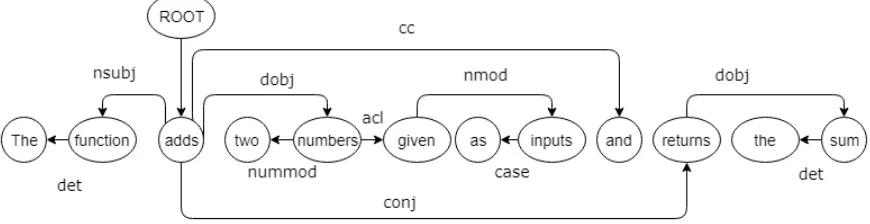
example, consider the following comment
-// The function adds two numbers given as inputs and returns the sum
Using the Stanford Dependency Parser[CM14], the dependency tree created for the
com-ment text is shown in Fig. 3.6. The arrow labels indicate the type of grammatical
dependen-cies (nominal subject, direct object), and the arrow directions denote dependent words. The arrow from the word
‘numbers’
to‘two’
shows that‘two’
modifies‘numbers’
.Average Dependency Distances
To convert these syntactic relationships into a quantitative complexity feature, we use the
metric Average Dependency Distances (ADD) as proposed by[Oya11]. It uses distances
between dependent words to find sentence complexity. For a dependency relation in the
tree, the dependency distance is calculated by finding the absolute value of the difference between the two word positions. For example, in Fig. 3.6, a dependency relation exists
between
‘adds’
and‘returns’
. The dependency distance between them is 10−3=7 since‘returns’
is the tenth word in the sentence and‘adds’
is the third. The final ADD value is the sum of all such dependency distances divided by the number of dependencies [Oya11].Net Comment Complexity
We have applied this metric to Java comment data to find the complexity of comments.
Since ADD is implemented at the sentence level, we first split each comment into separate
sentences based on the delimiters ‘.’, ‘?’, ‘!’. In case of Javadoc comments, we have assumed
that every line beginning with an ‘@’ tag is also a separate sentence. For each sentence, we
construct its dependency parse tree using a Python wrapper[Guo]for the Stanford CoreNLP
library[Man14]and calculate the ADD. The net complexity value for the comment is the
maximum ADD across all sentences.
3.2.2
Comment Similarity with Source Code
The second feature deals with finding the degree of similarity between a comment and
its corresponding source code. We first preprocess both the comment and code texts.
After tokenizing, we further split tokens on camel case and underscores to separate out any identifier names. In case of code, we also split on dots to split instances of method
calls/method chaining. Next, we convert all text to lower case. In order to retain only those
tokens relevant to the analysis, we remove the commonly occurring English stopwords.
However, we remove only those stopwords which are not Java keywords. Finally, we also
remove all punctuation from tokens.
To compute the semantic similarity between the comment and code tokens, we use the
expressing similar concepts together[Pri10]. The synonym sets themselves are linked with
each other to convey complex relationships between concepts.
We extract these synonym sets for all word tokens in the comment and code using the nltk
interface for WordNet. The degree of similarity between two synonym sets can be found
using nltk’s path similarity function, which returns a score ranging from 0 to 1. Higher
scores between a pair of synonym sets indicate highly similar concepts. For each synonym
set in the comment, we find a synonym set in the code that gives the highest path similarity
score. The final value is the average of all these scores across all comment synonym sets.
While retrieving synonym sets, the nltk interface also requires a part of speech parameter to be provided along with the word token. Different synonym sets are returned for the
same token based on the provided part of speech. nltk includes support for nouns, verbs,
adjectives, and adverbs. Instead of using Part-of-Speech Taggers to predict a single part of
speech for the token, we retrieve all synonym sets across all applicable parts of speech for
comment and code tokens to increase the probability of finding a closer match. We choose
the synonym sets with the highest path similarity scores.
3.3
Comment Classification through Machine Learning
Based on their complexity and code similarity, we aim to classify comments into two
categories - satisfactory and unsatisfactory, using supervised machine learning techniques.
We first apply Logistic Regression to the data since Logistic Regression usually performs
well for the binary classification problem. We also perform classification using Support
CHAPTER
4
EXPERIMENTAL RESULTS
Since our focus is on student-written comments, the data we used for our experiments
consists of submissions and grades for two Java programming assignments from the Fall
2017 course - ‘Programming Concepts - Java’ (CSC 216). In this section, we have evaluated the effectiveness of comment classification using these submissions.
4.1
Data for Experiments
Each of the assignments required students to write and submit multiple Java classes, along
with comments for appropriate program constructs. The course TAs have then manually
evaluated all files from each submission for their Javadoc content according to the following
criteria
-1. The comments evaluated are for three types of declarations - classes, methods, and
fields.
score. This score is based on how well the comments address behaviors, abstractions,
and states of the corresponding classes, methods, and fields.
3. For each type of comment, the score assigned can be 0, 1, 2, or 3, with 3 being the
highest and denoting strong comment quality.
We built the comment dataset by running the comment extraction and feature creation
pro-cesses on these student submissions. We then associated this data with the corresponding
grades/scores, which we used as labels for the classification task.
Each assignment submission also included certain pre-written Java files, which were
pro-vided by the TAs and were usually required for creating the project GUI. We excluded such
files from our analysis since they were not written by students.
4.1.1
Comment Extraction
We first extracted every comment-code pair from all submitted files. For the two
assign-ments, we scanned a total of 3825 files and extracted 60181 comments. Table 4.1 shows
the extraction results per assignment. Although students were asked to write comments wherever appropriate, the comments that were going to be graded were class, method, and
field comments. As a result, they were among the most documented constructs. Over 70%
of all comments were of these three types, as seen in Table 4.2
Table 4.1Extracted comments per assignment.
Number of submissions Number of files Total comments
Assignment 1 225 2475 34229
Assignment 2 167 1350 25952
Table 4.2Top six most commented constructs.
Statement type Number of comments Percentage of total comments
Method Declaration 28613 47.5%
Field Declaration 11041 18.3%
Class Declaration 4474 7.4%
Constructor Declaration 4280 7.1%
Statement Expression 1986 3.3%
If Statement 1899 3.2%
4.1.2
Dataset Preparation
To build a suitable dataset for training, we carried out the following data preparation tasks
for each assignment
-1. We restricted the classification to class, method, and field comments due to the lack
of grading data for any other comments. Although we filtered out all other types,
we considered constructor comments as method comments due to their syntactic
similarity. Similarly, we treated interface and enum declaration comments as class
comments since they were usually defined in separate Java files.
2. Through the feature extraction process, we calculated complexity and similarity
values for each individual comment. However, since all comments of a particular type
were assigned a single score, we avoided training on individual comments. Instead,
we aggregated comments of each type within a submission and found the means of
their complexity and similarity values. We then associated the corresponding scores
with these aggregated features.
3. To make the classification more effective, we grouped the scores assigned by TAs into
two major classes
-• Scores 0, 1, and 2 were relabeled as 0.
• Scores of 3 were relabeled as 1.
The submissions belonging to class ‘1’ are considered to be satisfactorily commented,
4. Finally, for each assignment, we separated out comments by type and created three
distinct datasets of class, method, and field comments, as shown in Tables 4.3 and
4.4.
Table 4.3Datasets for Assignment 1.
Dataset Records with label ‘1’ Records with label ‘0’ Total records
Class Comments 144 74 218
Method Comments 134 87 221
Field Comments 186 28 214
Table 4.4Datasets for Assignment 2.
Dataset Records with label ‘1’ Records with label ‘0’ Total records
Class Comments 110 57 167
Method Comments 119 47 166
Field Comments 142 23 165
4.2
Model Details
We utilized Logistic Regression and Support Vector Machines (SVMs) to classify class,
method, and field comments from i) Assignment 1, ii) Assignment 2, iii) Assignments 1 and
2 taken together.
We trained the two classifiers on each dataset by using 75% of the data for training and
set-ting aside the rest for validation. We also performed 5-fold cross-validation and parameter
tuning on the training sets to select the best models. While defining training-validation
ensured that every set and fold had an equal proportion of each class label as the original
dataset. We applied our models to the corresponding validation sets to classify assignment
submissions as satisfactorily/unsatisfactorily commented.
4.3
Performance of the Models
We have used accuracy, precision, recall, and f1-scores to measure the performance of our
models.
Ac c u r a c y = T P+T N
T P+T N +F P+F N × 100 (4.1)
P r e c i s i o n = T P
T P+F P (4.2)
R e c a l l = T P
T P+F N (4.3)
F1s c o r e =2 × P r e c i s i o n × R e c a l l
P r e c i s i o n + R e c a l l (4.4)
where TP: True Positives (instances belonging to class ‘1’ being classified as ‘1’)
TN: True Negatives (instances belonging to class ‘0’ being classified as ‘0’)
FP: False Positives (instances belonging to class ‘0’ being classified as ‘1’)
FN: False Negatives (instances belonging to class ‘1’ being classified as ‘0’)
As a result, precision denotes the ratio of correctly classified satisfactory submissions to the
ones that were predicted to be satisfactory. Recall denotes the ratio of correctly classified
satisfactory submissions to the ones that were actually satisfactory. The f1-score takes both
precision and recall into account by calculating their harmonic mean.
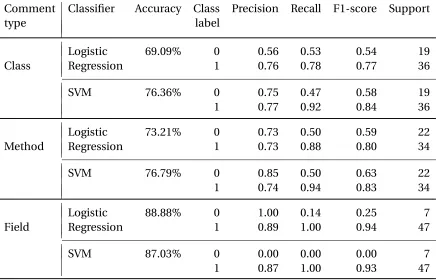
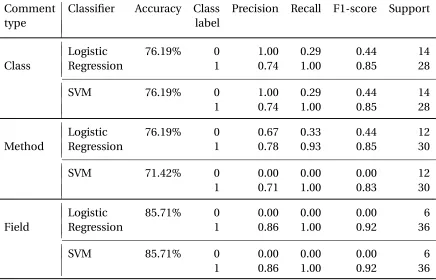
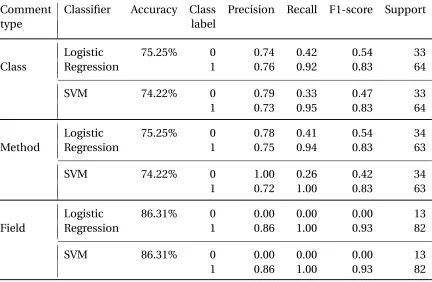
Tables 4.5, 4.6, and 4.7 show the classification results obtained on all datasets in each
Table 4.5Performance for Assignment 1.
Comment Classifier Accuracy Class Precision Recall F1-score Support
type label
Logistic 69.09% 0 0.56 0.53 0.54 19
Class Regression 1 0.76 0.78 0.77 36
SVM 76.36% 0 0.75 0.47 0.58 19
1 0.77 0.92 0.84 36
Logistic 73.21% 0 0.73 0.50 0.59 22
Method Regression 1 0.73 0.88 0.80 34
SVM 76.79% 0 0.85 0.50 0.63 22
1 0.74 0.94 0.83 34
Logistic 88.88% 0 1.00 0.14 0.25 7
Field Regression 1 0.89 1.00 0.94 47
SVM 87.03% 0 0.00 0.00 0.00 7
Table 4.6Performance for Assignment 2.
Comment Classifier Accuracy Class Precision Recall F1-score Support
type label
Logistic 76.19% 0 1.00 0.29 0.44 14
Class Regression 1 0.74 1.00 0.85 28
SVM 76.19% 0 1.00 0.29 0.44 14
1 0.74 1.00 0.85 28
Logistic 76.19% 0 0.67 0.33 0.44 12
Method Regression 1 0.78 0.93 0.85 30
SVM 71.42% 0 0.00 0.00 0.00 12
1 0.71 1.00 0.83 30
Logistic 85.71% 0 0.00 0.00 0.00 6
Field Regression 1 0.86 1.00 0.92 36
SVM 85.71% 0 0.00 0.00 0.00 6
Table 4.7Performance using Assignments 1 and 2 together.
Comment Classifier Accuracy Class Precision Recall F1-score Support
type label
Logistic 75.25% 0 0.74 0.42 0.54 33
Class Regression 1 0.76 0.92 0.83 64
SVM 74.22% 0 0.79 0.33 0.47 33
1 0.73 0.95 0.83 64
Logistic 75.25% 0 0.78 0.41 0.54 34
Method Regression 1 0.75 0.94 0.83 63
SVM 74.22% 0 1.00 0.26 0.42 34
1 0.72 1.00 0.83 63
Logistic 86.31% 0 0.00 0.00 0.00 13
Field Regression 1 0.86 1.00 0.93 82
SVM 86.31% 0 0.00 0.00 0.00 13
4.4
Analysis
Although the accuracy values of Logistic Regression and SVM were relatively consistent,
SVM tended to perform slightly better when the data was more balanced, and support for the majority class (‘1’) was less than twice as that of the minority class (‘0’). For example,
in Assignment 1 (Table 4.5), SVM performed well on instances with label ‘1’ and achieved
high f1-scores of 0.84 and 0.83 for class and method comments respectively.
However, for unbalanced datasets, as was the case in Assignment 2 (Table 4.6), the SVM
was more likely to classify all observations into the majority class. Here, Logistic Regression
handled the data imbalance better for method comments. Although its f1-score for the
minority class dropped to 0.44, it correctly identified more True Negatives than SVM.
Similarly, Logistic Regression achieved better accuracy and f1-scores when we combined
data from Assignments 1 and 2 (Table 4.7). It attained an accuracy of 75.25% for class and
method comments, with f1-scores of 0.83. Both Logistic Regression and SVM performed
comparatively poorly while classifying field comments. However, this could be attributed to
a significantly large imbalance in the data, where support for the majority class was around
six times that of the minority class. Another limitation in the analysis could be that the TAs
may not have been consistent while grading. Multiple TAs grading different assignments
could make the grading subjective.
Overall, our approach can be considered effective for highlighting submissions with
satis-factory comments, giving sufficiently high values of accuracy and f1-scores for the class
labelled ‘1’. It also yielded consistent results using multiple classifiers and generalized to
CHAPTER
5
CONCLUSION
Given the importance of writing effective comments, courses teaching introductory
pro-gramming have developed assignments that require students to document their code using
comments. The process of evaluating these and providing feedback to students is, however, a manual one. We have developed a machine learning based approach, which analyzes
the natural language used in student-written comments and determines if their
program-ming assignments are well-commented. As a part of this process, we have automated the
extraction of comments and introduced a technique to associate comments with their
corresponding lines of code.
Based on the results of applying Logistic Regression and SVM, our approach can be
con-sidered as an effective preliminary test to help filter out assignments which are likely to
be well-commented. At the moment, this classification is restricted to two broad classes – satisfactory and unsatisfactory. However, in the future, we aim to assign distinct grades to
commented programs. Having tested our approach with class, method, and field
Finally, we plan to use more advanced natural language processing and learning techniques
BIBLIOGRAPHY
[Avi] Aviles, J.-R.Comment Parser. https://pypi.org/project/comment_parser/.
[CM14] Chen, D. & Manning, C. “A Fast and Accurate Dependency Parser using Neural Networks”.Proceedings of the 2014 Conference on Empirical Methods in Natural
Language Processing (EMNLP). Doha, Qatar: Association for Computational
Linguistics, 2014, pp. 740–750.
[Che18] Chen, H. et al. “Automatically Detecting the Scopes of Source Code Comments”.
2018 IEEE 42nd Annual Computer Software and Applications Conference (COMP-SAC). Vol. 01. 2018, pp. 164–173.
[Cor14] Corney, M. et al. “‘Explain in Plain English’ Questions Revisited: Data Structures Problems”.Proceedings of the 45th ACM Technical Symposium on Computer
Science Education. SIGCSE ’14. ACM, 2014, pp. 591–596.
[Cut11] Cutrone, L. et al. “Auto-Assessor: Computerized Assessment System for Marking Student’s Short-Answers Automatically”.2011 IEEE International Conference on Technology for Education. 2011, pp. 81–88.
[DeP12] DePasquale, P. J. et al. “//TODO: Help Students Improve Commenting Practices”.
2012 Frontiers in Education Conference Proceedings. 2012, pp. 1–6.
[Guo] Guo, L.stanfordcorenlp. https://pypi.org/project/stanfordcorenlp/.
[Hao11] Haouari, D. et al. “How Good is Your Comment? A Study of Comments in Java Programs”.2011 International Symposium on Empirical Software Engineering
and Measurement. 2011, pp. 137–146.
[Kha10] Khamis, N. et al. “Automatic Quality Assessment of Source Code Comments: The JavadocMiner”.Proceedings of the Natural Language Processing and Infor-mation Systems, and 15th International Conference on Applications of Natural
Language to Information Systems. NLDB’10. Springer-Verlag, 2010, pp. 68–79.
[Kle11] Klein, R. et al. “Automated Assessment of Short Free-Text Responses in Computer Science Using Latent Semantic Analysis”.Proceedings of the 16th Annual Joint
Conference on Innovation and Technology in Computer Science Education.
ITiCSE ’11. ACM, 2011, pp. 158–162.
[Lou18] Louis, A. et al.Deep Learning to Detect Redundant Method Comments. arXiv: 1806.04616[cs.SE]. 2018.
[Man14] Manning, C. D. et al. “The Stanford CoreNLP Natural Language Processing Toolkit”.Association for Computational Linguistics (ACL) System Demonstra-tions. 2014, pp. 55–60.
[MA18] Mohammadi-Aragh, M. J. et al. “Coding the Coders: A Qualitative Investigation of Students’ Commenting Patterns”.2018 ASEE Annual Conference & Exposition. ASEE Conferences, 2018.
[Oya11] Oya, M. “Syntactic Dependency Distance as Sentence Complexity Measure”.
Proceedings of the 16th International Conference of Pan-Pacific Association of Applied Linguistics(2011).
[Pri10] Princeton University.About WordNet. https://wordnet.princeton.edu/. 2010.
[PS05] Pulman, S. G. & Sukkarieh, J. Z. “Automatic Short Answer Marking”.
Proceed-ings of the Second Workshop on Building Educational Applications Using NLP.
EdAppsNLP 05. Association for Computational Linguistics, 2005, pp. 9–16.
[Pyt01] Python Software Foundation.Abstract Syntax Trees. https://docs.python.org/3/ library/ast.html. 2001–.
[SG] Sagalovskiy, D. & Grist Labs.asttokens. https://pypi.org/project/asttokens/.
[Sch07] Schreck, D. et al. “How Documentation Evolves over Time”.Ninth International Workshop on Principles of Software Evolution: In Conjunction with the 6th ESEC/FSE Joint Meeting. IWPSE ’07. ACM, 2007, pp. 4–10.
[Ste13] Steidl, D. et al. “Quality Analysis of Source Code Comments”.2013 21st
Interna-tional Conference on Program Comprehension (ICPC). 2013, pp. 83–92.
[Tan07] Tan, L. et al. “/* iComment: Bugs or Bad Comments? */”.Proceedings of
Twenty-first ACM SIGOPS Symposium on Operating Systems Principles. SOSP ’07. ACM,
2007, pp. 145–158.