Contents lists available atScienceDirect
Information Processing and Management
journal homepage:www.elsevier.com/locate/infoproman
QMOS: Query-based multi-documents opinion-oriented
summarization
Asad Abdi
a,⁎, Siti Mariyam Shamsuddin
a, Ramiz M. Aliguliyev
baUTM Big Data Centre (BDC), Universiti Teknologi Malaysia, Johor, Malaysia
bInstitute of Information Technology, Azerbaijan National Academy of Sciences, 9, B. Vahabzade Street, AZ1141 Baku, Azerbaijan
A R T I C L E I N F O
Keywords: Sentiment analysis Sentiment summarization Sentiment dictionary Contextual polarity
A B S T R A C T
Sentiment analysis concerns the study of opinions expressed in a text. This paper presents the QMOS method, which employs a combination of sentiment analysis and summarization ap-proaches. It is a lexicon-based method to query-based multi-documents summarization of opinion expressed in reviews.
QMOS combines multiple sentiment dictionaries to improve word coverage limit of the in-dividual lexicon. A major problem for a dictionary-based approach is the semantic gap between the prior polarity of a word presented by a lexicon and the word polarity in a specific context. This is due to the fact that, the polarity of a word depends on the context in which it is being used. Furthermore, the type of a sentence can also affect the performance of a sentiment analysis approach. Therefore, to tackle the aforementioned challenges, QMOS integrates multiple stra-tegies to adjust word prior sentiment orientation while also considers the type of sentence. QMOS also employs the Semantic Sentiment Approach to determine the sentiment score of a word if it is not included in a sentiment lexicon.
On the other hand, the most of the existing methods fail to distinguish the meaning of a review sentence and user's query when both of them share the similar bag-of-words; hence there is often a conflict between the extracted opinionated sentences and users’needs. However, the sum-marization phase of QMOS is able to avoid extracting a review sentence whose similarity with the user's query is high but whose meaning is different. The method also employs the greedy algo-rithm and query expansion approach to reduce redundancy and bridge the lexical gaps for similar contexts that are expressed using different wording, respectively. Our experiment shows that the QMOS method can significantly improve the performance and make QMOS comparable to other existing methods.
1. Introduction
Nowadays, opinion mining, sentiment analysis, and subjectivity attracted significant attention from both the research community and industry (Khan, Qamar, & Bashir, 2016b). The main goal of sentiment analysis is to use an automated approach to identify positive, negative, or neutral sentiment from documents (Hung & Chen, 2016). Natural Language Processing (NLP) techniques allow people to automatically retrieve, extract, classify and summarize a huge amount of textual information. Text summarization is a process to create a short version of a source text, including important and essential information. There are several types of summary such as a single document, multiple documents, generic, query-based, opinion-based, etc. (Abdi, Idris, Alguliyev, & Aliguliyev,
https://doi.org/10.1016/j.ipm.2017.12.002
Received 26 August 2017; Received in revised form 2 November 2017; Accepted 8 December 2017 ⁎Corresponding author.
E-mail address:[email protected](A. Abdi).
Available online 21 December 2017
0306-4573/ © 2017 Elsevier Ltd. All rights reserved.
2015b). Opinion/sentiment summarization is one of the new types. It aims to obtain significant information and the overall opinion/ sentiment orientation of an opinionated document (Balahur, Kabadjov, Steinberger, Steinberger, & Montoyo, 2012). Surely, Opinion/ sentiment summarization is one of the strong NLP methods. It can be considered as an expert system to assist human or process other tasks for selecting a logical choice or decision making (Lloret et al., 2015). Sentiment summarization includes set of process to determine opinion-oriented information from people's opinions on various subjects (Hu, Chen, & Chou, 2017). The main task of traditional summarization methods is to determine the important information and eliminate the redundant information (Abdi & Idris, 2014a,b; Abdi, Idris, Alguliev, & Aliguliyev, 2015a). Unlike a traditional summarization method, a sentiment summarization method relies on two main factors: sentiment degree and relevant information selection.
This paper proposes a Query based Multi-documents Opinion-oriented Summarization (QMOS) method. It aims to extract and summarize the opinionated sentences related to the user's query. The proposed method needs to perform two main phases:Phase 1: sentiment analysis, it includes the following steps; thefirst step calculates the sentiment score of each sentence. The second step recognizes the polarity of each sentence and user's query (e.g., positive, negative, neutral). The third step selects sentences with the same sentiment orientation of the opinion of the correlated user's question. Subsequently, it passes these sentences to the next phase, summarizer.Phase 2:Summarizer, it determines user's query relevant sentences using graph-based ranking model. It calculates the total sentence score including query relevant score and sentence sentiment score. This processfilters out the sentences with less possibility to answer the question. It extracts the answers from the top ranked sentences. The sentences with higher rank are assumed to more possibly contain the answers.
Phase 1—in the current phase, the sentiment analysis is performed based on a lexicon-based method. Thus, we combined several sentiment dictionaries in order to create a High-Coverage Lexical resource (HCL). Our aim is to expand the sentiment dictionary coverage in order to improve word coverage limit of the individual lexicon. On the other hand, different sentiment lexicons com-plement each other. Furthermore, phase 1 also employs Semantic Sentiment Approach (SSA) to determine sentiment score of a word if it is not included in a sentiment lexicon. Since the polarity of a word depends on the context in which the word is being used, the polarity of a word presented by a lexicon can be reversed. On the other hand, the performance of a sentiment analysis method relies on the types of sentences. Thus, to cope the aforementioned challenges, the QMOS considers multiple strategies such asnegation handling, but-clause handling and the subjective/objective handling, sarcastic sentence handling, interrogative/conditional sentences handling to adjust word prior sentiment orientation and determine the type of a sentence, respectively.
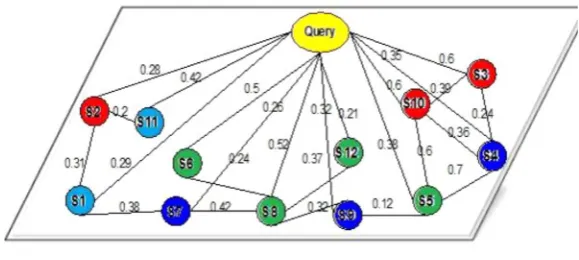
Phase 2—the summarizer phase takes as input a set of opinionated sentences from the phase 1. Subsequently, it processes all the sentences and generates a summary. This summary must represent the useful content and opinions to the user in a compressed form. The current phase relies on the graph-based model, where the nodes represent review sentences and user's query. The edge between two nodes shows the similarity measure between two sentences (StoS) or similarity measure between user's query and a sentence (Q to S) (refer to section“3.3.Summarizer phase”). Most of the previous studies on query based review summarizations used a bag-of-word (BOW) approach to identify query relevant sentences and calculate similarity measures. Although the BOW approach is very simple, it has some important drawbacks as it:1)disrupts the word order;2)breaks the syntactic structures;3)is not able to distinguish the meaning of two sentences. For an instant, given two sentences S1andS2, (i.e.,S1:‘Father helps son strongly’; S2:’Son helps father strongly’), the existing methods based on the BOW approach will infer that two sentences S1and S2are similar. Therefore, both the syntactic information and semantic information must be used when comparing two sentences (Abdi & Idris, 2014a,b; Abdi et al., 2015a; Abdi, Idris, Alguliyev, & Aliguliyev, 2015a). The summarizer phase also integrates both the semantic and syntactic in-formation to capture the meaning of two sentences when they share similar bag-of-words (BOW). Furthermore, the QMOS uses the Content Word Expansion (CWE) method to1)improve the sentence ranking result;2)tackle the limit of information expressed in each sentence;3)overcome vocabulary mismatch problem in sentence comparison. It also bridges the lexical gaps for similar contexts that are expressed in a different wording. Finally, the current phase checks the redundancy information in order to increase the quality of a summary.
We make the following contributions in this research:1)we combine several sentiment dictionaries to improve word coverage limit of the individual lexicon;2)the proposed method uses the SSM method to determine the sentiment score of a word if it not included in sentiment lexicon;3)it also considers the contextual polarity for sentiment analysis (e.g., negation, but-clause);4)it considers the type of a sentence (e.g., sarcasm, subjective/objective and interrogative/ conditional);5)the method also integrates both the semantic and syntactic information using a linear equation to capture the meaning of two sentences;6)it uses the CWE method to overcome vocabulary mismatch problem in sentence comparison;7)it also checks the redundancy information in order to increase the quality of summary. Although some of previous systems consider the contextual polarity, the type of a sentence, the content word expansion, the combination of semantic and syntactic information or the redundancy removal to produce a query based multi-documents opinion-oriented summarization model, to the best of our knowledge, a method in which the contextual polarity, the type of a sentence, the content word expansion, the combination of semantic and syntactic information or the redundancy removal for a sentiment-oriented summarisation are used has not been thoroughly studied.
We also conduct two extensive experiments on data sets: Experiment 1 aims to evaluate the performances of the proposed method (compared with the existing methods) and analyze the effect of different parameters values (i.e.,γandβ). In experiment 2 we analyze the effect of semantic similarity measure (SSM), word order similarity measure (WOSM), content word expansion (CWE) and se-mantic sentiment approach (SSA) and contextual polarity on QMOS method. We also compare different state-of-the-art sentiment dictionaries.
2. Literature review
2.1. Text summarization
Text summarization systems produce a summary of one or more source text automatically. A summary normally contains the aim, results, conclusions presented in a source text (Abdi & Idris, 2014a,b; Tayal, Raghuwanshi, & Malik, 2017).
Categorization of Text Summarization Systems(Abdi et al., 2015b; Mendoza, Bonilla, Noguera, Cobos, & León, 2014)—the output of the system may be an abstractive or extractive summarization. An extractive summarization includes a set of significant sentences that are determined using statistical and linguistic features of sentences. Anabstractive summarizationtries to develop a comprehension of the main concepts in a text and then expose those concepts. A summarization system can be based onsingle document or multiple documents. In single document summarization system a single-document is used to generate a summary, while in multi-document summarization systems, multiple documents on the same subject are used to generate a single summary. Besides these facts, text summarization system can also be either indicative or informative summarization. The indicative summary only introduces the basic idea of a text to the user. Indicative summaries can be used to encourage the readers to read the main documents. The informative summary produces brief information of the main text that can be considered as a replacement for the original text. Summarization systems can create a general summary, where the system considers the total document. Unlike the general summary, the system can also produce a question-based summary, where the system tries to answer user's question.
2.2. Sentiment analysis and opinion mining
Sentiment analysis also named opinion mining aims to analyze the opinions expressed in a review document and to categorize the opinions as positive, negative or neutral (Rana & Cheah, 2016). Sentiment analysis is one of the new research topics in natural language processing domain. An opinion/sentiment includes two important parts,EandS. TheEcan be an entity or a feature of an entity and theScan be a positive/negative opinion, sentiment, orientation or polarity onE.
Different Levels of Analysis—the sentiment analysis can be performed at three main levels (Rana & Cheah, 2016):
1) Document-level:it classifies the whole document as positive, negative or neutral;2) Sentence level:the sentence level sentiment analysis module analyzes a sentence and determines whether the sentence has a positive, negative or neutral sentiment;3) Aspect/ feature level:unlike document level and sentence level sentiment analysis, feature level analysis is able to determine what accurately people like and don't like. It is able to detect whether the tendency on aspect/feature is positive, negative or neutral. In the sentence, “the color quality of this television is amazing”,the aspect/feature is‘color quality’of the‘this television’.The opinion on the‘color quality’ aspect/feature is positive.
There are different types of opinions:1) regular opinion, indicates to simply express an opinion (e.g.,‘the book has been written well’). A regular opinion can also be direct opinion or indirect opinion. Direct opinion expresses opinion directly on a feature or an entity, while indirect opinion expresses opinion indirectly on a feature or an entity;2) Comparative opinion (Jindal & Liu, 2006) indicates the difference between entities, products, etc. (e.g.,‘Sony is better than Samsung’). Furthermore, an opinion can be expressed explicitly or implicitly in a review text. Theexplicit opinionsare a subjective expression that indicates regular or comparative sen-timents, whileimplicit opinionsare objective expressions that indicate regular or comparative sentiments. There are also two im-portant concepts that are relevant to sentiment/opinion analysis:1)subjective sentence expresses subjective views and feelings (e.g., “I like VAIO”); 2) objective sentence expresses factual information, no sentiment or opinion (e.g., “VAIO is a SONY product”) (Riloff, Patwardhan, & Wiebe, 2006). Emotion is also related to sentiment analysis that presents our feeling and opinion. The re-searches categorized people's opinions into some groups such as,‘love’,‘joy’,‘surprise’,‘anger’,‘sadness’, and‘fear’.
Sentiment analysis approaches are split into three groups:1) dictionary based approach (unsupervised approach) —in this ap-proach, the sentiment/opinion words are used to express a positive/negative opinion/sentiment. As an example, the words like (‘excellent’,‘well’) and (‘poor’,‘ugly’) are used to make a positive and negative sentiment, respectively. However, a list of these words is named opinion/sentiment dictionary or lexicon (e.g., AFINN (Nielsen, 2011), Sentiment140 Lexicon (Mohammad, Kiritchenko, & Zhu, 2013)). Dictionary-based method employs a sentiment lexicon to perform sentiment analysis, using extracting opinion words and scoring sentiment related words;2) machine learning approach(supervised approach), machine Learning based method—it used a set of popular machine learning approach to perform sentiment analysis (e.g., ANN (Lee & Choeh, 2014), SVM (Shahana & Omman, 2015)). Machine learning method is able to handle large collections of review documents;3) Hybrid approach(composition of supervised and unsupervised approach).
2.3. Sentiment-based summaries
Text summarization determines most relevant sentences from a reviews text and the sentiment analysis component identifies and categorizes objective or subjective sentences and their polarity (positive, negative or neutral), respectively (Liu, 2012).
Although there are several literatures on text summarization (e.g.,Sadh, Sahu, Srivastava, Sanyal, & Sanyal, 2012) and sentiment analysis (e.g., Mladenović, Mitrović, Krstev, & Vitas, 2016), there is few work on the combination of two areas (Saggionα & Funk, 2010). The multi-text summarization method has been used for review summarization in various proposed methods as follows. Lu, Duan, Wang, and Zhai (2010)proposed a method based on the online ontologies of entities and aspects to summarize opinions. Their systemfirst selects aspects that capture major opinions. It orders aspects and their corresponding sentences based on a coherence measure, which tries to optimize the ordering so that they best follow the sequences of aspect appearances in their original postings.
InNishikawa, Hasegawa, Matsuo, and Kikui (2010), a summarization technique was proposed, which generates a traditional text summary by selecting and ordering sentences taken from multiple reviews, considering both informativeness and readability of the final summary. The informativeness was defined as the sum of the frequency of each aspect-sentiment pair. Readability was defined as the natural sequence of sentences, which was measured as the sum of the connectivity of all adjacent sentences in the sequence. Wang, Zhu, and Li (2013) also proposed a technique to summarize the user's reviews on Rice cooker (Collected from Ama-zon.com).Paul, Zhai, and Girju (2010)proposed an algorithm. The algorithm generates a macro multi-view summary and a micro multi-view summary. A macro multi-view summary contains multiple sets of sentences, each representing a different opinion. A micro multi-view summary contains a set of pairs of contrastive sentences. The algorithm includes two steps. In thefirst step, it uses a topic modeling approach to modeling and mining both topics and sentiments. In the second step, a random walk formulation was proposed to score sentences and pairs of sentences from opposite viewpoints based on both their representativeness and their con-trastiveness with each other.
Lloret et al., (2015)proposed text summarization approach to produce a concise opinion summary of reviews (collected from both Amazon.com and WhatCar.com).Hu et al. (2017)used a multi-text summarization approach to summarize user's review on the hotel. In addition to text processing approaches (e.g., BOW, semantic approaches), the method also considered four main factors:‘author credibility’,‘review time’,‘review usefulness’and‘conflicting opinions’. At the end, the review summarization is generated.
Summing up, various methods have been proposed to summarize users’reviews. There are some problems with the most existing systems that we considered in this paper. We improved the existing systems as follows:1)QMOS combines several sentiment dic-tionaries to improve word coverage limit of the individual lexicon.2)QMOS employs the Semantic Sentiment Approach (SSA) to determine the sentiment score of a word if it is not included in a sentiment lexicon.3)QMOS also considers the contextual polarity for sentiment analysis.4)It considers the type of a sentence that can affect the performance of a sentiment analysis approach.
Furthermore, most of the previous studies on query based review summarizations focused on bag-of-word approach to identify query relevant sentences from a reviews text. They disregard the syntactic information in original review text; hence there is often a conflict between the retrieved sentences and users’needs. Therefore, we solve this problem using the combination of semantic and syntactic information to identify more query relevant sentences. On the other hand, a query consists of very few words. So, iden-tifying important sentences to answer user's question using this little information can be considered as the main problem. However, QMOS employs content word expansion method to tackle the aforementioned problem.
3. Proposed method: QMOS
This section aims to present step-by-step an approach for Question-based Multi-documents Opinion-oriented Summarization. Fig. 1displays the architecture of the QMOS. The method contains the following stages:
1.Pre-processing, in this stage the basic NLP techniques are performed on both review documents and user's question. The review text and user's query will be prepared for more process.
2.Sentiment analysis, the task of the current stage is to analyze review sentences (the query is also considered as a sentence) in order to identify set of subjective sentences with the same sentiment orientation of the opinion of the correlated user's question. Subsequently, we pass these sentences to the next stage,Summarizer stage.
3.Summarizer, this stage employs the graph-based ranking model to select more relevant sentences to the user's query. It also calculates the Total Sentence Score (TSS). Finally, the summary generation step creates thefinal summary.
We describe each stage in the following sections. We also used the following list (Table 1) of abbreviations to explain our proposed method.
3.1. Pre-processing
The pre-processing principally contains the following functions:1)Sentence splitting;2)Stemming;3)Stop-word deletion;4) Part-of-speech (POS) tagging.
Sentence splitting—since the sentiment analysis is performed at the sentence level, this function split the review text into several sentences. A sentence ends with a sentence delimiter (“.”,“?”,“!”).
Review Text User's Question
Sentiment analysis
CM:Combination Model
SSCA: Statistical Similarity Calculation Approach Pre- processing
Sentence splitting
Stop-word deletion
POS Tagging
Stemming
Opinion words
Semantic Sentiment Approach (SSA)
WordNet Contextual polarity
Sentence Scoring
Sentence orientation
Summary genaration
1- Sentiment shifter
4- Question and conditional sentences 3- Subjective and objective
2- sarcasm
Summarizer phase
Graph-based ranking model
SSCA CM
Summary text
Resource No. of words General Inquirer 11,789
AFINN 2,477
Opinion Lexicon 6,786
SenticNet 50,000
SO-CAL 6,306 NRC Hashtag Sentiment Lexicon 54,129
Sentiment140 Lexicon 62,468 Subjectivity Lexicon 8,221 WordNet-Affect 4,787 SentiWordNet 155,287 Subjective sentences
Fig. 1.The Architecture of the QMOS.
Table 1
List of abbreviations.
List of abbreviations
Word- Set (WS) Sentiment Analysis Model (SAM) Part-of-speech (POS) Semantic Sentiment Approach (SSA)
Compound Model (CM) Semantic Similarity Measurement (SSM) Total Sentence Score (TSS) High-Coverage Sentiment Lexicon (HCL)
Average ROUGE Score (ARS) Document Understanding Conference (DUC) Sentence Sentiment Score (SSS) Word-Order Similarity Measurement (WOSM) Text Analysis Conference (TAC) Statistical Similarity Calculation Approach (SSCA) Content Word Expansion (CWE) Semantic similarity measure between two words (SWS)
Table 2displays a sample of the stop words1,2,3. It is worth nothing that we excluded a set of words as explained in section (‘3.2.3. Contextual polarity for sentiment analysis, Sentiment shifter’).
Stemming–it aims to get the stem or root of a word. It is useful to identify words that belong to the same stem. This process obtains the root of each word using the WordNet lexical database (Miller & Charles, 1991). It includes 121,962 unique words, 99,642 synsets (each synset is a lexical concept represented by a set of synonymous words) and 173,941 senses of words.
Part-of-speech (POS) tagging — the POS tagging allows to automatically tag each word its morphological category (e.g., “Teacher/NNP helps/VBZ her/PRP$ students/NNS”). We used an English part-of-speech tagger which was developed byTsuruoka and Tsujii (2005)University of Tokyo.
3.2. Sentiment analysis
The pipeline of the sentiment analysis model (SAM), which goes from identifying opinion sentences to sentence orientation, is shown inFig. 1. The SAM performs the following main steps:
1. Taking all sentences from the review text as input. LetSentencreview text={ ,S S1 2⋯SN}includes all sentences from the review text, whereNis the number of sentences;
2. Determining type of sentences and contextual polarity; 3. Computing sentence sentiment score;
4. Determining sentence orientation.
3.2.1. Sentiment lexicons combination
In this section, we aim to create High-Coverage sentiment Lexicon, HCL. We merge several existing sentiment lexicons with different size and format. We also employ the semantic sentiment method (SSM) in order to expand the sentiment dictionary coverage and improve the individual dictionary limited word.
Many sentiment dictionaries (e.g., SentiWordNet (Baccianella, Esuli, & Sebastiani, 2010), Micro-WNOp (Cerini, Compagnoni, Demontis, Formentelli, & Gandini, 2007), WordNet-Affect (Strapparava & Valitutti, 2004)) have been manually or automatically Table 2
Sample of the Stop words.
Stop words
By Often Vol The Of Before Under Until
whatever Nothing Both Beyond Between Besides Usually With
Voz Ok Okay Vol Ord Onto Did Others
From Yet Yes Upon Off Even Own By
Table 3
An overview of ten lexical resources.
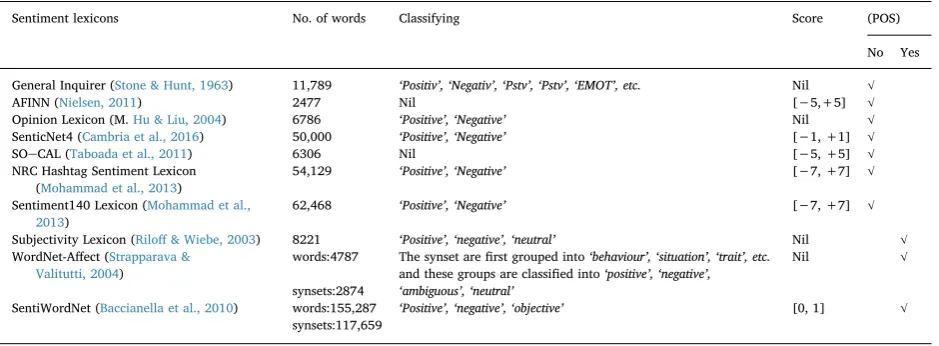
Sentiment lexicons No. of words Classifying Score (POS)
No Yes
General Inquirer (Stone & Hunt, 1963) 11,789 ‘Positiv’,‘Negativ’,‘Pstv’,‘Pstv’,‘EMOT’, etc. Nil √
AFINN (Nielsen, 2011) 2477 Nil [−5,+5] √
Opinion Lexicon (M.Hu & Liu, 2004) 6786 ‘Positive’,‘Negative’ Nil √ SenticNet4 (Cambria et al., 2016) 50,000 ‘Positive’,‘Negative’ [−1, +1] √
SOeCAL (Taboada et al., 2011) 6306 Nil [−5, +5] √
NRC Hashtag Sentiment Lexicon (Mohammad et al., 2013)
54,129 ‘Positive’,‘Negative’ [−7, +7] √
Sentiment140 Lexicon (Mohammad et al., 2013)
62,468 ‘Positive’,‘Negative’ [−7, +7] √
Subjectivity Lexicon (Riloff& Wiebe, 2003) 8221 ‘Positive’,‘negative’,‘neutral’ Nil √ WordNet-Affect (Strapparava &
Valitutti, 2004)
words:4787 The synset arefirst grouped into‘behaviour’,‘situation’,‘trait’, etc. and these groups are classified into‘positive’,‘negative’,
Nil √
synsets:2874 ‘ambiguous’,‘neutral’
SentiWordNet (Baccianella et al., 2010) words:155,287 ‘Positive’,‘negative’,‘objective’ [0, 1] √ synsets:117,659
1http://dev.mysql.com/doc/refman/5.5/en/fulltext-stopwords.html.
constructed to classify positive and negative opinions in a text. We employed a number of sentiment dictionaries. An overview of the most commonly used sentiment lexicons is presented inTable 3. As shown inTable 3, some of the lexicons include sentiment scores with various numerical ranges. Furthermore, some of them categorized sentiment words into positive, negative and neutral while some of them classified into types of emotions (e.g.,“bad”,“joy”,“happy”,“sadness”). Since these lexicons have a different format, we standardize them to have one of the sentiment values 1, 0,−1. The processes of the standardization are explained as follows. It is worth noting, the sentiment score of each word in the combined dictionary, HCL, is calculated using the averaging the sentiment values of the overlapping words.
The processes of merging the sentiment dictionaries are the following steps:
General Inquirer (GI) (Stone & Hunt, 1963)—sentiment word of GI have been classified into more than 180 groups. Therefore, we consider‘positiv’,‘affil’,‘strong’,‘active’,‘doctrin’,‘pstv’,‘virtue’,‘PosAf'f’and‘yes’in this classification as positive words and assigned them a sentiment score of (+1). We also considered‘negative’,’ngtv’,‘week’,‘fail’,‘passive’,‘decrease’,‘finish’,‘no’,‘negaff’ in this classification as positive words and assigned them a sentiment score of (−1).
AFINN (Nielsen, 2011)—we normalize the sentiment score from [−5,+5] to [−1,+1].
Opinion Lexicon (M.Hu & Liu, 2004)—the sentiment words in opinion lexicon have been categorized into positive and negative words. Therefore, we assigned sentiment value of +1to positive words. We also assigned sentiment value of−1 to negative words. Finally, we dedicated sentiment score of 0 to words which appear in both positive and negative categories.
SenticNet4 (Cambria, Poria, Bajpai, & Schuller, 2016)—in this dictionary, a sentiment value (within a range of [−1,+1]) has been assigned to each sentiment word. However, we employed the sentiment score of each word.
SentiWordNet (Baccianellaet al., 2010)—we used the following equations to calculate the sentiment value for each word within the range of [−1, 1] (Khan, Qamar, & Bashir, 2016a).
= −
Sentiscore (Posscore Negscore) (1)
Where,posscoreandnegscoreare positive sentiment score and negative sentiment score of each word, respectively. If senti_-score> 0 the sentiment word orientation is positive. Ifsenti_score< 0 the sentiment word orientation is negative. Finally, If senti_score= 0 the sentiment word objective.
SOeCAL (Taboada, Brooke, Tofiloski, Voll, & Stede, 2011)—the sentiment value of each sentiment word is normalized from [−5,+5] to [−1,+1].
Subjectivity Lexicon (Riloff& Wiebe, 2003)—words have been categorized into positive, negative, both and neutral words. These categories: positive, negative, both and neutral are considered +1,−1, 0 and 0 respectively.
WordNet-Affect (Strapparava & Valitutti, 2004)—there are various classification (e.g.,‘positive-emotion’,‘negative- emotion’, ‘ambiguous-emotion’, and‘neutral- Emotion’) to categorize each word. Each category is assigned +1,−1, 0 and 0 respectively. NRC Hashtag Sentiment Lexicon and Sentiment140 Lexicon (Mohammadet al., 2013)—words are normalized from [−7,+7] to [−1,+1]. A positive value illustrates a positive orientation. A negative value illustrates a negative orientation.
3.2.2. Semantic sentiment approach (SSA)
One of the main restrictions of sentiment dictionaries, as mentioned above, they are limited by their sentiment words. In other words, a sentiment word will be discarded if it is not included in the dictionary. Therefore, to tackle the aforementioned problem and the lexical gaps, we employ the SSA approach to determine sentiment score of a word if it not included in HCL. In this approach, we considered some specific POS (i.e.Noun, Adjective, Adverb, and verb).
Given a word (W), LetWS={W W1, 2⋯WN}denote the synonymous words that are collected using WordNet. In the second step, by a loop for each wordWofWS,it undertakes certain tasks:1)it checks if the word appears in the HCL, a) the sentiment score is obtained; b) if the sentiment score is equal to 1, add (+1) unit to the positive sentiment score (Possw); c) if sentiment score is equal to (−1), add (−1) unit to the negative sentiment score (Negsw). Finally the total sentiment value of the wordWis calculated using the Eq. (2).
∑
∑
= × − ×
S
n Pos m Neg
1 1
sw sw sw (2)
Where,nandmare number of positive and negative words respectively.
3.2.3. Contextual polarity for sentiment analysis
Usually, a dictionary-based approach used pre-defined sentiment score to determine the overall sentiment orientation of a text. However, the pre-defined sentiment score may affect the performance of a dictionary-based approach. This is due to the fact that, the polarity of a word presented by a sentiment lexicon can be reversed since the polarity of a word (positivity or negativity) depends on the context in which it appears.
sentence handling, question/ conditional sentences handling, sarcastic sentence handling and sentiment shifter (e.g. negation handling, but-clause handling) for sentiment analysis.
Subjective and objective sentence—a subjective sentence includes a sentiment word (i.e., ‘good’, bad’, ‘excellent’,‘poor’) or expresses an opinion, while an objective sentence does express an opinion or expresses factual information (Chen et al., 2017).
Question and conditional sentences—a review sentence including a sentiment word may not present any opinion. Question and conditional sentences can be considered as this type of sentences (Narayanan, Liu, & Choudhary, 2009). A question word,“may you tell us which Samsung TV is good?”,“If I canfind a good TV in the shop, I will buy it”and“is your car in a good condition?”.All sentences include sentiment words (e.g.,“good”), but they do not express a positive or negative opinion on TV. However, all conditional and question sentences do not express opinion or sentiments (Liu, 2012).
Sarcasm handling—it can also be considered as one of the challenges in sentiment analysis. Sarcasm detection automatically is very difficult, because the lexical features do not provide enough information to detect it (Bharti, Babu, & Jena, 2015). It is used to dispraise and mock (Lunando & Purwarianti, 2013). Unlike the negation, a sarcastic sentence presents a negative sentiment using positive words (Povoda, Burget, & Dutta, 2016). In other words, the surface of a sarcastic sentence is a positive opinion but the meaning is negative opinion (Liu, 2012). As an example: the sentence,“I love waiting forever for the doctor”, presents a positive opinion (love), but the overall sentence expresses a negative opinion.
The QMOS detects a sarcastic sentence based on the interjection words and a set of following heuristic rules proposed by Bharti et al. (2015). If an interjection word,Table 4, appears in a sentence, the sentence tends to be a sarcastic sentence (Bharti et al., 2015; Lunando & Purwarianti, 2013).
Heuristic rules to identify sarcasm:
1)Interjection words + (adjective OR adverb). 2)Interjection words + adjective + adverb. 3)Interjection words + adverb + adjective. 4)Interjection words + adjective + noun. 5)Interjection words + adverb + verb.
Sentiment shifter—sentiment shifter includes a set of words that change the sentiment orientation of a sentence (Xia, Xu, Yu, Qi, & Cambria, 2016). A sentiment shifter contains negations, but-clause (contrasts), etc. Due to the result of research S.Li, Lee, Chen, Huang, and Zhou (2010)the negations and the but-clause (contrasts) cover more than 60 percentage structures sentiment shift.
1.Negation handling. A negation includes some special words,Table 5, that can change the sentiment of a sentence from negative to positive and vice versa. However, we can detect a negation sentence using a set of pre-defined negation words: if a negation word appears in a sentence, the polarity of a sentiment word will be changed. Usually, the sentiment word appears between the negation word and the punctuation mark (‘.’,‘,’,‘!’,‘?’,‘:’,‘;’). Given the sentence“He does not like red car”, the negation word, “does not”change the sentiment orientation of the word“Like”.
It is worth nothing, we don't consider a negation word that it is a part of phrase such as,“not only”,“not wholly”,“not all”,“not just”,“not quite”,“not least”,“no question”,“not to mention”and“no wonder”.
2.But-clause handling. It contains some words like“but”,“with the exception of”,“except that”,“except for”,“however”,“yet”,“ un-fortunately”,“thought”,“although”and“nevertheless”. These words usually change the sentiment orientation of the sentence fol-lowing them. In other words, the sentiment orientations before the contrary word (e.g., but) and after the contrary word are opposite to each other (Liu, 2012). As an example, given the sentence“I don't like this laptop, but the CPU speed is high”. The but‑clause changes the sentiment orientation of the previous phrase“I don't like this laptop”. However, the polarity of a sentence Table 4
Sample of interjection words.
Interjection words
Wow Aha Bah New Yay Uh
Wah Achoo Ack Eek Duh Doh
Eh Alas Gee Uggh Woops Tut
Feh Huh Hup Hurrah Oh ouch
Table 5
Sample of Negation words (Kolchyna et al., 2015; Li et al., 2010).
Negation words
no not Don't hardly Can not None Never Nothing nowhere
are not Was not Did not lacking Would not Nobody Nothing Nowhere Cant
Were not Have not neither nor without Seldom Wont Couldn't Doesn't
can be set as follows:” “I don't like [−1] this laptop, but the CPU speed is high [+1]”.
3.2.4. Sentence sentiment score calculation
Let QRS={ ,S S1 2⋯Sn} indicate all sentences from the review text, where n is the number of sentences. The
= ⋯
Sss {( ,S Sentence1 score), ( ,S2 Sentencescore) ( ,Sn Sentencescore)} refers to sentence sentiment score, where Si is a sentence and Sentencescoreis a corresponding sentiment score. For each sentence ofQRSthe following tasks are performed.
In thefirst step, the system checks whether the sentenceSiis an interrogative (Q) or conditional (C) sentence. If theSiis a Q/C sentence:i)the sentiment score of sentenceSiequals 0;ii)theSiand its sentiment score are added toSss; iii)the process will be performed by the next sentence ofQRS.
If theSiis not a Q/C sentence, the method by a loop for each word of sentenceSithat belongs to the word class (i.e.,“noun”, “verb”,“adjective”,”adverb”), performs the following task:
i. Each word (W) is looked up in sentiment lexicon, HCL; if the word appears in HCL, its sentiment sore is obtained;finally, the pair of sentiment score and word is added to an array. LetWSC={(W value1, ), (W2, value)⋯(Wn, value)}indicate the sentiment word and its sentiment score.
ii. If the word is not included in the HCL, the method used the SSA to determine the sentiment score of the current word. If the SSA returned any value, the pair of sentiment score and word is added toWSC. If the SSA did not return a value, the method continues the process by the next word.
In the second step, the method checks if the current sentence includes a sentiment word, it considers the sentence as a subjective sentence and then,i)calculates the sentiment score using the third step;ii)theSiand its sentiment score are added toSss; ii)the process will be performed by the next sentence ofQRS.
If the current sentence does not include a sentiment word, the sentence is an objective sentence, and theni) the sentence sentiment score equals 0. Then,ii)theSiand its sentiment score are added to Sss; c)the process will be performed by the next sentence ofQRS.
In the third step, the method checks negation handling, but-clause handling, and sarcasm handling. It calculates the sentiment score of the current sentence using theEq. (3). Finally, the current sentence and its sentiment score are added toSss.
∑
= ×
=
Sentence S
K Score W
( ) 1 ( )
score
i k
i
1 (3)
Where,kis the number of the sentiment word in a sentence,Si. Score(Wi) indicates the sentiment score of word,Wi. The aforementioned tasks are performed for each sentence ofQRS.
3.2.5. Sentence orientation
Given theSss, the method determines the orientation of each sentence (user's question also is considered as a sentence). Therefore, a sentence is positive, if its sentiment score is above 0; a sentence is negative if its sentiment score is below 0; a sentence is neutral if its sentiment score is zero. LetPOSsentence ={ ,S S1 2⋯Sp}andNegsentence ={ ,S S1 2⋯Sq}indicate positive sentences and negative sentences, respectively. The sentence polarity is defined as following:
= ⎧
⎨ ⎩
> < = Sentence polarity S
Positive if Sentence S Negative if Sentence S Neutral if Sentence S ( )
( ) 0 ( ) 0 ( ) 0 score
score
score (4)
Finally, the sentiment analysis phase sends theSUBsentences, theNegsentence, thePOSsentenceandSss to the next phase, summarizer phase. It is worth noting, theSUBsentences, NegsentenceandPOSsentenceinclude sentences with the same sentiment orientation of the opinion of the correlated user's question.
3.3. Summarizer phase
The current phase produces a summary using the sentences that are relevant to the user's query and also expressed opinions. To do this, the summarizer phase performs the following tasks.
3.3.1. Graph-based ranking model
(Sj,Q)). Finally, the similarity score between sentenceSjandQis calculated usingEq. (9).
3.3.2. Statistical similarity calculation approach (SSCA)
The SSCA computes the similarity measures of (S to S) and (Q to S). The overall task of SSCA is to compute similarity measure using the combination semantic and syntactic information are as follows. It is worth noting the query is also considered as a sentence.
1. Take two sentencesS1andS2;
2. Create a word set usingS1andS2; /*section a) The Word- Set (WS)*/
3. Create a semantic-vector forS1andS2, separately;/* section c) Semantic Similarity Measurement (SSM)*/ 4. Create a word-order vector forS1andS2, separately;/* section d) Word-order Similarity Measurement (WOSM)*/ 5. Compute the semantic similarity measure (SSM) betweenS1andS2; /* usingEq. (6)*/
6. Compute the word-order similarity measure (WOSM) betweenS1andS2; /* usingEq. (7)*/ 7. CombineSSMandWOSMas afinal similarity score (FSS) using a linear equation; /* usingEq. (8)*/ 8. The FSS is assigned to the edge betweenS1and S2.
We explain each task in the following sections. a) The Word- Set (WS)
Let S1={W W1, 2, ⋯WK} andS2={W W1, 2, ⋯WL} be two sentences. LetWS={W W1, 2, ,…WN} be a ‘word-set’, where N the number of distinct words from sentences S1andS2.TheWSis created using the following steps:
1. Take two sentences, S1andS2;WS=ϕ 2. For each word (W)From sentenceS1,
2.1. If theW∈WSThen, continue step 2 by next word; otherwise, go to step 2.2; 2.2. If theW∉WSThen, AddWtoWS; jump to step 2;
3. Repeat steps (2- 2.2) for sentenceS2.
The corresponding process is shown inAlgorithm 1. b) Content Word Expansion (CWE) method
CWE method is generally used to solve the fundamental problem of word mismatch in the comparison between user's question and sentences, and information limit. The CWE method is based on semantic word similarity. The semantic similarity measure between two words (SWS) is calculated using theEq. (5).
Fig. 2.Graph-based ranking model.
Algorithm 1
The creation of "word-set".
Input: Sentence 1, Sentence 2;
Output:WS= {W1, W2…Wn},WSdenotes an array that includes all distinct words from two sentences; 1: LetWbe a word of the Sentence 1 or Sentence 2;
2: LetRWbe the root of wordW, it is obtained using WordNet; 3: LetLbe the length of Sentence1 or Sentence2;
4: Setl= 0; 5: For eachW,
i. l = l + 1; ii. GetRW;
iii. Look forRWin word set;
Dice measure(Vani & Gupta, 2014). The similarity measure between two wordsw1andw2based on their synonyms can be defined as follows:
=⎧ ⎨ ⎩ ≠ = ∩ +
w w if
if
Sim ( , ) w w
1 w w
syns w syns w
syns w syns w
Dice 1 2
2· ( ) ( )
( ) ( ) 1 2
1 2
1 2
1 2
(5) Where,syns(w) is the set of words (synonyms) based on the WordNet. |syns(w)| represents the cardinality of the setsyns(w).
c) Semantic Similarity Measurement (SSM)
The current section introduces a popular measure to calculate semantic similarity measure.
The Jaccard measure(Jaccard, 1912)—the Jaccard measure calculates semantic similarity between S1and S2using the fol-lowing steps:
1. Create the semantic-vector for both sentences S1and S2usingAlgorithm 2; 2. Calculate the semantic similarity between two sentences usingEq. (6).
= ∑ ∑ + ∑ − ∑ = = = = S S w w
w w w w
Sim ( , )
( · ) ( · ) j m j j j m j j m j j m j j
Jaccard 1 2
1 1 2
1 12 1 22 1 1 2 (6)
WhereS1=(w11,w12, ,…w1m)andS2=(w21,w22, ,…w2m)are the semantic vectors of sentencesS1andS2, respectively;wpjis the weight of thejthword in vectorS
p, mis the number of words. d) Word-order Similarity Measurement (WOSM)
WOSM employed syntactic-vector approach (Li, McLean, Bandar, O'shea, & Crockett, 2006) to compute word-order similarity. The WOSM is calculated using the following steps:
1. Create the syntactic-vector for both sentences S1 and S2 usingAlgorithm 3; 2. Calculate the word order similarity measure between two sentences usingEq. (7).
= − −
+
O O
O O
Simwosm( ,S Sq x) 1 1 2
1 2 (7)
WhereO1=(d11,d12, ,…d1m)andO2=(d21,d22, ,…d2m)are theSYVofS1andS2, respectively;dpjis the weight of thejthcell in vectorOp. e) Sentence similarity measure using SSM and WOSM (SSWOS)
As analyzed inPérez et al. (2005), the strength of semantic measure and syntactic measure can complete each other. Therefore, SSWOS integrates semantic and syntactic information in the comparison between two sentences using the following linear equation. Algorithm 2
semantic-vector.
Input: sentence 1, sentence 2,”word-set”; Output: semantic vector;
1: LetSbe either senteence1 or sentence2; 2: LetWtbe a word of the word set;
3: LetRWbe the root of the wordWt, it is obtained using the WordNet; 4: LetWbe a word ofS;
5: LetSWSdenotes the semantic similarity measure between two words; 6: LetLbe the length ofS;
7: Setl= 0; 8: For eachWt,
i. l = l + 1; ii. GetRW; iii. Look forRWinS;
iv. IfRWwas inS, then set the corresponding element in semantic vector to“1”; v. Otherwise,
a. For eachW,
1.SWS (W, Wt) is calculated usingEq. (5);
2. IfSWS > 0,Then AddSWSto array1; /*array1indicates similarity value between two words*/ 3. Iterate untill≤L;
b. If array1=Null, then jump to step 9; otherwise, c. Select the most similarity value from array1;
=β Sim S S + −β Sim S S
Simsswos(S , S )1 2 · SSM ( ,1 2) (1 )· WOSM( ,1 2) (8) Whereβ∈(0, 1) is a parameter to create effective use of bothSimSSMandSimWOSM.
3.3.3. Compound model (CM)
The CM includes two main steps:1)identifying query relevant sentences;2)total sentence score computing.
Identifying query relevant sentences — in the first step, the CM identifies query relevant review sentences using Eq. (9) (Badrinath, Venkatasubramaniyan, & Madhavan, 2011; Chali, Hasan, & Joty, 2011) to identify query relevant sentences. LetP(s|q) indicate the similarity measure of a sentenceSgiven a queryQ. P(s|q) is calculated using the sum of the similarity measure (StoQ) and the similarity measure (Sto other sentences in review text), as shown in following equation.
∑
= ×
∑∈ + − × ∈ ∑∈ ×
P s q γ Sim s q
Sim l q γ
Sim s d
Sim l d P d q
( ) ( , )
( , ) (1 )
( , )
( , ) ( )
l T d T l T (9)
Where,Tincludes all sentences in the review text. 0 <γ< 1 is the weighting parameter, to determine the relative contribution of two similarities. Following (Erkan & Radev, 2004; Otterbacher, Erkan, & Radev, 2005),Eq. (9)can be considered in matrix form as follows:
⎧ ⎨ ⎩
=
= + −
+
P M P
M βU (1 β W)
k T k
( 1)
(10) Where,W, UandMare square matrices. Let matrixWindicate the similarity measure (Sto other sentences. LetUindicate the similarity measure (Sto Q).Kindicates thekthiteration. 0 < γ< 1 is the weighting parameter. The vectorP=[ , ,p1…pN] corre-sponds to the stationary distribution of the matrixM. The combination model based onEq. (10)follows the following tasks.
1. Make the square matrixW,whereWi j, =Sim(S , S )i j is calculated usingEq. (8). 2. Make the square matrixU, whereUij=Sim(S , q)i s calculated usingEq. (8).
3. RepeatP(k+1)=[γU+(1−γ W) ]TPkuntil the loop constraint is reached. Usually the iteration is terminated when P(k+1)−Pk is smaller than the threshold value, defined by the user. VectorPis initialized as the uniform distribution⎡⎣ , , ,… ⎤⎦
N N N
1 1 1 . 4. LetPdenote the result. Each sentence Siobtains its ranking score corresponding topi(1≤i≤N).
Total sentence score computing—in the current step, the Total Sentence Score (TSS) is calculated using the following equation:
= ×
TSS S( ) P s q( ) SPS S( ) (11)
Where,P(s|q) is calculated usingEq. (9).SPSindicates sentence polarity score, whereSPS S( )=Sentencescore(S) if the sentence is positive.SPS S( )=Sentencescore( )S × ( 1)− if the sentence is negative.
3.3.4. Summary generation: sentence selection and redundancy removal
Thefinal summary includes the opinionated sentences that are relevant to the user's query. Since the opinionated sentences are Algorithm 3
Word order Vector.
Input: sentence1, sentence2,”word set”; Output: Lexical vector;
1: LetSbe either senteence1 or sentence2; 2: LetWtbe a word of the word set;
3: LetRWbe the root of the wordWt, it is obtained using the WordNet; 4: LetWbe a word ofS;
5: LetSWSdenotes the semantic similarity measure; 6: LetLbe the length ofS;
7: Setl= 0; 8: For eachWt,
i. l = l + 1; ii. GetRW; iii. Look forRWinS;
iv. IfRWwas in Sen, then set the corresponding element in vector to index position of word inS; v. Otherwise,
a. For eachW,
1.SWS (W,Wt)is calculated usingEq. (5);
2. IfSWS > 0, Then assign SSM to array1; /* array1indicates similarity value between two words*/ 3. Iterate until l≤L;
b. If array1=Null, then jump to step 9; otherwise, c. Select the most similarity score from array1;
extracted from several documents, the sentences may include the same content. Therefore, the method must consider the redundancy problem. It considers two main tasks to cope the aforementioned problem. First, each review sentence score is calculated using the Eq. (11). Second, before adding a review sentence to concise summary text, each review sentence is compared to other sentences (Eq. (12)) and the sentence that is not more similar to other candidate sentences is included in the concise summary text. The method used the greedy algorithm (Wan, Yang, & Xiao, 2007; Zhang et al., 2005) to eliminate redundancy. The greedy algorithm contains 5 main steps as follows:
1. LetA1= ∅andA2={S ii =1, 2 , }…N, where A1is a null set and A2indicates the score of each sentence computed usingEq. (11). 2.A2is sorted based on their sentence scores in descending order.
3. A sentence,Si, with high score, is moved fromA2toA1.
4. Then again, compute the scores of all sentences inA2by taking into account the redundancy penalty (Eq. (12)). However, for each sentenceSj∈A2,
= − ×
Score S( )j Score S( )j (Sim S S( ,i j) TSS S( ))i (12)
Where,Sim(si, sj) is computed usingEq. (8).
5. The steps(2)–(4)are repeated untilA2= ∅or the number of sentences infinal summary has been satisfied. As the result, the set A1is considered as afinal summary.
3.4. How QMOS works?
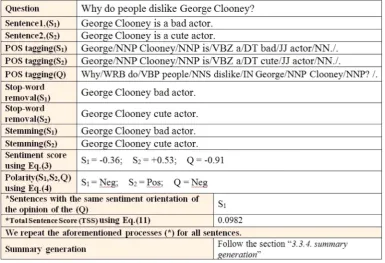
The current section provides an example to better convey how the QMOS functions. Given two sentences and a user's question, as shown inFig. 3, the QMOS applies Pos-tagger to sentences and user's query. The result is shown in“Part of speech tagging”field. After this step, the QMOS stems all different words, as shown in“Stemming” field. Finally, the QMOS applies the stop word-removal procedure to sentences and question. The output is also given in“Stop word-removal“field. Furthermore, the method provides the significant information such as, the sentiment score of each sentence, the classification of positive, negative and neutral sentences, Total Sentence Score (TSS), identifying sentences with the same sentiment orientation of the opinion of the correlated user's question, identifying user's query relevant sentences and extracting the answers from the top ranked sentences using section“3.3.4. summary generation”.
4. Experimental evaluation
We conducted two experiments on datasets:a)Blog06 corpus provided by the Text Analysis Conference4(TAC) 2008;b)DUC 2006 datasets provided by Document Understanding Conference5(DUC). We describe the details of experiment 1 and experiment 2 in the followings sections.
4.1. Data set
This section describes the dataset used throughout the experiments. We used the data produced by the TAC 2008 and DUC 2006 to assess the performance of our proposed method, QMOS. The TAC 2008 includes three main tasks: 1) Question Answering; 2) Recognizing Textual Entailment; 3) Summarization (Update, Opinion Pilot). In this project, we focused on the opinion task of text summarization. Opinion summarization pilot (OSP) aims to summarize the opinions expressed in the blog documents. The OSP task is a complex task which containsquestion answering, multi-document summarizationandsentiment/opinion analysis. Given a set of blog documents and a list of questions, a summary that answered to opinion-oriented questions is produced. The data for OSP task belongs to Blog06 corpus that has been used in several TREC tracks in 2006 and 2007. The data includes 609 blog documents relevant to 25 topics. Each topic contains 10–39 blog pages. It is worth noting, the summary text generated by QMOS is considered as a candidate summary and the summary text generated by the TAC 2008 is denoted the reference summary. The DUC 2006 data sets include 50 document clusters. Each cluster of DUC 2006 data sets includes 25 relative documents. To evaluate the QMOS, we need a gold standard data, which is a set of all correct results. For this purpose, in order to create a gold standard, the text summaries are produced using the opinionated sentences. Each text summary of multi-documents is created using the following steps:
1)Assessment of opinionated questions—the annotators determine the polarity of the user's question. In other words, they tag the opinion of the user's query with‘Polarity = Pos’,‘Polarity = Neg’or‘Polarity = Neu’.Table 6shows an example of some questions of TAC 2008 and DUC 2006 datasets. In DUC 2006, we focused on opinion-asking topics.
2)Sentence polarity annotation—in the current step the annotators split the text contents into sentences, and then tag the opinion of each sentence with‘Polarity = Pos’,‘Polarity = Neg’,‘Polarity = Neu’or‘Polarity = null’.
3)Sentence categorization—the sentences are categorized into two distinct groups: objective sentences (factual sentences, a sentence not expressed any opinion,‘Polarity = Neu’or‘Polarity = null’) and subjective sentences (‘Polarity = Pos’,‘Polarity = Neg’). 4)Production of summaries to answer each question—at this step only the subjective sentences are selected to answer the user's
question. They consider the following conditions to select appropriate sentences:i)the sentences should be close to the user's question;ii)the user's question and the sentences should have the same sentiment orientation (positive or negative). Finally, the produced summary for each question is considered as the gold standard dataset. The dataset includes approximately 5071 positive sentences, 3489 negative sentences, 239 but-clauses and 302 negations.
We conducted two experiments to assess the performance of the QMOS. We select a set of documents randomly. These documents are split into two distinct datasets (training dataset (70%) and testing dataset (30%)).
Table 6
Sample of the Questions.
Dataset Questions
TAC 2008 Why did people enjoy "A Million Little Pieces”? What do people like about System of a Down?
What reasons are given for positive opinions of David Irving's arrest and trial? What do people like about System of a Down?
Why do people dislike George Clooney? Why don't people like Subway sandwiches? DUC 2006 < /narr >
Discuss conditions on American Indian reservations or among Native American communities. Include the benefits and drawbacks of the reservation system. Include legal privileges and problems.
< /narr > < /narr >
What are the advantages and disadvantages of home schooling? Is the trend growing or declining? < /narr >
< /narr >
Why are wetlands important? Where are they threatened? What steps are being taken to preserve them? What frustrations and setbacks have there been?
< /narr >
4.2. Evaluation metrics
We used the standard ROUGE-N metric (Eq. (13)) (C.-Y.Lin, 2004) to evaluate the performance of the QMOS. ROUGE has been adopted by DUC6as the official evaluation metric for text summarization. ROUGE-N is calculated as follows:
− =
∑ ∑ −
∑ ∑ −
−
−
ROUGE N
Count (N gram)
Count (N gram) S ϵ Reference summaries N gram ɛ S match
S ϵ Reference summaries N gram ɛ S (13)
Where,Nindicates the length of the n-gram and Countmatch(N-gram) indicates the total NO. of the n-grams occurring in both a reference and a candidate summaries. Count (N-gram) indicates the No. of the n-grams in the reference summaries. In our experi-ments, we employed two metrics ROUGE-1 and ROUGE-2. We also measured the average ROUGE score usingEq. (14).
= − + −
Average ROUGE Score ARS( ) ROUGE 1 ROUGE 2
2 (14)
4.2.1. What is ROUGE and how it works for evaluation of summarization tasks?
ROUGE7,8stands for Recall-Oriented Understudy for Gisting Evaluation. It includes a set of metrics (e.g., ROUGE-N (an n-gram of size 1, 2 and 3 is referred to as“unigram”,“bigram”and“trigram”, respectively); ROUGE-L (Longest Common Subsequence (LCS)); ROUGE-W (Weighted LCS-based statistics); ROUGE-S (Skip-bigram) and ROUGE-SU (Skip-bigram plus unigram)) for evaluating automatic sum-marization of texts. It works by comparing an automatically produced summary (system-produced) against a reference (gold) sum-mary (human-produced). Given a gold sumsum-mary:“diet must have apple and banana”and a system summary:“Apple and banana are for good diet”, we calculate the ROUGE-1, ROUGE-2 and ARS as follows.
1) We extract the individual words (unigram) and two adjacent words (bigram) from both gold and system summaries: =
Gold summaryunigram {diet, must, have, apple, and, banana}; =
System summaryunigram {Apple, and, banana, are, for, good, diet}; =
Gold summarybigram {diet must, must have, have apple, apple and, and banana}; =
System summarybigram {Apple and and banana banana are are for for good good diet, , , , , }.
2) To calculate ROUGE-1 (refers to the overlap of unigrams between the system summary and gold summary) usingEq. (13), wefirst calculate the denominator of the ratio–which is the number of unigrams in the gold summary. So, it is 6. Then, for the numerator, wefind how many unigrams co-occur in gold summary and system summary. So, it is 4. Finally, ROUGE-1 value would be:(4/ 6=0.6666).
3) To calculate ROUGE-2 (refers to the overlap of bigrams between the system and gold summaries) usingEq. (13), wefirst calculate the denominator of the ratio–which is the number of bigrams in the gold summary. So, it is 5. Then, for the numerator, wefind how many bigrams co-occur in gold summary and system summary. So, it is 2. Finally, ROUGE-2 value would be:(2/5=0.4). 4) The ARS value is calculated using theEq. (14): ((0.4 + 0.6666)/2=0.5333).
4.3. Experiment 1
This section evaluates the performance of the proposed method. We start with parameter setting followed by comparing the performance of QMOS with the existing methods. Finally, we present a statistical significance test.
4.3.1. Parameter setting
In the current section, we focused on optimizing QMOS parameters. To be more specific, we try to optimize theβ(refer to section e) Sentence similarity measure using SSM and WOSM (SSWOS)) and theγ(refer toSection 3.3.3. Compound Model (CM)). In order to accomplish this, we ran the QMOS on the training dataset. We carry out experiments with differentγandβranging from 0.1 to 0.9 with a step of 0.1. To estimate the values ofγandβ,we used gradient search strategy (a nested loop) (Abdi et al., 2015a),Algorithm 4, whereγis outer loop andβis inner loop. In thefirst pass of the outer loop when the value ofγbecomes 0.1 then control enters into the inner loop whereβis varied from 0.1 to 0.9 to observe the variation in performance. The second pass of the outer loop also triggers the inner loop again. This repeats until the outer loopfinishes. The results of aforementioned nested loop are reported in Table 7.Table 7presents the experimental results achieved by using variousβandγvalues. We evaluated the results in terms of ROUGE-1, ROUGE-2 and ARS. On analyzing the results, we found that the best performance was achieved withβ=0.8andγ=0. 5. Theβandγproduced values for the three metrics as follows: 0.4079 (ROUGE-1), 0.0824 (ROUGE-2), 0.2452 (ARS). The best values inTable 7have been marked using boldface. As a result, we can recommend the settingβ=0.8,γ=0. 5to evaluate the QMOS on the test dataset.
6http://duc.nist.gov/.
4.3.2. Comparison with related methods
In this section, we will compare the QMOS performance with the other existing well-known methods. We compare QMOS with more other methods:1)NUS (Lin, Hoang, Qiu, Ye, & Kan, 2008);2)CCNU (He, Chen, Gui, & Li, 2008);3)Italica (Cruz, Troyano, Ortega, & Enríquez, 2008);4)Summarizers (Cruz et al., 2008);5)IIITSum (Varma et al., 2008); 6) PolyU (Li, You, Hu, & Wei, 2008). Since these systems obtained good results on the TAC 2008 and DUC 2006 datasets, we selected them for comparison. We ran our method on testing dataset only withγ= 0.5 andβ= 0.8. The evaluation measures values are displayed inTable 8.Table 8shows the QMOS obtained the best result in comparison with the Italica, which is the best existing approach and has an ARS of (22.71%). However, due to the result, the QMOS outperformed the other existing method.
Algorithm 4 optimizing.
Data set: Training data; Forγ=0.1toγ=0.9
Forβ=0.1toβ=0.9 Begin
Apply the QMOS to dataset; End
Table 7
Performance of the QMOS against different values ofγandβ.
β γ ROUGE-1 ROUG-2 ARS
β= (0.1 .. 0.7) 0.1 . . .
. . . .
0.9 . . .
β= 0.8 0.1 0.3872 0.0769 0.2321
0.2 0.3914 0.0772 0.2343
0.3 0.3953 0.0792 0.2373
0.4 0.3980 0.0801 0.2391
0.5 0.4079 0.0824 0.2452
0.6 0.4071 0.0822 0.2447
0.7 0.4061 0.0808 0.2435
0.8 0.3950 0.0802 0.2376
0.9 0.3910 0.0811 0.2361
β= (0.9) 0.1 . . .
. . . .
0.9 . . .
Table 8
The Performance of the QMOS against other methods.
ROUGE values of the methods =
β 0.8,γ=0.5
System ROUGE-1 ROUGE-2 ARS
QMOS 0.4123 0.0985 0.2554
IIITSum 0.1511 0.0323 0.0917
Summarizers 0.3279 0.0439 0.1859
CCNU 0.2011 0.0554 0.1283
PolyU 0.2932 0.0760 0.1846
NUS 0.3484 0.0546 0.2015
Italica 0.3796 0.0745 0.2271
Table 9
Detailed comparison between the QMOS and other approaches.
QMOS improvement (%)
Metrics Italica NUS PolyU CCNU Summarizers IIITSum
ROUGE-1 +8.61 +18.34 +40.62 +105.02 +25.74 +172.87
4.3.3. Detailed comparison
We used the relative improvementEq. (15)for comparison between the QMOS and other approaches. ⎛
⎝
− ⎞
⎠ × Our method Other method
Other method 100 (15)
Table 9displays the results. In Tables 9‘‘+’’indicates that QMOS method improves the existing approaches.Table 9shows that among the existing approaches the Italica obtained the best results. However, In comparison with the approach Italica, QMOS improved the performance of the Italica approach as follows: 8.61% (ROUGE-1), 32.21% (ROUGE-2).
4.3.4. Statistical significance test
We compared the QMOS with other existing method statistically using the Wilcoxon signed rank test (‘a non-parametric statistical hypothesis test’). To do this, we create seven groups:1) Italica, 2) IIITSum, 3) Summarizers, 4) CCNU, 5) PolyU 6) NUS and 7) QMOS. Each two groups are compared at a time (e.g. QMOS, IIITSum). Each group includes the ROUGE-1 and ROUGE-2 scores.Table 10 presents the P-values produced by Wilcoxon's signed rank test for comparison of two groups at a time. We considered two hypotheses: H0(Null): there is not the difference between the ROUGE values of two groups.HA(alternative): there exists a significant difference. All P-values are less than 0.05, As shown inTable 10. For example, the test between QMOS and the IIITSum produced a P-value of 0.011 (ROUGE-1). The same result is also achieved by all other methods. However, this is a strong evidence to accept the alternative hypothesis and refuse the null hypothesis.
4.4. Experiment 2
This section aims to examine the effectiveness of sentiment lexicon size, analyze the effect ofSSM, WOSM, CWEandSSA ap-proaches, and examine the influence of contextual polarity in sentiment analysis.
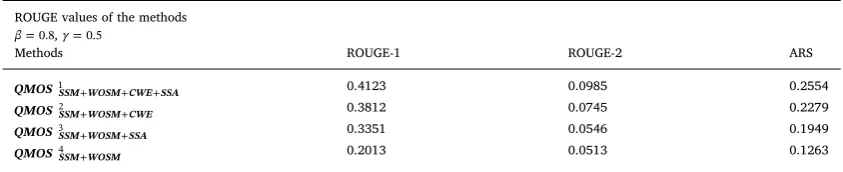
4.4.1. Comparison withQMOSSSM WOSM CWE2 + + ,QMOSSSM WOSM SSA3 + + andQMOSSSM WOSM4 +
In this section, we compareQMOS1SSM WOSM CWE SSA+ + + , withQMOSSSM WOSM CWE2 + + ,QMOSSSM WOSM SSA3 + + andQMOSSSM WOSM4 +
where SSM + WOSM + CWE (semantic and syntactic similarity measures combined with content word expansion), SSM + WOSM + SSA(semantic and syntactic similarity measurescombined with Semantic Sentiment Approach),SSM + WOSM (se-mantic similarity measurecombined withsyntactic similarity measure), andSSM + WOSM + CWE + SSA(all four types of approaches). In this experiment, our aim is to examine the efficiency of the combinationSSM + WOSM + CWE + SSAon QMOS method.
The results of QMOS1SSM WOSM CWE SSA+ + + , QMOSSSM WOSM CWE2 + + , QMOSSSM WOSM SSA3 + + and QMOSSSM WOSM4 + are reported in
Table 11. From the result, we canfigure out that the performance ofQMOSSSM WOSM CWE SSA1 + + + is better thanQMOSSSM WOSM CWE2 + + , + +
QMOSSSM WOSM SSA3 and
+
QMOSSSM WOSM4 in terms of the ARS value. In other words, a QMOS method that combines all four
ap-proaches could achieve better ARS value that one that combines a subset of apap-proaches. Due to the results, we used the combine SSM + WOSM + CWE + SSAfor the proposed method.
Sentiment lexicon size—we also investigated whether more sentiment words (bigger sentiment dictionary) can lead to promising results. The relationship between the number of dictionary words and the performance (in terms of the ARS value) is shown inFig. 4. The horizontal axis ofFig. 4illustrates the number of words of each sentiment dictionaries. The vertical axis shows theARSvalues. We see that the two smallest dictionaries, i.e., AFINN (word size: 2477) and WordNet-Affect (word size: 4787) perform poorly. There Table 10
P-values produced by Wilcoxon's test by comparing QMOS with other methods.
Data set IIITSum Summarizers CCNU PolyU NUS Italica
5% significance level
Blog06 ROUGE-1 metric
0.011 0.022 0.012 0.004 0.002 0.030
ROUGE-2 metric
0.010 0.023 0.011 0.031 0.030 0.022
Table 11
Performance of the QMOS against various tests (SSM + WOSM + CWE + SSA),SSM + WOSM + CWE, SSM + WOSM + SSAandSSM + WOSM.
ROUGE values of the methods =
β 0.8,γ=0.5
Methods ROUGE-1 ROUGE-2 ARS
+ + +
QMOSSSM WOSM CWE SSA1 0.4123 0.0985 0.2554
+ +
QMOSSSM WOSM CWE2 0.3812 0.0745 0.2279
+ +
QMOSSSM WOSM SSA3 0.3351 0.0546 0.1949
+
seems to be a correlation that larger is better. It can be observed that the SentiWordNet (word size: 155,287) leads to the highest throughput. The reason is due to the wide coverage of sentiment words.
4.4.2. Influence of contextual polarity in sentiment analysis
In this section, we compare QMOS(contextual polarity)with QMOS(without contextual polarity). QMOS(contextual polarity)employs the subjective and objective sentence handling, question and conditional sentences handling, sentiment shifter (e.g.negation handling, but-clause handling, sarcasm handling) to analysis user's reviews, while QMOS (without contextual polarity)only uses the subjective and objective sentence handling to analysis user's reviews.
In this experiment, our aim is to examine the efficiency of the contextual polarity in sentiment analysis. The results of QMOS (contextual polarity)and QMOS(without contextual polarity)are presented inTable 12. It can be seen that the performance of QMOS(contextual polarity)is better than QMOS(without contextual polarity)in term of the results of ARS. Due to the results, we also considered the QMOS (contextual polarity)to analysis user's reviews.
4.5. Discussion
FromTables 7–9, we obtained the following observations. The QMOS outperforms other methods and obtained good perfor-mance. This is due to the facts that,1)it is able to identify the synonymous words among all sentences using theCWE method,while other methods (e.g., Italica, PolyU and IIITSum) do not use content word expansion approach.
2)Unlike other method (e.g,NUS, CCNU, Summarizers), the QMOS is able to distinguish the meaning of two sentences by using the combination of semantic and syntactic information. It integrates the semantic and syntactic information to compute (S to S) and (Q to S) similarity measures.
3)Since a dictionary-based method has limited word coverage, we combined several sentiment lexicons in order to tackle the aforementioned challenge, while other methods (e.g, IIITSum, Summarizers, CCNU, NUS and Italica) do not use the combination of several sentiment lexicons. Furthermore, in the case where the word does not appear in the lexicon (HCL), QMOS uses SSA method to compute the sentiment score of that word. We also examined whether more sentiment words can lead to better performance of the QMOS.Fig. 4shows a bigger sentiment dictionary leads to the promising result.
4)The QMOS also considers contextual polarity and the types of sentences in sentiment analysis, while other methods (e.g, IIITSum, Summarizers (excluding types of sentences), CCNU (excluding interrogative sentences handling), PolyU, NUS (excluding negation handling) and Italica (excluding types of sentences). Regarding to Table 12, it can be observed that contextual polarity handling improves the performance of QMOS method.
General Inquirer
AFINN
Opinion Lexicon SenticNet4
SO-CAL NRC
Sentiment140 Lexicon
Subjectivity Lexicon
WordNet-Affect SentiWordNet HCL
0 5 10 15 20 25 30
11,789 2,477 6,786 50,000 6,306 54,129 62,468 1,83,000
8,221 4,787 1,55,287
ARS Value (%
)
Fig. 4.Performance and the size of sentiment dictionary words.
Table 12
Performance of the QMOS against various tests.
ROUGE values of the methods =
β 0.8,γ=0.5
Methods ROUGE-1 ROUGE-2 ARS
QMOS(contextual polarity) 0.4123 0.0985 0.2554