IDENTIFICATION OF RAINFALL TEMPORAL PATTERNS
1
Fadhilah Yusof 2 Nur Syereena Nojumuddin and 3 Zulkifli Yusop
1,2
Department of Mathematical Sciences, Faculty of Science, Universiti Teknologi Malaysia, 81310 UTM Johor Bahru, Johor, Malaysia.
3
Instititute of Environmental and Water Resources Management, Universiti Teknologi Malaysia, 81310 UTM Johor Bahru, Johor,
Malaysia.
1
[email protected], [email protected], [email protected]
Abstract. Temporal pattern for rainfall events is required in the design and evaluation of hydrologic safety for hydraulic structures. In this paper, a method of statistical cluster analysis is applied to identify event-based representative temporal rainfall pattern in fourteen stations in Johor. The 8 hour separation time of no rain is used to divide the 5 years rainfall data into individual rainfall event according to the monsoons. The analysis is implemented from the dimensionless mass curve ordinates as the attributes in statistical cluster analysis of the cumulative storm depth over the non-dimensionalized time. As a result, three representative rainstorm patterns are identified and classified under the two basic types of advanced-type (A) and central-peak type (C) for northeast and southwest monsoon. Meanwhile, only one basic type is identified to represent rainstorm pattern during the inter-monsoon that is advanced type (A). In addition, the rainfall pattern is dependent on rainfall depth and duration, season and geographical location by contingency table test. The rainfall information presently used for design in Malaysia is very dissimilar to the representative curves derived in this study. The identification of three representative rainfall temporal patterns according to the monsoon seasons in Johor can be used as a basis to stochastically generate the plausible rainfall hyetographs of the specified pattern in Johor.
INTRODUCTION
Design of hydraulic structures in river systems are often confronted with a lack of available data at specific point in a catchment owing to the models of hydrology and water quality often require long records of short-time increment precipitation data. These data are generally not available except at research experimental watershed facilities. If rainfall data are readily available, they can be served for the further analysis as the process of designing and analyzing of hydro systems need an appropriate rainfall pattern. For this reason, it is imperative that the designer knows the time distribution of rainfall so that runoff can be managed appropriately. For example, when considering storm-water management for a new site, a detention structure may be installed to detain the new runoff and release it at a controlled rate. If the detention system is improperly designed, it may inflate the cost or increase the risk. Therefore, an appropriate temporal pattern for a design storm is importance in the design and evaluation of hydrologic safety. Thus, a variety point of rainfall data products can be used in such design studies such as the historical time series, a synthetically generated time series, intensity-duration –frequency (IDF) relations and design storms.
Design storms are often used in urban drainage design for drainage and storm water management projects. Information about the storm event under consideration is often required to design a hydraulic structure. When designing a hydraulic structure to manage rainfall and runoff, a time distribution pattern (hyetograph) for the rainfall event is used to create a hydrograph. A complete description of a design storm involves the specification of storm depth, duration and its temporal pattern. A first design of hyetograph which is called as the Chicago method is introduced by Keifer and Chu in the year 1957 for the use in sewer design. It is based on an intensity duration curve for a specific return period. Hence, the method for determining the time-varying rainfall input in the absence of data is through mass curves by Huff has been developed in the year 1967. In the study of storm patterns in IIlinois urban areas, he presented a mass rainfall curve which the time distributions were classified into four groups depending on whether the maximum intensity occurred in the first, second, third, or fourth quarter of the duration. For each quarter, dimensionless time distributions were presented for various probability levels. However, according to Bonta (1987,1997), a problem with developing Huff curves is that they can be affected by factors such as season of year, climatic region; sampling-time interval of raw data, storm size, number of storm, etc.
1980s, Yen and Chow applied the method of statistical moments to describing hyetographs. Data from over 9000 rainstorms at four locations were used (Boston, Massachusetts; Elizabeth City, North Carolina; San Luis Obispo, California; and Urbana, Illinois), with the analysis focused primarily on the first two moments with respect to the beginning of the event. They found that a general non-dimensional triangular hyetograph could be established, utilizing only the first moment. To characterize rainfall pattern there are methods which parametrically treat the dimensionless rainfall mass curve as a cumulative distribution function (CDF) of the dimensionless time. Hence, the same method of characterizing temporal rainfall events pattern were conducted by Yen and Chow (1983) and Fang and Tung (1996).
Twenty years later, the principle component analysis and cluster analysis have been used to classify hyetograph and hydrographs by Hannah et al (2000), Lana et al (2001) and Lin et al (2004). In addition, Wu S.J (2006) has done the studied on identification of representative rainfall temporal patterns in Hong Kong territory by using statistical cluster analysis. Last but not least, in 2008, Pelczer, I.J and Cisneros-Iturbe H.L. investigated on the identification of rainfall patterns over the Valley of Mexico of years 1993 till 2005 using clustering algorithm. The basic aim of cluster analysis is to find ‘natural grouping’ of a set of individuals by a relevant attributes. Cluster analysis allocates a set of individuals to a set of mutually exclusive and exhaustive groups such that individuals within the group are similar to one another whereas individuals between different groups are dissimilar. In general, the divisive (K-means method) and hierarchical (average and Ward’s methods) clustering techniques can be applied to perform the cluster analysis and each method defines the similarity and the distance measurement somewhat differently. The result from different applications Fang and Tung (1996) and Ramos (2001) revealed that the effects of using methods of K-means, Ward and others on the final classification result were significant.
identify representative storm pattern occurred in Johor as the dimensionless rainfall mass curves ordinates are used as the attributes in statistical cluster analysis. Hence, the factor that affecting the rainfall pattern occurrence is investigates by using contingency table test. The representative curves result in the study is compare to the dimensionless hyetograph of the design storm given in the Urban Storm water Management Manual for Malaysia (DID, 2000).
Study region and data
Johor are situated in the southern part of Peninsular Malaysia and are located between the 1°20"N and 2°35"N latitudes. Johor has total land area of 19,210 km2 and a population of about 3.2 million as of 2010. Johor has a humid tropical climate with monsoon rain from November to March blowing from the South China Sea. The average annual rainfall is 2355 mm with average temperatures ranging between 25.5 °C and 27.8 °C.
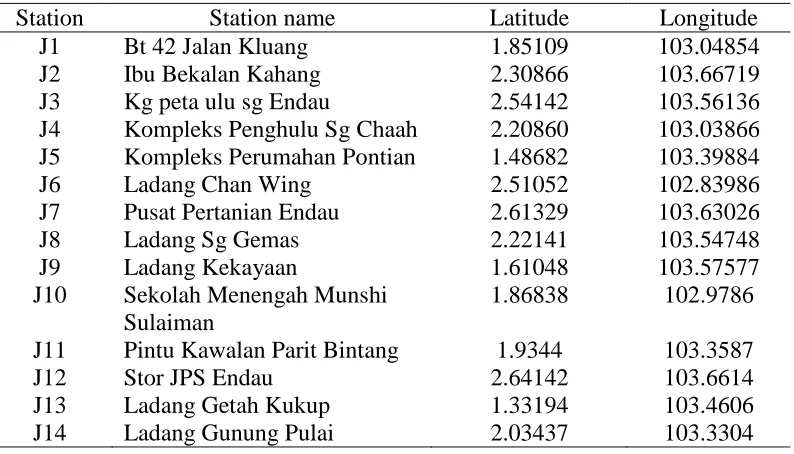
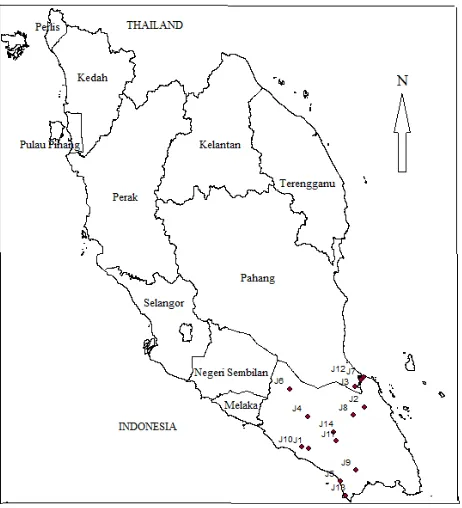
Hourly rainfall data in this study are obtained from Department of Irrigation and Drainage (DID) of the Government of Malaysia. Rainfall measured by 14 rain gauges in Johor was used in the study. The period of data available ranged from 2007 to 2011. The details of rain gauges are shown in Table 1 and the locations of the rain gauges are shown in Figure 1.
Table 1: Rain gauge stations used in Johor.
Station Station name Latitude Longitude
J1 Bt 42 Jalan Kluang 1.85109 103.04854
J2 Ibu Bekalan Kahang 2.30866 103.66719
J3 Kg peta ulu sg Endau 2.54142 103.56136
J4 Kompleks Penghulu Sg Chaah 2.20860 103.03866 J5 Kompleks Perumahan Pontian 1.48682 103.39884
J6 Ladang Chan Wing 2.51052 102.83986
J7 Pusat Pertanian Endau 2.61329 103.63026
J8 Ladang Sg Gemas 2.22141 103.54748
J9 Ladang Kekayaan 1.61048 103.57577
J10 Sekolah Menengah Munshi Sulaiman
1.86838 102.9786
J11 Pintu Kawalan Parit Bintang 1.9344 103.3587
J12 Stor JPS Endau 2.64142 103.6614
J13 Ladang Getah Kukup 1.33194 103.4606
Figure 1: Location of the rain gauge stations in Johor used in the study
IDENTIFICATION OF RAINSTORM PATTERN
Determination of rainfall event
Characterization of Rainfall Patterns
During a rainfall event, the precipitation amounts differ with respect to time at a given location. To identify the different storm patterns for the observed storm events, temporal patterns of storm events should be characterized. As rainfall duration and total depth vary from one event to another, characterization of similarity or dissimilarity of different rainfall patterns can best be made through the use of a dimensionless scale. By using dimensionless rainfall mass curves or hyetograph, the effect of rainfall duration and depth are removed, leaving the temporal variation of rainfall event as the only factor for differentiating events of different patterns. After non-dimensionalization, rainfall event with different depths and durations can be combined, examined and categorized for identifying representative rainfall patterns.
To characterize the storm temporal pattern using the rainfall mass curve, the selection of the number of time points over the storm duration is subjective. Too few points may not accurately describe the underlying variation of storm pattern. On the other hand, too many points would capture unwanted sample noises masking the essential feature of storm pattern. According to a study on Wyoming by Fang and Tung, Y.K, the entire storm duration was divided into six equal intervals and Wu, S.J (2006) divide the entire duration into 12 equal intervals. Therefore, in this study, a non-dimensionalized rainfall mass curve is divided into 10 intervals and the corresponding dimensionless rainfall mass ordinates Fτ at t= j⁄10 with j=1, 2… 10 are used to represent a rainstorm pattern as its suitable with the rainfall characteristic used in the study. Non-dimensionalized rainstorm pattern can be obtained by adjusting the scale of the duration and depth of a rainfall mass curve as
(3)
Cluster Analysis for Identification Representative Rainfall Patterns
As rainstorm pattern varies among events, it is useful to categorize them into several representative types so that individual rainfall patterns within each type are similar to one another, but not necessarily identical, whereas individual rainfall patterns between different types are dissimilar. Euclidean distance based on K-means clustering method by MacQueen (1967) is adopted herein to classify pattern typically occurred in Johor. Hence, the study used dimensionless rainfall mass curves ordinates denoted as F-based ordinates as the attributes in statistical cluster analysis to identify representative rainfall patterns in Johor. The representative of rainfall pattern can be determined after the rainfall event data is classified into 3,4,5 and 6 group. To remove the scale effects of the attributes used in the cluster analysis, attributes are standardized so that they have a zero mean and a unit standard deviation. The proper number of rainfall patterns can be determined by identifying the appropriate number of group that results from the k-means clustering analysis. Since the appropriate number of group to represent rainfall pattern is not known in advanced, it is commonly determined by a trial-and-error process of visually examining the averaged dimensionless mass curve for each group resulting from the cluster analysis. The better clustering is when the similarity within a group is greater and the difference between groups is greater. The K-means clustering algorithm is performed by using the three steps until its convergence. The three steps are (1) determine the centroid coordinate and by using k=3, 4, 5 and 6; (2) determine the distance of each object to the centroids and (3) group the object based on minimum distance. Repeat the three steps above until convergence or no object move group.
The centroid coordinates of the points
( ( ) ( ) s given by equation (1);
( (1) The Euclidean distance formula is given in equation (2);
Factors Affecting the Rainfall Pattern
As the identification of rainfall pattern based on the statistical cluster analysis, the rainfall pattern is derived from the dimensionless rainfall mass curve of many rainfall events with different durations and depths that have occurred at different seasons at various locations in Johor. The investigation of whether the occurrence frequency of one particular rainfall pattern might be affected by the season, geographical location or rainfall depth and duration can be done by statistical contingency table introduced by (Conover, 1980). In the study, the chi-square test is conducted to compute the p-value. The degree of freedom associated with the chi-square test, which equal to (nc-1)(nr-1) with nc and nr
being the number of column and row, respectively. In practice, the significance level of 5% is used for decision making. If the p-value is lower than 5%, the factor under consideration is considered to have significant effect on the occurrence frequency of various rainfall patterns.
Comparison of Representative Rainstorm Pattern with the Malaysian Design Storm
The dimensionless hyetograph of the design storm given in the Urban Storm water Management Manual for Malaysia (DID, 2000) is also compared with the best representative rainfall pattern identify in the study. The development of temporal rainfall patterns in the manual is based on an approach discussed in ‘‘Australian rainfall and runoff” (DID, 2000, chapter 13, pp. 5–16). The dimensionless hyetographs are presented for durations of 10, 15, 30, 60, 120, 180, and 360 min. The comparison is between the best representative rainfall pattern result in the study and 2-h West Coast design storm given in the manual (DID, 2000).
RESULT AND DISCUSSION
Determination of rainfall event
Table 2: Number of rainstorm event occurrences by monsoon season during 2007-2011.
Station Number of storm event during
southwest (May-September)
Number of storm event during
northeast (November-Mac)
Two inter-monsoon
(April-October)
J1 352 295 121
J2 212 172 86
J3 187 197 80
J4 188 189 61
J5 233 213 102
J6 191 205 74
J7 245 257 95
J8 123 171 64
J9 195 195 83
J10 247 264 100
J11 260 253 114
J12 218 275 82
J13 296 352 132
J14 298 366 130
Total 3245 3404 1324
Figure 2 shows the average number of rainstorm events for all the fourteen stations by monsoon. Northeast monsoon received the highest average number of rainstorm event with 243, followed by southwest monsoon with 232 and inter-monsoon with 94.
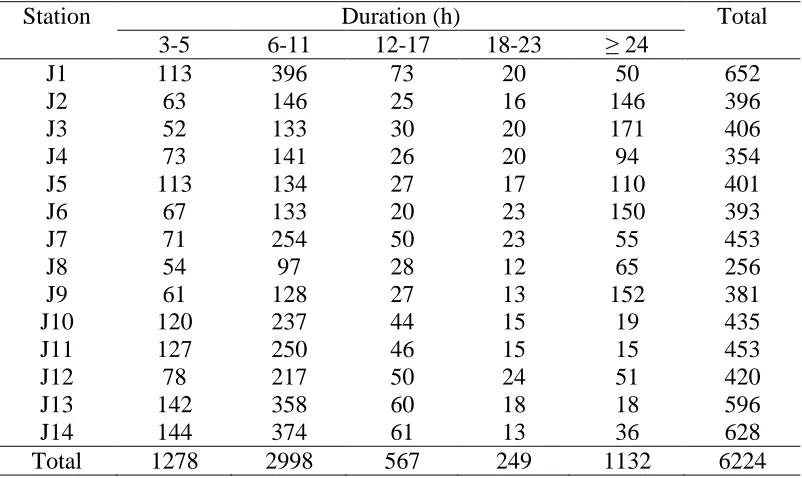
Table 3: Statistics of storm duration
Station Duration (h) Total
3-5 6-11 12-17 18-23 ≥ 24
J1 113 396 73 20 50 652
J2 63 146 25 16 146 396
J3 52 133 30 20 171 406
J4 73 141 26 20 94 354
J5 113 134 27 17 110 401
J6 67 133 20 23 150 393
J7 71 254 50 23 55 453
J8 54 97 28 12 65 256
J9 61 128 27 13 152 381
J10 120 237 44 15 19 435
J11 127 250 46 15 15 453
J12 78 217 50 24 51 420
J13 142 358 60 18 18 596
J14 144 374 61 13 36 628
Total 1278 2998 567 249 1132 6224
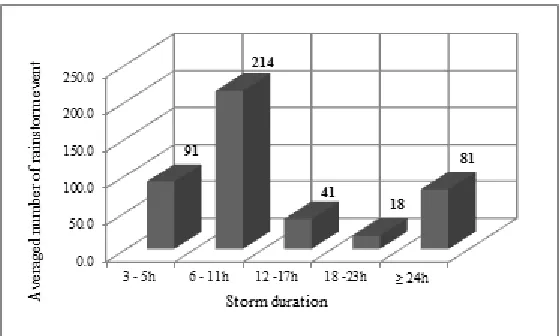
Figure 3: Average number of rainstorm events by different storm duration.
Characterization of Rainfall Patterns
Figure 4: Mean of event depth by monsoon seasons
Cluster Analysis for Identification Representative Rainfall Patterns
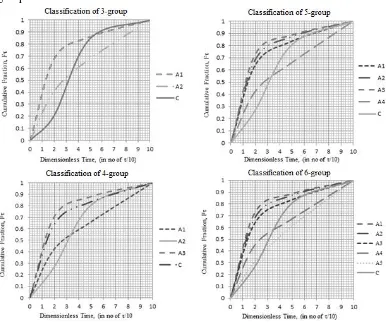
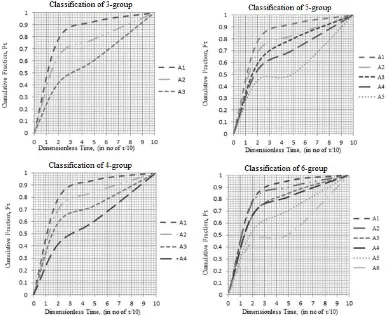
Figures 5-7 show the average rainfall mass curve under 3, 4, 5 and 6 groups of classification based on the monsoon seasons. In these figures the graphs of the cumulative fraction of rainfall depth over dimensionless time are shown, hence the gradient of the curve represents the intensity of the rainfall pattern. Figure 5, 6 and 7 represent the rainfall temporal patterns during the northeast, southwest and inter-monsoon, respectively. It can be observed that most of the curves recorded the highest intensity during the early part for northeast and inter-monsoon whereas during southwest the curves recorded the highest intensity during the center part.
group. Meanwhile, for inter-monsoon, by referring to Figure 7, all curves have the highest gradient at the beginning part of dimensionless time for all the four groups.
Figure 5: Rainstorm pattern for northeast
Figure 6: Rainstorm pattern for southwest
Figure 7: Rainstorm pattern for inter-monsoon
the same group as the shape of the curve (C2, C3 and C4) is similar to one and another and not different from the (C1). In addition, the (A1 and A2) in the 3 group of classification in Figure 5 and 6 are characterized as the different group as the shape of these two curves is not same although they are the same type. As a result, the 3 group is the best representative rainfall pattern present during northeast and southwest monsoon in Johor. The three patterns that are under the two basic types of rainfall patterns are advanced-type (A1 and A2) and central-peak type (C). Meanwhile, by comparing the result of all groups in Figure 7, the three group of classification is the representative of rainfall temporal distribution profiles during inter-monsoon as the three advanced type (A1, A2 and A3) are not similar in curve shape and difference between each group although it represent the same basic type of rainfall pattern. Therefore, basic type for inter-monsoon is advanced pattern (A1, A2 and A3).
Factors Affecting the Rainfall Pattern
Table 4: Contingency table of four typical rainfall in Johor.
Rainfall patterns Column
Total
A1 A2 A3 C
Rainfall duration (h)
3-12 2426 1766 96 1614 5902
13-22 261 256 12 184 713
23-32 63 122 13 47 245
33-42 35 65 7 25 132
≥43 34 99 10 21 164
Row Total 2819 2308 1891 138 7156
χ2
= 187 DF = 12 p-value = 0.00
Rainfall depth (mm)
0-70 1302 1022 62 929 3315
71-140 505 420 20 305 1250
141-210 314 224 16 194 748
211-280 190 157 9 132 488
281-350 155 96 7 100 558
351-490 160 133 10 112 415
≥490 89 129 7 62 287
Row Total 2715 2181 131 1834 6861
χ2
= 39.3 DF = 18 p-value = 0.003
Season
Northeast 1657 1333 0 217 3207
Southwest 797 328 0 1674 2799
Inter-monsoon
365 647 138 0 1150
Row Total 2819 2308 138 1891 7156
χ2
= 0.0004 DF = 6 p-value = 0.00
Region
Western 1353 599 0 297 2249
Northern 1596 586 0 114 2296
Southern 101 238 0 218 557
Eastern 281 508 138 297 1224
Row Total 3331 1931 138 926 6326
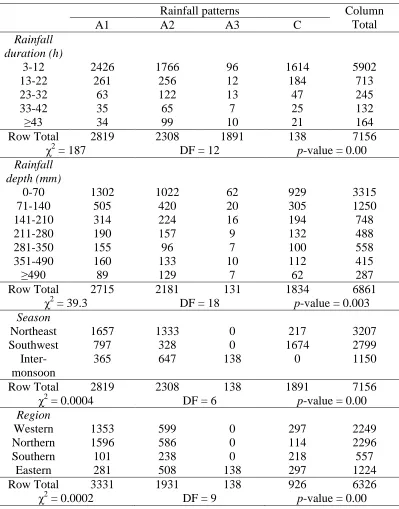
By referring to the Table 4, the contingency table shows the p-values of 0.00 (˂ 0.05) for rainfall duration, depth, season and region. As the significance level of 5% is used in the study, therefore it can be concluded that the occurrence frequency of various rainfall patterns in Johor are affected by the rainfall depth, duration, season and the geographical location. The result from the contingency tables analysis provides the basis for choosing rainfall types that are most likely to occur in Johor. The selection of the appropriate rainfall pattern cannot be randomly done as the frequency of occurrence of different rainfall patterns is dependent on rainfall depth and duration, seasonal and regional
Comparison of Identification Rainstorm Pattern with the Malaysian Design Storm
Figure 8: Comparison between the best representative rainfall pattern in Johor and 2-h West Coast design storm given in the manual (DID, 2000)
curve is closest to the southwest monsoon in Figure 8. The situation appears to get worse in the inter-monsoon representative rainfall curve presented. However, the design storm represents the central-peaked type which has a high intensity at the central part of the rainfall event. Therefore, it may be concluded that the design storm in DID (2000) does not represent the ‘‘typical” temporal pattern but it represent the basic type of rainfall in Malaysia.
SUMMARY AND CONCLUSION
ACKNOWLEDGMENTS
The authors are grateful to the Malaysian Drainage and Irrigation Department for providing the hourly precipitation data. The work was financed by the Research University Grant (RUG) Q.J130000.2526.08H21 by University Technology Malaysia.
REFERENCES
[1] Adams, B.J and Papa, F. 2000. Urban stormwater management planning
with analytical probabilistic models, John Wiley & Sons, Inc, Canada.
[2] Bonta, J.V. 1997. Proposed use of Huff Curves for hyetograph characterization. In: Proceedings of the Workshop on Climate and Weather
Research. Denver, Colorado.223: 111-124.
[3] Bonta, J.V., Rao, A.R. 1987. Factors affecting development of Huff curves. Transactions of the ASAE 30(6): 1689-1693.
[4] Fang, T.Q., Tung, Y.K. 1996. Analysis of Wyoming extreme precipitation patterns and their uncertainty for safety evaluation of hydraulic structure. Technical Report, WWRC-96.5, Wyoming Water Resource Centre, University of Wyoming, Laramie, Wyoming.
[5] Hannah, D.M., Smith B.P.G., Gurnel, A.M., McGregor RM (2000). An approach to hydrograph classification. Hydrol Process 14: 317-338.
[6] Huff, F.A. 1967. Time distribution of rainfall in heavy storms, Water
Resources Research 3(4): 1007-1019.
[7] Keifer, C.J and Chu, H.H. 1957. Synthetic rainfall pattern for drainage design, ASCE J Hydraulic Div 83 (HY4) :1-25.
[8] Lana, X; Serra, C; Burgueno, A. 2001. Patterns of monthly rainfall shortage and excess in terms of the standardized precipitation index for Catalonia (Ne Sapin). Int J Climatol 21: 1669-1691.
[9] Lin, G.F., Chen, L.H., Kao, S.C. (2004). Development of regional design hyetograph. Hydrol Process (in press).
[10] MacQueen, J. 1967. Some methods for classification and analysis of multivariate observations. In: Proceedings of the 5th Berkeley symposium
1: 281-297.
[11] Pilgrim, D.H.and Cordery, I. 1975. Rainfall temporal patterns for design floods, J Hydraulic Div ASCE 101 (HY1): 81-95.
[12] Pelczer, I.J and Cisneros-Iturbe H.L. (2008): Identification of rainfall patterns over the Valley of Mexico. Proceedings of 11th International
[13] Ramos, M.C. 2001. Divisive and hierarchical clustering techniques to analyse variability of rainfall distribution patterns in a Mediterranean region. Atmos Res 57: 123-138.
[14] Yen, B.C & Chow, V.T. 1980. Design hyetographs for small drainage structures. J. Hydraul. Div. ASCE, 106(HY6), 1055-1076.
[15] Yen, B.C., Chow, V.T. 1983. Local design rainfall, vol II-methodology and analysis. Report, FHWA/RD-82/064, Federal Highway Administration, US Department and of Transportation, Washington, DC,USA.