3D Printing in Architecture
Rajshree Mathur 1
1
Architecture Department, GGSIPU, MBSSPA, Delhi, India
Abstract
Technology is evolving at a fast pace and so is technology of construction. The technologies and processes to produce buildings have remained stagnant for a large period of time. Also our method of construction has an impact on the environment. The paper discusses about an alternative method of construction, using technology called as 3D printing. The paper discusses about the technology, various methods of using the technique, its method of application and the advantages it offers. Further it gives a brief idea about the technology and explains the need for including 3D printing as part of our construction methods in comparison to the traditional method of construction.
Keywords: Rajshree mathur, 3D printing, architecture, construction, Contour crafting,
1. Introduction
Technology is evolving at an ever increasing pace and has been for decades. Everyday objects have become marginal in size and cheaper to produce. With all the changes that we have undergone our living spaces seem to have remained unhindered. The technologies and processes to produce buildings have remained stagnant since the turn of the Industrial Revolution and the growth potential of these methods hasn’t been on par with other aspects of human life. Besides that, concern for the environment has just begun to become understood and incorporated in the construction of buildings.
3D Printing is one automated process that could reduce our carbon footprint and cost of construction. It could increase labor safety and efficiency and drastically reduce time to build. This technology can be traced back to the 80’s but its dive into Architecture has been recent. Although it’s still not prevalent in India on a scale like it is in other parts of the world, its effect and need in India is still desirable. 3D Printing is also known as different terminologies in the context of architecture such as Rapid Prototyping, Desktop Manufacturing, Automated Fabrication, Layer Fabrication etc.
2. What Is 3d Printing?
2.1 Subheadings
3D Printing is an additive manufacturing technology through which 3 dimensional models can be created by layering successive layers of material. These models can be created via 3D printers which range from many
different sizes and purposes. The Printers gather commands from Computer Aided Design Programs to create models or they can even replicate them with use of 3D scanners.
3D Printers have been used not only in Architecture but in some other fields like Medicine, Engineering, Construction, Aerospace, Dental, Industrial Design, consumer Products, jewellery, Footwear etc. In the Medicine field 3D printers have been used to print vital organs and body parts for surgeons to refer to before surgeries or even use them directly as replacements in human bodies. If a technology is good enough to be used in the most important and complex of situations such as the human body then it is justified to be a part of any other field.
In the context of Architecture, 3D printing is in its infancy but it’s showing real promise. At the present time 3D printing is slowly but surely becoming a vital tool in the whole design and construction process. Using this technology to create buildings has already brought about an impact on time, cost, labor safety and the economic market. We have known of two ages in Architecture, Pre Industrial Revolution; when the buildings were slow to construct but were unique and customizable and Post Industrial Revolution; when the buildings became quicker to construct due to mass production but lost their uniqueness and customizability. 3D printing can allow us to bridge the gap between mass production and customizability. (ZCorp.com)
2. History Of 3D Printing
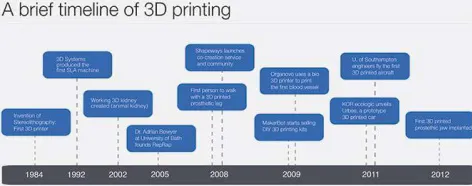
In 1984 Charles Hull came up with Stereolithography, a process by which tangible 3D objects could be created through digital data. In this technology 3D models were created via images.
In the history of manufacturing, subtractive methods have often come first. The province of machining (generating exact shapes with high precision) was generally a subtractive affair, from filing and turning through milling and grinding.
Additive manufacturing’s earliest applications have been on the tool-room end of the manufacturing spectrum. For example, rapid prototyping was one of the earliest additive variants and its mission was to reduce the lead time and cost of developing prototypes of new parts and devices, which was earlier only done with subtractive tool-room methods (typically slowly and expensively). However, as the years go by and technology continually advances, additive methods are moving ever further into the production end of manufacturing. Parts that formerly were the sole province of subtractive methods can now in some cases be made more profitably via additive ones. (3dprinting.com)
3. How 3D Printing Works
Figure 3-1 Basic 3D printing working diagram. Image Source: individual.troweprice.com
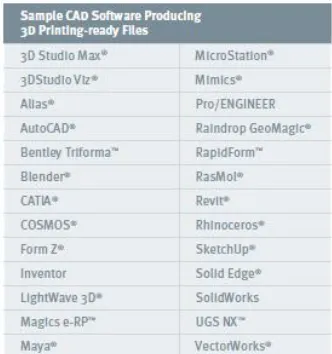
The first step is creating a digital file which contains all data to be used by the 3D printer while creating the model. The software used in this process are called CAD (Computer Aided Design) programs. Various CAD programs used in 3D printing are shown in figure 3-2.
Figure 3-2 List of CAD programs compatible with 3d printing. Image Source: zcorp.com
3.1 Process And Technologies
3D Printing is a straight forward technology. Basically it’s an additive manufacturing technology which is further divided on the basis of how the additive layers are formed or joined. These processes and technologies are divided on the basis of how these layers are formed.
The American Society for Testing and Materials (ASTM group) have set some standards and classified these additive manufacturing processes into 7 categories. These categories are:
• Vat Photopolymerisation
• Material Jetting • Binder Jetting
• Material Extrusion
• Powder Bed Fusion
• Sheet Lamination
• Directed Energy Deposition
3.1.1 Vat Photopolymerisation
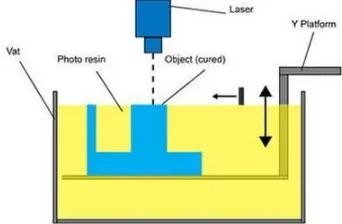
In this process the 3D printer has a compartment filled with ultraviolet curable photopolymer resin which is used to make layers upon layers and is then hardened with UV light. For each layer, the laser beam traces a cross-section of the part pattern on the surface of the liquid resin. Exposure to the ultraviolet laser light cures and solidifies the pattern traced on the resin and joins it to the layer below.
the use of supporting structures which serve to attach the part to the elevator platform and to hold the object because it floats in the basin filled with liquid resin. These are removed manually after the object is finished. [3] (3dprinting.com)
Figure 3-3 Vat photopolymerisation schematics. Image source: lboro.ac.ukI
3.1.2 Material Jetting
This process is closely related to inkjet printing in the way that it uses little droplets one on top of each other to create 3D form and is then solidified by UV light.
Figure 3-4 Material Jetting schematics. Image source: custompartnet.com
3.1.3 Binder Jetting
In this process two materials are used; powder base material and a liquid binder. The powder is layered on top of each other and then glued together by the liquid binder which is spread through nozzles. “In the build chamber, powder is spread in equal layers and binder is applied through jet nozzles that glue the powder particles in the shape of a programmed 3D object. The finished object is glued together by binder remains in the container with the powder base material. After the print is finished, the remaining powder is cleaned off and used for 3D printing the next object.
Figure 3-5 Binder jetting 3D printing technology overview. Image source: additively.com
3.1.4 Material Extrusion
The most commonly used technology in this process is Fused Deposition modeling (FDM). This process works by depositing a plastic material through the nozzle which is heated to melt the material so as to ease the distribution of it, the material hardens immediately after being laid. “The FDM technology works using a plastic filament or metal wire which is unwound from a coil and supplying material to an extrusion nozzle which can turn the flow on and off. The nozzle is heated to melt the material and can be moved in both horizontal and vertical directions by a numerically controlled mechanism, directly controlled by a computer-aided manufacturing (CAM) software package. The object is produced by extruding melted material to form layers as the material hardens immediately after extrusion from the nozzle.
This technology is most widely used with two plastic filament material types: ABS (Acrylonitrile Butadiene Styrene) and PLA (Polylactic acid) but many other materials are available ranging in properties from wood filed, conductive, flexible etc. (3dprinting.com)
3.1.5 Powder Bed Fusion
The most commonly used technology in this process is Selective laser sintering (SLS). It works by using a laser to fuse small particles of glass, plastic, metals or ceramic into a mass.
This technology uses a high power laser to fuse small particles of plastic, metal, ceramic or glass powders into a mass that has the desired three dimensional shape. The laser selectively fuses the powdered material by scanning the cross-sections (or layers) generated by the 3D modeling program on the surface of a powder bed. After each cross-section is scanned, the powder bed is lowered by one layer thickness. Then a new layer of material is applied on top and the process is repeated until the object is completed.
All untouched powder remains as it is and becomes a support structure for the object. Therefore there is no need for any support structure which is an advantage over SLS and SLA. All unused powder can be used for the next print.
Figure 3-7 SLS system schematic. Image source: 3dprinting.com 3.1.6 Sheet Lamination
Sheet lamination involves material in sheets which is bound together with external force. Sheets can be metal, paper or a form of polymer. Metal sheets are welded together by ultrasonic welding in layers and then CNC milled into a proper shape. Paper sheets can be used also, but they are glued by adhesive glue and cut in shape by
precise blades. A leading company in this field is Mcor
Technologies.
printing
3.1.7 Directed Energy Deposition
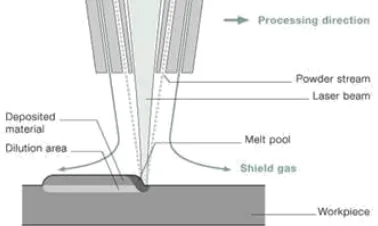
This process is mostly used in the high-tech metal industry and in rapid manufacturing applications. The 3D printing apparatus is usually attached to a multi-axis robotic arm and consists of a nozzle that deposits metal powder or wire on a surface and an energy source (laser, electron beam or plasma arc) that melts it, forming a solid object.
Figure 3-10 Direct Energy Deposition with metal powder and laser melting. Image source: Merlin project.
4: 3D Printing In Architecture
The concept of creating a house or a building using robotics and minimal human labor seemed like a very farfetched idea a few years ago, it seemed expensive and premium if it were to become feasible; this is not true anymore, on the contrary it’s one of the most cheap, affordable and eco-friendly ways of constructing buildings nowadays. Contour Crafting which is a 3D printing process founded by Dr Behrokh Khoshnevis, is based out of the University of Southern California in USA.
Contour Crafting is a process by which large-scale structures can be fabricated quickly in a layer-by-layer fashion – like 3D-printing a building. The process slashes the cost of building a structure by minimizing the man-hours needed to manufacture it and also increases the speed at which the house can be put on the market, lowering the financing cost by allowing it to turn a profit for the builder more quickly. The process is also much safer for construction workers than traditional building techniques, which would lower the cost of insurance for building companies.
4.1 Application Of Countour Crafting In
Construction
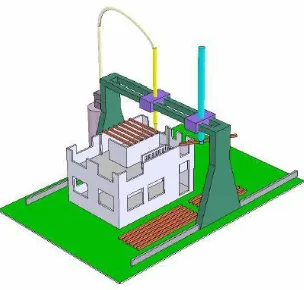
Figure 4-1 Construction of conventional buildings using CC. Image Source: contourcrafting.org
As seen in figure 4-1 the gantry system moves along two parallel rails which are installed on site. The Nozzle system on top of the gantry (yellow column) moves up and down for precise extrusions and modeling along with the gantry to work at different heights of the structure. The other robotic arm (blue column) on top of the gantry helps to place construction materials on the structure such as lintels and so on. The Nozzle system goes around the contours of the building to extrude walls. When one layer is complete it automatically moves up and starts extruding the second layer on top of that. The building is completed layer by layer. These layers are decided by the layering task graph already discussed in the previous chapter. Other parts of the building such as roof, pipes, lintels and window frames are placed by the other robotic arm (blue column)
Adobe Structures (buildings made from clay) can also be created which include different features like domes and vaults without using eternal supports like shown in Figure 4-2
Figure 4-2 Construction of adobe buildings using CC. Image Source: contourcrafting.org
Figure 4-3 CC Gantry and Nozzle Image Source: contourcrafting.org
4.2 Advantages
4.2.1 CostConventional methods of construction cost 4 times more than Contour Crafting method of construction. Bad weather conditions also affect labor at sites and drive up costs due to work stoppages; bad weather conditions will not be a hindrance to CC machines. CC method of construction uses waste materials and results in almost zero wastage which reduces costs also.
4.2.2 Labour
Figure 4-4 Number of workers at normal construction site (left) vs. Almost no worker at CC construction site (right). Image Source: contourcrafting.org
4.2.3 Safety
Number of injuries at construction sites will be reduced by CC as less people will be required at site and most of the construction work will be done by the machines.
4.2.4 Productivity
Traditional Construction can take months or even years. This is not the case with CC. At a construction rate of about 20 seconds per square foot of wall (three minutes per square meter), a modest-sized 2,500-square-foot home could be constructed in about 18 or 19 hours with a workforce of about four people.
4.2.5 Design Flexibility
The process allows architects to design freely with complex geometries and does not inhibit them while still being a MSF process.
4.2.6 Multiple Materials
Numerous materials can be used for outside surfaces and for fillers in between surfaces. Multiple materials that chemically react with one another may be fed through the CC nozzle system and mixed in the nozzle barrel immediately before deposition. The quantity of each material may be controlled by computer and correlated to various regions of the geometry of the structure being built. This will make possible the construction of structures that contain varying amounts of different compounds in different regions. (B. Khoshnevis Automated Construction by Contour crafting – Related Robotics and Information Technologies)
4.2.7 Utility Conduits
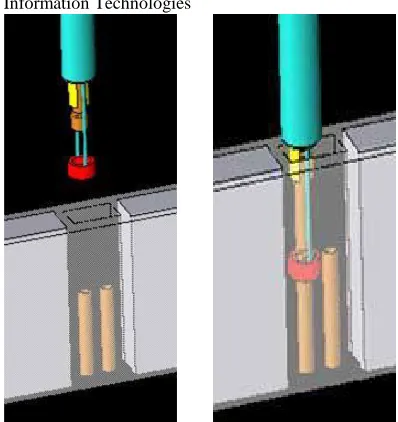
Utility Conduits may be built directly into the structure or the walls according to the CAD data. (See Figure 4-5 and 4-6)
Figure 4-5 Complex Wall Section. Image Source: Automated Construction by Contour crafting – Related Robotics and Information Technologies
Figure 4-6
Sample sections made with CC and filled with Plumbing Pipes. Image Source: Automated Construction by Contour crafting – Related Robotics and Information Technologies
4.2.8 Paint Ready Structures
The CC automated process is separated from other automated processes due to its nozzle and trowel system and the surface finish that the trowel is able to ensure irrespective of the size of the nozzle orifice. Therefore any material being extruded through the nozzle like sand, clay, gravel, reinforcement fiber, concrete or any locally available material can be mixed and extruded through the CC nozzle. The surface finish is ensured through the trowel and no further preparations have to be made to the surfaces in order to paint them. An automated paint system can further be introduced with the CC system.
4.2.9 Smart Materials
Since deposition in CC is controlled by computer, accurate amounts of selected construction materials, such as smart concrete, may be deposited precisely in the intended locations. This way the electric resistance, for example, of a carbon filled concrete may be accurately set as dictated by the design. Elements such as strain sensors, floor and wall heaters can be built into the structure in an integrated and fully automated manner. (B. Khoshnevis Automated Construction by Contour crafting – Related Robotics and Information Technologies)
4.2.10 Automated Reinforcement
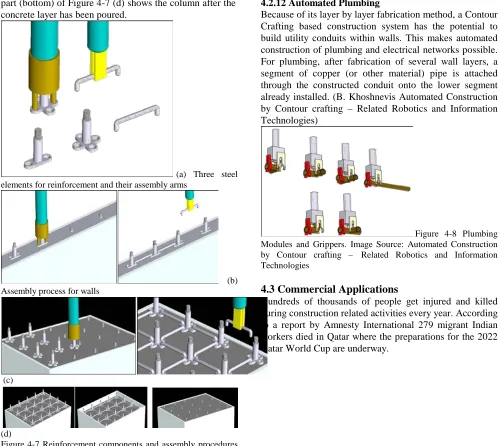
how the three modular components will work together to provide reinforcement in walls. Figure 4-7 (c) shows how columns will be reinforced. The first part of Figure 4-7 (d) shows the completed reinforcement, the second part besides it shows the column after the rim is built, the third part (bottom) of Figure 4-7 (d) shows the column after the concrete layer has been poured.
(a) Three steel elements for reinforcement and their assembly arms
(b) Assembly process for walls
(c)
(d)
Figure 4-7 Reinforcement components and assembly procedures for walls and columns. Image Source: Automated Construction by Contour crafting – Related Robotics and Information Technologies
Alternate structural materials can also be used through CC like Fiber Reinforced Plastics (FRP). Since the CC nozzle orifice doesn’t need to be very small, glass and carbon fiber tows can be fed through the CC nozzle resulting in continuous reinforcement while simultaneously being deposited with the matrix materials. This can be achieved through a single nozzle or dual Nozzle systems on a single
Gantry.
4.2.11 Automated Tiling
Automated Tiling can be integrated by spreading adhesion material through CC nozzle and placing tiles though robotic arms.
4.2.12 Automated Plumbing
Because of its layer by layer fabrication method, a Contour Crafting based construction system has the potential to build utility conduits within walls. This makes automated construction of plumbing and electrical networks possible. For plumbing, after fabrication of several wall layers, a segment of copper (or other material) pipe is attached through the constructed conduit onto the lower segment already installed. (B. Khoshnevis Automated Construction by Contour crafting – Related Robotics and Information Technologies)
Figure 4-8 Plumbing Modules and Grippers. Image Source: Automated Construction by Contour crafting – Related Robotics and Information Technologies
4.3 Commercial Applications
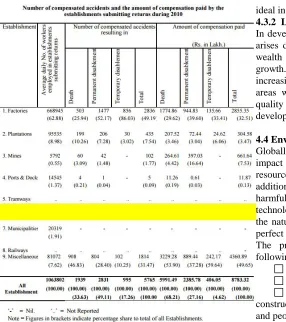
Figure 4-9 Indian Labor injury and death statistics. Image Source: Indian Labor Journal, 2013
In figure 4-9 we can see Building and Construction Labor Fatality rates are second only to Mining Fatality Rates in India. Contour Crafting allows workers to work in safer conditions and can be employed in any working condition around the world.
Contour Crafting will also replace labor power with intelligence which will allow women and even the elderly to participate in the construction industry. Waste is minimized as a result of using intelligent robotics because materials will be precisely measured prior to construction. As a whole CC will reduce wastage, be environmentally friendly, reduce labor fatalities and diversify the construction industry.
4.3.1 Emergency Housing
Millions of people are left homeless due to natural disasters, wars and riots across the world. Homes are lost within hours and it takes years to convert the affected area back to the way it was. Humanitarian aid like food, water, medicine and clothing helps in these situations but shelter is usually only available in temporary forms. Contour Crafting is able to build a 2000sqft house fit with all electrical and plumbing utilities in less than 24 hours with the help of waste material available on site in less than 24
ideal in these situations. 4.3.2 Low Income Housing
In developing countries like India the problem of housing arises due to the fact that we do not have the economic wealth to develop the cities at the rate of our population growth. Another problem is that of slum dwellings increasing within our cities. Contour Crafting if used in areas where slum growth is prevalent will increase the quality of life of those areas and reduce the growth rate of development of slums.
4.4 Environmental Aspects
Globally, the construction industry has a huge negative impact on the environment through exploitation of natural resources and through generation of construction waste. In addition, it contributes significantly to environmentally harmful emissions. Contour Crafting is a robotic technology with very accurate computer control. Due to the nature of this technology, materials are extruded with perfect precision and near zero waste.
The proposed technology could result in the following environmental health and safety benefits:
Less total material use
Less total energy use for all construction activities
Less material and energy waste during
construction Less transportation of material, equipment and people.
During the use phase, there will be:
More efficient buildings and therefore less energy
consumption in HVAC
Efficient internal space use for occupants
Increased structural strength and durability due to less aging material
Increased seismic safety due to improved
construction design and material.
(Source: Paradigm Shift, TJCD 2006. Mansour Rahimi. TJCD Crafting Technologies 2009)
4.5 Viability Of Contour Crafting In India
For a country that is highly labor intensive when it comes to Building and Construction, India along with China, Saudi Arabia and South Korea leads the line with countries that have emerged as potential and growing markets to exploit automated construction; specifically Contour Crafting when in terms of affordable housing construction. India is at number four of the top 10 countries in which contour crafting is most applicable.
Contour Crafting solves a lot of problems that the Indian housing crisis has to offer plus it will also provide women in India a chance to participate in the construction industry, something which does not conform to social norms but will broadcast India in a positive light on the global stage. (Source: Mansour Rahimi. TJCD Crafting Technologies 2009)
5. Conclusions
Automation has been a factor in nearly all industries and is slowly taking over everywhere. In the future automation will play a huge role in Architecture, Civil Engineering and Building Construction. A time will come when all the steps in making a building will be performed by machines. Contour Crafting due to its use of in situ materials and fast construction speed has the potential to be used in low income housing and emergency housing; it can also be used in luxury housing with complex curves and geometries.
The cost of a CC produced buildings are also exponentially less than traditional methods of building construction. This is due to the fact that CC construction is based on volume example: a curved wall of the same volume as a straight wall will take the same time to manufacture and will cost the same.
The environmental impact of Contour Crafting is also positive. Precise use of materials by machines on site leads to almost zero waste. The ability to use materials on site in construction is also noteworthy.
Contour Crafting requires significantly less labor than traditional building methods. Less labor means that CC will reduce labor cost and will increase labor safety. It also will result in people who haven’t been able to participate in construction related activities like women, senior citizens and the physically handicapped as construction will become a computer and management task.
There are various research tasks that still need to be undertaken for Contour Crafting to become commercially viable on a much larger scale because current construction methods segregate architecture, engineering, construction, inspection etc. but as a stepping stone to complete building automation Contour Crafting seems promising.
References
(1) Behrokh Khoshnevis, Dooil Hwang and Ke-Thia Yao,
Zhenghao Yeh. (2006) Mega-scale fabrication by contour crafting. Int. J. Industrial and Systems Engineering, Vol. 1, No. 3, 2006.
(2) Hongkyu Kwon. (2002) Experimentation and Analysis
of Contour Crafting (CC) process using Uncured Ceramic Materials
(3) David Weinstein, Peter Nawara. (2015) Determining
the Applicability of 3D Concrete Construction (Contour Crafting) of Low Income Houses in Select Countries Cornell Real Estate Review Volume 13 Article 11
(4) Dong Min Kim. (2013) Contour Crafting: A Future
Method of Building
(5) Mansour Rahimi, Mahdi Arhami and Behrokh
Khoshnevis. (2009) Crafting Technologies. Times Journal of Construction and Design.
(6) B. Khoshnevis, A. Carlson, N. Leach and M.
Thangavelu. (2012) Contour Crafting Simulation Plan For Lunar Settlement Infrastructure Build-Up. NIAC Phase-I Final Project Report – October 2012.
(7) B. Khoshnevis. (2004) Automated Construction by
Contour Crafting – Related Robotics and Information Technologies. Journal of Automation in Construction – Special Issue: The best of ISARC 2002, Vol 13, Issue 1, January 2004, pp 5-19.
(8) Gabriel Fernandes, Lucas Feitosa. (2015) Impact of
Contour Crafting on Civil Engineering. International Journal of Engineering Research & Technology (IJERT) Vol. 4 Issue 08, August-2015
(9) B. Khoshnevis. (2006) Paradigm Shift. Times Journal
of Construction and Design.
(10) Indian Labor Journal Volume 54 June 2013 No. 6
(11) (2009) How 3D Printing works. www.zcorp.com
(11) www.contourcrafting.org
(12) 3dprinting.com