of Managing the Range Resources1
E. WILLIAM ANDERSON
State Range Conservationist, Soil Conser- vation Service, U.S.D.A., Portland, Oregon.
Highlight
Experience has proven fhaf an effecfive grazing sys- iem is bofh pracfical and scienfifically sound. An effec- five grazing sysfem musf be failored fo fhe resource. If musf provide for flexibilify. There are ceriain principles which need io be observed. The efficiency of grazin!@ wifbin a pasfure is an imporianf facfor which Can be defermined. If denofes fhe degree of succ-ees b&g ob- fained by fhe grazing sysZem and poi.n&$ eti v&erg cor- recfive range management is neede*d: In &day’s range livesiock indusiry wifh ifs nofably low iaie of net refurn on invesfmenf. efficiency is of prime concern. Ranchers are faced wifh rising cosfs of range livesfock ranching and fhe need for increased efficiency in order fo sfay in fhe business and meef fhe rising demand for red meaf. They musf, fherefore, look crifically af fhe remaining big opporfunify for increased efficiency-fheir range- land. Some ranchers already have recognized and made fhis essential move. They realize fhai rangeland produc- ing less fhan if could increases fhe cosf of operafion as compared fo rangeland in full producfion. Reducing cosf of operafion is a major ifem for increasing nei refurn on invesfmenf.
In the Glossary of Range Terms published by
the American Society of Range Management, a
grazing system is defined as “the manipulation of livestock grazing to accomplish a desired re- sult.”
Fences, water developments, stock trails, rid- ing, and salting typify measures and facilities which make a grazing system workable and ef- fective. These items help control or influence the movement of livestock.
Brush control, fertilization, waterspreading, pitting, and seeding typify treatments which speed up the process of range improvement. They facili- tate a grazing system because, when applied properly, they contribute tremendously to the rate and ease with which the n&tie forage can be improved.
The core of a grazing system, however, is *man- agement of the forage crop itself. The objective is to improve or maintain the vigor, proportion, and stand of major forage plants and to harvest them efficiently. Deferred grazing and its rota- tion among a number of pastures over a period of years, range readiness, season of use, and safe de- gree of use constitute major forage management practices.
An effective grazing system is both practical and scientifically sound. It can be designed for a
1 Presented before the Twentieth Annual Meeting, American Society of Range Management, Seattle, Washington, February 15, 1967.
complex. With either extreme, however, there is a point beyond which the cost-benefit ratios be- come questionable.
Two effective grazing systems seldom are ex- actly alike. To be effective and practical, a graz- ing system needs to be tailored to an individual ranch or grazing allotment. It needs to take into account the kind and condition of available re- sources and the demands on these resources for grazing by both livestock and game, for watershed stabi%ty, &id for soil protection. It needs to be flexible enough to be manipulated readily to com- ply with changes in the markets, weather, and the desires and needs of the operator.
Before a grazing system can be tailored to an individual operating unit, those who are develop- ing the system must understand two important sets of basic principles. The grazing system itself has to be understood-what it is designed to do, how it works theoretically, and what results can be expected. Secondly, the growth requirements of the forage resource to which the system will be applied must be understood-which are the key management species, what is range readiness stage, how closely can the key species be grazed safely during the spring, or in summer, or fall and winter.
1 SPRING I SUMIIER I FALL I
REPEAT CYCLE
FIG. 1. Simple illukti9n of rotation of deferred grazing applied to three pastures. Cross-hatched arw represent how the graz- ing animals are moved from pasture to paswre.
Grazing System
Fig. 1 illustrates how a grazing system cati be presented graphically to emphasize the principles involved in a simple manner (Frandsen, 1950). Depicted is one system-rotation of deferred graz- ing-for managing cattle on bunchgrass forage, which is increasing in popularity (Anderson, 1967). Cross-hatched areas represent how the grazing animals are moved from pasture to pasture. This system has several maj,or features which affect the results obtained. They include: (a) a portion of the range is rested from grazing (deferred)
from beginning of spring growth until after seed maturity; (b) the forage crop on the deferred area is grazed in late summer, fall, or early winter, rather than leaving it ungrazed and wasted; (c) a safe degree of use of key management species is observed as a principle of sound forage manage- ment; (d) the season of use on each portion of the range is rotated over a period of years; (e) turn-in is in the pasture that was deferred the previous year; and (f) generally no pasture is grazed more than half of any one growing ,season or at the same portion of the growing season in successive years.
The manner in which these factors are applied may vary from region to region, or locally with major changes in vegetation, or with differences between one livestock enterprise and another.
Growth Curve
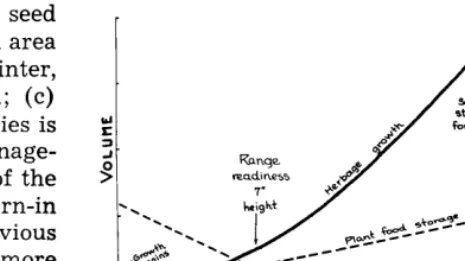
The second set of basic principles which needs to be understood has to do with the growth re- quirements of the major forage species. Fig. 2 is a simple illustration of top growth and plant food storage in roots of bluebunch wheatgrass (Agro- pyron spicatum). This chart briefly presents Mc- Ilvanie’s (1942) work on carbohydrate storage in bluebunch wheatgrass.
The growth curve (Anderson, 1952) is charac- terized by a period of slow growth in early spring followed by rapidly increasing growth and then a gradual tapering off in early summer.
During the period of slow development in early spring, a bunchgrass depends almost entirely upon plant food which it stored during the end of the previous growing season in its roots, crown, and lower stems. During this stage these food re‘- serves are depleted. When soil and air tempera- tures become more favorable, the plant begins to manufacture food. As the leaf growth increases, so does the size and production capacity of the plant’s food factory. As the production curve rises sharply, the food reserve is partially re- plenished. Plant food storage is ,completed during a relatively short period during the latter part of the primary growing season.
Fall rains and warm weather commonly result in new fall growth of bluebunch wheatgrass. Re- growth is made at the expense of the plant’s food reserves which decreases the supply available for the next year’s spring growth. The situation may appear to be detrimental, but this is not entirely true. Warm fall rains and good regrowth gener- ally results in a good grass year the following year, if fall regrowth is not kept grazed off. The
production of bluebunch wheatgrass depends
largely upon deep soil moisture stored during the fall and winter (Blaisdell, 1958). Obviously, spring
- GROW1 NQ SEASON -
FIG. 2. Generalized herbage growth and plant food storage for a key management species, bluebunch wheatgrass.
-GROWING SLASON -
c GRAZING SEASON I
FIG. 3. Rotation of deferred grazing theoretically correlated with growth curve of key management species in each of three pastures.
rains further increase forage production, especially if they occur during the peak growing season.
Correlation
Fig. 3 illustrates how the growth curve in each of the three pastures would be affected theoretic- ally by the grazing system during 1 year.
When stock are turned into Pasture 1 at range readiness, they remove forage about as fast as it grows. The dashed-line curve shows how this pas- ture would be grazed closely during the early spring season if properly stocked. When the stock are removed from Pasture 1, the forage plants can grow uninterruptedly for the remainder of the growing season. Regrowth following early spring grazing commonly results in the formation of some seedstalks, which is accompanied by food storage and other important physiological and morphological processes of the growth cycle.
ted line. When the key management species have been grazed to a safe degree of use, the stock are moved to the summer pasture. Usually, bluebunch wheatgrass has little or no regrowth if grazed this late in the growing season.
Pasture 3 has been deferred and allowed to go
through a complete growth cycle ungrazed. This
results in increased vigor of the forage plants and
the entire plant community. Yet the forage crop
in this pasture is eventually harvested, rather than wasted. At this time of year, the quality of blue- bunch wheatgrass forage is not all that is desired. The forage in this deferred pasture is as good, however, as any other mature bluebunch wheat- grass range. And, there is more of it per acre because it hasn’t been grazed. The solid-line curve illustrates how the mature forage crop in Pasture 3 is harvested and, when a safe degree of use is reached, the stock are returned to Pasture 1 to clean up any regrowth that grew in May and June.
Ideally, having a fall pasture such as crop af- termath, which could be grazed in lieu of Pasture 3 during the early fall, is desirable. Then Pasture 3 as well as Pasture 1 could be grazed in late fall and early winter when rains usually soften the
bunchgrass forage; it is more readily taken by
cattle and good utilization can be obtained. Fur- thermore, the value of this forage to the ranch operation in late fall and early winter is high be- cause it substitutes for hay. Even though some supplements may be needed, the cost of harvest- ing an early winter range usually is considerably less than feeding hay in drylot. Reducing costs is a good way to increase net profit.
Obviously, such a simple grazing system sel-
dom, if ever, can be used on a ranch or grazing allotment. It would be complicated by areas which are best suited for grazing during a particular season; by stock being grazed on Federal range or
on leased lands at various seasons; by use of sup-
plemental irrigated pastures, hay aftermath, mead- ows, grain stubble, and so on. Variations such as these can be included in the grazing program, however, and the principles of good range man-
agement coordinated with the growth require-
ments of the native key forage species.
These three charts emphasize the necessity for
understanding both the resource and the grazing
system. They illustrate how a system of grazing can be made to fit the resource rather than trying to apply a standardized grazing system irrespec- tive of the resource.
Again, it is pertinent to emphasize: (1) Know the resource; (2) Tailor the grazing system to fit
the resource, not to a standardized format; (3)
Allow for flexibility so that needed adjustments
can be made in time to comply with unpredicted changes in weather, markets and so on.
Checking Results
NO successful grazing system is static. Once
a system is worked out theoretically, it can be-
come out-of-date the next year because of unpre- dictable situations. And yet, thoroughly evaluat- ing the resources and figuring out a theoretical system is almost a requirement for its success. A base to start from is a necessity.
Grazing systems commonly are put into effect step-by-step over a period of years. One or a com-
bination of practices are inaugurated during a
single season. Following the application of each
phase of the grazing plan, it is highly desirable to check the results being obtained in terms of its affect on the forage resource. It is also important to check progress during the grazing season. This procedure is called a utilization check or a man- agement check. Management checks should be an integral part of each grazing system. Timely man- agement checks provide guidelines for determin- ing needed adjustments and additional treatments.
Experience has pinpointed several essential
features for making a successful management
check. The technique for reading degree of use of key forage plants must be simple and easy to do. It should be suited to various ways of travers- ing the terrain such as on foot or horseback, by jeep or even by helicopter (Chohlis and Schlots,
1950). The use classes should be few-five has
proven adequate and only three may be needed in some situations. A general picture of the pattern of grazing is all that is needed. For normal range
management an accurate measurement would be
too costly and no more useful, if as much. Zones of use which represent the pattern of use within
each pasture should be mapped, particularly in
rough terrain range. The mapped pattern pro- vides a guideline for evaluating the need for addi-
tional measures and adjustments and indicates
where they are needed within a pasture. It pro- vides a record from which progress over a series of years can be determined.
The following case history illustrates the im-
portance of knowing the pattern of use within the pasture. It is taken from data obtained in a series of annual management checks which were made on the Central Oregon Land Utilization Project
by the Soil Conservation Service beginning in
1949. A grazing system-rotation of deferred
grazing-was inaugurated on this project in 1950.
Management checks were made annually to deter-
project now is known as the Crooked River Na- tional Grasslands administered by the U.S. Forest
Service. Annual management checks have been
continued and a remarkably effective grazing sys- tem has been maintained over the years. For about 15 years, this project has been one of the outstand-
ing examples of good range management in the
Nation. In 1950 when the project was about llO,- 000 acres in size, it produced about 13,625 animal
unit months of grazing. Today, the project is
about 106,000 acres. It is estimated by the Forest Service that the production in 1967 will be about 17,500 AUM. By 1970, if the present rate of de-
velopment is maintained, the annual production
should reach about 34,000 AUM.
Efficiency of Grazing
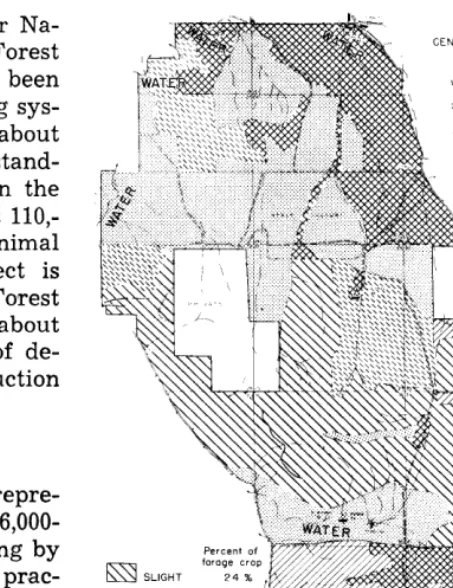
Fig. 4 shows the pattern of grazing, as repre- sented by use-zones, which occurred in one 6,000- acre pasture as a result of season-long grazing by cattle in 1949. Season-long grazing had been prac- ticed for nearly 15 years on this and other pas- tures of the project. In 1949, this particular pas- ture was grazed by 250 A.U. of cattle for 7.5
months-April 15 to November 30-for a total of
1900 AUM. Although Ithe weighted-average utili-
zation for the entire pasture was 113% of proper
use-only 13% over a perfect average use-the
wide variation in degree of grazing indicated a stupendous need for corrective range management. Fifty percent of the forage in this pasture was
being wasted or destroyed. Another 36% was
being grazed too closely for maintenance or im-
provement of the grazing resource. As inefficient as this grazing was, however, it represents a com- mon situation that exists on bunchgrass ranges in rough topography being grazed season-long.
During 1949 a range site and condition inven- tory was made of the project which, together with
the management check, provided the basis for
planning the grazing system. A three-pasture
grazing system was planned for this and two ad- jacent pastures of similar size: Range readiness, rotation of deferred grazing, safe use of key man-
agement species, additional stockwater, progres-
sive salting into under-used areas, and consider- ably more riding to distribute the livestock repre- sent broadly the measures planned.
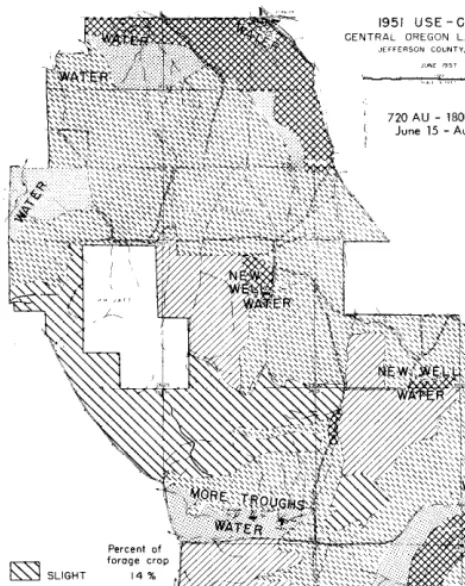
After 2 years of applying the new grazing sys- tem to the three pastures, and the benefit of addi-
tional stockwater, the 1951 management check
showed remarkable improvement in grazing ef-
ficiency, as illustrated by Fig. 5. Forage being
wasted or destroyed was reduced to 30% of the total. Heavy use was reduced to about 10%. Safe use was obtained on a good portion of the forage supply *
FIG. 4. Utilization cattle in 1949.
pattern in a pasture grazed season-long by
The amount of grazing within this pasture had not been reduced significantly as a part of the graz- ing plan. The manner by which the AUM were ob- tained, however, was changed drastically in 1950 and 1951. In 1951, the pasture was grazed by 720
AU of cattle for 2.5 months-June 15 to August
30-for a total of 1,800 AUM. The other two pas-
tures in the grazing system carried this herd for the remainder of the season.
In 1951 the weighted average utilization in this pasture was a perfect 100% of proper use. This, again, has no real meaning until it is evaluated along with the pattern of use. Alone, it indicates that the stocking rate and the length of the grazing season were about right for that year. The use- pattern, however, shows that, in spite of correct stocking and grazing season, there still was need for corrective range management.
In 1953 after two more years of improving the grazing system, this area was grazed as two pas- tures as shown by Fig. 6. The larger portion was
grazed by 640 AU of cattle for 36 days-April 25
to May 31--and again by 125 AU for 60 days-
October 1 to November Sl-for a total of 1,015
AUM. The southern portion was grazed by 722
AU for 15 days-June 1 to 15-for 361 AUM. The
FIG. 5. Utilization pattern in 1951 after two years of corrective range management and with range developments.
and again in 1953 was the cause. When the forage was grazed to a safe degree of use, the stock were moved to other pastures which resulted in fewer total AUM from this area. Other pastures and range seedings on the project acted as buffers to compensate for the general droughty conditions.
For both segments of the original pasture, the forage being wasted and destroyed was reduced to 5%. Heavy use, however, increased to ‘25% of the total forage crop. An increase in close utiliza- tion can be expected when adverse growing condi- tions occur. If adverse weather continues for sev- eral years, a reduction in stocking is mandatory or arrangements must be made for additional feed, otherwise the forage resource will be damaged. Grazing efficiency probably should be on the light side in relatively good years in order to have some reserve on hand to act as a buffer when adverse weather temporarily affects the operation, as in 1953. The decree of grazing efficiency in a pas- ture can be attributed to all the treatments and improvements, to the system of forage manage- ment, and to the weather collectively. It is not the result of the system of forage management alone.
biscussion
To improve grazing efficiency, it is necessary to employ a system of forage management that
fits the resource to be managed as well as the needs of the livestock enterprise and other uses of the resource such as wildlife, recreation and watersheds. Adequate stockwater is essential. Good fences must be properly placed and pastures must be of the correct size-not too large or small -to control the livestock. Riding frequently to distribute livestock, and more important, to pe- riodically analyze the pattern of use, usually is essential for high efficiency (Skovlin, 1965). Ob- serving safe use of key forage species is an abso- lute must for optimum production of forage and, consequently, livestock products - from animals
consuming the forage.
good markets and sales of their respective prod- ucts.
The story of grazing efficiency on rangeland is entirely different. Almost no one except a few Federal and State employees and a very few pri- vate consultants have sincerely pushed scientific- ally sound range management to achieve grazing efficiency on the range. Achieving range effi- ciency involves almost no special products to be bought by the rancher from some company. Con- sequently, there is no advertising program for good range management as there is for products for animal health or machinery, for example. There are no industries which go all out to support
the theme of efficient range management. It
would be helpful if the banking business would take an active interest in advertising good range
management since its commodity-money and re-
turns on investment-is involved primarily. Ranchers are faced with rising costs of range livestock ranching and the need for increased ef- ficiency in order to stay in the business and meet the rising demand for red meat. They must there- fore look critically at the remaining big oppor- tunity for increased efficiency-their rangeland. Some ranchers already have recognized and made this essential move (Skeete, 1966). They realize that rangeland producing less than it could in- creases the cost of operation as compared to range- land in full production. Reducing cost of opera- tion is a major item for increasing net return on investment.
As the need for grazing efficiency becomes acknowledged to a greater degree, the significance of sound grazing systems will come alive. Ranch- ers, scientists, and technicians will be challenged time and again to work harmoniously to effi- ciently produce livestock products and at the same time improve rangelands. And it should not be overlooked that restored rangeland contributes greatly to wildlife, rural beauty, and recreation and, at the same time, reduces silting of streams, lakes and reservoirs, and improves the quality and dependability of watersheds.
LITERATURE CITED
ANDERSON, E. WILLIAM. 1952. Grazing Management of bunchgrass-type forage. Northwest Science 26 (1) : 32-36.
ANDERSON, E. WILLIAM. 1967. Rotation of deferred graz- ing. J. Range Manage. 20: 5-7.
BLAISDELL, JAMES P. 1958. Seasonal development and yield of native plants on the upper Snake River plains and their relation to certain climatic factors. USDA Tech. Bull. 1190.
CHOHLIS, G. JOHN., AND FRED SCHLOTS. 1950. Range con- dition and soil site classification by helicopter. J. Range Manage. 3: 114-117.
FRANDSEN, WALDO R. 1950. Management of reseeded ranges. J. Range Manage. 3: 125-129.
MCILVANIE, SAMUEL K. 1942. Carbohydrate and nitrogen trends in bluebunch wheatgrass, Agropyron spicatum,
with special reference to grazing influences. Plant Physiol. 17: 540-557.
SKEETE, GEORGE M. 1966. Can ranchers adjust to fluctu- ating forage production. J. Range Manage. 19: 258-262. SKOVLIN, JOHN M. 1965. Improving cattle distribution
on western mountain rangelands. USDA Farmers Bull. 2212.
Oregon Ryegrass is at “Home on the Range”
Let Oregon Grown Annual Ryegrass make its home on your range. It mixes well with annual legumes to pro- vide rapid ground cover forming excellent pasture. Good range pasture will increase your meat production. Oregon Ryegrass works to stabilize your needed top- soil and, if managed properly, will reseed itself year after year.WHEN THE TALK T”iNS TO GRASS SAY, “MAKE MINE OREGON RYEGRA&.”
0
For a free brochure on the “Marvels of Oregon Ryegrass”, write:
Oregon Ryegrass Growers Seed Commission
P. 0. Box 247 Dept. 12