Electronic Thesis and Dissertation Repository
12-17-2014 12:00 AM
Improved Non-Local Means Algorithm Based on Dimensionality
Improved Non-Local Means Algorithm Based on Dimensionality
Reduction
Reduction
Golam Morshed Maruf
The University of Western Ontario
Supervisor
Dr. Mahmoud R. El-Sakka
The University of Western Ontario Graduate Program in Computer Science
A thesis submitted in partial fulfillment of the requirements for the degree in Master of Science © Golam Morshed Maruf 2014
Follow this and additional works at: https://ir.lib.uwo.ca/etd
Recommended Citation Recommended Citation
Maruf, Golam Morshed, "Improved Non-Local Means Algorithm Based on Dimensionality Reduction" (2014). Electronic Thesis and Dissertation Repository. 2615.
https://ir.lib.uwo.ca/etd/2615
This Dissertation/Thesis is brought to you for free and open access by Scholarship@Western. It has been accepted for inclusion in Electronic Thesis and Dissertation Repository by an authorized administrator of
IMPROVED NON-LOCAL MEANS ALGORITHM BASED ON DIMENSIONALITY REDUCTION
(Thesis format: Monograph)
by
Golam Morshed Maruf
Graduate Program in Department of Computer Science
A thesis submitted in partial fulfillment of the requirements for the degree of
Masters of Science
The School of Graduate and Postdoctoral Studies The University of Western Ontario
London, Ontario, Canada
ii
Abstract
Non-Local Means is an image denoising algorithm based on patch similarity. It compares a
reference patch with the neighboring patches to find similar patches. Such similar patches
participate in the weighted averaging process. Most of the computational time for Non-Local
Means is consumed to measure patch similarity. In this thesis, we have proposed an
improvement where the image patches are projected into a global feature space. Then we
have performed a statistical t-test to reduce the dimensionality of this feature space.
Denoising is achieved based on this reduced feature space and the proposed modification
exploits an improvement in terms of denoising performance and computational time.
Keywords
Non-Local Means algorithm, image denoising, image smoothing, image enhancement,
iii
Dedication
To
My loving parents and sister
M.A. Malek, Mahera Begum and Nusrat Mahin
iv
Acknowledgments
This dissertation has been accomplished under the supervision of Dr. Mahmoud R. El-Sakka
in the Department of Computer Science, University of Western Ontario.
I am expressing my heartiest gratitude to the Almighty, most gracious and most merciful to
give me the ability to complete my thesis successfully. I would like to thank my thesis
supervisor Dr. Mahmoud R. El-Sakka for his noteworthy and valuable direction, guidance,
motivation and encouragement in the way of my progress. Moreover, I am also thankful to
all of my professors from the University of Western Ontario for building my background to
complete this task.
v
Table of Contents
Abstract ... ii
Dedication ... iii
Acknowledgments ... iv
List of Tables ... viii
List of Figures ... x
List of Appendices ... xv
Chapter 1 ... 1
Introduction ... 1
1.1 Motivations ... 1
1.2 Thesis contributions ... 2
1.3 Thesis outline ... 3
Chapter 2 ... 4
Background ... 4
2.1 Additive white Gaussian noise... 4
2.2 Image denoising domains ... 4
2.3 Non-Local Means algorithm ... 6
2.4 Applications of Non-Local Means ... 8
2.5 Improvement over Non-Local Means ... 9
2.6 T-test ... 11
Chapter 3 ... 14
Methodology ... 14
vi
3.1.2 T-test ... 15
3.1.3 Non-Local Means algorithm ... 16
3.1.4 Parameter Setting ... 18
3.1.5 Selected Parameters ... 31
Chapter 4 ... 34
Experimental Results and Analysis ... 34
4.1 Data set... 34
4.2 Noise Generation ... 34
4.3 Performance measure ... 35
4.3.1 Peak Signal to Noise Ratio ... 36
4.3.2 Structural Similarity Index (SSIM) ... 37
4.4 Results and Analysis ... 37
4.4.1 Parameter Setting ... 37
4.4.2 Performance analysis using PSNR... 38
4.4.3 Performance analysis using SSIM ... 41
4.4.4 Running time performance analysis... 44
4.4.5 Visual quality comparison and intensity profile ... 47
4.4.6 Summary ... 59
Chapter 5 ... 60
Conclusion and Future Work ... 60
5.1 Conclusion ... 60
5.2 Future Work ... 61
vii
Appendices ... 65
Appendix A ... 65
viii
List of Tables
Table 3- 1: Average PSNR comparison for all test images between different patch sizes for
different noise levels. ... 20
Table 3- 2: Average PSNR comparison for all test images between different search region
sizes for different noise levels. ... 23
Table 3- 3: Average PSNR and average number of features comparison for patch size 7×7 for
all test images between different threshold values for different noise levels. ... 26
Table 3- 4: Average PSNR and average number of features comparison for patch size 5×5 for
all test images between different threshold values for different noise levels. ... 27
Table 3- 5: Average PSNR comparison for all test images between different patch sizes for
different noise levels. ... 32
Table 3- 6: Average PSNR comparison for all test images between different patch sizes for
different noise levels. ... 33
Table 4-1: PSNR(dB) comparison for Lena image among the proposed method, the NLM
method, variants of the NLM method and the BM3D method for different noise levels. ... 39
Table 4-2: Average PSNR(dB) comparison for all test images among the proposed method,
the NLM method, variants of the NLM method and the BM3D method for different noise
levels. ... 40
Table 4-3: SSIM comparison for Lena image among the proposed method, the NLM method,
variants of the NLM method and the BM3D method for different noise levels. ... 42
Table 4-4: Average SSIM comparison for all test images among the proposed method, the
NLM method, variants of the NLM method and the BM3D method for different noise levels.
ix
Table 4-5: Running time (in milliseconds) performance analysis for Lena image among the
proposed method, the NLM method, variants of the NLM method and the BM3D method for
different noise levels. ... 45
Table 4-6: Average running time (in milliseconds) performance analysis for all test images
among the proposed method, the NLM method, variants of the NLM method and the BM3D
method for different noise levels. ... 46
Table A- 1: PSNR (dB) comparison for standard Peepers image between our proposed
method and other denoising algorithms………. .65
Table A- 2: SSIM comparison for image Peppers between proposed method and other
denoising algorithms for different noise level. ... 66
Table A- 3: PSNR (dB) comparison for standard Boat image between our proposed method
and other denoising algorithms. ... 72
Table A- 4: SSIM comparison for image Boat between proposed method and other denoising
algorithms for different noise level. ... 73
Table A- 5: PSNR (dB) comparison for standard Couple image between our proposed
method and other denoising algorithms. ... 79
Table A- 6: SSIM comparison for image Couple between proposed method and other
x
List of Figures
Figure 2-1: Probability Distribution for Gaussian noise. ... 5
Figure 2-2:The Non-Local Means scheme where similar patches q1 and q2 are assigned
weights larger than q3. ... 8
Figure 2-3: Student t distribution ... 13
Figure 3 - 1: Set of test images (512 × 512) for performance analysis……. ………..18
Figure 3 - 2: Performance analysis using Woman 1 image over different patch sizes where
noise level is σ=40. (a) patch size 5×5, PSNR = 29.55, (b) patch size 7×7, PSNR = 29.79, (c)
patch size 9×9, PSNR = 29.31, and (d) patch size 11×11, PSNR = 28.10. ... 21
Figure 3 - 3: Performance analysis using Woman 1 image over different search region sizes
where noise level is σ=40 (a) search region size=14×14, PSNR = 29.11, (b) search region
size=21×21, PSNR = 29.78, (c) search region size=28×28, PSNR = 29.78, and (d) search
region size=35×35, PSNR = 29.79. ... 24
Figure 3 - 4: Average PSNR and average number of features comparison for patch size 7×7
and threshold value 3 over different noise levels. ... 28
Figure 3 - 5: Average PSNR and average number of features comparison for patch size 7×7
and threshold value 5 over different noise levels. ... 28
Figure 3 - 6: Average PSNR and average number of features comparison for patch size 5×5
and threshold value 3 over different noise levels. ... 29
Figure 3 - 7: Average PSNR and average number of features comparison for patch size 5×5
and threshold value 5 over different noise levels. ... 29
Figure 3 - 8: Performance analysis using Woman 1 image over different threshold values
where noise level is σ=40 and patch size is 7×7 (a) threshold value 3, PSNR = 29.79, (b)
threshold value 5, PSNR = 29.79, (c) threshold value 7, PSNR = 29.33, and (d) threshold
xi
Figure 4- 1: Set of images for performance analysis………. 35
Figure 4- 2: Noise generation (a) Noise free image Lena. (b) Noisy image with Additive
white Gaussian noise (noise level σ=50). ... 36
Figure 4- 3: Bar graph for average PSNR comparison for the proposed method, the NLM
method, variants of the NLM method and the BM3D method for different noise levels. ... 41
Figure 4- 4: Bar graph for average SSIM comparison for all test images among the proposed
method, the NLM method, variants of the NLM method and the BM3D method for different
noise levels. ... 44
Figure 4- 5: Performance analysis for the average running time (in milliseconds) among the
proposed method, the NLM method, variants of the NLM method and the BM3D method for
different noise levels. ... 47
Figure 4- 6: Subjective comparison for denoising performance for Non-Local Means at noise
level σ=20. (a) Noise free image Lena, (b) noisy image with Additive white Gaussian noise,
(c) denoised image using the NLM method, PSNR= 31.89, and (d) denoised image using the
proposed method, PSNR = 33.32. ... 49
Figure 4- 7: Subjective comparison for denoising performance for Non-Local Means at noise
level σ=40. (a) Noise free image Lena, (b) noisy image with Additive white Gaussian noise,
(c) denoised image using the NLM method, PSNR= 28.42, and (d) denoised image using the
proposed method, PSNR = 29.97. ... 50
Figure 4- 8: Subjective comparison for denoising performance for Non-Local Means at noise
level σ=60. (a) Noise free image Lena, (b) noisy image with Additive white Gaussian noise,
(c) denoised image using the NLM method, PSNR= 25.55, and (d) denoised image using the
proposed method, PSNR = 25.98. ... 51
Figure 4- 9: Subjective comparison for denoising performance for Non-Local Means at noise
level σ=80. (a) Noise free image Lena, (b) noisy image with Additive white Gaussian noise,
(c) denoised image using the NLM method, PSNR= 23.05, and (d) denoised image using the
xii
noise level σ=100. (a) Noise free image Lena, (b) noisy image with Additive white Gaussian
noise, (c) denoised image using the NLM method , PSNR= 22.18, and (d) denoised image
using the proposed method, PSNR = 22.29. ... 53
Figure 4- 11: Output analysis for edge and contrast preservation for Lena image. (a) Original
Lena image (b) Noise free fragment of Lena image (c) noisy fragment with σ=40
(d)denoised fragment using the original NLM method; (d) denoised fragment using the
proposed method. ... 54
Figure 4- 12: Row number 50 of the House image is chosen as the scan line (dark red
horizontal line) to generate intensity profiles. ... 55
Figure 4- 13: Intensity profile of the House image at scan Line 50 (σ=10). ... 56
Figure 4- 14: Intensity profile of the House image at scan Line 50 (σ=50). ... 56
Figure 4- 15: Intensity profile of the House image and denoised image by the NLM method
at scan Line 50(σ=10). ... 57
Figure 4- 16: Intensity profile of the House image and denoised image by the proposed
method at scan Line 50(σ=10). ... 57
Figure 4- 17: Intensity profile of the House image and denoised image by the NLM at scan
Line 50(σ=50). ... 58
Figure 4- 18: Intensity profile of House image and denoised image by the proposed method
at scan Line 50 (σ=50). ... 58
Figure A- 1: Subjective comparison for denoising performance for Non-Local Means at noise
level σ=20. (a) Noise free image Peppers. (b) Noisy image with Additive white Gaussian
noise. (c) Denoised image with NLM, PSNR= 31.2973. (d) Denoised image with Proposed
xiii
Figure A- 2: Subjective comparison for denoising performance for Non-Local Means at
noise level σ=40. (a) Noise free image Peppers. (b) Noisy image with Additive white
Gaussian noise. (c) Denoised image with NLM, PSNR= 28.2603. (d) Denoised image with
Proposed method, PSNR = 29.7362. ... 68
Figure A- 3: Subjective comparison for denoising performance for Non-Local Means at noise
level σ=60. (a) Noise free image Peppers. (b) Noisy image with Additive white Gaussian
noise. (c) Denoised image with NLM, PSNR= 24.2415. (d) Denoised image with Proposed
method, PSNR = 25.7656. ... 69
Figure A- 4: Subjective comparison for denoising performance for Non-Local Means at noise
level σ=80. (a) Noise free image Peppers. (b) Noisy image with Additive white Gaussian
noise. (c) Denoised image with NLM, PSNR= 23.3125. (d) Denoised image with Proposed
method, PSNR = 23.5756. ... 70
Figure A- 5: Subjective comparison for denoising performance for Non-Local Means at noise
level σ=100. (a) Noise free image Peppers. (b) Noisy image with Additive white Gaussian
noise. (c) Denoised image with NLM, PSNR= 21.4862. (d) Denoised image with Proposed
method, PSNR = 21.7658. ... 71
Figure A- 6: Subjective comparison for denoising performance for Non-Local Means at noise
level σ=20. (a) Noise free image Boat. (b) Noisy image with Additive white Gaussian noise.
(c) Denoised image with NLM, PSNR= 29.6207. (d) Denoised image with Proposed method,
PSNR = 30.7237. ... 74
Figure A- 7: Subjective comparison for denoising performance for Non-Local Means at noise
level σ=40. (a) Noise free image Boat. (b) Noisy image with Additive white Gaussian noise.
(c) Denoised image with NLM, PSNR= 26.3797. (d) Denoised image with Proposed method,
PSNR = 27.4276. ... 75
Figure A- 8: Subjective comparison for denoising performance for Non-Local Means at noise
level σ=60. (a) Noise free image Boat. (b) Noisy image with Additive white Gaussian noise.
(c) Denoised image with NLM, PSNR= 23.8791. (d) Denoised image with Proposed method,
xiv
noise level σ=80. (a) Noise free image Boat. (b) Noisy image with Additive white Gaussian
noise. (c) Denoised image with NLM, PSNR= 22.0718. (d) Denoised image with Proposed
method, PSNR = 22.1941. ... 77
Figure A- 10: Subjective comparison for denoising performance for Non-Local Means at
noise level σ=100. (a) Noise free image Boat. (b) Noisy image with Additive white Gaussian
noise. (c) Denoised image with NLM, PSNR= 20.9146. (d) Denoised image with Proposed
method, PSNR = 20.9538. ... 78
Figure A- 11: Subjective comparison for denoising performance for Non-Local Means at
noise level σ=20. (a) Noise free image Couple. (b) Noisy image with Additive white
Gaussian noise. (c) Denoised image with NLM, PSNR= 30.1471. (d) Denoised image with
Proposed method, PSNR = 30.5116. ... 81
Figure A- 12: Subjective comparison for denoising performance for Non-Local Means at
noise level σ=40. (a) Noise free image Couple. (b) Noisy image with Additive white
Gaussian noise. (c) Denoised image with NLM, PSNR= 26.1758. (d) Denoised image with
Proposed method, PSNR = 26.7854. ... 82
Figure A- 13: Subjective comparison for denoising performance for Non-Local Means at
noise level σ=60. (a) Noise free image Couple. (b) Noisy image with Additive white
Gaussian noise. (c) Denoised image with NLM, PSNR= 23.1847. (d) Denoised image with
Proposed method, PSNR = 23.3052. ... 83
Figure A- 14: Subjective comparison for denoising performance for Non-Local Means at
noise level σ=80. (a) Noise free image Couple. (b) Noisy image with Additive white
Gaussian noise. (c) Denoised image with NLM, PSNR= 21.8258. (d) Denoised image with
Proposed method, PSNR = 21.9186. ... 84
Figure A- 15: Subjective comparison for denoising performance for Non-Local Means at
noise level σ=100. (a) Noise free image Couple. (b) Noisy image with Additive white
Gaussian noise. (c) Denoised image with NLM, PSNR= 20.9146. (d) Denoised image with
xv
List of Appendices
Appendices ... 65
1
Chapter 1
Introduction
An image may be numerically represented as a two dimensional function u, in the spatial
coordinates x and y. Intensity or gray level is the amplitude of u at any pair of
coordinates. A digital image is composed of finite number of elements called pixels. An
image may be contaminated with noise during acquisition, transmission or
transformation. Noise is a variation of pixel intensity. Such noise can be additive or
multiplicative. Additive noise is generally independent of image data whereas
multiplicative noise is dependent on image data. Additive noise can be formularized as,
v(i)=u(i)+n(i), (1.1)
whereas, multiplicative noise is formularized as,
v(i)=u(i)×n(i). (1.2)
Here, u(i) is the “original” value, n(i) is the “noise” value and v(i) is the “observed” value
at pixel i. Reducing noise is of great benefit for many applications such as face
recognition, object tracking, medical imaging, segmentation. That is why the need of
proper image denoising algorithm has grown with much interest. Despite the good quality
of acquisition devices, an image denoising method is always required to reduce unwanted
signals. Image denoising is used to find the best estimate of the original image from its
noisy version. Many methods for image denoising have been proposed in recent years,
(see chapter 2).
1.1
Motivations
When applying noise reduction algorithms we need to consider several factors, including
computational time. Digital cameras need to apply noise reduction at real time using
their internal CPU and memory while using computers for denoising can relatively have
Chapter 1:Introduction
2
Some of the basic filtering such as Gaussian and average filtering have a drawback of
over-smoothing on edges and losing image details. Wavelet based denoising method [1],
anisotropic diffusion [2], bilateral filtering [3] try to overcome this drawback and
preserve the image quality by preserving edges. But they may introduce a staircase effect
(makes the image appears like a cartoon image) or false edges. Recently, Buades et al. [4]
proposed a denoising algorithm called Non-Local Means (NLM) which allows
neighboring patches in the search window to participate in the denoising process for a
certain reference patch in the noisy image. Most of the computational time for NLM is
allocated to the similarity measure. In a general case, NLM needs to search the entire
image for similar patches and performs weighted average based on this similarity.
However, searching in a fixed area around the pixel of interest (POI) can reduce this
computational time. Our main focus is to further reduce this computational time and
improve denoising performance over the original Non-Local Means algorithm.
1.2
Thesis contributions
The Non-Local Means algorithm searches neighboring patches to match with the
reference patch. The original algorithm requires an extensive amount of time to select
patches similar to the reference patch. These similar patches contribute to the weighted
averaging process to denoise the center pixel of the reference patch. The computation
time for NLM algorithm can be reduced by improving this searching process. In our
method, we have created feature vectors for the noisy image. Then we have implemented
a statistical t-test on these feature vectors and reduced their dimensionality. These
reduced feature vectors contribute to the denoising process. Our proposed method
reduces the computational time and improves the overall performance of the original
NLM algorithm.
3
1.3
Thesis outline
We have formalized our thesis into five chapters including this introductory discussion as
Chapter 1. In Chapter 2, we discuss Gaussian noise, image denoising domains, the
Non-Local Means algorithm, as well as its variants. In addition we present a statistical t-test.
In Chapter 3, we introduce our proposed method in details and explained its parameters.
In Chapter 4, we present our experimental results and compare our proposed method with
other denoising algorithms. Finally in Chapter 5, we give our concluding remarks and
Chapter 2:Background
4
Chapter 2
Background
Noise may distort an image and degrade its visual quality. Image denoising schemes
attempt to reduce this noise and improve image visual quality. There are many denoising
algorithms aiming to reduce noise from digital images. One of the most successful image
denoising scheme is the Local Means (NLM) algorithm. In this chapter, the
Non-Local Means algorithm and its improvements as well as statistical t-test will be discussed.
2.1
Additive white Gaussian noise
White noise is a random signal with a constant power spectral density. Gaussian noise is
a statistical noise having normal distribution. The probability density function (PDF) of a
white Gaussian noise is given by,
𝑃𝐷𝐹(𝑧)
=
1σ 2π
e
−(z−µ)2
2σ2 (2.1)
where, z represents the Gaussian random variable, µ is the mean of z and σ is the standard deviation of z. Figure 2-1 shows the probability density function for Gaussian noise.
Approximately 68.27% of the values are found inside
µ
± 𝜎 , 95.45% of the values arefound inside
µ
± 2𝜎 and 99.73% withinµ
± 3𝜎.2.2
Image denoising domains
Image denoising can be performed either in the frequency domain or in the spatial
domain. In case of frequency domain, an image is transformed into the frequency
domain, the denoising operations are performed there, and the resulting denoised images
5
Figure 2-1: Probability Distribution for Gaussian noise
Perhaps the Block-Matching and 3D (BM3D) scheme [5] is one of the most successful
image denoisign algorithms that operates in the frequency domain. It relies on the
assumption that an image has a locally sparse representation in its transform domain. It
attempts to find similar blocks with respect to a reference patch and builds a 3D stack of
these 2D blocks. Then it applies 3D transform on the 3D stack and performs denoising. It
then applies inverse 3D transform and return 2D estimate of the original image. Finally,
collaborative filtering process gives a 3D estimation of the jointly filtered 2D blocks.
Spatial domain denoising works directly on the image data. One of the most successful
spatial domain denoising scheme is the Non-Local Means algorithm. In the Non-Local
Means algorithm a center pixel inside the reference patch is denoised by calculating a
weighted average, where patches similar to the reference patch contribute into this
Chapter 2:Background
6
2.3
Non-Local Means algorithm
In the Non-Local Means algorithm a discrete noisy image v={ v(j)|j ϵ I }, where I is the
input image, can be denoised by the estimated value NL[v](i) for a pixel i. It is computed
as a weighted average for all of the pixels in the image,
(2.2)
where, the weight w(i, j) depends on the similarity between the pixel i and the pixel j of
the intensity gray level vectors 𝑣(𝑁𝑖) and 𝑣(𝑁𝑗). Here, 𝑁𝑘 is the square patch around the
center pixel k. The weight is then assigned to value v(j) to denoise pixel i. The summation
of all weight is equal 1 and each weight value w(i ,j) has a range between [0, 1]. To
measure similarity between patches, the Euclidean distance between patches is calculated
𝑣
𝑁
𝑖− 𝑣(𝑁
𝑗)
22 . (2.3)The weight w(i, j) is computed as,
𝑤 𝑖, 𝑗 =𝑍(𝑖)1 𝑒−
𝑣𝑁𝑖−𝑣(𝑁𝑗)
2 2
ℎ 2 . (2.4)
Here, Z(i) is a normalization constant such that,
Z(𝑖) = e−
𝑣𝑁𝑖−𝑣(𝑁𝑗)
2,𝜎 2 ℎ 2
j . (2.5)
Here, h is a smoothing kernel width which controls decay of the exponential function and
therefore controls the decay of the weights as a function of the Euclidean distances.
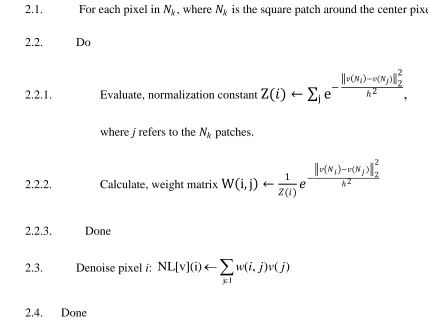
The algorithm is summarized as follows,
I j ) ( ) , ( =7
Algorithm Non-Local Means
Input I:Image with additive white Gaussian noise
Output NL(I): Denoised image
1. For each pixel i, where i ϵ [1, N],
2. Do
2.1. For each pixel in 𝑁𝑘, where 𝑁𝑘 is the square patch around the center pixel k,
2.2. Do
2.2.1. Evaluate, normalization constant
Z(𝑖) ← e
−𝑣 𝑁𝑖−𝑣(𝑁𝑗) 22
ℎ2
j
,
where j refers to the 𝑁𝑘patches.
2.2.2. Calculate, weight matrix
W i, j ←
1 𝑍(𝑖)𝑒
− 𝑣 𝑁𝑖 −𝑣(𝑁𝑗 ) 2
2
ℎ2
2.2.3. Done
2.3. Denoise pixel i:
I j ) ( ) , (
NL[v](i) w i j v j
2.4. Done
Figure 2-2 shows an example of the patch similarity measure for the NLM algorithm.
Here, the reference patch p is compared with its neighboring patches q1, q2 and q3. As
q1 and q2 are more similar to the reference patch p than q3, their weights, i.e. w(p, q1) ,
Chapter 2:Background
8
Figure 2-2: The Non-Local Means scheme where similar patches q1 and q2 are
assigned weights larger than q3.
In the NLM algorithm, when a patch size is M × M , the search region size is p × p, and
the image size is K × K, the complexity of the NLM algorithm will be 𝑂(𝑝2𝑀2𝐾2).
2.4
Applications of Non-Local Means
The Non-Local Means algorithm has been used in many applications. It has been used in
medical imaging such as on MR brain image [14][15], CT scan image [16], 3D
ultrasound imaging [17][18], diagnosis of heart echo images [19] . It has been used in
other applications such as video denoising [20][21][22], SAR image denoising [23][24],
9
2.5
Improvement over Non-Local Means
Many improvements have been suggested on the Non-Local Means algorithm in recent
years. Most of the significant improvements on the Non-Local Means algorithm have
been done using the patch regression, probabilistic early termination, a patch based
dictionary, neighborhood classification, principal component analysis and cluster trees. In
this section, we have described them briefly.
Bhujle [9] proposed a dictionary based denoising in which patches with similar
photometric structures are clustered together to create groups. Here, they build a
dictionary prior to denoising which can be accessed at a constant time. In their proposed
method, they build a global dictionary from all test images. Their approach can find
almost similar patches from the global dictionary in a short amount of time instead of
searching around the whole search window.
To search inside the dictionary, they build a tree data structure where searching starts
from the root node and calculate the distance between the reference patch. They also
suggested another improvement related to the patch edges. It improves the space and time
complexity by storing the residual image into the dictionary.
The proposed dictionary based NLM and their improvements on edge patch based
dictionary outperforms the original NLM by preselecting the similar patches and
performs denoising based on the calculated weights. In addition, edge patch based
dictionary reduces space and time to perform denoising by preselecting similar patches
based on residual edge image.
Mahmoudi et al. [10] accelerate the NLM algorithm by pre-classifying neighborhood
patches based on average gray values, gradient orientation, or both.
Chaudhury et al. [6] claimed that the denoising performance of the Non-Local Means
Chapter 2:Background
10
Vignesh et al. [7] proposed a speed up technique for the Non-Local Means algorithm
based on a probabilistic early termination (PET). In the original Non-Local Means
algorithm [4] distance calculation takes a significant amount of time. Neighborhood
selection can be done earlier using a soft decision. Contributing pixels can be rejected
when the expected distance value is below the weighted average. Probability models
based on patch features are used at each stage of distance computation to accept or reject
a patch. This scheme is called the probabilistic early termination (PET) scheme.
Tasdizen et al. [12] proposed principal component based Non-Local Means algorithm
where a global feature space is created to select important features. Image patches are
projected into the lower dimensional feature space and the dimensionality is reduced.
This reduced feature space is used for similarity measure rather than the entire feature
space.
Here, they proposed PCA to reduce the dimensionality of this feature space. PCA is
applied on the global feature space rather than on local feature space to provide an
efficient algorithm. They sort the eigenvectors in a descending order of eigen values and
projected the image patches into the lower subspace.
Reduced feature space gives better results over the original NLM denoising algorithm
and the author claims that it performs better in all cases. PCA is a data driven approach
and can adapt to a given image.
Brox et al. [13] proposed a technique to improve the performance of the NLM method
using a clustering tree. Here they introduced two novel techniques for NLM. Firstly, they
have introduced clustering tree for the Non-Local Means algorithm which allows a fast
pre-selection. It performs faster when the NLM algorithm considers the whole image as a
search region and works better for a fixed window size. Secondly, they have introduced
11
2.6
T-test
A hypothesis is a statement or claim about the state of an incident e.g. state of nature,
scientific investigation, market analysis, weather prediction which is unknown. Statistical
hypothesis is stated in terms of population parameters e.g. population mean and variance.
Researchers gather data and look for evidence to support or contradict about it. Testing a
hypothesis refers to accumulating relevant information and making a decision about the
action to be taken about the hypothesis. Testing a statistical hypothesis involves (1)
determination of test statistics and (2) utilization of the sample values of the statistics.
The test is performed to chose either a given hypothesis (called null hypothesis H0 ) or a
competing hypothesis (called alternate hypothesis 𝐻1).
Let, testing procedure comprises that a statistics is a function of several random variables
𝑋1, 𝑋2, … , 𝑋𝑛which gives,
𝑉 = 𝑉(𝑋1, 𝑋2, … , 𝑋𝑛) (2.6)
Based on the observed random samples V, it decides to choose hypothesis between Ho or
H1. In respect to the distribution of V, two regions are chosen. Accepted region consists
of the values who adopt null hypothesis Ho. Rejected regions adopt alternate
hypothesis 𝐻1. Here the main terminology is to decide whether a null hypothesis Ho is
accepted or rejected.
The population random variable X is a part of the competing hypotheses and their
distribution is not fully known. The observation of V leads to a decision regarding the
chosen hypothesis. For example, if a random variable contains a parameter θ, which may
have two observation 𝜃0or 𝜃1, The test statistics helps to decide whether to accept or
reject θ. For 𝜃0as null hypothesis, we can write the following equations to represent
hypothesis testing problem.
𝐻𝑜: 𝜃 = 𝜃0 (2.7)
Chapter 2:Background
12
Possible outcome of the test is divided into two classes. One in the acceptance region A
and other in the critical region or rejection region B. Finally, if V falls in region A then
𝐻𝑜is accepted and if it falls in B then 𝐻𝑜is rejected.
It can be well explained using an example. Suppose that there are two identical boxes of
jelly beans. Box 1 contains 60 red jelly beans and 40 green jelly beans. Box 2 contains 40
red jelly beans and 60 green jelly beans. The proportion of red jelly beans p, for these two
boxes are
Box 1: p= 0.60
Box 2: p= 0.40
Suppose that there is a box on a table, but we do not know which one it is. We assume
that it is box 2, but we are not sure about that. To test our hypothesis that the box 2 is on
the table or not, we pick 10 random jelly beans. The number of red jelly beans in the test
samples will be used to decide whether box 2 is on the table or not.
W.S. Gosset derived the probability distribution for this statistics which named as
“student’s t” or simply t distribution. Figure 2-3 shows the student t distribution. This
function has only one parameter named degree of freedom. That is why t distribution
with v degree of freedom is called t(v) which is quite similar to the normal distribution
having bell shaped curve. The difference between normal distribution and t distribution is
that t distribution has a fatter tail over the normal distribution. This concluded as t
distribution has more probability in the extreme tail over the normal distribution. This
characteristic persists as for small value of the degree of freedom but it reduces as degree
of freedom exceeds 30 or more. When the degree of freedom is infinite, t distribution is
13
Figure 2-3: Student t distribution
In summary, we have discussed Gaussian noise, image denoising domains, the Non-Local
Means algorithm, as well as its variants. In addition we have discussed statistical t-test in
Chapter 3:Methodology
14
Chapter 3
Methodology
Non-Local Means is one of the most popular and powerful image denoising algorithm
available in recent years. It performs denoising in spatial domain and improves visual
quality of a noisy image. It can preserve edges and fine details. It denoises the center
pixel inside a reference patch by calculating a weighted average. Patches similar to the
reference patch contribute into this averaging process. In our thesis, we have reduced the
computational time to find similar patches by reducing the feature space.
3.1
Improved Non-Local Means Algorithm
Non-Local Means algorithm needs to search its neighboring area to find similar patches.
The utilized image patch size is usually 5×5, 7×7 or 9×9, which can be represented by 25,
49 or 81 dimensional feature vectors, respectively. This feature vector space is used to
assess the similarity between patches. In our proposed algorithm, a global feature vector
space is created in a preprocessing step (step 1). After that, a statistical test called t-test is
performed on this global feature vector space to reduce its dimensionality (step 2). This
reduced feature vector space is used during the rest of the denoising process.
3.1.1
Preprocessing
In the first step, we have created a feature vector space for the noisy image. An image
patch is linearized and represented as a row vector of size j. Thus the dimension of this
feature vector space will be j× N, where N is the total number of pixels in an image.
15
(3.1)
Here, for example if we have a patch size of 7×7 then j will be equal to 49. This matrix
will be used during the dimensionality reduction process.
3.1.2
T-test
We have implemented a paired t-test of the null hypothesis. This test is performed on the
matrix C. For each test case (i.e., each column in the matrix C), once the t value is
determined, the students t-distribution lookup table is used to find the value of p. When
the calculated p value is below a given threshold value, then the null hypothesis is
rejected. In our denoising problem, we have considered each patch as a feature vector.
The hypothesis tries to accept or reject a feature (i.e. an entire column in the matrix C).
Here, the null hypothesis is whether a feature is significant or not. In calculating the null
hypothesis, one uses the following normalization equation
𝑇 =
𝑥 −µ0𝑠 𝑛 (3.2)
Where, 𝑥 is the sample mean,
µ
0 is the population mean, s is the sample standarddeviation and n is the sample size. When the null hypothesis is accepted, it concludes that
the feature is significant. Otherwise, this feature is not significant. Thus the entire column
is deleted and hence reduces the size of matrix C.
Chapter 3:Methodology
16
3.1.3
Non-Local Means algorithm
In the Non-Local Means algorithm, a discrete noisy image v= {v (i) |i ϵ I}, where I is the
input image, can be denoised by calculating the weighted average,
𝑁𝐿 𝑣 𝑖 = 𝑤 𝑖, 𝑗 𝑣(𝑗)𝑗𝜖𝐼 (3.3)
Here, the weight w (i , j) depends on the similarity between the pixel i and the pixel j of
the intensity gray level vectors 𝑣(𝑁𝑖) and 𝑣(𝑁𝑗). Here, 𝑁𝑘 is the square patch around the
center pixel. This weight is assigned to value v(j) which denoises pixel i. It can be
computed as,
𝑤 𝑖, 𝑗 =
1 𝑍(𝑖)𝑒
− 𝑣 𝑁𝑖 −𝑣(𝑁𝑗 ) 2
2
ℎ2 (3.4)
Here, h is the smoothing kernel width which controls the decay of the exponential
function.
𝑣
𝑁
𝑖− 𝑣(𝑁
𝑗)
2 2
is the Euclidean distance between two pixels i and j. Z(i) is
a normalization constant calculated as,
Z(𝑖) = e
−𝑣 𝑁𝑖 −𝑣(𝑁𝑗 ) 22 ℎ2
j (3.5)
We have reduced the size of the feature vector over the original NLM algorithm. In our
proposed method 𝑁𝑘 is replaced by 𝑓𝑘, where 𝑓𝑘 is the reduced feature vector. Then we
17
Our proposed algorithm is summarized as follows.
Algorithm Improved Non-Local Means
Input I:Image with additive white Gaussian noise
Output NL(I): Denoised image
1. Crate a global feature matrix C (as shown in Equation 3.1).
2. Perform the t-test on matrix C to produce the reduced row matrix 𝑓𝑘.
3. For each pixel i, where i ϵ [1, N],
4. Do
4.1. For each pixel in 𝑁𝑘, where 𝑁𝑘 is the square patches around the center pixel k,
4.2. Do
4.2.1. Evaluate the normalization constant Z(𝑖) ← e− 𝑣 𝑓𝑖 −𝑣(𝑓𝑗 ) 2 2 ℎ 2
j ,
where j refers to the 𝑁𝑘 patches.
4.2.2. Calculate the weight matrix
W i, j ←
1 𝑍(𝑖)𝑒
− 𝑣 𝑓𝑖 −𝑣(𝑓𝑗 ) 2 2
ℎ2
4.2.3. Done
4.3. Denoise pixel i:
I j ) ( ) , (
NL[v](i) w i j v j
Chapter 3:Methodology
18
3.1.4
Parameter Setting
Our proposed algorithm depends on the following parameters,
1. Patch size,
2. Search region size,
3. Threshold value.
We have analyzed the effect of these parameters on our test images and reported their
comparative performance in terms of PSNR (see Section 4.3.1) in the following sections.
Figure 3-1 shows the test images used in our experiment.
(a) Bridge (b) Columbia (c) Lake (d) Lax
(e) Milk drop (f) Plane (g) Woman 1 (h) Woman 2
19
3.1.4.1
Patch Size
Large patch size suppresses small details whereas small patch size fails to denoise
properly. Yet in the case of large patch size, it is difficult to find patches similar to the
reference patch, as such repeated patterns may appear less frequently.
In our experiment we have three parameters. Here, we have fixed the size of search
region and the threshold value. We have taken the search region of size 21×21 and the
threshold value 5. Then we have analyzed the effect of different patch sizes on our test
images at various noise levels.
Table 3-1 shows the effect of various patch sizes on our test images and reported their
average PSNR values over all test images at various noise levels. It has been found that,
patch size 7×7 works better for noise level σ<80 and patch size 5×5 works better for
higher noise levels.
Figure 3-2(a) - (d) show the effect of patch sizes 5×5, 7×7, 9×9 and 11×11, respectively
on Woman 1 image for noise level σ=40 . It has been found that Figure 3-2 (b) performs
Chapter 3:Methodology
20
Table 3- 1: Average PSNR comparison for all test images between different patch sizes
for different noise levels.
Noise Level 3×3 5×5 7×7 9×9 11×11
Search region sizes 21×21, threshold value = 5
10 32.10 33.62 33.75 32.93 32.08
20 29.25 30.42 30.60 29.88 29.07
30 27.51 28.67 28.78 28.09 27.27
40 26.29 27.33 27.49 26.83 25.91
50 25.42 26.42 26.54 25.94 25.04
60 23.18 24.11 24.27 23.67 23.10
70 21.93 22.99 23.03 22.45 22.08
80 21.49 22.52 22.25 21.94 21.52
90 20.78 21.76 21.74 21.09 20.85
21
(a) (b)
(c) (d)
Figure 3 - 2: Performance analysis using Woman 1 image over different patch sizes
where noise level is σ=40. (a) patch size 5×5, PSNR = 29.55, (b) patch size 7×7, PSNR =
Chapter 3:Methodology
22
3.1.4.2
Search Region Size
Large search region size helps to find more patches similar to the reference patch.
Whereas, small search region size faces difficulty to find enough similar patches.
Here, we have fixed the size of the threshold value. We have taken the patch sizes from
Section 3.1.4.1. For noise level σ<80, we have chosen patch size 7×7 and the threshold
value 5. For noise level σ>80, we have chosen patch size 5×5 and the threshold value 5.
Then we have observed the effect of different search region sizes over all test images at
various noise levels.
Table 3-2 shows the effect of search region sizes on our test images and reported their
average PSNR values. It has been found that, for patch size 7×7 and noise level σ<80, the
search region sizes 21×21, 28×28 and 35×35 perform the best. For patch size 5×5 and
noise level σ>80, the search region sizes 15×15, 20×20 and 25×25 show the best
performance. We have selected the minimum search region size for each case to reduce
complexity.
Figure 3-3 (a)-(d) show the effect of search region sizes 14×14, 21×21, 28×28 and 35×35,
respectively on Woman 1 image for noise level σ=40. Figure 3-3 (b), (c) and (d) show
23
Table 3- 2: Average PSNR comparison for all test images between different search
region sizes for different noise levels.
Noise Level 14×14 21×21 28×28 35×35
Patch size 7×7, threshold value = 5
10 32.12 33.75 33.75 33.75
20 29.34 30.60 30.60 30.61
30 27.60 28.78 28.78 28.78
40 26.37 27.49 27.49 27.49
50 25.47 26.54 26.54 26.55
60 23.26 24.27 24.27 24.27
70 22.08 23.03 23.03 23.04
Noise Level 10×10 15×15 20×20 25×25
Patch size 5×5, threshold value = 5
80 21.45 22.52 22.52 22.52
90 20.86 21.75 21.75 21.76
Chapter 3:Methodology
24
(a) (b)
(c) (d)
Figure 3 - 3: Performance analysis using Woman 1 image over different search region
sizes where noise level is σ=40 (a) search region size=14×14, PSNR = 29.11, (b) search
region size=21×21, PSNR = 29.78, (c) search region size=28×28, PSNR = 29.78, and (d)
25
3.1.4.3
Threshold value
The threshold value determines whether a hypothesis is accepted or rejected. Here, we
have analyzed the effect of this threshold value for different noise levels.
Here, we have chosen parameters form the Section 3.1.4.1 and Section 3.1.4.2. For a
noise level σ<80, we have chosen the patch size 7×7 and the search region size 21×21. For noise level σ>80, we have chosen the patch size 5×5 and the search region size
15×15. Then we have observed the effect of different threshold values over all test
images at various noise levels.
Table 3-3 and Table 3-4 show the value of average PSNR and the average number of
features selected for each noise levels at various threshold values. Here, the threshold
value represents the percentage of rejection. The bolded PSNR values represent the best
results among these two tables. If we check the values from these two tables, we can find
that the threshold value 3 and the threshold value 5 show the best result for the noise
levels σ<80, patch size of 7×7 and for the noise levels σ>80, patch size of 5×5,
respectively. We have chosen threshold value 5 as it requires fewer features to produce
the same result.
Figure 3-4 and Figure 3-5 show the average PSNR and the average number of features
for the patch size 7×7 for the threshold value 3 and the threshold value 5, respectively
over all test images at various noise levels. Figure 3-6 and Figure 3-7 show the average
PSNR and the average number of features for the patch size 5×5 for threshold value 3 and
the threshold value 5, respectively. Figure 3-8 (a)-(d) show the effect of the threshold
values at 3,5,7 and 9, respectively on Woman 1 image for noise level σ=40. It has been
Chapter 3:Methodology
26
Table 3- 3: Average PSNR and average number of features comparison for patch size
7×7 for all test images between different threshold values for different noise levels.
Noise Level
3 5 7 9 11
Patch size 7×7, search region size 21×21
10 PSNR 33.75 33.75 33.51 33.31 33.12
# of Features
Size
42.13 39.38 36.88 35.38 33.63
20 PSNR 30.60 30.60 30.39 30.21 30.02
# of Features
Size
40.38 38.13 35.75 33.88 32.75
30 PSNR 28.79 28.78 28.54 28.41 28.12
# of Features
Size
39.75 37.13 35.75 33.63 31.75
40 PSNR 27.48 27.48 27.30 27.24 27.10
# of Features
Size
39.13 36.88 34.63 32.76 30.75
50 PSNR 26.54 26.54 26.33 26.25 26.10
# of Features
Size
38.5 36 33.89 32.63 30.63
60 PSNR 24.27 24.27 24.11 23.95 23.85
# of Features
Size
37.75 35.38 33 32.5 30.38
70 PSNR 23.03 23.03 22.94 22.85 22.69
# of Features
Size
37.63 35.73 32.88 31.75 29.5
80 PSNR 22.26 22.26 22.24 22.18 22.11
# of Features
Size
36.88 33.87 31 29.88 28.5
90 PSNR 21.74 21.74 21.71 21.66 21.58
# of Features
Size
36.5 33.88 30.88 29.75 28.38
100 PSNR 21.07 21.06 21.08 20.98 20.96
# of Features
Size
27
Table 3- 4: Average PSNR and average number of features comparison for patch size
5×5 for all test images between different threshold values for different noise levels.
Noise Level
3 5 7 9 11
Patch size 5×5, search region size 15×15
10 PSNR 33.61 33.61 33.57 33.56 33.55
# of Features
Size
24.17 23.5 23.17 22.83 22.17
20 PSNR 30.38 30.37 30.36 30.33 30.31
# of Features
Size
24.17 23.5 22.83 22.67 21.83
30 PSNR 28.65 28.64 28.61 28.60 28.59
# of Features
Size
23.83 23 22.67 22.5 21.83
40 PSNR 27.32 27.31 27.31 27.30 27.29
# of Features
Size
23.83 22.83 21.83 21.67 20.83
50 PSNR 26.41 26.41 26.40 26.39 26.38
# of Features
Size
23 22.67 21.83 21 20.83
60 PSNR 24.10 24.10 24.09 24.08 24.07
# of Features
Size
23 21.83 21 20 19.67
70 PSNR 22.98 22.97 22.97 22.96 22.95
# of Features
Size
22.67 21.83 20.83 19.17 18.83
80 PSNR 22.52 22.52 22.33 22.15 21.94
# of Features
Size
22.67 21 19 19 17.83
90 PSNR 21.76 21.76 21.50 21.34 21.11
# of Features
Size
21.83 20.83 19 18 17.33
100 PSNR 21.12 21.12 20.91 20.81 20.73
# of Features
Size
Chapter 3:Methodology
28
Figure 3 - 4: Average PSNR and average number of features comparison for patch size
7×7 and threshold value 3 over different noise levels.
Figure 3 - 5: Average PSNR and average number of features comparison for patch size
7×7 and threshold value 5 over different noise levels. 0 5 10 15 20 25 30 35 40 45
10 20 30 40 50 60 70 80 90 100
A ve rag e Value s Noise Levels PSNR
Number of Features
0 5 10 15 20 25 30 35 40 45
10 20 30 40 50 60 70 80 90 100
A ve rag e Value s Noise Levels PSNR
29
Figure 3 - 6: Average PSNR and average number of features comparison for patch size
5×5 and threshold value 3 over different noise levels.
Figure 3 - 7: Average PSNR and average number of features comparison for patch size
5×5 and threshold value 5 over different noise levels. 0 5 10 15 20 25 30 35 40
10 20 30 40 50 60 70 80 90 100
A ve rag e Value s Noise Levels PSNR
Number of Features
0 5 10 15 20 25 30 35 40
10 20 30 40 50 60 70 80 90 100
A ve rag e Value s Noise Levels PSNR
Chapter 3:Methodology
30
(a) (b)
(c) (d)
Figure 3 - 8: Performance analysis using Woman 1 image over differentthreshold values
where noise level is σ=40 and patch size is 7×7 (a) threshold value 3, PSNR = 29.79, (b)
threshold value 5, PSNR = 29.79, (c) threshold value 7, PSNR = 29.33, and (d) threshold
31
3.1.5
Selected Parameters
To confirm the performance of our selected parameters, we have evaluated the effect of
patch size by keeping the value of search region size and the threshold value constant.
Table 3-5 shows the effect of patch sizes while the search region size is 21×21 and the
threshold value is 5. It has been found that the patch size 7×7 performs the best. Table
3-6 shows the effect of patch size while the search region size is 15×15 and the threshold
value is 5. It has been found that patch size 5×5 performs the best. The bolded PSNR
value represents the best results among these two tables. It has been found that for noise
level σ<80, patch size 7×7 performs the best and for noise level σ>80, patch size 5×5
performs the best among these two tables.
Noise level estimation can be performed before assigning these parameters.
Pre-classification of homogeneous areas [28] [29], image filtering [30] [31], Wavelet
transform [32] and local variance estimate [33] are most widely used models to estimate
the noise from an image.
Finally, we can conclude that for noise level σ<80, patch size 7×7 performs the best.
Whereas for noise level σ>80, patch size 5×5 performs the best (see Section 3.1.4.1). For
patch size 7×7, search region size 21×21 performs the best and for patch size 5×5, search
region size 15×15 performs the best (see Section 3.1.4.2). Threshold value 5 shows the
Chapter 3:Methodology
32
Table 3- 5: Average PSNR comparison for all test images between different patch sizes
for different noise levels.
Noise Level 3×3 5×5 7×7
9×9
11×11
Search region size 21×21, threshold value = 5
10 32.09 33.62 33.75 32.91 32.06
20 29.21 30.43 30.60 29.88 29.07
30 27.52 28.64 28.78 28.07 27.28
40 26.27 27.31 27.49 26.81 25.90
50 25.41 26.41 26.54 25.92 25.03
60 23.18 24.11 24.27 23.67 23.10
70 21.93 22.99 23.03 22.45 22.08
80 21.49 22.13 22.48 21.97 21.52
90 20.78 21.38 21.65 21.13 20.85
33
Table 3- 6: Average PSNR comparison for all test images between different patch sizes
for different noise levels.
Noise Level 3×3 5×5 7×7
9×9
11×11
Search region size 15×15, threshold value = 5
10 32.07 33.67 33.43 32.42 32.09
20 29.21 30.39 30.31 29.41 29.07
30 27.52 28.64 28.50 27.70 27.28
40 26.30 27.32 27.23 26.46 25.91
50 25.42 26.40 26.28 25.58 25.04
60 23.18 24.10 24.03 23.35 23.10
70 21.93 22.98 22.80 22.13 22.08
80 21.41 22.52 22.23 22.09 21.47
90 20.71 21.76 21.41 21.27 21.11
Chapter 4:Experimental Results and Analysis
34
Chapter 4
Experimental Results and Analysis
We have tested our image denoising algorithm on a standard image set with noise
standard deviation σ ranging from 10 to 100 for additive white gaussian noise. We have
compared our proposed method with the Non-Local Means algorithm as well as its
variants. We have compared our results and analyzed it based on the PSNR and the SSIM
measures. We also analyzed and compared the results subjectively.
4.1
Data set
We have used standard images for our test purpose. Figure 4-1 shows the test images.
These standard images are initially noise free. We contaminated them with additive white
gaussian noise for testing purpose.
4.2
Noise Generation
Noise can be defined as a deviation from the ideal signal. In general, additive noise is
evenly distributed over the original image. To generate a noisy image for our testing
purpose, the generated noise is added to the original image. The final signal is kept under
the maximum range of intensity value of gray image. Figure 4-2 shows the example of a
35
(a) Lena (b) Man (c) Boat (d) Baboon
(e) Barbara (f) Peppers (g) Hill (h) Couple
Figure 4- 1: Set of images for performance analysis.
4.3
Performance measure
To evaluate the performance of our denoising algorithm we have used the Peak Signal to
Noise Ratio (PSNR) and the Structural Similarity (SSIM) measure. These are widely
Chapter 4:Experimental Results and Analysis
36
(a) (b)
Figure 4- 2: Noise generation (a) Noise free image Lena. (b) Noisy image with Additive
white Gaussian noise (noise level σ=50).
4.3.1
Peak Signal to Noise Ratio
The peak signal to noise ratio (PSNR) represents the ratio between the maximum powers
of a signal to the noise which degrades the original image. This measure is based on the
Mean Squared Error (MSE) which assesses the difference between the original image
data and the degraded image data. Given the original image data 𝑢𝑖𝑗 and the degraded
image data 𝑣𝑖𝑗 of size M×N, MSE is defined as,
𝑀𝑆𝐸 =
1𝑀×N
(𝑢
𝑖𝑗− 𝑣
𝑖𝑗)
2 𝑁𝑗 =0 𝑀
𝑖=0 (4.1)
𝑃𝑆𝑁𝑅 = 10 log
10 𝑀𝐴𝑋2
37
where MAX is the maximum possible pixel intensity value. High PSNR value indicates a
better reconstruction or denoising. The drawback of PSNR is that it relies only on pixel
numerical values rather than any structural similarity.
4.3.2
Structural Similarity Index (SSIM)
The structural similarity index is used to find similarity between two images. Similar
pixels have strong inter-dependencies when they are closer. The following equation
measures SSIM
𝑆𝑆𝐼𝑀 =
(2µ𝑥µ𝑦+𝑐1)(2𝜎𝑥𝑦+𝑐2)(µ𝑥2+µ𝑦2+𝑐1)(𝜎𝑥2+𝜎𝑦2+𝑐2) (4.3)
Where, x and y are two windows of identical size. In this equation
µ
𝑥 andµ
𝑦 are theaverage of x and y, 𝜎𝑥2 and 𝜎𝑦2 are the variance of x and y and 𝜎𝑥𝑦 is the co-variance.
𝑐1 = (𝑘1𝐿)2 and 𝑐2 = (𝑘2𝐿)2; 𝑘1 ≪ 1 , 𝑘2 ≪ 1 and L is the dynamic range of pixel
values.
4.4
Results and Analysis
4.4.1
Parameter Setting
The performance of the proposed method is assessed using peak signal to noise ratio
(PSNR) and the structural similarity measure (SSIM). For noise levels σ<80, we have
considered the patch size to be 7×7, the search region size to be 21×21 and the threshold
value to be 5. For noise levels σ>80, the patch size is set to be 5×5, the search region size
is set to be 15×15 and the threshold value is set to be 5 (see Section 3.1.5). During the
rest of our results and analysis we have used these parameters for our proposed method.
We have used Matlab R2013b (version 8.2.0.29) for our implementation purposes. All of
Chapter 4:Experimental Results and Analysis
38
under Linux OS using Ubuntu 14.1. The execution time was recorded in milliseconds. All
of the test results are recorded and averaged after 10 runs.
4.4.2
Performance analysis using PSNR
The performance of our proposed method is compared in terms of PSNR with other
denoising schemes, namely the original NLM method, the principal component analysis
based NLM method (PCA-NLM), the patch regression based NLM method (NLM-
Patch) and the BM3D method.
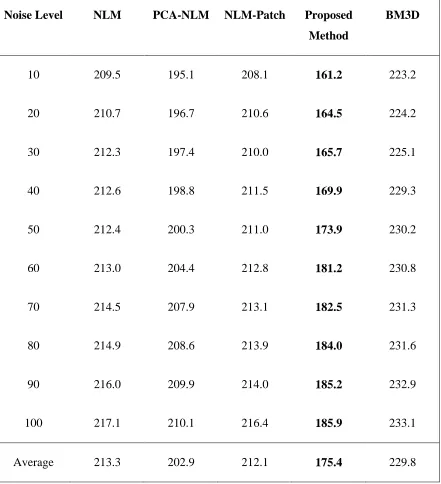
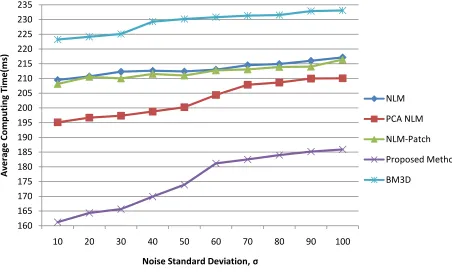
Table 4-1 and Table 4-2 show the comparative performance for Lena image and the
average comparative performance for all test images at different noise levels,
respectively. The bolded values represent the highest PSNR value among all of the
algorithms for a given noise level. Figure 4-3 compares the average PSNR for the
proposed method and all other denoising algorithms.
It has been found that, the proposed method performs better than all other methods except
BM3D. In case of the BM3D method, the proposed method performs better than the
BM3D method only when σ<50. The BM3D method performs better at the higher noise
39
Table 4-1: PSNR(dB) comparison for Lena image among the proposed method, the
NLM method, variants of the NLM method and the BM3D method for different noise
levels.
Noise Level NLM PCA-NLM NLM-Patch Proposed
Method
BM3D
10 34.57 34.58 33.21 35.91 35.79
20 31.89 31.92 30.09 33.32 32.94
30 30.0 31.05 27.71 31.55 31.16
40 28.42 29.02 25.85 29.97 29.79
50 27.10 26.99 25.46 27.65 28.70
60 25.55 24.98 23.89 25.98 28.27
70 23.99 24.01 23.10 24.93 27.57
80 23.05 23.51 22.82 23.96 26.97
90 22.99 22.98 21.95 23.09 26.45
100 22.18 22.19 21.17 22.29 25.95
Chapter 4:Experimental Results and Analysis
40
Table 4-2: Average PSNR(dB) comparison for all test images among the proposed
method, the NLM method, variants of the NLM method and the BM3D method for
different noise levels.
Noise Level NLM PCA-NLM NLM-Patch Proposed
Method
BM3D
10 32.52 32.94 31.47 33.94 33.84
20 29.87 29.95 29.04 31.0 30.50
30 28.13 28.26 27.45 28.96 28.38
40 26.69 26.43 25.87 27.72 27.70
50 25.49 25.38 24.61 26.49 26.86
60 23.85 23.87 22.75 24.30 25.94
70 22.90 22.81 22.31 23.22 25.29
80 22.32 22.32 21.92 22.60 24.75
90 21.73 21.57 20.89 21.86 24.18
100 21.13 20.94 20.14 21.19 23.68
41
Figure 4- 3: Bar graph for average PSNR comparison for the proposed method, the NLM
method, variants of the NLM method and the BM3D method for different noise levels.
4.4.3
Performance analysis using SSIM
Table 4-3 and Table 4-4 show the SSIM comparison for Lena image and the average
SSIM comparison for all test images between the proposed method and the other
denoising schemes, respectively. The bold face digits represent the highest SSIM value
among all of these algorithms. Figure 4-4 compares average SSIM between the proposed
method and other the denoising schemes.
For noise level σ<50, the proposed method performs better than all other denoising
schemes. Yet, for noise level σ>50 the proposed method performs better than the original
NLM and its variants. The BM3D performs better at higher noise levels.
Appendix A exhibits further analysis on Pepper, Boat and Couple image. 18 19 20 21 22 23 24 25 26 27 28 29 30 31 32 33 34 35
10 20 30 40 50 60 70 80 90 100
PS N R v al u e
Noise Standard Deviation, σ
NLM
PCA NLM
NLM-Patch
Proposed Method