
The uses of M2M communication protocol and IoT
model interoperability standard and segments for
the new business concept.
Sanket Chauhan1, Dr.Kalpesh Popat2
1
Faculty of Computer Application, Marwadi University, Rajkot, Gujarat, India
2
Faculty of Computer Application, Marwadi University, Rajkot, Gujarat, India
Abstract
The M2M communications protocol features a range of intelligent devices that share, connect, and monitor information, making efficient and intelligent decisions without the need for human intervention. Machine-to-Machine Communication (M2M) is a new concept in protocol communication, in which the entire battlefield is not only controlled but also controlled by different-different intelligent sensors. M2M will be a force that is changing the market for a variety of real-time monitoring and evaluation applications such as healthcare, home automation system, environmental monitoring, smart learning, data predicting techniques, and industrial automation, as it is compatible with a variety of features and functions. This paper addressed the different perspectives of M2M communication and suggested a new application scenario.
Keywords: M2M Communication, Segments of M2M, M2M vs
IoT, M2M Standards, Value Chain
1. Introduction
The M2M (Machine to Machine) has grown. Almost a decade has passed since the idea of extending the reach of networked entities (wireless, wired, private, and public) beyond humans and their preferred communication devices to the terms of “Internet of Things (IoT) ".
The original vision was that countless new devices that largely go unnoticed by people work together to increase the footprint of end-user services. This creates new ways to ensure safety or comfort, to optimize a variety of goods: delivery mechanisms that enable efficient tracking of people or vehicles while creating new systems and adding value. As with any vision, it took some time before initial efforts were made to refine the original vision by testing
new business models, developing unique solutions to prove feasibility and predicting the effects of inadequate interoperability. In recent years, it has emerged that there are new viable sources of demand that can be covered and monetized. The role of M2M is to determine the conditions under which a device can exchange information through a communications network with a commercial application so that the device and/or the application can serve as the basis for this information exchange. In this definition, the communication network plays a key role. A compiled application and a device can hardly be considered as an M2M relationship.
2. Vision and Evaluation of M2M
Communication.
The most common meaning of M2M is machine-to-machine, which is referred to in this work. Machine-to-machine communication (M2M) is essentially understood to mean the communication between computers, integrated processors, smart sensors, actuators and mobile devices with no or limited human intervention.
2.1 Types of wireless communication
Wireless Communication technology can be used for four distinct types of communication. [11]
1. Human-to-Human communication(H2H) 2. Human-to-Machine Communication (H2M) 3. Machine-to-Human communication(M2H) 4. Machine-to-Machine communication(M2M)
At Evince, we are committed to finding innovative, innovative and innovative solutions and methods to address old issues for the customer. At the same time, our solutions are also cost-effective, which together with our experience with the Internet of Things certainly helps to find the best possible solution to the problem in context.
Fig. 1 Evaluation of M2M Communication.
3. Review of literature
Fuchun Joseph Lin et. al have focused on service platform is considered the key to driving the development of IoT / M2M applications in a variety of vertical markets, including smart energy, smart transportation, home, and industrial automation, electronic health and connected vehicles. The effort will be used as a feasibility study to explore the usefulness of the concept of a common IoT / M2M service platform and the urgent need for an international standard to define such a platform. We intend to use the results of the study to develop an appropriate IoT / M2M curriculum for the next generation. [1]
Yue Gao et. al have studied and analyzed the projected growth of the Internet of Things (IoT). Many technologies
are available today, the industry trend suggests that cellular systems will play a key role in ensuring global IoT connectivity. Since the spectrum is generally a bottleneck for 3GPP technologies, White Space TV (TVWS) approaches are a promising way to handle the billions of connected devices in a highly flexible, reliable and scalable way. [2]
Chen Hongsong et. al have investigated the cases of Communication from machine to machine (M2M) has become increasingly important in recent years. However, its evolution and character represent a new security challenge. Security and trust issues in the M2M system are severe. A safety and trust survey in the M2M system is required. They include the typical research progress technology and safety product. All this will help to understand the safety and confidence in the M2M system. [3]
Mahbubul Alam et. al have proposed Machine-to-machine (M2M) communication has attracted great attention in the research community and has gained momentum from a commercial point of view as operators begin to provide services in the areas of fleet management, logistics, automation of the home, etc. But the wider domain of the Internet of things (IoT) is what many see as a development of M2M. The challenges of entering IoT will be explored with a focus on networks and computing. [4]
Zubair Md. Fadlullah et. al have suggested the smart grid's advanced measurement infrastructure today offers the greatest growth potential in the machine-to-machine market. Among them, the most reliable technology for facilitating M2M communication in the SG originated area network and also its deficiency is found. Also, a possible solution is presented to address this shortcoming and to improve the scalability of SG communications. [5]
DongBum Seo et. al have given an overview of ubiquitous mobile applications on the cloud computing platform is increasing due to the rapid advances in cloud technology. Our system offers a combined architecture of ubiquitous computing and cloud computing that supports a powerful mobile application framework that requires high performance. It consists of three layers: the cloud service layer (CSL), the machine-to-machine service layer (M2M) and the ubiquitous service layer. [7]
Rapeepat Ratasuk et. al have evaluated 3GPP presents a narrow-band long-term evolution (LTE) system to support the Internet of things. In standalone mode, NB-IoT can occupy a GSM channel (200 kHz) while band and in-band protection modes use a physical resource block of LTE (180 kHz). The design goals of NB-IoT include low-cost devices, high range (20 dB improvement over GPRS), long battery life (over 10 years) and a huge capacity. Latency is relaxed, although a 10-second delay target is the goal of exception messages. The specifications for NB-IoT are expected to be finalized in 2016. [8]
Penn H. SU et. al have explored Failover for service-oriented distributed networks is a prerequisite for the Internet of Things (IoT) to run forever as a single implementation. Resource reconfiguration is necessary to achieve failover mechanisms when devices are replaced or services fail. This can be a particular challenge if application services have more than just end-to-end transfers between heterogeneous or versatile devices, for which duplicates can be expensive and redundant. In particular, a device with a failed service must be assumed by another service partner in which users, including developers and installers, do not participate. We develop the fault tolerance mechanism for the IoT, which is distributed and takes into account the dynamics within the IoT. [9]
Hongkun Li et. al have studied and analyzed Internet of Things (IoT) and Machine to Machine (M2M) communication provides great opportunities to connect various devices, such as sensors and actuators, and to collect and process the data collected. This, in turn, enables the kind of services that make smart homes and
smart transportation applications a reality. For applications or services in different industries (such as Smart Home and Smart Transport) that need to share and reuse information and work together, interworking and interoperability have become essential. However, interworking and interoperability between industries have not been fully addressed in the context of M2M / IoT. Semantics is an ideal technique to create a common ground for collaboration and interaction. It focuses on sharing data between different applications and services. [10]
4. M2M Standards & Segments
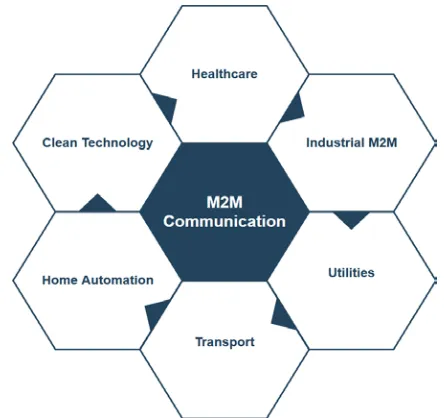
Unlike other ICT segments where operating systems can be implemented despite the lack of standards, some segments of the M2M market demand strict standards to ensure long-term investment protection. Several M2M applications, including smart metering or smart grids, are expected to use the devices installed for more than 20 years. While this lifestyle may seem unrealistic (or at least unusual) for traditional TELCO deployment, the infrastructure provided by utility companies has very long delivery cycles that can dramatically affect its design and, consequently, the Fourth level of related standards.
Fig. 2 Segments of M2M Communication. [12]
Table 1: Machine-to-Machine vs. IoT uses parameters difference. [13]
Parameters M2M IOT
Short for Machine to Machine Internet of Things Ideology M2M concept in which two or more
machines can communicate with each other and perform certain functions without human intervention. In the M2M
model, a certain degree of intelligence can be observed.
with an internal and / or external environment, which in turn controls decision-making.
Connection Type Point to Point Through IP network using various
communication types Communication
Protocol
Old proprietary protocol and communication techniques
Internet protocols used commonly
Value Chain Linear Multi sided
Focus Area For monitoring and control of 1 or few infrastructure
To address everyday needs of humans.
Device in scope Limited devices in scope Large number of device in scope
Scalability Less scalable then IoT More scalable due to cloud based architecture Current uses Remote monitoring, Fleet control Smart cities, Smart Agriculture
Business Type B2B B2B and B2C
Technology Integration
Vertical Vertical and Horizontal
Related terms Sensor, data and Information End users, devices, wearable, cloud and Big data
According to above table description for actual difference between M2M and IoT: In the current market scenario for uses of multi shad proposed models mainly depend on IoT basis architectures. M2M concept is for connecting two models directly without any human mediators. In IoT is communicate with middle layer communication protocols through networks. Also using IoT can connect large numbers of devices which related terms of different elements.
5. Conclusion and Future Work
For batter operability of interconnection between different resources, IoT and other technologies are mandatory. This paper highlights various segment evaluations and discusses the implementation issues in the context of uses Machine-to-Machine device models. Comparative Study of different models is listed. The comparative criteria include Security, Robustness, Response time, User Interface, Communication, Cost, and Device Orientation. Future work would involve designing, developing and implementing an IoT based model for Smart Homes, Smart Grid, Smart Agricultures, Smart Class, Smart Cities, Smart Industry, etc.
6. References
[1] F. J. Lin, Y. Ren, and E. Cerritos, “A feasibility study on developing IoT/M2M applications over ETSI M2M architecture,” Proc. Int. Conf. Parallel Distrib. Syst. - ICPADS, pp. 558–563, 2013.
[2] Y. Gao, Z. Qin, Z. Feng, Q. Zhang, O. Holland, and M. Dohler, “Scalable and Reliable IoT Enabled by
Dynamic Spectrum Management for M2M in LTE-A,”
IEEE Internet Things J., vol. 3, no. 6, pp. 1135–1145, 2016.
[3] C. Hongsong, F. Zhongchuan, and Z. Dongyan, “Security and trust research in M2M system,” Proc. 2011 IEEE Int. Conf. Veh. Electron. Safety, ICVES 2011, no. 20090460245, pp. 286–290, 2011.
[4] M. Alam, R. H. Nielsen, and N. R. Prasad, “The evolution of M2M into IoT,” 2013 1st Int. Black Sea Conf. Commun. Networking, BlackSeaCom 2013, pp. 112–115, 2013.
[5] Z. M. Fadlullah, M. M. Fouda, N. Kato, A. Takeuchi, N. Iwasaki, and Y. Nozaki, “Toward intelligent machine-to-machine communications in smart grid,”
IEEE Commun. Mag., vol. 49, no. 4, pp. 60–65, 2011.
[6] Yan Zhang, Rong Yu, Shengli Xie, Wenqing Yao, Yang Xiao, and M. Guizani, “Home M2M networks: Architectures, standards, and QoS improvement,” IEEE Commun. Mag., vol. 49, no. 4, pp. 44–52, 2011.
[7] D. B. Seo, C. S. Jeong, Y. B. Jeon, and K. H. Lee, “Cloud infrastructure for ubiquitous M2M and IoT environment mobile application,” Cluster Comput., vol. 18, no. 2, pp. 599–608, 2015.
[8] R. Ratasuk, B. Vejlgaard, N. Mangalvedhe, and A. Ghosh, “NB-IoT system for M2M communication,”
2016 IEEE Wirel. Commun. Netw. Conf. Work. WCNCW 2016, no. Wd5g, pp. 428–432, 2016.
Forum Internet Things, WF-IoT 2014, pp. 45–50, 2014.
[10] H. Li, D. Seed, B. Flynn, C. Mladin, and R. Di Girolamo, “Enabling Semantics in an M2M/IoT Service Delivery Platform,” Proc. - 2016 IEEE 10th Int. Conf. Semant. Comput. ICSC 2016, pp. 206–213, 2016.
[11] https://docplayer.net/10512765-Cps-communications-dr-bheemarjuna-reddy-tamma-iit-hyderabad.html
[12] www.fokus.fraunhofer.de/en/ngni/workingareas/m2m
[13] https://ipwithease.com/internet-of-things-vs-machine-to-machine-iot-vs-m2m/
Sanket Chauhan is a Ph.D. scholar of Marwadi University, Rajkot, Gujarat. He obtained his Master’s degree in Computer Application in CHARUSAT University, Changa. He is currently a Teaching Assistant and iOS Trainer at Marwadi University. He has taken an 84+ seminar or workshop on iOS development across Gujarat colleges and universities. Right now, He is an Apple Authorized Trainer.
![Table 1: Machine-to-Machine vs. IoT uses parameters difference. [13]](https://thumb-us.123doks.com/thumbv2/123dok_us/7878639.1307109/3.612.315.543.378.520/table-machine-machine-vs-iot-uses-parameters-difference.webp)
