Organizing XML Data in a Wireless Broadcast System
by Exploiting Structural Similarity
Yongrui Qin1•Quan Z. Sheng2 •Hua Wang3 •
Nickolas J. G. Falkner4
Published online: 30 August 2017
The Author(s) 2017. This article is an open access publication
Abstract Wireless data broadcast is an efficient way of delivering data of common interest to a large population of mobile devices within a proximate area, such as smart cities, battle fields, etc. In this work, we focus ourselves on studying the data placement problem of periodic XML data broadcast in mobile and wireless environments. This is an important issue, particularly when XML becomes prevalent in today’s ubiquitous and mobile com-puting devices and applications. Taking advantage of the structured characteristics of XML data, effective broadcast programs can be generated based on the XML data on the server only. An XML data broadcast system is developed and a theoretical analysis on the XML data placement on a wireless channel is also presented, which forms the basis of the novel data placement algorithm in this work. The proposed algorithm is validated through a set of experiments. The results show that the proposed algorithm can effectively place XML data on air and significantly improve the overall access efficiency.
Keywords Mobile computingPeriodic data broadcastXML Multi-item queryData placement algorithm
1 Introduction
Wireless technologies have become deeply embedded in our daily lives [1]. At the end of 2011, there were 6 billion mobile subscriptions, estimated by the International Telecom-munication Union [2]. That is equivalent to 87% of the world population, and is a huge increase from 5.4 billion in 2010 and 4.7 billion mobile subscriptions in 2009.
& Yongrui Qin [email protected]
1 School of Computing and Engineering, University of Huddersfield, Huddersfield, UK 2
Department of Computing, Macquarie University, Sydney, Australia
3 College of Engineering and Science, Victoria University, Melbourne, Australia 4
Broadcast is one of the basic ways of information access via wireless technologies. In a wireless data broadcast system, the server broadcasts public information to all mobile devices within its transmission range via a downlink broadcast channel. Mobile clients ‘‘listen’’ to the downlink channel and access information of their interest directly when the desired information arrives. Broadcast is bandwidth efficient because all mobile clients can share the same downlink channel and retrieve data from it simultaneously. Broadcast is also energy efficient at the clients because downloading data costs much less energy than sending data [3].
Wireless data broadcast services have been available as commercial products for many years (e.g., StarBand and Hughes Network). Recently, there has been a push for such systems from industry and various standard bodies. For example, born out of the ITU ‘‘IMT-2000’’ initiative, the Third Generation Partnership Project 2 is developing Broadcast and Multicast Service in CDMA2000 Wireless IP network. Systems for Digital Audio Broadcast (DAB) and Digital Video Broadcast (DVB) are capable of delivering wireless data services. Recent news also reported that XM Satellite Radio [4] and Raytheon have jointly built a communication system, known as the Mobile Enhanced Situational Awareness Network (MESA), that would use XM satellites to relay information to soldiers and emergency responders during a homeland security crisis.
On the other hand, information expressed in semi-structured formats is widespread over the past years. XML has rapidly gained popularity as a de facto standard to represent semi-structured information. Popular Web browsers provide support for XML and nearly all major IT companies (e.g., Microsoft, Oracle, and IBM) have integrated XML into their software products. Delivering information in XML format is also popular in Web services and in various kinds of Publish/Subscribe systems.
Combining both trends of the proliferation of mobile computing technologies and XML data, broadcasting information in XML format in a wireless environment would be a preferable way of information delivering and sharing. Consequently, the research of XML data broadcast is of great importance and in fact it has been attracting more and more research interests [5–12]. To further demonstrate the practicability of XML data broad-casts, a potential application by detailing a real life scenario will be presented in Sect.3. There are two typical data broadcast modes: (1)Periodic Broadcast Modeand (2) On-Demand Broadcast Mode[3]. In the periodic broadcast mode, data is periodically broadcasted on a downlink channel via which the server sends data to clients. Clients only need to ‘‘listen’’ to that channel and download the data that they are interested in. In contrast, for the on-demand broadcast mode, clients send their queries to the server via an uplink channel and the server considers all submitted requests and decides the content of the next broadcast cycle. This work is focused on the periodic broadcast mode since it has many benefits. Firstly, it can save uplink bandwidth as no requests will be sent from mobile clients, thereby reducing power consumption at the clients. Secondly, it can effectively deliver information to an unlimited number of clients simultaneously. This is because the number of mobile clients will not affect the workload on the server.
Data placement algorithms determine what data items to be broadcasted by the server and their order on wireless channels, aiming to reduce average waiting time for mobile clients. To a large extent, the data placement problem of XML data is similar to that in multi-item contexts [13,14] where mobile clients may request multiple items each time. However, there are some drawbacks of existing data placement approaches in the tradi-tional data broadcast models.
profile of their interests to the servers [15, 16]. However, such models may limit the practicability of the proposed placement algorithms in real situations because: (1) new mobile clients may join in the network at anytime; and (2) mobile users may be reluctant to disclose their queries to the server via an uplink channel due to expensive communication cost and privacy concerns. Secondly, in the traditional data broadcast systems, data items themselves on the server are normally independent and it is difficult to discover underlying relationships between data items, which means user queries must be known in advance for the design of data placement algorithms. Alternatively, the authors of [17] applied data mining techniques to discover association rules from the history access patterns of a set of data. This avoids to obtain access patterns of mobile clients on-the-fly. However, in this approach, the availability of such history access patterns of mobile clients is a necessity, which may not always be available.
By contrast, in XML data broadcast, data items (or XML documents) usually share parts of their structure. Taking structural sharing between XML documents into consideration, it becomes feasible to analyze and estimate clients’ access patterns. Then XML data can be effectively placed on wireless channels based only on the XML data on the server because the server can generate XML data placement according to the structural similarity among XML data. In this way, user queries that focus on structural information matching can benefit from such data placement. To the best of our knowledge, little work has addressed similar data placement strategies in the context of wireless data broadcast. Therefore, this paper studies the data placement problem of periodic XML data broadcast. Firstly, an XML broadcast system is described and a theoretical analysis on the data placement problem of periodic XML data broadcasts is presented. Secondly, based on the analysis, a novel greedy data placement algorithm is designed. In a nutshell, the main contributions of this paper are summarized as follows:
• In the context of periodic XML data broadcasts, by taking advantage of the structural characteristics of XML data, it is shown to be feasible to generate appropriate data placement results based only on the XML data on the server.
• A theoretical analysis on the data placement problem of periodic XML data broadcasts is presented. Based on the analysis, a novel greedy data placement algorithm which organizes XML data on air is proposed.
• Extensive experiments are conducted to show the effectiveness of the proposed data placement algorithm.
A preliminary version of this paper appeared in [18], where the emphasis is focused on the introduction of the data placement algorithms and preliminary experiments. This paper significantly extends the work in [18] from the following aspects, including: (1) a detailed theoretical analysis on the data placement problem is presented, which forms the basis of the data placement algorithms; (2) a more detailed and rigorous time complexity analysis of the proposed data placement algorithms is provided; (3) a more detailed introduction of Index Distribution Strategy facilitating the understanding of used indexing schemes in this proposed work is added; (4) experiments on two more data sets and more experimental results are presented to further show the applicability and low maintenance cost of the proposed data placement algorithms.
Section5presents the related experimental study for evaluating the performance of the proposed data placement algorithm. Finally, Sect.6discusses the related work and Sect.7
gives some concluding remarks.
2 Background
In this section, a potential application scenario is firstly described. Then an overview of the broadcast system used in this work is provided and background knowledge of XML structural sharing is also introduced.
2.1 Application Scenario
The following scenario can be used to show potential applications of XML data broadcast in real life.
Consider a live basketball game. Information about the game and the players on the court is usually the interest of a large number of audience. When the game progresses, the volume of such information is expected to increase, which means the information content is dynamic. Normally, a basketball stadium can accommodate 10,000 to 60,000 audience at the same time. This large number of audience are likely to be interested in similar game information. They may even want to access the game information at the same time (suppose most of them are with mobile devices). In this context, data broadcast is a preferable way of delivering latest information to the audience. Then thousands of audi-ence in the stadium can access game information simultaneously by just ‘‘listening’’ to the broadcast channel. Audience do not need to contend limited bandwidth (i.e., the use of the uplink channel) and other system resources (i.e. the server processing capacity) with each other.
In this scenario, it is assumed that (1) the audience are not only interested in the real-time information about the basketball game, but also interested in some historical records/ statistics information about the players, the basketball teams or the coach teams, etc; (2) the audience may want more statistics information about the current basketball game than the limited live statistics information shown on the large screens inside the stadium. Therefore, a broadcast service would be very helpful for the audience to obtain more desired information about the game.
Meanwhile, audience could be outside of the stadium, such as basketball fans who are watching live text information about the game via the Internet at their homes. Therefore, the game information could also be delivered via the Internet to online audience and other Web service providers who have subscribed this basketball game. Using XML format to represent game information can satisfy all these needs and realize simplicity, generality, and usability of game information at the same time.
2.2 A Wireless XML Data Broadcast System
downlink channel does not mean each mobile client would need to set up a different downlink connection. All mobile clients only need to tune in the downlink channel and listen to it for the desired information. Thus this downlink channel can be shared by all mobile clients. Mobile clients cannot send their individual queries to the server in this model as no uplink channel is available.
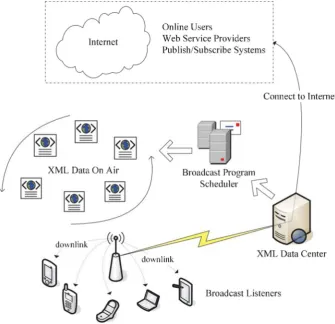
There are several notable advantages of such a system model. Firstly, it can serve an arbitrary large number of mobile clients simultaneously. Secondly, extra energy cost at the client side for using an uplink channel can be avoided. Further, after applying air indexing techniques [8,19], mobile clients will also be able to determine when the desired data will be broadcasted on the wireless channel (for more details about air indexing, please refer to Sect.4.3). Before the desired data is available, they can switch to energy saving mode to reduce power consumption. As a result, the battery life of mobile clients can be extended. From the figure, it can be seen that the XML Data Center could be connected to the Internet and deliver information to online users, Web service providers and Publish/Sub-scribe systems, etc. With the use of XML data, these different applications can be inte-grated seamlessly with the wireless data broadcast system for the purpose of sharing and delivering the same information to different users.
2.3 XML Structural Sharing
The goal of this work is to place XML documents on the broadcast channel based on the information at the server side. This work proposes to explore structural sharing between different XML documents and place documents according to the structural sharing results. Here, structural sharing refers to overlaps of path sets (defined in the below) of XML documents.
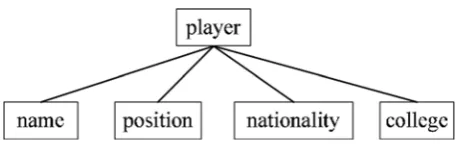
Some existing work on measuring structural sharing between XML documents can be found in [20,21]. The main idea of their work is based on the concept ofpath sets. Here, a path set of an XML document contains all full paths (paths that are from the root element to the leaves) and their subpaths. A simple example is depicted in Fig.2. The path set of
this example is: {/player/name, /player/position,
/player/national-ity, /player/ college, /player, /name, /position, /national/player/national-ity, /college}. A path set of an XML documentdis denoted asPS(d), while |PS(d)| denotes the number of paths inPS(d).
Different types of metric can be adopted, such as Jaccard metric [22, 23], Dice’s coefficient [24] and Lian’s metric [25], to measure the structural sharing or similarity between two XML documentsdianddj. The exact forms of these metrics based onPSare
as follows (Jaccard metric is denoted asJðdi;djÞ, Dice’s coefficient is denoted asDðdi;djÞ
and Lian’s metric is denoted asLðdi;djÞ):
Jðdi;djÞ ¼jPSðdiÞ
T
PSðdjÞj
jPSðdiÞSPSðdjÞj ð1Þ
Dðdi;djÞ ¼2 jPSðdiÞ
T
PSðdjÞj
jPSðdiÞj þ jPSðdjÞj ð2Þ
Lðdi;djÞ ¼ jPSðdiÞ
T
PSðdjÞj
maxfjPSðdiÞj;jPSðdjÞjg ð3Þ
Equation (1) computes the proportion of common paths over the union of all paths in two given XML documentsdianddj, Eq. (2) computes the result of twice of the number of
common paths over the total number of all paths in the two given XML documents, and Eq. (3) computes the proportion of common paths over all the paths in the larger path set of the two given XML documents. From the above definitions, it can be seen that both Jaccard metric and Dice’s coefficient give more weights on the total structural information of two comparing documents while Lian’s metric emphasizes on the difference of these docu-ments. All three metrics can vary in the interval [0, 1]. If PSðdiÞ ¼PSðdjÞ, then Jðdi;djÞ ¼Dðdi;djÞ ¼Lðdi;djÞ ¼1. Clearly, the larger the values of these metrics are, the
more structural sharing the two comparing XML documents have. From these equations, we can have a better understanding about what kind of structural information a specific metric emphasizes on. Further, on top of these metrics, we will introduce a new metric that is more suitable for assisting data placement of XML data in wireless broadcast later in this paper.
3 Analysis of the Data Placement Problem
In this section, a theoretical analysis on the data placement problem in periodic XML data broadcasts is presented.
In the literature, two critical metrics, namelyaccess timeandtuning time, are used to measure a system’s performance [26]. Access time1 refers to the time elapsed from the moment a query is issued to the moment it is answered, whiletuning timerefers to the time a mobile client stays in active mode to receive the requested XML documents and the index information. Data placement mainly affects access time because tuning time depends on the total content downloaded by mobile clients but not on the order of data. Hence, access time is used as the metric in this analysis. In periodic broadcast, queries are used to describe the interests of mobile clients and help mobile clients to skip irrelevant data on air, but they are not actually submitted to the broadcast server.
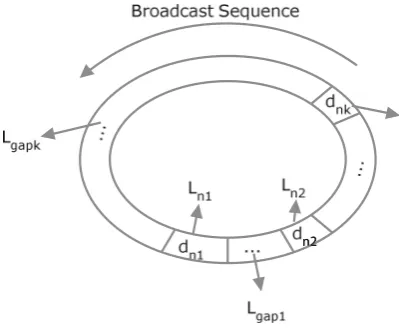
Table1 lists the symbols used in the rest of the paper and Fig.3 shows a broadcast program (or a broadcast sequence)ron the wireless channel which is broadcasted peri-odically. The broadcast programrcan start from any XML documentdi. However, it is
assumed thatrstarts fromd1(this will then comply with the definition ofrin Table1) to simplify the analysis.
With the basic assumption that queries can be issued at any time with an equal prob-ability (this means the issue time of queries follows a uniform distribution), the expected access time ofq, denoted asATqexp, can be computed in the following:
ATq exp¼
Xk
i¼1
Ldni Lr Lrþ
Lgapi
Lr Lr
1 2 Lgapi
¼X k
i¼1
Ldni þX k i¼1 Lgapi 1 Lr Xk i¼1 1 2 L
2
gapi
¼ Lr 1
2 Lr
Xk
i¼1
L2
gapi
ð4Þ
In this equation,Ldnirefers to the length of documentdni,Lrrefers to the total length of all documents inrandLgapi refers to the total length of all documents ingapi.
It should be noted that, we derive the first line of Eq. (4) in the following:
1. Case 1:qis issued whendiis broadcast. The probability of this case is Ldni
Lr and the total access time will be the whole broadcast cycle, which isLr.
2. Case 2:qis issued in the middle of broadcastinggapi. The probability of this case is Lgapi
Lr and the average access time will beLr 1 2 Lgapi.
1
According to Eq. (4)2and a given broadcast programr,ATqexpcan be calculated simply according to the gaps between consecutive documents required by q. Further, from the above equation, it can be seen that in order to improve the expected access efficiency,
Pk i¼1L
2
gapi should be as large as possible.
Moreover, the sum of all gaps, denoted asLgaps, can be computed as
Lgaps¼X k
i¼1
Lgapi¼ Lr
Xk
i¼1
Ldni¼ Lr Lrq ð5Þ
Here,Lrqrefers to the total length of all documents required byq, which is
Pk i¼1Ldni. Note thatLrqis independent of any data placement results. In other words,Lrqis fixed for a givenq, which in turn indicates thatLgapsis fixed.
n2 n2 n2
Fig. 3 A broadcast program showing positions of documents required by queryq
2
This result is exactly the same as [27] although the deduction process is different. The further analysis on this result in the following is new.
Table 1 Symbols overview Symbol Description
D XML document set.fd1;d2;d3;. . .;dng
q Query issued by a mobile client
k Number of documents required byq
r A complete broadcast program (or broadcast sequence). It is the result of a data placement algorithm running on a givenD.\d1;d2;d3;. . .;dn[. (Note:ris different fromDasDis a set of documents butris a sequence of the same set of documents.)
gap Unmatched documents ofqthat are placed between two adjacent matched documents inr
L The length of documents
ATq
In order to derive the lower and upper bounds ofPki¼1L2
gapi and to analyze the data placement strategy, the following propositions for the below function fðXÞ are firstly presented.
FunctionfðXÞ ¼Pki¼1xi2is with the following constraints:
1. x1þx2þ þxk ¼M
2. x1;x2;. . .;xk0
where Mis a positive constant. The lower bound and the upper bound of fðXÞ can be denoted asfðXÞandfðXÞ, respectively.
Proposition 1 Given fðXÞdefined as above, then fðXÞ M2
When x1¼x2¼ ¼xk1¼0and xk¼M (or any other kind of combinations with k1
zeros and only one M),fðXÞreaches its upper bound, i.e.,fðXÞ ¼M2. Proposition 2 Given fðXÞdefined as above, then
fðXÞ M
2
k
When x1¼x2¼ ¼xk ¼Mk,fðXÞ reaches its lower bound, i.e.,fðXÞ ¼M
2
k.
Note that, the proof of Proposition 1 and 2 is in the ‘‘Appendix’’.
Moreover, givenfðXÞdefined as above and suppose thatmvariables, i.e.x1;x2;. . .;xm,
have been determined (m\k) while the restkmvariables are not.MPm
i¼1xican be
denoted asM0. The next step is to determine the next variable. Without loss of generality, xmþ1 can be used as the next variable to be determined, which aims to maximize or minimizefðXÞ.fðXÞxmþ1 can be denoted as the function withmþ1 determined variables (xi, 1imþ1) and km1 undetermined variables. Then given two values of this
variable, i.e.xmþ1andx0mþ1 and supposexmþ1\x0mþ1, the following propositions are true:
Proposition 3 For fðXÞxmþ1and fðXÞx0
mþ1,it is true that
fðXÞxmþ1[fðXÞx0
mþ1 xmþ1\x
0 mþ1
M0 2
fðXÞxmþ1\fðXÞx0mþ1 M0
2 xmþ1\x
0 mþ1 Indefinite Otherwise 8 > > > > < > > > > :
Proposition 4 For fðXÞx
mþ1and fðXÞx0mþ1
,it is true that
fðXÞ
xmþ1[fðXÞx0mþ1
xmþ1\x0mþ1 M0 km
fðXÞ
xmþ1\fðXÞx0mþ1
M0
kmxmþ1\x
The proof of these propositions can be found in the ‘‘Appendix’’. Now according to Propositions1and2, it is true that
L2
gaps
k
Xk
i¼1
L2
gapi L 2
gaps ð6Þ
Then according to Eq. (4), it is true that
LrL
2
gaps
2 Lr AT
q
exp Lr L2
gaps
2k Lr ð7Þ
From the above two inequations, it can be seen that in order to improve the expected access efficiency,Pki¼1L2gapi should be as large as possible. According to Proposition1, when one of the gaps equals toLgapsand all other gaps equal to 0, the best expected access efficiency can be achieved. Thus, when all XML documents required by q are placed together and broadcasted in sequence,ATqexpcan be minimized. Also, according to Eq. (5), the above inequation can be rewritten to
LrðLr LrqÞ 2
2 Lr AT
q
exp Lr
ðLr LrqÞ 2
2k Lr ð8Þ
Here Inequation (8) shows both the lower and upper bounds ofATq
expforqin another
form. It is worth mentioning that both bounds are independent of any data placement results. Moreover, it can be inferred that when k increases,rq will include more
docu-ments. ThenLrqincreases as well. However, the decrease of differenceLr Lrqleads to larger lower and upper bounds ofATq
exp, which means the system’s overall performance
will degrade.
The above analysis focuses on a single query. However, generalizing it to multiple queries would be much more complicated. Actually, determining an optimal broadcast sequence for multiple multi-item queries is an NP-Complete problem [27].
When there are multiple queries to consider for a broadcast program, these queries are not likely to require the same XML documents. In such cases, Proposition1and Inequation (6), which minimizes expected access time for a single query, cannot help to find an optimal solution for all queries.
However, from Inequation (6) and (8) it can be inferred that the upper and lower bounds offðXÞshould be as large as possible which can lead to larger probability of having large results offðXÞ. This in turn enlarges the probability thatATqexpis smaller forqaccording to Inequation (6) and (8). Then, for multiple queries, according to Propositions3 and4, whenxmþ1M
0
2 andxmþ1
M0
km, it is desirable to decreasexmþ1to have largerfðXÞxmþ1and fðXÞ
xmþ1. In other words, if each gap can be progressively reduced as much as possible, larger lower and upper bounds ofPki¼1L2
gapi can be obtained. In this way, both the lower and upper bounds of the overall expected access time can be reduced with a higher probability.
For example, if it is required to minimizePki¼1L2
initial broadcast program. After that, the system should append XML documents required by only one query to the broadcast program to form a final broadcast program. Hence, the system can construct a final broadcast program in a greedy style.
Now the problem becomes how the system can determine which documents should be placed together first as the system cannot obtain queries in advance. Related solution will be discussed in the next section.
4 The Data Placement Algorithm
This section introduces the data placement algorithm for periodic XML data broadcasts, based on the theoretical analysis in the previous section. Firstly the structural sharing property of XML data is discussed, which is used to estimate the potential access patterns of mobile clients, i.e., the probability of accessing a small set of similar XML documents simultaneously. Then a novel greedy data placement algorithm is put forward based on it.
4.1 Structural Sharing in XML Data
Intuitively, for any two given XML documents, the system can utilize one of the three structural similarity metrics described in Sect.2.3 to calculate the similarity between them and the similarity results can be used to approximate the probability that a specific query is matched with both documents at the same time. For example, if two XML elements are under structurally similar paths, then it is more likely that that either both elements satisfy, or none satisfies, a given query [20]. Therefore, if two XML documents are with larger structural similarity, i.e. d1 and d2, then they would have a higher probability to be required simultaneously. However, there are still three other cases to be considered, such as requiringd1but notd2, requiringd2 but notd1and requiring neither of d1 and d2. Therefore, the above similarity metrics consider only successful match probabilities of both XML documents and do not consider unsuccessful match probabilities.
Nonetheless, unsuccessful match cases have effects on the expected access time as well. According to Propositions1 and 2, in order to have better access efficiency, the gaps between any two required documents by a single query should be as less uniform as possible. Based on this, it can be inferred that in the above example, cases of requiredd1 but notd2and requiredd2but notd1are likely to generate more uniform gaps while other two cases (required both documents or neither) are likely to have less uniform gaps. Observing this, a new similarity metric calledCohesionis defined to give a more accurate estimation of access patterns of mobile clients in the following.
Note that, for any queryqrequiring at least one of the documents inD,qmust match some paths inPSðDÞand it has a probability ofjPSðDÞjjPSðdÞjto matchd. If a queryqfails to match any document inD, the issuer ofqonly needs to locate and download air index3to confirm that his/her query does not match any document. Then he/she can stop waiting for the result to be broadcasted. All these queries only need to access the index information on air and therefore, their expected access time depends heavily on the index distribution, which is not the focus of this work. To estimate their expected access time, interested readers are
3
referred to [19] for more details. Hence, this work only considers successful queries. This is because the access time of unsuccessful queries will depend on the indexing method but not on the data placement results. That means data placement algorithms will not affect the access time of unsuccessful queries.
Now suppose there is a set ofnXML documentsD ¼ fd1;d2;. . .;dngon the server, the access probability of any document dfor queries which successfully match at least one document in the setDcan be approximated as follows:
PrðdÞ ¼jPSðdÞj
jPSðDÞj ð9Þ
and for anyi,j(1i;jn)
PrðdidjÞ ¼
jPSðdiÞ PSðdjÞj
jPSðDÞj ð10Þ
Here, PSðDÞ ¼Sni¼1PSðdiÞ. According to this equation, PrðdidjÞ refers to the
probability of a given query matchingdi but not matchingdj.
There would be many different matching cases for a given set D. Take two XML documentsd1andd2 inDas an example. As mentioned previously, there would be four cases of matching of them and the probability of each case is shown in Table2. This table also includes positive and negative effects on the expected access time (ATexp) for
each case. Positive effects refer to the situation that, if we put the two documents with high probabilityPrðd1Td2Þor 1Prðd1Sd2Þtogether, according to our previous analysis, we should expect to achieve smallerATexp. In terms of negative effects, it means if we put the
two documents with high probability Prðd1d2Þ or Prðd2d1Þ, we would expect to achieve largerATexp.
Based on Table2and the previous analysis, it can be seen that, given two documents, if both documents are matched against the same query or neither of the documents is mat-ched, the two documents will tend to be more similar to each other, i.e.,Prðd1Td2Þ or 1Prðd1Sd2Þis higher. On the other hand, if only one of the two documents is matched against a given query, the similarity between them tends to be smaller, i.e., 1=Prðd1d2Þ or 1=Prðd2d1Þ is smaller. Based on this observation, CohesionCðdi;djÞof XML doc-umentsdianddjis defined as follows:
Cðdi;djÞ ¼Prðdi
T
djÞ ð1PrðdiSdjÞÞ
maxfPrðdidjÞ;PrðdjdiÞg
ð11Þ
Heredianddjare both in setD. It is easy to see thatCðdi;djÞ ¼Cðdj;diÞ. According to
Eqs. (9), (10) and (11),Cðdi;djÞ can be calculated after finding path sets ofdi,dj inD.
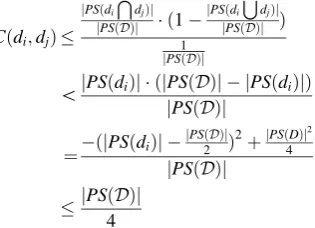
Cohesion values can vary in a wide range which exceeds interval [0, 1]. Strictly speaking, Cohesion values only vary in interval½0;jPSðDÞj4 if we define thatCðdi;djÞ ¼jPSðDÞj4 when PSðdiÞ ¼PSðdjÞ. The reason of doing so is: ifPSðdiÞ 6¼PSðdjÞ, the upper bound should be
jPSðDÞj
ðdidjÞ;PrðdjdiÞg jPSðDÞj1 . Without loss of generality, let jPSðdiÞj jPSðdjÞj,
according to Eqs. (9) and (10), (11) can be rewritten as follows:
Cðdi;djÞ
jPSðdiTdjÞj
jPSðDÞj ð1
jPSðdiSdjÞj
jPSðDÞj Þ
1
jPSðDÞj
\jPSðdiÞj ðjPSðDÞj jPSðdiÞjÞ jPSðDÞj
¼ðjPSðdiÞj jPSðDÞj
2 Þ
2
þjPSðDÞj4 2 jPSðDÞj
jPSðDÞj
4
Then the above result gives the upper bound of Cohesion Cðdi;djÞ. From this upper bound, we can infer that CohesionCðdi;djÞmay reachjPSðDÞj4 when (1)djis very small and
has little structural overlapping withdi, and (2)diis big and contains half of the paths of all
documents. Now Cohesion values can be normalized to interval [0, 1] in the following
C0ðdi;djÞ ¼
4Cðdi;djÞ
jPSðDÞj PSðdiÞ 6¼PSðdjÞ
1 PSðdiÞ ¼PSðdjÞ
8 <
: ð12Þ
It can also be inferred thatC0ðdi;djÞ ¼1 if and only ifPSðdiÞ ¼PSðdjÞ. Similar to the other three similarity metrics, the larger the value of Cohesion is, the more structural sharing the two comparing XML documents have.
Table 2 Matching cases for documentd1andd2in a docu-ment setD
Case Probability Effect onATexp
4.2 The Greedy Data Placement Algorithm
Based on the discussions of structural sharing between XML documents, it becomes feasible to generate a broadcast program for periodic data broadcasts in a greedy way. From previous discussions, if more structural sharing of two XML documents is observed, the probability to match both XML documents simultaneously will become larger. As a result, the Greedy Data Placement Algorithm (GDPA) places XML documents with most structural sharing together first as an initial broadcast program. Then it progressively appends other XML documents to the broadcast program in a descendant order of struc-tural sharing. Detailed steps of GDPA are shown in Algorithms 1 and 2.
Algorithm 1 initializes a structural sharing matrixS[n][n] fornXML documents on the broadcast server. Note that, all four similarity metrics defined in Sects.2.3and4.1can be used in Algorithm 1 to compute structural sharing between two documents (Line 6). All of them are symmetric which means for any one of these metrics, it must be true that S½j½i ¼S½i½j. Also it is true thatJðdi;djÞ ¼Dðdi;djÞ ¼Lðdi;djÞ ¼C0ðdi;djÞ ¼1 ifi¼j. Therefore, the algorithm only needs to calculate matrixSfor entriesS[i][j] wherei\j.
between the required documents but not by the sequence of them. Therefore, the sequence of the first pair of XML documents can be simply placed according to the ascendant order of document lengths (Line 3 to 7). Then from Line 9 to Line 21, Algorithm 2 appends the XML document with the maximum structural sharing to the head documentdhead or the
rear documentdrearofr. If the maximum structural sharing is derived between documentd
and documentdhead,dwill be appended intorfrom head; otherwise,dwill be appended
intorfrom rear. Once the selected document is added tor, that document will be removed fromD0. Then a similar process onD0will be repeated until all XML documents are placed intorin order.
Time ComplexitySuppose there are totallyndocuments on the server and each docu-ment containspelements (or in other words,ppaths) on average. Then in Algorithm 1, the forloop from Line 2 to Line 4 takesOðnplogpÞtime (it is proposed to use sorted sets here in order to speed up the set operations in the following lines). Note that intersections or differences between two sorted sets take linear time, which meas Line 6 in Algorithm 1 takes O(p) time. Therefore, thefor loop from Line 5 to Line 8 takesOðn2pÞ time since there areOðn2Þpairs of documents. Finally, in Algorithm 2, Line 2 takesOðn2Þtimes and the while loop from Line 9 to Line 21 takesOðn2Þ time as well. Putting all the times together, the total time complexity of both Algorithms 1 and 2 isOðnplogpþn2pÞ.
Now consider the scenarios of adding a new document or removing an existing docu-ment from the docudocu-ment set on the server. For adding a new docudocu-ment, the update time complexity would be Oðplogpþnpþn2Þ. This is because it takes OðplogpÞ time to compute the sorted path set for the new document, O(np) time to intersect with the n existing documents on the server and finally, it takesOðn2Þ to recompute the whole data placement. For removing an existing document from the server, the update time com-plexity would be justOðn2Þas the algorithm only needs to recompute the data placement for the restn1 documents.
4.3 Index Distribution Strategy
In order to improve energy conservation, smart mobile devices can switch between two operation modes: active modeand doze mode. In the active mode, a device can listen, compare, and download the required data; while in the doze mode, it turns off antennas and some processes to save energy. The energy consumed in active mode can be up to 100 times of that in doze mode [28]. However, after a broadcast programris generated, mobile clients cannot locate information of their interests as there is no auxiliary information to assist them, which means mobile clients would need to stay in active mode all the time. Air indexing can help to solve this problem.
This work adopts Compact Index (CI) [8] as the index structure and (1,m) index scheme [19] as the index distribution strategy.
CI provides a two-tier air index scheme [8]. The basic structure of CI is the combination of all the DataGuides (containing structural information only and supporting simple XPath queries, while branching queries are not supported) of XML documents inr, which utilizes RoXSum [29] technique to integrate these DataGuides, where common structural infor-mation amongst different XML documents can be combined to form much smaller structural representations about the original XML document set. In this basic index structure, every unique-label path (with only structural information) of a document appears exactly once for supporting simple XPath queries. Thus it contains the entire unique-label paths in all of the XML documents. CI also includes a two-tier structure which enables efficient access protocol at the client which facilitates the index access. Normally, CI is only 1.5% of the original XML data in terms of size. More details can be found in [8].
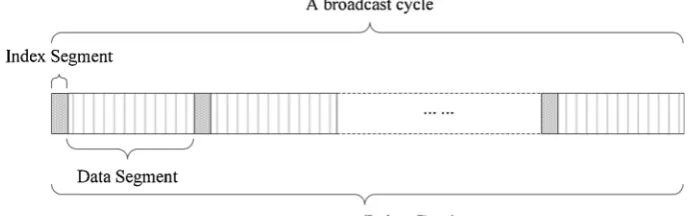
The idea of (1,m) index scheme [19] is shown in Figure4. From the figure, it can be seen that the generated broadcast program ris divided into mdata segments and before broadcasting each data segment, an index segment will be broadcasted first. The optimal
value m is given by ffiffiffiffiffiffiffiffiLdata
Lindex
q
. Here,Ldata refers to the total length of the raw broadcast
programrwithout any index information andLindexrefers to the length of index, which is CI in this work. (1,m) index scheme can best balance access time and tuning time of mobile clients. More details can be found in [19].
5 Experiments
This section reports the performance of the proposed data placement algorithm. The algorithm efficiency is shown in terms of access time, which is a common measure of performance in data broadcasts. Since this is the first work that determines broadcast schedules based only on XML data on the server, the proposed algorithm is compared with a common random data placement algorithm (RDPA).
5.1 Experimental Setup
The experiments are run on three data sets (DS1,DS2,DS3) each with 250 XML docu-ments and two more data sets (DS4,DS5) with 500 and 1000 XML documents, respec-tively. All generated documents are defined by News Industry Text Format (NITF) DTD
[30]. This DTD is published for news copy production, press releases, and Web-based news organizations. The average depth of all five document sets is between 6 and 8 while the maximum depth is 22.
The details of these data sets are shown in Table3. Data inDS1 can be well clustered into 6 clusters. Moreover, for any two documentsdi;djin two different clusters ofDS1, the
minimum similarity values, the maximum similarity values and the average similarity values of all four metrics (normalized Cohesion is adopted here) are shown in Table4. It can be seen that all clusters are quite different from each other and share very little structural information. Data in DS2 are miscellaneous. Documents in DS2 cannot be classified into fine clusters. Data inDS3 are a mix of well-clustered data and miscellaneous data, which include 125 XML documents fromDS1 and 125 XML documents fromDS2. Similar toDS2, data inDS4,DS5 are miscellaneous as well.
In the experiments, XPath queries are generated using the generator developed by [31]. Queries are allowed to repeat. The generator provides several parameters to generate different types of XPath queries, such as query depth, probability of * and // and so on. The probability of * and // appearing in each query’s step is between 5% and 30% (denoted PROB, and the default value is 10%). Here, * operator will match any element node in the document while // operator will select nodes in the document from the current node that match the selection no matter where they are. Query Incoming Rate (denotedQIR) means the number of newly issued queries from mobile clients in a unit of time. This unit of time is measured by the time that mobile wireless system takes to broadcast a block of 1024-byte XML data. The maximum depth of generated XPath queries (denotedMQD) is between 5 and 8. Table5shows the value range of parameters in the experiments. It should be noted that the user queries are assumed to follow a uniform distribution.
The random data placement algorithm (denoted RDPA) is compared with GDPA [im-plemented using all four similarity metrics defined in Equations (1), (2), (3) and (12)]. In RDPA, the server broadcasts XML documents in a random order. This random order is implemented by a Java classRandom. When applying a series of pseudorandom numbers on the order of XML documents in a broadcast program, there would be conflicts. For example, suppose there are totallyNdocuments to be broadcasted. It is needed to generate pseudorandom numbers between 1 and N. Afterkout of Ndocuments having been ran-domly placed, the next chosen document may be one of the firstkdocuments. If such case happens, it is simply ignored and Random class is used to generate pseudorandom numbers between 1 and Nk for the rest Nk documents. In this way, a random order of Ndocuments can be simulated.
Both RDPA and GDPA are implemented on Java Platform Standard Edition 6 running on Windows 7 Enterprise, 64-bit Operating System. All the experimental results are obtained by running 30 consecutive broadcast cycles. When varyingPROB,QIRandMQD
Table 3 Data sets in the
experiments Set name Length Remark
Minimum Maximum Average
DS1 2.4KB 8.1KB 5.0KB 6 clusters
DS2 0.5KB 45.9KB 12.4KB Miscellaneous
DS3 2.4KB 24.8KB 9.9KB Hybrid
DS4 0.5KB 55.8KB 12.3KB Miscellaneous
are set to their default values. When varyingQIR,PROBandMQDare set to their default values. Similarly, when varyingMQD,PROBandQIRare set to their default values.
Regarding air indexing and index distribution strategy, as mentioned in Sect.4, in the experiments, Compact Index (CI) [8] is adopted as the index structure and (1,m) index scheme [19] is adopted as the index distribution strategy. This is because CI is the state-of-the-art indexing technique for XML data broadcast and (1,m) index scheme is the most popular index distribution strategy for traditional periodic data broadcast. More details can be found in [8,19].
5.2 Performance of GDPA
The experimental results are shown in Figs.5,6,7,8and9. Average access time (AAT) is the performance metric. Also only AATis considered for all successful matched queries and abandon unsuccessful matched queries. The main reason for this is that, AAT of unsuccessful queries is determined by index distribution but not by data placement results (more details about this can be found in [19]). Note that, GDPA can be implemented with four different similarity metrics defined in Sect.4, which are Jaccard metric, Dice’s coefficient, Lian’s metric and the proposed Cohesion. Through the experiments, Jaccard metric and Dice’s coefficient always yield the same results. Therefore, GDPA implemented with them is denoted asJ/Dmethod in all figures. Meanwhile, GDPA implemented with Lian’s metric is denoted asLianmethod and GDPA implemented with Cohesion is denoted asCohesionmethod.
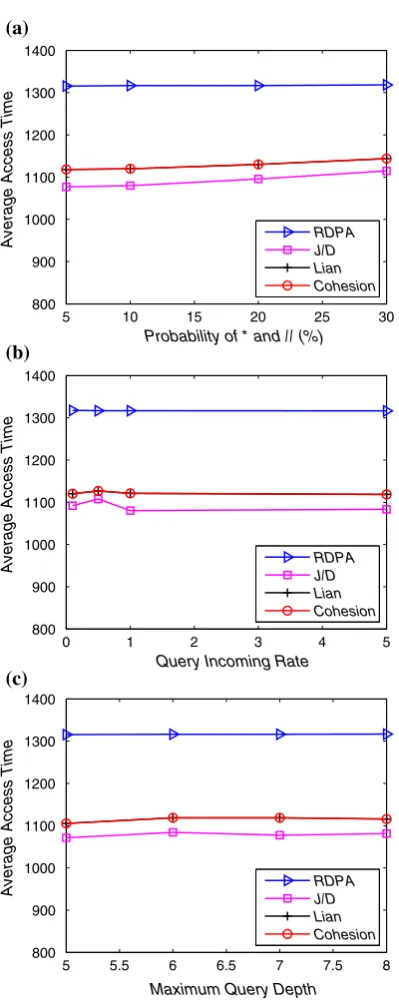
Figure5 shows the results on DS1. From the figure it can be seen that all GDPA methods outperform RDPA significantly. Specifically, J/D method achieves the best results while Lian method and Cohesion method provides similar results. This indicates that J/D method better fits well-clustered data. Also, the reason for Lian method and Cohesion method showing similar results is that both methods emphasize on the common structure of both comparing XML documents against the larger document [see also Eqs. (3) and (11)]. Further, sinceDS1 is well-clustered, from the definitions of Lian and Cohesion metrics, it can also be inferred that the partial order of similarity results using these two methods are similar to each other. Note that, according to the data placement algorithm described in Table 4 Similarity between
clusters inDS1 Metric Similarity
Minimum Maximum Average
Jaccard 0.0097 0.1102 0.0435
Dice 0.0049 0.0583 0.0225
Lian 0.0057 0.1039 0.0345
Cohesion 0.0229 0.4620 0.1457
Table 5 Workload parameters
for the experiments Parameter Range Default Description
PROB 5–30% 10% Probability(* and //)
QIR 0.1–5 1 Query incoming rate
Sect.4, the data placement results are determined by the partial order of the similarity results. Hence, forDS1, Lian method and Cohesion method yield similar results.
In Fig.5a, GDPA methods become slightly worse whenPROBincreases. SinceDS1 is well-clustered, most queries only require documents in the same clusters. ThusPROBhas
5 10 15 20 25 30
800 900 1000 1100 1200 1300 1400
Probability of * and // (%)
Average Access Time RDPA
J/D Lian Cohesion
0 1 2 3 4 5
800 900 1000 1100 1200 1300 1400
Query Incoming Rate
Average Access Time RDPAJ/D
Lian Cohesion
5 5.5 6 6.5 7 7.5 8
800 900 1000 1100 1200 1300 1400
Maximum Query Depth
Average Access Time RDPAJ/D
Lian Cohesion (a)
(b)
(c)
Fig. 5 EvaluatingAAT
Performance onDS1: well-clustered data set with 250 documents.aVaryingPROB,
less effect onAAT. In Fig.5b, whenQIRincreases, J/D method becomes slightly better. This indicates that J/D method can achieve better scalability than other methods when accessing well-clustered data. Figure5c shows that all GDPA methods remain stable as MQDincreases. It is interesting to note that for RDPA,AATalways remains stable.
5 10 15 20 25 30
3000 3050 3100 3150 3200
Probability of * and // (%)
Average Access Time
RDPA J/D Lian Cohesion
0 1 2 3 4 5
3075 3080 3085 3090 3095 3100 3105 3110 3115 3120
Query Incoming Rate
Average Access Time
RDPA J/D Lian Cohesion
5 5.5 6 6.5 7 7.5 8
3050 3100 3150 3200
Maximum Query Depth
Average Access Time
RDPA J/D Lian Cohesion (a)
(b)
(c)
Fig. 6 EvaluatingAAT
Performance onDS2:
miscellaneous data set with 250 documents.aVaryingPROB,
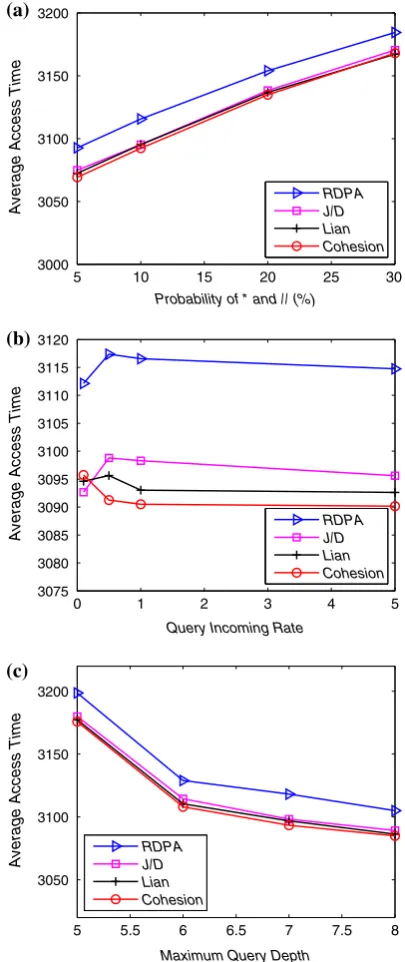
Figure6 shows the results on DS2. From the figure it can be seen that all GDPA methods achieve better performance when compared with RDPA. Specifically, Cohesion method achieves the best results while J/D method achieves the worst results among GDPA methods. This indicates that Cohesion method better fits miscellaneous data. In Fig.6a, both GDPA methods and RDPA become worse when PROB increases. It is clear that
5 10 15 20 25 30
2300 2350 2400 2450 2500 2550
Probability of * and // (%)
Average Access Time RDPAJ/D
Lian Cohesion
0 1 2 3 4 5
2360 2380 2400 2420 2440 2460
Query Incoming Rate
Average Access Time RDPA
J/D Lian Cohesion
5 5.5 6 6.5 7 7.5 8
2350 2400 2450 2500
Maximum Query Depth
Average Access Time RDPA
J/D Lian Cohesion (a)
(b)
(c)
Fig. 7 EvaluatingAAT
Performance onDS3: a mixed set of well-clustered data and miscellaneous data with 250 documents.aVaryingPROB,
PROBhas more effect onAATfor miscellaneous data. In Fig.6b, whenQIRincreases from 0.1 to 0.5, GDPA methods J/D and Lian together with RDPA become worse while Cohesion method still becomes better. After that, whenQIRincreases, all methods become slightly better. This shows that Cohesion method can achieve best scalability when accessing miscellaneous data. Note that, we have seen some intersecting lines when the
5 10 15 20 25 30
6100 6150 6200 6250 6300 6350 6400
Probability of * and // (%)
Average Access Time
RDPA J/D Lian Cohesion
0 1 2 3 4 5
6150 6200 6250 6300
Query Incoming Rate
Average Access Time
RDPA J/D Lian Cohesion
5 5.5 6 6.5 7 7.5 8
6150 6200 6250 6300 6350 6400
Maximum Query Depth
Average Access Time
RDPA J/D Lian Cohesion (a)
(b)
(c)
Fig. 8 EvaluatingAAT
performance onDS4:
miscellaneous data set with 500 documents.aVaryingPROB,
QIRis very small. The main reason for this is that whenQIRis very small, the average (or the expected) access time is unstable as the total number of queries is too small. Fig.6c shows that all methods achieve betterAATasMQDincreases since selectivity of queries drops with the increase ofMQD.
5 10 15 20 25 30
1.13 1.14 1.15 1.16 1.17 1.18 1.19
1.2 x 10 4
Probability of * and // (%)
Average Access Time
RDPA J/D Lian Cohesion
0 1 2 3 4 5
1.17 1.175 1.18 1.185 1.19 1.195 1.2 1.205
1.21 x 10 4
Query Incoming Rate
Average Access Time
RDPA J/D Lian Cohesion
5 5.5 6 6.5 7 7.5 8
1.17 1.18 1.19 1.2 1.21 1.22 x 10
4
Maximum Query Depth
Average Access Time
RDPA J/D Lian Cohesion (a)
(b)
(c) Fig. 9 EvaluatingAAT
Performance onDS5:
miscellaneous data set with 1000 documents.aVaryingPROB,
Figure7shows the results on DS3. Similarly, all GDPA methods achieve better per-formance when compared with RDPA. Specifically, Lian method achieves the best results while J/D method provides the worst results among GDPA methods. This shows that Lian method better fits hybrid data. However, Cohesion method achieves very similar perfor-mance of Lian method. In Fig.7a, both GDPA methods and RDPA become worse when PROB increases.PROB has more effect on AATfor hybrid data. In Fig.7b, whenQIR increases, all GDPA methods become slightly better and still Lian method provides the best results. Figure7c shows that all methods achieve betterAATasMQDincreases since selectivity of queries drops with the increase ofMQD.
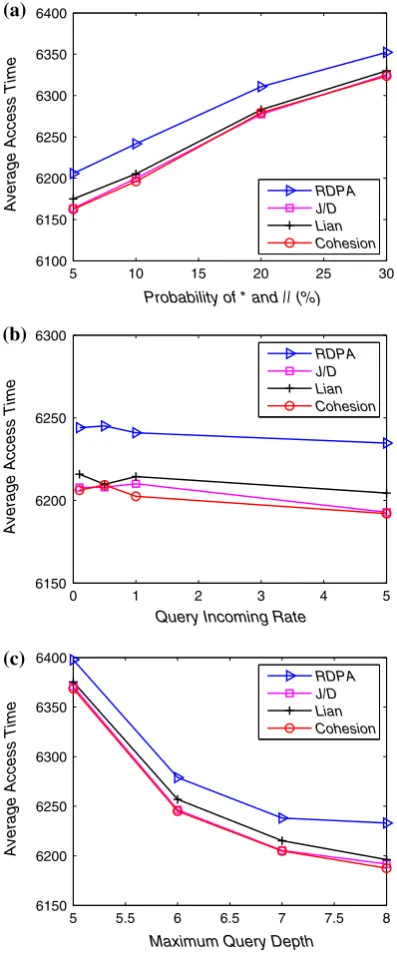
Similar experiments were also conducted using larger data sets (including 500 and 1000 XML documents respectively). The results of experiments are shown in Figs.8 and9. From these figures, similar trends can be observed in Fig.6.
Therefore, from the above experiments, it can be seen that GDPA methods always achieve betterAATwhen compared with RDPA. When accessing well-clustered data, J/D method achieves the best performance. When accessing miscellaneous data, Cohesion method provides better performance in most cases. This is because the J/D metric emphasizes on the common paths between two XML documents according to their defi-nitions (the Jaccard and Dice similarity defidefi-nitions). This also means, the J/D metric is more suitable for well-clustered data sets. In contrast, the Cohesion metric emphasizes on both the common paths (representing the probability that two documents are matched against a given query at the same time) and the difference in the path sets of two docu-ments (representing the probability that two docudocu-ments are not matched against the same query at the same time). Therefore, the Cohesion metric is more suitable for miscellaneous data sets. Finally when accessing hybrid data, Lian method shows better performance in most cases since Lian method emphasizes on the difference between XML documents but not on common paths.
Query selectivity and document coverage rate were also investigated in the experiments. Here, query selectivity refers to the average proportion of documents matched with a user query and document coverage rate refers to the proportion of documents in the entire document set on the server required by at least one user query. The results are obtained using all workload parameters at default values. As can be seen from Table6, the query selectivity is ranging from around 32 to 45%. The main reason for this is that the prob-ability of * and // is 10% by default. Further, for all data sets. the document coverage rate is 100%, which is mainly due to the same reason of query selectivity. This shows that all documents on the server are covered in all the experiments.
Finally, the maintenance cost of the data placement algorithms is studied. The main-tenance cost is measured when adding a new document to the server or removing an existing document from the server. The maintenance results are shown in Table7. From the table it can be seen that, when adding a new document in a document set with 250 documents on the server, the time cost to calculate the similarity between the new docu-ment and all the existing docudocu-ments (shown as ‘‘Similarity Time’’ in the table) is ranging from 209 to 238 ms on average for the Dice, Jaccard and Lian metrics. For the Cohesion metric, it takes a bit longer which is 378 ms on average due to fact that the Cohesion metric requires more set operations that the other three metrics. Meanwhile, the time cost to readjust the data placement (shown as ‘‘Placement Time’’ in the table) is quite similar among all four metrics, which is ranging from 168 to 181 ms. A similar pattern is observed when adding a new document to a larger document set.
Time costs for four metrics are quite similar to each other. For example, when removing an existing document from a document set with 250 documents, the Placement Time is ranging from 165 to 185 ms. Again, a similar pattern is observed when removing an existing document from a larger document set.
6 Related Work
Many studies have been done to investigate data placement techniques to reduce access time [32–34]. These studies generally assume that each user query requires one data item only. Other studies handle data placement problems for queries that may require multiple data items.
Multi-item data placement problem is related to the data placement problem of XML data which is the focus of this work. It is proved to be a NP-Complete problem [27]. A data placement method for multi-item queries called QEM is introduced in [35], which opened up a new perspective in this field. In addition, several improved methods are proposed [17, 36]. The above work is all within the scope of periodic broadcast and generally assumes that the clients’ queries are already known in advance. However, in some applications, the user demands may be either unknown or costly to collect the related information due to the mobility of mobile users and privacy concerns.
Multi-item data placement problem in the on-demand broadcast mode has also attracted lots of interests [13,37]. These approaches are in pure on-demand broadcast mode and Table 6 Query selectivity and
document coverage rate Data set Query selectivity (%) Coverage rate (%)
DS1 44.8 100
DS2 33.6 100
DS3 35.6 100
DS4 32.6 100
DS5 33.2 100
Table 7 Data placement update time (in ms)
No. of documents Metric Add Remove
Similarity time Placement time Placement time
250 Dice 228 168 165
Jaccard 209 169 174
Lian 238 174 171
Cohesion 378 181 185
500 Dice 343 745 751
Jaccard 359 814 811
Lian 419 844 837
Cohesion 763 811 801
1000 Dice 781 1212 1233
Jaccard 640 1152 1187
Lian 691 1192 1202
strictly require that mobile clients submit their queries to the server for desired data. Otherwise, the server will not broadcast related data on air. This is because the server filters and schedules data solely based on submitted queries. However, frequent use of uplink channel leads to high communication cost via uplink channel, which can shorten battery life of mobile clients dramatically.
The above mentioned studies focus on flat data broadcasts, in which indices of data items are generally key-based and data do not contain structural information. Recently, besides the traditional flat data broadcast, a wealth of work dealing with XML data broadcast has appeared. Some work addresses the performance optimization of query processing of XML streams in wireless broadcast [6,38], while other work designs indexing techniques for XML data broadcast based on existing XML indexing techniques [7, 8]. However, their work mainly focuses on air indexing techniques similar to content based indexing techniques in XML stream processing or XPath query based indexing techniques. Moreover, this kind of work does not study the data placement problem for XML data broadcast.
Data placement problem for XML data broadcast is investigated in [39]. In that work, the broadcast schedules are generated based on clustering results of XML data on the server. However, the clustering process requires manually specifying the number of clusters and has to compare different clustering results based on clients’ query distribution in order to find the optimal clustering result, which differs from this work.
7 Conclusion
In this paper, the data placement problem of periodic XML data broadcast has been studied. Taking advantage of the structured characteristics of XML data, it becomes fea-sible to generate effective broadcast programs based only on XML data on the server. This not only makes the proposed approach distinguished from previous studies, but also enables it to have broader applicability. A theoretical analysis of the problem is presented and structural sharing in XML data is also discussed, which forms the basis of the novel greedy data placement algorithm (GDPA). The experiments demonstrated that the pro-posed algorithm could improve access efficiency and achieve better scalability.
In the near future, some on-going work includes further improving system’s perfor-mance by investigating the insights of structural sharing among XML documents. For example, details on how to measure structural sharing distribution in an XML document set can be explored to show how the distribution affects the expected access time of queries and how to choose a similarity metric based on structural sharing distribution in a set of XML documents, etc.
Open Access This article is distributed under the terms of the Creative Commons Attribution 4.0 Inter-national License (http://creativecommons.org/licenses/by/4.0/), which permits unrestricted use, distribution, and reproduction in any medium, provided you give appropriate credit to the original author(s) and the source, provide a link to the Creative Commons license, and indicate if changes were made.
Appendix
Proof of Proposition1
fðXÞ ¼ ðx1þx2þ þxnÞ22
X
i6¼j
xixjM2
Whenx1¼x2¼ ¼xk1¼0 andxk¼M(or any other kind of combinations with
k1 zeros and oneM, which means only 1 positive variable exists4.),fðXÞreaches its upper boundfðXÞ ¼M2. In all other cases, if two or more variables are positive, i.e.x1[0 andx2[0, then 2Pi6¼jxixj2 ðx1x2Þ[0 which indicatesfðXÞ\M2. h
Proof of Proposition2
Proof Mathematical induction can be used to prove the proposition (for allk1). For the base step, whenk¼1,fðXÞ ¼x2
1, it is trivial to prove thatfðXÞ ¼M21 ðM1Þ 2
andfðXÞ ¼M2sincex
1¼M¼M1.
For the inductive step, it is assumed that when k¼n, fðXÞ M2
n and when
x1¼x2¼ ¼xn¼Mn,fðXÞreaches its lower boundfðXÞ ¼M
2
n. Then fork¼nþ1, it is
true that
fðXÞ ¼X n
i¼1
x2i þx2nþ1
n Mxnþ1
n
2
þx2nþ1
¼ðnþ1Þ x
2
nþ12Mxnþ1þM2 n
¼ðnþ1Þ ðxnþ1 M nþ1Þ
2
þnM2
nþ1 n
M
2
nþ1
From the above induction, it can be seen that when xnþ1¼nþM1 and
x1¼x2¼ ¼xn¼Mxnnþ1¼nþM1,fðXÞ reaches its lower boundfðXÞ ¼ M
2
nþ1.
Because both the base step and the inductive step have been shown, by the principle of
mathematical induction the proposition is true. h
Proof of Proposition3
Proof According to the definitions offðXÞx
mþ1, it is true that
fðXÞxmþ1¼X m
i¼1
x2i þx2mþ1þ X k
i¼mþ2 x2i
SinceM0¼MPmi¼1xi¼Pki¼mþ1xi, according to Proposition1, it is true that
4
fðXÞxmþ1¼X m
i¼1
x2i þx2mþ1þ ðM0xmþ1Þ2
¼X m
i¼1
x2i þ2x2mþ12M0xmþ1þM0 2
¼X m
i¼1
x2i þ2 xmþ1 M0 2 2 þM 02 2
According to the above result, for anyxmþ1\x0mþ1 it can be inferred that
1. fðXÞxmþ1[fðXÞx0
mþ1, ifxmþ1\x
0 mþ1M
0
2
2. fðXÞx
mþ1\fðXÞx0mþ1, if
M0
2 xmþ1\x
0 mþ1
3. Indefinite for all other cases h
Proof of Proposition4
Proof According to the definitions offðXÞx
mþ1, it is true that
fðXÞx
mþ1¼
Xm
i¼1
x2i þx2mþ1þ X k
i¼mþ2 x2i
SinceM0¼MPmi¼1xi¼Pki¼mþ1xi, according to Proposition2, it is true that
fðXÞ xmþ1¼
Xm
i¼1
x2i þx2mþ1
þ ðkm1Þ M 0x
mþ1 km1
2
¼X m
i¼1 x2i
þðkmÞx
2
mþ12M0xmþ1þM02 km1
¼X m
i¼1 x2i
þðkmÞ xmþ1 M0
km
2
þðkmkm1ÞM02
km1
According to the above result, for anyxmþ1\x0mþ1 it can be inferred that
1. fðXÞ
xmþ1[fðXÞx0mþ1
, ifxmþ1\x0mþ1 M 0
km
2. fðXÞx
mþ1\fðXÞx0mþ1
, ifkmM0 xmþ1\x0mþ1
References
1. Shaddad, R. Q., Mohammad, A. B., Al-Gailani, S. A., Al-hetar, A. M., & Elmagzoub, M. A. (2014). A survey on access technologies for broadband optical and wireless networks.Journal of Network and Computer Applications,41, 459–472.
2. The International Telecommunication Union (ITU). (2011) Measuring the information society 2012. http://www.itu.int/dms_pub/itu-d/opb/ind/D-IND-ICTOI-2012-SUM-PDF-E.pdf
3. Jianliang, X., Lee, D.-L., Qinglong, H., & Lee, W.-C. (2002).Handbook of wireless networks and mobile computing(pp. 243–265). Hoboken: Wiley.
4. SiriusXM. (2017). Accessed on April 3, 2017.http://www.siriusxm.com
5. Park, C.-S., Kim, C. S., & Chung, Y. D. (2005). Efficient stream organization for wireless broadcasting of XML data. InASIAN(pp. 223–235).
6. Chung, Y. D., & Lee, J. Y. (2007). An indexing method for wireless broadcast XML data.Information Sciences,177(9), 1931–1953.
7. Qin, Y., Sun, W., Zhang, Z., Yu, P., He, Z., & Chen, W. (2009). A novel air index scheme for twig queries in on-demand XML data broadcast. InInternational conference on database and expert systems applications (DEXA)(pp. 412–426).
8. Sun, W., Yu, P., Qin, Y., Zhang, Z., & Zheng, B. (2009). Two-tier air indexing for on-demand XML data broadcast. In IEEE international conference on distributed computing systems (ICDCS) (pp. 199–206).
9. Park, J. P., Park, C.-S., & Chung, Y. D. (2010). Energy and latency efficient access of wireless XML stream.Journal of Database Management,21(1), 58–79.
10. Wu, J., Liu, P., Gan, L., Qin, Y., & Sun, W. (2011). Energy-conserving fragment methods for skewed XML data access in push-based broadcast. In International conference on Web-Age Information Management (WAIM)(pp. 590–601).
11. Sun, W., Liu, P., Wu, J., Qin, Y., & Zheng, B. (2012). An automatbased index scheme for on-demand XML data broadcast. InInternational conference on database systems for advanced applica-tions (DASFAA) (2)(pp. 96–110).
12. Park, C.-S., Park, J. P., & Chung, Y. D. (2012). PrefixSummary: A directory structure for selective probing on wireless stream of heterogeneous XML data. IEICE Transactions on Information and Systems,95–D(5), 1427–1435.
13. Sun, W., Zhang, Z., Yu, P., & Qin, Y. (2008). Efficient data scheduling for multi-item queries in on-demand broadcast. InThe IEEE/IFIP international conference on embedded and ubiquitous computing (EUC) (1)(pp. 499–505).
14. Chen, J., Lee, V. C. S., & Liu, K. (2010). On the performance of real-time multi-item request scheduling in data broadcast environments.Journal of Systems and Software,83(8), 1337–1345.
15. Acharya, S., Alonso, R., Franklin, M. J., & Zdonik, S. B. (1995). Broadcast disks: Data management for asymmetric communications environments. InThe ACM international conference on management of data (SIGMOD)(pp. 199–210).
16. Acharya, S., Franklin, M. J., & Zdonik, S. B. (1997). Balancing push and pull for data broadcast. InThe ACM international conference on management of data (SIGMOD)(pp. 183–194).
17. Chang, Y.-I., & Hsieh, W.-H. (2004). An efficient scheduling method for query-set-based broadcasting in mobile environments. InIEEE international conference on distributed computing systems (ICDCS): Workshops(pp. 478–483).
18. Qin, Y., Sheng, Q. Z., Mehdi, M., Wang, H., & Xie, D. (2013). Effectively delivering XML information in periodic broadcast environments. In International conference on database and expert systems applications (DEXA)(pp. 165–179).
19. Imielinski, T., Viswanathan, S., & Badrinath, B. R. (1997). Data on air: Organization and access.IEEE Transactions on Knowledge and Data Engineering,9(3), 353–372.
20. Rafiei, D., Moise, D. L., & Sun, D. (2006). Finding syntactic similarities between XML documents. In
International conference on database and expert systems applications (DEXA): Workshops (pp. 512–516).
21. Helmer, S. (2007). Measuring the structural similarity of semistructured documents using entropy. In
International conference on very large data bases (VLDB)(pp. 1022–1032).
22. Lin, D. (1998). An information-theoretic definition of similarity. In International conference on machine learning (ICML)(pp. 296–304).
23. Ganesan, P., Garcia-Molina, H., & Widom, J. (2003). Exploiting hierarchical domain structure to compute similarity.ACM Transactions on Information Systems,21(1), 64–93.
25. Lian, W., Cheung, D. W.-L., Mamoulis, N., & Yiu, S.-M. (2004). An efficient and scalable algorithm for clustering XML documents by structure.IEEE Transactions on Knowledge and Data Engineering,
16(1), 82–96.
26. Imielinski, T., Viswanathan, S., & Badrinath, B. R. (1994). Power efficient filtering of data an air. In
International conference on extending database technology (EDBT)(pp. 245–258).
27. Chung, Y. D., & Kim, M.-H. (2001). Effective data placement for wireless broadcast.Distributed and Parallel Databases,9(2), 133–150.
28. Viredaz, M. A., Brakmo, L. S., & Hamburgen, W. R. (2003). Energy management on handheld devices.
ACM Queue,1(7), 44–52.
29. Vagena, Z., Moro, M. M., Tsotras, V. J. (2007). RoXSum: Leveraging data aggregation and batch processing for XML routing. In IEEE international conference on data engineering (ICDE) (pp. 1466–1470).
30. IPTC. (2000). International Press Telecommunications Council, News Industry Text Format (NITF), version 2.5.http://www.nitf.org, visited on 20/09/2012.
31. Diao, Y., Altinel, M., Franklin, M. J., Zhang, H., & Fischer, P. M. (2003). Path sharing and predicate evaluation for high-performance XML filtering. ACM Transactions on Database Systems, 28(4), 467–516.
32. Sun, W., Shi, W., Shi, B., & Yijun, Y. (2003). A cost-efficient scheduling algorithm of on-demand broadcasts.Wireless Networks,9(3), 239–247.
33. Sun, B., Hurson, A. R., & Hannan, J. (2004). Energy-efficient scheduling algorithms of object retrieval on indexed parallel broadcast channels. InInternational conference on parallel processing (ICPP)(pp. 440–447).
34. Kang, S. H. (2011). Wireless data broadcast scheduling with utility metric based on soft deadline.IEICE Transactions,94–B(5), 1424–1431.
35. Chung, Y. D., & Kim, M.-H. (1999). QEM: A scheduling method for wireless broadcast data. In
International conference on database systems for advanced applications (DASFAA)(pp. 135–142). 36. Lee, G., Yeh, M.-S., Lo, S.-C., & Chen, A. L. (2002). A strategy for efficient access of multiple data
items in mobile environments. InIEEE international conference on mobile data management (MDM)
(pp. 71–78).
37. Qin, Y., Wang, H., & Xiao, J. (2011). Effective scheduling algorithm for on-demand XML data broadcasts in wireless environments. InThe Australasian Database Conference (ADC)(pp. 95–102). 38. Park, S.-H., Choi, J.-H., & Lee, S.K. (2006). An effective, efficient XML data broadcasting method in a
mobile wireless network. InInternational conference on database and expert systems applications (DEXA)(pp. 358–367).
39. Qin, Y., Wang, H., & Sun, L. (2011). Cluster-based scheduling algorithm for periodic XML data broadcast in wireless environments. InInternational conference on advanced information networking and applications (AINA) workshops(pp. 855–860).
Quan Z. Shengis a full professor and Head of Department of Com-puting, Macquarie University. Prof. Sheng’s research interests include Internet of Things, Big Data Analytics, Smart Cities, Service-Oriented Computing, and Pervasive Computing. Prof. Michael Sheng has pub-lished more than 300 publications in premier journals and conferences such as ACM Computing Surveys, VLDB Journal, TSC, ACM TOIT, TIST, TKDD, IEEE TPDS, TKDE, Communication of the ACM, IEEE Computer, IEEE Internet Computing, VLDB, WWW, ICDE, CIKM, ICSE, ICWS, and ICSOC. Prof. Sheng is the recipient of several major awards including ARC Future Fellowship in 2014, the Chris Wallace Award for Outstanding Research Contribution in 2012, and Microsoft Research Fellowship in 2003.
Hua Wangreceived the Ph.D. degree in computer science from the University of Southern Queensland (USQ) in 2004. He was a Professor with USQ from 2011 to 2013. He is currently a Full-Time Professor with the Centre for Applied Informatics, Victoria University. He has authored or co-authored over 200 peer-reviewed research papers mainly in data security, data mining, access control, privacy and Web services, as well as their applications in the fields of e-health and e-environment.