Performance Analysis of New Conversion Tool from
Relational Datasets to XML Datasets on Selected Websites
1
.B. Hemanth Kumar, 2. Prof. M. Surendra Prasad Babu.
1. Associate Professor, Dept., of Information Technology, 2. RVR & JC College of Engineering, Guntur, A.P. India
3.
2.Professor, Dept., of CS & SE, AU college of Engineering, Andhra University, Visakhapatnam, A.P, India.
Abstract: Over the years internet has become essential part of extensive business applications to exchange or restructure large amounts of business information. Relational database (RDB) is normally used for traditional data processing, where as Extensible Markup Language documents (XML Documents) are widely useful for performing online conversation in B2B applications. In fact XML data formats may be treated as de facto standard of data representation and exchange format for massive amount of enterprise information over the web. Performance of the application depends on both type of the data structures used and the type of the information maintained in the structures. Resource Description Framework (RDF) of semantic web uses XML to describe an Internet resource as a directed graph to provide a mechanism for describing the machine understandable meaning of any document. In this paper performance analysis is conducted for XML conversion tools developed by the authors with some of the existing tools on some selected datasets. In this analysis JDBC is used to extract data from relational datasets and Java XML Parsers to parse and extract the XML datasets.Experiments show that, the tools developed by the authors produce XML documents efficiently with high scalability than the existing tools.
I. INTRODUCTION
The eXtensible Markup Language (XML), a fast maturing technology, has powerful applications in industry, military, government, and scientific application. XML was developed in 1998 and it is accepted by World Wide Web Consortium (W3C)[1] . The anticipated benefits of XML include easier integration of legacy systems, improved application communications, superior knowledge representation, and platform independence.
Application programs request the data sets and the database servers respond to these requests with respect to the type of the data structures available on the server. The extraction of data on the internet depends upon the type of the data structures used to maintain data and type of the application programs used to retrieve data. The application must immediately get the response from the corresponding database to improve the performance of the overall system. To process a web page intelligently, a computer must understand the data, and it is possible only by using a new generation computing called in Semantic Web [2]. It is an extension of the current World Wide Web which provides both the structure to a Web document and also a way of describing the machine understandable meaning of a document. Semantic Web mainly focuses on the data and information [3].
Hemanth Kumar et al [4] proposed a semantic web system for Information retrieval using J2EE Technologies. A new java based GUI Semantic data conversion tool to convert Relational datasets into Xml datasets has also been developed by them [5]. When creating Xml data sets the tool also generates a DTD for the corresponding Xml datasets. The primary objective of the present paper is to generate the XML datasets using this tool for three typical data sets namely (i). www.indiakisan.net data sets [6]which contains the extensive information about the Indian agriculture, (ii) Gramarogya data sets[7] and (iii) Engineering college data sets. The performance of the proposed tool has been evaluated by comparing the results with the results of generating XML datasets with the existing tools.
2. SELECTED DATASETS 2.1. India Kisan Datasets.
The available relational tables of the a typical dataset in indiakisan web portal are considered and presented in table 1. The number of records are 11937 and size of this dataset is 1098.5 KB. Each relational data set contains a number of tuppels and a number of columns. Initially the conversion tool is applied on these relational datasets which will convert the relational datasets into corresponding XML data sets.
2.2 Gramarogya Datasets:
www.bharathgramaarogya.net is an Internet application which gives health information & knowledge. This application provides the suitable information for various requests on health related areas. The home page is as shown in the figure:2.
A typical dataset in Gramarogya portal is considered and presented in the table 2. The number of records are 4311 and size of this dataset is 1074.9 KB.
Table: 1
Table Name No. of
columns
No. of Rows
Size in KB
Table Name No. of columns
No. of Rows
Size in KB
advisory_crop 3 8 2.1 rice_adv_fert 2 3 1.1
advisory_crops 3 16 2.4 rice_adv_fertsub 4 14 5.5
advisory_cropsuggestion 6 33 2.8 rice_adv_water 3 8 4.4
advisory_districts 3 3 2.1 rice_rain_disease 4 44 16.0
biodiesel_tb_fertilizer 3 4 1.4 rice_soiltypes 3 2 3.1
biodiesel_tb_functional_uses 2 4 2.5 rice_transplantation 4 3 8.5
biodiesel_tb_general_inf 2 39 5.5 rice_zones 2 7 2.2
biodiesel_tb_harvesting 2 3 1.2 Rules 2 7 3.4
biodiesel_tb_irrigation 2 3 1.2 Sdepth 6 18 1.9
biodiesel_tb_keyfactors 1 7 1.1 Season 2 5 1.9
biodiesel_tb_land 2 2 1.4 seed_rate 3 2 1.1
biodiesel_tb_nursery_det 2 46 6.1 Sgadvice 5 95 7.0
biodiesel_tb_nursery_mgnt_id 3 14 1.5 sgadvice_sys 2 68 6.6
biodiesel_tb_spacing 3 12 1.3 Sgirritems 3 10 1.6
biodiesel_tb_weed_mgnt 2 3 1.3 Sgrainitems 3 5 1.3
border_measer 5 12 1.4 sgrain_sub1 7 83 22.3
coleus_tb_about 2 15 3.0 Soil 2 4 2.1
coleus_tb_climate 2 4 1.6 Soiltype 1 3 1.1
coleus_tb_economics 2 2 2.7 space_moisture 3 3 1.1
coleus_tb_general 2 29 4.6 sprink_rate 4 40 2.7
coleus_tb_irrigation 2 5 1.7 States 3 1 2.0
crop_and_oil 5 5 1.3 surf_spec 4 7 1.6
j_alt_irr 10 16 2.3 Wdepth 6 18 2.1
j_cotton_irr 9 2 1.1 Webdirectory 15 14 2.0
j_toba_rain 15 16 2.9 wheat_adv_adopt 3 6 4.2
kg_sit 2 3 2.1 wheat_adv_weed 4 9 6.2
nc_sit 2 3 2.1 wheat_crop 3 4 1.2
nutrient_mgt 3 5 1.2 wheat_disease 2 8 1.2
Rainfed 4 2 1.1 wheat_seed 2 6 1.1
Rate 6 30 2.4 wheat_water 2 2 1.1
Researcharticals 3 2 2.4 wheat_weed 2 2 1.0
Result 5 26 2.2 Zone 2 2 2.1
rf_type 2 2 2.1 z_crop 2 3 2.1
Figure:2
Table 2.
Table Name No.
of Rows
No. of columns
Size in KB
Table Name No.
of Rows
No. of columns
Size in KB
Brinjal_cure 6 3 16 mango_disease 7 4 16.0 brinjal_symptoms 6 11 16 mango_symptoms 13 2 16.0 Cardio 5 16 2.1 nephro_db 354 2 48 cashew_copt 10 2 16 Neurodatasmell 7 8 3.7 cashew_rt 113 3 16 Neurodynamic 4 8 2.6 cashew_solt 12 2 16 neurogradual1 7 6 3.1 chilli_deccon 12 2 16 Neurohemiplezia 15 8 6.9 Chilli_dlist 12 2 16.0 neurosurgery_brain_head 4 3 16.0 Chilli_otable 15 2 16.0 neurosurgery_brain_tumor 4 3 16.0 Chilli_rlist 106 3 16.0 neurosurgery_brain_vasc 3 3 16.0 Cotton_disease 16 3 16.0 neurosurgery_spine_comp 3 3 16.0 Decfrcyc 7 10 7.8 neurosurgery_spine_infection 3 3 16.0
Dermdata 4 19 1.6 Nose 3 16 3.4
Ear 3 14 3.1 obst_db 56 2 16
horticulture_contact 2 6 16.0 Psycht 3 12 2.8 Incfrecyc 4 7 4.3 Stable 29 8 4.2 infections_table 29 2 16 Symptoms 2 28 2.4 ladyfinger_disease 5 4 16.0 Throat 3 16 3.4 lillydisease_cure 3 2 16.0 tomato_cure 6 3 16.0 lillydisease_symptom 10 2 16.0 tomato_sym 6 10 16.0 lillyvirus_cure 3 3 16.0 turmeric_farm 36 14 16.0 lillyvirus_symptom 33 10 16.0 turm_prevention 35 3 16.0 lily_prevention 33 3 16.0 Urodata 5 19 1.7
Users 32 7 5.0
Table 3:
Table Name No. of Rows
No. of columns
Size in KB
Table Name No. of Rows
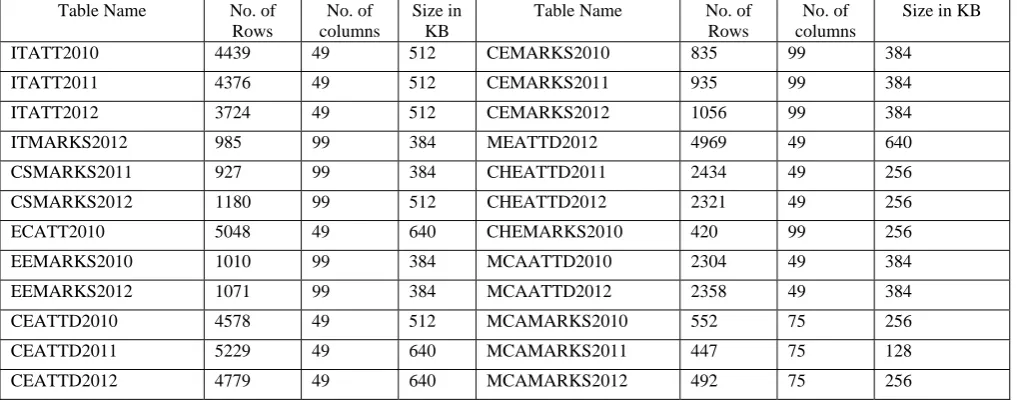
No. of columns
Size in KB ITATT2010 4439 49 512 CEMARKS2010 835 99 384 ITATT2011 4376 49 512 CEMARKS2011 935 99 384 ITATT2012 3724 49 512 CEMARKS2012 1056 99 384 ITMARKS2012 985 99 384 MEATTD2012 4969 49 640 CSMARKS2011 927 99 384 CHEATTD2011 2434 49 256 CSMARKS2012 1180 99 512 CHEATTD2012 2321 49 256 ECATT2010 5048 49 640 CHEMARKS2010 420 99 256 EEMARKS2010 1010 99 384 MCAATTD2010 2304 49 384 EEMARKS2012 1071 99 384 MCAATTD2012 2358 49 384 CEATTD2010 4578 49 512 MCAMARKS2010 552 75 256 CEATTD2011 5229 49 640 MCAMARKS2011 447 75 128 CEATTD2012 4779 49 640 MCAMARKS2012 492 75 256
2.3 Engineering College Datasets:
Atypical data set consisting of the information about the student marks and the attendance of an Engineering college for three consecutive years are collected from the Department of Information Technology, RVR & JC, Guntur and presented in table 3. The number of records is 125124 and the size of the dataset is 13824 KB
3. DATA CONVERSION TOOLS:
Bob Lyons [8] developed a XML conversion tool, namely, Unidex XML converter2.2, which provides B2B integration solutions to its clients in the financial, insurance and
telecommunications industries.This converter performs the conversions: (a) flat file to XML document (b) XML document to flat file and (c) flat file to flat file. It runs on any platform for which a Java Virtual Machine is available. Microsoft foundations developed a Windows based graphical transformation engine, namely, RustemSoft XML Converter Standard Edition Converter [9] for creating XML documents from any database. It is designed for 32-bit operating systems and runs only on Microsoft.NET2.0 Framework.
graphical data mapping, conversion, and integration tool that maps data between any combination of XML, database, flat file, EDI(Electronic Data Interchange), Excel, XBRL(eXtensible Business Reporting Language), and/or Web service and transforms data instantly or auto generates royalty-free data integration code for the execution of recurrent conversions.
The XML Conversion Utility [11] allows you to convert large XML files to delimited text files. The XML Conversion Utility converts an XML file into a pipe (|) delimited output file. This tool is extremely helpful for users who want to import large XML files into a tool that reads delimited text, such as Excel, and to extract reports from XML files.
Boston based eXcelon Corporation proposed a tool named CSV-to-XML Adapter in Stylus Studio package[12], which converts a Coma Separated Value Data file(CSV File) into XML through one-time data conversion operation. Softanic[13] developed Easy XML Converter, which Convert XML to Excel, Text, HTML, Access, XML, support batch mode. The software has an information window that displays related data from the different levels of the XML file. Perfect Data Solutions developed a conversion tool ‘Access to XML Converter’[14], which converts access database to XML format. Effective XLS to XML converter software scan whole access database and successfully convert to XML file. Ecrion Software Inc developed a tool ‘Ecrion Data Architect’[15], which provides a complete solution for integrating data from multiple sources and generate a unified XML representation. It maps data from multiple sources including databases (Oracle, SQL Server, MySQL, etc.), web services, XML files, spreadsheets etc.
The authors proposed new conversion tool [5] that can dynamically generate the XML datasets for the given Relational datasets. It can convert any relational datasets into XML datasets and generates corresponding DTD to validate the XML datasets. It can be used on any operating system which supports Java Virtual Machine (JVM).
3.1. Features of the Proposed XML Conversion Tool: The proposed tool is a graphical interface that can dynamically generate the xml datasets for the given Relational datasets. This has the following features.
It can convert dynamically any relational datasets into XML datasets.
Can use this tool on any operating system which supports JVM.
It generates the XML file and corresponding DTD for the generated XML file.
It can validate the generated xml file.
It minimize the of the size of the generated XML data.
It can display the RDB datasets in a tabular format and XML datasets in a tree structure format.
It can sort the data on a particular field.
3.2. Features of the RustemSoft XML Converter Standard Edition:
Using this software, enterprises can share data with customers, suppliers or partners as well as distribute data across business units. This tool has the following features.
It can produce static XML documents.
It is designed for 32-bit operating systems and runs only on Microsoft.NET2.0 Framework.
Because it is developed on Microsoft.NET it runs on Microsoft Windows family.
It is not portable. i.e. you cannot run this application on any platform.
4. IMPLEMENTATION OF DATA CONVERSION TOOLS TO SOME TYPICAL DATASETS:
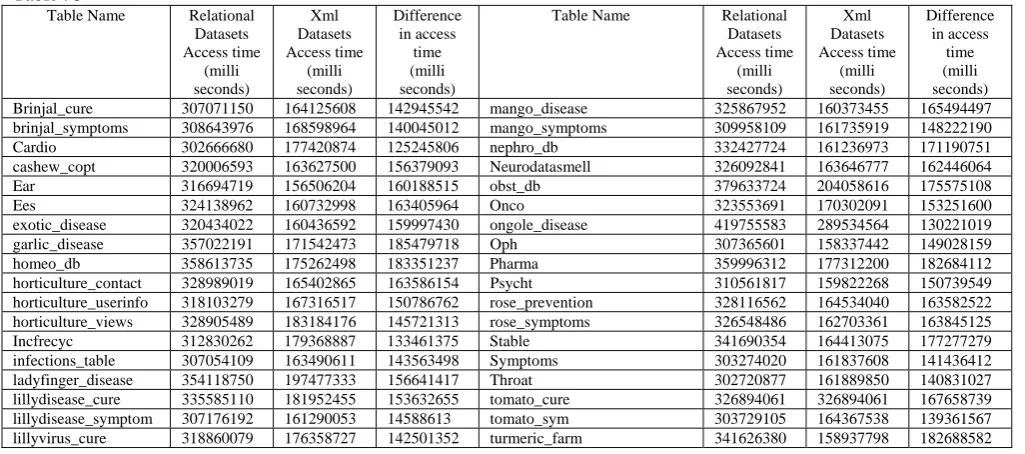
Three experiments are conducted to implement data Conversion tools mentioned in Section 3 to generate the corresponding XML datasets. The first experiment is conducted for some of the datasets available on India Kisan application database server. The second experiment is conducted for some of the datasets available on Gramarogya application database server. The third experiment is conducted for some of the datasets available on Engineering College database server. The results are presented in table 3, table 4 and table 5 respectively. In these tables the root element represents the table name and each row represents one sub-element of the root element. This sub-element name is treated as record, i.e., for each row of the table there exists one element of type record in the XML data set. The columns of the tables are treated as child elements of the element record. The first column represents the Name of the dataset, second column represents the corresponding access time in relational dataset format, third column represents the access time of the corresponding XML dataset format and fourth column gives the differences between the access time in milliseconds. The value of the child element is the corresponding value of the relational data set. The schema of the relational data set represents the Document Type Definition of the XML data set.
4.1. Conversion of Indiakisan RDB Datasets into XML Datasets:
Table :4
Table Name Relational
Datasets Access time (milliseconds)
Xml datasets Access time (milliseconds)
Difference in access
time (milli seconds)
Table Name Relational Datasets
Access time (milli seconds)
Xml datasets
Access time (milli seconds)
Difference in access
time (milli seconds)
advisory_crop 339225516 254655550 84569966 rice_adv_fert 306482527 161645125 144837402
advisory_crops 324364410 168854980 155509430 rice_adv_fertsub 358210052 202537752 155672300
advisory_cropsuggestion 351613962 189325459 162288503 rice_adv_water 343921923 200193320 200193320
advisory_districts 302522527 159078598 143443929 rice_rain_disease 495157066 346851625 148305441
advisory_irrigation 318144065 159145646 158998419 rice_rain_pest 357460236 183562156 173898080
advisory_months 333299623 166357456 166942167 rice_ricecharacteristics 575699705 451866368 123833337
Bdensity 314884154 178321547 136562607 rice_seasons 366340974 221980167 144360807
biodiesel_tb_economics 311353818 164665341 146688477 rice_seed 348005403 187033827 160971576
biodiesel_tb_fertilizer 324138962 160732998 163405964 rice_soiltypes 338862341 173985521 164876820
biodiesel_tb_functional_uses 318103279 167316517 150786762 rice_transplantation 362905620 219498847 143406773
crop_and_oil 341690354 164413075 177277279 surf_spec 306530579 170694040 135836539
crop_fert 840907993 735603826 105304167 swtools_brix_values 429067382 374106485 54960897
crop_soil 341690354 164413075 177277279 swtools_pol_values 716869882 699999301 16870581
Dist 307054109 163490611 143563498 tobacco_adv_adop 304165753 177085076 127080677
drip_state 307176192 161290053 14588613 tobacco_adv_variety 336502545 187342246 149160299
Items 307341855 267666980 39674875 water_eff 294979110 165873875 129105235
j_alt_irr 335506887 188069434 147437453 Wdepth 303230718 18684134 116389373
nc_sit 320727076 163483627 157243449 wheat_crop 313611367 164243780 149367587
nutrient_mgt 303047454 169363983 133683471 wheat_disease 314930529 163550395 151380134
Onlineuser 345338025 211754846 133583179 wheat_fert 318830466 160762890 158067576
Organic 321202275 184446068 136756207 wheat_irr_crop 352719689 177372264 175347425
org_goals 299932812 164004922 135927890 wheat_irr_fert 331915090 187163732 144751358
org_result 337857186 188157992 149699194 wheat_irr_land 339978963 167353113 172625850
org_sub1 332452867 184079821 148373046 wheat_irr_water 330028258 171914587 158113671
org_sub2 301125702 173009699 128116003 wheat_land 292428228 25487541 37552818
org_sub3 315521386 160198014 155323372 wheat_pest 301852889 162385723 139467166
pest_mgt 311164407 160303055 150861352 wheat_raindisease 403714159 219463368 184250791
pest_tab_crops 292477675 162650561 129827114 wheat_rain_pest 421215546 259353353 161862193
pest_tab_crop_defects 495838438 495838438 115370809 wheat_rain_seed 351408070 184581839 166826231
Rainfed 299673282 163250358 136422924 wheat_seed 283266170 162058586 121207584
Rate 338537719 205367162 133170557 wheat_water 288915770 158584680 130331090
Researcharticals 324341502 165215691 159125811 wheat_weed 300470590 159707448 140763142
Result 332952652 178473522 154479130 Zone 318909526 161115729 157793797
rf_type 307151049 162748897 144402152 z_crop 305157220 155906686 149250534
4.2. Conversion of Gramarogya RDB Datasets in to XML Datasets:
In the second experiment the proposed conversion tool is applied to generate the XML datasets corresponding to the
relational datasets for the Gramarogya application. The results are presented in the table 5. The access time for each dataset is shown separately in the table5.
Table : 5
Table Name Relational Datasets Access time
(milli seconds)
Xml Datasets Access time
(milli seconds)
Difference in access
time (milli seconds)
Table Name Relational
Datasets Access time
(milli seconds)
Xml Datasets Access time
(milli seconds)
Difference in access
time (milli seconds)
Brinjal_cure 307071150 164125608 142945542 mango_disease 325867952 160373455 165494497
brinjal_symptoms 308643976 168598964 140045012 mango_symptoms 309958109 161735919 148222190
Cardio 302666680 177420874 125245806 nephro_db 332427724 161236973 171190751
cashew_copt 320006593 163627500 156379093 Neurodatasmell 326092841 163646777 162446064
Ear 316694719 156506204 160188515 obst_db 379633724 204058616 175575108
Ees 324138962 160732998 163405964 Onco 323553691 170302091 153251600
exotic_disease 320434022 160436592 159997430 ongole_disease 419755583 289534564 130221019
garlic_disease 357022191 171542473 185479718 Oph 307365601 158337442 149028159
homeo_db 358613735 175262498 183351237 Pharma 359996312 177312200 182684112
horticulture_contact 328989019 165402865 163586154 Psycht 310561817 159822268 150739549
horticulture_userinfo 318103279 167316517 150786762 rose_prevention 328116562 164534040 163582522
horticulture_views 328905489 183184176 145721313 rose_symptoms 326548486 162703361 163845125
Incfrecyc 312830262 179368887 133461375 Stable 341690354 164413075 177277279
infections_table 307054109 163490611 143563498 Symptoms 303274020 161837608 141436412
ladyfinger_disease 354118750 197477333 156641417 Throat 302720877 161889850 140831027
lillydisease_cure 335585110 181952455 153632655 tomato_cure 326894061 326894061 167658739
lillydisease_symptom 307176192 161290053 14588613 tomato_sym 303729105 164367538 139361567
Table : 6
Table Name Relational Datasets Access time
(milli seconds)
Xml datasets Access time
(milli seconds)
Difference in access
time (milli seconds)
Table Name Relational Datasets Access time
(milli seconds)
Xml datasets Access time
(milli seconds)
Difference in access
time (milli seconds) ITATT2010 2452194902 1714616522 737578380 CEMARKS2010 1168794358 1110285246 58509112 ITATT2011 2422078783 1743347828 678730955 CEMARKS2011 1243049326 1149675727 93373599 ITATT2012 2151860920 1414937652 736923268 CEMARKS2012 1338689135 1279908759 58780376 ITMARKS2010 1225736791 1121311508 104425283 MEATTD2010 2561580033 1733826226 827753807 CSMARKS2012 1541887587 1405455721 136431866 CHEATTD2012 1467031425 1021245437 445785988 ECMARKS2012 1534416525 1490793104 43623421 BTATTD2012 956037150 400915200 555121950 EEATT2010 2821280917 1903610375 917670542 BTMARKS2010 562958421 365666307 197292114 EEATT2011 2561663842 1791865726 769798116 BTMARKS2011 489922881 336279611 153643270 EEATT2012 2221131736 1607491176 613640560 BTMARKS2012 386609751 208588243 178021508 CEATTD2010 2451137226 1756217341 694919885 MCAMARKS2010 677372403 483777966 193594437 CEATTD2011 2781396239 1936626303 844769936 MCAMARKS2011 667623678 404897829 262725849 CEATTD2012 2534185769 1821643812 712541957 MCAMARKS2012 627538696 436802164 190736532
4.3. Conversion of Engineering College RDB Datasets in to XML Datasets:
In the third experiment, the proposed conversion tool is applied to generate the XML datasets corresponding to the relational datasets for the college database. The results are presented in the table 6.The access time for each dataset is shown separately in the table6.
5. PERFORMANCE ANALYSIS:
In this paper an application program is also developed in Java to evaluate the access time for the given datasets. The inputs for this application program are relational data set and XML data set. The same type of data and the same number of fields are maintained in relational data set and XML data set.
This application program will read the data from the relational dataset as well as from corresponding XML dataset which is already generated by the conversion tool. The output of this application program is the access time to process the data from each dataset. The access time for each dataset is presented in table4, table5 and table6 respectively.
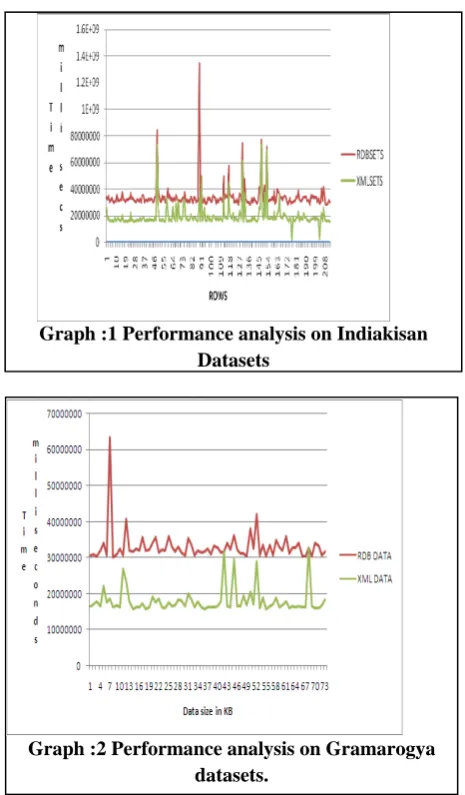
5.1 Performance Analysis on Indiakisan Datasets: Access times of Indiakissan Datasets in RDB format and XML format are given in the table 4. The performance of the proposed tool with respect to access time is as shown in the graph 1. In this graph ‘ ’line indicates access time on RDB datasets and ‘ ’ line indicates access time on XML datasets. From the graph, it can be noted that, the time line to access the XML datasets is always below to the time line to access the relational datasets and hence it can be concluded that it takes less time to access the XML datasets than Relational Datasets.
5.2 Performance Analysis on Gramarogya Datasets. Access time of Gramarogya Datasets in RDB format and XML format are given in the table 5. The performance of the proposed tool with respect to access time is as shown in the graph 2. In graph ‘ ’ line indicates access time on RDB datasets and ‘ ’ line indicates access time on XML datasets. From graph1, it can be noted that, the time line to access the XML datasets is always below to the time line to access the relational datasets and hence it can be concluded
that it takes less time to access the XML datasets than Relational Datasets.
5.3 Performance Analysis Engineering College Datasets: Access time of Engineering College Datasets in RDB format and XML format are given in the table 6. The performance of the proposed tool with respect to access
Graph :1 Performance analysis on Indiakisan Datasets
time is as shown in the graph 3. In graph line indicates access time on RDB datasets and line indicates access time on XML datasets. From graph3, it can be noted that, the time line to access the XML datasets is always below to the time line to access the relational datasets and hence it can be concluded that it takes less time to access the XML datasets than Relational Datasets.
6. PROPOSED TOOL COMPARISON WITH RUSTOMSOFT XMLCONVERTER:
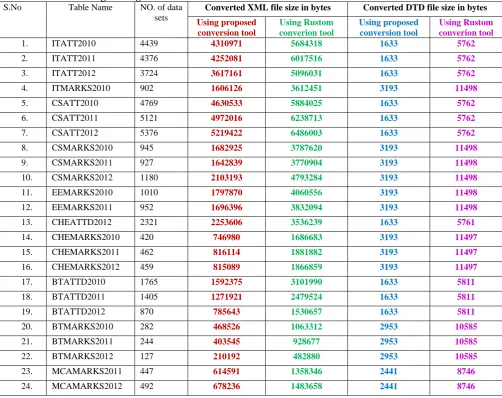
The Rustom Soft XML converter is applied on Engineering College datasets to convert relational datasets to corresponding XML datasets. It is also applied to generate the DTD structure for the generated XML datasets. The size of the generated XML datasets and DTD structures using proposed tool and Rustom Soft XML converter are presented in table7. First column represents serial number, the secondcolumn represents the Name of the dataset, third column represents the number of datasets, fourth column represents size of the XML dataset by using proposed tool, fifth column represents size of the XML dataset by using Rustom Soft conversion tool, sixth column represents size of the DTD by using proposed tool, and seventh column represents size of the DTD by using Rustom conversion tool.
Table 7: Comparison of XML File Size and DTD File Size After Conversion by Proposed Tool and Rustomsoft XML Converter on Engineering Students Datasets.
S.No Table Name NO. of data sets
Converted XML file size in bytes Converted DTD file size in bytes
Using proposed conversion tool
Using Rustom converion tool
Using proposed conversion tool
Using Rustom converion tool
1. ITATT2010 4439 4310971 5684318 1633 5762
2. ITATT2011 4376 4252081 6017516 1633 5762
3. ITATT2012 3724 3617161 5096031 1633 5762
4. ITMARKS2010 902 1606126 3612451 3193 11498
5. CSATT2010 4769 4630533 5884025 1633 5762
6. CSATT2011 5121 4972016 6238713 1633 5762
7. CSATT2012 5376 5219422 6486003 1633 5762
8. CSMARKS2010 945 1682925 3787620 3193 11498
9. CSMARKS2011 927 1642839 3770904 3193 11498
10. CSMARKS2012 1180 2103193 4793284 3193 11498
11. EEMARKS2010 1010 1797870 4060556 3193 11498
12. EEMARKS2011 952 1696396 3832094 3193 11498
13. CHEATTD2012 2321 2253606 3536239 1633 5761
14. CHEMARKS2010 420 746980 1686683 3193 11497
15. CHEMARKS2011 462 816114 1881882 3193 11497
16. CHEMARKS2012 459 815089 1866859 3193 11497
17. BTATTD2010 1765 1592375 3101990 1633 5811
18. BTATTD2011 1405 1271921 2479524 1633 5811
19. BTATTD2012 870 785643 1530657 1633 5811
20. BTMARKS2010 282 468526 1063312 2953 10585
21. BTMARKS2011 244 403545 928677 2953 10585
22. BTMARKS2012 127 210192 482880 2953 10585
23. MCAMARKS2011 447 614591 1358346 2441 8746
24. MCAMARKS2012 492 678236 1483658 2441 8746
The data size comparisons for XML datasets and corresponding DTD structures are as shown in the Graph:4 and Graph:5 respectively. In graph4 line indicates XML data size using proposed tool and line indicates XML data size using Rustom conversion tool. In graph 5 line indicates DTD size using proposed tool and line indicates DTD size using Rustom conversion tool.
From graph4 and graph 5, it can be concluded that the size of data, converted by using Rustom Soft XML converter is more than the data converted by using the proposed tool.
7. CONCLUSIONS:
Performance analysis of the three data sets presented in the above experiments indicates that the efficiency of the system with respect to data access time is less when the data maintained in XML format than RDB. All the Applications which will process only text data can directly interact with XML datasets. As per W3C recommendations, in Semantic web applications the data will be represented in RDF[16][17] format which follows the XML syntax. So the XML datasets can be used in the Semantic web systems more effectively.
The disadvantage of maintaining the text information in RDB is that the application program has to identify the database server and again the database within that server for each query. It means that the application needs two operations to extract information from the relational database which is a time consuming process. But when data is represented in an XML format, the XML data and the
application program can be maintained within the same root. Therefore to extract the information from the XML data the application needs only one operation i.e. identifying the XML data. Consequently in web applications it is better to use XML datasets than RDB datasets. The performance of all the dynamic web services depends up on the access time. By minimizing the access time we can increase the performance of a system.
REFERENCES:
[1]. Dr. Peter Chen, Dr. Mladen Vouk , “XML and the Semantic Web: What is the future?”, Proceedings of the IEEE 36th Hawaii International Conference on System Sciences (HICSS’03), 6-9 Jan. 2003, pages 123-124.
[2]. Zhaoyan Jin, Quanyuan Wu, Hua Fan, “Restructuring XML Document --from the Perspective of Sorting” IEEE 3rd International Conference on Communication Software and Networks (ICCSN), Xi'an , 27-29 May 2011, Pags 529-533..
[3]. B. Hemanth Kumar, M. Surendra Prasad Babu, “An Implementation of Semantic Web System for Information retrieval using J2EE Technologies” (IJCSE) International Journal on Computer Science and Engineering, Vol. 3 (6), 2011,2498-2505.
[4]. B. Hemanth Kumar, M. Surendra Prasad Babu, “Design and Development of a New JAVA Based Conversion Tool from Relational Database toXML Datasets” (IJCSIT) International Journal of Computer Science and Information Technologies, Vol. 3 (6), 2012,5439-5446.
[5]. www.Indiakisan.net
[6]. www.bharathgramaarogya.net .
[7]. B2B Integration Solutions from Unidex:
http://www.unidex.com/xflat.htm.
[8]. Rustem Soft XML Converter Standard Edition:
http://www.rustemsoft.com/
[9]. http://www.ecrion.com/landingpage/databasetoxml.aspx.
[10]. Stefan Decker, Prasenjit Matura, Sergey Melnik, “Framework for the Semantic Web: An RDF Tutorial “ IEEE INTERNET COMPUTING, IEEE Computer Society, November-December 2000, pages 68-73, http://computer.org/internet
[11]. Ora Lassila, Ralph R. Swick, “Resource Description Framework (RDF) Model and Syntax Specification” W3C recommendation, Feb. 1999, http://www.w3.org/TR/1999/REC-Rdf-Syntax-19990222 [12]. Chen Zhifeng, “Research on the Application of XML in Web
Services”, 2009 IEEE International Conference on Multimedia Information Networking and Security, Wuhan, China, Vol:1, pages 680-683.
[13]. Ranjit Bose, “Applying Semantic Web Services to Web-based Information Systems and Applications“, Proc. of Fifth IEEE International Conference on Information Technology: New Generations, 2008, Las Vegas, Nevada, USA. Pages 1150-1155. [14]. T. Bray, J. Paoli, C.M.Sperberg, McQueen, E. Maler, “XML 1.0
Extensible Markup Language (XML) 1.0 (Second Edition)”, W3C Recommendation, 6 October 2000,
[15]. Martin Hep, “Semantic Web and Semantic Web Services Father and Son or Indivisible Twins?” IEEE Internet Computing, Vol: 10, No: 2, March-April 2006 pages 85-88.
[16]. Tim Berners-Lee, James Hendler, Ora Lassila, “The Semantic Web”, Scientific American Degital Magazine , Vol:284, No:5, May 2001, pages 29-37.
[17]. Wei Zhang and Robert A. van Engelen “An Adaptive XML Parser for Developing High-Performance Web Services” , IEEE Fourth International Conference on eScience, 7-12 Dec. 2008, Indianapolis, IN,pages 672 - 679.
[18]. Silberschatz, Henry F. Korth, “Database System Concepts ”, McGraw-Hill.
[19]. Brett McLaughlin, “Enterprise Applications in Java and J2EE”, O'Reilly Media, 07-01-2000.
[20]. http://www.oracle.com/technetwork/java/javase/jdbc/index.html. [21]. XML Schema Part 0: Primer, W3C Working Draft,
[22]. Zhaoyan Jin, Quanyuan Wu, Hua Fan “ Restructuring XML Document -from the Perspective of Sorting” 978-1-61284-486-2/111$26.00 ©2011 IEEE pages 529-5.