Relational Hash
?Avradip Mandal and Arnab Roy
Fujitsu Laboratories of America Sunnyvale, CA, USA
{amandal,aroy}@us.fujitsu.com
Abstract. Traditional cryptographic hash functions allow one to easily check whether the original plaintexts are equal or not, given a pair of hash values. Probabilistic hash functions extend this concept where given a probabilistic hash of a value and the value itself, one can efficiently check whether the hash corresponds to the given value. However, given distinct probabilistic hashes of the same value it is not possible to check whether they correspond to the same value. In this work we introduce a new cryptographic primitive calledRelational Hash using which, given a pair of (relational) hash values, one can determine whether the original plaintexts were related or not. We formalize various natural security notions for the Relational Hash primitive - one-wayness, twin one-wayness, unforgeability and oracle simulatibility.
We develop a Relational Hash scheme for discovering linear relations among bit-vectors (elements of Fn2) and Fp-vectors. Using the linear Relational Hash schemes we develop Relational Hashes for
detecting proximity in terms of hamming distance. The proximity Relational Hashing schemes can be adapted to a privacy preserving biometric identification scheme, as well as a privacy preserving biometric authentication scheme secure against passive adversaries.
Keywords: Probabilistic Hash Functions, Functional Encryption, Biometric Authentication.
1
Introduction
Traditional cryptographic hash functions, like MD-5 and SHA-3, enable checking for equality while hiding the plaintexts. Since these are deterministic functions, this just involves checking if the hashes are identical. The notion of probabilistic hash functions was developed in [Can97,CMR98]. In this setting, the computa-tion of hashes is randomized and thus no two independently generated hashes of the same plaintext look same. However, given the plaintext and a hash, it can be checked efficiently if the hash corresponds to the plaintext. Probabilistic hashes can provably enable strong privacy guarantees in standard model, like oracle simulatability, which deterministic hash functions cannot provide. Oracle simulatability captures the notion that a hash reveals nothing about the value except enabling equality checking. This typically has come at the price of efficiency. In addition, the property of compression, which is desirable for deterministic hash functions, is no longer at the forefront.
However, probabilistic hashes suffer from the drawback that for verification of equality the plaintext has to be provided in the clear, which deterministic hashes do not require. Probabilistic hashes do not allow checking whether the plaintexts are equal, given two distinct hash values. This drawback can preclude use of probabilistic hashes in certain scenarios where it is desirable to hide the plaintext from the verifier as well. For example, consider a scenario where password equality is to be checked by a server. If the server uses deterministic hashes, then only the hash of the password could be transmitted to the server. However, with probabilistic hashes, the actual password has to be sent to the server for verification1. Therefore question arises whether we can build probabilistic hashes which allow verification given two distinct hashes of the plaintexts.
?
This is the full version of the article “Relational Hash: Probabilistic Hash for Verifying Relations, Secure against Forgery and More”, which appears in proceedings of CRYPTO 2015 [MR15], cIACR 2015.
So suppose we had a probabilistic hash functionphwhich allows efficient checking of equality of plaintexts
x1 and x2, givenph(x1, r1) and ph(x2, r2), where the ri’s are randomnesses used for hashing. Now we run into a different problem. The existence of such a functionality implies that a secrecy property called 2-value perfect one-wayness (2-POW) [CMR98] would no longer hold. This property states that the distribution of two probabilistic hashes of the same value is computationally indistinguishable from the distribution of probabilistic hashes of two independent values. The property trivially breaks down if we have an efficient mechanism for checking if two hashes correspond to the same plaintext. In addition to being a strong security notion, this property also implies oracle simulatability [CMR98]. So now the question is:
How do we develop probabilistic hashes which enable equality checking just given hashes but at the same time preserve 2-value perfect one-wayness?
Our Contributions. We propose a cryptographic primitive calledRelational Hash which attempts to model the question above. One of the key ideas is to have distinct, but related, hashing systems for the individual
co-ordinates, i.e., have two probabilistic hash functions ph1 andph2 and enable checking ofx1 ?
=x2, given
ph1(x1, r1) andph2(x2, r2). Having two hashing systems leaves open the possibility that they can
individ-ually be 2-POW. Extending equality, we define Relational Hash with respect to a relation R, such that given two hashes ph1(x1, r1) and ph2(x2, r2), we can efficiently determine whetherR(x1, x2) holds. It may
also be desirable to compute ternary relationsR0 onx
1, x2 and a third plaintext parameterz, so that given
ph1(x1, r1), ph2(x2, r2) and z, we can efficiently determine whether R0(x1, x2, z) holds. For any Relational
Hash primitive, we formalize a few natural and desirable security properties, namely one-wayness, unforge-ability, twin one-wayness and oracle simulatability. The notion of oracle simulatability was introduced in [Can97,CMR98] for the equality relation. Here we extend this concept for arbitrary relations.
For the equality relation, there is a simple construction which extends Canetti’s scheme in [Can97]. While the [Can97] probabilistic hash on a plaintext m and randomness r is (gr,grm), one can consider bilinear groups G1 and G2 with a pairing e : G1×G2 → GT and define ph1(x1, r1) := (gr1,gr1x1) and
ph2(x2, r2) := (hr2,hr2x2) with g∈ G1 and h∈ G2. Plaintext equality of two hashes (c1, c2) and (d1, d2)
of different types can be done as:e(c1, d2) ?
=e(c2, d1). We do not develop this construction formally in the
body of the paper, additionally relegating some proof sketches to Appendix I2.
For hamming proximity relations among vectors, especially low characteristic ones, the constructions turn out to be far more sophisticated and form the main thrust of our paper. Towards that end, we first develop a construction for a linear Relational Hash scheme. In our scheme, for anyx, y, z∈Fn
2, given just the hashes
ofxandyand the plaintextz, it is possible to verify whetherx+y=? z. A linear Relational Hash scheme is also trivially an equality Relational Hash scheme, by takingzto be all 0’s. We also extend our construction to verify linear relations over Fn
p. We show that our linear Relational Hash constructions satisfy all four security notions: one-wayness, unforgeability, twin one-wayness and oracle simulatability. Next we show that using a linear Relational Hash and error correcting codes it is possible to build Relational Hashing schemes which can verify proximity relations and enjoy one-wayness, unforgeability and a stronger version of twin one-wayness. It remains open to build a proximity Relational Hash scheme which is oracle simulation secure.
Application. A motivating application of the proximity relation hash primitive is a privacy preserving bio-metric identification scheme. Consider a scenario where there is a database of fingerprints of known criminals. The database should not reveal the actual fingerprints, even internally. An investigative officer might want to check, whether a candidate fingerprint digest matches with the database. Using a Relational Hash scheme for proximity relation, one can build a biometric identification scheme which guarantees complete template privacy (to the server, as well as to the investigating officer). While storing the fingerprints in the database, hashes of type 1 are used. On the other hand, the officer gets access to type 2 hash of the fingerprint template. The Relational Hash scheme will guarantee that, with access to a relational secret key the server can only verify whether the original templates are close to each other or not. To construct authentication schemes, rather than identification schemes, additional protocol layers are needed to address replay attacks and so
2
on. Merely providing a type 2 hash of the challenge biometric template does not suffice as that can easily be replayed. We leave open the construction of such protocols building on the Relational Hash primitive. However, we show that for the case of a passive adversary attempting to recover the biometric template, a Relational Hash can be seen as a biometric authentication mechanism (Section 4).
Relation to Fuzzy Extractor/ Secure Sketch based schemes. Existing biometric authentication schemes, e.g. fuzzy vault [JS02], fuzzy commitment [JW99] and secure sketch [DRS04,DS05] based schemes guarantee template privacy only during the registration phase. Boyen solved this issue in [Boy04], by constructing a “Zero Storage remote biometric authentication scheme”, which provides complete template privacy. Boyen’s construction only assumes that the biometric template comes from a high entropy distribution. Compared to that, we only achieve a passive adversary secure biometric authentication scheme assuming uniform distribution of biometric templates. On the positive side, our biometric authentication scheme is much simpler, in particular during authentication the client generates the authentication token on its own, without requiring any intervention from the server. Moreover, for our primary application - the non-interactive biometric identification mechanism, the advantage becomes more apparent. It is not readily clear whether one can build such identification mechanism based on fuzzy extractors/ secure sketches.
Relation to Multi-Input Functional Encryption (MIFE). Goldwasser et al proposed the concept of MIFE in [GGG+14], which is a functional encryption which enables the computation of f(x
1, x2,· · ·, xn) given the encryptions of x1, x2,· · · , xn. The paper [GGG+14] is a merge of two independent and concurrent works [GGJS13,GKL+13]. While a Relational Hash scheme for a relationR can be considered an MIFE for
evaluating the relationR, there are several important differences between the MIFE work of [GGG+14] and
Relational Hash. We only consider the fully public key model where encryption keys for all the co-ordinates are given to the adversary.
We first remark that an indistinguishability based functional encryption security definition (FE-IND) for the equality relation is a rather trivial notion. The FE-IND notion asks the adversary to query two sets of
n-tuples, and the challenger randomly selects which set to encrypt. We observe that even a standard CPA secure public-key encryption scheme satisfies this notion, where the functional key is simply the secret key for decryption. The FE-IND security notion is satisfied for equality because the restriction on the adversary’s queries forces it to choose equal sets of messages to the challenger. So in the end the adversary has information theoretically no clue about which of the messages was chosen for encryption by the challenger. In a Relational Hash scheme, even when given the relational key, the encryption of the plaintexts is required to be at least one-way secure. No such guarantee is provided by the standard CPA scheme, since giving the full decryption key fully exposes the plaintext to the functional key recipient.
Thus we have to resort to the simulation based security notion (FE-SIM) for any meaningful assurance of security. The only possibility result in the fully public key setting is given by [GKL+13], who give a
construction of FE-SIM secure encryption scheme for a class of functionalities they call “learnable” functions. They also prove that if an FE-SIM secure scheme exists for a class of functionalities, then this class must be learnable. Briefly, a 2-ary functionf(., .) is learnable if, given a description off and oracle access tof(x, .), one can output the description of a function that is indistinguishable fromfx(.), which is the restriction of
f on fixing the first input tox. This has to hold true with high probability even if the distinguisher is given
x. One can immediately see that equality is not a learnable function. Whenxcomes from high min-entropy distribution, it is not possible to learn the value of x efficiently by querying f(x, .) on various inputs. A distinguisher can immediately thwart any such ‘learnt’ function by simply testing it onx.
Relation to Property Preserving (Tagged) Encryption (PPE). PPE [PR12] is a special case of MIFE in the symmetric key setting. PPE offers IND based security guarantees, where attacker queries are constrained such that the preserved property values cannot be trivially used for distinguishing purposes. Moreover, PPE involves a secret key, whereas for Relational Hashes all the keys are public. For our public key case, the trivial construction which makes the functional key the same as the decryption key, is IND secure and does not provide any meaningful security guarantee. On the other hand, for the symmetric key PPE schemes, chosen message security is non-trivial.
Relation to Perceptual Image Hashing (PIH). PIH [KVM04] is a related technique which aims to construct hash of images invariant under geometric transformations which preserve perceptual similarity. There are several differences, most importantly: (1) the primary objective of PIH is the detection of similar inputs, however privacy of the inputs may not be preserved, (2) generating hashes requires a secret key, and (3) while for PIH the hashes are required to be equal for similar images, we require that the hashes are randomized and a verification algorithm is given which uses a key to perform the relation check.
Organization of the paper. In Section 2, we formally define the notion of Relational Hash and its desired security properties. In Section 3, we construct a Relational Hash for linearity over Fn2, with extension to
Fnp. In Section 4, we show how to construct a proximity (in terms of hamming distance) Relational Hash using a linear Relational Hash and a linear error correcting code. In Section 5, we describe relations among notions of security for constructing Relational Hashes for various relations. Standard hardness assumptions are summarized in Appendix A.
Notations. We denote a sequencexj,· · · , xk ashxii k
i=j. We treatF n
p as anFpvector space and writex∈Fnp also ashxiini=1. Group elements are written in bold font:g,f. The security parameter is denoted asλ.
2
Relational Hash
The concept ofRelational Hash is an extension of regular probabilistic hash functions. In this work, we only consider 3-tuple relations. Suppose R ⊆ X ×Y ×Z be a 3-tuple relation, that we are interested in. We abuse the notation a bit, and often use the equivalent functional notation R : X×Y ×Z → {0,1}. The Relational Hash for the relation R, will specify two hash algorithmsHash1 and Hash2 which will output
the hash valuesHash1(x) andHash2(y) for any x∈X andy∈Y. Any Relational Hash must also specify
a verification algorithmVerify, which will take Hash1(x),Hash2(y) and anyz ∈Z as input and output
R(x, y, z). Formally, we define the notion of Relational Hash as follows.
Definition 1 (Relational Hash).Let{Rλ}λ∈Nbe a relation ensemble defined over set ensembles{Xλ}λ∈N, {Yλ}λ∈Nand{Zλ}λ∈Nsuch thatRλ⊆Xλ×Yλ×Zλ. A Relational Hash for{Rλ}λ∈Nconsists of four efficient algorithms:
– A randomized key generation algorithm: KeyGen(1λ)outputs keypk from key spaceKλ.
– The hash algorithm of first type (possibly randomized): Hash1:Kλ×Xλ→RangeXλ, hereRangeXλ denotes the range ofHash1 for security parameterλ.
– The hash algorithm of second type (possibly randomized):Hash2:Kλ×Yλ→RangeYλ, hereRangeYλ denotes the range ofHash2 for security parameterλ.
– The deterministic verification algorithm:
Verify:Kλ×RangeXλ×RangeYλ×Zλ→ {0,1}.
Treating the third parameterzdifferently from the first two might strike as odd. Our reason behind the choice of this asymmetric definition is to convey the intention that we are not trying to hidezand that the verifier or attacker can choose the value ofz to test relations.
In the rest of the paper we will drop the subscript λfor simplicity and it will be implicitly assumed in the algorithm descriptions. Often, we will also denote the 1 output ofVerifyasAccept, and the 0 output
asReject. The definition of Relational Hashing consists of two requirements:Correctness andSecurity (or
Correctness: Informally speaking, the correctness condition is, if an honest party evaluatesVerify(Hash1(
pk, x),Hash2(pk, y), z) for some keypk which is the output of KeyGen and any (x, y, z) ∈ X ×Y ×Z,
the output can differ from R(x, y, z) only with negligible probability (the probability is calculated over the internal randomness ofKeyGen,Hash1andHash2). Formally,
Definition 2 (Relational Hash - Correctness). A Relational Hash scheme(KeyGen,Hash1,Hash2,
Verify)for a relationR⊆X×Y×Z satisfies correctness if the following holds for all(x, y, z)⊆X×Y×Z:
Pr
pk←KeyGen(1λ)
hx←Hash1(pk, x)
hy←Hash2(pk, y)
: Verify(pk, hx, hy, z)≡R(x, y, z)
≈1
Security: The notion of security for a Relational Hash will depend on the context where the Relational Hash is going to be used and also on the a priori information available to the adversary. Recall that for a regular hash function one of the weakest form of security is one-wayness. We will consider Probabilistic Polynomial Time (PPT) adversaries for our security definitions.
Definition 3 (Security of Relational Hash - One-way). Let X and Y be (independent) probability distributions overX andY. We define a Relational Hash scheme (KeyGen,Hash1,Hash2,Verify)to be
one-waysecure for the probability distributions X andY, if the following hold:
– pk←KeyGen(1λ),x← X,y← Y,hx←Hash1(pk, x),hy←Hash2(pk, y)
– For any PPT adversary A1, there exists a negligible function negl(), such that Pr[A1(pk, hx) = x] < negl(λ).
– For any PPT adversary A2, there exists a negligible function negl(), such that Pr[A2(pk, hy) =y] < negl(λ).
Here the probabilities are calculated over the internal randomness ofKeyGen,Hash1 andHash2, internal
randomness of the adversarial algorithmsA1 andA2 as well as the probability distributionsX andY.
The above definition captures the security notion in case the adversary has access to either type 1 or type 2 hash values. We observe that if the distributionsX andY remain independent, Relational Hash still remains one-way secure, even if the adversary has access to both type of hash values. However for correlated
xandy, sampled from a joint probability distributionΨ overX×Y, the previous security notion does not provide sufficient security guarantee when the attacker has access to both types of hash values. For these kind of distributions we define a stronger security notion calledtwin one-wayness as follows.
Definition 4 (Security of Relational Hash - Twin One-way).Let Ψ be a probability distribution over
X×Y. We define a Relational Hash scheme(KeyGen,Hash1,Hash2,Verify)to be twin one-waysecure
for the probability distribution Ψ, if the following hold:
– pk←KeyGen(1λ),(x, y)←Ψ,hx←
Hash1(pk, x),hy←Hash2(pk, y)
– For any PPT adversary A1, there exists a negligible functionnegl(), such thatPr[A1(pk, hx, hy) =x]< negl(λ).
– For any PPT adversaryA2, there exists a negligible functionnegl(), such thatPr[A2(pk, hx, hy) =y]< negl(λ).
Here the probabilities are calculated over the internal randomness ofKeyGen,Hash1 andHash2, internal
randomness of the adversarial algorithmsA1 andA2 as well as the probability distributionΨ.
Remark 1. For our application scenarios: biometric identification and authentication, the twin one-wayness property plays a key role. Intuitively, this guarantees that even if the server has access to both type of hashes coming from biometric templates (possibly generated at different times) of the same person, the template still remains one-way to the server3.
In this work, we are mostly interested in sparse relations (Definition 7). Informally speaking, for a sparse relationR⊆X ×Y ×Z and unknownxit is hard to output y andz such that (x, y, z)∈R. A Relational Hash scheme is called unforgeable if given hx=Hash1(pk, x) andpk it is hard to output hy, z, such that
Verify(pk, hx, hy, z) outputs 1. Formally,
Definition 5 (Security of Relational Hash - Unforgeable). LetX andY be (independent) probability distributions over X andY. A Relational Hash scheme (KeyGen,Hash1,Hash2, Verify)is unforgeable
for the probability distributions X andY, if the following holds:
– pk←KeyGen(1λ),x← X,y← Y,hx←
Hash1(pk, x),hy←Hash2(pk, y)
– For any PPT adversary A1, there exists a negligible functionnegl(), such that:
Pr[(hy0, z)←A1(pk, hx)∧Verify(pk, hx, hy0, z) = 1]<negl(λ)
– For any PPT adversary A2, there exists a negligible functionnegl(), such that:
Pr[(hx0, z)←A2(pk, hy)∧Verify(pk, hx0, hy, z) = 1]<negl(λ)
For Relational Hash functions, the strongest form of security notion is based on oracle simulations. The concept of oracle simulation was introduced in [Can97]. However, over there the author was interested in regular probabilistic hash functions. In case of Relational Hash functions, we want to say that: having
hx = Hash1(pk, x) gives no information on x, besides the ability to evaluate the value of R(x, y, z) for
any y,z chosen from their respective domains. Similarly,hy=Hash1(pk, y) should not provide any extra
information other than the ability to evaluate the value ofR(x, y, z) for anyx∈X andz∈Z. Also, having access to bothhxandhy, one should be able to only evaluate R(x, y, z) for anyz∈Z.
For any relationR⊆X×Y×Zandx∈X,y∈Y, letRx(·,·) :Y×Z→ {0,1},Ry(·,·) :X×Z→ {0,1} andRx,y(·) :Z → {0,1}be the oracles defined as follows:
– For anyy0 ∈Y, z0∈Z, Rx(y0, z0) = 1 if and only if (x, y0, z0)∈R.
– For anyx0∈X, z0 ∈Z, Ry(x0, z0) = 1 if and only if (x0, y, z0)∈R.
– For anyz0∈Z, Rx,y(z0) = 1 if and only if (x, y, z0)∈R.
We note that giving oracle access to Rx,y on top ofRx andRy is not superfluous as bothxand y are generated and kept unknown from the adversary.
Definition 6 (Security of Relational Hash - Oracle Simulation). Let Ψ be a probability distribution overX×Y. A Relational Hash scheme (KeyGen, Hash1,Hash2,Verify)is said to be oracle simulation
secure with respect to the distribution Ψ if for any PPT adversary C, there exists a PPT simulator S such that for any predicate P(·,·,·) : K×X×Y → {0,1} (where K is the range of KeyGen), there exists a negligible functionnegl(), such that
Pr[C(pk,Hash1(pk, x),Hash2(pk, y)) =P(pk, x, y)]
−Pr[SRx,Ry,Rx,y(pk) =P(pk, x, y)]
<negl(λ),
where(x, y)←Ψ andpk←Keygen(1λ).
3
Strictly speaking, we need a stronger a security criterion, i.e. not only the server should be able to recover exact
3
Relational Hash for Linearity in
F
n2
We now construct a Relational Hash scheme for the domainsX, Y, Z=Fn2 and the relationR={(x, y, z)|x+
y=z∧x, y, z∈Fn2}.
KeyGen: Given the security parameter, bilinear groups G1,G2,GT are generated of prime orderq,
expo-nential in the security parameter, and with a bilinear pairing operatore. Now we sample generatorsg0←G1
and h0 ← G2. Next we samplehaii
n+1
i=1 and hbii
n+1
i=1, all randomly from Z∗q. Define gi =g ai
0 and hi =hb0i.
Now we define the output ofKeyGenas pk:= (pk1, pk2, pkR), defined as follows:
pk1:=hgii n+1
i=0 , pk2:=hhii
n+1
i=0 , pkR:=
n+1
X
i=1
aibi
Hash1: Given plaintextx=hxii n i=1 ∈F
n
2 andpk1=hgii n+1
i=0, the hash is constructed as follows: Sample a
randomr∈Z∗
q and then compute the following:
hx:=gr0,Dg(i−1)xirE
n
i=1
,grn+1
Hash2: Given plaintexty =hyiini=1 ∈Fn2 and pk2 =hhiini=0+1, the hash is constructed as follows: Sample a
randoms∈Z∗q and then compute the following:
hy:=hs0,Dh(i−1)yisE
n
i=1
,hsn+1
Verify: Given hashes hx = hhxiiin=0+1 and hy = hhyiini=0+1, the quantity z = hziini=1 ∈ Fn2 and pkR, the
algorithmVerifychecks the following equality:
e(hx0, hy0)pkR ?
=e(hxn+1, hyn+1)
n Y
i=1
e(hxi, hyi)(−1)
zi
Correctness. Correctness of the scheme follows from standard algebraic manipulation of pairing operations. Details are given in Appendix B.
One-wayness. This Relational Hash can be shown to be one-way secure based on theSXDHassumption, and a new hardness assumption we callBinary Mix DLP. The assumption says if we choose a randomxfrom Fn
2
(for sufficiently largen),nrandom elements g1,· · ·,gn from groupGthen given the productQn i=1g
(−1)xi
i it is hard to find any candidatex.
Assumption 1. (Binary Mix DLP) : Assuming a generation algorithm G that outputs a tuple (n, q,G) such thatGis a group of prime orderq, theBinary Mix DLP assumption asserts that given random elements hgiini=1 from the groupGandQni=1g
(−1)xi
i , for a randomx←F n
2, it is computationally infeasible to output
y∈Fn2 such that
n Y
i=1
g(i−1)xi = n Y
i=1
g(i−1)yi.
There is an interesting parallel between the Binary Mix DLPassumption and the Discrete Log hardness assumption which may appeal to the appreciation of its hardness at an intuitive level. The Discrete Log problem asks to find w ∈ Z∗
q given a random element g ∈ G and gw. Consider the sequence of elements
g1 =g,g2 = g2,· · ·,gλ =g2
λ
, where λ = lgq. When we think of the binary expansion of w= wλ· · ·w0
and interpret the vector W =wλ· · ·w0 in Fλ2+1, then equivalently we are asking for computing W, given
the productQλ i=0g
wi
In theBinary Mix DLPproblem, the difference is that thegi’s are independently random and that instead of raising thegi’s to the powers 0 or 1, we raise them to the powers±1. This is, of course, not a formal proof of its hardness. In Appendix E.1, we show that theBinary Mix DLPassumption can actually be reduced to the more standardRandom Modular Subset Sum assumption [Lyu05]. As an added assurance, in Appendix E.2, we show that theBinary Mix DLPassumption is also secure in the Generic Group Model [Sho97].
TheBinary Mix DLPassumption is similar to [BGG95], where Bellare et al define a hash function to be a subset product of publicly given random group elements based on the bits of the plaintext. In our case, we either use a random group element or its inverse depending on the bit. They achieve reduction fromDLPto collision resistance. In contrast, this does not work for one-wayness, as for certain admissible values of (q, n) our function (as also [BGG95]) may turn out to be collision-free.
Theorem 1. The above algorithms(KeyGen,Hash1,Hash2,Verify)constitute a Relational Hash scheme
for the relationR={(x, y, z)|x+y=z∧x, y, z∈Fn2}. The scheme is one-way secure under theSXDHand Binary Mix DLP(Assumption 1) assumptions, whenxandy are sampled uniformly fromFn
2.
The proof is given in Appendix C.
Twin one-wayness. Until now, we have shown this Relational Hash is one-way when the adversary has access to only one type of hash values. However, an important scenario to consider is the case when adversary has access to both type of hash values for anyx uniformly drawn from Fn2. The following theorem claims our
scheme is indeed twin one-way secure in this case and is proved in Appendix E.3.
Theorem 2. The above algorithms(KeyGen,Hash1,Hash2,Verify)constitute a Relational Hash scheme
for the relation R={(x, y, z)| x+y=z∧x, y, z∈Fn2}. The scheme is twin one-way secure in the generic
group model, when xis sampled uniformly from Fn2 andy=x.
Unforgeability and Oracle Simulation Security. In Section 5, we show this Relational Hash is in fact a 2-value perfectly one-way function, albeit under a stronger hardness assumption. By Theorem 8 from Section 5, that will imply this Relational Hash construction is also unforgeable and oracle simulation secure.
Remark 2. This linear Relational Hash construction is weakly homomorphic, in the sense that, given
Hash2(y) = (hy0,hhyii
n
i=1, hyn+1) =
hs0,Dh(i−1)yisE
n
i=1
,hsn+1,
it is easy to construct
Hash2(y+t) =
hy0,
D
hy(i−1)tiE
n
i=1, hyn+1
=hs0,
D
h(i−1)yi+tisE
n
i=1,h
s n+1
for any t∈ Fn2. Hash1 is also homomorphic in a similar manner. However, this does not really refute any
of our security claims. In fact, in next section we will see this linear homomorphism gives us strong security guarantee for relation hash construction for hamming proximity (Theorem 4).
Remark 3. Theorem 2 and Remark 2 imply that givenHash1(x),Hash2(y) andx+y it is hard to output
either ofxory, for uniformly sampledxandy fromFn2.
Relational Hash for Linearity in Fnp: For any prime p, we can choose the order q of the bilinear groups to be exponential in the security parameters as well as equal to 1 (modp). This means the group Z∗q has a subgroup Jp of prime order p. Let ω be an arbitrary generator of Jp. We can publish this ar-bitrary generator as part of the public key. For Hash1 evaluation (similarly in Hash2), we can simply
calculatehxiasgω
xir
i (instead ofg
(−1)xir
i ). Similarly during verification, instead of checkinge(hx0, hy0)pkR ?
=
e(hxn+1, hyn+1)Q
n
i=1e(hxi, hyi)(−1)
zi
, we can just checke(hx0, hy0)pkR ?
=e(hxn+1, hyn+1)Q
n
i=1e(hxi, hyi)ω
−zi
4
Relational Hash for Hamming Proximity
In this section we construct a Relational Hash for the domainsX, Y =Fn2 and the relation4 Rδ ={(x, y)|
dist(x, y) ≤ δ∧x, y ∈ Fn2}, where dist is the hamming distance and δ is a positive integer less than
n. Specifically, we construct a Relational Hash for proximity from a family of binary (n, k, d) linear er-ror correcting codes (ECC)C and a Relational Hash for linearity in Fk
2: (KeyGenLinear,HashLinear1,
HashLinear2,VerifyLinear).
For any C ∈ C, Encode and Decode are the encoding and decoding algorithms of the (n, k, d) error correcting code C. For any x∈Fn2, weight(x) is the usualhamming weight of x, denoting the number of
one’s in the binary representation ofx. For any error vectore∈Fn2, with weight(e)≤d/2 andm∈F
k
2 we
have,
Decode(Encode(m) +e) =m.
Ifweight(e)> d/2, the decoding algorithmDecodeis allowed to return⊥.
KeyGen: Given the security parameter, choose a binary (n, k,2δ+ 1) linear error correcting codeC, where
kis of the order of the security parameter. RunKeyGenLinearand letpklin be its output. Publish,
pk:= (Encode,Decode, pklin)
Hash1: Given plaintextx∈Fn2 andpk= (Encode,Decode, pklin), the hash value is constructed as follows: Sample a randomr←Fk
2 and then compute the following:
hx1:=x+Encode(r)
hx2:=HashLinear1(pklin, r)
Publish the final hash valuehx:= (hx1, hx2).
Hash2 is defined similarly.
Verify: Given the hash values hx = (hx1, hx2), hy = (hy1, hy2) and pk = (Encode,Decode, pklin)
verification is done as follows.
– Recover zas z:=Decode(hx1+hy1).
– Output RejectifDecodereturns⊥ordist(Encode(z), hx1+hy1)> δ
– Output VerifyLinear(pklin, hx2, hy2, z).
Theorem 3. The above algorithms(KeyGen,Hash1,Hash2,Verify)constitute a Relational Hash for the
relation Rδ = {(x, y) | dist(x, y) ≤ δ∧x, y ∈ Fn2}. The scheme is one-way secure with respect to the
uniform distributions on Fn
2 if the linear Relational Hash is a one-way secure with respect to the uniform
distributions on Fk
2. The scheme is unforgeable for the uniform distributions on Fn2 if the linear Relational
Hash is unforgeable with respect to the uniform distributions onFk
2.
The proof is given in Appendix F.
4
Note that Relational Hash is defined over 3-tuple relations (Definition 2). However, here proximity encryption is defined over 2-tuple relations. 2-tuple relations can be regarded as special cases of 3-tuple relations, where the third entry does not matter. E.g. the relationR0δ⊆Fn2×Fn2 ×Z (whereZ is any non empty domain) and (x, y, z)∈R
0
δ
Twin one-wayness. For our target application scenarios (biometric identification / authentication), we need a slightly stronger security property compared to the Twin one-wayness as defined in Definition 4. We only consider a passive adversary looking at the communication transcripts between the entities. Consideration of active adversaries would require an additional challenge-response mechanism which we do not develop in this paper. In particular, we should show that if an attacker has access toHash1(x) and a number of samples of Hash2(yi) (wherexand theyi’s are biometric templates generated by same individual), the attacker cannot output any other biometric templatez near to x. If we assume that every individual’s biometric template has full entropy we can model the scenario as follows:
x←Fn
2, yi=x+ei,
where theei’s are sampled from some known noise distributionΞ, such that with high probability we have
weight(ei)≤δ. We now show that, given Hash1(x) and any number of samples5 Hash2(yi), the attacker cannot outputz, such thatdist(x, z)≤δ. The proof, which is a reduction to twin one-wayness of the linear Relational Hash is given in Appendix F.
Theorem 4. If the above Relational Hash forRδ={(x, y)|dist(x, y)≤δ∧x, y∈Fn2}, is instantiated by the
twin one-waysecure linear Relational Hash in Section 3, then for a randomx←Fn2 and for any polynomially
bounded number of error samplese1,· · · , et←Ξ, given(Hash1(x),Hash2(x+e1),· · · ,Hash2(x+et))it is hard to outputx0∈Fn2 such thatdist(x0, x)≤δ.
Privacy Preserving Biometric Authentication Scheme. Suppose we have a biometric authentication scheme, where during registration phase a particular user generates a biometric template x∈ {0,1}n and sends it to the server. During authentication phase the user generates a new biometric templatey∈ {0,1}n and sends y to server. The server authenticates the user if dist(x, y) ≤ δ. The drawback of this scheme is the lack of template privacy. However, if we have a Relational Hash (KeyGen,Hash1,Hash2,Verify)
for the relation Rδ = {(x, y) | dist(x, y)≤ δ∧x, y ∈ Fn2}, we readily get a privacy preserving biometric
authentication scheme as follows: 1. A trusted third party runsKeyGen and publishespk ←KeyGen. 2. During Registration, the client generates biometric template x∈ {0,1}n and sends hx=
Hash1(pk, x) to
the server. 3. During Authentication, the client generates biometric template y ∈ {0,1}n and sends hy =
Hash2(pk, y) to the server. 4. The server authenticates the client iffVerify(pk, hx, hy) returns Accept.
If we assume that the biometric templates of individuals follow uniform distribution over {0,1}n, then Theorem 3 would imply that the server can never recover the original biometric templatex. Moreover, the unforgeability property guarantees that even if the server’s database gets leaked to an attacker then also the attacker cannot come up with a forgedhy0, which would authenticate the attacker. Theorem 4 will guarantee that even with access to the registered hash and several authentication transcripts from the same individual, the biometric template will remain private to the server.
In spite of these strong guarantees there is a significant drawback of our privacy preserving authentication scheme. One basic premise of this scheme is that the biometric templatexcomes from a uniform distribution over{0,1}n. From a practical point of view this is really a strong assumption. One interesting open problem in this direction is whether we can build a privacy preserving biometric authentication scheme whenxcomes from a distribution with high min-entropy which is not necessarily uniform.
5
Relation among Notions of Security for Relational Hashes
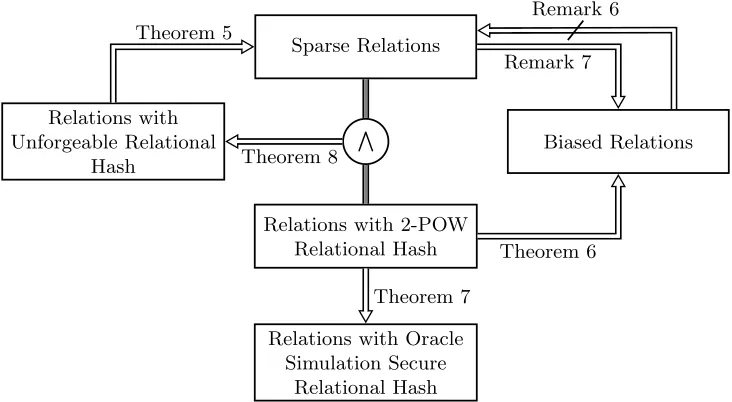
In Section 2 we introduced three natural definitions of security for Relational Hash functions: one-wayness, unforgeability and oracle simulation security. In this section we define the notion of sparse and biased relations. We show, if a Relational Hash function is unforgeable, that implies the relation must be sparse. Following [CMR98], we extend the notion of 2-value Perfectly One-Way (2-POW) function. We show if a Relational Hash function is 2-POW, then the relation must be biased. We also show that the 2-POW
5
property is actually a sufficient condition for oracle simulation security, as well as unforgeability (when the relation is sparse).
We begin by asking the question: What kind of relations can support the existence of an unforgeable Relational Hash? It is easy to see that certain relations cannot support unforgeability. Take, for example, the relationR(x, y, z), where x, y∈Fn
2 andz∈F2which returns 1 iff the parity ofx+y is equal to the bit
z. One cannot construct an unforgeable hash for this relation because given the type 1 hash of a randomx, it is easy to construct a type 2 hash of ay such that the relational verification outputs 1, without knowing
x: We just pick an arbitraryy, compute a type 2 hash of the arbitraryy and verify with the relational key with the type 1 hash ofxfor both zvalues 0 and 1.
So the intuitive property of relations supporting unforgeability is that without knowing x, it should be hard to come up with (y, z), such thatR(x, y, z) holds. We formalize this intuition below in definingsparse relations.
Relations with Unforgeable Relational
Hash
Biased Relations Sparse Relations
Relations with 2-POW Relational Hash
Relations with Oracle Simulation Secure
Relational Hash
V
Theorem 5
Remark 7
Theorem 6 Theorem 8
Theorem 7
Remark 6
Fig. 1. Relationship among Types of Relations. Arrowhead indicates direction of implication. Strike on an arrow indicates the existence of a counter-example.
Definition 7. A relation R⊆X×Y ×Z is called a sparse relation in the first co-ordinate with respect to a probability distributionX overX, if for all PPTsA:
Pr[x← X,(y, z)←A(λ) : (x, y, z)∈R]<negl(λ)
Similarly, we can define asparse relation in the second co-ordinate with respect to a probability distribution Y over Y. A relation R ⊆X ×Y ×Z is called asparse relation with respect to probability distributions X over X and Y over Y, if it is a sparse relation in first coordinate with respect toX, as well as a sparse relation in second coordinate with respect toY.
Remark 4. Similar to Section 2, the definitions given in this sections are actually defined with respect to ensemble of probability distributions Xλ,Yλ,Kλ, ensemble of setsXλ, Yλ, Zλ, Kλ and ensemble of relation
Rλ. However, for simplicity we drop the subscript λ.
Now, we show if a Relational Hash function is unforgeable, that implies the relation must be sparse.
Theorem 5. If a Relational Hash scheme(KeyGen,Hash1,Hash2,Verify)for a relationRis unforgeable
Proof. Suppose, the relation R is not sparse over first coordinate, and there exists an PPT attacker A
such that Pr[x← X,(y, z)←A(λ) : (x, y, z)∈R] is non-negligible. Now, given an unforgeability challenge
(pk, cx), such thatpk←KeyGen(1λ) andcx←Hash1(pk, x) for somex← X; we can just get (y, z)←A(λ)
and output (Hash2(pk, y), z). From the correctness of the Relational Hash function, it follows that this output
is a valid forgery with non-negligible probability. ut
Following [CMR98], we recall the definition of 2-value perfectly one-way (POW) functions. Intuitively, this property states that the distribution of a two probabilistic hashes of the same value is computationally indistinguishable from the distribution of probabilistic hashes of two independent values. This is a useful property, because if we can show a Relational Hash function is 2-POW, we show that it would immediately imply the Relational Hash function is oracle simulation secure, as well as unforgeable (if the relation is sparse).
Definition 8 (2-value Perfectly One-Way function). Let X be a probability distribution overX. Let
H ={hk}k∈K be a keyed probabilistic function family with domain X and randomness space U, where the key k gets sampled from a probability distribution K over K.H is 2-value perfectly one-way (POW) with respect to X andK if for any PPT distinguisherD,
Pr[D(k, hk(x, r1), hk(x, r2)) = 1]
−Pr[D(k, hk(x1, r1), hk(x2, r2)) = 1]
<negl(λ),
where x, x1, x2 are drawn independently from X,k is drawn from K and r1, r2 are generated uniformly at
random from the randomness spaceU.
Remark 5. In [CMR98], the keykwas universally quantified, and the function familyH was called 2-POW if the inequality was true for all k ∈ K. However, for our purpose it is sufficient if we consider random k
coming from the distributionK (orKeyGen).
Now we ask what kind of relations can support the existence of 2-POW Relational Hashes? Intuitively, we require that it should be hard to distinguish two distinct samplesx andw from the distribution X by testing relations with a (y, z) tuple which is efficiently computable without knowing the samples. That is we should have R(x, y, z) and R(w, y, z) come out equal most of the time. This intuition is formalized in the following definition ofbiased relations.
Definition 9. A relationR⊆X×Y ×Z is called a biased relationin the first co-ordinate with respect to a probability distributionX overX, if for all PPTsA:
Pr[x, w← X,(y, z)←A(λ) :R(x, y, z)6=R(w, y, z)]<negl(λ)
Similarly, we can define abiased relation in the second co-ordinate with respect to a probability distribution Y over Y. A relation R ⊆ X×Y ×Z is called a biased relation with respect to independent probability distributionsX overX andY overY, if it is a biased relation in first coordinate with respect toX, as well as a biased relation in second coordinate with respect toY.
Remark 6. We observe that if a relationR is biased, then its complement ¯R is also biased. Now one might begin to think that maybe for a biased relationR, eitherRor ¯Ris sparse. However, the following counterex-ample shows that this is not the case. Consider the relationR(x, y, z) which outputs the first bit ofy. This is a biased relation, but neitherR, nor its complement ¯Ris sparse.
Remark 7. The other direction is actually an implication, that is, if a relation R is sparse then it is also biased. The proof intuition is as follows: Given an algorithmAbreaking the biased-ness of R, we construct an algorithm breaking the sparse-ness ofR. LetAoutput (y, z), such that with probabilitypover the choice
of x← X, R(x, y, z) = 1 and therefore with probability 1−p, R(x, y, z) = 0. The probability of breaking
Now, we show if a Relational Hash is 2-POW, then the relation must be biased.
Theorem 6. For a Relational Hash scheme(KeyGen,Hash1,Hash2,Verify)for a relationR, ifHash1
is 2-value Perfectly One-Way with respect to X and KeyGen, then R is a biased relation in the 1st co-ordinate with respect to X.
Proof. We are given that,
∀ P P T D:
Pr[D(k,Hash1(k, x, r1),Hash1(k, x, r2)) = 1]
−Pr[D(k,Hash1(k, x1, r1),Hash1(k, x2, r2)) = 1]
<negl(λ)
SupposeRis not a biased relation in the 1st co-ordinate. Then, there exists an efficient algorithmA, which outputs (y, z)∈Y ×Z, such that Pr[x←X,(y, z)←A(λ) :R(x, y, z)6=R(w, y, z)] is non-negligible in the security parameter. So now given (k,Hash1(k, x, r1),Hash1(k, w, r2)), we generate (y, z)←A(λ), compute
Hash2(k, y, r0) and then computeVerify(k,Hash1(k, x, r1),Hash2(k, y, r0), z) andVerify(k,Hash1(k, w,
r2),Hash2(k, y, r0), z). By the correctness of the Relational Hash scheme, these boolean results areR(x, y, z)
andR(w, y, z) respectively. In the caseR(x, y, z) =R(w, y, z), the distinguisherDoutputs 1, else 0. By the
non-sparseness ofR,D will have a non-negligible chance of distinguishing the distributions. Hence we get a
contradiction. ut
Theorem 7, stated below, shows that if a Relational Hash is 2-POW, then it is also oracle simulation secure. The proof is given in Appendix G.
Theorem 7. For a Relational Hash scheme (KeyGen,Hash1,Hash2,Verify), if the algorithms Hash1
andHash2are individually 2-value Perfectly One-Way for distributions(X,KeyGen)and(Y,KeyGen)
re-spectively, then the Relational Hash scheme is Oracle Simulation Secure for the distributionX ×Y. Formally, for all PPT C, there exists a PPT S, such that:
Pr[C(pk,Hash1(pk, x),Hash2(pk, y)) =P(pk, x, y)]
−Pr[SRx,Ry,Rx,y(pk) =P(pk, x, y)]
<negl(λ),
wherepk←KeyGen,x← X,y← Y.
Finally, we show that if a Relational Hash is 2-POW as well as sparse, then it must be unforgeable.
Theorem 8. If(KeyGen,Hash1,Hash2,Verify)is a Relational Hash scheme for a sparse relationRwith
respect to independent probability distributionsX andY andHash1 (Hash2) is 2-value Perfectly One-Way
for distribution X (Y) andKeyGen, then the Relational Hash scheme is unforgeable for the distributionX (Y).
Proof. Assume that the scheme is not unforgeable. This means that given (pk,Hash1(pk, x, r)) forx← X,
there is an attacker A, which outputs Hash2(pk, y, s) and z, such that R(x, y, z) = 1, with non-negligible
probability. Using A, we now build an attacker B which distinguishes the distributions (pk,Hash1(pk, x, r1),
Hash1(pk, x, r2)) and (pk,Hash1(pk, x, r1),Hash1(pk, x0, r2)) with non-negligible probability. Given (pk,
Hash1(pk, x, r1),Hash1(pk, w, r2)), B sendsHash1(pk, x, r1) to A. With non-negligible probability A
out-puts Hash2(pk, y, s) and z, such that R(x, y, z) = 1. Now since R is a sparse relation, if w 6= x, then
with non-negligible probability R(w, y, z) = 0, whereas ifw = x, then R(w, y, z) = 1. Now R(w, y, z) can be efficiently evaluated by computingVerify(pk,Hash1(pk, w, r2),Hash2(pk, y, s), z). Thus, B will have a
non-negligible probability of breaking the 2-value POW security ofHash1. ut
Stronger Security Properties for the Relational Hash Constructions. In Theorem 9, we show that the Relational Hash construction for linearity overFn
2 from Section 3 is actually a 2-value perfectly one-way
function. This property is based on a stronger hardness assumption calledDecisional Binary Mix(Assumption 2). In Appendix E.2(Theorem 13) we show that this assumption holds in the Generic Group Model [Sho97]. One can easily verify that the linearity relation overFn2,R={(r, s, z)|r+s=z∧r, s, z∈Fn2} is actually
a sparse relation with respect to uniform distributions over Fn2. Hence, by Theorem 7 and Theorem 8 we
Assumption 2 (Decisional Binary Mix). Assuming a generation algorithmG that outputs a tuple(n, q,G) such that G is a group of prime order q, the Decisional Binary Mix assumption asserts that for random
x, y← Fn2, given random elements hgii n i=1,hfii
n
i=1 from the group G it is hard to distinguish the following
distributions:
n Y
i=1
g(i−1)xi,
n Y
i=1
f(i−1)xi
! and
n Y
i=1
g(i−1)xi,
n Y
i=1
f(i−1)yi
!
.
Theorem 9. The algorithms (KeyGen,Hash1,Verify) in Section 3 constitute a 2-value Perfectly One
Way Function for the uniform distribution onFn
2, under theDecisional Binary Mix(Assumption 2) andDDH
assumptions.
The proof is given in Appendix H.
On Stronger Security Properties for the Proximity Hash Constructions. We observe that our
proximity hash construction is not 2-POW secure. This is readily seen by considering the first component of the proximity hash, which isx+c, wherexis the plaintext andcis a codeword. Two independent hashes ofx
will have first componentsx+candx+c0, and therefore adding them will lead toc+c0, which is a codeword. However for the hash of an independently randomly generated y, the first component will be y+c00. If we add the first components we get x+y+c+c00, which is unlikely to be a codeword. Therefore there is an efficient distinguisher for the 2-POW distributions. Our construction is also not Oracle Simulation secure, because it reveals the syndrome of the plaintext with respect to the ECC used - this is more information than what the simulation world can provide. We leave it as an open problem to construct 2-POW and Oracle Simulation secure Relational Hashes for proximity.
References
BBS04. Dan Boneh, Xavier Boyen, and Hovav Shacham. Short group signatures. In Matthew Franklin, editor, CRYPTO 2004, volume 3152 ofLNCS, pages 41–55. Springer, August 2004.
BGG95. Mihir Bellare, Oded Goldreich, and Shafi Goldwasser. Incremental cryptography and application to virus protection. In27th ACM STOC, pages 45–56. ACM Press, May / June 1995.
Boy04. Xavier Boyen. Reusable cryptographic fuzzy extractors. In Vijayalakshmi Atluri, Birgit Pfitzmann, and Patrick McDaniel, editors,ACM CCS 04, pages 82–91. ACM Press, October 2004.
Can97. Ran Canetti. Towards realizing random oracles: Hash functions that hide all partial information. In Burton S. Kaliski Jr., editor,CRYPTO’97, volume 1294 ofLNCS, pages 455–469. Springer, August 1997. CMR98. Ran Canetti, Daniele Micciancio, and Omer Reingold. Perfectly one-way probabilistic hash functions
(preliminary version). In30th ACM STOC, pages 131–140. ACM Press, May 1998.
DH76. Whitfield Diffie and Martin E. Hellman. New directions in cryptography. IEEE Transactions on Infor-mation Theory, 22(6):644–654, 1976.
DRS04. Yevgeniy Dodis, Leonid Reyzin, and Adam Smith. Fuzzy extractors: How to generate strong keys from biometrics and other noisy data. In Christian Cachin and Jan Camenisch, editors,EUROCRYPT 2004, volume 3027 ofLNCS, pages 523–540. Springer, May 2004.
DS05. Yevgeniy Dodis and Adam Smith. Correcting errors without leaking partial information. In Harold N. Gabow and Ronald Fagin, editors,37th ACM STOC, pages 654–663. ACM Press, May 2005.
GGG+14. Shafi Goldwasser, S. Dov Gordon, Vipul Goyal, Abhishek Jain, Jonathan Katz, Feng-Hao Liu, Amit Sahai, Elaine Shi, and Hong-Sheng Zhou. Multi-input functional encryption. In Phong Q. Nguyen and Elisabeth Oswald, editors,EUROCRYPT 2014, volume 8441 ofLNCS, pages 578–602. Springer, May 2014. GGJS13. Shafi Goldwasser, Vipul Goyal, Abhishek Jain, and Amit Sahai. Multi-input functional encryption.
Cryp-tology ePrint Archive, Report 2013/727, 2013. http://eprint.iacr.org/2013/727.
GKL+13. S. Dov Gordon, Jonathan Katz, Feng-Hao Liu, Elaine Shi, and Hong-Sheng Zhou. Multi-input functional encryption. Cryptology ePrint Archive, Report 2013/774, 2013. http://eprint.iacr.org/2013/774. JS02. Ari Juels and Madhu Sudan. A fuzzy vault scheme. Cryptology ePrint Archive, Report 2002/093, 2002.
http://eprint.iacr.org/2002/093.
KVM04. Suleyman Serdar Kozat, Ramarathnam Venkatesan, and Mehmet Kivan¸c Mih¸cak. Robust perceptual image hashing via matrix invariants. InImage Processing, 2004. ICIP’04. 2004 International Conference on, volume 5, pages 3443–3446. IEEE, 2004.
Lyu05. Vadim Lyubashevsky. On random high density subset sums. Electronic Colloquium on Computational Complexity (ECCC), 12(007), 2005.
MR15. Avradip Mandal and Arnab Roy. Relational Hash: Probabilistic Hash for Verifying Relations, Secure against Forgery and More. In Rosario Gennaro and Matthew Robshaw, editors,CRYPTO 2015, volume xxxx ofLNCS, pages xxx–xxx. Springer, August 2015.
PR12. Omkant Pandey and Yannis Rouselakis. Property preserving symmetric encryption. In David Pointcheval and Thomas Johansson, editors, EUROCRYPT 2012, volume 7237 of LNCS, pages 375–391. Springer, April 2012.
RS09. Alon Rosen and Gil Segev. Chosen-ciphertext security via correlated products. In Omer Reingold, editor, TCC 2009, volume 5444 ofLNCS, pages 419–436. Springer, March 2009.
Sho97. Victor Shoup. Lower bounds for discrete logarithms and related problems. In Walter Fumy, editor, EUROCRYPT’97, volume 1233 of LNCS, pages 256–266. Springer, May 1997.
A
Hardness Assumptions
We summarize the standard hardness assumptions used in this paper.
Assumption 3 (DLP). Assuming a generation algorithmG that outputs a tuple(q,G,g) such thatGis of prime order q and has generator g, the DLP assumption asserts that given (g,gx)it is computationally infeasible to outputxfor randomx←Zq. More formally, for all PPT adversariesAthere exists a negligible function negl()such that
P r[(q,G,g)← G(1λ);x←
Zq :A(g,gx) =x] <negl(λ)
Assumption 4 (DDH [DH76]). Assuming a generation algorithm G that outputs a tuple (q,G,g)such that G is of prime order q and has generator g, the DDH assumption asserts that it is computationally infeasible to distinguish between (g,ga,gb,gc) and (g,ga,gb,gab) for a, b, c ← Z∗q. More formally, for all PPT adversaries Athere exists a negligible functionnegl()such that
P r[(q,G,g)← G(1λ);a, b, c←Zq∗:A(g,ga,gb,gc) = 1]−
P r[(q,G,g)← G(1λ);a, b←
Z∗q :A(g,ga,gb,gab) = 1]
<negl(λ)
Assumption 5 (SXDH [BBS04]). Consider a generation algorithmG taking the security parameter as input, that outputs a tuple(q,G1,G2,GT, e,g1,g2), where G1,G2 andGT are groups of prime orderq with generatorsg1,g2ande(g1,g2)respectively and which allow an efficiently computableZ∗q-bilinear pairing map
e:G1×G2→GT. The Symmetric eXternal decisional Diffie-Hellman (SXDH) assumption asserts that the Decisional Diffie-Hellman (DDH) problem is hard in both the groupsG1 andG2.
Assumption 6 (Random Modular Subset Sum [Lyu05]). Assuming a generation algorithmG that out-puts a tuple(n, q),where q is prime,theRandom Modular Subset Sumassumption asserts that given random elements haiini=1 from the group Zq and c = Pin=1iai for a random ← {0,1}n, it is hard to output
η∈ {0,1}n such that
n X
i=1
ηiai=c (modq).
More formally, for all PPTA, there exists a negligible function negl()such that
Pr
(n, q)← G(1λ), haiini=1←Zq
← {0,1}n, c=Pn
i=1iai
η←A(haiini=1, c)
: n X
i=1
ηiai=c (modq)
B
Correctness of the
F
n2
Linear Relational Hash
For any,x, y∈Fn2 we have
Hash1(x) = (hx0,hhxii n
i=1, hxn+1) =
gr0,Dg(i−1)xirE
n
i=1
,grn+1
Hash2(y) = (hy0,hhyii
n
i=1, hyn+1) =
hs0,Dh(i−1)yisE
n
i=1,h
s n+1
Hence,
e(hxn+1, hyn+1)
n Y
i=1
e(hxi, hyi)(−1)
(xi+yi)
=e(grn+1,hsn+1) n Y
i=1
eg(i−1)xir,h(i−1)yis
(−1)(xi+yi)
= n+1
Y
i=1
e(gri,hsi) = n+1
Y
i=1
egair
0 ,h
bis
0
=e(gr0,hs0)Pin=1+1aibi =e(hx
0, hy0)pkR
This shows that our relational hash scheme correctly verifies tuples of the form (x, y, x+y) for anyx, y∈Fn2.
On the other hand, if the verification equation gets satisfied for somez∈Fn2, we must have
e(gr0,hs0) Pn+1
i=1 aibi =e(gr n+1,h
s n+1)
n Y
i=1
eg(i−1)xir,h(i−1)yis
(−1)zi
=⇒ n X
i=1
aibi= n X
i=1
(−1)xi+yi+zia
ibi
LetQ⊆ {1,· · ·, n}be the set of indices, such thati∈Qif and only ifxi+yi6=zi. Now, the above equation reduces to
X
i∈Q
aibi = 0.
Ifx+y6=z, thenQis non empty and we can consider a fixedi∗∈Qand we have
ai∗bi∗=−
X
i∈Q\{i∗} aibi.
Now, if we fix ai’s and bi’s for i ∈ Q\ {i∗} and consider only the randomness of ai∗ and bi∗, the above
equation holds with probability at most 1/qwhenP
i∈Q\{i∗}aibi 6= 0 and with probability at most 2/qwhen P
i∈Q\{i∗}aibi= 0. This implies for any tuple (x, y, z) withz6=x+y, the verification equation gets satisfied with probability at most 2/q. Hence the above algorithms in fact constitute a correct relational hash for
linearity overFn2. ut
C
One-wayness of
F
n2Linear Relational Hash: Proof of Theorem 1
In this section we go through a sequence of lemmas, leading to proof of Theorem 1.
Lemma 1. (DDH) :For random g,h←Gandr←Z∗
q, the following tuples are computationally indistin-guishable under the DDH assumption:
(g,h,gr,hr)≈DDH (g,h,gr,h−r).
Proof. We have,
(g,h,gr,hr)≈DDH(g,h,gr,hr
0
)≈statistical (g,h,gr,h−r
0
)≈DDH (g,h,gr,h−r),
Lemma 2. Under theBinary Mix DLP assumption(Assumption 1), given random elements g,hgii n i=1 from
a group Gand gr,v=Qn i=1g
(−1)xir i ,hzii
n i=1 =hg
r ii
n
i=1 for random r ←Z
∗
q and randomx←Fn2 it is hard
to output y∈Fn
2 such that
v=
n Y
i=1
z(i−1)yi.
Formally, for all PPT adversariesAthere exists a negligible function negl()such that
Pr "
G← G(1λ);g,hgii n
i=1←G;r←Z∗q;x←F n
2;
y←Ag,hgii
n i=1,g
r,v=Qn i=1g
(−1)xir i ,hzii
n i=1=hg
r ii
n i=1
:v= n Y
i=1
z(i−1)yi
#
<negl(λ)
Proof. Suppose there exists an adversary A∗ for which the above probability is non negligible. We will show, using the adversary A∗ we can break Lemma 2 challenge. Let (hgii
n
i=1,w =
Qn i=1g
(−1)xi
i ) be the Binary-Mix-DLP (Assumption 1) challenge. We choose random g ← G and random r ← Z∗q. We send
g,hgiini=1,gr,wr,hgr ii
n i=1
to the adversary A∗. We publish the output of A∗ to the Binary-Mix-DLP challenger. Clearly, the success probability of breaking the Binary-Mix-DLP assumption is same as success probability of the adversary A∗. Hence, under Binary-Mix-DLP assumption the success probability of A∗
can not be non-negligible. ut
Lemma 3. Under the DDH assumption, given random elementsg,hgii n
i=1 from a groupG, randomr←Z∗q and any x∈Fn2 the following tuples are computationally indistinguishable.
g,hgiini=1,gr,
n Y
i=1
gri,Dg(i−1)xirE
n
i=1
!
≈DDH g,hgiini=1,gr,
n Y
i=1
g(i−1)xir,hgriini=1 !
Proof. We define a sequence of games hGameji n
j=1. We argue, in Gamej, for random g,hgii n
i=1 from a
group G, random r←Z∗q and anyx∈Fn2 the following tuples are computationally indistinguishable under
DDH assumption
g,hgii n i=1,g
r, j−1
Y
i=1
g(i−1)xir
n Y
i=j
gri,hgriiij−=11,Dg(i−1)xirE
n
i=j
≈DDH
g,hgii n i=1,g
r, j Y
i=1
g(i−1)xir
n Y
i=j+1
gri,hgriiji=1,Dg(i−1)xirE
n
i=j+1
.
Ifxj = 0, then the above two distributions are in fact identical. So, we can only consider the casexj= 1. In this case we need to show the following distributions are computationally indistinguishable under DDH.
g,hgii n i=1,g
r,gr j
j−1
Y
i=1
g(i−1)xir
n Y
i=j+1
gri,hgriij−i=11,g−rj ,Dg(i−1)xirE
n
i=j+1
(1)
≈DDH
g,hgii n i=1,g
r,g−r j
j−1
Y
i=1
g(i−1)xir
n Y
i=j+1
gri,hgriij−i=11,grj,Dg(i−1)xirE
n
i=j+1
. (2)
(whereχis eitherhrorh−rwith probability 1/2 each). Given a DDH challenge (g,h,gr, χ), we take random huii
j−1
i=1 ←Z
∗
q and randomhuii n
i=j+1←Z
∗
q and invoke adversaryA∗ with input
g,hg uiij−1
i=1,h,hg
uiin
i=j+1,g
r, χ j−1
Y
i=1
g(−1)xiuir
n Y
i=j+1
guir,hguirij−1
i=1, χ
−1,Dg(−1)xiuirE
n
i=j+1
.
Depending on whetherχtakes the valuehrorh−r, the above expression is identically distributed as expres-sion (1) or expresexpres-sion (2). So, using the output ofA∗, we can break the DDH challenge. In other words, there is no such adversaryA∗, which breaksGamej with non-negligible probability, forxj= 1. Now, transitioning through the sequence of gameshGamejinj=1we can argue the validity of this lemma. ut
Lemma 4. Under the Binary Mix DLP(Assumption 1) and DDH Assumptions, given random elements
g,hgˆii n
i=1 from a group G and g
r,vˆ = Qn i=1gˆ
r i,hˆzii
n i=1 =
D ˆ
g(i−1)xirE
n
i=1 for a random r ← Z
∗
q, and ran-dom r←Fn2 it is hard to outputy∈Fn2, such that
ˆ v= n Y i=1 ˆ
z(i−1)yi.
Formally, for all PPT adversariesAthere exists a negligible function negl()such that
Pr "
G← G(1λ);g,hgˆii n
i=1←G;r←Z
∗
q;r←Fn2;
y←Ag,hˆgiini=1,gr,vˆ=Qn i=1gˆ
r i,hˆzii
n i=1=
D ˆ
g(i−1)xirE
n
i=1
: ˆv= n Y
i=1
ˆ
z(i−1)yi
#
<negl(λ)
Proof. Suppose we are given a Lemma 2 challenge
g,hgiini=1,gr,v= n Y
i=1
g(i−1)xir,hziini=1=hgriini=1 !
,
for some randomg,hgiini=1 ←G, randomr←Z∗q and randomx←Fn2. Lemma 2 says, it is hard to output
y∈Fn2 such that
v=
n Y
i=1
z(i−1)yi.
We will show if there exists an adversaryA∗ which breaks Lemma 4 with non-negligible probability; we can use the adversaryA∗to break Lemma 2 challenge with non-negligible probability. A∗ takes input
g,hgiini=1,gr,vˆ = n Y
i=1
gri,hˆziini=1=Dg(i−1)xirE
n
i=1
!
and outputsy. Whenever,A∗ succeeds we have
ˆ v= n Y i=1 ˆ
z(i−1)yi.
Lemma 3 says, Lemma 4 and Lemma 2 challenges are indistinguishable for all x∈ Fn
2 (hence, for random
x←Fn
2 as well) under DDH assumption. Hence we can give the Lemma 2 challenge
g,hgiini=1,gr,v= n Y
i=1
g(i−1)xir,hzii n i=1=hg
r ii
n i=1
!
toA∗ and with non-negligible probabilityA∗’s outputy will satisfy the relation
v=
n Y
i=1
z(i−1)yi,
Proof of Theorem 1 Now we show that if the relational hash from Section 3 is not one-way secure (and we have a one-wayness adversaryB), then we can construct an adversaryAbreaking Lemma 4. To achieve
that, consider that the adversary Ais given a Lemma 4 challenge g,hgˆii n i=1,g
r,Qn i=1gˆ
r i,
D ˆ
g(i−1)xirE
n
i=1
.
We now construct the one-wayness challenge as follows: We sampleu, s andhuiini=1, all randomly fromZ∗q. Sampleh0 randomly fromG2. Now we define the output ofKeyGen to bepk:= (pk1, pk2, pkR) defined as follows:
pk1:= g,
D ˆ gu −1 i i En i=1
,gu
n Y
i=1
ˆ
g−i1
!
, pk2:= h0,hhu0isi
n i=1,h
s
0
, pkR:=us
Observe thatg,Dgˆu
−1 i
i En
i=1
,h0,hhu0isi
n i=1,h
s
0 andusare all uniformly random and independent elements of
their respective domains 6. The group element guQn i=1gˆ
−1
i is determined given the other elements. Hence (pk1, pk2, pkR) has identical distribution as the output of the originalKeyGen.
A publishes (pk1, pk2, pkR) to the adversaryB and then also gives a challenge hash:
hx :=
g
r,Dˆg(−1)xir·u−1 i
i
En
i=1
,gr·u
n Y
i=1
ˆ
gri
!−1
.
OnceB outputs an elementy∈Fn2,Ajust relays that to the Lemma 4 challenger. Now, observe thathx
is identically distributed asHash1(x) for a randomx←Fn2. Therefore, the probability thaty=xis same as
the advantage ofB against the security of the relational hash scheme. Therefore the scheme is secure given
Lemma 4. ut
D
Relational Hash for Linearity in
F
npFor any primep, we now construct a Relational Hash scheme for the domainsX, Y, Z=Fn
p and the relation
R={(x, y, z)|x+y=z∧x, y, z∈Fn
p}.
KeyGen: Given the security parameter, bilinear groups G1,G2,GT are generated of prime orderq,
expo-nential in the security parameter and equal to 1 (modp). This means the group Z∗q has a subgroup Jp of prime order p. Letω be an arbitrary generator ofJp. Now we sample generatorsg0 ←G1 and h0 ← G2.
Next we samplehaiini=1+1 and hbiini=1+1, all randomly from Zq. Define gi =g ai
0 and hi =hb0i. Now we define
the output ofKeyGenaspk:= (ω, pk1, pk2, pkR) defined as follows:
pk1:=hgii n+1
i=0 , pk2:=hhii
n+1
i=0 , pkR:= n+1
X
i=1
aibi
Hash1: Given plaintextx=hxii n i=1∈F
n
p, ωandpk1=g0,hgii n
i=1, the hash is constructed as follows: Sample
a randomr∈Z∗
q and then compute the following:
hx:=gr0,DgωixirE
n
i=1
,grn+1
Hash2 is analogously defined in the groupG2.
Verify: Given hasheshx=hhxiini=0+1 and hy=hhyii
n+1
i=0, the parameterz=hzii
n i=1 ∈F
n
p andpkR andω, the algorithmVerifychecks the following equality:
e(hx0, hy0)pkR ?
=e(hxn+1, hyn+1)
n Y
i=1
e(hxi, hyi)ω
−zi
6 Roughly, ˆgu−1i
i ’s are randomized by the ˆgi’s; h uis