JOURNIU OF
MNGE NNIGEMENT
Published bimonthly-January, March, May,July, September, November-by the Society for Range Management 2120 South Birch Street Denver, Colorado 80222 Copyright @ 1974 by the Society for Range Management Managing Editor
FRANCIS T. COLBERT 2120 South Birch Street Denver, Cola. 80222 Editor
ELBERT H. REID
624 South Shields Street Fort Collins, Colo. 80521 Book Review Editor DONALD N. HYDER
Agricultural Research Service Colorado State University Fort Collins, Colo. 80521 Copy Editor
PATRICIA G. SMITH 2120 South Birch Street Denver, Colo. 80222 Editorial Board 1971-73
C. KENNETH PEARSE, Laguna Hills, Calif. SYLVESTER SMOLIAK, Lethbridge, Albta. ELVIS R. BEATY, Athens, Ga.
DON DWY ER, Logan, Utah 1972-74
LOWELL K. HALLS, Nacogdoches, Tex. ROBERT L. ROSS, Bozeman, Mont. G. W. TOMANEK, Hays, Kan. HENRY A. WRIGHT, Lubbock, Tex. 1973-75
DWIGHT R. CABLE, Tucson, Ariz. JOHN P. WORKMAN, Logan, Utah RUSSELL J. LORENZ, Mandan, N.D. LEWIS L. YARLETT, Portland, Ore.
INDIVIDUAL SUBSCRIPTION is by membership in the Society for Range Management.
LIBRARY or other INSTITUTIONAL SUBSCRIP- TIONS, on a calendar year basrs. are $15.00 postpaid to all countries. Payments from outside the United States should be remitted in US dollars by international money order or draft on a New York bank.
lost due to a change of address cannot be replaced unless adequate notice is given. To assure uninterrupted ser- CHANGE OF ADDRESS notices should be sent to the Managing Editor, 2120 S. Birch St., Denver, CO 80222, no later than the first day of the month of issue. Copies
TABLE OF CONTENTS:
Vol. 27, No. 1, January 1974
ARTICLES 5 12
15
20
23
27
30 33 36
41
45 48
53
55
57
61
66
71
Range Burning by Henry A. Wright
Asphalt-Fiberglass for Precipitation Catchments by Lloyd E. Myers and Gary W. Frasier
Spring Food Habits of White-tailed Deer in the South Texas Plains by James H. Everitt and D. Lynn Drawe
Estimating Intake and Digestibility of Native Flint Hills Hay by M. Rama Rao, Leniel H. Harbers, and Ed F. Smith
Range Vegetation and Sheep Production at Three Stocking Rates on Stipa- Bouteloua Prairie by S. Smoliak
Presettlement Vegetation of Cache Valley, Utah and Idaho by A. C. Hull, Jr., and Mary Kay Hull
The Zootic Disclimax Concept by Alan A. Beetle
Root Dynamics of a Shortgrass Ecosystem by Dale L. Bartos and Phillip L. Sims Condition and Trend of the Big Sagebrush/Needleandthread Habitat Type in Nevada by Paul T. Tueller and Wilbert H. Blackburn
Effects of Light and Temperature on Germination of Sideoats Grama by D. F. Cole, R. L. Major, and L. Neal Wright
Longleaf Uniola and Spike Uniola Require Shade by Gale L. Wolters Mechanical and Chemical Range Renovation in Southeastern Wyoming by Frank Rauzi
Herbicide Plus Various Additives for Follow-up Control of Shredded Mesquite by Ronald E. Sosebee
Atrazine Residue and Seedling Establishment in Furrows by Richard E. Eckert, Jr.
Effect of a Wetting Agent and Nitrogen Fertilizer on Establishment of Ryegrass and Mustard on a Burned Watershed by Leonard F. Debano and C. Eugene Conrad
Influence of Insects on Mesquite Seed Production by L. L. Smith and D. N. Ueckert
Microdensitometry to Identify Plant Communities and Components on Color Infrared Aerial Photos by Richard S. Driscoll, Jack N. Reppert, and Robert C. Heller
New Adjustable, Decimal, Collapsible Quadrat vs Three Old Quadrats-an Evaluation by Ch. M. Anwar Khan
TECHNICAL NOTES 76
78
Using a Grid to Estimate Production and Utilization of Shrubs by H. W. Springfield
Effect of pH on Germination of Three Grass Species by J. Stubbendieck 78 Winterfat Seeds Viable after 8 Years’ Refrigerated Storage by H. W. Springfield
vice, provide your local postmaster with a Change of BOOK REVIEWS Address Order (POD Form 3575), indicating thereon to
guarantee forwarding postage for second-class mail. BUSINESS CORRESPONDENCE, concerning subscrip- tions, advertising, reprints, back issues, and related matters, should be addressed to the Managing Editor, 2120 S. Birch St., Denver, CO 80222.
80 Wildflowers of Louisiana and Adjoining States (Brown); Men Who Matched the Mountains (Tucker and Fitzpatrick).
81 Conversion Tables for Metric and U.S. Weights and Measures by E. William Anderson
EDITORIAL CORRESPONDENCE, concerning manu- scripts or other editorial matters, should be addressed to
the Editor, 624 S. Shields St., Fort Collins, CO 80521. COVER: Dozed juniper being burned near Baird, Texas. Fireline in the foreground (see article by INSTRUCTIONS FOR AUTHORS appear each year in Henry A. Wright, page 5).
the March issue; copies of these instructions are available from the editor.
Range Burning
HENRY A. WRIGHT
Highlight: There are many uses for prescribed burning in the management of forests, chaparral, grasslands, watersheds, and wildlife. Some of these uses have been pointed out in this paper. There are also many dangers in using fire, both in its application and in its results. To minimize harmful effects, fire should never be used during extended dry periods; burns should always take place when the soil is damp or wet. Moreover, the user should be an experienced professional with a thorough knowledge of eco- systems, weather, and fire behavior.
We know a lot about the effect of fire on western rangelands and its value as a tool, but information necessary to con- duct specific prescribed burns is generally inadequate or nonexistent. Thus, the use of fire is frightening, and many desirable prescribed burns just don’t get started. Few land managers have the training or courage to conduct a burn. Most have been exposed only to catastrophic fires, which are untimely, have undesirable effects, and scare everyone in their path.
There are other fears which inhibit prescribed burning. One is a fear of the liability consequences if a fire gets away. This fear affects individual landowners and also influences government agencies. Another fear, which has been important in the past but may be less so now, is a concern about one’s career if he lets a fire get away.
In this paper I intend to point out the usefulness of prescribed burns in many plant communities, the reasons why most wildfires are detrimental, and how pre- scribed burns can be conducted. Hope- fully, it will stimulate some thinking and encourage others to use fire as it has been used in parts of the West.
The author is professor of range manage- ment, Department of Range and Wildlife Man. agement, Texas Tech University, Lubbock.
The paper is a contribution of the College of Agricultural Sciences, Texas Tech University, No. T-9-128.
Manuscript received August 2, 197 3
JOURNAL OF RANGE MANAGEMENT 27(l)
Use of Fire as a Tool
Where prescribed burning is an appli-
cable tool, many objectives can be
achieved simultaneously. Increased herb- age yields, increased utilization, increased availability of forage, improved wildlife
habitat (more food with unburned
patches for cover), control of undesirable shrubs, a mineral seedbed for establish- ment of commercial trees, and control of various diseases (e.g. liver fluke and brownspot) can all be achieved with one burn. For example, in mesquite (Prosopis glandulosa)-tobosa (Hilaria mu tica) com- munities in west Texas (Fig. l), we use fire to (a) remove accumulated litter, (b) increase yields of tobosa (Fig. 2) (c) increase palatability of tobosa, (d) reduce mesquite canopy to acceptable levels, (e) top-kill mesquite and leave the stems in a state where wood borers will attack and aerate them to such an extent that they will be easily consumed by a reburn, (f) kill 40 to 80% of three species of cactus, and (g) kill undesirable annual broom- weeds (Xanthocephalum dracun&loides) (Wright, 1972a). By contrast, spraying this same community with 2,4,5-T will not increase yields of tobosa (Dahl et al., 1971), will not increase palatability of tobosa, will not kill pricklypear (Opuntia phaeacanthu) or cholla (0. imbricata), and will leave the wood of mesquite resistant to wood borers.
Fire also achieves multiple objectives in the aspen parkland of Alberta, Canada.
Januarv 1974
Fall or spring burns in the aspen forest (a) top-kill all woody plants such as quaking aspen (Populus tremuloides), snowberry (Symphoricarpos occidentalis), rose (Rosa woodsii), raspberry (Rubus stri- gosus), gooseberry (Ribes oxya- canthoides), willow (Salix sp.), and silver- berry (Elaeagnus commutata), (b) provide a seedbed for the establishment of forage seedlings, (c) increase the supply of palat- able browse for cattle, (d) sharply in- crease the food supply and habitat for white-tail deer and ruffed grouse, and in the grasslands (a) eliminate litter buildup from rough fescue on north-facing slopes, and (b) during wet years maintain stable forage yields (Bailey, 1972, personal com- munication).
Management after a burn is essential for obtaining desirable results. Grazing animals will frequently concentrate on a burn because the feed is more palatable, nutritious, and readily available. For this reason burning must be done on a man- ageable unit basis. If small areas within large pastures are burned, animals will concentrate on the burn, regardless of how long the rancher waits to turn the animals in. This is why burns are often criticized for killing the grass when in reality they probably produce more grass than control areas. Moreover, burning small areas may be an effective way to get animals to overbrowse some species such as aspen and thus destroy some brush.
Prescribed Burns vs Wildfires Because of the variety of seasons and weather conditions in which a burn can
occur, one must be careful how he
interprets the results of a fire study. If the data is from a wildfire, the fire probably occurred during a very dry year. If the data is from a prescribed burn, the fire probably occurred during a wet year.
Naturally, fires during dry years are harm- ful because they magnify drouth stress on plants, whereas fires during wet years are generally beneficial because moisture is generally not limiting and fires increase soil temperature and stimulate nitrifi- cat,on.
As an example, in west Texas tobosa produced 2813 lb/acre after burning dur- ing a wet year in 1969 and only 625
6
lb/acre after burning during a dry year in 1971 (Wright, 1972a). The controls pro- duced 1128 and 954 lb/acre, respectively. Yields from the burned plots are typical for a comparison of results of a pre- scribed burn with those of a wildfire. Ideally, a prescribed burn should be conducted during the dormant season, when the soil is wet, relative humidity is 20 to 60%, average wind velocities are 5
to 15 mph, and air temperature is 65 to 75°F.
In addition to occurring during dry years, wildtires frequently ocax during the active growing season, which is very
untimely and severely damages many
plants. For best results, burns should be
conducted when preferred plants are
dormant. In southern states, spring burn- ing favors the desired warm season plants over cool season plants. By contrast, in the Northwest fall burning is preferred to minimize damage to the dominant cool season plants.
Effect of Fire on Vegetation
The usefulness of fire to stimulate forage production in stagnated grassland
communities has been demonstrated by
many researchers (Weaver and Tomanek,
1951; Weaver and Albertson, 1956;
Ehrenreich, 1959; Hadley and Kieck-
hefer, 1963; Vogl, 1965; Wright, 1972~~; and Anderson et al., 1970). Buildup of litter in except of 2,000 lb/acre lowers soil temperatures, which reduces bacterial actlvlty, ties up nutrients, and slows the general nitrogen cycling process, particu- larly during cool, wet years. In dry years. however, when wildfires are prevalent, litter is important for insulation and protection from flash floods.
Other benefits OCCUI in the Great
Plains. Cool ~eascm plants such as annual
broomweed are easily controlled by
spring burning (Wright, 1969). By con- trast, the warm season perennial grasses are greatly favored. This is a good example of how fire can be used success- fully as a management tool to depress one plant and enhance another. Moreover, the utilization of coarse, unpalatable species can be increased for 6 months to 1 year (Heirman and Wright, 1973; Klett, et al., 1971). Pricklypear, tasajillo (0. lepto- cau2is), and cholla can easily be killed with the use of fire (Heirman and Wright, 1973). Fire does not kill the pricklypear or cholla directly, but insects attack them after fire. We have recorded second-year mortalities of pricklypear after burning as high as 85%.
rata), although it temporarily harms bunchgrasses such as needleandthread (Stipa comata) and Idaho fescue (Fesruca idahoensis) (Blaisdell, 1953; Wright and Klemmedson, 1965; Conrad and Poulton,
1966). Rhizomatous species such as
thickspike wheatgrass (Agropyron
dasystochyum and plains reedgrass (C&magrostis montanensis) are favored by fall burning (Blaisdell, 1953). Undesir- able shurbs such as horsebrush (Tetra- dymia canescens) and downy rabbitbrush (Chrysothomnus puberulus) are also favored by burning. Bitterbrush (Purshia tridentam) is severely harmed by burning (Nord, 1965).
Where tires are prevalent in grasslands, they have considerable value in control-
ling brush (Humphrey, 1958; Sauer,
1959; Wright, 1972b). Griffiths (1910) and Wooten (1916) believed that fires almost entirely prevented the establish- ment of undesirable shrubs in the south- ern desert. Griffiths stated that because of the slow growth of shrubs, he felt that they could be controlled by tires that occurred only once in 10 years. Drouth
and competition from healthy grasses
interact with fire to further restrict the growth of shrubs (Johnson, 1962; Wright,
1972b). However, when domestic live-
stock graze these grassland areas, compe- tition from grasses is lessened, fires are less frequent, and shrubs increase.
Juniper is one of the best examples of a shrub being controlled by fire in grass- lands (Fig. 3). Most species are non- sprouters and are readily killed by fire. Thus, juniper is generally found in the rougher and more dissected topography of grasslands (Wells, 1970).
By contrast, stagnant communities of chaparral are greatly rejuvenated by oc-
casional fires (Hams, 1971). Decadent stands of mixed-chaparral brush will pro- duce 13 to 106 lb/acre of browse (Gib- bens and Schultz, 1963), whereas after burning these same communities produce from 750 to 2,750 lb/acre (Biswell, 1969). However, fire is not necessary for true chaparral communities to maintain their identity (Hams, 1971).
Shrub species which are dependent upon seed for survival, such as many juniper and chaparral species, can be eliminated from a community if fires are too frequent. This is why juniper is not a climax species on grasslands, but is climax on rocky breaks where it is protected from frequent fires (Burkhardt and Tis- dale, 1969). Since nonsprouting species must reach a certain age to set seed (Hanes, 1971), a burning frequency of more than 15 years has been considered most desirable for the maintenance of these shrubs (Biswell, 1969). Otherwise, a change in the relative frequencies of various species of shrubs following fire will occur, as has been reported by Buell and Cantlon (1953) in New Jersey and Horton and Kraebel (1955) in California.
For years our forests were protected from fire by foresters whose training was dominated by European philosophy. To- day we know that this was the wrong approach, because most of our forests evolved with fires. Without the natural sequence of fire, our forests have become
plagued by inadequate reproduction,
overstocking, stagnation, diseases and insects, as well as excessive fuel accumula- tion (Vogl, 1971). Protection of red- woods (Sequoia g&ma) in the Sequoia National Park has created a dog-hair thicket of young pines (Pinus ponderma and P. lambertiana), white fir (Abies
concolor), incense cedar (Libocedrus
decumns), and mature brush, with no
regeneration of redwoods (Kilgore,
1970). Now expensive handwork, along with prescribed burning, is being used to protect these trees from the threat of
disastrous wildfires and ultimate
extinction.
Natural fires occur in ponderosa pine every 5 to 10 years (Weaver, 19512.; Kallander, 1969). They not only reduce hazards from wildfires, but they thin the stands, prepare a mineral seedbed for regeneration, and maintain a healthy understory (Weaver, 1951b). Shrubs are killed back, but most resprout vigour- ously and appear fully recovered 11 years after the tire. Prescribed burning tech- niques for this vegetation type have been developed by Biswell et al. (1955) and Buck(1971).
In the Douglas-fir zone of the Inter- mountain region, shrubs utilized by wild- life are favored by fires and have a dominant influence on plant communities for 20 to 50 years (Mue&er, 1965; Lyon, 1969). Species greatly enhanced by fire include Scouler willow (S&.x scouleriana), serviceberry (Amelanchier alnifolia), Rocky Mountain maple (Acer glabrum), huckleberry (Vaccinium sp.),
thimbleberry (Rubus parvifloms), and
oceanspray (Holodiscus discolor). Scouler willow is especially abundant after burn- ing (Mueggler, 1965; Leege, 1969). All of these species are sprouters and increase in density because root crowns of single plants produce multiple sprouts (Lyon,
1966).
Berry plants which are preferred by many species of wildlife,-blackberries, thimbleberries, raspberries (Rubus spp.), gooseberries (Ribes sp.), strawberries
(Fragaria spp.), cranberries (Vibmnum
sp.), huckleberries (Gaylussacia sp.), and blueberries (Vaccinium spp.)-thrive after fires. I” forests of the northeastern United States, blueberries (Vaccinium
angusfifoh?z, V: myrefelloides, and V.
vacih2s) persist for years in the under- story of unburned communities as deca- dent plants. For maximum production of berries, they must be rejuvenated peri- odically by removal of dead or decadent stems and clones (Sharp, 1970). Brow” (1960) found blueberries consistently more prevalent on areas with a fire history than on adjacent unburned com- munities.
Effect of Fire on Wildlife
Planned uses for wildlife should follow more of our prescribed burns and wild- fires. It should not always be necessary to restock a forest with trees for the sole objective of growing as many trees as soon as possible. Land has many uses, as the United States Forest Service emblem depicts, and we should strive for variety. Variety is especially important in wildlife habitat management.
Following the Tillamook burns in
Oregon that devastated 355,397 acres, deer and other wild animals and birds increased dramatically (Isaac, 1963). Not only was forage more plentiful, but the deer were healthy and free of liver fluke
and lungworms that had plagued the
coast deer herds for years before the wildfire. Biologists discovered that the fire had wiped out the dry-land snail, which is the intermediate host for liver fluke and certain lungworms over vast areas.
Deer, elk, moose, bobwhite quail, wild turkey, doves, prairie chicken, sharptails, ruffed grouse, waterfowl and many song birds are favored by fires which create variety in habitat (Miller, 1963; E.
Komarek, 1963). The Kenai National
Moose Range in Alaska is in the Boreal Forest and would never have been set aside as a moose range had it not been for the widespread fires occurring on the peninsula from 1870 to 1900 (Spencer
and Hakala, 1964). Moose thrive on
willow, quaking aspen, and shoots of
paper birch (Betula papyrifera var.
Kanaica), which grow luxuriantly after
burns. By contrast, caribou are not
favored by these browse foods. During the winter caribou feed principally on slow-growing lichens, some of which re- quire more than a century for reestablish-
ment following destruction by fire
8
(Scotter, 1964).
Other subclbnax animals that have
reportedly increased following fires are
cougars, wolves, coyotes, deer mice,
ground squirrels, and beavers. Climax species such as bobolinks, sparrows, car- ibou, martens, wolverines, tree squirrels, and grizzly bear usually decrease.
Many people have a misconception
about animals being killed by fires. Occa- sionally, animals are killed by fires, par- ticularly large wildfires, but most verte- brates manage to escape the heat of tires by flying or running away, going below the ground a few inches, hiding in rock outcrops, or seeking islands missed by the fire. Studies in California by Howard et al. (1959) showed that fire did not harm cottontails, rats, mourning doves, quail, and several species of birds. 1” fact, the number of all animals increased immedi- ately after the fire. Phillips (1965) listed a large number of ungulates associated with forests and woodland-savanahs in east Africa; the only report of any mature animals being killed by fire was after a fire in 1869 in which a dead elephant and buffalo were found. Phillips noted that occasionally a few species of very young animals were killed by fires.
Fires adversely affect population dens- ities of animals principally by altering the habitat - not by killing. Habitat, more
than anything else, determines the species and their densities. A patchy burn (about 20% unburned area) is most desirable for wildlife. This leaves adequate cover for upland and big game and a winter food supply of various nuts and acorns. Pre- scribed fires, in general, greatly increase the diversity of wildlife species, as well as population densities on all vegetation
types (R. Komarek, 1963; Marshall,
1963).
Techniques for Burning
There are two basic fuel types (Fig. 4)&nonvoIatile and volatile (fuels con- taining ether extractives such as waxes, oils, terpenes, and fats). Grasses and hardwoods are nonvolatile fuels, whereas chaparral, sagebrush, juniper, and slash are volatile fuels. Nonvolatile fuels such as grass are relatively safe to burn. Pro- cedures to burn such fuels have been outlined by Wright (1972a). Volatile fuels, however, are explosive and create serious firebrand problems. They can be burned safely, but wide firelines and a thorough knowledge of weather and fire
behavior are necessary (Green, 1970;
Wright et al., 1972).
Our procedure for burning 4,000 lb/ acre or more of nonvolatile fuel is as follows:
prevailing winds are from the southwest. FIRE PLAN FOR NONVOLATILE FUELS (b) Cut a 15-ft fireline on the down-
wind sides (in this example north and east) of the area to be burned.
(c) Cut a lo-ft fireline 100 ft inside the north and east sides (downwind).
100 ft
(d) Backfire the lOO-ft strip on the downwind sides when winds are less than 8 mph and when relative humidities are between 50 and 60%. The fire is very docile under these conditions and if a spot fire occurs, it can be easily extin- guished.
(e) After the downwind firelines have been burned, the main portion of the pasture can be burned with a wind that averages from 8 to 15 mph. Winds in excess of 8 mph are necessary to burn down standing woody stems (Wright,
1972a). Relative humidities should aver- age from 25 to 40%.
R.H.= 25- 40% Wind ~8 - 15 mph Temp. * 60 F
These conditions can be varied with experience, depending on the amount of fine fuel and the goal of the burning. For example, a goal of killing shrubs or burning logs with light fuel (less than 2,000 lb/acre), requires a wind in excess of 8 mph. If the only concern is to remove dead litter, a backfire for the main burn is sufficient. In practice, we usually burn around a prescription be- cause the weather is seldom perfect.
The primary dangers in burning grass- lands come from tumbleweeds and fire- whirls. Tumbleweeds will ignite and then tumble, leaving flames in their path. Firewhirls develop where wind shears occur, such as when a headfire runs into a backfire, or a fire goes up slope into a wind. We have seen several firewhirls develop when headfires met backfires while winds were 10 to 15 mph. We have also seen two huge firewhirls devel- op when winds were light and variable. For these reasons, we prefer to burn with a steady wind and never burn into back- fires, unless we have at least a 300 ft fire- line. Burning should be done with can- yons, not across them.
Fig. 5. After firelines are cut, a lOO-ft strip on the downwind sides (north and east) of a pasture
is backfired with winds less than 8 mph and with relative humidities between 50 and 60%. Then the pasture is headfired with the prevailing wind (southwest) averaging from 8 to 1.5 mph and relative humidities from 25 to 40%.
one day to burn piles of dozed juniper after receiving 0.25 inch of rain. Small piles must be dry to ignite easily and to burn completely. After pile burning is completed (June l), defer the pasture so that adequate grass fuel will be available to burn the pasture the following spring.
stem), burn when wind is less than 8 mph and relative humidity is 50 to 60%. If the grass fuel is less than 2,000 lb/acre (e.g. buffalograss), burn when wind is less than 8 mph and relative humidity is 25 to 40%. This prepares the firelines for the major burn that follows.
(d) Eight months later in February, burn grass in the strips. If the grass fuel is more than 2,000 lb/acre (e.g. little blue-
(e) Burn into the prepared firelines when wind is 8 to 15 mph and relative humidity is 25 to 40%. If there are large
FIRE PLAN FOR VOLATILE FUELS
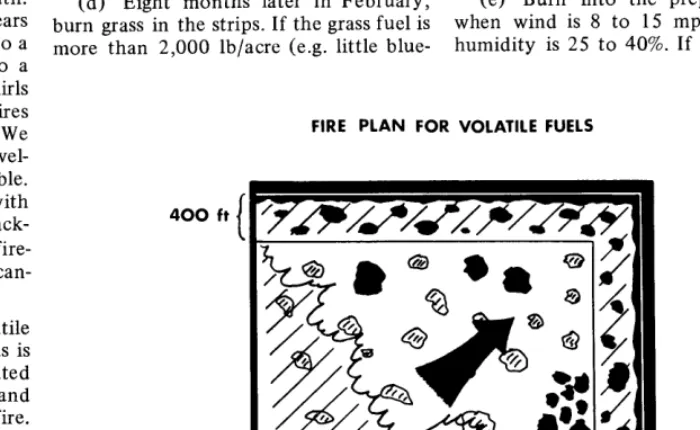
Our procedure for burning volatile fuels on the Edwards Plateau in Texas is quite different (Fig. 6). It is illustrated below, where juniper has been dozed and there is adequate grass to carry the fire. (a) Graze the pasture heavily before spring green-up.
(b) Doze lo-ft firelines on each side of a 400-ft wide strip on the downwind sides (north and east in this example) of the pasture to be burned.
R.H.= 25-40% Wind q 8 - 15 mph
Temp. : 65 - 75 F
(c) While the grass is green (between May 1 and June l), burn the large piles of dead fuel in the 400-ft strips (black splotches in Fig. 6). Wind should be less than 10 mph, and relative humidity should be above 45%. Care should be taken not to burn into areas with thick leaf mats of oak leaves. Oak leaves will ignite easily from cinders. Wait at least
Fig. 6. When the grass isgreen, juniper piles in the 400-ft strip (black splotches) on the downwind
sides (north and east) are burned with wind velocities less than IO mph and relative humidity above 45%. Eight months later (when grass is dormant), the grass in the 400-ft strip is burned when the wind is less than 8 mph and relative humidity is between 50 and 60%. Lower relative humidities may be used if the grass fuel is less than 2,000 lb/acre. All large concentrations of piles are backfired on the downwind sides of main area to be burned, and then the entire area is burned into the prepared firelines with a wind of 8 to 15 mph and a relative humidity of 25 to 40%.
R. H. q 50 - 60%
Wind < 8 mph
N
R. H. = 50 - 60% Wind < 8 mph
concentrations of piles within 50 to 60 ft of each other on the downwind sides, backfire them before headfiring the gen- eral area.
These volatile fuels put up live fire- brands that can easily travel 1,000 ft and ignite other fuels at this distance during dry years. Thus, weather at the time of burning is extremely important. Large piles of volatile fuels can be safely burned during dry, freezing weather, but flare- ups will be common during the following warm weather.
Current research also indicates that firebrands are not a serious problem when maximum winds are less than 5 mph, when lo-hr time-lag fuel moisture is over 15%, when air temperature is below 60’~ and when burns are conducted within 24 hr of a rain (Bunting, 1974). Any other time they can ignite punky wood or COW chips. They can also ignite bark and wood if the cinder is large enough and falls in a tight spot. Grass is very difficult for firebrands to ignite, unless the brands are flaming or they fall in a tight bunchgrass.
Temperatures
Mineral soil surface temperatures of
grassland fires vary from 182°F to
1260°F for fuels that vary from 1546 to 7025 lb/acre (Stinson and Wright, 1969). Temperatures above 150°F in these fires generally last only from 0.9 to 5.4 min- utes (Stinson and Wright, 1969), which indicates that seeds of most plants can survive in grass fires (Daubenmire, 1968). Plant tissue, however, is easily killed with temperatures above 150°F that last from 1 to 12 minutes, depending on moisture content of the plant tissue (Wright, 1970). The relation between time and temperature to kill plant tissue is an exponential function (Hare, 1961).
Below the mineral soil surface, temper- atures decrease sharply (Heyward, 1938; Bentley and Fenner, 1958). Under long- leaf pines, where the principal fuel was grass, the majority of temperatures at depths of l/S to l/4 inch in soil ranged from 150 to 175°F and generally per- sisted for 2 to 4 minutes, after which they declined rapidly (Heyward, 1938).
Soil temperature increases were negligible below a depth of l/4 inch, even when flames were 12 ft high.
Above the soil surface, temperatures rise very rapidly during fires (Bentley and
Fenner, 1958; Ito and Iizumi, 1960;
Whittaker, 1961). Whittaker found that some temperatures were 932°F greater at 8 inches above than at ground level. Davis
and Martin (1960) measured tempera-
tures as high as 1600” F at 1 ft above a
10
fire in 8 year-old gallberry-palmetto roughs. Where trees are present in heavy grass fuels, temperatures on the windward side are commonly 700”F, while tempera- tures on the lee side are about 1400°F (Fahnestock and Hare, 1964). This is why trees are often scorched on one side only. Bunchgrasses with large accumulations of dead plant material often generate high temperatures for a long period of time after the main fire has passed (Wright, 1971). The passing fire ignites the outer edge of the plant and then fuel within the
plant generates temperature up to
1000°F within 1 hr. Temperatures above 200°F for over 2 hr are common in large bunchgrasses, but not in small bunch- grasses or rhizomatous species.
Where heavy logs and deep brush are piled, duff surface temperatures vary from 1150 to 1841°F (Isaac and Hop- kins, 1937; Bentley and Fenner, 1958). Maximum temperatures 3 to 15 ft within
and above brush piles are commonly
2000°F and can be as high as 2600°F (Countryman, 1964).
Safety
We have a major responsibility for conducting prescribed fires safely so that they do not go beyond the planned fire lines. Unfortunately, we only have mini- mal research data on how to conduct prescribed burns. We have a few excellent practioners around the world who know how to conduct prescribed burns, but their rules are general, sometimes regional in nature, and very little information is
documented. For example, the people
who burn in the Kruger National Park in South Africa do a lot of burning every year and are good at it, but they cannot tell us under what relative humidity, wind speed, fuel moisture, etc., they burn, except in relative terms.
To conduct burns safely, the fire boss needs precise research data on which to base a fire plan. We are getting this kind of data in Texas, and it is being collected in a few other states. We can give precise prescriptions to burn mesquite-tobosa and dozed ashe juniper communities.
Despite our efforts to get good field- tested research on prescribed burns, we must still acknowledge that conducting prescribed fires is dangerous. People must be informed about these dangers-what they are and how we make plans to combat them. The unexpected behavior of a fire is always a threat, and only the man with years of experience can attempt to forecast most of the dangers. Thus,
during the burning of volatile fuels, a dozer should be on standby and the area should be patrolled with pumper trucks.
Backfires are much safer to conduct than headfires, but they are also less damaging to brush species. Fast-moving headfires consistently do more damage to brush and trees than slow-moving back- fires (Fahnestock and Hare, 1964). Back- fires are also more difficult to keep burning in many fuel types unless the wind and relative humidity are unsafe. We prefer to use headfires as outlined previ-
ously. They are more destructive to
shrubs and require less fuel to carry them. As preparations for a burn begin, the fire boss should maintain contact with a fire weather forecaster from the U. S. Weather Service. These people are trained to give “spot weather forecasts” for specific areas, and give much better fore- casts than the local area forecaster. It is generally necessary to follow weather patterns for several days ahead of a planned burn, so that you can pick an appropriate day for burning.
Pollution
Recent information on pollution from
wood smoke has been summarized by
Komarek (1970) and Dieterich (1971). In general, air-borne particulates are the primary pollutant of fires. However, they are short-lived. Hydrocarbons are another combustion product, but few, if any, appear in the combustion of wood prod- ucts that are important in photo-chemical reactions (Fritchen et al., 1970). Carbon monoxide is a pollutant from fires, but it seems to oxidize quite readily (Fritchen et al., 1970) and does not pose an immediate threat to people, plants, or animals (Dieterich, 1971). Forest fires, including wildfires and prescribed burns, produce only 8% of all pollutants in the United States (Dieterich, 1971). This
percentage can be influenced by the
dryness of fuels at the time of burning. Dry fuels burn much cleaner than green fuels (Darley et al., 1966).
Literature Cited
Anderson, K. L., E. F. Smith, and C. E. Owensby, 1970. Burning bluestem range. J. Range Manage. 23:81-92.
Bentley, J. F., and R. L. Fenner, 1958. Soil temperatures during burning related to post- fire seedbeds on woodland range. J. Forest. 56:737-740.
Biswell, H. H., A. M. Schultz, and J. L. Launchbaugh. 1955. Brush control in pon- derosa pine. Calif. Agr. 9:3, 14.
Biswell, H. H. 1969. Prescribed burning for wildlife in California brushlands. Amer. Wildlife and Natur. Resources Conf. Trans.
34:438-446.
Blaisdell, J. P. 1953. Ecological effects of planned burning of sagebrush-grass range on the upper Snake River plains. U. S. Dep. Agr. Tech. Bull. 1075. 39 p.
Brown, J. H., Jr. 1960. The role of fire in altering the species composition of forest in Rhode Island. Ecology 41:310-316.
Buck, B. 1971. Prescribed burning on the Apache National Forest. p. 165-172. In Symp. on Planning for Fire Manage., Phoenix, Ariz. (Dep. Watershed Manage., Univ. Ariz., Tucson, Ariz.)
Buell, M. F., and J. E. Cantlon. 1953. Effects of prescribed burning on ground cover in the New Jersey pine region. Ecology 34:520-528.
Bunting, S. C. 1974. Ignition capabilities of non-flaming firebrands. M.S. Thesis. Texas Tech Univ., Lubbock, Texas. 38 p. Burkhardt, W. J., and E. W. Tisdale. 1969.
Nature and successional status of western juniper vegetation in Idaho. J. Range Man- age. 22: 264-270.
Conrad, E. C., and C. E. Poulton. 1966. Effect of a wildfire on Idaho fescue and bluebunch wheatgrass. J. Range Manage. 19:138-141. Countryman, C. M. 1964. Mass fires and fire
behavior. U. S. Forest Serv. Res. Paper PSW-19. 53 p.
Dahl, B. E., J. P. Goen, and B. Stelm. 197 1. Revegetation techniques and water use fol- lowing mechanical and chemical brush con- trols, Noxious Brush and Weed Control Research Highlights, ICASALS Spec. Rep, 51:26.
Darley, E. F., F. R. Burleson, E. H. Mateer, J. T. Middleton, and V. P. Osterli. 1966. Contribution of burning of agricultural wastes to photochemical air pollution. J. Air Poll. Control Assoc. 16:685-690.
Dieterich, J. H. 1971. Air-quality aspects of prescribed burning. p. 139-15 1. In Proc. Prescribed Burning Symposium. Charleston, South Carolina. Southeastern Forest Exp. Sta.
Daubenmire, R. F. 1968. Ecology of Fire in Grasslands. p. 209-266. In Advances in Ecological Research No. 5. Academic Press, New York.
Davis, L. S., and R. E. Martin. 1961. Time- temperature relationships of test headfires and backfires. U. S. Forest Serv. Fire Con- trol Notes 22:20-21.
Ehrenreich, J. H. 1959. Effects of burning and clipping on growth of native prairie in Iowa. J. Range Manage. 12:133-138.
Fahnestock, G. R., and R. C. Hare. 1964. Heating of tree trunks in surface fires. J. Forest. 62:799-805.
Fritchen, L. J., H. Bovee, K. Buettner, R. Charlson, L. Monteith, S. Pickford, and J. Murphy. 1970. Slash fire atmospheric pollu- tion Pacific Northwest Forest and Range Exp. Sta., USDA Forest Service Res. Paper PNW-97. 42 p.
Gibbens, R. P. and A. M. Schultz. 1963. Brush manipulation on a deer winter range. Fish and Game 49:95-l 18.
Green, L. R. 1970. An experimental prescribed burn to reduce fuel hazard in chaparral. Forest Service Res. Note PSW-216. 6 p. Griffiths, D. A. 1910. A protected stock range
in Arizona. U. S. Dep. Agr., Plant Indus. Bull. 177. 28 p.
Hadley, E. B., and B. J. Kieckhefer. 1963. Productivity of two prairie grasses in rela- tion to fire frequency. Ecology 44: 389-395. Hanes, T. L. 1971. Succession after fire in
chaparral of southern California. Ecol. Monogr. 41:27-52.
Hare, R. C. 1961. Heat effects on living plants. U.S. Dep. Agr. Occasional Paper 183. 32 p. Heirman, A. L., and H. A. Wright. 1973. Fire in medium fuels of west Texas. J. Range Manage. 26:331-335.
Heyward, F. 1938. Soil temperatures during forest fires in the longleaf pine region. J. Forestry 36:478491.
Horton, J. S., and C. J. Kraebel. 1955. Develop- ment of vegetation after fire in the chamise chaparral of southern California. Ecology 36:244-262.
Howard, W. E., R. L. Fenner, and H. E. Childs, Jr. 1959. Wildlife survival in brush burns. J. Range Manage. 12:230-234.
Humphrey, R. R. 1958. The desert grassland-a history of vegetational change and an analy- sis of causes. Bot. Rev. 24:193-252.
Isaac, L. A. 1963. Fire-a tool not a blanket rule in Douglas-fir ecology. Proc. Tall Tim- bers Fire Ecol. Conf. 2: l-l 7.
Isaac, L. A., and H. G. Hopkins. 1937. The forest soil of the Douglas-fir region and the changes wrought upon it by logging and slash burning. Ecol. 18 :264-279.
Ito, M., and S. Iizumi. 1960. Temperatures during grassland fires and their effect on some species in Kawatabi, Miyagi Prefec- ture. Sci. Rep. Res. Inst. Tohoku Univ. D-Vol. 1 l(2): 109-l 14.
Johnson, T. N., Jr. 1962. One-seed juniper invasion of northern Arizona grasslands. Ecol. Monogr. 32: 187-207.
Kallander, H. 1969. Controlled burning on the Fort Apache Indian Reservation, Ari- zona. Proc. Tall Timbers Fire Ecol. Conf. 9:241-249.
Kilgore, B. 1970. Restoring fire to the Sequoias. Nat. Park and Conserv. Mag. 44: 16-22.
Klett, W. E., Hollingsworth, D., and J. L. Schuster. 1971. Increasing utilization of weeping lovegrass by burning. J. Range Manage. 24: 22-24.
Komarek, E. V., Sr. 1963. The use of fire in wildland management. Proc. Ariz. Water- shed Symp. 7:23-30.
Komarek, R. 1963. Fire and the changing wildlife habitat. Proc. Tall Timbers Ecol. Conf. 2: 35-43.
Komarek, E. V., Sr. 1970. Controlled burning and air pollution: an ecological review. Proc. Tall Timbers Fire Ecol. Conf. 10:141-173. Leege, T. A. 1969. Burning seral brush ranges
for big game in northern Idaho. N. Amer. Wildlife and Natur. Resources Conf. Trans. 34:429-437.
Lyon, L. J. 1966. Initial vegetal development following prescribed burning of Douglas-fir in south-central Idaho. USDA Forest Serv. Res. Paper. INT-29. 17 p.
Lyon, L. J. 1969. Wildlife habitat research and fire in the Northern Rockies. Proc. Tall Timbers Fire Ecol. Conf. 9:213-227.
Marshall, J. T. 1963. Fire and birds in the mountains of southern Arizona. Proc. Second Annual Tall Timbers Fire Ecol. Conf. 2: 135-141.
Miller, H. A. 1963. Use of fire in wildlife management. Proc. Tall Timbers Fire Ecol.
Conf. 2: 19-30.
Mueggler, W. F. 1965. Ecology of seral shrub communities in the cedar-hemlock zone of northern Idaho. Ecol. Monogr. 35: 165-185. Phillips, J. 1965. Fire-as Master and Servant: Its influence in the bioclimatic regions of Trans-Saharan Africa. Proc. Tall Timbers Fire Ecol. Conf. 4:7-l 09.
&otter, G. C. 1964. Effects of forest fires on the winter range of barren-ground caribou in northern Saskatchewan. Canadian Wildlife Service. Bull. Ser. 1, No. 18. 111 p. Sharp, W. M. 1970. The role of fire in ruffed
grouse habitat management. Proc. Tall Tim- bers Fire Ecol. Conf. 10:47-61.
Spencer, D. L., and J. B. Hakala. 1964. Moose and fire on the Kenai. Proc. Tall Timbers Fire Ecol. Conf. 3: 1 l-34.
Stinson, K. J., and H. A. Wright. 1969. Temper- atures of headfires in the southern mixed praire of Texas. J. Range Manage. 22: 169-174.
Vogl, R. J. 1965. Effects of spring burning on yields of brush prairie savanah. J. Range Manage. 18:202-205.
Vogl, R. J. 1971. The future of our forests. Ecol. Today 1:6-9.
Weaver, H. W. 1951a. Fire as an ecological factor in the southwestern pine forests. J. Forest. 49:93-98.
Weaver, H. W. 1951b. Observed effects of prescribed burning on perennial grasses in the ponderosa pine forests. J. Forest. 49:267-271.
Weaver, J. E. and F. W. Albertson. 1956. Grasslands of the Great Plants. Johnson Publ. Co., Lincoln, Neb. 395 p.
Weaver, J. E., and G. W. Tomanek. 1951. Ecological studies in a midwestern range: the vegetation and effects of cattle on its composition and distribution. Neb. Conser. Bull. 31. 82 p.
Wells, P. V. 1970. Postglacial vegetational his- tory of the Great Plains. Science 167: 1574-1582.
Whittaker, E. 1961. Temperatures in heath fires. J. Ecol. 49:709-715.
Wooten, E. 0. 1916. Carrying capacity of grazing ranges in southern Arizona. U. S. Dep. Agr. Bull. 367. 40 p.
Wright, H. A. 1969. Effect of spring burning on tobosa grass. J. Range Manage. 22:425-427. Wright, H. A. 1970. A method to determine
heat-caused mortality in bunchgrasses. Ecol- ogy 51:582-587.
Wright, H. A. 1971. Why squirreltail is more tolerant to burning than needle-and-thread. J. Range Manage. 24:277-284.
Wright, H. A. 1972a. Fire as a tool to manage tobosa grasslands. Proc. Tall Timbers Fire Ecol. Conf. 12: 153-167.
Wright, H. A. 1972b. Shrub response to fire. p. 204-217. In Wildland and Shrubs-Their Biology and Utilization. An International Symposium, Utah State University, Logan, Utah. USDA Forest Service Gen. Tech. Rep. INT-1.
Wright, H. A., C. M. Britton, R. L. Wink, and B. Beckham. 1972. A progress report on techniques to broadcast burn dozed juniper. Proc. Tall Timbers Fire Ecol. Conf. 12:169-174.
Wright, H. A., and J. 0. Klemmedson. 1965. Effects of fire on bunchgrasses of the sagebrush-grass region in southern Idaho. Ecology 46:680-688.
Catchments
LLOYD E. MYERS AND GARY W. FRASIER
Highlight: Field experience gained in the construction of nine water harvesting catchments since 1962 has shown that field-fabricated asphalt-fiberglass coverings are a dependable means of providing water for livestock on many rangeland areas. Initial construction costs, including site preparation and labor, were less than $1.25 per square yard. The asphalt-fiberglass coverings are easy to install, require no sophisticated equipment or skills, and are highly resistant to mechanical damage to wind or animals.
Efficient management of many large rangeland areas requires adequate and dependable livestock water supplies. Suf- ficient numbers of reliable streams and wells are frequently not available. Ponds built by damming intermittent streams often go dry just when they are needed the most. As a result, ranchers in some areas haul water for their livestock at costs estimated as high as $38 per 1,000 gallons (Pearson et al., 1969). Collection of precipitation by artificial catchments could provide water at less cost than hauling. Economic analyses have shown that installation of water harvesting catchments can be a sound investment for the stockman (Workman et al., 1968). Such catchments have been and are being built by governmental agencies to obtain water for livestock.
Many materials and methods have
been investigated in attempts to lower the cost of artificial catchments (Myers, 1967). Some of these are promising but need further development. One relatively new material, field-fabricated asphalt- fiberglass, appears worthy of immediate
consideration by rangeland managers.
The authors are research hydraulic engineers, Agricultural Research Service, U.S. Water Con- servation Laboratory, Phoenix, Arizona. At present, the senior author is associate deputy administrator, Western Region, Agricultural Re- search Service, U.S. Department of Agriculture, Berkeley, California.
The research is a contribution from the Agr. Res. Serv., U.S. Dep. Agr.
The authors acknowledge the assistance and support of the personnel of the San Carlos Apache Indian Tribe; Fort Apache Indian Tribe; Phoenix Area Office, Bureau of Indian Affairs. Department of the Interior; Safford District Office, Bureau of Land Management, Depart- ment of the Interior; Southwest Watershed Research Center, Agricultural Research Service, U.S. Dep. Agr.; Hawaiian Commercial and Sugar Co., Puunene, Hawaii, Kukaiau Ranch, Paauilo, Hawaii, and the Soil Conservation Service, U.S. Dep. Agr., Hawaii Work Units, in installation of the various catchments. Special mention is made of John Griggs, physical science techni- cian, U.S. Water Conservation Laboratory, Phoenix, Arizona, for his contribution in devel- oping the techniques of installation and the evaluation of the materials.
Manuscript received March 19, 1973.
12
Field experience since 1962 has shown that this material is strong, durable, rela- tively easy to install, and costs less than sheet steel or butyl rubber.
Performance of Asphalt-Fiberglass Catchments
Nine asphalt-fiberglass catchments, fabricated on site by saturating glass matting with low viscosity asphalt emul- sion and then sealing with roofing grade asphalt emulsion, have been constructed since 1967. Five of these were installed in areas of such rugged terrain that use of 4-wheel drive vehicles was necessary to gain access. Two installations were on sites where buried rocks up to 3 feet in diameter could not be removed and no other type of ground cover, including reinforced butyl sheeting, could have been used.
Performance of eight of these catch- ments has been excellent. Seal coat appli- cation was not made on the ninth catch- ment until 16 months after base coat application, and the seal coat asphalt did not bond satisfactorily to the oxidized base coat. No significant deterioration or mechanical damage by wind or animals has been observed on any of the other catchments. As further evidence of dura- bility, asphalt-fiberglass linings installed in two small reservoirs during 1962 and
1964 are still in reasonably good condi- tion despite an almost total lack of maintenance. Deer have climbed in and out of one of these reservoirs, on 45” side slopes, with no damage to the lining. Plant growth problems have been limited to two catchments in Hawaii. On one of
these catchments, windblown seeds
sprouted in three 2-ft2 patches of soil on the surface. These were removed in less than 5 min by hand pulling. On the other catchment, some grass grew through the membrane near the edge because of inad- equate soil sterilization before catchment installation.
Since 1967, runoff from a 2,500-ft2 asphalt-fiberglass catchment at the Gran- ite Reef Test Site near Mesa, Arizona, has averaged 95% of the rainfall measured by a standard weighing raingage. This is in an 8-inch average annual rainfall area where, on the average, 50% of the total rainfall occurs in storms of less than 0.4 inch. Eighty percent of the total rainfall occurs in storms with rainfall intensities of less than 0.2 inch/hour. Preliminary rainfall- runoff measurements for the catchment on Maui, Hawaii, in a loo-inch average annual rainfall area, indicated good rain- fall collection efficiency.
Water running off an asphalt surface can be discolored by oxidized asphalt, particularly in arid regions. The discolora- tion is directly proportional to the time between rains and inversely proportional to the volume of runoff (Frasier et al., 1970). Discoloration is minimal in high rainfall areas. The discolored water is odorless and tasteless and is readily con- sumed by cattle.
Construction of Catchments
Catchments should be installed on a natural slope of 5 to 20%. All vegetation must be cleared to bare soil, and rocks larger than l-inch diameter should be removed by hand raking. Larger rocks that are partially buried in the soil may be left in place if there are no sharp projections and the rock surface merges smoothly with the soil surface as shown in Figure 1. A low berm or dike is constructed around the perimeter of the catchment, as shown in cross section in Figures 2 and 3. When water is conveyed from the catchment to the storage struc- ture through a pipe, the berms on the lower side can be made higher to provide short-term water storage on the catch- ment during high intensity rainfall, there- by reducing the required pipe size. The catchment surface and berms should be compacted with a roller or rubber-tired vehicle to obtain a reasonably smooth surface. To prevent regrowth of vegeta- tion, a suitable soil sterilant should be applied. A trench, at least 5 inches wide and 4 inches deep, is dug on top of the berms around the plot for anchoring the edges of the asphalt-fiberglass cover.
The fiberglass used is fabricated from multiple-length, chopped glass strands
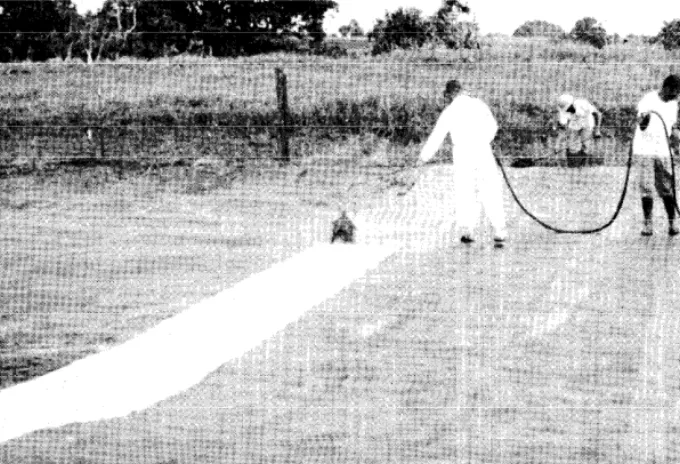
bonded into a continuous mat 36 to 72 inches wide with a polyester resin sizing which softens when treated with asphalt. Starting on the lower berm of the catch- ment, the fiberglass is unrolled in a strip transverse to the slope with the lower edge extending into the bottom of the anchor trench. The ends of this fiberglass strip and subsequently laid strips must also extend into the side trenches. Care should be taken to avoid wrinkles. The fiberglass is then coated with l/2 to 3/4 gal of asphalt emulsion per square yard to saturate the mat and bond it to the underlying soil as shown in Figure 4. Both cationic and anionic emulsions with 60% solids have proved satisfactory for this base coat. The asphalt can be applied with standard gear pump asphalt spray equipment, or it can be poured on the fiberglass from buckets and spread with soft-bristled industrial floor brooms. After the first fiberglass strip is coated, the next strip is unrolled, overlapping the first strip about 4 inches, and coated with asphalt. This procedure is continued up the slope until the entire catchment is covered. The asphalt emulsion softens the sizing in the matting, allowing it to conform to minor irregularities in the catchment surface within a few hours. Immediately after this base coat is ap- plied, the trenches around the catchment are partially backfilled to prevent wind from damaging the covering before the asphalt sets and hardens.
The seal coat is applied after the base coat has cured and is no longer tacky. During warm, sunny weather, the base coat will cure in 1 or 2 weeks. Light rainfall during the curing will not ordin- arily damage the base coat, but installa-
tions should be made during clear
SOIL COMPACTED AROUND ROCK\
G
S
ACCEPTABLE ACCEPTABLE NOT ACCEPTABLE Fig. 1. Illustration of acceptable and nonacceptable buried rocks.
weather if possible. During this time, any “fishmouth” wrinkles in lap joints should be repaired to prevent wind or water entry. This is easily done by cutting the wrinkle lengthwise along the center of the wrinkle, pressing the cut edges flat, plac- ing a fiberglass patch over the wrinkle, and saturating the patch with asphalt emulsion.
The seal coat used is a roofing type asphalt-clay emulsion, with a minimum solids content of 48%, guaranteed for 10 years when applied to a roof at a rate of l/3 gal per yd2. The seal coat is applied to the fiberglass by spraying or spreading with brooms at a rate of l/3 to l/2 gal per yd2. Good coverage of lap joints is easier with brooms than with spraying, because the material can be brushed against the laps to fill any small voids. A single, carefully applied seal coat should be adequate for catchment surfaces. Seal coats usually require 2 days of clear, warm weather for curing. Rain can seri- ously damage uncured seal coats. After the seal coat application, the anchor trenches are completely backfilled.
Maintenance of Catchments
All water harvesting structures should
be visited at least every 6 months to make sure float valves, drinking troughs, water storage systems, and catchment surfaces are maintained in good operating condi- tion. A new seal coat will have to be applied to an asphalt-fiberglass catchment surface every 5 to 10 years, depending on the quality of the material used and the care with which it was applied. Exposure of the white fiberglass will indicate the need for a new seal coat. The catchment should be given a light tack coat of cutback asphalt to ensure bonding of the seal coat to the oxidized surface.
Although properly constructed
asphalt-fiberglass catchments are highly
resistant to mechanical damage, such
damage can occur. Holes in the cover are easily repaired with a patch of fiberglass matting saturated with asphalt emulsion. Large patches should also be given a seal coat. Windblown seeds can germinate and grow in any soil accumulating on the lining surface. The plants and soil should be removed. Penetrating-type plants such as yucca (Yucca sp.) or nut sedge (Carex sp.) not removed or killed during plot
preparation can grow up through the
12-18”
P
5-7’--1-3-4’-(
CATCHMEN~
SURFACE5-
15 %
SLOPEh
COLLECTION’ PIPE
F&. 2. Desired shape of berm at lower edge of catchment area.
= CD 4
I
BURIAL
TRENCH I
Fig. 3. Berm shape for sidesof catchment area.
Fig. 4. Laying the fiberglizss mat and spraying with asphalt emulsion.
lining. Small plants can be killed by injecting soil sterilant under the lining. Large plants can be removed by cutting the lining, digging them out, and patching the cut area.
Catchment Construction Costs
Detailed on-site costs for constructing
an asphalt-fiberglass catchment on a
rough, rocky, brush-covered site near Safford, Arizona, are presented in Table 1. Three men spent 7 hours raking cob- bles and debris from the l,lOO-yd2 site after brush clearing, rough smoothing, and berm construction by a bulldozer. Asphalt emulsion was purchased in 55- gallon drums, and the price includes the cost of the drums. Total on-site cost was $1,342. A second catchment, installed on a relatively rock-free, naturally smooth site near Tombstone, Arizona, cost less. The site was prepared by a road grader in 1 hour, with no hand raking, and the asphalt was purchased at a bulk lot price in the user’s drums. On-site cost of this 1 ,l OO-yd’ catchment was $1 ,OS 0. Experi-
ence in constructing nine asphalt-
fiberglass catchments indicates that, by making necessary adjustments in costs of materials, equipment, and wages, the in- formation in Table 1 gives a reasonable estimate of probable construction costs. The total cost of the collected water is also dependent upon water storage costs, land costs, and the precipitation (Cooley et al., 1972; Dedrick et al., 1969).
The above costs do not include site selection, surveying, or travel to and from
the job. These costs will be required for any type of catchment construction. Sim- ilarly, fencing costs are not included. The Tombstone catchment, installed in July 1971, was not fenced because the asphalt- fiberglass is resistant to damage by animal traffic. Observations a year later showed no damage from cattle walking on the catchment surface.
Advantages
Field experience gained in the con- struction of nine water harvesting catch- ments since 1962 has shown that field- fabricated asphalt-fiberglass coverings are
t*
Table 1. Construction costs for l,lOO-yd2
asphalt-fiberglass catchment.
Item
Plot preparation
cost
Bulldozer, 6 hr at $20 Labor, 14 hr at $3.50 Supervision, 10 hr at $6
Soil sterilant Monoborchlorate,
150 lb at 14 cents Labor, 2 hr at $3.50 Supervision, 1 hr at $6
Asphalt-fiberglass Fiberglass 1% oz,
1,200 yd2 at 40 cents SS-2 emulsion, 55 0 gal
at 30 cents Brooms, 3 at $5 Labor, 20 hr at $3.50 Supervision, 10 hr at $6
Seal coat
Roofing emulsion, 370 gal at 60 cents Brooms, 3 at $5 Labor, 8 hr at $3.50 Supervision, 4 hr at $6
Total
$120 49 60 $229
$ 21 7 6 $34
$480
165 15 70 60 $790
$222 15 28 24 $289 --
$1,342
a dependable means of providing water for livestock on many rangeland areas. Catchments can be constructed with this material at an initial cost, including site preparation and labor, of less than $1 .25/yd2.
The asphalt-fiberglass coverings are easy to install, requiring no sophisticated equipment or skills. The material has been successfully installed on surfaces too rough for more conventional-type catch-
ment materials. Maintenance on the
covering is simple and should require less than 3 man-hours per year between seal
Fig.5. Completed asphalt-fiberglass lined catchment and reservoir on Fort Apache Indian
Reservation.