Taking proof-based verified computation a few steps closer to practicality
(extended version)
1Srinath Setty, Victor Vu, Nikhil Panpalia, Benjamin Braun, Muqeet Ali, Andrew J. Blumberg, and Michael Walfish The University of Texas at Austin
Abstract. We describe GINGER, a built system for un-conditional, general-purpose, and nearly practical verifi-cation of outsourced computation. GINGERis based on PEPPER, which uses the PCP theorem and cryptographic techniques to implement an efficient argument system (a kind of interactive protocol).GINGERslashes query costs via protocol refinements; broadens the computa-tional model to include (primitive) floating-point frac-tions, inequality comparisons, logical operafrac-tions, and conditional control flow; and includes a parallel GPU-based implementation that dramatically reduces latency.
1
Introduction
We are motivated byoutsourced computing: cloud com-puting (in which clients outsource computations to re-mote computers), peer-to-peer computing (in which peers outsource storage and computation to each other), volunteer computing (in which projects outsource com-putations to volunteers’ desktops), etc.
Our goal is to build a system that lets a client outsource computation verifiably. The client should be able to send a description of a computation and the input to a server, and receive back the result together with some auxiliary information that lets the clientverifythat the result is cor-rect. For this to be sensible, the verification must be faster than executing the computation locally.
Ideally, we would like such a system to be uncondi-tional,general-purpose, andpractical. That is, we don’t want to make assumptions about the server (trusted hard-ware, independent failures of replicas, etc.), we want a setup that works for a broad range of computations, and we want the system to be usable by real people for real computations in the near future.
In principle, the first two properties above have been achievable for almost thirty years, using powerful tools from complexity theory and cryptography. Interac-tive proofs (IPs) and probabilistically checkable proofs (PCPs) show how one entity (usually called the veri-fier) can be convinced by another (usually called the prover) of a given mathematical assertion—without the verifier having to fully inspect a proof [5, 6, 20, 32]. In our context, the mathematical assertion is that a given computation was carried out correctly; though the proof 1This paper is an extended and revised version of a previous publi-cation [49]. This version includes four Appendices (B–E) that were elided for space, and eliminates an incorrect theoretical claim in the published paper. We thank Alessandro Chiesa, Yuval Ishai, Nir Bi-tanksy, and Omer Paneth for noticing the error and bringing it to our attention.
is as long as the computation, the theory implies— surprisingly—that the verifier need only inspect the proof in a small number of randomly-chosen locations or query the prover a relatively small number of times.
The rub has been the third property: practicality. These protocols have required expensive encoding of compu-tations, monstrously large proofs, high error bounds, prohibitive overhead for the prover, and intricate con-structions that make the asymptotically efficient schemes challenging to implement correctly.
However, a line of recent work indicates that ap-proaches based on IPs and PCPs are closer to practicality than previously thought [22, 47, 48, 53]. More generally, there has been a groundswell of work that aims for poten-tially practical verifiable outsourced computation, using theoretical tools [11, 12, 21, 25, 26].
Nonetheless, these works have notable limitations. Only a handful [22, 47, 48, 53] have produced work-ing implementations, all of which impose high costs on the verifier and prover. Moreover, their model of com-putation is arithmetic circuits over finite fields, which represent non-integers awkwardly, control flow ineffi-ciently, and comparisons and logical operations only by degenerating to verboseBooleancircuits. Arithmetic cir-cuits are well-suited to integer computations and numeri-cal straight line computations (e.g., multiplying matrices and computing second moments), but the intersection of these two domains leaves few realistic applications.
This paper describes a built system, called GINGER, that addresses these problems, thereby taking general-purpose proof-based verified computation several steps closer to practicality. GINGER is an efficient argument system [37, 38]: an interactive proof system that assumes the prover to be computationally bounded. Its starting point is thePEPPERprotocol [48] (which is summarized in Section 2).GINGER’s contributions are as follows.
(1)GINGERslashes query costs (§3).GINGERreduces costs by trading off more queries that are cheap for fewer of a more expensive type (keeping the total number of queries roughly the same); the justification for the sound-ness of this trade is rooted in a careful revisiting of the PCP’s soundness and its sources of overhead. GINGER also slashes network costs by orders of magnitude, by compressing queries.
condi-tional control flow. Moreover, we have a compiler (de-rived from Fairplay [40]) that transforms computations expressed in a general-purpose language to an executable verifier and prover. The core technical challenge is rep-resenting computations as additions and multiplications over a finite field (as required by the verification proto-col); for instance, “not equal” and “if/else” do not obvi-ously map to this formalism, inequalities are problematic because finite fields are not ordered, and fractions com-pound the difficulties. GINGER overcomes these chal-lenges with techniques that, while not deep, require care and detail. These techniques should apply to other proto-cols that use arithmetic constraints or circuits.
(3)GINGERexploits parallelism to slash latency (§5). The prover can be distributed across machines, and some of its functions are implemented in graphics hardware (GPUs). Moreover, GINGER’s verifier can use a GPU for its cryptographic operations. Allowing the verifier to have a GPU models the present (many computers have GPUs) and a plausible future in which specialized hard-ware for cryptographic operations is common.2
We have implemented and evaluated GINGER (§6). Compared toPEPPER[48], its base,GINGERlowers net-work costs by 1–2 orders of magnitude (to hundreds of KB or less in our experiments). The verifier’s costs drop by multiples, depending on the cost of encryption; if we model encryption as free, the verifier can gain from out-sourcing when batch-verifying 740 computations (down from 2800 in PEPPER). The prover’s CPU costs drop by about a factor of 2, and our parallel implementa-tion reduces latency with near-linear speedup. Comput-ing with rational numbers in GINGER is roughly two times more expensive than computing with integers, and arithmetic constraints permit far smaller representations than a naive use of Boolean or arithmetic circuits.
Despite all of the above, GINGER is not quite ready for the big leagues. However,PEPPERandGINGERhave made argument systems far more practical (in some cases improving costs by 20 or more orders of magnitude over a naive implementation). We are thus optimistic about ultimately achieving true practicality.
2
Problem statement and background
Problem statement. A computerV, known as the veri-fier, has a computationΨand some desired inputxthat it wants a computerP, known as theprover, to perform. Preturnsy, the purported output of the computation, and thenV andP conduct an efficient interaction. This in-teraction should be cheaper forV than locally comput-ingΨ(x). Furthermore, ifPreturned the correct answer, it should be able to convinceV of that fact; otherwise, 2One may wonder why, if the verifier has this hardware, it needs to outsource. GPUs are amenable only to certain computations (which include the cryptographic underpinnings ofGINGER).
Vshould be able to reject the answer as incorrect, with high probability. (The converse will not hold: rejection does not imply thatPreturned incorrect output, only that it misbehaved somehow.) Our goal is that this guarantee beunconditional: it should hold regardless of whether Pobeys the protocol (given standard cryptographic as-sumptions aboutP’s computational power). IfPdeviates from the protocol at any point (computing incorrectly, proving incorrectly, etc.), we call itmalicious.
2.1 Tools
In principle, we can meet our goal using PCPs. The PCP theorem [5, 6] says that if a set of constraints is satisfi-able (see below), there exists aprobabilistically check-ableproof (a PCP) and a verification procedure that ac-cepts the proof after querying it in only a small number of locations. On the other hand, if the constraints cannot be satisfied, then the verification procedure rejectsany purported proof, with probability at least 1−.
To apply the theorem, we represent the computation as a set of quadratic constraints over a finite field. A quadratic constraintis an equation of total degree 2 that uses additions and multiplications (e.g.,A·Z1+Z2−
Z3 ·Z4 = 0). A set of constraints is satisfiable if the variables can be set to make all of the equations hold simultaneously; such an assignment is called a satisfy-ing assignment. In our context, a set of constraintsCwill have a designated input variableX and output variable Y (this generalizes to multiple inputs and outputs), and
C(X =x,Y = y)denotesC with variableXbound tox andYbound toy.
We say that a set of constraints C isequivalent to a desired computationΨif: for allx,y,C(X=x,Y =y)is satisfiable if and only ify= Ψ(x). As a simple example, increment-by-1 is equivalent to the constraint set{Y =
Z+1,Z = X}. (For convenience, we will sometimes refer to a given inputxand purported outputyimplicitly in statements such as, “If constraints C are satisfiable, thenΨexecuted correctly”.) To verify a computationy= Ψ(x), one could in principle apply the PCP theorem to the constraintsC(X=x,Y =y).
Unfortunately, PCPs are too large to be transferred. However, if we assume a computational bound on the proverP, then efficient argumentsapply [37, 38]:V is-sues its PCP queries toP(soVneed not receive the entire PCP). For this to work,Pmust commit to the PCP be-foreseeingV’s queries, thereby simulating a fixed proof whose contents are independent of the queries.Vthus ex-tracts a cryptographic commitment to the PCP (e.g., with a collision-resistant hash tree [42]) and verifies thatP’s query responses are consistent with the commitment.
lin-ear PCPs, the PCP itself is a linear function: the verifier submits queries to the function, and the function’s out-puts serve as the PCP responses. Ishai et al. thus design alinear commitment primitivein whichPcan commit to a linear function (the PCP) and V can submit function inputs (the PCP queries) toP, getting back outputs (the PCP responses) as ifPitself were a fixed function.
PEPPER [48] refines and implements the outline above. In the rest of the section, we summarize the lin-ear PCPs thatPEPPERincorporates, give an overview of PEPPER, and provide formal definitions. Additional de-tails are in Appendix A.1.
2.2 Linear PCPs, applied to verifying computations Imagine thatVhas a desired computationΨand desired inputx, and somehow obtains purported outputy. To use PCP machinery to check whethery= Ψ(x),V compiles
Ψinto equivalent constraintsC, and then asks whether
C(X = x,Y = y)is satisfiable, by consulting anoracle π: a fixed function (that depends onC,x,y) thatV can query. Acorrectoracleπis the proof (or PCP);Vshould accept a correct oracle and reject an incorrect one.
A correct oracleπ has three properties. First,πis a linear function, meaning thatπ(a) +π(b) =π(a+b)for alla,bin the domain ofπ. A linear functionπ:Fn→F is determined by a vectorw; i.e.,π(a) = ha,wifor all a ∈ Fn. Here,Fis a finite field, and ha,bidenotes the inner (dot) product of two vectorsaandb. The parameter nis the size ofw; in general,nis quadratic in the number of variables in C [5], but we can sometimes tailor the encoding ofwto makensmaller [48].
Second, one set of the entries inwmust be a redundant encoding of the other entries. Third,wencodes the actual satisfying assignment toC(X=x,Y =y).
A surprising aspect of PCPs is that each of these prop-erties can be tested by making a small number of queries toπ; ifπis constructed incorrectly, the probability that the tests pass is upper-bounded by > 0. For instance, a key test—we return to it in Section 3—is the linear-ity test[17]:V randomly selectsq1andq2 fromFn and checks ifπ(q1)+π(q2) =π(q1+q2). The other two PCP tests are thequadratic correction testand thecircuit test. The completeness and soundness properties of linear PCPs are defined in Section 2.4. A detailed explanation of why the mechanics above satisfy those properties is outside our scope but can be found in [5, 13, 35, 48]. 2.3 Our base:PEPPER
We now walk through the three phases of PEPPER[48], which is depicted in Figure 1. The approach is to com-pose alinear PCPand alinear commitment primitivethat forces the prover to act like an oracle.
Specify and compute. Vtransforms its desired compu-tation,Ψ, into a set of equivalent constraints,C.Vsends
x y
Enc(r)
y ←Ψ(x)
q1, q2, ..., qµ, t
prover (P)
Enc(π(r))
consistency test
π(q1), …, π(qµ), π(t) linear PCP verifier
linearity test π(q1), …, π(qµ)
q1, q2, ..., qµ r
π(r)
t
π(t)
quad. test circuit test
verifier (V)
π
Figure 1—ThePEPPERprotocol [48], which isGINGER’s base.
Though not depicted, many of the protocol steps happen in par-allel, to facilitate batching.
Ψ(orC) toP, orPmay come with them installed. To gain from outsourcing,Vmust amortize the costs of compilingΨtoCand generating queries. Thus,Vverifies computations in batches [48] (although they need not be executed in a batch). Abatch(of sizeβ) refers to a set of computations in whichΨis the same but the inputs are different; a member of the batch is called aninstance. In the protocol,V has inputsx1,. . .,xβ that it sends to P(not necessarily all at once), which returnsy1,. . .,yβ; for each instancei,yiis supposed to equalΨ(xi).
For each instancei, an honestPstores a proof vector withat encodes a satisfying assignment toC(X=xi,Y=
yi);wiis constructed as described in Section 2.2. Being a
vector,wican also be regarded as a linear functionπi—or
an oracle of the kind described above.
Extract commitment. V cannot inspect {πi} directly
(they are functions; written out, they would have an en-try for each value in a huge domain). Instead,Vextracts a commitmentto eachπi. To do so,Vrandomly generates a
commitment vector r∈Fn.Vthen homomorphically
en-crypts each entry ofrunder a public keypkto get a vector Enc(pk,r) = (Enc(pk,r1),Enc(pk,r2),. . .,Enc(pk,rn)).
We emphasize thatEnc(·)need not be fully homomor-phic encryption [28] (which remains unfeasibly expen-sive);PEPPERuses ElGamal [24, 48].
Vsends(Enc(pk,r),pk)toP. IfPis honest, thenπiis
linear, soPcan use the homomorphism ofEnc(·)to com-pute Enc(pk,πi(r)) from Enc(pk,r), without learning
r. P replies with (Enc(pk,π1(r)),. . .,Enc(pk,πβ(r))), which isP’s commitment to{πi}.Vthen decrypts to get
(π1(r),. . .,πβ(r)).
Verify. V now generates PCP queriesq1,. . .,qµ ∈ Fn, as described in Section 2.2.V sends these queries toP, along with aconsistency query t=r+Pµ
j=1αj·qj, where each αj is randomly chosen from F (here, ·represents scalar multiplication).
however, the following steps happenβ times in parallel, using the same queries for each of theβ instances. IfP is honest, it returns(πi(q1),. . .,πi(qµ),πi(t)).V checks
that πi(t) = πi(r) +P
µ
j=1αj·πi(qj); this is known as
theconsistency test. IfPis honest, then this test passes, by the linearity ofπ. Conversely, if this test passes then, regardlessofP’s honesty,Vcan treatP’s responses as the output of an oracle (this is shown in previous work [35, 48]). Thus,V can use {πi(q1),. . .,πi(qµ)} in the PCP
tests described in Section 2.2.
2.4 PCPs and arguments defined more formally The definitions of PCPs [5, 6] and argument systems [20, 32] below are borrowed from [35, 48].
A PCP protocol with soundness error includes a probabilistic polynomial time verifierVthat has access to a constraint setC.Vmakes a constant number of queries to an oracleπ. This process has the following properties: • PCP Completeness.IfCis satisfiable, then there ex-ists a linear function πsuch that, afterV queries π, Pr{VacceptsCas satisfiable} =1, where the proba-bility is overV’s random choices.
• PCP Soundness. If C is not satisfiable, then Pr{VacceptsCas satisfiable} < for allpurported proof functionsπ˜.
An argument(P,V)with soundness errorcomprisesP andV, two probabilistic polynomial time (PPT) entities that take a set of constraintsCas input and provide:
• Argument Completeness.IfCis satisfiable andPhas access to a satisfying assignmentz, then the interac-tion ofV(C)andP(C,z)makesV(C)acceptC’s satis-fiability, regardless ofV’s random choices.
• Argument Soundness.IfCis not satisfiable, then for every malicious PPTP∗, the probability overV’s ran-dom choices that the interaction ofV(C)andP∗(C)
makesV(C)acceptCas satisfiable is less than.
3
Protocol refinements in
GINGERIn principle,PEPPERsolves the problem of verified com-putation. The reality is less attractive: PEPPER’s com-putational burden is high, its network costs are absurd, and its applicability is limited (to straight line numeri-cal computations). Our system,GINGER, mitigates these issues: it lowers costs through protocol refinements (pre-sented in this section), and it applies to a much wider class of computations (as we discuss in Section 4).
GINGER’s protocol refinements reduce CPU costs by changing the composition of queries in the PCP proto-col, and reduce network costs (by orders of magnitude) by compressing queries. Though not surprising theoreti-cally, these refinements are important to practicality, and are rooted in careful inspection of the theory.
Details. GINGER includes three protocol refinements. The first calls for more linearity tests per PCP run, in re-turn for fewer PCP runs. The trade is favorable because linearity tests are cheaper than the other tests; the trade is permissible because the extra linearity tests decrease soundness error in a single run, necessitating fewer runs. In more detail,soundness error(for example,in Sec-tion 2.4) refers to the probability that a protocol or test succeeds when the condition that it is verifying or test-ing is actually false; the ideal is to have a small upper-bound on soundness error. Meanwhile, the soundness of the PCP protocol in Section 2.2 and Appendix A.1 is controlled by the soundness of linearity testing [17]. Specifically, the base analysis proves that if the prover returnsy6= Ψ(x), then the prover survives all tests (lin-earity, quadratic correction, circuit) with probability less than 7/9, requiringρruns to make(7/9)ρsmall; the 7/9 comes from the soundness of linearity testing.
To simplify slightly, the result of doing more linearity testing per PCP run is to decrease the 7/9 to something smaller (call itκ), at which point a lower value ofρis re-quired to makeκρsmall. The simplification here is that we are ignoring a parameter and some of the subtleties of the analysis; Appendix A.2 contains details. We note that our upper-bound on soundness error is 1 in 2 mil-lion, which is somewhat low by cryptographic standards. However, in practice, this failure rate (when the prover is malicious) is reasonable.
The second protocol refinement inGINGERis to reuse queries. Specifically, some of the queries generated dur-ing linearity testdur-ing can do double-duty as required queries elsewhere in the protocol. This refinement is de-tailed and justified in Appendix A.2 also.
The third refinement saves network costs by compress-ing queries; the verifier sends, in the second round, a short seed, or key. At that point, both the verifier and the prover derive the PCP queries from the seed, by apply-ing a pseudorandom generator to the seed to obtain the required “random” bits. (Note that the verifier still sends a full consistency query to the prover.) While a proof of security of this refinement seems difficult in the standard model (similar issues have been noted by others [50]), this approach admits a natural proof in the random ora-cle model; Appendix A.3 contains details.
Savings. Figure 2 depicts the costs under PEPPER and GINGER. Recall that a PCP run underPEPPERconsists of a linearity test, a quadratic correction test, and a circuit test (§2.2). The queries in each of the tests are roughly the same cost to construct (the cost scales with n, the number of high-order terms in the PCP encoding). How-ever, the circuit test is far more expensive to check: it requires a linear pass over the input and output (which is reflected in the “Process PCP responses” row).
PEPPER[48] GINGER
PCP encoding size (n) s2+s, in general s2+s, in general
V’s per-instance CPU costs
Issue commit queries (e+2c)·n/β (e+2c)·n/β
Process commit responses d d
Issue PCP queries ρpepp·(Q+n·(4c+ (`pepp+1)·f))/β ρging·(Q+n·(2ρlin·c+ (`ging+1)·f))/β
Process PCP responses ρpepp·(2`pepp+|x|+|y|)·f ρging·(2`ging+|x|+|y|)·f
P’s per-instance CPU costs
Issue commit responses h·n h·n
Issue PCP responses (ρpepp·`pepp+1)·f·n (ρging·`ging+1)·f·n
Network cost (per instance) ((ρpepp·`pepp+1)· |p|+|ξ|)·n/β (|p|+|ξ|)·n/β
Upper-bound on soundness error (7/9)ρpepp=9.9·10−7 κρging
=5.8·10−7
|x|,|y|: # of elements in input, output β: batch size (# of instances) (§2.3)
n: # of components in linear functionπ(§2.2) e: cost of encrypting an element inF
s: # of variables in constraint set (§2.1) d: cost of decrypting an encrypted element
χ: # of constraints in constraint set (§2.1) f: cost of multiplying inF
K: # of additive terms in constraints forΨ h: cost of ciphertext add plus multiply
ρlin=15: # of linearity tests per PCP run inGINGER(§A.2) c: cost of pseudorandomly generating an element inF
`pepp=7: # of high-order PCP queries inPEPPER(§A.1) |p|: length of an element inF
`ging=47 (=3·ρlin+2): # of high-order PCP queries inGINGER(§A.2) |ξ|: length of an encrypted element inF
ρpepp=55: # of PCP reps. in base scheme (§A.1) Q=χ·c+K·f: circuit query setup work (§2.2)
ρging=8: # of PCP reps. inGINGER(§A.2) κ: upper-bound on PCP soundness error inGINGER
Figure 2—High-order costs and error inGINGER, compared to its base (PEPPER[48]), for a computation represented asχconstraints
oversvariables (§2.1). The soundness error depends on field size (Appendix A.2); the table assumes|F| = 2128. Many of the
cryptographic costs enter through the commitment protocol (see Section 2.3 or Figure 12); Section 6 quantifies the parameters. The “PCP” rows include the consistency query and check. The network costs slightly underestimate by not including query responses.
Note that whileGINGERdoesmorelinearity queries thanPEPPER,GINGERdoes fewer of the more expensive PCP queries.
number of queries as PEPPER in total (376 high-order queries for GINGER, 385 for PEPPER, for the target soundness of 10−6) but far fewer circuit tests (8 inGIN -GER, 55 in PEPPER). As a result, GINGER has smaller values of β∗, the minimum batch size (§2.3) at which V gains from outsourcing. As shown in Section 6.1, the reduction inβ∗ is roughly a factor of 3. Moreover, the lower costs allow the verifier to gain from outsourcing even when the problem size is small. For example, un-derPEPPER, the fixed costs of the protocol preclude the verifier’s breaking even form×mmatrix multiplication form=100 (because 55·(|x|+|y|) =55·3m2 >m3); GINGER, however, can break even for this computation, with a batch size of 2300.
We note that while both protocols,PEPPERandGIN -GER, perform hundreds of PCP queries, this cost is dom-inated by the cost to construct a single encrypted com-mitment query (becauseeis orders of magnitude larger than the other parameters; see (shown in Appendix E)). In fact, next to that query, the main cost of many PCP queries is in network costs. However,GINGER’s proto-col refinements save 1-2 orders of magnitude in network costs (if we take|p| =128 bits and|ξ| =2·1024 bits, and holdβconstant); see Section 6.1.
4
Broadening the space of computations
GINGER extends to computations over floating-point fractional quantities and to a restricted general-purpose programming model that includes inequality tests, log-ical expressions, conditional branching, etc. To do so, GINGERmaps computations to the constraint-over-finite-field formalism (§2.1), and thus the core protocol in Sec-tion 3 applies. In fact, our techniques3apply to the many protocols that use the constraint formalism or arithmetic circuits. Moreover, we have implemented a compiler (de-rived from Fairplay’s [40]) that transforms high-level computations first into constraints and then into verifier and prover executables.
GER broadens the set of computations soundly and how one can apply the approach to further computations. Framework to map computations to constraints. To map a computationΨover some domainD(such as the integers,Z, or the rationals,Q) to equivalent constraints over a finite field, the programmer or compiler performs three steps, as illustrated and described below:
ΨoverD −−−−→(C1) ΨoverU −−−−→(C2) θ(Ψ)overF y(C3) CoverF C1 Bound the computation.Define a setU ⊂Dand
re-strict the input toΨsuch that the output and interme-diate values stay inU.
C2 Represent the computation faithfully in a suitable fi-nite field.Choose a finite field,F, and a mapθ:U→ Fsuch that computingθ(Ψ)overθ(U) ⊂Fis iso-morphic to computing Ψover U. (By “θ(Ψ)”, we meanΨwith all inputs and literals mapped byθ.) C3 Transform the finite field version of the computation
into constraints.Write a set of constraints overFthat are equivalent (in the sense of Section 2.1) toθ(Ψ).
4.1 Signed integers and floating-point rationals We now instantiate C1 and C2 for integer and rational number computations; the next section addresses C3.
Consider m × m matrix multiplication over N-bit signed integers. For step C1, each term in the output, Pm
k=1AikBkj, has m additions of 2N-bit subterms so is
contained in[−m·22N−1,m·22N−1); this is our setU. For step C2, takeF=Z/p(the integers mod a prime p, to be chosen shortly) and define θ: U → Z/p as θ(u) =umodp. Observe thatθmaps negative integers to{p+21,p+23,. . .,p−1}, analogous to how processors represent negative numbers with a 1 in the most signifi-cant bit (this technique is standard [18, 54]). Of course, addition and multiplication inZ/pdo not “know” when their operands are negative. Nevertheless, the computa-tion overZ/pis isomorphic to the computation overU, provided that|Z/p| > |U| (as shown in Appendix B). Thus, for the givenU, we requirep>m·22N. Note that a largerpbrings larger costs (see Figure 2), so there is a three-way trade-off amongp,m,N.
We now turn to rational numbers. For step C1, we re-strict the inputs as follows: when written in lowest terms, their numerators are (Na +1)-bit signed integers, and
their denominators are in {1, 2, 22, 23,. . ., 2Nb}. Note that such numbers are (primitive) floating-point num-bers: they can be represented asa·2−q, so the decimal
point floats based onq. Now, form×mmatrix multiplica-tion, the computation does not “leave”U={a/b:|a|<
2Na0,b∈ {1, 2, 22, 23,. . ., 2N
0
b}}, forN0
a =2Na+2Nb+
log2mandNb0 =2Nb(shown in Appendix B).
For step C2, we takeF = Q/p, the quotient field of Z/p. Takeθ(ab) = (amodp,bmodp). For anyU⊂Q,
there is a choice ofpsuch that the mapped computation overQ/pis isomorphic to the original computation over Q(shown in Appendix B). For ourUabove,p >2m· 22Na+4Nbsuffices.
Limitations and costs. To understand the limitations of GINGER’s floating-point representation, consider the numbera·2−q, where|a| <2Na and|q| ≤ N
q. To
rep-resent this number, the IEEE standard requires roughly Na+logNq+1 bits [30] while GINGERrequiresNa+
2Nq+1 bits (shown in Appendix B). As a result,GIN
-GER’s range is vastly more limited: with 64 bits, the IEEE standard can represent numbers on the order of 21023and 2−1022(withNa =53 bits of precision) while
64 bits buys GINGERonly numbers on the order of 232 and 2−31 (withN
a = 32). Moreover, unlike the IEEE
standard, GINGERdoes not support a division operation or rounding.
However, comparing GINGER’s floating-point repre-sentation to itsintegerrepresentation, the extra costs are not terrible. First, the prover and verifier take an ex-tra pass over the input and output (for implementation reasons; see Appendix B for details). Second, a larger prime p is required. For example,m×m matrix mul-tiplication with 32-bit integer inputs requires pto have at least log2m+64 bits; if the inputs are rationals with Na =Nq = 32, thenprequires log2m+193 bits. The end-to-end costs are about 2×those of the integers case (see Section 6.2). Of course, the actual numbers depend on the computation. (Our compiler computes suitable bounds with static analysis.)
4.2 General-purpose program constructs
Case study: branch on order comparison. We now il-lustrate C3 with a case study of a computation,Ψ, that includes a less-than test and a conditional branch; pseu-docode forΨis in Figure 3. For clarity, we will restrict
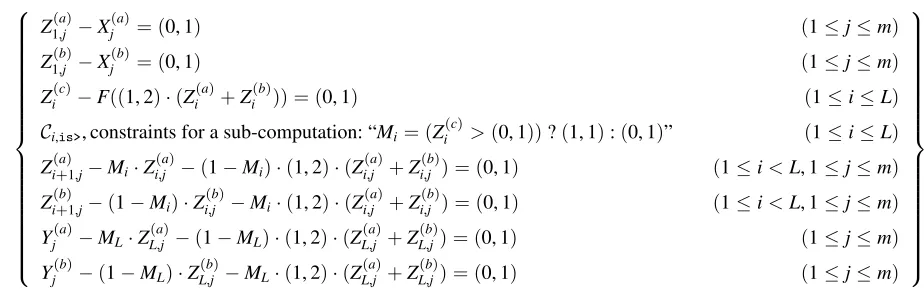
Ψto signed integers; handling rational numbers requires additional mechanisms (see Appendix C).
Ψ:
if (X1 < X2) Y = 3 else
Y = 4
C<=
B0(1−B0) =0,
B1(2−B1) =0,
. . .
. . .
BN−2(2N−2−BN−2) =0,
θ(X1)−θ(X2)−(p−2N−1)−PNi=−02Bi =0
CΨ=
M{C<},
M(Y−3) =0, (1−M){C>=}, (1−M)(Y−4) =0
Figure 3—Pseudocode for our case study ofΨ, and corresponding constraintsCΨ.Ψ’s inputs are signed integersx1,x2; per steps
C1 and C2 (§4.1), we assumex1−x2∈U⊂[−2N−1, 2N−1), wherep>2N. The constraintsC<testx1<x2by testing whether the
bits ofθ(x1)−θ(x2)place it in[p−2N−1,p).M{C}means multiplying all constraints inCbyMand then reducing to degree-2.
other. (Note that the prover need not execute the untaken branch.) Figure 3 depicts the complete set of constraints,
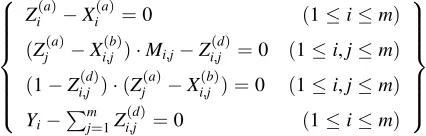
CΨ; these constraints are satisfiable if and only if the prover correctly computesΨ(shown in Appendix C). Logical expressions and conditionals. Besides order comparisons and if-else, GINGERcan represent==,&&, and||as constraints. An interesting case is!=: we can representZ1!=Z2with{M·(Z1−Z2)−1=0}because this constraint is satisfiable when(Z1−Z2)has a multi-plicative inverse and hence is not zero. These constructs and others are detailed in Appendix D.
Limitations and costs. We compile a subset of SFDL, the language of the Fairplay compiler [40]. Thus, our limitations are essentially those of SFDL; notably, loop bounds have to be known at compile time.
How efficient is our representation? The program con-structs above mostly have concise constraint representa-tions. Consider, for instance,comp1==comp2; the equiv-alent constraint setCconsists of the constraints that rep-resentcomp1, the constraints that representcomp2, and an additional constraint to relate the outputs ofcomp1
andcomp2. Thus,C is the same size as its two compo-nents, as one would expect.
However, two classes of computations are costly. First, inequality comparisons require variables and a con-straint for every bit position; see Figure 3. Second, the constraints for if-else and ||, as written, seem to be degree-3; notice, for instance, theM{C<}in Figure 3. To be compatible with the core protocol, these constraints must be rewritten to be total degree 2 (§2.1), which car-ries costs. Specifically, ifC hassvariables andχ con-straints, an equivalent total degree 2 representation of M{C}hass+χvariables and 2·χconstraints (shown in Appendix D).
5
Parallelization and implementation
Many of GINGER’s remaining costs are in the crypto-graphic operations in the commitment protocol (see Ap-pendix A.1). To address these costs, we distribute the prover over multiple machines, leveragingGINGER’s in-herent parallelism. We also implement the prover and verifier on GPUs, which raises two questions. (1) Isn’t this just moving the problem? Yes, and this is good:GPUs are optimized for the types of operations that bot-tleneckGINGER. (2) Why do we assume that theverifier has a GPU? Desktops are more likely than servers to have GPUs, and the prevalence of GPUs is increasing. Also, this setup models a future in which specialized hardware for cryptographic operations is common.
Parallelization. To distributeGINGER’s prover, we run multiple copies of it (one per host), each copy receiving a fraction of the batch (Section 2.3). In this configura-tion, the provers use the Open MPI [2] message-passing library to synchronize and exchange data.
To further reduce latency, each prover offloads work to a GPU (see also [53] for an independent study of GPU hardware in the context of [22]). We exploit three levels of parallelism here. First, the prover performs a cipher-text operation for each component in the commitment vector (§2.3); each operation is (to first approximation) separate. Second, each operation computes two indepen-dent modular exponentiations (the ciphertext of an ElGa-mal encryption has two elements). Third, modular expo-nentiation itself admits a parallel implementation (each input is a multiprecision number encoded in multiple ma-chine words). Thus, in our GPU implementation, a group of CUDA [1] threads computes each exponentiation.
We also parallelize the verifier’s encryption work dur-ing the commitment phase (§2.3), usdur-ing the approach above plus an optimization: the verifier’s exponentiations are fixed base, letting us memoize intermediate squares. As another optimization, we implement simultaneous multiple exponentiation [41, Chapter 14.4], which accel-erates the prover.4
We implement exponentiations for the prover and ver-ifier with thelibgpucryptolibrary of SSLShader [36], modified to implement the memoization.
GINGER’s protocol refinements reduce per-instance network costs by 20–30×(to hundreds of KBs for the computations
we study), prover CPU costs by about a factor of 2, and break-even batch size (β∗) by about 3×. §6.1
With accelerated encryptionGINGERbreaks even from outsourcing short computations at small batch sizes; for 400×400
matrix multiplication, the verifier gains from outsourcing at a batch size of 740. §6.1
Rational arithmetic costs roughly 2×integer arithmetic underGINGER(but much more than native floating-point). §6.2
Parallelizing results in near-linear reduction in the prover’s latency. §6.3
Figure 4—Summary of main evaluation results.
computation (Ψ) O(·) input domain (see §4.1) size ofF s n default local matrix mult. O(m3) 32-bit signed integers 128 bits 2m2 m3 m=200 800 ms matrix mult. (Q) O(m3) rationals (Na=32,Nb=32) 220 bits 2m2 m3 m=100 5.90 ms deg-2 poly. eval. O(m2) 32-bit signed integers 128 bits m m2 m=100 0.40 ms deg-3 poly. eval. O(m3) 32-bit signed integers 192 bits m m3 m=200 160 ms m-Hamming dist. O(m2) 32-bit unsigned 128 bits 2m2+m 2m3 m=100 0.90 ms bisection method O(m2) rationals (Na=32,N
b=5) 220 bits 16·(m+|C<|) 256·(m+|C<|)2 m=25 180 ms
Figure 5—Benchmark computations.sis the number of constraint variables;saffectsn, which is the size ofV’s queries and ofP’s
linear functionπ(see Figure 2). Only high-order terms are reported forn. The latter two columns give our experimental defaults and
the cost of local computation (i.e., no outsourcing) at those defaults. In polynomial evaluation,VandPhold a polynomial; the input
is values for themvariables. The latter two computations exercise the program constructs in Section 4.2. Inm-Hamming distance,
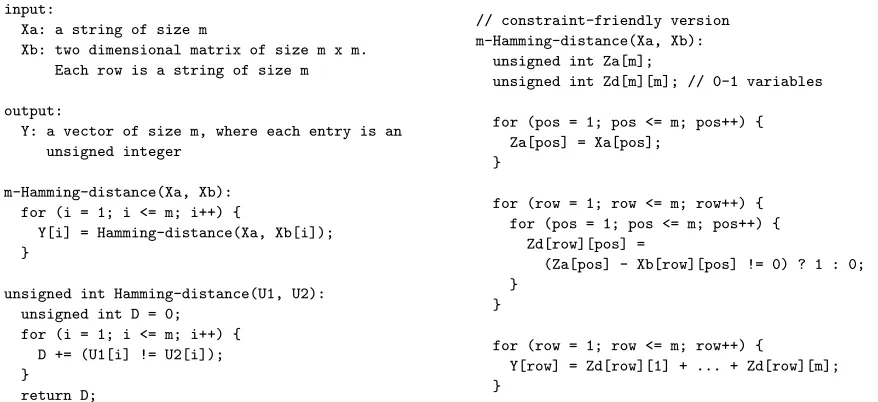
VandPhold a fixed set of strings; the input is a lengthmstring, and the output is a vector of the Hamming distance between the
input and the set of strings. Bisection method refers to root-finding via bisection: bothVandPhold a degree-2 polynomial inm
variables, the input is twom-element endpoints that bracket a root, and the output is a small interval that contains the root.
vokes gcc; this component is 1105 lines of Python code. For efficiency, PEPPER [48] introduced specialized PCP protocols for certain computations. For some exper-iments we use specialized PCPs inGINGERalso; in these cases we write the prover and verifier manually, which typically requires a few hundred lines of C++. Automat-ing the compilation of specialized PCPs is future work.
The verifier and prover are separate processes that ex-change data using Open MPI [2]. GINGERuses the El-Gamal cryptosystem [24] with 1024-bit keys. For gener-ating pseudorandom bits,GINGERuses theamd64-xmm6
variant of the Chacha/8 stream cipher [15] in its default configuration as a pseudorandom generator.
6
Experimental evaluation
Our evaluation answers the following questions: • What is the effect of the protocol refinements (§3)? • What are the costs of supporting rational numbers and
the additional program structures (§4)?
• What isGINGER’s speedup from parallelizing (§5)? Figure 4 summarizes the results.
We use six benchmark computations, summarized in Figure 5 (Appendix E has details). For bisection method and degree-2 polynomial evaluation,V andPwere pro-duced by our compiler; for the other computations, we use tailored encodings (see Section 5). We implemented and analyzed other computations (e.g., edit distance and circle packing) but found thatVgained from outsourcing only at implausibly large batch sizes.
Method and setup. We measure latency and comput-ing cycles used by the verifier and the prover, and the amount of data exchanged between them. We account for the prover’s cost in per-instance terms. Because the verifier amortizes costs over a batch (§2.3), we focus on thebreak-even batch size,β∗: the batch size at which the verifier’s CPU cost fromGINGERequals the cost of com-puting the batch locally. We measure local computation using implementations built on the GMP library (except for matrix multiplication over rationals, where we use na-tive floating-point).
For each result that we report, we run at least three ex-periments and take the averages (the standard deviations are always within 5% of the means). We measure CPU time using getrusage, latency using PAPI’s real time counter [3], and network costs by recording the number of application-level bytes transferred.
Our experiments use a cluster at the Texas Advanced Computing Center (TACC). Each machine is configured identically and runs Linux on an Intel Xeon processor E5540 2.53 GHz with 48GB of RAM. Experiments with GPUs use machines with an NVIDIA Quadro FX 5800. Each GPU has 240 CUDA cores and 4GB of memory.
empiri-100 102 104 106
matrix mult (m=100)
matrix mult (m=200)
d-3 poly eval (m=100)
d-3 poly eval (m=200)
network costs (KB)
input+output input+output
input+output input+output Pepper Pepper Pepper Pepper
Ginger Ginger Ginger Ginger
Figure 6—Per-instance network costs ofGINGERand its base
(PEPPER[48]), compared to the size of the inputs and outputs.
At this batch size (β = 5000),GINGER’s refinements reduce
per-instance network costs by a factor of 20–30 compared to
PEPPER.GINGER’s network costs here are hundreds of KB or less. The y-axis is log-scaled.
PEPPER GINGER
local 4.2 s 4.2 s
CPU
β∗ 4500 1800
verifier aggregate 5.3 hr 2.1 hr prover aggregate 1.7 yr 140 days prover per-instance 3.4 hr 1.8 hr
GPU
β∗ 3600 1300
verifier aggregate 4.3 hr 1.5 hr prover aggregate 1.4 yr 97 days prover per-instance 3.4 hr 1.8 hr
crypto hardware
β∗ 2800 740
verifier aggregate 3.3 hr 52.3 min prover aggregate 1.1 yr 57 days prover per-instance 3.4 hr 1.8 hr
Figure 7—Break-even batch sizes (β∗) and estimated running
times of prover and verifier atβ=β∗, for matrix multiplication
(m = 400), under three models of the encryption cost. The
verifier’s per-instance work is not depicted because it equals the
local running time, by definition ofβ∗. The local running time
is high in part because the local implementation uses GMP.
cal results are at most 2%–15% more than are predicted by the model.
6.1 The effect ofGINGER’s protocol refinements We begin with m × m matrix multiplication (m =
100, 200) and degree-3 polynomial evaluation (m =
100, 200), and batch size ofβ = 5000. We report per-instancenetwork and CPU costs: the total network and CPU costs over the batch, divided byβ.
Figure 6 depicts network costs. In our experiments, these costs for matrix multiplication are about the same as the cost to send the inputs and receive the ouputs; for degree-3 polynomial evaluation, the costs are about 100 times the size of the inputs and outputs (owing to a large problem description, namely allO(m3)coefficients). Per-instance,GINGER’s network costs are hundreds of KB or less, a 20–30×improvement overPEPPER.
In this experiment,GINGER’s prover incurs about 2×
less CPU time compared toPEPPER (estimated using a
mat. mult. mat. mult. (Q)
local 66.3 ms 5.90 ms
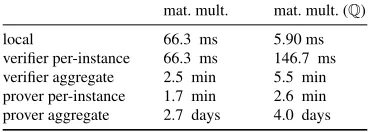
verifier per-instance 66.3 ms 146.7 ms verifier aggregate 2.5 min 5.5 min prover per-instance 1.7 min 2.6 min prover aggregate 2.7 days 4.0 days
Figure 8—Estimated running times ofGINGER’s verifier and
prover for matrix multiplication (m=100), under integer and
floating-point inputs, atβ =2200 (the break-even batch size
for this computation over integers). The “local” row refers to
GMP arithmetic forZand native floating-point forQ.
Han-dling rationals costs 1.5–2.2×(depending on the metric) more
than handling integers, but both are still far from native.
computation (Ψ) # Boolean gates (est.) # constraint vars. m-Hamming dist. 1.3·106 2·104
bisection method 3.0·108 1528
Figure 9—GINGER’s constraints compared to Boolean circuits,
form-Hamming distance (m = 100) and bisection method
(m = 25). The Boolean circuits are estimated using the
un-modified Fairplay [40] compiler.GINGER’s constraints are not
concise but are far more so than Boolean circuits.
cost model from [48]) but still takes tens of minutes per-instance; this is obviously a lot, but we reduce latency by parallelizing (§6.3). For this computation and at this batch size (β = 5000), GINGER’s verifier takes a few hundreds of milliseconds per-instance, less than locally computing using our baseline of GMP.
Amortizing the verifier’s costs. Batching is both a lim-itation and a strength ofGINGER:GINGER’s verifiermust batch to gain from outsourcing butcanbatch to drive per-instance overhead arbitrarily low. Nevertheless, we want break-even batch sizes (β∗) to be as small as possible. Butβ∗mostly depends one, the cost of encryption (Fig-ure 2), because after our refinements the verifier’s main burden is creatingEnc(pk,r)(see §2.3), the cost of which amortizes over the batch.
What values ofemake sense? We consider three sce-narios: (1) the verifier uses a CPU for encryptions, (2) the verifier offloads encryptions to a GPU, and (3) the verifier has special-purpose hardware that canonly per-form encryptions. (See Section 5 for motivation.) Under scenario (1), we measuree=65µs on a 2.53 GHz CPU. Under scenario (3), we takee = 0µs. What about sce-nario (2)? Our cost model concernsCPU costs, so we need an exchange rate between GPU and CPU exponen-tations. We make a crude estimate: we measure the num-ber of encryptions per second achievable on an NVIDIA Tesla M2070 (which is 229,000) and on an Intel 2.55 GHz CPU (which is 15,400), normalize by the dollar cost of the chips, and obtain that their throughput-per-dollar ratio is 2×. We thus takee=65/2=32.5µs.
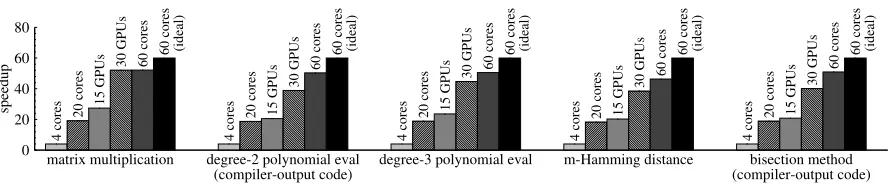
0 20 40 60 80
matrix multiplication degree-2 polynomial eval (compiler-output code)
degree-3 polynomial eval m-Hamming distance bisection method (compiler-output code)
speedup
4 cores 4 cores 4 cores 4 cores 4 cores
20 cores 15 GPUs 20 cores 15 GPUs 20 cores 15 GPUs 20 cores 15 GPUs 20 cores 15 GPUs
30 GPUs
30 GPUs 30 GPUs 30 GPUs 30 GPUs
60 cores 60 cores (ideal) 60 cores 60 cores (ideal) 60 cores 60 cores (ideal) 60 cores 60 cores (ideal) 60 cores 60 cores (ideal)
Figure 10—Latency speedup observed byGINGER’s verifier when the prover is parallelized. We run withm = 100,β = 120
for matrix multiplication;m=256,β =1200 for degree-2 polynomial evaluation;m=100,β =180 for degree-3 polynomial
evaluation andm-Hamming distance; andm=25,β=180 for bisection method.GINGER’s prover achieves near-linear speedups .
of local computing, and solve forβ∗. The values ofβ∗ are 1800 (CPU), 1300 (GPU), and 740 (crypto hard-ware). We also use the model to predict V’s and P’s costs atβ∗, underPEPPERandGINGER. Figure 7 sum-marizes. The aggregate verifier computing time drops significantly (2.5–3×) under all three cost models. The prover’s per-instance work is mostly unaffected, but as the batch size decreases, so does its aggregate work. 6.2 EvaluatingGINGER’s computational model To understand the costs of the floating-point representa-tion (§4.1), we compare it to two baselines: GINGER’s signed integer representation and the computation exe-cuted locally, using the CPU’s floating point unit. Our benchmark application is matrix multiplication (m =
100). Figure 8 details the comparison.
We also considerGINGER’s general-purpose program constructs (§4). Our baseline isBooleancircuits (we are unaware of efficient arithmetic representations of these constructs). We compare the number of Boolean circuit gatesand the number ofGINGER’s arithmetic constraint variables, since these determine the proving and verify-ing costs under the respective formalisms (see [5, 48]). Taken individually, GINGER’s constructs (<=, &&, etc.) are the same cost or more than those of Boolean cir-cuits (e.g.,||introduces auxiliary variables). However, Boolean circuits are in general far more verbose: they represent quantities by their bits (which GINGER does only when computing inequalities). Figure 9 gives a rough end-to-end comparison.
6.3 Scalability of the parallel implementation To demonstrate the scalability ofGINGER’s paralleliza-tion, we run the prover using many CPU cores, many GPUs, and many machines. We measure end-to-end la-tency, as observed by the verifier. Figure 10 summarizes the results for various computations. In most cases, the speedup is near-linear.
7
Related work
A substantial body of work achieves two of our goals— it is general-purpose and practical—but it makes strong assumptions about the servers (e.g., trusted hardware).
There is also a large body of work on protocols for special-purpose computation. We regard this work as orthogonal to our efforts; for a survey of this land-scape, see [48]. Herein, we focus on approaches that are general-purpose and unconditional.
Homomorphic encryption and secure multi-party protocols. Homomorphic encryption (which enables computation over ciphertext) and secure multi-party pro-tocols (in which participants compute over private data, revealing only the result [34, 40, 56]) provide only pri-vacyguarantees, but one can build on them for verifiable computation. For instance, the Boneh-Goh-Nissim ho-momorphic cryptosystem [19] can be adapted to evaluate circuits, Groth uses homomorphic commitments to pro-duce a zero-knowledge argument protocol [33], and Ap-plebaum et al. use secure multi-party protocols for ver-ifying computations [4]. Also, Gentry’s fully homomor-phic encryption [28] has engendered protocols for verifi-able non-interactive computation [21, 25, 27]. However, despite striking improvements [29, 44, 51], the costs of hiding inputs (among other expenses) prevent any of the aforementioned verified computation schemes from get-ting close to practical (even by our relaxed standards). PCPs, argument systems, and interactive proofs. Ap-plying proof systems to verifiable computation is stan-dard in the theory community [5–7, 10, 16, 32, 37, 38, 43], and the asymptotics continue to improve [13, 14, 23, 46]. However, none of this work has paid much attention to building systems.
Very recently, researchers have begun to explore using this theory for practical verified outsourced computation. In a recent preprint, Ben-Sasson et al. [12] investigate when PCP protocols might be beneficial for outsourcing. Since many of the protocols require representing compu-tations as constraints, Ben-Sasson et al. [11] study im-proved reductions to constraints from a RAM model of computation. And Gennaro et al. [26] give a new charac-terization of NP to provide asymptotically efficient argu-ments without using PCPs.
m domain component CMT-native CMT-GMP GINGER
256 Z verifierprover 40 ms22 min 0.6 s2.5 hr 0.6 s19 min
network 87 KB 0.3 MB 0.2 MB
128 Q verifierprover –– 220 ms41 min 270 ms6.1 min
network – 0.9 MB 0.2 MB
Figure 11—CMT [22] compared toGINGER, in terms of
amor-tizedCPU and network costs (GINGER’s total costs are divided
by a batch size ofβ=5000 instances), form×mmatrix
mul-tiplication. CMT-native uses native data types but is restricted to small problem sizes and domains. CMT-GMP uses the GMP
library for multi-precision arithmetic (as doesGINGER).
system of Ishai et al. [35]. In contrast, Cormode, Mitzen-macher, and Thaler [22] (hereafter, CMT) built upon the protocol of Goldwasser et al. [31], and a follow-up effort studies a GPU-based parallel implementation [53].
Comparison of GINGER and CMT [22, 53]. We compared three different implementations:CMT-native, CMT-GMP, andGINGER. CMT-native refers to the code and configuration released by Thaler et al. [53]; it works over a small field and thereby exploits highly efficient machine arithmetic but restricts the inputs to the compu-tation unrealistically (see Section 4.1). CMT-GMP refers to an implementation based on CMT-native but modified by us to use the GMP library for multi-precision arith-metic; this allows more realistic computation sizes and inputs, as well as rational numbers.
We perform two experiments usingm×mmatrix mul-tiplication. Our testbed is the same as in Section 6. In the first one, we run withm = 256 and integer inputs. For CMT-GMP andGINGER, the inputs are 32-bit unsigned integers, and the prime (the field modulus) is 128 bits. For CMT-native, the prime is 261−1. In the second ex-periment,mis 128, the inputs are rational numbers (with Na =Nb = 32; see Section 4.1), the prime is 220 bits,
and we experiment only with CMT-GMP andGINGER. We measure total CPU time and network cost; for CMT, we measure “network” traffic by counting bytes (the CMT verifier and prover run in the same process and hence the same machine). Each reported datum is an average over 3 sample runs; there is little experimental variation (less than 5% of the means).
Figure 11 depicts the results. CMT incurs a significant penalty when moving from native to GMP (and hence to realistic problem sizes). Comparing CMT-GMP and GINGER, the network and prover costs are similar (al-though network costs for CMT reflect high fixed over-head for their circuit). The per-instance verifier costs are also similar, butGINGERis batch verifying whereas CMT does not need to do so (a significant advantage).
A qualitative comparison is as follows. On the one hand, CMT does not require cryptography, has better
asymptotic prover and network costs, and for some com-putations the verifier does not need batching to gain from outsourcing [53]. On the other hand, CMT applies to a smaller set of computations: if the computation is not ef-ficiently parallelizable or does not naturally map to arith-metic circuits (e.g., it has order comparisons or condi-tionality), then CMT in its current form will be inappli-cable or inefficient, respectively. Ultimately,GINGERand CMT should be complementary, as one can likely ease or eliminate some of the restrictions on CMT by incorporat-ing the constraint formalism together with batchincorporat-ing [52].
8
Summary and conclusion
This paper is a contribution to the emerging area of practical PCP-based systems for unconditional verifi-able computation. GINGER has combined protocol re-finements (slashing query costs); a general computa-tional model (including fractions and standard program constructs) with a compiler; and a massively parallel im-plementation that takes advantage of modern hardware. Together, these changes have brought us closer to a truly deployable system. Nevertheless, much work remains: efficiency depends on tailored protocols, the costs for the prover are still too high, and looping cannot yet be han-dled concisely.
Acknowledgments
Detailed attention from Edmund L. Wong substantially clarified this paper. Yuval Ishai, Mike Lee, Bryan Parno, Mark Silberstein, Chung-chieh (Ken) Shan, Sara L. Su, Justin Thaler, Brent Waters, and the anonymous review-ers gave useful comments that improved this draft. The Texas Advanced Computing Center (TACC) at UT sup-plied computing resources. We thank Jane-Ellen Long, of USENIX, for her good nature and inexhaustible patience. The research was supported by AFOSR grant FA9550-10-1-0073 and by NSF grants 1055057 and 1040083.
We thank Alessandro Chiesa, Yuval Ishai, Nir Bi-tanksy, and Omer Paneth for their careful attention, and for noticing a significant error in a previous version of this paper.
Our code and experimental configurations are avail-able athttp://www.cs.utexas.edu/pepper
References
[1] CUDA (http://developer.nvidia.com/what-cuda). [2] Open MPI (http://www.open-mpi.org).
[3] PAPI: Performance Application Programming Interface. [4] B. Applebaum, Y. Ishai, and E. Kushilevitz. From secrecy to
soundness: efficient verification via secure computation. In ICALP, 2010.
[6] S. Arora and S. Safra. Probabilistic checking of proofs: a new characterization of NP.J. of the ACM, 45(1):70–122, Jan. 1998. [7] L. Babai, L. Fortnow, L. A. Levin, and M. Szegedy. Checking
computations in polylogarithmic time. InSTOC, 1991. [8] M. Bellare, D. Coppersmith, J. H˚astad, M. Kiwi, and M. Sudan.
Linearity testing in characteristic two.IEEE Transactions on Information Theory, 42(6):1781–1795, Nov. 1996.
[9] M. Bellare, S. Goldwasser, C. Lund, and A. Russell. Efficient probabilistically checkable proofs and applications to approximations. InSTOC, 1993.
[10] M. Ben-Or, S. Goldwasser, J. Kilian, and A. Wigderson. Multi-prover interactive proofs: how to remove intractability assumptions. InSTOC, 1988.
[11] E. Ben-Sasson, A. Chiesa, D. Genkin, and E. Tromer. Fast reductions from RAMs to delegatable succinct constraint satisfaction problems. Feb. 2012. Cryptology eprint 071. [12] E. Ben-Sasson, A. Chiesa, D. Genkin, and E. Tromer. On the
concrete-efficiency threshold of probabilistically-checkable proofs.ECCC, (045), Apr. 2012.
[13] E. Ben-Sasson, O. Goldreich, P. Harsha, M. Sudan, and S. Vadhan. Robust PCPs of proximity, shorter PCPs and applications to coding.SIAM J. on Comp., 36(4):889–974, Dec. 2006.
[14] E. Ben-Sasson and M. Sudan. Short PCPs with polylog query complexity.SIAM J. on Comp., 38(2):551–607, May 2008. [15] D. J. Bernstein. ChaCha, a variant of Salsa20.
http://cr.yp.to/chacha.html.
[16] M. Blum and S. Kannan. Designing programs that check their work.J. of the ACM, 42(1):269–291, 1995.
[17] M. Blum, M. Luby, and R. Rubinfeld. Self-testing/correcting with applications to numerical problems.J. of Comp. and Sys. Sciences, 47(3):549–595, Dec. 1993.
[18] D. Boneh and D. M. Freeman. Homomorphic signatures for polynomial functions. InEUROCRYPT, 2011.
[19] D. Boneh, E. J. Goh, and K. Nissim. Evaluating 2-DNF formulas on ciphertexts. InTCC, 2005.
[20] G. Brassard, D. Chaum, and C. Cr´epeau. Minimum disclosure proofs of knowledge.J. of Comp. and Sys. Sciences, 37(2):156–189, 1988.
[21] K.-M. Chung, Y. Kalai, and S. Vadhan. Improved delegation of computation using fully homomorphic encryption. InCRYPTO, 2010.
[22] G. Cormode, M. Mitzenmacher, and J. Thaler. Practical verified computation with streaming interactive proofs. InITCS, 2012. [23] I. Dinur. The PCP theorem by gap amplification.J. of the ACM,
54(3), June 2007.
[24] T. ElGamal. A public key cryptosystem and a signature scheme based on discrete logarithms.IEEE Transactions on Information Theory, 31:469–472, 1985.
[25] R. Gennaro, C. Gentry, and B. Parno. Non-interactive verifiable computing: Outsourcing computation to untrusted workers. In CRYPTO, 2010.
[26] R. Gennaro, C. Gentry, B. Parno, and M. Raykova. Quadratic span programs and succinct NIZKs without PCPs. Apr. 2012. Cryptology eprint 215.
[27] R. Gennaro and D. Wichs. Fully homomorphic message authenticators. May 2012. Cryptology eprint 290.
[28] C. Gentry.A fully homomorphic encryption scheme. PhD thesis, Stanford University, 2009.
[29] C. Gentry, S. Halevi, and N. Smart. Homomorphic evaluation of the AES circuit. InCRYPTO, 2012.
[30] D. Goldberg. What every computer scientist should know about floating-point arithmetic.ACM Computing Surveys, 23(1):5–48,
Mar. 1991.
[31] S. Goldwasser, Y. T. Kalai, and G. N. Rothblum. Delegating computation: Interactive proofs for muggles. InSTOC, 2008. [32] S. Goldwasser, S. Micali, and C. Rackoff. The knowledge
complexity of interactive proof systems.SIAM J. on Comp., 18(1):186–208, 1989.
[33] J. Groth. Linear algebra with sub-linear zero-knowledge arguments. InCRYPTO, 2009.
[34] Y. Huang, D. Evans, J. Katz, and L. Malka. Faster secure two-party computation using garbled circuits. InUSENIX Security, 2011.
[35] Y. Ishai, E. Kushilevitz, and R. Ostrovsky. Efficient arguments without short PCPs. InConference on Computational Complexity (CCC), 2007.
[36] K. Jang, S. Han, S. Han, S. Moon, and K. Park. SSLShader: Cheap SSL acceleration with commodity processors. InNSDI, 2011.
[37] J. Kilian. A note on efficient zero-knowledge proofs and arguments (extended abstract). InSTOC, 1992.
[38] J. Kilian. Improved efficient arguments (preliminary version). In CRYPTO, 1995.
[39] H. Lipmaa. Progression-free sets and sublinear pairing-based non-interactive zero-knowledge arguments. InTCC, 2012. [40] D. Malkhi, N. Nisan, B. Pinkas, and Y. Sella. Fairplay—a secure
two-party computation system. InUSENIX Security, 2004. [41] A. J. Menezes, P. C. van Oorschot, and S. A. Vanstone.
Handbook of applied cryptography. CRC Press, 2001. [42] R. C. Merkle. Digital signature based on a conventional
encryption function. InCRYPTO, 1987.
[43] S. Micali. Computationally sound proofs.SIAM J. on Comp., 30(4):1253–1298, 2000.
[44] M. Naehrig, K. Lauter, and V. Vaikuntanathan. Can homomorphic encryption be practical? InACM Workshop on Cloud Computing Security, 2011.
[45] B. Parno, C. Gentry, J. Howell, and M. Raykova. Pinocchio: Nearly practical verifiable computation. InIEEE Symposium on Security and Privacy, May 2013. To appear.
[46] A. Polishchuk and D. A. Spielman. Nearly-linear size holographic proofs. InSTOC, 1994.
[47] S. Setty, A. J. Blumberg, and M. Walfish. Toward practical and unconditional verification of remote computations. InHotOS, 2011.
[48] S. Setty, R. McPherson, A. J. Blumberg, and M. Walfish. Making argument systems for outsourced computation practical (sometimes). InNDSS, 2012.
[49] S. Setty, V. Vu, N. Panpalia, B. Braun, A. J. Blumberg, and M. Walfish. Taking proof-based verified computation a few steps closer to practicality. InUSENIX Security, Aug. 2012.
[50] H. Shacham and B. Waters. Compact proofs of retrievability. In Asiacrypt, Dec. 2008.
[51] N. Smart and F. Vercauteren. Fully homomorphic SIMD operations. Aug. 2011. Cryptology eprint 133. [52] J. Thaler. Personal communication, June 2012. [53] J. Thaler, M. Roberts, M. Mitzenmacher, and H. Pfister.
Verifiable computation with massively parallel interactive proofs. InUSENIX HotCloud Workshop, June 2012. [54] C. Wang, K. Ren, J. Wang, and K. M. R. Urs. Harnessing the
cloud for securely outsourcing large-scale systems of linear equations. InIntl. Conf. on Dist. Computing Sys. (ICDCS), 2011. [55] D. A. Wheeler. SLOCCount.
Commit+Multidecommit
The protocol assumes an additive homomorphic encryption scheme(Gen,Enc,Dec)over a finite field,F.
Commit phase
Input: Prover holds a vectorw∈Fn, which defines a linear functionπ:Fn→F, whereπ(q) =hw,qi.
1. Verifier does the following:
• Generates public and secret keys(pk,sk)←Gen(1k), where
kis a security parameter.
• Generates vectorr∈R Fnand encryptsrcomponent-wise, soEnc(pk,r) = (Enc(pk,r1),. . .,Enc(pk,rn)).
• SendsEnc(pk,r)andpkto the prover.
2. Using the homomorphism in the encryption scheme, the prover computese←Enc(pk,π(r))without learningr. The prover
sendseto the verifier.
3. The verifier computess←Dec(sk,e), retainingsandr.
Decommit phase
Input: the verifier holdsq1,. . .,qµ∈Fnand wants to obtainπ(q1),. . .,π(qµ).
4. The verifier picksµsecretsα1,. . .,αµ∈RFand sends to the prover(q1,. . .,qµ,t), wheret=r+α1q1+· · ·+αµqµ∈Fn.
5. The prover returns(a1,a2,. . .,aµ,b), whereai,b∈F. If the prover behaved, thenai=π(qi)for alli∈[µ], andb=π(t).
6. The verifier checks:b=? s+α1a1+· · ·+αµaµ. If so, it outputs(a1,a2,. . .,aµ). If not, it rejects, outputting⊥.
Figure 12—The commitment protocol ofPEPPER[48], which generalizes a protocol of Ishai et al. [35].q1,. . .,qµare the PCP
queries, andnis the size of the proof encoding. The protocol is written in terms of an additive homomorphic encryption scheme, but
as stated elsewhere [35, 48], the protocol can be modified to work with a multiplicative homomorphic scheme, such as ElGamal [24].
A
Protocol refinements in
GINGERThis section describes the base protocols (A.1), states and analyzes GINGER’s modifications (A.2), and de-scribes howGINGERcompresses queries to save network costs (A.3). For completeness, we also show that the ver-sion ofGINGERin which we use a pseudorandom func-tion to produce the “random” bits for PCP queries is sound (A.4).
A.1 Base protocols
GINGER uses a linear commitment protocol from PEP -PER[48]; this protocol is depicted in Figure 12.5As de-scribed in Section 2.3, PEPPER composes this protocol and a linear PCP; that PCP is depicted in Figure 13. The purpose of {γ0,γ1,γ2} in this figure is to make a ma-liciously constructed oracle unlikely to pass the circuit test; to generate the{γi},V multiplies each constraint
by a random value and collects like terms, a process de-scribed in [5, 13, 35, 48]. The completeness and sound-ness of this PCP are explained in those sources, and our notation is borrowed from [48]. Here we just assert that the soundness error of this PCP is = (7/9)ρ; that is, if the proofπ is incorrect, the verifier detects that fact with probability greater than 1−. To make≈ 10−6, PEPPERrequiresρ=55.
A.2 GINGER’s PCP modifications
GINGER retains the (P,V) argument system of PEP -PER [48] but uses a modified PCP protocol (depicted in
5LikePEPPER,GINGERverifies in batches (§2.3), which changes the protocols a bit; see [48, Appendix C] for details.
Figure 14) that makes the following changes to the base PCP protocol (Figure 13):
• Recycle queries [9].
• Amplify linearity queries and tests. • Make fewer PCP runs.
We analyze the soundness of these changes below. Al-though this analysis is not a theoretical contribution (it is an application of well-known techniques), we include it below for two reasons. The first is completeness. The second is that the choice of parameters (e.g., the number of repetitions of each kind of test) requires care, so it is worthwhile to “show our work.”
Lemma A.1(Soundness of GINGER.). The soundness error ofGINGERis upper-bounded by
G=κρ+2·µ·(23
p
9/2+1)· 3 s
1
|F| +S,
whereκwill be constrained below,µis the number of PCP queries, andSis the error from semantic security.
prob-The linear PCP from [5]
Loopρtimes:
• Generate linearity queries: Select q1,q2 ∈R Fs and
q4,q5 ∈RFs
2
. Takeq3←q1+q2andq6←q4+q5.
• Generate quadratic correction queries: Selectq7,q8 ∈R Fs
andq10∈RFs
2
. Takeq9←(q7⊗q8+q10).
• Generate circuit queries: Selectq12 ∈R Fsandq14 ∈R Fs
2 .
Takeq11←γ1+q12andq13←γ2+q14.
• Issue queries. Sendq1,. . .,q14 to oracleπ, getting back
π(q1),. . .,π(q14).
• Linearity tests: Check thatπ(q1) +π(q2) =π(q3)and that
π(q4) +π(q5) =π(q6). If not,reject.
• Quadratic correction test: Check that π(q7) ·π(q8) =
π(q9)−π(q10). If not,reject.
• Circuit test: Check that (π(q11)−π(q12)) +
(π(q13)−π(q14)) =−γ0. If not,reject.
IfVmakes it here,accept.
Figure 13—The linear PCP thatPEPPERuses. It is from [5].
The notationx⊗yrefers to the outer product of two vectorsx
andy(meaning the vector or matrix consisting of all pairs of
components from the two vectors). The values{γ0,γ1,γ2}are
described briefly in the text.
ability thatf fails the BLR linearity test [17]. As stated by Bellare et al. [8]:
• IfDist(f) =δ, thenRej(f)≥3δ−6δ2. • IfDist(f)≥ 1
4, thenRej(f)≥ 2 9. Claim A.2. For allδ ∈ {δ|3δ−6δ2 < 2
9and 0≤δ≤ 1
4}, ifRej(f)≤3δ−6δ
2, thenDist(f)≤δ.
Proof. This follows directly from Bellare et al. [8]. Fixδ. Assume to the contrary thatDist(f)> δ. Case I:
Dist(f)< 1
4. ThenRej(f)≥3·Dist(f)−6·(Dist(f)) 2> 3δ−6δ2. Case II: Dist(f) ≥ 1
4. Then Rej(f) ≥ 2 9 > 3δ−6δ2. Thus, both cases lead toRej(f) > 3δ−6δ2, which contradicts the given.
We say thatf isδ-close to linear, ifDist(f)≤ δ. Letδ∗ be the lesser root of 3δ−6δ2=2/9.
Corollary A.3. LetEbe the event thatf passes the BLR test. For 0< δ < δ∗, if Pr{E}>1−3δ+6δ2, thenf is δ-close to linear.
Corollary A.4. Let T refer to a test that performs ρlin independent BLR linearity tests. For δ < δ∗, if Pr{f passesT} > (1−3δ+6δ2)ρlin, then f is δ-close to linear.
Having considered the soundness error of linearity test-ing, we now consider the soundness error of the PCP.
GINGER’s PCP protocol
Loopρtimes:
• Generate linearity queries: selectq4,q5∈RFsandq7,q8 ∈R
Fs
2
. Takeq6←q4+q5andq9←q7+q8. Performρlin−1
more iterations of this step.
• Generate quadratic correction queries, by reusing
random-ness of linearity queries: Takeq1←(q4⊗q5+q7).
• Generate circuit queries, again reusing randomness of
lin-earity queries: Takeq2←γ1+q4. Takeq3←γ2+q8.
• Issue queries. Send(q1,. . .,q3+6ρlin)to oracle π, getting
backπ(q1),. . .,π(q3+6ρlin).
• Linearity tests: Check thatπ(q4) +π(q5) = π(q6) and
π(q7) +π(q8) =π(q9), and likewise for the otherρlin−1
iterations. If not,reject
• Quadratic correction test: Check that π(q4) · π(q5) =
π(q1)−π(q7). If not,reject.
• Circuit test: Check that (π(q2)−π(q4)) +
(π(q3)−π(q8)) =−γ0. If so,accept.
IfVmakes it here,accept.
Figure 14—GINGER’s PCP protocol, which refinesPEPPER’s
protocol (Figure 13). This protocol recycles queries [9] and am-plifies linearity testing.
Claim A.5. Choose 0< δ < δ∗. Chooseκ >max{(1−
3δ+6δ2)ρlin, 4δ+2/|
F|}. If a purported proof oracleπfor constraintsCpasses one iteration of the tests in Figure 14 with probability≥κ, thenCis satisfiable.
Proof. (Sketch.) From Corollary A.4 and the given, π is δ-close to linear. We can now apply the proof flow that establishes the soundness of linear PCPs, as in [5]. (A self-contained example is in Appendix D of [48].) Specifically, since πisδ-close to linear and the proba-bility of passing the quadratic correction test is greater than 4δ+2/|F|, thenπ’s closest linear function is of the right form. Sinceπ’s closest linear function is of the right form and since sinceπ’s probability of passing the circuit test is greater than 4δ+1/|F|, thenCis satisfiable.
We are able to recycle queries within a PCP run be-cause, as Bellare et al. [9] observe, the preceding analysis does not require that the quadratic correction and circuit tests are independent of the linearity tests.
Claim A.6. The soundness of the PCP in Figure 14 is at least 1−κρ.
Proof. Assume C is not satisfiable. By Claim A.5, the probability that anyπpasses one iteration is less thanκ. This implies that for allπ, the probability of passingρ iterations is less thanκρ.
![Figure 1—The PEPPERThough not depicted, many of the protocol steps happen in par- protocol [48], which is GINGER’s base.allel, to facilitate batching.](https://thumb-us.123doks.com/thumbv2/123dok_us/7884640.1308251/3.612.315.541.67.210/figure-pepperthough-depicted-protocol-protocol-ginger-facilitate-batching.webp)
![Figure 2—High-order costs and error in GINGER, compared to its base (PEPPER [48]), for a computation represented as χ constraintsover s variables (§2.1)](https://thumb-us.123doks.com/thumbv2/123dok_us/7884640.1308251/5.612.74.543.75.346/figure-ginger-compared-pepper-computation-represented-constraintsover-variables.webp)


![Figure 11—CMT [22] compared to GINGERtiplication. CMT-native uses native data types but is restrictedto small problem sizes and domains](https://thumb-us.123doks.com/thumbv2/123dok_us/7884640.1308251/11.612.71.294.71.152/figure-compared-gingertiplication-native-native-restrictedto-problem-domains.webp)