West Texas Range1
Highlight
Behavior of four Angora goats was studied in sixteen observation periods for four seasons on a west Texas range. The goats consistently fed during two definite daylight feeding periods: (a) early morning, and (b) late afternoon to dusk. Bedding generally occurred whenever darkness became evident and little or no feeding activity was observed between that time and daybreak. The four goats differed somewhat in their behavioral activities, but were remarkably similar in their vegetation preference. Seasonal difference seemed to have an imnortant I effect unon both vegetative A preference and behavioral activities.
Un Estudio Sobre las Actividades de Cabras de Angora en un
Pastizal Natural en el Oeste de Texas
Resumen2
Cuatro cabras fueron marcadas y sus actividades fueron observadas a trav& de1 afio. Las cabras mostraron un patrc’m de actividades sistemAtico a travds de1 afio. Empezaron el dia levantkndose y rumiando por un tiempo breve, seguido por una epoca de pas- tore0 de tres horas, luego por 30 minutos de descanso y despuCs pastoreo otra vez hasta mediodia. Tomaron agua y descansaron en la sombra durante medio dia hasta tres horas antes de la puesta de1 sol. Comieron otra vez por tres horas o sea hasta en la noche cuando tomaron agua otra vez y comieron sal, seguido por descanso por toda la noche. Aproximadamente de 34.4% de su tiempo de pastoreo fuC con gramineas y 65.6% fug ramoneo.
result of his observations, suggested the adoption of a system of rotation grazing. Since then many studies have been conducted on the be- havior of cattle. However, despite widespread use of goats, few studies have been conducted on them, and little is known of their behavioral activities.
According to Hughes and Reid (1951), Tribe (1950) reported obser- vations made over 12 consecutive months on the habits of five sheep confined in a l-acre paddock. Rec- ords were kept on one animal in the group. The time occupied in various activities by the one animal assumed to reflect the actions of the group as a whole.
Parece ser que las estaciones de1 afio tienen un importante efecto en la preferencia de1 forraje pastoreado, y las actividades de las cabras.
Animal behavior studies have been conducted to help improve methods of livestock and range management problems. According to Johnstone-Wallace and Kennedy (l944), animal behavior studies began when James Anderson (1797), a Scottish farmer, described certain grazing habits of cattle, and, as a
Hughes and Reid (195 1) recorded the time spent by sheep in various activities during single 24-hr obser- vation periods over several months, extending from August, 1948, to October, 1949. Hughes and Reid were primarily interested in amount of time spent grazing, idling, and traveling.
Strasia et al. (1970) made a study concerning sheep on an alpine range. Strasia’s main objectives were to determine grazing activities, diet, and performance of sheep on alpine ranges and to evaluate these characteristics under herder and herderless management.
l Received December 30, 1970. 2 Por Edmund0 L. Aguirre y Donald L.
Huss, Dept. Zootecnia, I.T.E.S.M., Monterrey, Mexico.
Cory (1927), working in the Ed- wards Plateau section of Texas be- tween 1923 and 1927, developed
some interesting comparisons of GARY D. ASKINS AND EVERETT E. TURNER
Graduate Student and Division Director, Division
of
Range Animal Science and Applied Arts, Sul Ross State University, Alpine, Texas.82
and habits on the range. He fol- lowed and observed the animals only throughout the “animal day.” Cory considered the “animal day” as that period between arising and going to their rest or bedding down at night, apparently because he was convinced that “animals having gone to their rest will stay at rest during the night.” Also, he as- sumed that the balance of the 24-hr period was spent resting. Cory’s greatest interest was in the amount of time spent in various activities such as grazing, resting, ruminating, idling, and drinking water and the differences in time spent on these activities by different kinds of animals.
The objectives of this study were to obtain definite information con- cerning the behavior of Angora goats on the range, and their pref- erence for range forage. To deter- mine this, observations were made on the type of vegetation consumed and the amount of time spent ruminating, watering, salting, rest- ing, feeding, defecating, and urinat- ing. Also, seasonal differences were recorded.
Experimental Procedure The study was conducted over a period of one year so that seasonal differences could be noted. Four in- dividual Angora goats were chosen and labeled A, B, C, and D for convenience in recording data. One observation was made on each in- dividual goat for each different season; summer, fall, winter, and spring. Sixteen total observations were made on dates as indicated in Table 1. When it was possible, two goats were observed at the same time. To accomplish this, the two individual goats had to stay within close range of each other through- out the 24-hr period. This was the case with the fall, winter, and spring observations. During these three seasons it was easy to record the data of two goats as the animals tended to remain together as one main herd.
Table 1. Distribution and dates of observation of goats.
Period and date of observation
Goat SUmmeI Fall winter spring
A 7/26/69
B 10/25/69
C
D
l/IO/70
B 8/16/69
3/28/70
C 10/25/69
D
A l/10/70
C 8/23/69
3/28/70
D II/IS/69
A B
Z/28/70
D g/6/69
5/Z/70
A 11/15/69
B
C Z/28/70 5/Z/70
Texas, seventy miles west of Ozona. The goats were confined to fenced pastures and in which grazing was continuous throughout the year.
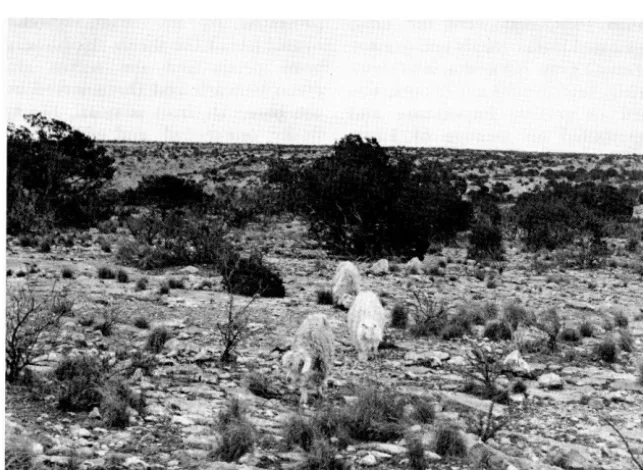
The pasture in which the goats were located is about two and one- half sections in size and is composed of draws that widen as they lengthen and with respect to the upland become deeper so that they are in- cluded between more or less steep slopes that form rocky hillsides and give three types of topography: valleys, slopes, and divides. One main large canyon cuts through the north end of the pasture. The main plants lending character to the range are cedar (.l~ni~erus pin-
chat), prickly pear (Op~ntia engel- manni), mesquite (Prosopis jzkli- flora), shin oak (Q~crcus breviloba),
persimmon (Diospyros texana), cat-
claw (Mimosa biuncifera), lotewood
(Condalia), ocotillo (Foquiera splen- deus), tasajillo (Opuntia lepto- caulis), and evergreen sumac (Rhus ?JiW?LS). The dominant grasses are wrights three-awn (Aristida wrightii) and red grama (lhteloua trifida). Figure 1 is a photograph of the pasture on which the goats grazed during the experiment.
Results and Discussion Feeding Activities of the Goats In order to fully discuss the feeding activities of the goats,
special interest will he placed upon two different classes of feeding: grazing and browsing.
The first classification, grazing, refers to the feeding of range live- stock on herbaceous plants in their natural state. In this particular study, the weeds, grasses, and leaves that had fallen to the ground are considered to have been consumed by grazing rather than browsing. Leaves and grass and weeds and
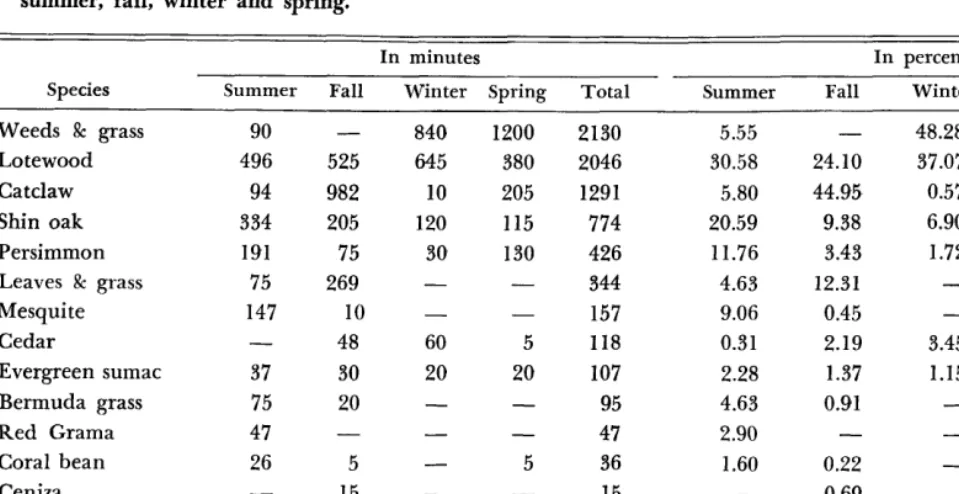
grass are shown as combined data in Table 2. The data were recorded in this manner because even under close observation of the grazing animals, it was difficult to deter- mine what they were grazing. A variety of immature plants that were not readily recognizable made the recording even more difficult. Table 2 presents data for all four goats. The feeding activities of the goats are recorded in minutes and in percentages of the total feeding time. All four goats spent most of their time graring weeds and grass. Goats A, B, C, and D grazed weeds and grass on the average of 39.ZG%, 25.84%, 21.59%, and 23.93% respec- tively, for the total feeding time for the combined observation pe- riods. Table 2 shows that the four goats, together, grazed weeds and grass on the average of 28% for the sixteen study periods. Under this category the major grasses, and weeds were as follows: wrights three-awn, six weeks grama (ISow trloua barb&a), and red grama as grasses, and lindheimer senna (Cas-
sia lindheirneviana), wooly dog-weed
(Dy.rsodia micropoides), tallow-weed
(Plan/ago hell&), and Cmrin T-O-
Table 2. Summary of the feeding activities of the four goats in minutes and percentages of the total feeding time for summer, fall, winter and spring.
Weeds 8c grass Lotewood Catclaw Shin oak Persimmon Leaves & grass Mesquite Cedar
Evergreen sumac Bermuda grass Red Grama Coral bean Ceniza Dagger Sacahuista Oco till0
Total
90
496
94
334 191 75 147 -
37 75 47 26 - - - 5 1622
-
525 982 205 75 269 10 48 30 20 -
5 15 - - -
2184
840 1200 2130
645 380 2046
10 205 1291
120 115 774
30 130 426
- - 344
- - 157
60 5 118
20 20 107
- - 95
- - 47
- 5 36
- - 15
10 - 10
5 - 5
- - 5
1740 2060 7606
5.55 30.58 5.80 20.59 11.76 4.63 9.06 0.31 2.28 4.63 2.90 1.60
- -
0.31
100.00
-
24.10 44.95 9.38 3.43 12.31 0.45 2.19 1.37 0.91 -
0.22 0.69 -
-
100.00
48.28 58.25 37.07 18.45
0.57 9.95
6.90 5.58
1.72 6.32
- - - - 0.57 0.29 - 100.00
-
0.24 0.97 - -
0.24 -
- -
100.90
28.00 26.90 16.97 10.18 5.60 4.52 2.06 1.55 1.41 1.25 0.63 0.48 0.20 0.13 0.06 0.06
100.00
grass which were grazed on an aver- age of 4.52%. The table indicates that leaves and grass were grazed mostly during the fall season. This was possibly caused from more leaves falling to the ground during that time of year. Under this category the major leaves consumed were persimmon, shin oak, lote- wood, and evergreen sumac. The grasses consumed were the same ones listed under weeds and grasses. Bermuda grass (Cynodon dactylon), which grew around a dirt tank, was third in grazing importance and contributed an average of 1.25% to the total feeding time.
The second class, browsing, refers to the feeding by range livestock upon the buds, flowers, fruits, twigs, and foliage of those woody plants commonly recognized as trees or shrubs while these parts remain a part of the plant. This purposely excludes the feeding on fallen foliage and fruit, which was con- sidered as grazing. The oaks, sumacs, and the mesquite tree are common examples of browse plants. In this particular study lotewood, catclaw, and shin oak were the most important browse plants. Each will be discussed in order of importance.
Lotewood (Condalia obtusifolia) is a rigid spiny and much-branched shrub, three to five feet high, of the buckthorn family. It is one of the most abundant shrubs in west- ern and southern Texas, and be- cause of this abundance and the fact that gotats browse its foliage, it is considered an excellent browse plant. The foliage is palatable, but protected by the stout, spinose branchlets of the shrub. Its flowers have petals and the leaves are green beneath and three-nerved at the base. Its fruit is small, black, fleshy, one-seeded, and edible, but not very palatable. Table 2 indi- cates that all four goats spent an average of 26.90% of the total feed- ing time for the combined observa- tion periods browsing upon the foliage of this plant. Goats A, B, and C consumed more lotewood during the observation periods than any of the other browse plants, while Goat D browsed slightly more catclaw; however, most of this was consumed during the fall of the year, whereas lotewood was con- sumed during all four seasons. It appears that all four goats utilized lotewood in a rather uniform man- ner throughout the seasonal periods.
Goats A, B, C, and D browsed lotewood on the average of 26.56%, 29.35%, 29.09%, and 22.73% respec- tively, of the total feeding time. The second most important browse plant was catclaw. Catclaw is a leguminous shrub armed with recurved spines. Its flowers, which are small, are grouped in a head or in a spike. The flowers have either 5 or 10 stamens. The foliage is relished by both goats and sheep, and in spite of the protection af- forded by its spines, it furnishes browse to a considerable extent. Table 2 indicates that all four goats spent an average of 16.97% of the total feeding time for the combined periods of observation, browsing upon catclaw. Average time spent feeding on catclaw for each in- dividual goat was 16.19%, ll.ll%,
17.330/o, and 23.76%. All four goats utilized more catclaw during the fall season and less during the winter season.
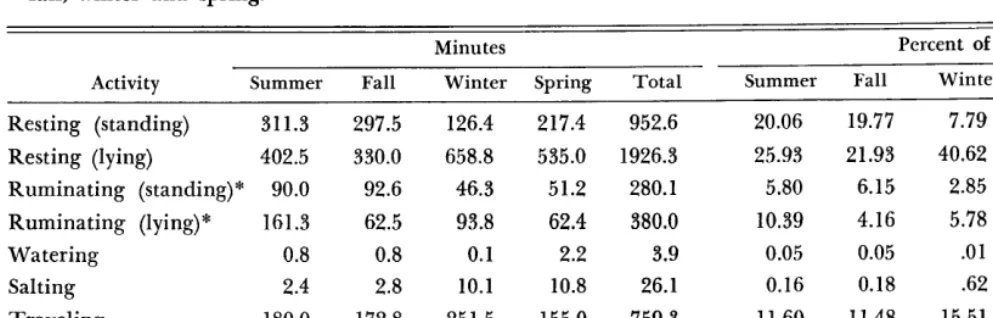
Table 3. Average general activities of the four goats in minutes and in percentages of the total activity for summer, fall, winter and spring.
Minutes Percent of time
Activity Summer Fall Winter Spring Total Summer Fall Winter Spring Total
Resting (standing) 311.3 297.5 126.4 217.4 952.6 20.06
Resting (lying) 402.5 330.0 658.8 535.0 1926.3 25.93
Ruminating (standing)* 90.0 92.6 46.3 51.2 280.1 5.80
Ruminating (lying)* 161.3 62.5 93.8 62.4 380.0 10.39
Watering 0.8 0.8 0.1 2.2 3.9 0.05
Salting 2.4 2.8 10.1 10.8 26.1 0.16
Traveling 180.0 172.8 251.5 155.0 759.3 11.60
Feeding 403.7 546.0 435.0 515.0 1899.7 26.0 1
Total 1552.0 1505.0 1622.0 1549.0 6228.0 100.00
19.77 21.93 6.15 4.16 0.05 0.18 11.48 36.28
100.00
7.79 14.04 15.30
40.62 34.54 30.93
2.85 3.31 4.50
5.78 4.03 6.10
.Ol 0.14 0.06
.62 0.70 0.42
15.51 10.00 12.19
26.82 32.24 30.50
100.00 100.00 100.00
+ The ruminating standing and lying time is included with the resting standing and lying time.
twelve feet tall. The leaves are shal- lowly round-lobed, green and shin- ing above and transiently silvery beneath; the bark is gray to silvery brown and scales off in thin strips. Its acorns are about one-half inch long and are half-included in the cup. At certain times the shin oak appears to be a favorite browse plant for goats. During the four seasons, each of the four individual goats consumed shin oak on a rather uniform basis, just as they did lotewood, but in smaller quan- tity. Goats A and B spent 9.21% and 10.75% of their total feeding time browsing on shin oak, while goats C and D spent an average feeding time of 11.36% and 9.57% browsing on shin oak. Data in- dicate that little variation existed between the four goats while con- suming shin oak. The average total time spent feeding on shin oak for the four goats during the combined observation periods was 10.18%. This was 16.72% less than lotewood and 6.79% less than catclaw.
Other browse plants that were of small importance, but were in- cluded in the diet of the goats, are persimmon, mesquite, cedar, ever- green sumac, and coral bean (So-
phora secundiflora). Average total time spent browsing upon these plants by the four goats was 5.60%, 2.06%, 1.55%, 1.41%, and 0.480/o, respectively (Table 2). Plants that were consumed only in very small
amounts were sacahuista (NoEina texana), ceniza (Leuco~hyllum
fru-
tescens), dagger (Yucca torreyi), and ocotillo. Average total time spent browsing upon these plants by the four goats was .06%, .20%, .13%, and .06%, respectively. Data from the vegetative part of the study in- dicate that goats prefer lotewood, catclaw, shin oak, and persimmon, in that order as browse plants.Feeding time
Feeding time is the time the animals spent on both grazing and browsing. The goats fed in a char- acteristic daily pattern throughout the study. The goats tended to feed in medium sized flocks, and while doing so traveled almost to the back of the pasture, where they made a wide circling turn back to their point of origin. Generally, if the goats started out in early morning from near the water supply, they would make one round trip and then return to water and salt. Each animal day was composed of two major feeding periods. The first major period began with rising about daylight and lasted until lo:30 a.m. Minor feeding periods followed, lasting about an hour each, and occurring around 1l:OO a.m. and 2:30 p.m. The second major period began about three hours before sunset and lasted until darkness. The four goats spent an average of 30.50% (516 min) of their
time feeding during the animal day (Table 3). This is a longer time than the 351 min reported by Cory (1927). On the average, the goats grazed less in the summer and more in the fall than any other time of the year. The former was possibly caused by high temper- atures, which forced the goats to remain in the shade for a longer period of time. The latter was probably caused by late summer rains which provided good forage cover during this time of year. This does not coincide with Cory’s (1927) data, when he reported goats to graze more in the winter and less in the fall. The difference here is possibly due to the condition of the range.
The effect of several extraneous factors on feeding time was con- sidered. Temperature seemed to have some effect. On very hot days the goats preferred to lie down under a shrub or tree until tem- peratures receded, then to graze until after dark and occasionally during the night.
that 34.4% of the feeding time throughout the four seasons of study was spent in grazing while 65.6% was spent in browsing.
Behavioral Activities of the Goats
Ruminating
Determination of ruminating time at night was the most difficult of all observations. Use of a flash- light occasionally disturbed the goats; they either stopped rumi- nating and stared in the direction of the light of they walked away. This difficulty undoubtedly intro- duced errors in the results. Total ruminating time for the four goats comprised about 10.60% of the 24 hr activities for the combined obser- vation periods. A division of the ruminating time for the goats was as follows: 4.50% while standing and 6.10% while lying down (Table 3). Total ruminating time for each individual goat was 11.05% (2.70% standing; 8.35% lying), 12.33% (7.08% standing; 5.25% lying), 9.97% (5.4% standing; 4.50% lying), and 8.86% (2.53% standing; 6.33% lying). Data from Table 3 indicate that the goats did most of their ruminating while standing in the summer months and least in the winter months; this is possibly due to the shortness of the days in the winter, which does not permit as much time for ruminating and conse- quently more of it is done while resting at night. The goats were observed ruminating early in the morning, during the day, and after bedding down at night. The results are in agreement with those from Cory’s study in 1927.
Resting
The data on resting were re- corded as that time when the goats ceased all their activities and laid down to rest, or stood idle. For the combined observation periods of the four goats, 46.23% of the total time was spent resting. Of this, 15.30% was spent while stand- ing, and 30.93% while lying down (Table 3). Goats A, B, C, and D spent total average resting times of 44.56%, 48.43%, 46.48%, and
35.25%, respectively. Table 3 pre- sents data indicating that the goats rested most in the winter months and least in the fall months, and more in the spring than in the summer months. This does not agree with Cory’s data stating that goats do most of their resting in the summer months and least in the winter months. However, both studies do agree on the fact that goats rest more in the spring than in the fall. The difference that exists here could be caused by cli- matic conditions, the condition of the range, the differences in the time that the goats were shorn of their fleeces, or to the variability between individual goats.
During the summer months high temperatures caused the goats to seek protection from the sun by bedding down under some shade tree. At times the animals would remain in the shade for five or six hours during the heat of the day. Nevertheless, when this occurred the animals prolonged their feed- ing activities well along into the night. This is possibly the reason that time spent on summer resting was not any larger. The goats spent most of their resting time lying down in the winter (40.62%) and the least in the fall (21.93%) while they spent most of their resting time (standing) in the sum- mer (20.06%) and the least in the winter (7.75%). The goats were shorn of their fleeces in late sum- mer; this possibly caused the ani- mals to spend more time resting while standing during the summer and early fall periods.
Traveling
Traveling was considered as that time spent walking or running from one place to another. The average daily distance traveled for the four goats was approximately 2.8 miles. Most of the traveling was added when the animals grazed and browsed near the water sup ply. According to Cory (1927), the greater amount of travel by goats is due to the flock’s remaining only a short while in any one locality, no matter how good the feeding
may be. Results from this study agree with Cory’s previous state- ment. Only when the goats were browsing on catclaw and lotewood, did they stay in any one locality for a long period of time. The goats traveled their greatest dis- tance, an average of 3.4 miles, in the winter, as compared to their shortest distance, which was 2.2 miles in the spring. The data agree with Cory’s results, with the ex- ception of the winter period. Cory’s results indicate that goats travel less during the winter period, whereas this study indicates that the animals travel more during the winter period. The variation that exists here is most likely caused by the quantity, as well as the quality of the range forage.
The goats spent 188 min or 12.19% of their 24-hr day traveling (Table 3). The greatest amount of the time spent traveling was during the winter months (251.5 min), and the least during the spring months (155.0 min).
Watering
On a percentage basis for the combined observation periods, the goats spent 0.06% of the animal day drinking water. This is an average of 0.9 min, which is identical with the data reported by Cory (1927). The goats spent most time drinking water in the summer months and the least in the winter months, and more in the spring months than in the fall months. These data also coincide with the results from Cory’s study. Apparently a larger amount of water was drunk during the summer months because of high air temperatures.
the day there, and then return to water and salt during the late afternoon.
Salting
occurred in the spring and least in the winter. The significant differ- ence that occurs here is likely caused by the changes in moisture content of the plants.
Whenever the animals drank water, they also salted from blocks of plain salt located about one hundred feet from the water trough. The goats very seldom licked salt without first drinking water. The average frequency of salting was the same as for drinking, two times daily. The goats licked salt an average of 6.7 min per day or 0.42% of their daily activity. This was 50% more time spent salting than the 3 min reported by Cory (1927). There was a highly signifi- cant difference between the four goats in the time spent on salting. The average time ranged from 3.73 to 10.2 min per day.
Summary and Conclusion A study was conducted on the behavior of Angora goats to deter- mine the type of vegetation con- sumed and the amount of time spent ruminating, watering, salting, traveling, resting, feeding, defecat- ing, and urinating.
Generally the goats walked di- rectly from the pasture to water, and after drinking, walked to the salt block and licked for a few minutes. After licking salt the goats performed other activities such as grazing, ruminating, or resting. The goats took more salt in the spring and winter months, and less in the summer and fall months. This is in parital agree- ment with Cory’s data, when he reported goats taking most salt in the winter months.
The goats tended to follow a sys- tematic behavioral pattern through- out the study period. They began their day by rising, standing idle, and ruminating for a short period of time. This was followed by a feeding period which lasted about three hours. Then a short rest period elapsed, lasting about 30 min, which was followed by a feed- ing period extending until noon. At this time the goats would par- take of water and then recline under a shade tree until approxi- mately three hours before sunset. During this three hours, the animals continued to feed until darkness, when they again took water and salt and then retired for the night.
Defecating and urinating
The goats defecated an average of 3.4 times per day for the total observation periods. Data were col- lected which indicated that the ani- mals defecated most in the spring months. Apparently, this was caused from good forage conditions during this time of year.
The goats spent approximately 12.19% of the day in travel, which is equivalent in time to 189 min. The average daily distance traveled by the goats was 2.8 miles.
The time occupied in the feeding activity for the goats was second to resting time. Feeding activities took 30.50% or 474 min of the ani- mal’s allotted day.
Time spent salting was 0.42% of the animal day consuming water. This is equivalent to 0.9 min in time.
The goats urinated an average All range livestock, in the course of 5.0 times per day. Most urinating of the day, will stand idle or lie
down to rest, and frequently there may be repetitions of this action. Average time spent resting by the four goats for the 24-hr day was 46.23% or 719 min.
Data for rumination, as in rest- ing, include both standing and lying time. Approximately 10.60% of the day was spent by the goats at ruminating, the equivalent in time being 165 min.
Grazing formed slightly more than one-third of the total feeding time for the goats. Weeds and grass were the most commonly grazed plants. Time spent in graz- ing these plants was 28% of the total feeding time.
Browsing constituted approxi- mately two-thirds of the total feed- ing time for the goats. Twelve species were recognized separately as browse plants. Lotewood sup- plied slightly less than one-half of the total browse consumed by the goats.
On the average, defecations and urinations occurred 3.4 and 5.0 times, respectively, for the com- bined observation periods.
Literature Cited
CORY, v. L. 1927. Activities of live- stock on the range. Texas Agr. Exp. Sta. Bull. 367.
HUGHES, G. P., AND D. REID. 1951. Studies on the behavior of cattle and sheep in relation to the utiliza- tion of grass. J. Agr. Sci. 41:350. JOHNSTONE-WALLACE, D. B., AND KEITH
KENNEDY. 1944. Grazing manage- ment practices and their relationship to the behavior and grazing habits of cattle. J. Agr. Sci. 34:191.
STRASIA, C. A., M. THORN, R. W. RICE, AND D. R. SMITH. 1970. Grazing habits, diet and performance of sheep on alpine ranges. J. Range Manage. 23:201-208.
SpecSsfs in Qualify N AT I V E G
R A
S S E S
Wheatgrasses l Bluestems l Gramas l Switchgrasses l Lovegrasses l Buffalo l and Many Others
We grow, haruest, process these seeds Native Grasses Harvested in ten States YouC Inquiries
Appreciated