ISSN 2286-4822
www.euacademic.org DRJI Value: 5.9 (B+)
The Moderating Effect of Budget
Implementation on Statutory Fund Allocation,
Leadership Behaviour, Managerial Accountability
in the Provision of Primary Education
MOHAMMED USMAN1
Department of Local Government and Development Studies Ahmadu Bello University, Zaria, Nigeria KALTHUM BINT HAJI HASAN School of Government, University Utara Malaysia (UUM) Sintok Kedah, Malaysia
Abstract
This study examines the moderating effect of budget implementation on statutory fund allocation, leadership behaviour and managerial accountability in the provision of primary education. The study adopts survey method and the questionnaires were personally administered to primary school teachers. In this survey, 524 teachers were selected using multistage sampling technique. In analysing the data elicited, SPSS 23 and PLS-SEM 3.0 software were employed. The results indicated that Budget implementation significantly affects provision of primary education. Similarly, there is a significant moderating effect of budget implementation on statutory fund allocation in the provision of primary education. However, leadership behaviour and managerial accountability showed insignificant or weak moderating effect on the provision of primary education. There is therefore need for stakeholders in primary education vis-à-vis government, teachers, parents, NGOs and other interest groups to consider budget implementation, statutory fund allocation and how they affect the overall performance of primary education for effective delivery.
Keywords: Budget Implementation, Statutory Fund Allocation, Leadership Behaviour, Managerial Accountability, Provision of Primary Education, Nigeria.
1. INTRODUCTION
The responsibility of providing primary education in Nigeria rests with the local governments. Primary education is one of the most important educational foundations as all other levels of education rest on the foundation built during primary education. It could therefore be said that primary education is key to the success or failure of the educational system (Fajoju, Aluede & Ojugo, 2016). It is therefore vital for local governments to provide qualitative primary education to their people. Education is important as it helps people to gain economic and social achievements and also serve as a catalyst for technological and economic advancement.
The problem of primary education in sub-Saharan Africa and especially in Nigeria, is a problem of neglect by successive governments over a significantly long period of time. Despite increase in primary education enrolment rate due largely to population increase, the region remains one of the most under-developed part of the world (Banya & Elu, 2001).
all, develop the children's ability to adapt to the constantly changing environment (FGN, 1981). In recognising the importance of education, the 1999 Constitution of the Federal Republic of Nigeria, stated that the government shall provide a good and enabling environment in order to develop education based on science and technology which will help in the eradication of illiteracy; education should therefore be compulsory, qualitative and free (Okoroma, 2006).
Several studies were carried on primary education in Nigeria and have made various discoveries and recommendations on how to improve the primary education sector for instance, see Bateman, 2006; Birdsall, Levince & Ibrahim, 2006; Chua & Wing, 2007; Daily News, 2010; Egwu, 2009; Omotayo, Ihebereme & Maduewesi, 2008; UNESCO, 2001). Education being an investment for national development, cannot be ignored especially primary education which serves as the foundational education upon which all over levels of education are built (Fajoju, Aluede, & Ojugo, 2016).
2. LITERATURE REVIEW
2.1 Statutory Fund Allocation
Statutory fund allocation (SFA) is the constitutionally mandated share of federal revenue which is distributed among the three levels of government in Nigeria (Okafor, 2010). The statutory fund allocation which is given to local governments on monthly basis forms the nucleus of the funds used by local governments in Nigeria (Ewetan, 2013; Akindele et al., 2002). It forms the majority of local governments‟ revenues. This means that the backbone or crux of local governments‟ finances in Nigeria rely on statutory fund allocation (Salami, 2011). It is with these finances that local governments provide social welfare services to their people including provision of primary education. There is therefore a relationship between statutory fund allocation which is an independent variable in this study and provision of primary education which is the dependent variable.
forms as much as 90% of their total income (Olatunji, Taiwo, & Adewoye, 2009). This means that substantial part of the finances of the local governments were being provided through SFA (Salami, 2011). Local governments in utilising these finances provide social welfare service to their people including among provision of primary education, which is among the most important services provided by local governments in Nigeria. SFA is therefore very important in the provision of primary education in Kaduna State, Nigeria. Therefore, it is hypothesised that:
H1: There is a positive relationship between Statutory Fund
Allocation and Provision of Primary Education by local governments in Kaduna State.
2.2 Leadership Behaviour
can therefore influence provision of primary education. Therefore, it is hypothesised that:
H2: There is a positive relationship between Leadership
Behaviour and Provision of Primary Education by local governments in Kaduna State.
2.3 Managerial Accountability
Managerial accountability depicts transparency and openness in the conduct of government business (Bovens, 2005). Managerial accountability is very important in the functions of local governments in Nigeria. According to Adeyemi et al. (2012), without managerial accountability at the local governments, development will be stultified. As a result, provision of welfare services at the local government will not be available including the provision of primary education. Due to lack of managerial accountability, many local governments were involved in corrupt practices which depicts very high level of fiscal indiscipline and financial irresponsibility (Agbo, 2010).
Accountability connotes being liable to justify and report all actions and relations on assigned matters or duties to groups or people. It allows for being answerable or liable for person's conduct or actions in office (Lindberg, 2009). When there is managerial accountability, officials should be able to explain and or justify for their actions or be sanctioned (Melena & McNeil, 2010). Managerial accountability improves service delivery as the officials are sure of being sanctioned when they are found wanting in the execution of their responsibilities. Managerial accountability therefore, goes a long way in improving social welfare service delivery especially provision of primary education which is one of the most important functions of local governments in Nigeria. It can be inferred from the above, that service delivery increases with improved managerial accountability. Therefore, it is hypothesised that:
H3: There is a positive relationship between Managerial
2.4 Budget Implementation
Budget is a document which shows government's plan in terms of income and expenditure outlays over a specific period, usually a year (Olurankinse, 2012). At the local government level, budget is the major medium through which financial activities of the government are organised, it is the tool for achieving control objectives, accountability, management and allocation of resources (Bello-Imam, 2010). Budget implementation is the translation or conversion of the planned budget into policy programmes, physical projects and activities.
Budget at the local government level usually undergoes a cycle. From budget conception/ formulation to budget preparation, then budget approval and authorisation, budget implementation and budget review and evaluation. When properly implemented, the outcome of budget is transformed from paperwork and finance record into series of activities which are usually physical. These include programmes, projects and activities or services which can be experienced. Budget implementation therefore has significant impact on organisational performance (Oke, 2013). It can therefore be concluded that there is a relationship between budget implementation and provision of primary education in Kaduna State, Nigeria. Therefore, it is hypothesised that:
H4: There is a positive relationship between Budget
Implementation and Provision of Primary Education by local governments in Kaduna State.
3. Theoretical Framework
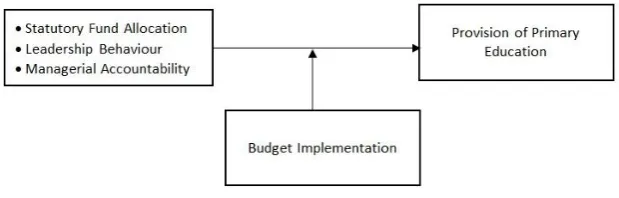
justification for large public investment in education. Public investment in education brings positive economic effects both at micro and macro levels. Investment in education in both developed and developing countries has resulted in economic success and individual achievement (Slottje, 2010). Human capital theory is the most valuable asset for growth and development (Cornachione, 2010; Robert, 2003). Public investment in education also have the potential to end poverty (Schultz, 1962). Based on the hypotheses of this study, a conceptual framework is proposed as shown in Figure 1 below.
4. METHODOLOGY
This study tries to examine the moderating effects of budget implementation on statutory fund allocation, leadership behaviour and managerial accountability in the provision of primary education in Kaduna State of Nigeria. Kaduna State is made up of twenty-three local governments areas. A sample of 9 out of the 23 local governments was drawn. In the determination of the sample size of this study, purposive sampling was chosen from all the stratum thereby making sure that all the population characteristics were represented (Sekaran & Bougie, 2009). Kaduna State has a total of 26,630 primary school teaching staff (Kaduna State Government website, 2018). According to the recommendation of Krejcie & Morgan (1970), the sample size for the population is 379. As corroborated by Comfrey and Lee (1992) and Mohd Ariff Bin Kasim (2012), a sample size of 50 is considered very poor, 100 regarded as poor, 200 is regarded as fair and a sample size of 300 and above is considered as good and adequate.
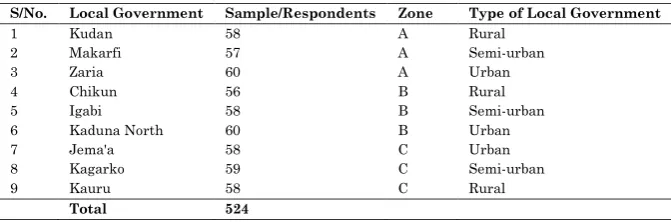
For the purpose of this study, multistage cluster sampling was adopted as it can be difficult to obtain a complete list of members of the population. However, as a complete list of groups or clusters in the population is possible (Creswell, 2012; Vogt, 2005), the local governments in Kaduna State were divided into three clusters, based on geo-political zones, as well as based on their developmental level. On the geopolitical level, the State has been divided into three zones which are; Zones A, B & C. Based on their developmental level, the State is further divided into three types of local governments which are; Urban, Semi-urban and Rural local governments. In clustering the samples, one urban, one semi-urban and one rural local government was selected from each of the 3 geopolitical zones of the State; making a total of 9 local governments as our sample. These 9 local governments were used as the respondents to whom the questionnaires were administered. Simple random sampling was used in determining subsample in each cluster. Simple random sampling was used to select the primary schools and the teachers that participated as respondents in this study (Creswell, 2012). In this study, the data collected from our respondents were analysed using SPSS 23 and PLS-SEM 3.0. Table 1 displays the population, cluster and sample of the study.
Table 1: Population and sample size based on cluster sampling technique
S/No. Local Government Sample/Respondents Zone Type of Local Government
1 Kudan 58 A Rural
2 Makarfi 57 A Semi-urban
3 Zaria 60 A Urban
4 Chikun 56 B Rural
5 Igabi 58 B Semi-urban
6 Kaduna North 60 B Urban
7 Jema'a 58 C Urban
8 Kagarko 59 C Semi-urban
9 Kauru 58 C Rural
Total 524
4.1 Measurement
in this study were adapted from previous studies (Bonica, 2015; Riggio et al., 2010; Salihu, 2010).
5. ANALYSIS AND RESULTS
5.1 Preliminary Analysis and Results
This study has generated a response rate of 79.39% which is considered as high. This agrees with the study of Aminu (2015), Gorondutse (2014) and Shamsudeen et al (2016). Of the 524 questionnaires distributed, 416 were successfully returned of which 27 were isolated as invalid. The remaining 389 questionnaires were then subjected to further analysis, the preliminary analysis revealed that 17 cases were found to be univariate outliers and were therefore deleted. A threshold of ±3.29 was used in checking for the univariate outliers (Tabachnick & Fidell, 2007). The remaining 372 cases were further considered for multivariate outliers. However, no case of multivariate outliers were detected as the highest value is way below the Mahalanobis threshold of multivariate outliers (Tabachnick & Fidell, 2007). Therefore, the remaining 372 cases were retained and used as the valid cases for this study.
In the analysis of non-response bias, the independent sample t-test was compared with Levene‟s test for equality of variance at significance level of 0.05 (Field, 2009; Pallant, 2010). The results obtained indicated that the equal variance has no statistical differences between early and late respondents. Thus, the problem of non-response bias does not exist in this study. This also means that the samples were adequate to represent the entire population and the outcomes can be generalised.
In the analysis of the CMV, an unrotated factor analysis with 100 items was used. The results showed that no single factor accounted for up to 50% of the total variance. The results indicated that there was no single factor that accounted for up to 50% of the total variance. The first factor accounted for 28.716% of the total variance. This result shows that it is far below the threshold of 50% (Lowry & Gaskin, 2014; Podsakoff, MacKenzie, Lee, & Podsakoff, 2003). This implies no existence of CMV in this study and the data were therefore subjected for further statistical analysis.
5.2 Assessment of the Measurement Model
5.2.1 Individual Item Reliability
Table 2: Loadings, Cronbach’s Alpha, Composite Reliability and Average Variance Extracted (AVE).
Items Standardised
Loadings Cronbach's Alpha Composite Reliability Average Variance Extracted (AVE)
Budget Implementation 0.902 0.918 0.504
BI1 0.700
BI10 0.675
BI11 0.655
BI13 0.726
BI14 0.758
BI15 0.709
BI20 0.690
BI3 0.711
BI5 0.715
BI7 0.746
BI9 0.719
Leadership Behaviour 0.901 0.919 0.511
LB1 0.592
LB10 0.553
LB12 0.541
LB13 0.644
LB14 0.821
LB15 0.782
LB16 0.762
LB17 0.747
LB18 0.811
LB19 0.764
LB20 0.771
Managerial Accountability 0.892 0.912 0.509
MA10 0.727
MA11 0.691
MA12 0.752
MA13 0.731
MA14 0.773
MA15 0.632
MA17 0.663
MA4 0.713
MA5 0.683
MA6 0.758
Provision of Primary Education 0.905 0.920 0.514
PPE1 0.675
PPE10 0.686
PPE12 0.673
PPE16 0.738
PPE18 0.707
PPE19 0.782
PPE20 0.789
PPE21 0.676
PPE6 0.673
PPE8 0.707
PPE9 0.764
Statutory Fund Allocation 0.856 0.889 0.504
SFA2 0.585
SFA3 0.757
SFA4 0.668
SFA5 0.819
SFA6 0.806
SFA7 0.736
SFA8 0.639
5.2.2 Convergent Validity
In this study, as recommended by Anderson & Gerbing (1988); Cunningham, Preacher & Banaji (2001) and Hair et al. (2017), the average variance extracted (AVE) of all the latent construct and the outer loadings of all the indicators were used for the examination of convergent validity. The result showed that acceptable values were achieved by all the indicators. The constructs‟ discriminant validities were also tested and Fornell-Larcker criterion was also observed. As explained by Hair et al. (2017), it is used in measuring the discriminant validity by comparing the latent variable of the correlations with the square-root of the average variables extracted (AVEs). When the square-root of the AVEs is higher than its correlation as compared to other reflective latent constructs in the same model of research work, it means that the reflective constructs have discriminant validity (Fornell & Larcker, 1981). In this study, all the all the constructs have attained the required discriminant validity measure as shown in table 3 below.
Table 3: Convergent Validity
Latent Variables BI LB MA PPE SFA
Budget Implementation (BI) 0.710
Leadership Behaviour (LB) 0.692 0.715
Managerial Accountability (MA) 0.709 0.780 0.714
Provision of Primary Education (PPE) 0.702 0.593 0.601 0.717
Statutory Fund Allocation (SFA) 0.596 0.497 0.493 0.631 0.710
5.3 Assessment of the Structural Model
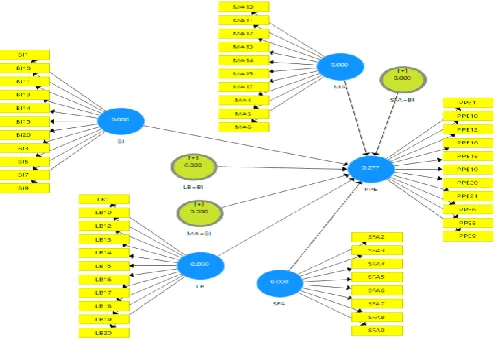
The structural model of this study is assessed by applying the standard bootstrapping procedure employing a total sample of 5000. The essence of this was to assess the significance of the path coefficients (Hair et al., 2017; Henseler, Ringle & Sinkovics, 2009). Table 4 below presents the result of both direct and moderating relationship among the variables of the study. Figure 2 also presents the full research model of this study.
positive relationship is also obtainable between Managerial Accountability (MA) and Provision of Primary Education (PPE) (β = 0.145, t = 2.564 and P<0.01). There is also a significant and positive moderating effect of Budget Implementation (BI) on Provision of Primary Education (PPE) (β = 0.390, t = 5.845 and P<0.01). Consequently, all the hypotheses H1, H2, H3, H4, are accepted.
Table 4: Assessment of the Structural Model
Hypothesis Original Sample β Std. T Stat. P Values Decision Dev.
SFA -> PPE 0.271 0.276 0.054 5.044 0.000* Supported
LB -> PPE 0.177 0.177 0.053 3.304 0.000* Supported
MA -> PPE 0.143 0.145 0.056 2.564 0.005* Supported
BI -> PPE 0.398 0.39 0.068 5.845 0.000* Supported
Note: * means it significant at 0.01 (1-tailed).
Figure 2: Structural model assessment with moderator (full model)
5.4 Variance Explained in the Endogenous Latent Variables (R2)
The coefficient of determination or R2 value, is the percentage of
variable in the Provision of Primary Education (dependent variables) as explained by Budget Implementation (Henseler & Chin, 2010; Hair et al., 2017; Hair et al., 2013). Even though the level of acceptance for R2 depends on the research context, it is recommended that the value
of R2 of 0.27 be considered as substantial, 0.13 as moderate while 0.02
1992; Hair et al., 2010). The R2 achieved in this study is 58%. This is
hence considered as substantially having a predicative accuracy. The result of variance explained (R2) is depicted in table 5 below.
Table 5: Variance explained in the endogenous latent variables (R2)
R Square R Square Adjusted
PPE 0.580 0.575
5.5 Assessment of Effect Size (f2)
The relative effect of Budget Implementation (BI) on the Provision of Primary Education (PPE) is shown by effect size through variations in the f2 (Chin, 1998). Assessment of effect size (f2) with values 0.35, 0.15
and 0.02 are regarded as significant (substantial), moderate and weak respectively. Precisely, the effect size of Budget Implementation (BI) is regarded as moderate (0.131), that of Leadership Behaviour (LB) and Managerial Accountability (MA) are regarded as weak (small) with f2 of 0.007 and 0.010 respectively, while the effect size of
Statutory Fund Allocation (SFA) is regarded as moderate, with f2 of
0.140 also as shown in Table 6 below.
Table 6: Assessment of Effect Size (f2)
Latent Variables Effect Size (f2) Effect
BI 0.131 Moderate
LB 0.007 Small
MA 0.010 Small
SFA 0.140 Moderate
5.6 Assessment of Predictive Relevance (Q2)
In determining the predictive relevance of the model, cross-validated redundancy measure was employed (Hair et al., 2017; Vinzi, Chin, Henseler & Wang, 2010). Table 7 has depicted the Q2 for the Provision
of Primary Education is above zero. As revealed by the Q2 value, it
implies that the model has predictive relevance (Chin, 1998; Hair et al., 2017; Henseler et al., 2009).
Table 7: Assessment of Predictive Relevance (Q2)
SSO SSE Q² (=1-SSE/SSO)
6. DISCUSSION
The purpose of this study is to examine the moderating effect of budget implementation on the relationship between statutory fund allocation, leadership behaviour and managerial accountability on the provision of primary education. The results of the study found a significant and positive effect of budget implementation on provision of primary education. Therefore, the findings of the study suggest that provision of primary education can be improved with proper implementation of budgets on primary education to the letter. Similarly, the findings also imply that the higher the statutory fund allocation to primary education sector, the more likely would be the provision of primary education be enhanced, hence their performance in terms of effectiveness of the primary education system in Nigeria. The findings are in agreement with previous studies that found statutory fund allocation to be significantly and positively affecting provision of primary education (Akindele, 2002; Gupta, Gauri & Khemani, 2004; Olaniyan, & Obadara, 2009; Salihu, 2010; Teboho, 2000). Thus, this denotes that the findings from this study on Provision of Primary Education could contribute to enhancing understanding of the relationship of budget implementation and provision of primary education, especially in a developing nation like Nigeria.
Similarly, budget implementation has a significant and positive moderating effect on the relationship between budget implementation and provision of primary education. The findings of this study point out that budget implementation directly moderates the provision of primary education. The findings provide support for some of the previous studies have established the moderating effect of budget implementation on the provision of primary education (Badri-Harun et al., 2016; Jimoh et al, 2012; Oke, 2013; Osabuohien & Efobi, 2012).
characterised by political and official corruption for personal and non-material gain, personal misconduct, conflicts of interest, violation of procedural due process, gross inefficiency, incompetency, corruption and attempts to cover up mistakes (McKinney & Howard, 1979; Onomode, 2000) cannot adequately support performance and provision of primary education. This has also been confirmed by previous studies (Okaneme, 2017; Uche, 2014).
Equally, there was also has a positive moderating effect of budget implementation on managerial accountability in the provision of primary education. However, the effect is insignificant or weak. This implies that managerial accountability does not necessarily affect provision of primary education. Nevertheless, previous studies have established relationship between managerial accountability and performance (Liberty & Mbaya, 2017; Melena and McNeil, 2010; McKinney & Howard, 1979; Onomode, 2000).
Accordingly, the findings from this study has significantly contributed to knowledge and literature in this field. First by enhancing the understanding of the relationship between budget implementation and provision of primary education. It also contributes to the understanding of the moderating effect of budget implementation on statutory fund allocation, leadership behaviour, managerial accountability in the provision of primary education.
7. CONCLUSION
accountability and provision of primary education and budget implementation and provision of primary education. Finally, it provides implication of each of the variables on the provision of primary education especially to all the stakeholders such as government (at all levels), teachers, parents, NGOs and other interest groups in primary education.
REFERENCES:
1. Akindele, S. T., Olaopa, O. R., & Obiyan, A. S. (2002). Fiscal Federalism and Local Government Finance in Nigeria: An Examination of Revenue Rights and Fiscal Jurisdiction.
International Review of Administrative Sciences, 68(4), 557–
577. https://doi.org/10.1177/0020852302684004
2. Akindele, M. (2002). Political Interference in Primary Education Financing in Nigeria. Kontagora Journal of Education, 5(1-2), 7.
3. Anderson, J. C., & Gerbing, D. W. (1988). Structural equation modeling in practice: A review and recommended two-step approach. Psychological bulletin, 103(3), 411.
4. Badri-Harun, A., Zainol, M. R., Amar, A., & Shaari, Z. H. (2016). Emotional intelligence as mediator between leadership styles and leadership effectiveness: A theoretical framework. International Review of Management and Marketing, 6(1S), 116-121.
5. Banya, K., & Elu, J. (2001). The World Bank and financing
higher education in sub-Saharan Africa. Higher
Education, 42(1), 1-34.
6. Bateman, P., (2006), Quality Assurance mechanisms open, distance e-learning (O-Del). A lead paper presented at a workshop organized by African Virtual University, Kenya in collaboration with Carnegie Corporation and Information Technology and Communication Unit Obafemi Awolowo University, Ile-Ife.
7. Bello-Imam, I. B. (2010). Local Government Finance in Nigeria
8. Birdsall, N., Levince, R., Ibrahim A., (2006) Building gender equality in urban life. Global Urban Research Development Magazine.Vol.2 Issue 1, pp. 9-14.
9. Bonica, A. (2015). Measuring public spending preferences using an interactive budgeting questionnaire. Research &
Politics, 2(2), 2053168015586471.
10. Bovens, M. (2005). The Concept of Public Accountability. In
The Oxford handbook of public management (pp. 182–208).
11. Chin, W. W. (1998). Commentary: Issues and Opinion on Structural Equation Modeling. MIS Quarterly, 22(1), 1.
12. Chua, A., and Wing, I., (2007) Quality assurance in an online education. The Universities 21 global appraisal British Journal of Educational Technology Vol. 38, No. 1 pp 133-152. 13. Cohen, J. (1992). A power primer. Psychological
bulletin, 112(1), 155.
14. Cornachione, E. B. (2010). Investing in Human Capital : Integrating Intellectual Capital Architecture and Utility Theory. The Journal of Human Resource and Adult Learning,
6(1), 29–40. Retrieved from
http://www.hraljournal.com/Page/4 Edgard B. Cornachione, Jr..pdf
15. Cunningham, W. A., Preacher, K. J., & Banaji, M. R. (2001). Implicit attitude measures: Consistency, stability, and convergent validity. Psychological science, 12(2), 163-170. 16. Daily News, (2010), Expansion of Primary Education in
Nigeria. Today News, Thursday, December 30, 2010. Retrieved from www.onlinenigeria.com.
17. Dasgupta, M. (2015). Middle Level Managers and Strategy: Exploring the Influence of Different Roles on Organisational Performance. Journal of General Management, 41(1), 25–43.
18. Duarte, P. A. O. & Raposo, M. L. B. (2010). A PLS model to study brand preference: An application to the mobile phone market. In Handbook of partial least squares (pp. 449-485). Springer Berlin Heidelberg.
20. Embertson, M. K. (2006), „Importance of Middle Managers in Health Care Organizations‟, Journal of Healthcare Management, Vol. 51, No. 4, pp. 223–232.
21. Ewetan, O. O. (2013). Fiscal Federalism in Theory and Practice, 5(1), 1075–1087.
22. Fajoju, S. A., Aluede, O., & Ojugo, A. I. (2016). Parental involvement as a correlate of academic achievement of primary school pupils in Edo State, Nigeria. Research in Education, 95(1), 33–43. https://doi.org/10.7227/RIE.0023 23. Federal Republic of Nigeria (FGN): National Policy on
Education. Federal Government Press, Lagos (1981).
24. Field, A. (2009). Discovering Statistics using SPSS (3rd ed.). London: Sage Publication.
25. Fornell, C. & Larcker, D. (1981). Evaluating structural
equation models with unobservable variable and
measurement error. Journal of Marketing Research, 39–50. 26. Gliem, J. A., & Gliem, R. R. (2003). Calculating, interpreting,
and reporting Cronbach‟s alpha reliability coefficient for Likert-type scales. Midwest Research-to-Practice Conference in Adult, Continuing, and Community Education.
27. Gorondutse, A. H. (2014). Effect of business social responsibility (BSR) on Performance of SMEs in Nigeria. 28. Gupta, M. D., Gauri, V., & Khemani, S. (2003). Decentralized
Delivery of Primary Health Services in Nigeria. Africa Region Human Development Working Paper Series Washington, DC,
The World Bank.
29. Hair, J. F., Anderson, R. E., Babin, B. J. & Black, W. C. (2010). Multivariate data analysis: A global perspective (Vol. 7). Upper Saddle River, NJ: Pearson.
30. Henseler, J., & Chin, W. W. (2010). A comparison of approaches for the analysis of interaction effects between latent variables using partial least squares path modelling. Structural Equation Modelling, 17(1), 82-109. 31. Henseler, J., Ringle, C. M. & Sinkovics, R. R. (2009). The Use
of Partial Least Squares Pathe Modelling in International Marketing. Advances in International Marketing, 20, 277–319. 32. Huy, Q. N. (2011), „How middle managers‟ group-focus
33. influence strategy implementation‟, Strategic Management Journal, Vol. 32, No. 13,pp. 1387–1410
34. Jimoh, Yekeen Adebayo; Olayide, Raji & Saheed, O. (2012). Influence of Leadership Styles and Emotional Intelligence on Job Performance of Local Government Workers in Osun State , Nigeria, 3(4), 973–997.
35. Kuyvenhoven, R., & Buss, W. C. (2011). A normative view of the role of middle management in the implementation of strategic change. Journal of Management and Marketing Research, 8, 1.
36. Liberty, S.M. & Mbaya, P.Y. (2017), “Administrative Abuses Affecting Public Accountability in Local Government Administration in Borno State, Nigeria.” Journal of Public Policy and Administration Research, Vol. 7, No. 2.
37. Lindberg, S. I. (2009). Accountability : the core concept and its
subtypes. London.
38. Lowry, P. B., & Gaskin, J. (2014). Partial Least Squares (PLS) Structural Equation Modelling (SEM) for building and testing behavioural causal theory: When to choose it and how to use
it. IEEE transactions on professional communication, 57(2),
123-146.
39. McKinney, J.B. and Howard, L.C. (1979), Public
Administration: Balancing Power and Accountability, Illinois:
Moore Publishing Company, Inc.
40. McNeil, Mary & Malena, Carmen. (2010). Demanding Good Governance: Lessons from Social Accountability Initiatives in Africa. 10.1596/978-0-8213-8380-3.
41. Meng, F. X., Reyes, T. B., Xu, A. G. & Shen, W. (2017). The Electronic Library. The Electronic Library, 35(2), 234–247. 42. National Policy on Education, (2004), Lagos NERDC.
43. Okafor, J. (2010). Local government financial autonomy in Nigeria: The State Joint Local Government Account.
Commonwealth Journal of Local Governance, (6 (July)), 124–
131.
45. Okoroma, N.S. (2006). Educational policies and problems of implementation in Nigeria. Australian Journal of Adult learning, 46 (2), 243-263.
46. Olaniyan, D. A., & Obadara, O. E. (2009). A critical review of management of primary education in Nigeria. International Journal of African & African-American Studies, 7(1).
47. Olatunji, O. C., Taiwo, O. A., & Adewoye, J. O. (2009). A review of revenue generation in Nigeria local government: A case study of Ekiti State. International Business Management.
48. Olurankinse, F. (2012). Due process and budget
implementation: an evaluation of Nigerian public sector auditing. Asian journal of finance and accounting, 4(2), 144-154.
49. Omotayo, D., Ihebereme, M. and Maduewesi, B. U., (2008) Management of Universal Basic Education (UBE) Scheme for Qualitative Education in Nigeria. High Beam Research. 50. Onimode, B. (2000) “Overview of Corruption and Organized
Crime in Africa” (in Eds), Lame, I and Odekunle, F, Fighting Corruption and Organized Crime in Nigeria: Challenges for
the New Millennium, Abuja: Spectrum Books Limited.
51. Pallant, J. (2010). SPSS survival manual, 4th edition. England: McGraw-Hill Education.
52. Podsakoff, P. M., MacKenzie, S. B., Lee, J. Y., & Podsakoff, N. P. (2003). Common method biases in behavioral research: A critical review of the literature and recommended remedies. Journal of applied psychology, 88(5), 879.
53. Riggio, R. E., Zhu, W., Reina, C., & Maroosis, J. A. (2010). Virtue-based measurement of ethical leadership: The Leadership Virtues Questionnaire. Consulting Psychology
Journal: Practice and Research, 62(4), 235.
54. Robert, D. (2003). Public management and sustainable development military and bureaucratic relationship in Nigeria. England: Ashgate publishing limited.
55. Salami, A. (2011). Taxation, revenue allocation and fiscal federalism in Nigeria: Issues, challenges and policy options.
Ekonomski Anali, 56(189), 27–50.
56. Salihu, A.A. (2010). Primary Education and Healthcare Service Delivery by Local Government in Oyo State, Nigeria (Doctoral dissertation). Retrieved from Parpustakaan Sultanah Bahiyah Library, Universiti Utara, Malaysia (UUM).
57. Schultz, T. W. (1962). Reflections on investment in man.
Journal of Political Economy, 70(5(2)), 1–8.
58. Slottje, D. (2010). Human capital measurement: Theory and practice. Journal of Economic Surveys, 24(2), 201–205. https://doi.org/10.111/j.1467-6419.2009.00612.x
59. Sterling, S. (2010). Sustainability education: Perspectives and
practice across higher education. Taylor & Francis.
60. Teboho, M. (2000). Nigeria education sector analysis: An analytical synthesis of performance and main issues. New
Youth University: New York, NY.
61. UNESCO, (2001), General Assembly Resolution and Road map Towards the Implementation of the Millennium Development Declaration. 56th Sessions item 40 of the Provision of the Agenda and Follow-up and the outcome of the Millennium Development Summit. New York.
62. Vinzi, V. E., Chin, W. W., Henseler, J. & Wang, H. (2010).
Perspectives on partial least squares. In Handbook of Partial Least Squares. Springer Berlin Heidelberg
63. Wooldridge, B., Schmid, T. and Floyd, S. W. (2008), „The middle management perspective on
64. strategy process: contributions, synthesis and future research,‟ Journal of Management, Vol.