ISSN 2286-4822 www.euacademic.org
Impact Factor: 3.4546 (UIF) DRJI Value: 5.9 (B+)
A study on systems thinking and practices (STAP)
in Hong Kong as a glocal systems movement
JOSEPH KIM-KEUNG HO Independent Trainer Hong Kong, China
Abstract:
Granted that there have been quite some tertiary education programmes, both business studies and non-business studies-related, running in Hong Kong for many years, there is scantly any study on systems thinking and practices (STAP) in Hong Kong. In this paper, the writer presents some findings, based on Internet search, newspaper article study, a Facebook-based survey and literature review (including the writer’s publications), to unearth a sketchy picture on systems thinking and practices (STAP) in Hong Kong. Overall, the findings indicate both a low level of adoption of STAP in Hong Kong and a substantial interest in learning systems thinking. Moreover, the sense of community on systems thinking in Hong Kong is found to be quite weak. Nevertheless, the writer encourages a glocal way to study and develop STAP in Hong Kong.
Key words: Facebook-based survey, glocal systems movement, systems thinking and practices (STAP), Hong Kong, multiple regression analysis, societal themes (STs)
Introduction
now, as the writer knows, there is no Hong Kong Systems Society that is similar to that in the UK, i.e., the UK Systems Society. Still, sporadic published works on systems thinking by some academics in Hong Kong do come up over the years. Overall, there is scarcely a sense of community of systems thinking among systems thinking intellectuals in Hong Kong. At the same time, as a long-time teacher involved in conducting systems thinking courses in Hong Kong, this writer is aware that quite a substantial group of people in Hong Kong have received tertiary education with systems thinking courses in their education programmes. This prompts the writer to ask: What happens to the systems movement in Hong Kong? On this question, there is as yet no evaluation study on the status of systems thinking and practices (STAP) in Hong Kong. As the writer sees it, finding out such a status is important to inform efforts to develop the systems movement in Hong Kong, and one with unique Hong Kong characteristics. Consequently, such a Hong Kong-based systems movement can reasonably be expected to make valuable contribution to the global systems movement (see Ho (2014a) for a discussion on the topic of systems movement.). This article makes an attempt to gauge the STAP status in Hong Kong based on: (1) Internet search, (2) a brief review of systems thinking publications with a specific Hong Kong context, and (3) a Facebook-based survey on people‟s perceptions of STAP in Hong Kong.
The glocalness of systems thinking and practices (STAP) and the societal themes (STs) of Hong Kong
movement here, is inevitably both global and local - i.e., glocal. On its globalness, this is exemplified by the existence of the International Federation for Systems Research, which provides a global source of systems thinking ideas for learning in Hong Kong1. More specifically, systems thinking and practices in a
certain place, be it a company or a society (e.g., Hong Kong), remains a part of the sub-systems movement to the global systems movement. As to the localness of STAP in Hong Kong, the specific local STAP are influenced by the idiosyncratic, broader social factors (which are discussed as societal themes in this paper) as well as the worldviews of the practitioners involved. In this regard, as critical systems thinking reminds us, STAP should embrace the commitment on social awareness (Jackson, 2003: chapter 14). This social awareness commitment comprises two main ideas: (i) be attentive to “the organizational and societal circumstances that lead to certain systems theories and methodologies being popular… at particular times”, and (ii) be attentive to “the consequences of use of the approaches” employed (Jackson, 2003: chapter 14). To comprehend the value of social awareness commitment of systems thinking and practices, we need to actually study them in a particular place. In this paper, the place that is focused on is Hong Kong2. To
contextualize the discussion of STAP in Hong Kong, some contemporary societal themes (STs) are identified using newspaper article study (Ho, 2015a). The following five themes are illustrative:
Societal theme 1 - The swelling localism (ST1): Localism
is about the “emotional attachment and sense of pride among all Hongkongers” (John Tsang, Financial Secretary, as quoted by Lau (2015).) It becomes increasingly visible since the Umbrella Movement in 2014 (Wordie, 2015). One indication of
1 Two main systems thinking journals are: Systems Research and Behavioral
Science (Wiley) and Systemic Practice and Action Research (Springer).
2 For readers who are not familiar with the city of Hong Kong, it is a Special
localism is the survey finding from the University of Hong Kong Public Opinion Programme that more Hong Kong people identify themselves as Hong kongers than citizens of PRC (Cheung, 2015a).
Societal theme 2 - The white elephant projects of the
government (ST2): A number of governmental infrastructure
projects have generated tremendous controversy. They are called white elephant projects because each of them involves a huge investment that is difficult to maintain and complete (Arora, 2015). Very often, they also create political and legal complications. Examples include: Hong Kong- Shenzhen-Guangzhou Express Rail Link, Hong Kong-Zhuhai-Macao Bridge, West Kowloon Cultural District, Cyberport, East Kowloon Cultural Centre, Lok Ma Chau Shopping mall, TST Waterfront, Kai Tak Cruise Terminal, and the Airport third runway project.
Societal theme 3 - Worsening self-censorship of local
news media (ST3): There is a general public concern that local
news media have practiced self-censorship, which primarily takes the form of reluctance to criticize the Central Government and, to a lesser extent, the Hong Kong Government, see for example, survey finding of the University of Hong Kong Public Opinion Programme (Cheung, 2015b). Recent events of the South China Morning Post bought by Alibaba Group and talks of Ming Pao Daily also being considered to be bought by Alibaba Group (ejinsight.com, 2015a) add to the public worry of self-censorship by local news media.
Societal theme 4 - Deteriorating quality of life (ST4):
(Literature on lead in water problem in Hong Kong (Facebook page) in the bibliography), and corruption of core values of Hong Kong, such as freedom of speech, human rights, rule of law, integrity, transparency and professionalism, etc. (Sunday examiner, 2015).
Societal theme 5 - Changing geographical imagination
(ST5): Used to be considered as Asia‟s World City, Hong Kong is
now gradually perceived as “just another Chinese city” and an “empty marketing shell” (Dodwell, 2015; Gurung, 2015). Meanwhile, Hong Kong, with Shenzhen, is now conceived as main nodes of China‟s planned “Marine Silk Road” (Zhou, 2015). The mission of Hong Kong, as the former Chief Executive of Hong Kong, Tung Chee-hwa sees it, is to “get behind China‟s vision to join the developed world” (Tung, 2015). Based on this official version of geographical imagination on Hong Kong, the city has “no future unless it can figure out a way to coexist with the mainland” (Lo, 2015). The present official geographical imagination is undoubtedly a concern to those who adhere to localism (ST1), many of whom are young people (Lo, 2015). This is especially the case when the recommended form of “co-existence” is corrupting to the core values of Hong Kong.
Some observations on systems thinking and practices (STAP) in Hong Kong
One way to glean systems thinking and practices (STAP) in Hong Kong is to conduct an Internet search on: (1) publications on STAP in Hong Kong or related to the Hong Kong setting, (2)
systems thinking-related training and educational
programmes, and (3) dedicated systems thinking-related conference and social networking activities. Findings by the writer are as follows (re: Hong Kong Systems Society Facebook group in the bibliography):
(1) Publications on systems thinking and practices (STAP1):
Examples include: (i) conceptual model development for energy and utility management with a soft systems approach (Ngai et al., 2011), (ii) integration of systems science methods and object-oriented analysis for organizational information requirements (Lai, 2000), (iii) soft systems modeling for information source analysis (Gregory and Lau, 1999), (iv) soft systems methodology for Business Process Re-engineering (Chan and Choi, 1997) and (v) system dynamic method for construction and demolition waste management in Hong Kong (Hao et al., 2007).
(2) Systems thinking-related training and education
programmes (STAP2) (re: the bibliography): Examples are:
as well as examination schemes of professional accounting bodies.
(3) Dedicated systems thinking-related conference and social
networking activities (STAP3): No relevant information is
found.
Overall, the Internet search result is that there are sporadic systems thinking publications (STAP1) and systems thinking-related training and education programmes in Hong Kong (STAP2). Also, the sense of local systems thinking community is weak (re: STAP3), as no relevant information is found. The next section is an account of the writer‟s academic activities in Hong Kong that is related to systems thinking.
Personal works on systems thinking with Hong Kong as the specific context
The main academic publications and activities of the writer have been related to systems thinking, and some are specifically about systems thinking in the Hong Kong setting. More detailed information is as follows:
(1) Systems thinking-related publications: Since 1992, the
writer has been conducting research works on a systems thinking theme called the Multi-perspective, Systems-based (MPSB) Research. More than 60 papers have been published that are related to the MPSB Research theme (see the MPSB Research Facebook page and the Managerial intellectual learning Facebook page in the bibliography). In particular, some of the papers applied systems thinking on a number of current topics of major public concerns in Hong Kong, e.g., the Umbrella Movement (Ho, 2014b), parallel trading (Ho, 2015b), quality of life (Ho, 2015c) and the Hong Kong airport 3rd runway project (Ho, 2015d; 2015e). They
(2) Systems thinking-related academic activities: Several Facebook groups and Facebook pages on the systems thinking-related works and news of the writer have been established. They are: (i) The Multi-perspective, Systems-based Research Facebook page, (ii) Hong Kong Systems Society Facebook group, (iii) Systems thinking in management Facebook group and (iv) Managerial Intellectual Learning Facebook page. This topic is mainly related to STAP3. Other than that, the Facebook platform can also be employed to launch training programmes on systems thinking; thus these Facebook-based academic activities can also be related to STAP2.
Right now, these activities and publications from the writer, quantitywise, make up a relatively large portion of STAP in Hong Kong. This shows that the systems movement in Hong Kong can at best be described as at the takeoff stage. The next section reports on a recent Facebook-based survey on perceptions of systems thinking and practices in management (STAPIM) adoption in Hong Kong. With the survey findings in the next section, a sketchy STAP picture in Hong Kong can be revealed.
Findings from a Facebook-based survey on perceptions of systems thinking and practices in management (STAPIM) adoption in Hong Kong
current or previous tertiary education students. Some of them studied for business studies-related programmes while others for non-business-studies-related ones. Invitation to participate in the survey was made by posting the online survey questionnaire on the writer‟s Facebook wall and several Facebook groups maintained by the writer. [It is not quite feasible to send Facebook messages as invitations to participate in survey as they are quickly blocked by the Facebook platform.] The Facebook-based questionnaire survey method has been evaluated by Ho (2014c), so not further discussed here. There are fourteen survey questionnaire questions, covering the respondents‟ profile as well as their perceptions on a number of topics related to systems thinking knowledge and adoption in Hong Kong. Ultimately, there were 59 respondents to the survey. The low participation rate to this survey probably is due to the Christmas holiday effect in December as well as the relatively academic (thus not interesting to non-academics) nature of the survey. Regardless, the survey statistics do reveal some information on systems thinking adoption in Hong Kong, also see appendix 1. The main findings, altogether five, are as follows:
Finding 1 (re: survey questions 4 and 5): The following
table, Table 1, describes the relationship between the field of education and opportunity to study systems thinking in management.
Table 1
Business-related Non-business related
Both business and non-business
related Have studied
systems thinking
8 (23%) 3 (33%) 7 (54%)
Have not studied systems thinking
21 (60%) 4 (44%) 5 (38%)
No idea/ no comments
Regarding table 1, the figures suggest that those with both business and non-business-related education (54%) have the highest tendency to have studied systems thinking; and then those with non-business-related education (33%) have a higher tendency to have studied systems thinking than those with business-related education (23%). This finding is associated with STAP2.
Finding 2 (re: survey questions 7, 13 and 14): The
following table, Table 2, depicts in a general way the respondents‟ knowledge on and interest in systems thinking in management.
Table 2
Familiarity with systems thinking in
management (re: question 7)
Interest in learning more about systems
thinking in management (re: question 13)
Perception of wide availability of systems thinking
training and education in Hong
Kong (re: question 14) Strongly feel this
way
2 (3%) 12 (21%) 5 (9%)
Mildly feel this way
22 (37%) 30 (52%) 18 (31%)
Do not feel this way
29 (49%) 9 (16%) 26 (45%)
No comments/ no ideas
6 (10%) 7 (12%) 9 (16%)
training and education in Hong Kong. Finding 2 is primarily related to STAP2.
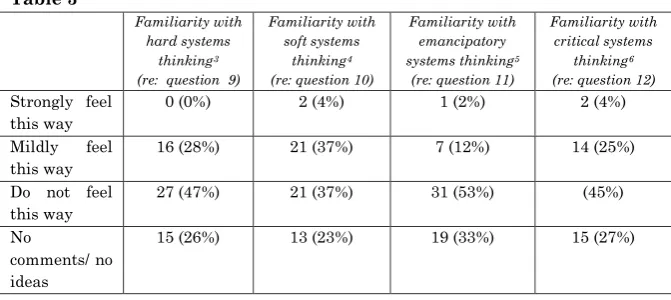
Finding 3 (re: survey questions 9, 10, 11 and 12): The
following table, Table 3, indicates the respondents‟ familiarity with various strands of systems thinking and methodologies.
Table 3
Familiarity with hard systems
thinking3
(re: question 9)
Familiarity with soft systems
thinking4
(re: question 10)
Familiarity with emancipatory systems thinking5
(re: question 11)
Familiarity with critical systems
thinking6
(re: question 12)
Strongly feel this way
0 (0%) 2 (4%) 1 (2%) 2 (4%)
Mildly feel this way
16 (28%) 21 (37%) 7 (12%) 14 (25%)
Do not feel this way
27 (47%) 21 (37%) 31 (53%) (45%)
No
comments/ no ideas
15 (26%) 13 (23%) 19 (33%) 15 (27%)
Regarding Table 3, less than half of the respondents feel that they are strongly or mildly familiar with the various strands of systems thinking. Among the various strands of systems thinking, they are least familiar with emancipatory systems thinking (only 14% are familiar with it) and are most familiar with soft systems thinking (41% are familiar with it). The survey does not cover the latest strand of systems thinking, i.e., postmodern systems thinking7. Presumably, most of the
respondents are also very unfamiliar with it. Finding 3 is basically associated with STAP2.
3 For further information on hard systems thinking, please refer to Jackson
(2003: chapter 4).
4 For further information on soft systems thinking, please refer to Jackson
(2003: chapter 10).
5 For further information on emancipatory systems thinking, please refer to
Jackson (2003: chapter 11).
6 For further information on critical systems thinking, please refer to Jackson
(2003: chapters 14-15).
Finding 4 (re: survey question 1, 2, 3, 6, 7, 8 and 14): The following multiple regression analysis (Lind et al., 2001) is to measure the correlation between a number of factors and the feeling that knowledge in systems thinking is able to improve problem-solving competence in the respondents‟ work-life. The survey data are analyzed using the regression function of Excel to produce values for the following multiple regression formula (Formula 1):
Formula 1 with variable values unknown
Feeling that knowledge in systems thinking improves problem-solving competence in work-life (y variable) = a + b1 x (x1: gender) + b2 x (x2: age group) + b3 x (x3: education background) + b4 x (x4: jobs involving people issues) + b5 x (x5: familiarity with systems thinking) + b6 x (x6: feeling of systems thinking training and education being widely available)
A brief description of the variables in the regression formula is provided here:
Variable y is related to survey question 8.
Variable x1 is related to survey question 1.
Variable x2 is related to survey question 2.
Variable x3 is related to survey question 3.
Variable x4 is related to survey question 6.
Variable x5 is related to survey question 7.
Variable x6 is related to survey question 14.
The coding scheme applied in the survey data for multiple regression analysis is provided in appendix 2.
Based on the Excel report on survey data related to formula 1, the resultant formula 1 produced, shown as follows (re: appendix 3):
Formula 1 with variable values known
systems thinking) + 0.0960 x (x6: feeling of systems thinking training and education being widely available)
Comments: The resultant formula 1 indicates that: (i)
only variable x4 (jobs involving people issues) has some positive correlation with the y variable and (ii) the null hypothesis that the b value of x4 being zero can be rejected (with p value at 0.97635% which is much smaller than the critical value of 5%). The correlations between the y variable and the rest of the x variables are quite weak and the hypotheses that the b values of them being zero cannot be rejected with critical value set at 5%. Ultimately, the y variable y can be affected by the general social conditions as represented by ST1 to 5; but these broader social conditions are not covered in this multiple regression analysis.
Finding 5 (re: survey question 1, 2, 3, 5, 6, 7, 8 and 13):
The following multiple regression analysis is to measure the correlation between a number of factors and the respondents‟ interest in learning more about systems thinking in management.
The survey data are analyzed using the regression function of Excel to produce values for the following multiple regression formula (Formula 2):
Formula 2 with variable values unknown
Interest in learning more about systems thinking in management (y variable) = a + b1 x (x1: gender) + b2 x (x2: age group) + b3 x (x3: education background) + b4 x (x4: have studied systems thinking in management) + b5 x (x5: jobs involving people issues) + b6 x (x6: familiarity with systems thinking) + b7 x (x7: feeling that knowledge in systems thinking improves problem-solving competence in work-life)
A brief description of the variables in the regression formula is provided here:
Variable y is related to survey question 13.
Variable x1 is related to survey question 1.
Variable x2 is related to survey question 2.
Variable x4 is related to survey question 5.
Variable x5 is related to survey question 6.
Variable x6 is related to survey question 7.
Variable x7 is related to survey question 8.
Based on the Excel report on survey data related to formula 2, the resultant formula 2 is produced, shown as follows (re:
appendix 4):
Formula 2 with variable values known
Interest in learning more about systems thinking in management (y variable) = 0.7590 + 0.0592 x (x1: gender) + 0.0096 x (x2: age group) – 0.3290 x (x3: education background) + 0.6506 x (x4: have studied systems thinking in management) + 0.0628 x (x5: jobs involving people issues) + 0.0578 x (x6: familiarity with systems thinking) + 0.1831 x (x7: feeling that knowledge in systems thinking improves problem-solving competence in work-life)
Comments: The resultant formula 2 indicates that: (i)
only variable x4 (have studied systems thinking in
management) has some positive correlation with the y variable
and (ii) the null hypothesis that the b value of x4 being zero can be rejected (with p value at 0.6868% which is much smaller than the critical value of 5%). The correlations between the y variable and the rest of the x variables are quite weak and the hypotheses that the b values of them being zero cannot be rejected with critical value set at 5%. This finding is also associated with STAP1 to 3 though they are not specifically covered in this multiple regression analysis exercise.
systems thinking in management. Thus, the findings point to a potentially higher level of adoption of STAPIM in Hong Kong, especially if wider availability of systems thinking training and education is provided. Probably, a stronger academic leadership is also needed for the local systems movement to move forward. Finally, it has to be recognized that, due to the small sample size of the survey, the findings are of very external validity.
Concluding remarks
The study, based on Internet search, newspaper article study, Facebook-based survey on STAPIM and literature review, shows that the existing level of systems thinking and practices (STAP) adoption in Hong Kong remains quite low. Nevertheless, there is quite a substantial interest on learning systems thinking. Overall, the systems movement in Hong Kong can be conceived as glocal, with the localness aspect partly explained by a number of local societal themes. At best, the local systems movement can be described to be at the take-off stage albeit one with a strong academic leadership lacking. So, whether it can actually take off is doubtful. Hopefully, the discussion in this pioneering paper is able to contribute to STAP with social awareness in Hong Kong and this nascent glocal systems movement. Lastly, it is recognized that much more research needs to be done on this systems movement topic.
BIBLIOGRAPHY:
Arora, M. 2015. “Money pits: 8 Hong Kong government „white elephant projects” Hong Kong Free Press October 13 (url address:
https://www.hongkongfp.com/2015/10/13/money-pits-8-hong-kong-government-white-elephant-projects/) [visited at December 28, 2015].
Chan, S.L. and C.F. Choi. 1997. “A conceptual and analytical
framework for business process reengineering”
International Journal of Production Economics 50(2-3)
June 16. Elsevier: 211-223.
Cheung, K. 2015a. “Poll: HK people more likely to identify themselves as „Hong Kongers‟ than „citizens of PRC‟”
Hong Kong Free Press December 23 (url address:
https://www.hongkongfp.com/2015/12/23/poll-hk-people-
more-likely-to-identify-themselves-as-hongkongers-than-citizens-of-prc/) [visited at December 28, 2015].
Cheung, K. 2015b. “55% believe local news media have practiced self-censorship, according to HKU survey”
Hong Kong Free Press October 7 (url address:
https://www.hongkongfp.com/2015/10/07/55-believe-
local-news-media-have-practiced-self-censorship-according-to-hku-survey/) [visited at December 28,
2015].
Doctor of Education (EdD), awarded by Northeastern
University (url address:
http://www.kaplan.edu.hk/khe/doctoral/doctor-of-education).
Dodwell, D. 2015. “Hong Kong as „Asia‟s World City‟? Not any
more –and here‟s why” South China Morning Post
November 20 (url address:
http://www.scmp.com/comment/insight-
opinion/article/1880768/hong-kong-asias-world-city?page=all) [visited at December 28, 2015].
Ejinsight.com. 2015a. “First SCMP, next Ming Pao: Alibaba said in buyout talks” Ejinsight.com December 17 (url address:
http://www.ejinsight.com/20151217-first-scmp-next-ming-pao-alibaba-said-buyout-talks/) [visited at
Ejinsight.com. 2015b “Police have worst public image among disciplinary forces: survey” Ejinsight.com December 9 (url address: http://www.ejinsight.com/20151209-police-
have-worst-public-image-among-disciplinary-forces-survey/) [visited at December 28, 2015].
Gregory, F.H. and S.P. Lau. 1999. “Logical Soft Systems Modelling for Information Source Analysis – The Case of Hongkong Telecom” The Journal of the Operational
Research society 50(2) February: 124-137.
Gurung, T. 2015. “How Hong Kong is gradually becoming just another Chinese city” ejinsight.com December 19 (url
address:
http://www.ejinsight.com/20151219-how-hong-kong-gradually-becoming-just-another-chinese-city/)
[visited at December 28].
Hao, J.L., M.J. Hills and T. Huang. 2007. “A simulation model using system dynamic method for construction and demolition waste management in Hong Kong
Construction Innovation 7(1) Emerald: 7-21.
Ho, J.K.K. 2014a. “Mapping and explaining the Multi-perspective, Systems-based Research sub-Systems
Movement” European Academic Research 2(9)
December: 11880-11900.
Ho, J.K.K. 2014b. “Using the Umbrella Movement in Hong Kong as an illustrative case study on the relationship-managing organization (RMO) notion in Soft Systems Thinking” European Academic Research 2(9), December: 11847-11879.
Ho J.K.K. 2014c. “A Research Note on Facebook-based questionnaire survey for academic research in business studies” European Academic Research 2(7) October: 9243-9257.
Ho, J.K.K. 2015a. “Establishing the basic knowledge required for local English newspaper article study in academic research projects (MASARP): the Hong Kong case”
Ho, J.K.K. 2015b. “Exploring the problem situation of parallel trading in Hong Kong with the enriched rich picture
building exercise (ERPBE)” European Academic
Research 3(3) June: 2774-2794.
Ho, J.K.K. 2015c. “A review of the notions of quality of life (QOL) and Livability based on Ackovian Systems
Thinking” American Research Thoughts 1(11)
September: 2513-2532.
Ho, J.K.K. 2015d. “An examination of the Hong Kong airport third runway project (HKATRP) using mode 2 strategic assumptions and surfacing technique (SAST) rationale”
American Research Thoughts 2(2) December: 3186-3205.
Ho, J.K.K. 2015e. “A survey on the Hong Kong Airport Third Runway project (HKATRP) in the Strategic Assumptions
and Surfacing Technique (SAST) spirit” European
Academic Research 3(9) December: 995-9972.
Hong Kong Systems Society Facebook public group, maintained
by Joseph K.K. Ho (url address:
https://www.facebook.com/groups/HK.Systems.Society/).
International Federation for Systems Research (url address: http://www.ifsr.org/).
Jackson, M.C. 2000. Systems Approaches to Management.
Kluwer Academic/ Plenum Publishes. London.
Jackson, M.C. 2003. Systems Thinking: Creative Holism for
Managers. Wiley. Chichester.
Kwiksurveys.com. A free to use online survey builder (url address https://kwiksurveys.com/about).
Lee, E. 2015. “Quality of life in Hong Kong worsening with political struggles and astronomic housing prices, research finds” South China Morning Post October 16
(url address:
http://www.scmp.com/news/hong-
kong/health-environment/article/1868445/quality-life-hong-kong-declined-last-year-chinese?page=all) [visited
Lai, L.S.L. 2000. “An integration of systems science methods
and object-oriented analysis for determining
organization requirement” Systems Research and
Behavioral Science 17(2). Wiley: 205-228.
Lau, S. 2015. “The bright side of localism: Hong Kong‟s finance minister sees a constructive sense of pride” South China
Morning Post December 27 (url address:
http://www.scmp.com/news/hong-
kong/politics/article/1895065/bright-side-localism-hong-kongs-finance-minister-sees) [visited at December 28,
2015].
Lind, D.A., W.G. Marchal and R.D. Mason. 2001. Statistical
Techniques in Business & Economics. McGraw-Hill.
Boston.
Literature on lead in water problems in Hong Kong Facebook page, maintained by Joseph K.K. Ho (url address: https://www.facebook.com/Literature-on-lead-in-water-problem-in-Hong-Kong-165532673792815/?fref=ts). Lo, A. 2015. “Why Hong Kong localism has no future” South
China Morning Post June 30 (url address:
http://www.scmp.com/comment/insight-
opinion/article/1829351/why-hong-kong-localism-has-no-future?page=all) [visited at December 28, 2015].
Managerial intellectual learning Facebook page, maintained by
Joseph K.K. Ho (url address:
https://www.facebook.com/managerial.intellectual.learni ng/).
Ngai, E.W.T., C.K.M. To, V.S.M. Ching, L.K. Chan, M.C.M. Lee, Y.S. Choi and P.Y.F. Chai. 2011. “Development of the conceptual model of energy and utility management in
textile processing: A soft systems approach”
International Journal of Production Economics 135(2)
February. Elsevier: 607-617.
Sunday examiner. 2015. “Core values of Hong Kong” Sunday
http://sundayex.catholic.org.hk/node/689) [December 28, 2015].
Systemic management, a module of the Executive MBA programme, the University of Hull, UK. (url address:
http://www.kaplan.edu.hk/khe/master/executive-mba).
Systems Thinking & Designing Services, offered by Institute of Design Knowledge, Hong Kong Design Centre (url
address:
http://www.idk-hkdc.org/#!m32-systems-thinking/c1qgm).
Systems thinking in management Facebook group, maintained
by Joseph K.K. Ho (url address:
https://www.facebook.com/groups/systems.thinking.man
agement/).
Systems Thinking in Practice, corporate training offered by the Hong Kong Polytechnic University and Institute for
Entrepreneurship (url address:
http://www.polyu.edu.hk/ife/corp/en/corporate_training/
medc4108a.php).
The Multi-perspective, Systems-based Research Facebook page, maintained by Joseph K.K. Ho (url address:
https://www.facebook.com/The-Multi-perspective-Systems-based-Research-1630606813892045/timeline).
The UK Systems Society (url address: http://www.ukss.org.uk/).
Timeout.com.hk 2013. “The city that can‟t sleep”
timeout.com.hk September 24 (url address:
http://www.timeout.com.hk/big-smog/features/61204/the-city-that-cant-sleep.html) [visited at December 28].
Tung, C.H. 2015. “Hong Kong must get behind China‟s vision to join the developed world” South China Morning Post
December 15 (url address:
http://www.scmp.com/comment/insight-
opinion/article/1891329/hong-kong-must-get-behind-chinas-vision-join-developed-world) [visited at December
Wikipedia.org. 2015. “Hong Kong” Wikipedia.org (url address:
https://en.wikipedia.org/wiki/Hong_Kong) [visited at
December 28, 2015].
Wordie, J. 2015. “The warning signs of Hong Kong localism our dozy leaders missed” Post Magazine September 27.
South China Morning Post (url address:
http://www.scmp.com/magazines/post-
magazine/article/1860999/warning-signs-hong-kong-localism-our-dozy-leaders-missed) [visited at December
28, 2015].
Zeng, V. 2015. “Four in 10 young Hongkongers „have suicidal thoughts due to stress‟” Hong Kong Free Press July 8
(url address:
https://www.hongkongfp.com/2015/07/08/four-in-10-
young-hongkongers-have-suicidal-thoughts-due-to-stress/) [visited at December 28, 2015].
Zhou, F. 2015. “Hong Kong and Shenzhen should improve transport connections” ejinsight.com December 5 (url
address:
http://www.ejinsight.com/20151205-hong-kong-shenzhen-should-improve-transport-connections/)
[visited at December 28, 2015].
Appendix 1: Survey questions and basic statistics
The Facebook-based survey questions (14 questions) and responses statistics, from December 11 to 13, 2015.
Survey questions Survey statistics
Question 1: What is your gender? Male: 24 (41%) Female: 35 (59%) Standard Deviation: 5.5 Responses: 59
Responses: 59 Question 3: What is your education
background?
Not yet a degree-holder: 9 (15%)
Finished University Undergraduate Degree study: 42 (71%)
Finished Master Degree study: 8 (14%)
Finished Ph.D. Degree study (or equivalent): 0 (0%)
Standard Deviation: 16.11 Responses: 59
Question 4: What is your field of education?
Business studies-related: 35 (59%) Non-business studies related: 9 (15%)
Both business and non-business studies-related: 13 (22%)
Not applicable/ no idea: 2 (3%) Standard Deviation: 12.34 Responses: 59
Question 5: Have you studied (or are studying) subjects related to systems thinking in management?
Yes, I have: 18 (31%) No, I have not: 31 (53%) No ideas/ no comments: 10 (17%) Standard Deviation: 8.65 Responses: 59
Question 6:
Do you feel that your job involves very much dealing with people issues with strong cultural, psychological and political considerations?
Yes, I strongly feel this way: 20 (34%) Yes, I mildly feel this way: 17 (29%) No, I do not feel this way: 19 (32%) No comments/ no ideas: 3 (5%) Standard Deviation: 6.87 Responses: 59
Question 7: Do you feel that you are familiar with the subject of systems thinking in management (or subjects of this nature)?
Yes, I strongly feel this way: 2 (3%) Yes, I mildly feel this way: 22 (37%) No, I do not feel this way: 29 (49%) No comments/ no ideas: 6 (10%) Standard Deviation: 11.12 Responses: 59
Question 8: Do you feel that having gained knowledge in systems thinking in management improves your problem-solving competence in your work-life?
Yes, I strongly feel this way: 12 (20%) Yes, I mildly feel this way: 29 (49%) No, I do not feel this way: 6 (10%) No comments/ no ideas: 12 (20%) Standard Deviation: 8.58 Responses: 59
Question 9: Do you feel that you are familiar with the subject of hard systems thinking and methodologies?
Yes, I strongly feel this way: 0 (0%) Yes, I mildly feel this way: 16 (28%) No, I do not feel this way: 27 (47%) No comments/ no ideas: 15 (26%) Standard Deviation:9.6
Responses: 58 Question 10: Do you feel that you
are familiar with the subject of soft systems thinking and
methodologies? No comments/ no ideas: 13 (23%) Standard Deviation: 7.79 Responses: 57
Question 11: Do you feel that you are familiar with the subject of emancipatory systems thinking and methodologies?
Yes, I strongly feel this way: 1 (2%) Yes, I mildly feel this way: 7 (12%) No, I do not feel this way: 31 (53%) No comments/ no ideas: 19 (33%) Standard Deviation: 11.52 Responses: 58
Question 12: Do you feel that you are familiar with the subject of critical systems thinking and methodologies?
Yes, I strongly feel this way: 2 (4%) Yes, I mildly feel this way: 14 (25%) No, I do not feel this way: 25 (45%) No comments/ no ideas: 15 (27%) Standard Deviation: 8.15 Responses: 56
Question 13: Do you feel that you are interested in learning more about the subject of systems thinking in management?
Yes, I strongly feel this way: 12 (21%) Yes, I mildly feel this way: 30 (52%) No, I do not feel this way: 9 (16%) No comments/ no ideas: 7 (12%) Standard Deviation: 9.12 Responses: 58
Question 14: Do you feel that training and education programmes of systems thinking in management are widely available in Hong Kong?
Yes, I strongly feel this way: 5 (9%) Yes, I mildly feel this way: 18 (31%) No, I do not feel this way: 26 (45%) No comments/ no ideas: 9 (16%) Standard Deviation: 8.14 Responses: 58
Appendix 2: Coding scheme applied to the survey data for multiple regression analysis
Age group
18 to 27: 22.5 28 to 37: 32.5 38 to 47: 42.5 48 to 57: 52.5 58 to 67: 62.5 68 or above: 72.5 Gender
Female: 1
Male: 2
Education background
Not yet a degree-holder: 1
Finished University Undergraduate Degree study: 2
Finished Ph.D. Degree study (or equivalent): 4 Topics about “have or have not”
Have not: 1
Have: 2
Intensity of feeling
No, I do not feel this way: 1 Yes, I mildly feel this way: 2 Yes, I strongly feel this way: 3
Appendix 3: Excel report on regression analysis for formula 1
SUMMARY OUTPUT
Regression Statistics
Multiple R 0.677744392 R Square 0.459337461 Adjusted R Square 0.354693099 Standard Error 0.545353365 Observations 38 ANOVA
df SS MS F
Regression 6 7.832912493 1.30548542 4.389509865 Residual 31 9.219719086 0.29741029
Total 37 17.05263158
Coefficients Standard Error t Stat P-value
Intercept 0.696249494 0.723926714 0.96176793 0.343608621 Gender -0.284393225 0.190602609 -1.4920741 0.14578739 Age group 0.021134332 0.014546118 1.45291903 0.156294576 Education
background -0.017387501 0.203634225 -0.0853859 0.932503655 Jobs involving people
issues 0.459694248 0.126210537 3.64228107 0.00097635 Familiarity with
systems thinking -0.011093104 0.173955314 -0.0637699 0.949562919 Systems training &
education widely
available 0.095993234 0.140219306 0.68459356 0.498687175
Appendix 4: Excel report on regression analysis for formula 2
SUMMARY OUTPUT
Regression Statistics
Observations 35 ANOVA
df SS MS F
Regression 7 6.875435578 0.98220508 3.059680094 Residual 27 8.667421565 0.32101561
Total 34 15.54285714
Coefficients Standard Error t Stat P-value
Intercept 0.758988522 0.700735193 1.08313173 0.288328304 Gender 0.059246762 0.212427806 0.27890305 0.782444365 Age group 0.009563362 0.015534314 0.6156282 0.543295032 Education background -0.328974017 0.226000286 -1.4556354 0.157023348 Have studied systems
thinking 0.650590878 0.222281691 2.92687569 0.006868396 Jobs involving people
issues 0.062767167 0.157870506 0.3975864 0.694061047 Familiarity with
systems thinking 0.057768782 0.194296045 0.29732351 0.768495132 Systems thinking
knowledge improves problem-solving