Abstract— In wireless sensor network, sensor and actor
are linked by wireless medium in distributed network to perform actuation task. Sensor collect information and actor response to it depend on their surroundings. Failure of an actor partition the network and lose connectivity and formed different block To overcome this failure we used here least disruptive topology repair algorithm to relocate node and path between nodes is not extended. In this paper we propose actor placement mechanism that considers both delay requirement and coverage of area. Each actor reposition itself to new position and reduced latency. Here we also use DARA and PDARA to maintain list of their multi hop neighbor and determine their scope. Ledir don’ t require additional pre failure communication overhead.
Keywords: DARA, inter-actor data, Least Disruptive
topology ,WSN, topology management.
I. INTRODUCTION
A wireless sensor network (WSN) is a wireless network consisting of spatially distributed autonomous devices using sensors to monitor physical or environmental conditions. A WSN system incorporates a gateway that provides wireless connectivity back to the wired world and distributed nodes. Recently Latency has emerged as a new communication paradigm to cope with underutilization problem of fixed spectrum allocation in wireless networks. In fixed spectrum allocation, allocated a spectrum on a long term basis for large geo graphical regions. Temporal and spatial utilization varies from. Fixed spectrum assignment policy has been adopted for a long time in the past, but due to scarcity of spectrum and underutilization of allocated spectrum, it is considered as an inefficient spectrum assignment mechanism. On the other hand, is based on cognitive radio technology that has an ability to change its transmitter parameters based on the interaction with its operating environment. Cognitive radio technology can identify allocated but currently unused spectrum and select the best available spectrum using cognitive capability and reconfiguration.
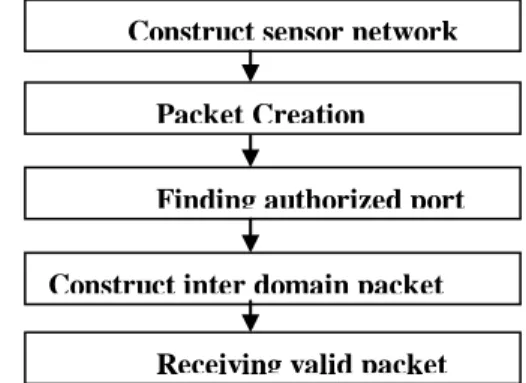
Figure 1 illustrate the construction of sensor network and transmit node across route and receiving a packet at destination
Figure 1: constructing network and receiving process Construct sensor Network
In this, we are going to connect the network .Each node is connected the neighboring node and it is independently deployed in network area. And also deploy the each port no is authorized in a node.
Packet creation
In this, browse and select the source file. And selected data is converted into fixed size of packets. And the packet is
send from source to detector.
Find authorized and unauthorized port
The Clone detection is defined as a mechanism for a WSN to detect the existence of inappropriate, incorrect, or anomalous moving attackers. In this module check whether the path is authorized or unauthorized. If path is authorized the packet is send to valid destination. Otherwise the packet will be deleted. According port not only we are going to find the path is authorized or Unauthorized.
Construct inter-domain packet filter
If the packet is received from other than the port no it will
be filtered and discarded. This filter only removes the unauthorized packets and authorized packets send to destination.
A Coverage and Latency Aware Route
Recovery from Multiple Node Failures in
Mobile Sensor Network
Ms. Kiran Likhar, Ms. Nitu Bisen, Prof. Shyam Dubey
Construct sensor network
Packet Creation
Receiving valid packet Finding authorized port Construct inter domain packet filter
Volume 5, Issue 8, August 2016
Receiving Valid packet
In this, after filtering the invalid packets all the valid Packets will reach the destination.
II. LITERATURE REVIEW
Ameer A. Abbasi Et Al[1] In this paper the author has proposed an algorithm to recover a faulty node. As in wireless sensor-actor networks the sensor nodes are to interact with surroundings and pass on the collected data to the actor node. If the actor node fails then the network breaks into disjoint blocks and results in loss of data. One of the effective recovery methodologies is to autonomously reposition a subset of the actor nodes to restore connectivity. This Contemporary recovery schemes either impose high node relocation overhead or extend some of the inter-actor data paths. This paper overcomes these shortcomings and presents a Least-Disruptive topology Repair (LEDIR) algorithm. The performance of this algorithm is verified through simulation.
G.Srinivasan et al [2] In the proposed system, we proposed TDMA (Time Division Multiple Access) MAC, which supports low duty cycle operations. In addition to that Time Division Multiple Access provides contention and collision free transmission. A new hybrid MAC protocol for wireless sensor network, called IH-MAC is used, which combines the strength of the Carrier Sense Multiple Access, link scheduling and broadcast scheduling. It guarantees shorter latency in critical condition like fire and delay-sensitive packets. Thus, recovery from multi node failure is made possible with minimal topology changes.
W.Youssef Et al[4], proposed an Intelligent safety aware gateway relocation scheme for wireless sensor networks Recently, wireless sensor networks (WSN) have received enormous attentions due to their potential use in many applications. They can be used to enrich our understanding of natural events, such as earthquakes and volcanoes, and to increase the performance of system.
N Tewani Et al[14] While the transformation of data some of the nodes stop working which results in a cut. To avoid and detect this problem here we propose a distributed and asynchronous algorithm known as Distributed Cut Detection. The algorithm consists of nodes, updating their local state periodically by communicating with their nearest neighbors. The state of a node converges to a positive value in the absence of a cut. If a node is disconnected from the source as a result of a cut, its state converges to 0 (de-active). The state of node determines whether it is connected to source or not. The nodes that are still connected to the source will be able to detect that a cut has occurred somewhere in the network. It has not only fast convergence rate but also independent of size of the network, as the delay between the occurrence of a cut and its detection by all the nodes can be made independent of the size of the network.
Neelofer Tamboli Et al[3] proposed a system that focuses on
redundant nodes in the network, replacing the failed node with a spare one is the best and most effective solution in terms of network connectivity and coverage.
K. Akkaya and M. Younis [8] proposed a system for wireless sensor and actor network to attention fromm wireless sensor network community with the idea of additionally employing more power nodes than the sensor which are called actors. These actor can take a certain action based o receive data from sensor. since most of these action are real time, they require minimize latency for both data gathering and completion . In this we propose framework consist of WSN which minimize coverage of region and network lifetime .first determine best location for actors in terms of latency and coverage.
III. TECHNIQUE USED
The recovery of network failure is very time imperceptible and difficult, to generate Combinational methodology to improve and enhance the existing technique. The propose algorithm provide the fast recovery and to avoid message dropping, so that provide high message delivery. Our propose protocol detect multiple faulty nodes and to apply the recovery scheme. The packets are forward from another path using shortest path.somealgorithm are required to calculate the information required while data transmission.
For path selection used i] Minimum-hop and shortest-path routing ii] Dijkstra and Bellman-Ford algorithms.
Routing protocols includes Link state: Open Shortest Path First Distance vector: Routing Information Protocol which is used to calculate the distance between nodes.
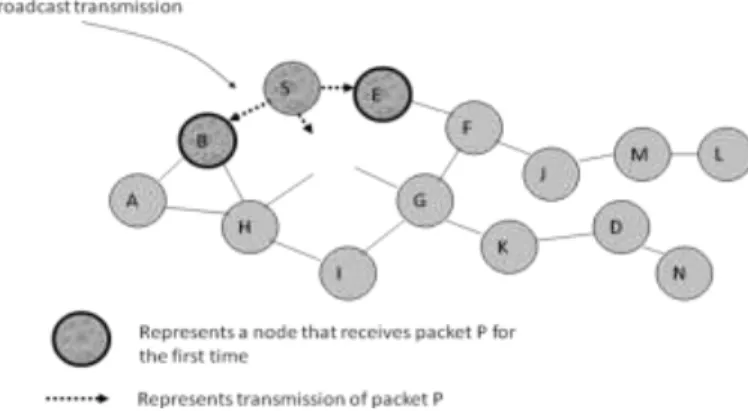
Figure 2
:
Sending and receiving processSender S broadcasts data packet P to all its neighbors each node receiving P, forwards P to its neighbors. Sequence numbers used to avoid the possibility of forwarding the same packet more than once Packet P reaches destination D provided that D is reachable from sender node D does not forward packet.
Least Disruptive Topology Repair Algorithm
The goal
for LeDiR is to restore the connectivity without extending the length of the shortest path among nodes compared to the pre-failure topology. Least Disruptive Topology Repair Algorithm overcomes the disadvantages ofpaths relative to its pre-failure status. This algorithm is used to detect and recover a multiple node failure. It is a localized and distributed algorithm which makes use of the existing route discovery activities. This method relocates the smallest number of nodes and there is no extension of data path. The LeDiR algorithm first detects the faulty node and finds whether it is a cut vertex by using the partially populated Shortest-path Routing Table (SRT) and invocates the recovery process. Then the block with least number of nodes are found out for relocation which limits the recovery overhead. Then the faulty node is replaced by the neighbor (parent node) of the failed node which belongs to the smallest block. After that the child nodes which are directly connected to the parent node are also relocated hereby recovering the connectivity.
1. The following parameters are used to vary the
characteristics of the topology in the different experiments: Number of deployed actors (N): This parameter affects the node density and the WSAN connectivity. Increasing N makes the WSAN topology highly connected. Communication range (r): All actors are assumed to have the same communication range r. The value of r affects the initial WSAN topology. While a small r creates a Sparse topology, a large r boosts the overall connectivity. The following metrics are used to measure the performance of LeDiR in terms of recovery overhead.1) Total travelled distance: reports the distance that the involved nodes collectively travel during the recovery. This can be envisioned as a network-wide assessment of the efficiency of the applied recovery scheme.
2. Number of relocated nodes: reports the number of nodes
that moved during the recovery. This metric assesses the scope of the connectivity restoration within the network.
3. Number of exchanged messages: tracks the total number
of messages that have been exchanged among nodes. This metric captures the communication overhead.
Furthermore, the following metrics are used to validate the path length performance of LeDiR:
1. Number of extended shortest paths: reports the total
number of shortest paths between pairs of nodes (i, j) that get extended as a result of the movement-assisted network recovery. Shortest paths are calculated by using the Floyd– Warshall algorithm. This metric validates our claim that LeDiR avoids extending the shortest path between any pair (i, j) of node while restoring connectivity. Thus, for LeDiR, this metric must be zero in all experiments.
2. Shortest paths not extended: reports average number of
shortest paths that are not extended per topology: This metric assesses how serious the potential path extension concern for contemporary approaches and further validates the correctness of LeDiR. This metric should be 100% for LeDiR.
IV. IMPLEMENTATION
Failure Detection
These will periodically send heartbeat messages to their neighbors to ensure that they are functional, and also report changes to the one-hop neighbors. Missing heartbeat messages can be used to detect the failure of this. Once a failure is detected in the neighborhood, the one-hop neighbors of the failed they would determine the impact, i.e., whether the failed node is critical to network connectivity. This can be done using the SRT by executing the well-known depth-first search algorithm.
Smallest Block Identification
Le DiR limits the relocation to nodes in the smallest disjoint block to reduce the recovery overhead. The smallest block is the one with the least number of nodes and would be identified by finding the reachable set of nodes for every direct neighbor of the failed node and then picking the set with the fewest nodes. Since a critical node will be on the shortest path of two nodes in separate blocks, the set of reachable nodes can be identified through the use of the SRT after excluding the failed node. In other words, two nodes will be connected only if they are in the same block.
Volume 5, Issue 8, August 2016
Figure 3: Implementation flow chart
Replacing faulty Node
If node 1 is the neighbor of the failed node that belongs to the smallest block, 1 is considered to replace the faulty node. Since node 1 is considered the gateway node of the block to the failed critical node (and the rest of the network), we refer to it as parent. A node is a child” if it is two hops away from the failed node, grandchild if three hops away from the failed node, and so on.
V. CONCLUSION
In this paper our contribution shows how Ledir algorithm is used to recover from multiple node failure in mobile sensor network. we are also used various type of algorithm like DARA, PDARA and shortest path algorithm to calculate minimum distance between node. So this algorithm avoids partitioning the network into disjoint block and recovers multiple node failure.
V. CONCLUSION
[1] Ameer A. Abbasi, Mohamed F. Younis, Senior Member,IEEE, and Uthman A. Baroudi, “ Recovering From a Node Failure in Wireless Sensor-Actor Networks With Minimal Topology Changes” , IEEE Transactions on Vehicular Technology, Vol. 62, No. 1, January 2013.
[2] Vani, AP/CSE, G.Srinivasan, M.Sangeetha, M.R.Suganyaa, “ Recovering From Multiple Node Failures in Wireless Sensor-Actor Networks with Minimal Topology Changes” , ISR NATIONAL Journal of Advanced Research in Electrical and Electronics Engineering Volume: 1 Issue: 1 08-May-2014.
[3] Neelofer Tamboli and Mohamed Younis” Coverage-Aware Connectivity Restoration in Mobile Sensor Networks” Department of Computer Science and Electrical Engineering University of Maryland, Baltimore County ICC IEEE 2009
[4] W. Youssef, M. Younis, and K. Akkaya, “ ” An intelligent safety-aware gateway relocation scheme for wireless sensor networks “ ,” in Proc. ICC, Istanbul, Turkey, Jun. 2006, pp. 3396– 3401, New Orleans, LA, Nov. 2008, pp. 15.
[5] Di tang tong tong li,jian Ren , jie wu “ ” Cost-Aware Secure Routing Protocol Design for wrireless Sensor Networks” , IEEE global communication GLOBECOM 2014
[6] S.Sathish, A. Lawrance Ramesh, G. Sarath Kumar A Survey on Node Recovery from a Failure in Wireless Sensor Networks” vol2 issue1 ver 2 march-2014.
[7] G.sumalatha,N.zareena,ch.gopi Raju“ review of failure node recovery algorithm” v12(2)94-98,june 2014 ISSN:2231-2803
[8] Akkaya and M. Younis, “ Coverage and Latency Aware Actor Placement Mechanisms in Wireless Sensor and Actor Networks” , International Journal of Sensor Networks Vol. 3, No. 2, 2008.
[9] F. Akyildiz and I. H. Kasimoglu, “ Wireless sensor and actor networks: Research challenges,” Ad Hoc Netw. J., vol. 2, no. 4, pp. 351– 367,
Oct. 2004.
[10] M. Younis, S. Lee, S. Gupta, and K. Fisher, “ A localized self-healing algorithm for networks of moveable sensor nodes,” in Proc. IEEE GLOBECOM,
Generate original message
Store information and forward to other node
Give reply
Store the informatio n
Transmit data in selected path
Generate testing message
Generate new testing message to particular node If no repl y If fail
Send the information
Confirm node failure and inform next position
to neighbor node
Ignore
Move to particular pos
[11] K. Akkaya, F. Senel, A. Thimmapuram, and S. Uludag, “ Distributed recovery from network partitioning in movable sensor/actor networks via controlled mobility,” IEEE Trans. Comput., vol. 59, no. 2, pp. 258– 271,Feb. 2010.
[12] A. Youssef, A. Agrawala, and M. Younis, “ Accurate anchor-free localization in wireless sensor networks,” in Proc. 1st IEEE Workshop Inf. Assurance Wireless Sensor Netw., Phoenix, AZ, Apr. 2005.
[13] S. Vemulapalli and K. Akkaya, “ Mobility-based self route recovery from multiple node failures in mobile sensor networks,” in Proc. 10th IEEE Int.Workshop WLN, Denver, CO, Oct. 2010. [14] N Tewani, Neeharika Ithapu, K Raghava Rao,
Sheik Nissar Sami, B. Sai Pradeep and V.Krishna Deepak, “ Distributed Fault Tolerant Algorithm for Identifying Node Failures in Wireless Sensor Networks” , International Journal of Innovative Technology and Exploring Engineering (IJITEE) ISSN: 2278-3075, Volume-2, Issue-5, April 2013.