http://dx.doi.org/10.4236/jss.2015.34001
Case Study on E-Business V Corp. Software
Project Risk Management with Interpretive
Structural Modeling
Jiangping Wan, Zhong Wang
School of Business Administration, South China University of Technology, Guangzhou, China Email: [email protected], [email protected]
Received 6 February 2015; accepted 23 March 2015; published 27 March 2015
Copyright © 2015 by authors and Scientific Research Publishing Inc.
This work is licensed under the Creative Commons Attribution International License (CC BY). http://creativecommons.org/licenses/by/4.0/
Abstract
The comprehensive risk management system based on the software project features of V Corp. is established. Four original risk factors are found with interpretive structural modeling, including analysis risk of product design, communication risk, human resource risk and decision making risk. Finally, some solutions are put forward to help e-business V Corp. improve the ability of software project risk management.
Keywords
Software Project Management, Comprehensive Risk Management System, Interpretive Structural Modeling, E-Business, Software, Case Study
1. Introduction
Today, the information technology has become one of the core competitiveness of e-business enterprises. Most of e-business businesses rely on information technology. E-business is the combination of “modern information technology” and “business”, to some extent, e-business enterprises compete at the information technology among enterprises. With the expansion of scale and scope of the market, it becomes a trend for software project management to be complicated and short cycled.
requirements are increasing so fast that companies often make software projects behind schedule and cause economic losses for lack of project risk management. Therefore, we constructed a risk structure model for e-business V Corp. and then proposed several solutions to deal with the four original risks. The paper is orga-nized as follows: Section 2 is literature review, Section 3 is e-business V Corp. software project risk manage-ment analysis, Section 4 is to construct a software project risks structure model with interpretive structural mod-eling (ISM), Section 5 is the analysis and solutions for original risk factors of e-business V Corp. software project, and Section 6 is conclusion.
2. Literature Review
The software risk management involves two primary steps each with three subsidiary steps [1]. The first primary step, risk assessment, involves risk identification, risk analysis, and risk prioritization: 1) Risk identification produces lists of the project-specific risk items likely to compromise a project’s success. Typical risk identifica-tion techniques include checklists, examinaidentifica-tion of decision drivers, comparison with experience (assumpidentifica-tion analysis), and decomposition; 2) Risk analysis assesses the loss probability and loss magnitude for each identi-fied risk item, and it assesses compound risks in risk item interactions. Typical techniques include performance models, cost models, network analysis, statistical decision analysis, and quality-factor (like reliability, availabil-ity, and security) analysis; 3) Risk prioritization produces a ranked ordering of the risk items identified and ana-lyzed. Typical techniques include risk-exposure analysis, risk-reduction leverage analysis (particularly involving cost-benefit analysis), and Delphi or group-consensus techniques. The second primary step, risk control, in-volves risk-management planning, risk resolution, and risk monitoring: 1) Risk-management planning helps prepare you to address each risk item (for example, via information buying, risk avoidance, risk transfer, or risk reduction), including the coordination of the individual risk-item plans with each other and with the overall project plan. Typical techniques include checklists of risk-resolution techniques, cost benefit analysis, and stan-dard risk management plan outlines, forms, and elements; 2) Risk resolution produces a situation in which the risk items are eliminated or otherwise resolved (for example, risk avoidance via relaxation of requirements). Typical techniques include proto-types, simulations, benchmarks, mission analyses, key-personnel agreements, design-to-cost approaches, and incremental development; 3) Risk monitoring involves tracking the project’s progress toward resolving its risk items and taking corrective action where appropriate. Typical techniques in-clude milestone tracking and a top 10 risk item list that is highlighted at each weekly, monthly, or milestone project review and followed up appropriately with reassessment of the risk item or corrective action.
J. P. Wan, D. Wan, and H. Zhang identify the risks of CN Group which is working at software outsourcing projects between Hong Kong and Guangdong, discovers the causal relationships among the risk factors, and constructs corresponding risk structure model with ISM. Five original risk factors are identified, including con-tracts risk, requirements definition and change, lack of communication, political and legal environment differ-ences, and exchange rate fluctuations [2]. J. P. Wan and D. J. Li figure out eleven kinds of common mindbugs among the twenty five kinds of mindbugs with questionnaire. The relationship between the six original risk fac-tors of implementation of the information technology service management (ITSM) project and these common mindbugs are also identified [3]. J. P. Wan and J. J. Hou study the possible risk factors during SAP Business One implementation with depth interview. The results are then adjusted by experts. 20 categories of risk factors that are totally 49 factors are found. Based on the risk factors during the SAP Business One implementation, questionnaire is used to study the key risk factors of SAP Business One implementation. The study illustrates that the structure is olive-like, in which the risk of data import is on the top, and the risk of senior managers is on the bottom [4]. J. P. Wan, Y.H. Cao and J. J. Hou study the comprehensive risk management system with the software project features of H Corp., the causal relationships among risks are discovered, and corresponding risk structure model is established with ISM. Five original risks are identified, including requirements analysis risk, project communication risk, schedule risk, risk of system design, and risk of project cooperation [5].
3. Overview of E-Business V Corp. and Its Software Project
platform, payment platform, Customer Relationship Management (CRM) platform and vendor financing plat-form. Communications among platforms need go through standard interface or layer which has clear informa-tion security requirements.
In our understanding, the features of e-business V Corp. software projects are as follows: 1) Software re-quirements are complicated, not only business department can make requests but product design department and technical department can also raise requirements. 2) Business requirements usually involve multiple platforms which have strong links with each other. Therefore it is very important to study correlation analysis among plat-forms at production design period. 3) V Corp. operates under functional organization structure, business quirements usually are raised by multiple departments, and many project stakeholders are involved. 4) To re-spond quickly and flexibly to changing business needs, V Corp. must iterate projects rapidly, and multi projects are often implemented at the same time. 5) Project management office coordinates and manages all project re-sources. Teamwork is an essential part of a successful project, and PMO has an important significance in cross team projects. 6) Software project implementation processes are under serious specifications, including design, research and develop, test, implementation, end of the project etc.
4. Establish Risk Factors Interpretative Structure Model
ISM method can be divided into the following steps: 1) Implement the ISM group; 2) Set the key issues; 3) Se-lect the factors have influence on the key issues of the system; 4) List the correlation of the factors; 5) Establish the adjacency matrix and accessible matrix, according to the correlation; 6) Breakdown the accessible matrix and build the structure model; 7) Establish the interpretative structure model based on the structure mode [6].
4.1. Identify Key Risk Factors of E-Business V Crop. Software Project
We consulted experts with Delphi, including project managers, product managers, developers, testers, business personnel, software development and the internal control manager, and QA, etc. Based on implementation of e-business V Crop. software project, 24 risk factors are identified. By the way of calculating variable coefficient, ten major risk factors are figured out as follows Table 1 (i.e. adjacency matrix).
4.2. Build Reachable Matrix
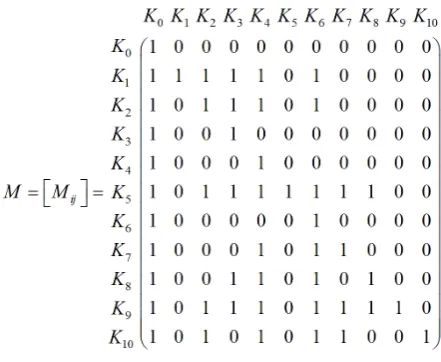
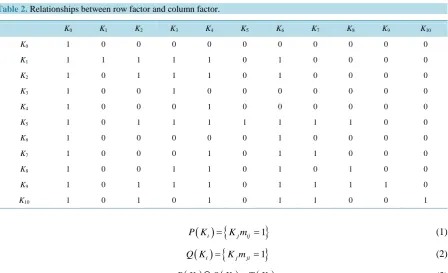
For 10 key risk factors Ki of V. Crop. software project (i = 1, 2, 3…10), “1” means Ki has influence on Kj, oth-erwise, “0” is used. The relationships between row factor and column factor can be illustrated as Table 2.
The reachable matrix is constructed with WINISM1.1 as Figure 1.
4.3. Build Re-Order Reachable Matrix
[image:3.595.201.422.527.708.2]The set for each factor Ki is obtained with the reachable matrix M:
Table 1.10 key risk factors of e-business V Corp. software project.
Code Risk factors Description
K1 Analysis risk of product design System analysts don’t perform feasibility analysis which leads to biases.
K2 Requirements change risk Business department always raises new requirements or changes previous
requirements, which leads to expanding project.
K3 Technology change risk Change technology because previous design cannot meet requirements, it may have
an impact on development progress.
K4 Software quality risk Testers failed to find bugs duo to carelessness, there might be a problem after
publishing software.
K5 Communication risk Communication mechanism doesn’t work across project teams.
K6 Schedule risk Failed to finish the project on schedule
K7 Software release risk Release plan faces problems because technology cannot support it or released software has a side effect on online business.
K8 Project management risk System of mechanism, progress and emergency management is incomplete.
K9 Human resources risk Employees especially technical experts run off.
K10 Decision making risk Make wrong decisions or failed to make decisions in time.
Table 2.Relationships between row factor and column factor.
K0 K1 K2 K3 K4 K5 K6 K7 K8 K9 K10
K0 1 0 0 0 0 0 0 0 0 0 0
K1 1 1 1 1 1 0 1 0 0 0 0
K2 1 0 1 1 1 0 1 0 0 0 0
K3 1 0 0 1 0 0 0 0 0 0 0
K4 1 0 0 0 1 0 0 0 0 0 0
K5 1 0 1 1 1 1 1 1 1 0 0
K6 1 0 0 0 0 0 1 0 0 0 0
K7 1 0 0 0 1 0 1 1 0 0 0
K8 1 0 0 1 1 0 1 0 1 0 0
K9 1 0 1 1 1 0 1 1 1 1 0
K10 1 0 1 0 1 0 1 1 0 0 1
( )
i{
j ij 1}
P K = K m = (1)
( )
i{
j ji 1}
Q K = K m = (2)
( )
i( )
i( )
iP K Q K =T K (3)
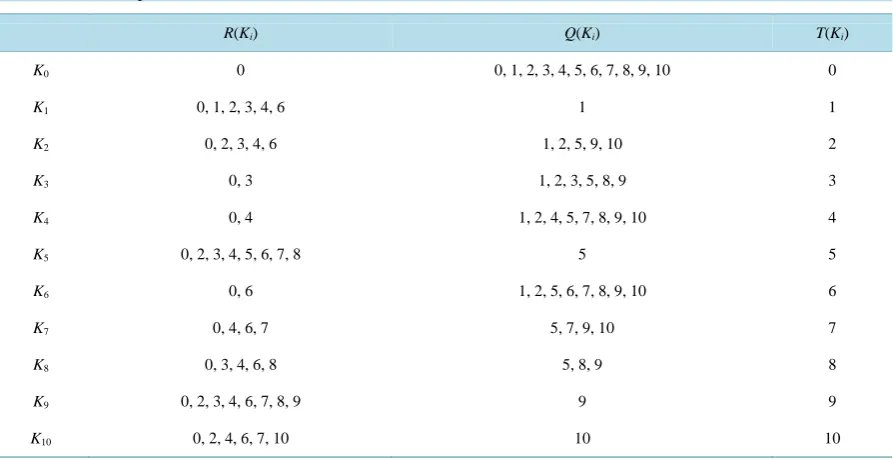
P(Ki) is called to reachable set, namely the set of all the reachable factors from factor Ki. Q(Ki), called ad-vanced set, refers to the set of all the factors can reach Ki. Q(Ri) means the universal set, which is the set of all the factors both belong to the reachable set and the advanced set (Table 3).
Because i = 0 meets R K
( )
i Q K( )
i =R K( )
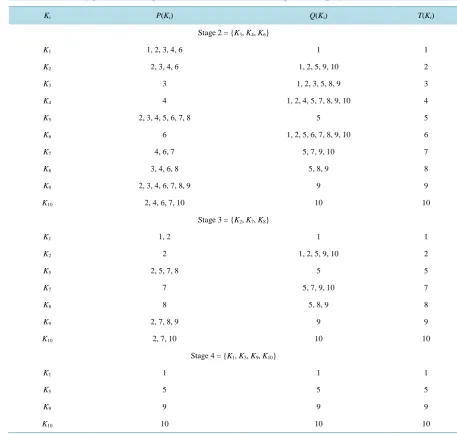
i , Stage 1 = {K0}. The relationship description of the top 10 riskfactors above is not intuitive enough. To express the relationship more clearly, the hierarchy is further analyzed (Table 4).
[image:4.595.90.539.316.589.2]Figure 2. Re-order reachable matrix.
Figure 3.Interpretative structure model of e-business V Corp. software project risks.
Table 3.Relationships between row factor and column factor.
R(Ki) Q(Ki) T(Ki)
K0 0 0, 1, 2, 3, 4, 5, 6, 7, 8, 9, 10 0
K1 0, 1, 2, 3, 4, 6 1 1
K2 0, 2, 3, 4, 6 1, 2, 5, 9, 10 2
K3 0, 3 1, 2, 3, 5, 8, 9 3
K4 0, 4 1, 2, 4, 5, 7, 8, 9, 10 4
K5 0, 2, 3, 4, 5, 6, 7, 8 5 5
K6 0, 6 1, 2, 5, 6, 7, 8, 9, 10 6
K7 0, 4, 6, 7 5, 7, 9, 10 7
K8 0, 3, 4, 6, 8 5, 8, 9 8
K9 0, 2, 3, 4, 6, 7, 8, 9 9 9
K10 0, 2, 4, 6, 7, 10 10 10
4.5. Analyze the Interpretive Structural Model
[image:5.595.92.539.440.670.2]Table 4. The hierarchy process of the top 10 risk factors of e-business V Corp. software project.
Ki P(Ki) Q(Ki) T(Ki)
Stage 2 = {K3, K4, K6}
K1 1, 2, 3, 4, 6 1 1
K2 2, 3, 4, 6 1, 2, 5, 9, 10 2
K3 3 1, 2, 3, 5, 8, 9 3
K4 4 1, 2, 4, 5, 7, 8, 9, 10 4
K5 2, 3, 4, 5, 6, 7, 8 5 5
K6 6 1, 2, 5, 6, 7, 8, 9, 10 6
K7 4, 6, 7 5, 7, 9, 10 7
K8 3, 4, 6, 8 5, 8, 9 8
K9 2, 3, 4, 6, 7, 8, 9 9 9
K10 2, 4, 6, 7, 10 10 10
Stage 3 = {K2, K7, K8}
K1 1, 2 1 1
K2 2 1, 2, 5, 9, 10 2
K5 2, 5, 7, 8 5 5
K7 7 5, 7, 9, 10 7
K8 8 5, 8, 9 8
K9 2, 7, 8, 9 9 9
K10 2, 7, 10 10 10
Stage 4 = {K1, K5, K9, K10}
K1 1 1 1
K5 5 5 5
K9 9 9 9
K10 10 10 10
5. Analysis and Solutions for E-Business V Corp. Software Project Original Risks
The four original risks of e-business V Corp. software project are identified, these are analysis risk of product design, communication risk, human resource risk and decision making risk. We will study these risks further and try to put forward corresponding solutions.
5.1. Analysis Risk of Product Design
5.2. Communication Risk
When implementing project, demanders, designers and developers may have different understanding of product requirements and project schedule, due to lack of communication or inefficient communication. We give sug-gestions as follows: 1) Set up communication mechanism, including communication methods, tools and fre-quency etc. 2) Make project communication plans, carry out plans and check results regularly after communica-tion.
5.3. Human Resource Risk
Company sometimes doesn’t have enough technicians, underestimates the quantity of project human resources, or works on multiple projects simultaneously, which may lead to project human resource risk. We can take solu-tions as follows: 1) Discipline entire project team to take part in project evaluation so that every member can understand project requirements and avoid biases of estimating human resources; 2) Make unified management of project human resources with project management software; 3) Set up project risk reporting mechanism. When project human resource risk occurs, we can take measures quickly and finish project milestone on time.
5.4. Decision-Making Risk
Unfamiliar with project objectives, insufficient decision making information can lead to project decision-making risk. We give suggestions as follows: 1) Set up project discussion team, all team members have discussion, ana-lyze and then make decision; 2) Project members assist project manager to collect information and ensure the information truthful, accurate and complete; 3) Set up project training team, organize employees to study project decision making, information collecting, sorting and analyzing regularly.
6. Conclusion
E-business is the combination of “modern information technology” and “business”, to some extent, e-business enterprises compete at the information technology among enterprises. The four original risks of software project are identified, including analysis risk of product design, communication risk, human resource risk and decision making risk with V Corp. case study. We also put forward suggestions to help e-business V Corp. improve the ability of software project risk management. We believe that the research is helpful for both the software project risk management of e-business enterprises and software project risk management study in China.
Acknowledgements
Thanks for helpful discussion with Mr. Wenlv Chen, and Mr. Jianzhang Li et al.
References
[1] Boehm, B.W. (1991) Software Risk Management: Principles and Practices. IEEE Software, 8, 32-41. http://dx.doi.org/10.1109/52.62930
[2] Wan, J.P., Wan, D. and Zhang, H. (2010) Case Study on Business Risk Management for Software Outsourcing Service Provider with ISM. Technology and Investment, 1, 257-266. http://dx.doi.org/10.4236/ti.2010.14033
[3] Wan, J.P. and Wan, D. (2011) Analysis on the Mindbugs in Information Technology Service Management Project Im-plementation. Technology and Investment, 2, 184-192. http://dx.doi.org/10.4236/ti.2011.23019
[4] Wan, J.P. and Hou, J.J. (2012) Research on SAP Business One Implementation Risk Factors with Interpretive Struc-tural Model. Journal of Software Engineering and Applications, 5, 147-155. http://dx.doi.org/10.4236/jsea.2012.53022 [5] Wan, J.P., Cao, Y.H. and Hou, J.J. (2013) Case Study on H Corp. Software Project Risk Management with ISM.
Technology and Investment, 4, 145-152. http://dx.doi.org/10.4236/ti.2013.43017