© 2018, IRJET | Impact Factor value: 6.171 | ISO 9001:2008 Certified Journal
| Page 4107
Blue Eyes Technology
D.D. Mondal
#1, Arti Gupta
*2, Tarang Soni
*3, Neha Dandekar
*41
Professor, Dept. of Electronics and Telecommunication, Sinhgad Institute of Technology and Science,
Narhe, Maharastra, India
2,3,4
Student, Dept. of Electronics and Telecommunication, Sinhgad Institute of Technology and Science,
Narhe, Maharastra, India
---***---ABSTRACT
: Emotions and facial expressions plays animportant role in communication in social interaction with other human beings which delivers rich information about their mood. The “BLUE EYES TECHNOLOGY” aims to create computational mechanisms that have perceptual and sensory abilities like those of human beings which enables the computer to gather facts about humans and interact with them. This paper implements the detection of emotions (happy, sad, fear, surprised, disgust and anger) by taking in account the human eye expressions and by using an emotion mouse. The emotion mouse obtains physiological data and emotional state of a person through the single touch of mouse having different sensors. Emotions are also determined by human eye expression in which the eye region from a video sequence is analyzed. From the different frames of the video stream, the human eyes can be extracted using the edge operator and then can be classified using a Support Vector machine (SVM) classifier. After the classification we use standard learning tool, Hidden Markov Model (HMM) to recognize the emotions from the human eye expressions. After the detection of emotion, suitable audio track will be played
Key Words
:
Blue eyes, emotion mouse, emotionrecognition, eye expressions, Support Vector Machine
(SVM), Hidden Markov Model (HMM).
1. INTRODUCTION
The aim of “BLUE EYES” technology is to create computational machines by addition of perceptual abilities in computer that helps them to verify human’s identity, feel their presence, and interact with them. Human recognition depends primarily on the stability to observe, understand, and integrate audio/visuals and sensoring information. Blue eyes technology makes a computer to sense and understand user’s feelings and their behavior and enables the computer to respond according to the detected emotional level. To give human abilities or power to a computer, so that the machine can naturally interact with human beings as humans interacts among themselves is the main of blue eyes technology.
The projected methodologies in this paper detect human emotions are emotion mouse and emotion recognition by human eye expressions. Emotion mouse is an input device which is designed in such a way that it can track the emotions of a user by a simple touch on it. The emotion mouse is used to evaluate and identify the user’s emotions
(such as happy, sad, anger, fear, disgust, surprised, etc) when the user is interacting with computer.
For carrying out an efficient man-computer interaction, the emotion recognition of humans is a significant component. It plays a critical role in communication by allowing people to express oneself beyond the verbal domain. The detection and categorization of various human emotions or different state of mind involves the analysis of emotions from human eye expression. For example, in security and surveillance, they can predict the offender or criminal’s behavior by analyzing the images of their face from the frames of the video sequence. The analysis of human emotions can be applied in a variety of application domains, such as video surveillance and human – computer interaction systems. In some cases, the results of such analysis can be applied to identify and categorize the various human emotions automatically from the videos.
2. RELATED WORK
Many approaches for blue eye technology and human emotion recognition have been proposed in the last two decades.
Mizna Rehman Mizna et. al. [1] this paper presents a technique which identifies human emotions (happy, surprise, sad or excited ) using image processing by taking out only the eye portion from the captured image which is further compared with images that are already stored in database. This paper intends two results of emotional sensory world. First, observation reveals the fact that different eye colors and their intensity results in change in emotions. It changes without giving any information on shape and actual detected emotion. It is used to successfully recognize four different emotions of eyes.
© 2018, IRJET | Impact Factor value: 6.171 | ISO 9001:2008 Certified Journal
| Page 4108
Mohammad Soleymani et. al. [3] this paper presents themethodology in which instantaneous detection of the user’s emotions from facial expression and electroencephalogram (EEG) signals is used. A set of videos having different emotional level were shown to a group of people and their physiological responses and facial expressions were recorded. Five annotators annotates the valence (from negative to positive) in the user’s face videos. A continuous annotation of arousal dimensions and valence is also taken for stimuli videos. Continuous Conditional Random Fields (CCRF) and Long-short-term-memory recurrent neural networks (LSTM-RNN) were used in detecting emotions continuously and automatically. The analyzed effect of the interference of facial muscle activities on EEG signals shows that most of the emotionally valued content in EEG features are as a result of this interference. However, the arithmetical analysis showed that in presence of facial expressions EEG signals carries complementary information.
T. Moriyama et. al. [4] this paper presents a system that has capabilities of giving detailed analysis of eye region images in terms of the position of the iris, angle of eyelid opening, and the texture, shape and complexity of the eyelids. The system uses an eye region model that parameterizes the motion and fine structure of an eye. The structural factors represent structural individuality of the eye, including the color and size of the iris, the complexity, boldness and width of the eyelids, the width of the illumination reflection on the bulge and the width of the bulge below the eye. The motion factors represent movement of the eye, including the 2D position of the iris and the up-down motion and position of the upper and lower eyelids.
Renu Nagpal et. al. [5] this paper presents the world’s first publicly available dataset of labeled data that has been recorded over the Internet of people naturally viewing online media. The AM-FED contains, 1) More than 200 webcam videos recorded in real-world conditions, 2) More than 1.5 lakhs frames labeled for the presence of 10 symmetrical FACS action units, 4 asymmetric (unilateral) FACS action units, 2 head movements, smile, general expressiveness, feature tracker fails and gender, 3) locations of 22 automatically detect landmark points, 4) baseline performance of detection algorithms on this dataset and baseline classifier outputs for smile. 5) Self-report responses of familiarity with, liking of and desire to watch again for the stimuli videos. This represents a rich and extensively coded resource for researchers working in the domains of facial expression recognition, affective computing, psychology and marketing. The videos that are recorded in real-world conditions are present in dataset. In particular, they exhibit non-uniform frame rate and non-uniform lighting. The camera position relative the viewer varies from video to video and in some cases the screen of the laptop is the only source of illumination. The videos contain viewers from a range of ages and customs some with glasses and facial hair. A large number of frames with fixed presence of facial action units and other labels is contained in data set.
3. METHODOLOGY USED
We have used two methodologies to detect the exact emotion of the human being.
3.1. EMOTION RECOGNITION FROM HUMAN EYES
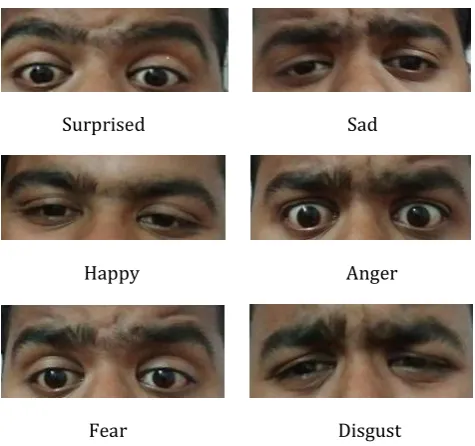
Facial expressions play an vital role in communications in social interactions with other human beings which conveys information about their emotions. The most crucial feature of human interaction that grants naturalism to the process is our ability to conclude the emotional states of others. Our goal is to classify the different human emotions from their eye expressions. The projected system presents a human emotion recognition system that analyzes the human eye region from the video sequences. From all the frames of the video stream the human eyes can be extracted using the well-known canny edge operator and classified using a non – linear Support Vector machine (SVM) classifier. Finally, a standard learning tool is used, Hidden Markov Model (HMM) for recognizing the emotions from the human eye expressions
Surprised Sad
Happy Anger
Fear Disgust
Fig -1: Sample eye expressions
[image:2.595.308.546.339.562.2]© 2018, IRJET | Impact Factor value: 6.171 | ISO 9001:2008 Certified Journal
| Page 4109
support vector machine (SVM) classifier and a HMM to builda human emotion recognition system.
[image:3.595.313.540.80.327.2]
Fig -2: Emotion recognition from human eyes
The methodology of emotion recognition from human eye expression is shown in Fig -2. In this methodology image of the user sitting in front of the camera is captured. Then image representing a set of frames is pre-processed and a noise free image is obtained. The noise free image is edge detected using Canny Edge Operator. The extraction of eye region from the resultant edge detected image takes place using the feature extraction process. The SVM classifier is used tp classify the extracted region of eyes. Finally, the corresponding emotions are recognized
3.2. EMOTION MOUSE
One proposed, non-invasive method for gaining user information through touch is via a computer input device, the mouse. Then the cardiac rhythm, the body temperature and other physiological attributes are taken in account with the mood.
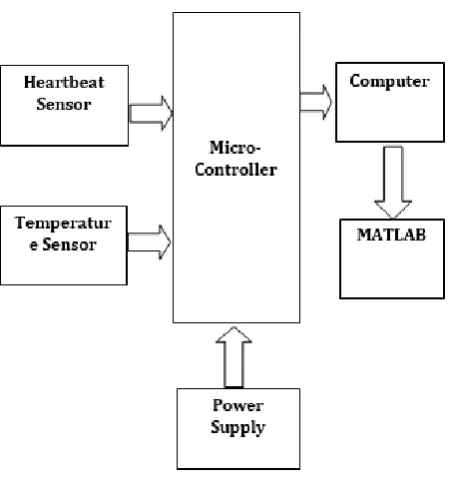
Fig -3: Emotion mouse
The block diagram of emotion mouse is shown in Fig -3, this device can measure heart rate and temperature and matches them with six emotional states: happiness, surprise, anger, fear, sadness and disgust. The emotion mouse includes a set of sensors such as infrared detectors and temperature-sensitive chips. These components can also be crafted into other commonly used items such as the office chair, the steering wheel, the keyboard and the phone handle. Integrating the system into the steering wheel, for instance, could allow an alert to be sounded when a driver becomes drowsy.
Heart rate is taken by IR on the thumb and temperature is taken using a thermistor chip. These values are input into a series of discriminate function analyses and correlated to an emotional state. Specifically, for the mouse, discriminate function analysis is used in accordance with basic principles to determine a baseline relationship, that is, the relationship between each set of calibration physiological signals and the associated emotion.
4. SYSTEM MODEL
[image:3.595.131.238.114.508.2]© 2018, IRJET | Impact Factor value: 6.171 | ISO 9001:2008 Certified Journal
| Page 4110
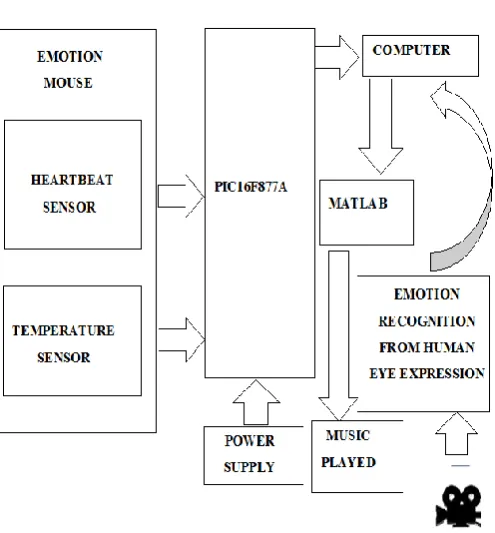
Fig -4: Block diagram of the systemFig -4 shows the block diagram of the system. In this system the data from the heartbeat sensor and temperature sensor of the emotion mouse is given to the micro-controller. The output of the micro-controller is then fed to the computer. The value of heartbeat sensor and temperature sensor is compared with the standard range of each emotion and the suitable emotion is selected on the other hand a webcam is connected with the computer which will take the image of the person from a video sequence and will further recognize the emotion by detecting the eye part. The captured eye section will be compared to the images stored in database to detect mood of the person. After detecting the mood, the music or audio command is played according to the detected mood.
5. RESULT
In proposed system, there are two results of the mentioned methodologies. Firstly, different eye expressions of the different people are taken in consideration by edge detection of eyes. Further each eye expression is categorized into a given set of emotions (happy, sad, fear, surprised, disgust, anger} to take in account a single standard expression for each emotion. Thus emotion of a person can be detected by comparing the eye expression of the person with the standard eye expressions of each emotion. Secondly, the values of heartbeat sensor and temperature sensor are compared with the standard value range of each emotion and accordingly the value range of a emotion that matches with the data values of the user is considered as the emotional state of the user. According to the detected emotion the music or audio command is played.
6. CONCLUSION
Recent research documents tell that the understanding and recognition of emotional expressions plays a very important role in the maintenance and development of social relationships. This paper gives an approach of creating computational machines that have perceptual and sensory ability like those of human beings which enables the computer to gather information about you through special techniques like facial expressions recognition and considering biological factors such as cardiac rhythm and body temperature. This makes it possible for computer and machines to detect the emotion of the human and respond to it.
REFERENCES
[1] Mizna Rehman Mizna
[email protected],Mamta Bachani, Sundas Memon, “Blue Eyes Technology”, 978-1-4799-0615-4/13/$31.00 ©2013 IEEE.
[2] S.R.Vinotha, R.Arun and T.Arun, “Emotion Recognition from Human Eye Expression”, International Journal of Research in Computer and Communication Technology, Vol 2, Issue 4, April-2013.
[3] Mohammad Soleymani, Member, IEEE, Sadjad Asghari-Esfeden, Student member, IEEE Yun Fu, Senior Member, IEEE, Maja Pantic, Fellow, IEEE, “Analysis of EEG signals and Facial expressions for continuous emotion detection”, 1949-3045 (c) 2015 IEEE. Personal use is permitted, but republication/redistribution requires IEEE permission.
[4] TT. Moriyama, T. Kanade, J. Xiao, and J.F.Cohn, “Meticulously Detailed Eye Region Model and Its Application to Analysis of Facial Images”, IEEE Trans. Pattern Analysis and Machine Intelligence, vol [13] Recognition Of Facial Expressions Of Six Emotions By Children With Specific Language Impairment, Kristen D. Atwood, Brigham Young University, August 2006.
[5] McDuff D., Kaliouby R., Senechal T., Amr M., Cohn J., Picard R.W., "Affective-MIT Facial Expression Dataset (AMFED): Naturalistic and Spontaneous Facial Expressions Collected In-the-Wild.”, 2013 IEEE Computer Society Conference on Computer Vision and Pattern Recognition Workshops (CVPRW'10), Portland, OR, USA, June 2013.
© 2018, IRJET | Impact Factor value: 6.171 | ISO 9001:2008 Certified Journal
| Page 4111
[7] N. Malandrakis, A. Potamianos, G. Evangelopoulos,and A. Zlatintsi,“A supervised approach to movie emotion tracking,” in 2011 E International Conference on Acoustics, Speech and Signal Processing (ICASSP). May 2011, pp. 2376–2379, IEEE.
[8] J. Nicolle, V. Rapp, K. Bailly, L. Prevost, and M. Chetouani, “Robust continuous prediction of human emotions using multiscale dynamic cues,” in ACM International Conference on Multimodal Interaction (ICMI), 2012, pp. 501–508.
[9] K. R. Scherer, “What are emotions? And how can they be measured?” Social Science Information, vol. 44, no. 4, pp. 695–729, 2005.
[10]S. Mariooryad and C. Busso, “Analysis and compensation of the reaction lag of evaluators in continuous emotional annotations,” in Affective Computing and Intelligent Interaction (ACII), 2013 Humaine Association Conference on, Sept 2013, pp. 85–90.
[11] Y. Song, L.-P.Morency, and R. Davis, “Learning a sparse codebook of facial and body micro expressions for emotion recognition,” in ACM International Conference on Multimodal Interaction (ICMI), 2013, pp. 237–244.