Technology (IJRASET)
Implementation of Binary Mask Algorithm for
Noise Reduction in Traffic Environment
Ms. Ankita A. Kotecha1, Prof. Y.A.Sadawarte2
1
M-Tech Scholar, Department of Electronics Engineering, B. D. College of Engineering, Maharashtra, India
2
Professor, Department of Electronics Engineering, B. D. College of Engineering, Maharashtra, India
Abstract: In this paper, we present a real-time implementation of the binary masking algorithm, which has been shown to significantly reduce the noise and improves speech-in-noise intelligibility. Binary masking algorithm is an effective way to improve the speech-in-noise intelligibility. The main goal is to implement binary mask algorithm for noise reduction. This paper presents the real time implementation of binary masking algorithm for noise reduction in traffic environment. We tested our algorithm implementation on an FPGA platform, and also software simulation in MTLAB produced results that verify that it effectively reduced the noise and measured noise reduction in the signal is 65%. And it minimizes the propagation delay up to 0.01ms.
Index Terms—Binary mask, Real-time systems, speech enhancement, cochlear implants (CIs), noise reduction, FIR filters.
I. INTRODUCTION
I N a noisy environment, such as a busy street or a crowded restaurant or the presence of the traffic noise the normal human hearing system is able to discern and comprehend speech, despite the multitude of intruding, competing sounds [1], [2]. Unfortunately, the ability to solve this “Traffic noise problem” is greatly diminished in individuals with sensorineural hearing loss [3], [4]. Current speech enhancement algorithms improve speech quality, but not necessarily intelligibility [8]. While hearing-impaired listeners do benefit from improved speech quality, communication problems still exist if intelligibility is not improved. The ideal binary mask is one algorithm specifically shown to improve speech intelligibility. In this paper, we will describe our real-time implementation of the IBM algorithm, realized in hardware on a field programmable gate array (FPGA). The low latency, low power and improved speech quality of our implementation make it practical for use in hearing aids and cochlear implants. Along with the binary masking algorithm , we are using the FIR filters which can filter out the noise up to 65% and improve the speech quality.
II. IDEAL BINARY MASKING ALGORITHM
A. Overview
[image:2.612.196.420.584.667.2]The idea about the binary mask (BM) algorithm is explained as follows. Speech is sparse in the time-frequency domain. If we consider that noise is also sparse in this domain, then it very likely does not overlap with the speech. So, it is easy to remove the noisy regions of the time-frequency plane (by applying the appropriate “binary mask”), which will leave us with intact, noise-free speech. The algorithm Can also effective even if the noise is not sparse in the time-frequency domain; the overall signal-to-noise ratio (SNR) of the speech can be greatly improved by discarding those regions of the time-frequency plane whose SNR fails to exceed a specified threshold. A practical implementation of the BM algorithm generally has three stages—spectral analysis, classification, and synthesis, as shown in Fig.
Fig. 1 High level block diagram of the binary mask algorithm.[1]
Technology (IJRASET)
belonging to class ‘1’ (clean speech, a.k.a. “target”), or class ‘0’ (noise). Third is the synthesis stage In the synthesis stage,
the TF-domain version of the original, noisy signal is multiplied by the binary mask, effectively removing all of the noise-containing portions of the signal. After the binary mask is applied, the TF units are then recombined to form a speech signal that is clean (or at least of higher SNR than before).
[image:3.612.171.479.404.682.2]B. Hardware module
Fig. 2 Hardware model of the project
Above fig shows the hardware module of the project which consist of FPGA Kit, mike, headphones, Amplifiers and power supply section. Actually main masking of the data has been done on the FPGA i.e. field programmable gate array. Ideal implementation of binary masking algorithm on the FPGA is much more feasible. Mike is used for giving the audio signal to the circuit. That audio signal is given to the FPGA. Amplifier section is used for amplifying the speech signal. And headphone is used for receiving the original output signal.
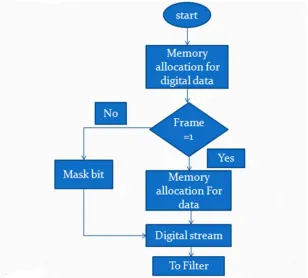
C. Flow chart of BM algorithm
Technology (IJRASET)
[image:4.612.95.553.91.290.2]D. FIR filter
Fig. 3 Simple averaging FIR filter
Filtering is a process of adjusting a signal - for example, removing noise. Noise in a sound waveform is represented by small, but frequent changes to the amplitude of the signal. A simple logic circuit that achieves the task of noise-filtering is an averaging Finite Impulse Response (FIR) filter. The schematic diagram of the filter is shown in Figure 3. An averaging filter, like the one shown in Figure 3, removes noise from a sound by averaging the values of adjacent samples. In this particular case, it removes small deviations in sound by looking at changes in the adjacent 8 samples. When using low-quality microphones, this filter should remove the noise produced when you speak to the microphone, making your voice sound clearer.
E. Software simulation and results
[image:4.612.107.498.422.657.2]Technology (IJRASET)
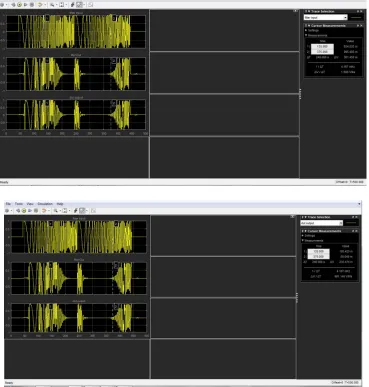
[image:5.612.123.492.82.469.2]Figure 5 : a) Noise present in the input waveform , b) Noise present in the in the output waveform
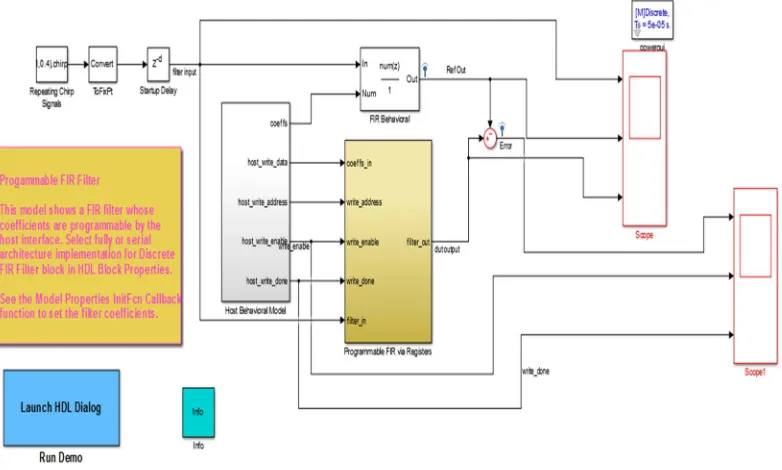
Fig 4. Shows software simulation of the model has been done in the MATLAB. The results of the design are shown in fig. 5 from fig we can observe that noise has been removed in the output waveform. Ideal binary masking is very feasible on the FPGA. It will significantly improves the speech quality by reducing the noise.
III. CONCLUSION
Binary masking algorithm is an effective way to improve the speech-in-noise intelligibility. This paper will provide the real time implementation of binary masking algorithm for noise reduction in traffic environment. It has been found that the binary mask algorithm will significantly improve the speech intelligibility and minimize the algorithm latency. The algorithm can also effective even if the noise is not sparse in the time-frequency domain by discarding those regions of the time-frequency plane whose SNR fails to exceed a specified threshold the overall signal-to-noise ratio (SNR) of the speech can be greatly improved. Main aim of this design is to improve the speech intelligibility, by reducing the noise and to minimize the algorithm latency. And it will reduce the noise up to 65% . This shows that IBM implementation on FPGA is more feasible.
REFERENCES
[1] D. S. Brungart, P. S. Chang, B. D. Simpson, and D Wang, “Isolating the energetic component of speech-on- speech masking with ideal time frequency segregation,” J. Acoust. Soc. Amer., vol. 120, no. 6, pp.4007–4018, Dec. 2006.
Technology (IJRASET)
72, Jan. 2013.
[3]N. Li and P. C. Loizou, “Effect of spectral resolution on the intelligibility of ideal binary masked speech,” J. Acoust. Soc. Amer., vol. 123, no. 4, pp. 64, Apr. 2008 [4]Z. Jin and D. Wang, “A supervised learning approach to monaural segregation of reverberant speech,” IEEE Trans. Audio, Speech, Lang.Process., vol. 15, no. 4, pp.
625–638, May 2009.
[5]W. Cole, Group Delay and Processing Delay in Hearing Aids the Facts and the Fantasies, Audioscan, Dorchester, ON, Canada, Tech. Rep., 2005. [6]Texas Instruments, TMS320C5535, ’C5534, ’C5533 ’C5532 Fixed- Point Digital Signal processors, Aug. 2011, Aug. 2011, datasheet, Rev. Mar. 2012. [7]H. Peeters, C.-C. Lau, and F. Kuk“Speech-in-noise” potential of hearing aids with extended bandwidth,” Hear Rev.vol.18,no.3,pp .28- 36, March.2011
[8]J. Amores, N. Sebe, P. Radeva, T. Gevers and A. Smeulders, “Boostin Contextual Information In Content Based Image Retrieval,”Proc.Workshop on Multimedia Information Retrieval, in conjunction withACM Multimedia, 2004.
![Fig. 1 High level block diagram of the binary mask algorithm.[1]](https://thumb-us.123doks.com/thumbv2/123dok_us/8579417.860395/2.612.196.420.584.667/fig-high-level-block-diagram-binary-mask-algorithm.webp)