Data Transmission Using Barcode Modulation
Technique
Dr. N. K. Chaudhari (Guide)1,Ms. Namrata D. Ninawe (Author)2
Electronics Engineering (Communication) Priyadarshini Bhagwati College of Engineering Nagpur, (INDIA).
Abstract: The concept of Barcode is of great relevance for use in wireless data transmission between hand held device . In a typical setup, any file on a cell phone, for example, can be transferred to a second cell phone through a series of images on the LCD which are then captured and decoded through the camera of the second cell phone. In this study, a new approach for data modulation in barcodes is introduced, and its performance is evaluated in comparison to other standard methods of barcode modulation. In this new approach, orthogonal frequency-division multiplexing (OFDM) modulation is used together with differential phase shift keying (DPSK) over adjacent frequency domain elements. A specific aim of this study is to establish a system that is proven tolerant to camera movements, picture blur, and light leakage within neighboring pixels of an LCD. Keywords: Barcode, data transfer, differential phase shift keying, orthogonal frequency-division multiplexing (OFDM) modulation.
I. INTRODUCTION
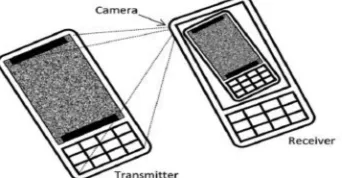
Barcode have played a great role in facilitating numerous identification processes since their invention in 1952. In fact barcode is a simple and cost-effective method of storing machine readable digital data on paper or product packages. As pressing needs to transfer even more data faster and with high reliability have emerged, there have been many improvements that were made on the original barcode design. Invention of two dimensional (2D) or matrix barcodes opened a new front for these cost-effective codes and their application in more complex data transfer scenarios like storing contact information, URLs among other things, in which QR codes have become increasingly popular. A comparison of 2D barcode performance in camera phone applications . A significant part of the endeavors in lattice scanner tag advancement have been devoted to standardized identifications showed on a bit of paper as that is the way they are typically utilized. With the substitution of books with tablets and digital book per users one could examine that re-arrangement of the paper with LCD may open another promising front for more extensive uses of 2D scanner tags as a mean of information exchange. In addition not at all like the static paper, the LCD might display time-differing standardized identifications for the inevitable exchange of floods of information to the accepting electronic device(s) as portrayed in Fig. 1. This thought has been actualized in where transmission of information between two phones through a progression of 2D QR codes is examined, accomplishing bit rates of under 10 kbps for cutting edge cell phones. Later the thought was further created in which a PC screen and a computerized camera are utilized for transmission and gathering with bit rates of more than 14 Mbp.
[image:2.612.221.392.536.625.2] [image:2.612.187.423.656.725.2]II. BARCODE.
A barcode is an optical machine-readable representation of data relating to the object to which it is attached. Originally barcodes systematically represented data by varying the width and spacing of parallel lines, and may be referred to as linear or one dimensional. Later they evolved into rectangles, dots, hexagons and other geometric patterns in two dimensions (2D). Although 2D systems use a variety of symbols, they are generally referred to as barcodes as well. Barcodes originally were scanned by special optical scanners called barcode readers. The different regions of barcode are as follows:
A. Structure of Barcode
1) Quiet Zone: The minimum required space for bar code scan-ability, preceding the Start Character of a bar code symbol. The quiet zone should be free from any printing and be the same color and reflectance as the background of bar code symbol. The Quiet Zone should be ten times the width of the narrowest element in the bar code, or 0.25 inch minimum, also known as Clear Area.
2) Start Code: Indicates the start of the barcode. These are special bar code characters & they signify the start of data to the scanner/reader. Start characters are usually stripped off and not transmitted to the host.
3) Check Digit: Check digit (not always present) is a mathematical sum that is used to verify the accuracy of the other elements of the barcode. It is the extra digit added at the end of a bar code to allow the scanner to confirm that it read the bar code correctly. It is typically stripped from the data and not transmitted to the host. Stop Code: Indicates the stopping point of the barcode. These characters signify the end of data to the scanner/reader. They are also stripped-off and not transmitted to the host.
4) Working of Barcode: Laser beam is incident on a mirror/prism which is then directed on the barcode from left to right. The dark bars of barcode absorb the incident light but the light is reflected by light spaces. Photodiode measures the reflected light and gives out electrical signal. The analog electrical signal is then converted into digital one. And corresponding barcode is read.
B. QR CODE
III. PSK-OFDM
While LCD innovation is enhancing pixel to pixel isolation, a picture's percentage catch bends still remain, bringing about neighboring pixels of the standardized identification stir up in the picture and resulting in some sort of Inter Symbol Interference. The fundamental thought in determining this issue is to translate the standardized tag picture as a remote radio sign for which ISI lessening strategies have al-prepared been demonstrated fruitful. One of the best and most achievable regulation strategies equipped for adapting to serious conditions in band restricted correspondence channels is the purported Orthogonal Frequency Division Multiplexing or OFDM. The a general thought is that when managing band-restricted, force con-strained, multipath channels, it is more effective to exchange a group of tight band signals in parallel rather than a solitary high transfer speed signal. Similarities of Barcode and Wireless RF Channel For simplicity each 2D image is reformulated into a 1D row vector containing all pixels in the 2D image. Each row can be considered as a time domain signal which has Pulse Amplitude Modulation (zeros are black and ones are white pixels). Consider taking a picture of this single row, in a band limited channel which has a combination of camera focus problems, resolution limitations, light leakage from white to black pixels, among other things. Moreover in a multipath channel in which the camera moves during image capture and mixes up the image of several neighboring pixels, the resulting image will suffer from high ISI. To solve these problems in a time domain radio signal, OFDM method is used to essentially divide the channel into multiple orthogonal low bandwidth channels and the low rate data is sent into these channels in parallel. So in case of the 1D data the inverse Fourier transform is used for displaying the data instead of using the PAM modulated process, where Her- mitian symmetry conditions should be met to have real-valued outputs. As a result, most artifacts only affect the high frequency components leaving low frequency components intact for data transmission.
This idea may be generalized to 2D signals to meet the requirement for transferring the entire image at once.
Instead of 1D inverse Fourier transform, the 2D version is used such that the effect of artifacts acting on two axes would be confined to high frequency components. The exact modulation scheme will be discussed later in this study.
In general each sub-carrier in an OFDM signal is modulated using M-quadrature amplitude modulation (MQAM).
Thus proper phase shift of each element should be estimated and compensated for before demodulation. This generally requires specific conditions on the channel characteristics like fast fading where pilot tones are used for channel estimation or slow fading where most methods would require multiple symbols in seeking similar channel responses (i.e.. similar transfer functions).
When using OFDM for transmission of data as images, all the channel equalization computations should be based on a single OFDM frame due to the independent channel response between subsequent frames, unless the frame rate is very high. In fact each frame is distorted by LCD-Camera relative motion during its own capture time. To mitigate this problem the phase difference between adjacent elements is used to convey data.
Using DPSK modulation prior to applying the inverse Fourier trans- form in OFDM modulation, data would not have to be stored in the absolute phase of the received elements but rather in its phase difference to the neighboring element, which eliminates the requirement for channel estimation and equalization if the channel response does not vary abruptly between adjacent subcarriers. Transmitter:
One of the advantages of using OFDM is its effective computation method which uses the Inverse Fast
Fourier Transform (IFFT) to modulate input data into orthogonal frequencies. The modulated signal should be real valued in order to be shown on an LCD, so the input to the IFFT algorithm should have Hermitian symmetry.
IV. CONCLUSION AND FUTURE WORK
mitigation of camera LCD movements where the phase of each element changes continuously. On the other hand, addition of a differential phase modulator before OFDM to modulate the data stream into phase differences of adjacent elements (DPSK-OFDM) causes the motion effect to increasingly weaken because of its gradual change from element to element, contributing to a small deviation from the ideal phase in the received signal.
It was observed that under relative LCD-camera motions that generate error rates in excess of 30% in PAM and QPSK-OFDM, the proposed system of DPSK-OFDM will maintain an error rate less than 8% which is practically correctable using error correction coding. Future inquiries in a resolution to this problem have to address the best choice of differential pattern to optimize performance for various motion scenarios. Moreover, extension of the current two-bit per symbol constellations increases data transfer capacity, and its BER performance evaluation would be required. Nevertheless, a study on the effect of perspective correction errors on the
BER performance of this algorithm compared to the other ones could augment our understanding of its applicability to real world scenarios.
REFERENCES
[1] Barcode Modulation Method for Data Transmission in Mobile Devices Amin Motahari , Member, IEEE, and Malek Adjouadi , Member, IEEE
[2] 3D Barcode Modulation Method for Data Transmission in Mobile Devices Navale Puja Vitthal1, Erande Swati Govind2, Badhe Priyanka Vasant
[3] Barcode modulation mechanism for handheld mobile communication arun kumar dandothi (m.e.) 1 s.prabhakar rao assistant professor ece department