Network Traffic Management
Vipul Jadav1 1
C U Shah University
Abstract: the purposes of this paper have to discuss issues related to Network Traffic Management. A relatively new category of net-work management is fast becoming a necessity in converged business Networks. Mid-sized and large organizations are finding they must control network traffic behavior to assure that their strategic applications always get the resources they need to perform optimally Controlling network traffic requires limiting bandwidth to certain applications, guaranteeing minimum bandwidth to others, and marking traffic with high or low priorities. This exercise is called Network Traffic Management.
I. INTRODUCTION
Computer network is a data communications a system which interconnects computer systems at various different sites. A network may be composed of any combination of LANs, or WANs. Network traffic can be defined in a number of ways. But in the simplest manner we can define it as the density of data present in any Network. In any computer Network, there are a lot of communication devices trying to access resources and at the same time getting requests to carry out some work for some other device [1]. Also at the same time certain types of communication devices may be busy to respond to the request being made to them. So there is lot of information exchange in the Network in form of request, response and control data. This data is basically in the form of a huge number of packets floating around in the Network. This huge amount of data acts as a load on the Network, which results in slowing down the operations of other communication devices. Due to this there is a lot of delay in communication activities. This ultimately results in congestion of the Network. This is the description of Network Traffic in its simplest form. In other words we can say that Network traffic is the load on the communication devices and the system.
This traffic on the network has now resulted in mid-sized and large organizations realizing that they must control network traffic behavior to ensure that their strategic applications always get the resources they need to perform optimally [2]. Controlling network traffic requires limiting bandwidth to certain applications, guaranteeing mini-mum bandwidth to others, and marking traffic with high or low priorities. This exercise is called traffic management.
II. GENERAL PROCESSES FOR TRAFFIC MANAGEMENT
III. TECHNIQUE FOR MEASURE NETWORK TRAFFIC
One of the easiest ways to comprehend Network Traffic is to consider an analogy with the road traffic. Consider that there is an emergency and someone has fallen sick and has to be rushed to the hospital. But when the ambulance tries to make its way through the roads of the city, it finds the roads totally blocked with cars n busses. The solution to this situation would be for a traffic policeman to step in and manage the traffic. He will first gauge the traffic, and then prioritize the traffic [3]. The ambulance will get the highest priority and the road will be made empty for the ambulance to pass. Similar is the case with Network Traffic. When you send a request on the network, it is possible that due to some problem or other requests you have to wait for some time. If over a period of time a number of packets queue up and wait then it results in traffic. Once traffic is created, you must wait till it is over, which can be for any length of time, depending on the situation. So, there has to be some way to deal with this situation. The solution for this is Network Traffic Management and this process starts first with measuring the traffic on the network [4].
A. Reasons to measure network traffic
The following are the reasons for which we have measure the network traffic. 1) Service monitoring - making sure things keep working.
2) Network planning - deciding when more capacity is needed.
3) Cost recovery - session times and traffic volumes can provide billing data.
4) Research - an improved understanding of what's happening should allow us to improve network performance.
B. Internet traffic
The basic performance metrics of Internet traffic can be listed as:- 1) Packet loss
2) Delay 3) Throughput 4) Availability
C. Drivers for measurement
There are number of other drivers strongly deals with requirement of measurement are – 1) Pricing
2) Service level agreements 3) Services
4) Applications
IV. NETWORK TRAFFIC MEASURE
Usually, traffic management is deployed at the WAN edge of an enterprise site. This is where the high-speed LAN meets the lower-speed WAN access link. The LAN-WAN juncture is also where both Internet and intranet traffic enter and exit the enterprise [5]. So it is the ideal place to “tame” traffic and to mitigate the impact of non-critical and even suspicious traffic picked up on the Inter-net. Limiting or blocking the network resources available to frivolous or undesirable traffic boosts the performance of enterprise resource planning (ERP), customer relation-ship management (CRM), and other strategic, business-critical applications.
V. APPROACHES FOR TRAFFIC MEASUREMENT
There are some approaches for traffic measurement as follows
A. Active Measurement of Traffic
As name indicates, in this measurement approach users or providers are directly related to the activities to the measurement [5]. There are number of different ways to carry out this measurement like
1)Injection of probes into network by users and providers 2) Ping and Trace out the Path connectivity and Round-trip delay
3) User-application performance as seen from hosts Like Loss, Delay and Throughput
iv)Distribute on measurement servers makes the Probes are spread across mesh of paths through network to check scalability and growth of probe traffic
B. Passive Measurement of Traffic
In this approach user is indirectly deal with system using some hardware or software tools. Basically some historical data is used to find the current traffic measurement The currently used techniques for this type of measurement are as follows
1) Packet monitors: This can be achieved by recording packet headers on link. It requires unique detail of protocol and architecture studies
2) Router / Switch traffic statistics: Analyzing router or switch, the intelligent devices installed at network, can provide network internal behavior. Using these devices we can get information about Packet drops, Counts and Flow statistics
3) Server and router logs: These records or logs can per-form well work in measuring. They provide summaries of dial session, routing updates or web-server log.
VI. MEASURING TOOLS
There are many tools available for measurement of traffic [7]. They are listed according their categories. The Local Systems which includes NETSTAT, TCPDUMP, ETHREAL and NTOP. The Remote (END) System which having MIB, IF-MIB, SNMP and MRTG. The Routers are also having NETFLOW (CISCO) and LFAP (ENTERA-SYS). Lastly the SNIFFERS having RMON, RMON2 and NETRAMET
VII.TRAFFIC ANALYSIS
After consecutive monitoring over a number of years, LAN and WAN traffic have been seen to follow different patterns.
A. LAN Traffic
Traffic on a LAN has shown to be self similar in nature
The patter of the variation of the traffic repeats itself over regular intervals.
B. WAN Traffic
Traffic on the WAN has been found to vary as per the following models [8]. 1) Random Traffic: The traffic here seems to follow no fixedpattern.
2) Poisson’s Model: Traffic Nature in Internet has been identified to confirm to the Poisson’s Model. This model gives us a rough idea of the characteristics of Internet Traffic. The model estimates the probability of the number of packets that should be present on the network after a given time if the average arrival rate of the packets is specified.
VIII. TRAFFIC MANAGEMENT
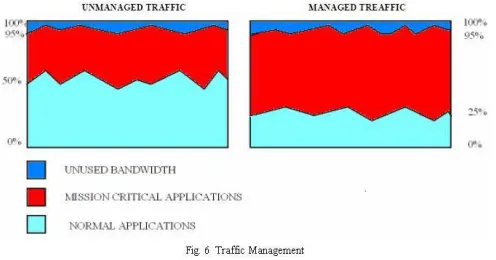
A look at the figure below will make the comprehension of network traffic before and after it is managed more clear [8]. The figure is a depiction of the transmission media whilst it is carrying the unmanaged traffic. As we can see normal applications such as maybe video, audio downloads etc are taking up the major portion of the available band width. Mission critical applications are left with only about 40 % bandwidth which means that there may be a lot of delay in the transmission data or processing of transactions. This is where the role of traffic management comes in.
The user can take a decision as to how much amount of bandwidth he wants to keep exclusively for mission critical applications, and then the rest can be used for other normal applications [9]. In the second figure we can see that the traffic has been managed in such a way that maximum bandwidth (nearly 70%) has been reserved for mission critical applications. 5% of bandwidth is unused which can also be used by these applications in case of a surge in traffic. Normal applications are left with only about 25% of the band width.
Management. Also the manner in which both the size of networks and the data which rides on them is increasing by the day, it has become imperative to monitor the kind of traffic flowing, priorities it and then manage the traffic accordingly.
[image:6.612.161.409.238.368.2]A. Figures
Fig. 1 General Process for Traffic Management
Fig. 2 Traffic Management at the WAN edge of an Enterprise
Fig. 3 Pictorial proof of self-similarity Fig. 4 Fixed Pattern Fig. 5 Average Traffic Fig. 6 Traffic Management
IX. CONCLUSION
To conclude we would like to reemphasize that, in to-day’s changing scenario, where the conventional way of doing things no longer holds good, organizations are fast realizing that in order that they stay in step with others in the race, they must embrace this concept of network
REFERENCES
[1] K. Dresner and P. Stone, “Multi-agent traffic management: An im-proved intersection control mechanism,” in Proceedings of the Fourth International Joint Conference on Autonomous Agents and MultiAgent Systems, Utrecht, The Netherland, July 2005.
[2] Roughan, M. “Simplifying the synthesis of Internet traffic matrices”. Computer Communication Review 35 93–96, 2005.
[3] M. Yuksel, B. Sikdar, K. S. Vastola and B. Szymanski, “Workload generation for ns Simulations of Wide Area Networks and the Inter-net”, Proc. Of Communication Networks and Distributed Sys-tems Modeling and Simulation Conference, pp 93-98, San Diego, CA, USA, 2000.
[4] Roughan, M. and Kalmanek, C. R. “Pragmatic modeling of broad-band access traffic”. Computer Communications 26 (8) 804–816, 2003. [5]Tomá, Vicente R. et al. “New technologies to work withtraffic management plans.”, Traffic Technology International-Annual review, 2003.
[6] NetVeda LLC, “Policy.Net: Policy Based Network Traffic Man-agementlice” http://www.netveda.com/ downloads/ PolcyNet_Whitepaper.pdf, 2003-2005 [7] Internet Traffic Management, http://www.sics.se /cna/tm/
[8] Wikipedia, http://en.wikipedia.org/wiki/ _management