THE FUNCTION, SIGNIFICANCE AND LIMITATIONS OF ‘GLOBALISATION’ IN THE NEW LABOUR DISCOURSE
Christopher Michael White
Thesis submitted in fulfillment o f the requirement of the PhD in International Relations, London School of Economics and Political Science,
UMI Number: U586B65
All rights reserved
INFORMATION TO ALL USERS
The quality of this reproduction is dependent upon the quality of the copy submitted.
In the unlikely event that the author did not send a complete manuscript and there are missing pages, these will be noted. Also, if material had to be removed,
a note will indicate the deletion.
Dissertation Publishing
UMI U586365
Published by ProQuest LLC 2014. Copyright in the Dissertation held by the Author. Microform Edition © ProQuest LLC.
All rights reserved. This work is protected against unauthorized copying under Title 17, United States Code.
ProQuest LLC
789 East Eisenhower Parkway P.O. Box 1346
F
Abstract
Table of Contents
Acknowledgements... 5
Chapter 1 Introduction Introduction...6
New Labour and Globalisation...6
Thinking about the Consequences o f Globalisation...10
Globalisation as a Contested Term...15
Reinterpreting the Significance o f Globalisation...20
The Function, Significance and Limitations o f the Thesis...23
Chapter 2 A Methodology for Understanding Globalisation in Specific Circumstances Introduction...33
Conceptualising Ideology: Thompson’s Typology...35
Four Critical Formulations o f Ideology...42
Hermeneutics and ‘The Problem o f Epistemology ’...53
Depth Hermeneutics and the Interpretation o f Ideology...59
Chapter 3 Understanding Globalisation Introduction...72
Keneiche Ohmae and the Strong Globalisation Thesis...75
Challenging the Strong Thesis: The Sceptics...82
Complex Globalisation Theory...94
A Critical Hermeneutic Approach...106
Chapter 4 Globalisation and the Domestic Realm Introduction...114
Globalisation as Liberalisation and a ‘Thing-in-Itself’...116
Globalisation and the Third Way: Depoliticising the Domestic Agenda...130
The Normative Dimension to Globalisation...141
Chapter 5 Globalisation and the Formulation of Foreign Policy Introduction...153
Globalisation and the Domestic Analogy...154
Foreign Policy in an age o f Globalisation...163
Chapter 6 Re-Interpreting the Significance of Globalisation to New Labour Introduction...197
Depth Hermeneutics and the Interpretation o f Ideology: Approaching the New Labour Discourse...198
Re-Interpreting the Domestic Significance o f Globalisation: Getting Elected...207
Chapter 7 Contesting The Future Significance of Globalisation: The Challenge of the New Social Movements.
Introduction... 243 The Challenge o f the Anti-Globalisation Movement:
Unpacking the Process, Debunking the Logic...245 Responding to the Challenge o f the Anti-Globalisation
Movement...260 Assessing The Significance and Function o f
Acknowledgements
My thanks are due to a number of persons who have assisted me with the preparation o f this thesis. Professor Michael Yahuda and Mr Mark Hoffman have commented on various points at an early stage in the work. More recently, Dr Leslie Sklair, Professor Anthony Giddens and Dr Kimberley Hutchings have also provided helpful comments and suggestions, some of which have been incorporated into this present work.
I also owe special thanks to a number of my colleagues and friends at the Department of International Relations. I am particularly grateful to Patrick Cullen and Eugenia Zorbas. In addition, I thank Dr Peter Weinberger, Ramin Kaweh, Christian Marius Stryken, Nisha Shah, Amnon Arah and Babak Bahador, for their helpful comments.
I am grateful to the London School o f Economics for financial assistance provided during my studies.
My thanks also go to my supervisor, Dr Peter Wilson, for his guidance and cheerful encouragement.
Chapter 1
Introduction
“The political debate today, is shaped as much by how a country sees its place in the world as by internal ideological debate”.1
“Globalization should not be seen as ineluctable... often, it serves as afallacious pretext fo r harmful, disastrous policies... [so] fatalism must give way to will”.
This thesis critically examines the idea of ‘globalisation’ in the New Labour discourse
over the period 1996-2001, challenging the version articulated by key members of the
party. In this chapter, I outline the orientation of the argument, and introduce some of
the key ideas that structure it. I begin by discussing why such a study is necessary,
locating the discussion of globalisation in the context of the 1997 general election. I then
outline the manner in which I approach the analysis of globalisation, before going on to
qualify its nature and focus, drawing attention to some of the limitations inherent in the
approach.
New Labour and Globalisation.
Much has changed since that fateful night in May 1997 when New Labour was
emphatically swept into power. The day after the election, Blair’s new government sat
on a one hundred and seventy eight majority. The Conservatives had lost 178 seats and
Labour had gained 145, with the swing from Conservative to Labour of 10.3%, a post-
war record. The Conservatives seemed to be at an impasse, stricken by internal
squabbles and bedevilled by charges of corruption, their ideas no longer appeared to
have their original innovative or revolutionary quality. Thus, whereas during the
eighteen years of Conservative rule it had seemed that Labour might never again govern,
by 2000, similar doubts were being aired about the Conservatives.4
However, though victory was emphatic, it would be wrong to conclude that all was well.
Days had barely passed before some began to voice disquiet. There concern: had New
Labour perhaps offered up too much, or perhaps too little, in their hunger for power?5
Such a concern overlaid a deeper worry: had New Labour sold out in order to secure
victory? Had the Financial Times got it right when they suggested that ‘Labour sets out
to make similar look different’?6 Was the party in fact ‘labouring under false
pretences’?7
Blair was certainly sure of his case, and not about to forget whom the e lectorate had
voted in. Following a bitter process of internal party changes, Blair and his inner circle
2 Final text o f the National Convention on Mondialisation, Europe, France, in Vedredi, No. 276. Quoted in Ben Clift, ‘Labour’s Third Way and European Social Democracy’, in Steve Ludlum and Martin J. Smith (eds.), New Labour in Government. (Basingstoke: MacMilllan Press Ltd, 2001), p.63.
3 D. Denver, ‘The Results: How Britain Voted’, in Andrew Geddes and Jonathon Tonge, (eds.), Labour’s Landslide: The British General Election. (Manchester: Manchester University Press, 1997), p.9.
4 Anthony King, (ed.), Britain at the Polls. (London: Chatham House, 1992). Anthony Heath, Roger Jowell & John Curtis, (eds.), Labour’s Last Chance? The 1992 Election and Beyond. (Aldershot: Dartmouth, 1994).
5 Polly Toynbee, Did Things Get Better? (London: Penguin Books, 2001). 6 Financial Times, 21st May 1996.
saw their victory as a triumph for a process of modernisation begun by Neil Kinnock in
the 1980’s, and as a mandate to pursue a policy agenda considerably different to days
o
gone by. Thus, ‘Old Labour’ was definitely out. As he was to reiterate countless times
following the election ‘we won as New Labour and we will govern as New Labour’.
And yet there is a certain irony here, in that such a resounding victory in favour of a
government so enamoured of the idea of change should nonetheless find that they are
criticised by so many for their reluctance to break free o f the conservative legacy.
In the first instance, Blair answers many of his detractors on this point, by locating New
Labour in a period that is presented as being genuinely new. The demise of the Cold
War, ever-greater levels of economic integration and unprecedented technological
advances all combine to explain the new times, and thereby justify New Labour’s
position. And centrally, the process understood to be driving this change is the process
of globalisation. Hence this thesis.
Whether business, political, or cultural (or academic), no self-respecting guru has missed
the opportunity to wax lyrical on the subject, and New Labour, like so many, have not
been immune from being caught up in this wave. In fact the idea of globalisation
actually underpins the approach of New Labour. New Labour wards off criticism
because, they say, new times require new approaches, and this applies no less to a party
of the left. We live in an age of ‘globalisation’. And as Blair is keen to point out, “no
8 Jon Sopel, Tony Blair: The Moderniser. (London: Michael Joseph, 1995). On the process o f
country is immune from the massive change that globalisation brings”.9 So significant is
globalisation that it is now possible to credibly talk of a ‘third way’ position in British
politics.
The question therefore, is what of these new times, and what status do we afford their
analysis? What is this thing, ‘globalisation’? In the following chapters I will examine the
function, significance and limitations of ‘globalisation’ in the New Labour
understanding over time, and in challenging the interpretation contained in the New
Labour discourse, offer an assessment that attaches a new significance to ‘globalisation’,
one that draws attention to the ideological and constitutive role that it plays in the New
Labour discourse.
The argument will take the following form. In interpreting ideology in the New Labour
discourse, I distinguish between two phases, roughly coinciding with the timing of
speeches on the topic, and more importantly, coinciding with what might be regarded as
a shifting set o f interests. The first period, from around 1996 through to the end of 1999,
is on the whole dominated by the ideas of Blair, who makes sense of the implications of
globalisation judged in terms of the domestic impact that it is perceived to have. A
second period, though overlapping, generally develops from 1999 onwards, and
concerns itself with thinking about globalisation judged against that backcloth of the
international realm and its consequences for foreign policy. In addition to Blair,
contributors to this second phase include notably Robin Cook and Clare Short. In the
final section of the thesis, I trace how an altered understanding of globalisation posited
by the non-governmental sector and new social movements has also played an important
role, in effect challenging the New Labour understanding in both areas. In this respect
one might qualify this development as potentially harbouring the demise of the term as a
significant feature of the New Labour corpus, and depending on the direction that this
debate takes, as ultimately representing a challenge to the entire project. The reaction to
this challenge will draw me to an examination of the response of Clare Short, Gordon
Brown and Robin Cook.
I now turn to what I mean by the function, significance and limitations of
‘globalisation’, and the means by which an evaluation can and ought to be made.
Thinking about the Consequences of Globalisation
For New Labour “certain key consequences flow from accepting globalisation and
working with it”.10 This is what I refer to as ‘the function of globalisation’ in the New
Labour discourse, that is the significance as accorded by New Labour. Such a view
relates to how globalisation operates as explanans, in other words ‘that doing the
explaining’. This involves an examination of how it is conceptualised and how it is used
to validate action in the political realm.
Undoubtedly, ‘globalisation’ has an important function to play in the New Labour
discourse. As an idea it has captured the imagination of the New Labour ‘top brass’, and
the subject, stressing its significance and profundity as witnessed by the challenge that it
represents. Of course, New Labour is not alone in treating the topic seriously. Like so
many other western mainstream parties, it is ‘globalisation’ that is seen to harbour ‘new
times’. However, what is perhaps unique about New Labour discourse is the way in
which globalisation functions in validating a new political philosophy.11 According to 1 9
Blair, “[t]he driving force behind the Third Way is globalisation”. And yet it is by no
means clear just what ‘Third Way’ politics is. As Wickham-Jones points out, “[t]he term
itself is frustratingly elliptical and vague”; being used “in different contexts with
different meanings”.13 So it is with globalisation.
And globalisation does not just function as the ‘driving force behind the Third Way’. It
is also important to recognise the sense in which it is significant as a result of its
evocative and populist nature. As will become clear, this fits well with the Blairite desire
for modernisation and radical change. Its widespread currency lends a populist
connotation to the broader New Labour programme. Blair is keen to tap into this, as it
holds out the opportunity of a transformed and improved future. Thus talk of ‘new
times’ is made all the more palatable given the wider context o f ‘global speak’.14
10 Tony Blair, ‘The Global Economy’, speech to the Keindanren, Tokyo, 5th January 1996.
11 See Noreena Hertz, The Silent Takeover: Global Capitalism and the Death o f Democracy. (London: William Heinemann, 2001), p.31.
12 Blair, ‘Facing the Modem Challenge’, op.cit. See also Anthony Giddens, The Third Wav. (Oxford, Polity Press, 1998).
13 Mark Wickham-Jones, ‘Labour’s Trajectory in Foreign Affairs: The Moral Crusade o f a Pivotal Power’, in Richard Little & Mark Wickham-Jones (eds.), New Labour’s Foreign Policy: A New Moral Crusade. (Manchester: Manchester University Press, 2000), p. 14.
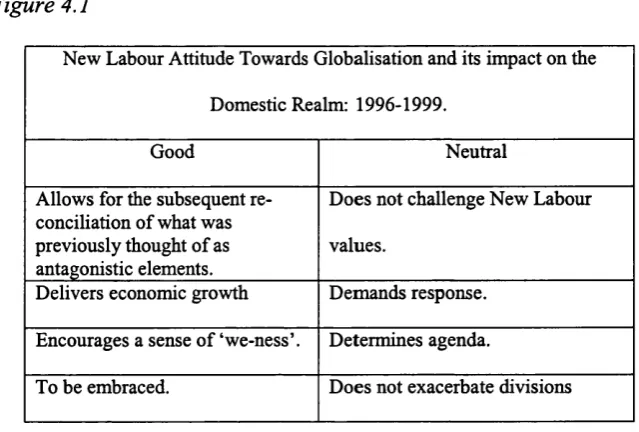
However, and as will be examined in chapter 4, globalisation also has more specific
consequences. Blair argues that in light of globalisation, “the key issue facing all
governments of developed nations is how to respond\ 15 This highlights how policy is
re-prioritised, and reoriented along particular lines. ‘Globalisation’ determines an agenda
that, first and foremost, compels a set of responses that are presented as unavoidable.
Hence the political program is presented as if its prescriptions are unavoidable
‘necessities’ associated with the ‘new times’. The programme, as a result, takes on the
status of being pragmatic. Such a stance allows New Labour to posit a move “beyond
the old boundaries between left and right altogether,” which by their nature are now seen
as being ‘dogmatic’, ‘ideological’ and ‘conservative’.16 In place of the ‘old left’ and
‘new right’ positions, the New Labour orientation is instead ‘progressive’, because it
embraces a new agenda that derives from the new times.
The consequences of this new setting then are far reaching, in that this relocation holds
out the opportunity of ‘de-politicising’ politics. ‘Ideology’, in an age of globalisation,
becomes a thing of the past: “[t]he era of grand ideologies... is over”.17 Emptied of
ideological content, with its policies now seen as unavoidable, domestic politics are
pursued in the ‘national interest’, and given meaning vis-a-vis the world ‘out there’.
Politics thus becomes increasingly technocratic, “what matters is what works”; there no
15 Tony Blair, ‘The Global Economy’, in Tony Blair, New Britain: Mv Vision o f a Young Country. (London: Fourth Estate, 1996), p .l 18, emphasis added.
16 Tony Blair, speech to the News Corporation Leadership Conference, Hayman Island, Australia. 17th July 1995. Quoted in Hertz, The Silent Takeover, op.cit., pp28-29.
1 ft
longer being any “right or left politics in economic management today”. Previous
controversies are apparently resolved and antagonistic themes now reconciled.
The function and significance of globalisation extends beyond the domestic realm. As
will be examined in chapter five, globalisation is also significant for New Labour
because it presents a set of experiences that are universal in content. This in effect
challenges the problematic of ‘incommensurability’; the idea that different points of
view ultimately preclude the possibility o f agreement on certain issues.19 For New
Labour, globalisation gives rise to a collective experience, which in turn spurs a logic
that encourages an evolving consensus on issues traditionally seen as antagonistic. It
encourages the possibility of a consensus developing, and validates a particular dialogue
as universal, thanks to the objective conditions brought about by globalisation. Not seen
as either divisive or dialectical (i.e. at once unifying and divisive), globalisation is rather
a process that opens the way for a hitherto nascent set of universal values and interests to
develop. Thus in addition to a third way in domestic politics, globalisation also gives
rise to the possibility, indeed the need, for a ‘third way’ in international affairs; in this
case suggesting a move beyond ‘idealist’ and ‘realist’ positions.
So what does all this imply for foreign policy? To begin with, on this view, the national
interest and ‘global interest’ increasingly becomes one and the same thing. This means
that the active pursuit of certain values and interests in the international arena becomes
less controversial, in fact allowing New Labour to articulate an agenda in foreign affairs
that can be described as ‘solidarist’ in orientation.20 That is to say, the active realisation
of issues of global justice must now be pursued in the national interest if international
order is to be secured in the long term.
Given the ‘world as it is’, increasingly unified in the face of the challenge and
opportunity globalisation presents, New Labour details a foreign policy that confidently
places the active pursuit of ‘British values’ - now posited as ‘global values’- at its heart.
This is the sense in which New Labour are able to articulate and validate its much
vaunted ‘ethical dimension’, a dimension that, according to Cook, does not significantly
compromise other issues deemed to be in the national interest. Respect for human rights,
for example, becomes a sin qua non of success in a global economy. The need to qualify
the norm of non-intervention becomes increasingly necessary and yet, given greater
interconnectedness, is also now less problematic, thanks to a set of universal values.
By pursuing a policy of ‘critical engagement’, one that encourages dialogue with all
regimes, the British national interest can therefore be maximised, and aided by the
possibility of exploiting its ‘pivotal’ status, Britain moreover, can have a significant
hand in realising this shared destiny.
Limitations of the Understanding: Globalisation as a Contested Term
Though we see that it plays an important function in the discourse, in evoking
globalisation, New Labour nevertheless court considerable controversy. A key
limitation, it will be seen, is that Blair and others have in effect articulated an account of
dubious worth and questionable staying power; particularly given the increasingly
negative connotations associated with globalisation by a wide variety of ‘civil society
groups’ united under the catchall term ‘anti-globalisation’.21
At first sight, it is quite surprising that New Labour should lend such credence to the
idea ‘globalisation’, when a cursory examination of the literature quickly attunes one to
the fact that it is a highly contested and indeed emotive issue. Nonetheless, in that they
do opt for the term as a key explanans, an important part of this thesis will concern itself
with some of the empirical and theoretical limitations to their understanding.
For some time now, a debate about the status of ‘globalisation’ has been unfolding in
which writers have increasingly questioned many of the assumptions attending to the
concept. In order to utilise this debate, and so make sense of the concept of globalisation
itself, I conduct a critical examination of the globalisation ‘literature’ in chapter 3. On
the basis of this examination, I argue that the position staked out by New Labour is in
the first instance untenable, in that it draws heavily upon a conceptualisation of
globalisation that has now largely been shown to be erroneous.
20 Hedley Bull, ‘The Grotian Conception o f International Society’, in Herbert Butterfield & Martin Wight (eds.), Diplomatic Investigations: Essays in the Theory o f International Politics. (London: Allen & Unwin, 1966), pp35-50.
This conceptualisation relates to what I refer to as the ‘strong thesis’. Constituting a
‘first wave’ of thinking on the topic, the ‘strong thesis’ contains a series of assumptions
that have subsequently been shown to be unsupportable. Essentially, this thesis holds out
that there now exists a ‘global economy’, entailing a ‘global logic’ that assumes an
increasingly circumscribed agenda for any government. Though of course containing
elements of truth, the general thrust o f the argument, I suggest, is overly simplistic
because it fails to recognise the considerable room for manoeuvre that governments still
retain. I argue that this view of globalisation, though still influential, mistakenly
conflates ‘globalisation’ for ‘liberalisation’.22
To develop this part of the argument, I draw upon the ‘sceptical’ critique of globalisation
O'X
posited by a number of prominent writers on the ‘left’. This ‘second wave’ response to
the initial understandings of globalisation can be seen as a challenge to the ‘strong
thesis’, and as such, their approach presents a challenge to many o f the assumptions
about globalisation made by New Labour.
‘Sceptics’ such as Hirst and Thompson, begin by debunking an understanding of
globalisation that they believe has solidified into a sort of ‘common sense’. In this
respect, the critique is important in that it challenges what might be referred to as a
‘hegemonic view’.24 In challenging this understanding, the sceptical critique questions
what globalisation is, or must be, by offering a conceptualisation of the process in the
abstract, thereby distinguishing it from other processes. This allows them to then apply
an empirical means of judgement.25
Secondly, and perhaps most importantly for my own purposes, the sceptical literature
questions the idea that globalisation entails certain consequences. In challenging the idea
of a ‘global logic’ unfolding out of the process of globalisation, the sceptical literature
dismisses the assumption that a particular set of policy responses must accompany the
process. As such the sceptical approach rejects the idea that these measures are
unavoidable and inevitable. Such a position is seen to be untenable, in that it is founded
upon empirically suspect information, and it should be said, sustained by a neo-liberal
outlook that need not be accepted.
It is possible to identify just such a ‘global logic’ operating in the New Labour
discourse. Talk of an inevitable and unavoidable policy programme in response to
globalisation constitutes a key tenet of the New Labour position. Either one accepts the
‘inevitable’ or suffer the consequences. Animated by a neo-liberal orientation, this
global logic subsequently provides a strong justification on the part of New Labour for
adhering to this circumscribed policy agenda. Therefore, in questioning any ‘logic’, at
24 See Stephen Gill, ‘Globalisation, Market Civilisation and Disciplinary Neo-Liberalism’, in Millennium: Journal o f International Studies, Vol. 24, No. 3, 1995, p.403.
least in the form to be found in the strong thesis, the sceptics provide an important
counter argument, that can also be read as a challenge to the New Labour adumbration.26
However, and additionally, the sceptical approach is also significant in that it suggests
that there is more to the problems of the initial understanding than just empirically
untenable assumptions. The sceptical response also draws attention to what it sees as
being a series of ‘myths’ surrounding this approach, in effect recognising that there is a
sense in which ‘the idea of globalisation’ has an important independent role to play in
any analysis. This highlights the need for a more ‘self reflexive’ approach to be taken
towards the topic, drawing attention to the importance of thinking about how one ought
to go about understanding globalisation. Importantly, the sceptical approach opens the
way for thinking about globalisation, not just as a ‘thing-in-itself, but also as a
discourse. Such an insight has important consequences for thinking about New Labour.
Focusing predominantly on the consequences of globalisation, and the appropriate
admixture of responses, rather than ‘globalisation’ itself, New Labour have in fact
maintained a rather fuzzy and under-theorised understanding of globalisation, generally
conflating globalisation with ‘liberalisation’. This view erroneously considers
globalisation as existing ‘out there’ as it were. The problem with such a
conceptualisation is that it fails to recognise the importance of ‘the idea of globalisation’
as a constitutive feature, and the role that this plays in sustaining and reproducing a
particular set o f processes over time.
This last point, involves developing my critique of globalisation at a more abstract level.
Based on certain hermeneutic postulates outlined in chapter 2, I argue that the New
Labour approach to the topic is also untenable because it commits certain positivist
‘fallacies’. By this I mean that their approach makes an erroneous distinction between
the object of study, in this case globalisation, and the subject operating on the basis of
this understanding. The nature of this distinction is such that it precludes any recognition
of the constitutive role played by the subject. In failing to recognise this dimension
‘globalisation’ is understood as if it were a ‘process-without-a-subject’. This is a
mistake. As Blair himself recognises (though in a different context), “how a country sees
its place in the world” is paramount.27
This approach - based on a particular ontological position concerning the nature of the
social realm as partly constituted by the interpretation held by social actors - forms a key
element for this thesis. Not only does it provide a means of assessment concerning the
limitations o f any account of what globalisation is, or can be, but it also provides an
important insight about the nature and significance of ‘meaning’ and ‘power’ that is
Re-interpreting the Significance of Globalisation.
New Labour’s vague and imprecise interpretation of globalisation might seem surprising
given the significance and function that it is accorded in underpinning so much of the
New Labour approach. This all the more so, considering that the ‘debate’ surrounding
the nature and significance of globalisation has itself become increasingly complex and
controversial. Why should New Labour p ersist with a reading that is contrary to the
sceptical reading of globalisation, and instead hold to a view that tends to obscure the
complex nature o f contemporary change?
A key argument made in the thesis is that one should not be at all surprised.
Globalisation, I argue, is accorded such a central significance because of its tendency to
obscure, and thanks to its ‘fuzzy’ nature. In this respect, I posit that an alternative
interpretation of globalisation can be validated in the context of the New Labour
discourse, referring to the ‘real significance’ of globalisation. This connotes an
‘ideological’ dimension to the discourse, in that it can be argued that the meaning of
globalisation is in fact manipulated in order to serve certain ‘masked’ interests. These
alternative interests I explain in terms New Labour’s concern for ‘electoral expediency’,
and latterly their concern to articulate a moral purpose to foreign policy whilst still
acting in accordance with the ‘national interest’.
In drawing attention to the ‘idea of globalisation’, and the constitutive role it has to play,
I draw attention to the importance o f ‘reification’; how globalisation is made real as a
result of people assuming that it is real and acting accordingly. ‘Reification’ in this
context refers to how globalisation is “established and sustained” by being represented -n o
as if it were “permanent, natural and outside of time”. In alluding to the process of
‘reification’, I draw attention to one way in which globalisation might be thought as
operating ‘ideologically’. Though globalisation is often considered to be in some way
ideological, what is often not clear is the validity (or even sense) of making such a
statement. Hence, in order to validate the position of this thesis, I build on the initial
tenets of the hermeneutic orientation in order to develop a particular conception of
ideology.
Of course, to dub something as being ‘ideological’ is to enter into a difficult and
contested terrain since it is a concept no less problematic than globalisation. Often
dismissed as untenable, it is nonetheless a concept that I shall argue has continued
validity. It remains a useful and valid critical tool of analysis, provided that it is
formulated along particular lines, one that defines ideology as “meaning in the service of
„ 29
power .
In chapter 2 I examine this particular conception, which will involve an examination of
the work of John Thompson, since it is he, I argue, who most thoroughly develops this
position. I locate his work in terms of the various controversies surrounding the meaning
of ideology, in order to draw out the strengths (and weaknesses) of this approach. The
strength of Thompson’s formulation, it will be seen, relates to the fact that he is able to
maintain a ‘critical’ (or pejorative) conception of ideology - thus retaining its usefulness
as a critical tool of analysis - whilst nonetheless answering to the ‘problem of
epistemology’. This relates to the difficulty of criticising a position as ideological,
mindful of the fact that one’s own perspective is itself socially embedded.
Following a discussion of these premises, chapter 2 goes on to outline a set of modus
operandi of ideology. These modus operandi refer to five general modes of operation of
ideology that can be applied to an analysis of the New Labour adumbration. Each of
these general ‘modes’ contains certain strategies. For example one strategy associated
with ‘reification’ is ‘passivization’, and involves the rendering of verbs into the passive
form. In this respect, New Labour will allude to how ‘globalisation’ is rewriting the
rules of trade, rather than specifically identifying the institutions and individual
representatives that collectively come together to rewrite these rules. Thus promulgated
so, the mechanics of the process are obscured, and the underlying mechanisms de
politicised.
In addition to reification, another strategy is legitimisation, whereby ‘relations of
a I
domination’ are portrayed as “just and worthy of support”. The associated strategies
here include ‘rationalisation’ and ‘universalisation’, the latter for example, referring to
how the discourse is able to persuade others that “institutional arrangements which serve
the interests of some individuals serve the interests of all”. Thus, returning to the idea
that globalisation gives rise to an experience that is depicted as universal; this can now
29 Ibid., p.7.
30 This draws attention to the problem inherent to Marx and his idea o f ‘false consciousness’. 31 Thompson, Ideology and Modem Culture, op.cit., p.60.
also be interpreted as ideological, in that it purposely denies the possibility that
globalisation (as liberalisation) in fact only favours some (in this case the UK).
Consequently, thanks to a strategy of ‘universalisation’, legitimacy is achieved by
masking the possibility that its current form is made manifest in part thanks to the ability
of certain key agents to determine its form, (reflecting the power of some agents to
determine outcomes in certain forums).
It will be seen that in a number of respects, the New Labour discourse, as it relates to
globalisation, contains many of these modus operandi, which will be more thoroughly
examined in chapter 6.
The Function. Significance and Limitations of the Thesis.
It is important at this stage to clearly demarcate what this thesis is not attempting to do.
Firstly, and most importantly, this thesis is not an attempt to invalidate the entire New
Labour programme.
As outlined at the beginning of this introduction, this thesis does indeed challenge the
New Labour interpretation concerning globalisation. Accordingly it can be classified
amongst the (growing) body of work that challenges their Third Way approach.
However, the nature of this challenge is such that it does not preclude an acceptance that
certain, highly significant changes in contemporary society are currently underway.
Rather, the author believes that understanding the plurality of changes in terms of a
generic concept like ‘globalisation’ is unhelpful. ‘Globalisation’, rather than clarifying
Given that significant changes are indeed underway, New Labour is right, indeed it is
their responsibility, to re-examine their position in order to take account o f this dynamic
changing environment. All governments must in part respond to altering circumstances.
Nonetheless, it is necessary to question how accurate their depiction is, given the extent
to which they rely upon ‘globalisation’ to explain and validate what they do. As a
substitute for more complex thinking about the variety of changes that characterise the
contemporary environment, New Labour exploits the idea. This is not simply a mistake
on the part of New Labour. I argue that it is possible to go one step further and suggest
that such a position does have broader ideological connotations.
What this means is that a policy position can be challenged where it has been validated
on an erroneous understanding of globalisation. Highlighting this however, does not
necessarily invalidate the particular policy, but rather means that the policy must instead
be validated according to a new position. This may of course be possible. Yet justifying
a policy in terms other than globalisation, will, I argue, once more involve ‘ideological’
differences coming to the for. For example, validating increasing ‘flexibility’ in the
labour market in terms of globalisation is invalid. That ‘flexibility’ is important can of
course nonetheless be sustained, though only in terms of a more specific contextual set
of claims relating to the economy (both domestic and international). This is important
because it draws attention to options, which in turn, will in part have to be located within
Secondly, this thesis does not suggest, in some conspiratorial fashion, that New Labour
is trying to dupe the public in order to realise certain dubious ends. Rather, I would
suggest that it is in the way of politics that ideas are often almost subconsciously evoked
for their rhetorical value, and as such manipulated in the process. E.H.Carr makes a
profound point when, in relation to the doctrine of the harmony of interests, he posits
that it “serves as an ingenious moral device invoked, in perfect sincerity, by privileged
groups in order to justify and maintain their dominant position”. The degree of
sincerity is not quantifiable in this context. Nonetheless, the point I would make is that
New Labour, (and particularly its leader), is so enamoured of the idea of globalisation
because it validates a particular strategy that they could not more candidly disclose.
In addition to outlining what this thesis does not attempt to do, it is also helpful to
outline a number of inherent problems. Of particular significance are problems
associated with ‘contemporaneity’ and ‘unity of outlook’.
The contemporary nature of the subject matter of this thesis poses a number of
difficulties. To begin with, there exists an ever-burgeoning material that is concerned
with globalisation. In chapter 3 , 1 discuss what I refer to as the ‘globalisation literature’
in order to locate and critique New Labour’s own understanding. I make this claim even
though it would be an impossible task to include all of this literature, or even a sizable
amount. Thus it might be argued that, lacking any definitive understanding of the term
precludes any valid and definitive critique. Nevertheless, there remain a number of
reasons why the literature is central.
Firstly, it is possible to identify certain key texts that capture the essentials of the various
approaches to globalisation. In chapter 3 ,1 distinguish ‘two waves’ of thinking about
globalisation. A first wave connotes the strong thesis as alluded to previously. In
addition, there exists a second wave of thinking, broader and more sophisticated in
scope. This second wave can be further distinguished in terms of its aims and objectives.
One strand, preoccupied with the strong thesis, remains economic in its focus, and is
largely geared towards debunking many of the claims associated with the strong thesis.
This strand I have labelled as the sceptics. Additionally, a more varied and complex
literature on globalisation can also be identified, which is perhaps more ambitious in its
scope. This strand of globalisation I generically label complex globalisation theory. This
set of distinctions are generally made by others also writing about the topic, and I
believe, with certain qualifications, are valid.34
34 These qualifications relate to timing and secondly, the extent to which there has actually been a ‘debate’. Firstly, in positing that certain ‘waves’ o f thought have developed one essentially assumes a chronological development to the literature. This in turn implies a debate o f sorts; that the literature on globalisation has developed as subsequent writers on the topic have entered the fray, aware o f initial writings and keen to point out problems in order to stake a new claim. However, there are strong reasons to be sceptical, or at least qualify this position. Firstly, key texts do not engage with the strong thesis, and develop in separate disciplines, reflecting the concerns and approaches o f these disciplines. For example, key initial texts can be ascribed to Ohmae (strong thesis/ economistic concern), but also Robertson, (sociology o f religion). Thus ‘globalisation’ as an idea does not originate solely in the economic (business) literature. Nonetheless, it is this former field, (the business/economic literature) that subsequently
Secondly, any methodological difficulties that follow from the contemporary nature of
the discussions as to the nature of globalisation, do not present a significant problem
with respect to an analysis of the New Labour position, because it is not actually
necessary to arrive at a definitive meaning to ‘globalisation’. The quest to arrive at a
definitive understanding of globalisation (whether actual or theoretical) is something
that most globalisation research has unsurprisingly concentrated on. However,
successive waves of thinking on the topic have increasingly problematised previous
assumptions and positions. I draw on this ‘negative’ side to the evolving literature in
order to critique the New Labour adumbration, which, it will be seen, largely rests on an
account that will be shown to be out of date.
The contemporary nature of the subject matter is also reflected in the fact that the New
Labour position has not itself remained entirely static. Indeed, an important part of this
thesis w ill be to highlight this development. As a result, the role and significance of
globalisation to New Labour has altered, most recently in response to the development
of an increasingly vocal and widespread ‘anti-globalisation’ lobby.
Following the events of Seattle in late 1999 for example, a number of key speeches on
the topic place a new emphasis on the need to ‘manage’ globalisation. As will be seen,
this is significant in that it re-introduces agency into the process of globalisation,
something that i s on the whole missing in the initial approaches that characterise the
New Labour position. Thus in contrast to the idea that globalisation underpins the New
Labour project, the novel direction taken by this new understanding - to the extent that it
takes on board the criticisms expressed by the new social movements - represents a
particular kind of challenge to the project as originally formulated. The significance of
globalisation here connotes a potentially critical (as opposed to ideological) role. Certain
methodological problems may therefore be said to arise as a result of the fact that the
position necessarily changes.
There are however, a number of ways in which I deal with this difficulty. The first way
is to organise the thesis in accordance with a rough chronology that, it will be seen,
reflects the development of thinking on globalisation. Secondly, I also contain the
analysis here, to an examination of New Labour’s first term of office (1997-2001).
Finally, and thirdly, I actually utilise the changing position in order to reinforce both the
method and conclusions arrived at in the thesis.
My argument, it will be remembered, is that during its first term of office, the New
Labour discourse develops and evolves in line with a differing set of circumstances that,
given the context, allow for ‘opportunistic’ responses. In order to make sense of this, a
critical hermeneutic approach is argued for, exactly because i t draws attention to the
centrality of time, meaning, power, and individuals and their circumstances.
Thus understanding ‘globalisation’, requires an appreciation of how it has embedded
itself in particular circumstances, explaining how it is made manifest as a result of
certain underlying conditions. This approach, I argue, helps us to understand an
important facet of globalisation by conceptualising it as an idea that can only be properly
understood when considered in an inherently changeable context. In this case that of the
UK. Hence the changing position held too by New Labour actually functions to
reinforce a deeper set of conclusions as to the real significance of ‘globalisation’,
explaining how a particular reality is constituted over time.
And this also applies in considering the future significance of globalisation. That is, we
must consider the altering circumstances of both New Labour, as well as the way the
term is itself altering in the broader context of the UK, in order to make sense of its
future significance. It is this that draws attention away from any objective account,
highlighting instead its relative nature; relative that is to interests, circumstances and its
general acceptance in a particular form.
I develop this argument in the final section of the thesis, and suggest that contemporary
developments reinforce the challenge to the interpretation of globalisation hitherto made
by Blair and Cook, in a way that poses a potential threat: undermining the very position
that ‘globalisation’ was once meant to underpin. In this respect, in the final section of the
thesis I move beyond the time period set here, but only in order to offer a tentative set of
conclusions as to the future function and significance of ‘globalisation’.
Finally, this last point draws attention to an additional difficulty concerning what I refer
to as the problem of ‘unity of outlook’, something closely related to the problems
I I I
viewpoints on ‘globalisation’ within New Labour and over time. Hence, whereas Tony
Blair stresses the need to respond to globalisation, Robin Cook and Claire Short also
stress the need to manage the process. Gordon Brown on the whole refrains from using
the term, and so it does not constitute a term of great significance in his speeches.
In answer to this, I have limited my analysis in the main, by concentrating on a few key
figures within the party, chiefly Tony Blair, Robin Cook and latterly Clare Short. Each
has spoken extensively on the topic, with the content of their speeches capturing all the
essential elements of the New Labour approach. Additionally, and given the time period
examined here, each figure concerns themselves with the three key areas that play a
crucial role with regards to ‘globalisation’: Blair, the Prime Minister, overseeing and
determining domestic policy; Cook, the Foreign Secretary, charged with developing and
articulating foreign policy; and Short the Overseas Development Minister at the
Department for International Development, concerned with development and poverty
eradication.
Secondly, the assumption is made that there in fact exists a certain hierarchy of
importance as to the varying views, with Blair being the most important. It is he, in
Labour circles, who almost alone until the end of the 1990’s developed thinking on
globalisation. O f course, he draws on others in his application of the term, yet most
significant in this respect, is the fact that Blair, as leader, is the key figure and locus of
power. Cook nevertheless, also constitutes a key figure. As Foreign Secretary, he plays
an important role in developing the idea of globalisation and its implications in foreign
on the reigns on domestic policy, explaining perhaps why any dissenting voices are not
heard on the topic, Cook is given considerable scope to develop his ideas in foreign
policy because it is seen as a less electorally important.
This also holds for the views of Clare Short at the Department for International
Development. But additionally, Short is also an important figure because she is forced to
deal with the international consequences of ‘globalisation’ for economic growth and
development. She is therefore, more sensitive to the development and direction that
thinking on globalisation takes in this important area.
In recognising a need for redistribution, Short in fact reflects a changing position as a
result of an altered perspective of globalisation, one brought about by those groups
concerned with poverty alleviation and development. This intervention, forcing on the
agenda questions of equity and redistribution, can generally be interpreted as reflecting a
return to the left, rather than a move beyond it. In assessing this development, the
prognosis as to the required solution, and the actual possibility of this solution coming
about means that I arrive only at a qualified conclusion. And in this respect, a nascent
third phase, or disjunctive in thinking on globalisation in the New Labour Discourse can
be at least be detected, something that I examine in the final chapter, concerned as it is
with the future significance of globalisation for New Labour. Nonetheless, the point
made in this respect, reinforces the central contention of this thesis - that globalisation
has been, and will doubtless continue to be, manipulated according to one’s perspective
Conclusion.
In sum, chapters 2 and 3, concerned respectively with the concept of ideology and
hermeneutics and an understanding of the concept of globalisation, provide the
subsequent method and means by which to judge the function and significance of
‘globalisation’ in the New Labour discourse. Chapter 4 will be concerned with an
analysis of the function and limitations of globalisation for thinking about the domestic
realm, and chapter 5 the international realm, before relating the two in chapter 6 in order
to critique this position in terms of the ideological elements that can be said to reside in
the discourse. In this chapter an alternative interpretation will be offered concerning the
‘real significance’ of globalisation, which is validated according to a set o f assumptions
about the circumstances of New Labour in power. In the final chapter, chapter 7 , 1 draw
attention to the nature of the contemporary challenge represented by the ‘new social
movements’, in order to suggest what the future significance of globalisation may be.
This introduces a converse significance to globalisation, moving away from an idea
capable of underpinning the New Labour, to a set of processes that may ultimately
Chapter 2
A Methodology for Understanding ‘Globalisation
9in Specific
Circumstances
Introduction
‘Globalisation’ is a social phenomenon, made real by the active and ongoing
interpretations of humans, it is not just a spatial phenomenon amenable to understanding
in analytical non-interpretative terms. In being understood in a non-interpretative
manner, globalisation is ‘de-politicized’ in the sense that it i s presented as if it were
inevitable and ineluctable. Policy is formulated in response to it. Understanding
globalisation exclusively in terms of this orientation has made possible the erroneous
assumption that its current manifestation does not in fact reflect the vested interests of a
minority. Thus, a failure to recognise the non-positivist connotations to ‘globalisation’
has significant consequences, in effect silencing important lines of inquiry.
In this chapter I develop this line of argument by discussing the nature of ideology and
what it means to refer to something as being ‘ideological’. To begin, I elaborate upon the
particular meaning I ascribe to the concept, one that is synonomous with the work of
John Thompson.1 I locate his work within the broader debate concerning the nature of
the concept, in order to highlight the strengths and weaknesses o f this approach. The
strengths of Thompson’s (re)formulation it will be seen, are twofold, and stem from the
manner in which he is able to maintain a critical function for ideology at the same time
as dealing with the ‘problem of epistemology’.
Firstly, in arguing for a particular orientation, Thompson vitiates the need to either
‘neutralize’ or reject the concept, the latter tendency currently being in vogue. Thompson
is therefore able to retain an interpretation of ideology as a pejorative thing. The result of
this is that the concept of ideology remains a useful critical tool of analysis. However,
and secondly, Thompson’s position is also important as a result of the hermeneutic
perspective that he is led to adopt, offering an important alternative orientation in
approaching ‘globalisation’ in general. As I shall go on to argue in chapter 3, a
hermeneutic approach to ‘globalisation’ allows for a set of novel insights as to its actual
nature, and consequently its actual significance. Therefore, in discussing the concept of
ideology, I also examine the hermeneutic tradition, and the role that meaning and power
plays in the constitution of ‘reality’.
In the final section of the chapter I examine the critical inflection Thompson lends to the
hermeneutic tradition, which, it will be seen, is distinct from the more conservative
orientation associated with the work of Gadamer and his particular brand of
philosophical hermeneutics. This will involve focussing on the specific methodology
that Thompson outlines, one that he labels ‘depth hermeneutics’. In combination with a
series of modus operandi of ideology, this will provide a methodology for understanding
globalisation in specific circumstances. I therefore outline the essential features of each
of these issues, and briefly discuss their relevance to my own stated interests.
Conceptualising Ideology: Thompson’s Typology
Thompson has widely gained recognition over the last twenty years as one of the
preeminent theorists of ideology. At the heart of his work has been the aim of
rehabilitating a critical conception of ideology. This revival has been undertaken with the
intention of countering the tendancy, common to contemporary theorising on the topic,
of rendering the concept either redundant or stripped of its pejorative and critical
association.
Thompson defines ideology in terms of the “the ways in which meaning serves, in
particular circumstances, to establish and sustain relations of power which are
systematically asymmetrical".3 This definition is explicitly critical in its formulation
which distinguishes it from a more neutral conception. In addition it posits a particular
notion of meaning, one associated with the hermeneutical tradition. To begin this
discussion, I examine the countertendancies of Thompson's own orientation, starting
with the arguments positing a neutral formulation.
Polity Press, 1984).
The tendancy to ‘neutralise’ the concept is typified by the conflation of ideology with
“‘systems of thought’, ‘systems of belief or ‘symbolic systems’”.4 On this view,
ideology is construed in terms of ‘isms’, for instance ‘Marxism’, ‘Liberalism’,
‘Conservatism’ etc. For Thompson, “ [njeutral conceptions are those which purport to
characterize phenomena as ideology or ideological without implying that these
phenomena are necessarily misleading, illusory or aligned with the interests of any
particular group.”5 This ascription of neutrality assigns ideology to all political
programmes, be they revolutionary or conservative, propogated by ‘sub-ordinate’ or
‘dominant’ groups.
A sophisticated variant of this conceptualisation occurs in the definition offered by
Martin Seliger.6 Seliger defines ideologies as “sets of ideas by which men [sic] posit,
explain and justify ends and means of organised social action, and specifically political
action, irrespective of whether such action aims to preserve, amend, uproot or rebuild a
given social order.”7 He contrasts this comprehensive definition, which he labels a ‘total’
account, with ‘partial’ accounts which by their nature deny that they are themselves
ideological. On this view, it is only by being partial that they are able to be critical of
4 Ibid., p.5. 5 Ibid., p53.
6 In addition to Martin Seliger, Thompson also considers, Alvin Gouldner, Louis Althusser and Karl Mannheim in this 'neutral' category. Alvin B. Gouldner, The Dialectic o f Ideology and Technology: The Origins. Grammar and Future o f Ideology. (London, MacMillan, 1976). Karl Mannheim, Ideology and Utopia. (London: Routledge, 1991, c l 936). Martin Seliger, Ideology and Politics. (London: Allen and Unwin, 1976),
another account. Thus any account which is critical, must accordingly be partial; and so o
by implication must be unsatisfactory.
As Eagleton has argued, such a formulation has both advantages and disadvantages.9 On
the plus side is the fact that such a formulation remains ‘faithful’ to a common sense
understanding of what ideology is. Such a view avers the disadvantage of considering
which ‘sets of ideas’ are and are not ideological at any one time. This therefore avoids
the problem of epistemology, in that it does not postulate that one account is ‘true’
whilst another is false. What matters is that they are essentially a coherent ‘set of ideas’
which are in some ways understood to be political in content, and purport as a result to
answer questions concerning the appropriate ends and means with regard to attaining the
good life.
Nevertheless, in severing any conceptualisation from its social context, Selliger, and the
neutral conception in general, fails to recognise what Thompson would consider to be
essential to any definition of ideology, and that is the centrality of power. The question
of power, occurs only when one is willing to factor in the prevailing social context. A
neutral account does not do so. Thus, to associate 'ideology1 with a set of ideas, as will be
demonstrated, fails to recognise the more diffuse sense in which meanings in a society
actually operate.10 They may in fact not have the sort of coherence that Seliger suggests,
nor may they be so easily identified.
8 This classic distinction first occurs in the work o f Mannheim. Mannheim, Ideology and Utopia, op.cit. 9 Eagleton, Introduction to Ideology, op.cit., p.7.
Why particular meanings prevail, perhaps at the expense of others, requires a broader
appreciation of the social order in which they exist. Meaning cannot be severed from, or
understood in isolation of historical context. A neutral conception considers ideology to
be about any set of beliefs motivated by social interests. In so doing the approach
jettisons the importance of power, as well as contextual considerations relating to the
given social order. The result of this view, is that the 'pejorative' connotation of ideology
is rejected, in favour of a more open and neutral understanding of the term. It is for these
reasons, considered strengths from a neutral standpoint, that Thompson does not accept a
neutral conceptualisation. Thus, if we are to retain the concept of ideology as a critical
tool of analysis, then we must reject the neutral position.
An alternative response to this neutral conception of ideology has been to dispense with
the concept altogether. As Thompson argues, this has come about because the concept is
considered “too ambiguous, too controversial and contested, too deeply marred by a
history in which it has been hurled back and forth as a term of abuse”.11 This
development can be further differentiated. Firstly, there is the ‘end of ideology’ thesis,
adumbrated forcefully by Daniel Bell et.al.12
11 Thompson, Ideology and M odem Culture, op.cit., p.6.
In essence, this thesis (first posited in the 1950s), postulated that the intensity of
11
ideology was inversely correlated to the degree of economic development. As countries
became increasingly ‘developed’ then so ‘ideology’ would demise. Ideology, on this
view, was associated with ‘totalizing’ and ‘comprehensive’ doctrines (for example
Marxism and Communism). As such, it was argued that, based on empirical research, it
was in fact possible to envisage and indeed discern that the age of ideology was coming
to an end.
Nevertheless, the ‘end of ideology’ debate has largely been dismissed as unsatisfactory
on a number of counts.14 To begin with, this view understood ideology in a particularly
limited and contradictory way.15 The view failed to recognise that the pejorative manner
in which ideology was understood was too restrictive, as they were simply equated with
such 'totalizing' doctrines as Marxism and Leninism. However, not only did the approach
erroneously restrict what constituted an ideology, but also suffered from the technocratic
and ‘objective’ approach to the social which it advocated. This was itself inadequate and
not, as it purported to be, 'value free'. In fact, as Eagleton points out, the totalizing (read
Marxist) views which they sought to replace were inspired by a particular political
orientation, reflecting the cold war situation of the late 1950’s.16
13 Walter Carlsnaes, The Concept o f Ideology and Political Analysis: A Critical Examination o f its Usage by Marx. Lenin, and Mannheim. (London: Greenwood Press, 1981), p.237. See also Seliger, Ideology and Politics, op.cit., p i 9.
14 For a discussion centering around this debate see the series o f essays contained in Waxman, The End o f Ideology Debate, op.cit.
15 Gouldner, The Dialectic o f Ideology and Technology, op.cit., p.4. Quoted in Eagleton, Introduction to Ideology, op.cit., p.4.
The second strain of thought, synonomous with Foucault, advocates replacing the
concept of ideology with the more capacious term ‘discourse’, reflecting a more diffuse 17
appreciation of power. In opting for a more capacious term to replace ideology
Foucault saught to reflect the more diffuse and ubiqitous identification of power with
knowledge. Power, in this Foucauldian sense, “is not something confined to armies and
parliaments: it is, rather, a pervasive, intangible network of force which weaves itself
• 18
mto our slightest gestures and most intimate utterances.” This generates a problem for
the continued use of the concept, should one wish to retain its critical, that is its
pejorative, association. The problem rests upon the premise that to retain a critical
association ideology must relate to the social context and so be concerned with relations
of power and dominance.
Power in the sense in which Foucault uses it is ubiquitous.19 Therefore, as Eagleton
points out, “if there are no values and beliefs not bound up with power, then the term
ideology threatens to expand to vanishing point.”20 True to task Foucault drops the term
opting instead for ‘discourse’.21 Nevertheless Foucault’s problem remains, in that the
question remains as to how one might legitimately discern between the relative
significance of power in differing circumstances. In opting for the term discourse,
Foucault is still unable to provide a means of discriminating between the significance of
17 Michel Foucault, Discipline and Punish: The Birth o f the Prison. (New York: Pantheon books, 1977). 18 Eagleton, Introduction to Ideology, op.cit. p.7. See also Umberto Eco, Travels in Hvper-Realitv: Essays. (San Diego: Harcourt Brace Jovanovich, 1986), p.244.
19 See Tim Dant, Knowledge. Ideology and Discourse: A Sociological Perspective. (London: Routledge, 1991), pp199-201.