A Conceptual Clarification, with an Application to
Participative Health Services Planning in Mexico
Murielle Bendeck Asfura
Department of Operational Research
London School of Economics and Political Science
Thesis submitted to the University of London
for the degree of Doctor of Philosophy
All rights reserved
INFORMATION TO ALL USERS
The quality of this reproduction is dependent upon the quality of the copy submitted.
In the unlikely event that the author did not send a complete manuscript and there are missing pages, these will be noted. Also, if material had to be removed,
a note will indicate the deletion.
Dissertation Publishing
UMI U615445
Published by ProQuest LLC 2014. Copyright in the Dissertation held by the Author. Microform Edition © ProQuest LLC.
All rights reserved. This work is protected against unauthorized copying under Title 17, United States Code.
ProQuest LLC
789 East Eisenhower Parkway P.O. Box 1346
Participatory development planning methods (PDPMs) have been developed
within the ‘people-centred* approach to development. Independently, problem
structuring methods (PSMs) have been developed within operational research (OR).
Both families o f methods claim to assist empowerment and participation.
Nevertheless, these concepts are used in ill-defined or even contradictory ways.
The aim of this research is to explore to what extent claims made that PSMs can
assist in development in the Third World are justified. The hypothesis developed and
adopted during this research is that the analytic assistance provided by PSMs can be
expected to contribute to a process of empowerment o f the disadvantaged principally
through improving participants' understanding o f their problematic situation, and
through providing structure to this understanding. PSMs generate this effect through
improving the quality o f dialogue between participants. Other more indirect expected
effects are also identified. In combination, these effects should tend to impact
positively on commitments to a course o f action, and on longer term increases in self
power.
In order to articulate this hypothesis it has been necessary to conduct some
conceptual clarification to achieve a clear meaning for the terms “power”, “self
power”, “participation”, “empowerment”, and “spaces for dialogue”. Using this as a
base, a conceptual model o f empowerment as a process has been developed, which
identifies the factors, pre-requisites and processes involved in disadvantaged social
actors’ ability to maintain or augment their self-power. This model provides the bases
for identifying the possible effects o f PSMs, and for evaluating their effectiveness.
To explore both our hypothesis and the adequacy of the conceptual model, a
case study o f the application o f one PSM - the Strategic Choice Approach (SCA) - in
a grassroots situation was carried out. This involved engagement in and observation o f
ongoing developmental activity o f the Community Health Committee in a small town
in Mexico.
were more ambiguous. Overall the results o f the case study are encouraging; however,
as they result from the application o f a particular PSM, extrapolation to more general
conclusions about the potential o f PSMs to empower disadvantaged social actors
should be made with caution.
The case experience also was generally supportive o f the conceptual model o f
empowerment, in that observed activities and processes could be interpreted
unproblematically within the model's framework. The model offers a vehicle for
further research aimed at confirming and enriching its structure.
Chapter 1 Introduction... 14
Chapter 2 Conceptual Framework Part I: Power and self-power.. 19
2.1 Power...21
2.1.1 The relational view o f pow er...22
2.1.2 Resources fo r power....27
2.2 Self-power... 32
2.2.1 Sen on capabilities and Doyal and G ough’s human needs...33
2.2.2 The concept o f self-power...39
Chapter 3 Conceptual Framework Part II: Empowerment,
participation, and spaces for dialogue... 47
3.1 Empowerment... 48
3.2 Participation...53
3.2.1 Types ofparticipation fo r the process o f empowerment...55
3.2.2 When participation takes place...58
3.3 Spaces for dialogue...59
3.3.1 The concept o f dialogue...60
3.3.2 The concept o f spaces fo r dialogue...66
Chapter 4 A conceptual model of the empowerment process... 71
4.1 Overview of the conceptual model for empowerment...72
4.2 A conceptual model of the empowerment process...75
4.3 The role of analytical tools in the conversion process...88
Chapter 5 Problem Structuring Methods and Participatory
Development Planning Methods... 94
5.1 Third World decision-making and development planning...95
5.1.1 Characteristics o f Third World decision-making....96
5.1.2 Development planning in the Third W orld...102
5.2 Participatory Rural Appraisal (PRA): its characteristics and technology... 105
5.2.1 Characteristics o f PRA...107
5.4 Comparison between PSMs and PRA... 125
5.5 Acceptance of PSMs as an innovation... 127
Chapter 6 Designing the case study... 137
6.1 Healthcare arrangements in the Mexican NHS and the scope for community participation... 139
6.2 Initial research design...146
6.3 Reorienting the case study: the use of an action research approach 149 6.3.1 A n action research approach...149
6.3.2 Implications o f the shift to AR fo r the research...151
6.3.3 Potential principal and direct effects from the use o f PSMs in the AR process...153
Chapter 7 Participatory health services planning in Alpuyeca
(Mexico)... 156
7.1 Describing the community selected for the research and its health committee... 157
7.1.1 Community selection criteria...160
7.1.2 About the community o f Alpuyeca and its health committee...162
7.1.3 The dental clinic project o f Alpuyeca’s C H C...168
7.1.4 Periods o f the intervention/Chronology o f the project...171
7.2 Selecting and using the methodology... 174
7.2.1 Alpuyeca’s CHC: an alternative OR client?...175
7.2.2 Alpuyeca's CHC problem situation and the appropriateness o f PSMs.. 178
7.2.3 Choosing the Strategic Choice Approach (SCA)...184
7.2.4 The period o f analytic work with the CHC: How the Strategic Choice Approach was used...190
7.3 Interpretation of the project experience...197
7.3.1 Evaluation o f the Alpuyeca project by SCA users...197
7.3.2 Evaluation by the researcher...200
7.3.3 Implications fo r wider use o f PSMs in Third World community groups 205
Chapter 8 Conclusions... 208
8.1 Summary of research process...208
8.2 Key findings... 211
8.3 Suggestions for future work... 217
Appendix B: Participatory Development Planning Methods... 226
Appendix C: Principles of Participatory Rural Appraisal... 230
Appendix D: The Strategic Choice Approach... 233
Appendix E: List of Interviewees...236
Appendix F: Guide Questions for Semi-structured Interviews... 238
Appendix G: Focus Group Questionnaire...239
Appendix H: Photographs from the Alpuyeca experience... 240
Appendix I: My experience in Alpuyeca...244
Table 2.1 Three views o f power within the relational perspective... 26
Table 2.2 Proposed classification o f power giving resources... 30
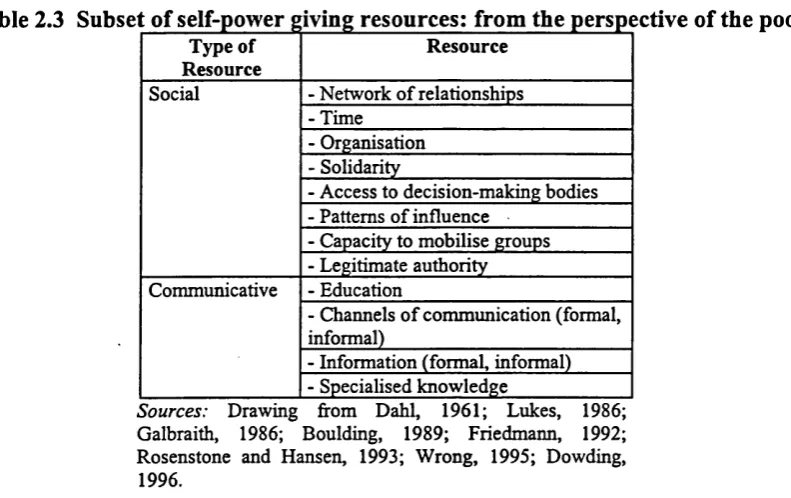
Table 2.3 Subset o f self-power giving resources: from the perspective o f the p o o r...45
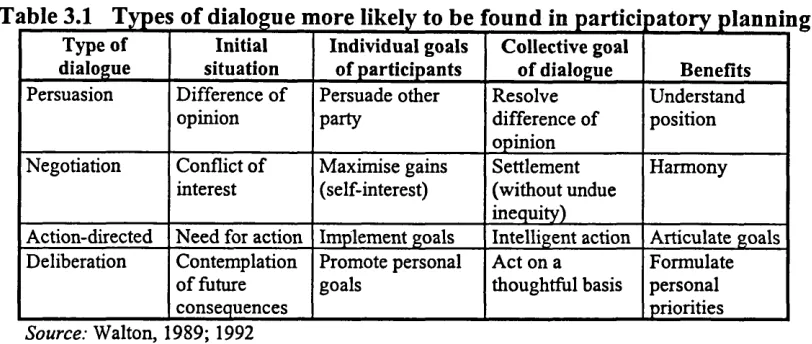
Table 3.1 Types o f dialogue more likely to be found in participatory planning 62 Table 4.1 Description o f the elements that operate in a model o f one o f the processes by which self-power is generated...79
Table 5.1 Attributes o f PRA...106
Table 5.2 The more major PSMs and their aims...120
Table 5.3 Attributes o f PSMs... 125
Table 5.4 Comparison o f attributes: PSMs and PRA ...126
Table 6.1 Principal and direct effects from the PSM intervention... 154
Table 7.1 Reasons for choosing S C A ...187
Table 7.2 Extract o f the options analysis... 195
Figure 3.1 Ladder o f citizen empowerment... 57
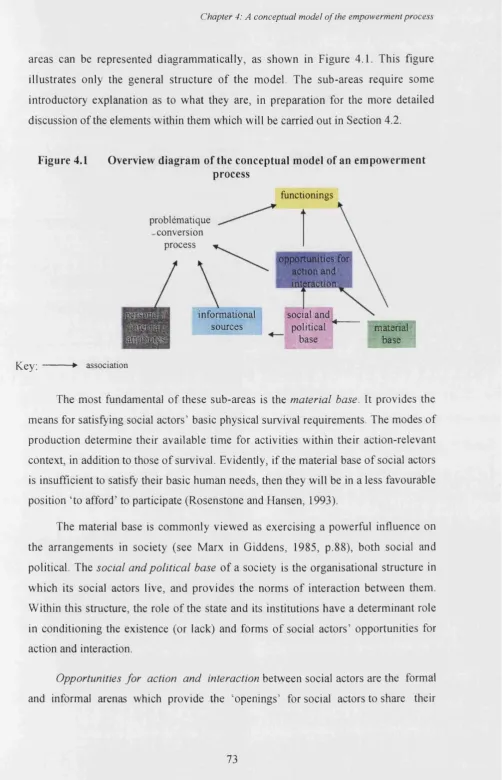
Figure 4.1 Overview diagram o f the conceptual model o f an empowerment process... 73
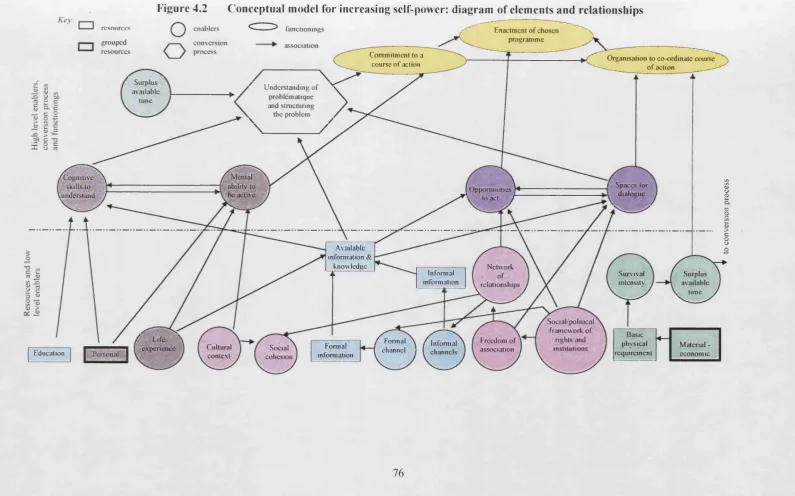
Figure 4.2 Conceptual model for increasing self-power: diagram o f elements and relationships... 76
Figure 4.3 Conceptual model with more formalised conversion process... 90
Figure 4.4 Conceptual model: Potential principal and direct effects o f PSMs ... 93
Figure 5.1 Overview diagram o f the analytic contribution to empowerment...97
Figure 5.2 Dissemination o f PSM: its potential adopters and the communication channels employed... 132
Figure 6.1 Structure o f the Mexican National Health System... 141
Figure 6.2 Levels o f responsibility in health management within the SSA ... 144
Figure 7.1 Structure o f the Mexican Federation and case study selection... 158
Figure 7.2 Spatial arrangements within the health centre o f Alpuyeca... 169
Figure 7.3 Decision graph from the first workshop session...193
Figure 7.4 Principal and direct effects on model elements from the analytic contribution to empowerment... 202
Map
To Jimmy
,
Allan
,
Debbie, Gabbie, Emily and Guillermo A.
who unknowingly have taught me
the importance o f enjoying
the small things in life
critically at his world in a dialogical encounter with others. Provided with the proper tools fo r such an encounter, he can gradually perceive his personal and social reality as well as the contradictions in it, become conscious o f his own perception o f that reality, and deal critically with it. ”
Richard Shaull (Foreword to Freire’s Pedagogy of the oppressed. 1972, p.16)
I would like to express my gratitude to the institutions in Mexico who provided
assistance to undertake this research. My greatest appreciation to the National
Institute o f Public Health (INSP), where I began my career in public health, for their
unlimited support. I am also thankful to the Mexican Health Foundation
(FUNSALUD) for funding the period of the fieldwork. I am grateful to interviewees,
colleagues and administrative staff from the INSP, the staff from the Ministry o f
Health o f the State o f Morelos, the Health Jurisdiction o f Cuernavaca, the local
government o f Xochitepec, and the local health clinic o f Alpuyeca for their undivided
co-operation.
The community o f Alpuyeca, and in particular the members o f its Community
Health Council, deserve special acknowledgement. Their enthusiasm and willingness
to learn and to share their livelihood with me was significant for the development o f
the fieldwork. I am extremely thankful to them. They gave me much more than I
could manage to ‘teach* them.
I am also grateful to the academic and administrative staff o f the Operational
Research department at the LSE for their continuous support. Special thanks to
Brenda Mowlam, Caroline Rudd and Diana Bolton.
To my families (Honduran, Mexican, U.S. and Spanish) and my friends (nearby
and far away), who have remained “al pie del canon” throughout the years - thank
you for being there. In different ways you have accompanied and motivated me
through this otherwise lonely process.
Completing this thesis has certainly been an arduous and sometimes painful
process. It undoubtedly would have not been possible without the invaluable guidance
and patience o f my supervisor, Professor Jonathan Rosenhead, to whom I am
infinitely grateful.
AR Action Research
CH C Community Health Council
CO R Community Operational Research
H GA Hypergame Analysis
INSP National Institute o f Public Health (Institute* Nacional de Salud Publica, Cuernavaca, Morelos, Mexico)
ISS Ideal Speech Situation
IT K Indigenous Technical Knowledge
NGOs Non-Governmental Organisations
NHS Mexican National Health System
O R Operational Research
ORS British Operational Research Society
PANDA Participatory Appraisal of Needs and the Development o f Action
PDPMs Participatory Development Planning Methods
PRA Participatory Rural Appraisal
PSMs Problem Structuring Methods
RA Robustness Analysis
R P K Rural People’s Knowledge
RRA Rapid Rural Appraisal
SCA Strategic Choice Approach
SHS Mexican State Health Systems
SODA Strategic Options and Decisions Analysis
SSA Mexican Ministry o f Health (Secretaria de Salud)
SSM Soft Systems Methodology
Capabilities - what the person can achieve (or ‘can do or be’) with the commodities s/he has.
Community - a collectivity o f individuals who despite any differences regarding wealth, sex, class, knowledge and power, share common interests and needs.
Conversion process - any process by which resources and enablers are transformed into functionings.
Empowered - having more resources for self-power than before.
Empowerment - the state of being empowered.
Empowerment process - any mechanism by which increases in self-power giving resources o f the disadvantaged are produced.
Enablers - the assets which are provided on an individual basis or a communal basis across society; they act as ‘facilitators’ or as catalysts which aid resources to become ‘activated’.
Functionings - the achievements o f a person; what the person succeeds in ‘doing’ or ‘being’ with the commodities at his/her command.
Negative freedom - the absence o f constraints imposed by others.
Participation - a means o f contributing to the effectiveness o f the empowerment process.
Positive freedom - the positive ability to choose.
Power - the ability o f a social actor, A, to induce other social actors to behave in a way which achieves A ’s preferred outcomes.
Power * - both the power and self-power o f social actors.
Resources - the assets which permit or constrain social actors’ capabilities.
Self-power - the capacity o f social actors to maintain or develop effective control over self-power giving resources and decisions which affect them.
Self-power giving resources - the assets which provide social actors with self-power.
Social actor - an individual or collectivity (e.g. groups, communities, non governmental organisations, government agencies, states) seeking to generate changes in the society which they are part of.
Introduction
The development problems o f the Third World are not new, and although
progress has been made, these problems remain unresolved. The majority o f the
population o f the Third World (or developing) countries has yet to satisfy its ‘basic
needs’ - securing access to food and shelter, and to services such as health and
sanitation (Stewart, 1985; Hettne, 1990; Friedmann, 1992; Schuurman, 1993; Phillips
and Verhasselt, 1994).
One o f the possible explanations o f this ‘phenomenon’ (continuing lack o f
satisfaction o f basic needs), and probably the most accepted one, is that this majority
lack resources, which leaves them in a position o f relative (not to say extreme)
disadvantage compared to the rest o f the world’s population. This explanation,
however, is one that could be described as: ‘the snake that bites its tail*. In other
words, the poor (the intended beneficiaries o f the development process) are poor
because they cannot satisfy their basic needs due to lack of resources, and they lack
resources to fulfil their basic needs because they are poor.
An alternative, and more substantiated, explanation is that for many years the
emphasis o f development initiatives was purely on economic growth and
industrialisation (see Seers, 1979; Simmons, 1988; and Todaro, 1994).1 The focus o f
this approach was on improving measures such as gross national product or per capita
income, thereby ignoring social aspects such as the distribution o f resources, and
access to opportunities (e.g. jobs) and services (e.g. health, education) (Kitching,
1989; Phillips and Verhasselt, 1994). The subsequent incorporation o f social aspects
into the objectives of development sought to alleviate the effects produced by the
economic growth focus (e.g. continuing poverty, fluctuating (un)employment rates,
unequal distribution of income and other development problems).
'See Appendix A, for an historical overview o f various development theories.
As a result o f this change in focus, recent decades have witnessed a shift to a
more people-centred - or participatory - approach to development (Nelson and
Wright, 1995; Rahman, 1995). The underlying principle o f this approach is that
people themselves (especially poor and disadvantaged groups) should become
actively involved in the decisions and activities oriented towards improving their life
conditions and those o f the societies in which they live.
For the people-centred approach to development to be effective, three
fundamental changes or transformations to improve the position o f relative
disadvantage and powerlessness o f the poor need to take place. The first is the
transformation o f social and political structures to provide the spaces and channels so
that people can voice their opinions, needs and concerns, as well as participate in the
decision-making processes related to them.
This restructuring leads to the second change, an increased awareness, by the
intended beneficiaries o f development, o f the resources which they need in order to
take action to improve their situation. And third, since development planning is “a
process concerned with guiding social change” (Sagasti, 1988, p. 431), the methods
which it uses ought to be appropriate for the new participatory orientation o f this
process.
Numerous innovative participatory development planning methods (PDPMs)
have been proposed or put into practice to guide social change with the active
involvement o f the beneficiaries. O f these methods Participatory Rural Appraisal -
PRA (Chambers, 1992, 1994a) will be given particular emphasis in Chapter 5. This is
because this approach has been the most widely applied in the Third World, and in
such diverse areas as agriculture, health, natural resources management, and food
security.
In parallel, but so far with almost no interaction, a variety o f ‘problem
structuring methods’ (PSMs) (also to be discussed in Chapter 5) have been developed
within the discipline o f operational research (OR). These new methods, sometimes
known as ‘soft’ OR, are also participatory, and interactive. PSMs have as their
purpose to assist decision-makers and organisations gain a better understanding o f
their problems. This is achieved through the exploration o f different perspectives, and
facilitating dialogue and negotiation, with a view to generating consensus on problem
structure and, usually, on initial commitments (Rosenhead, 1989a; 1992; 1996).
Writers (for example, Bomstein and Rosenhead, 1990; Thunhurst, 1992, 1996;
Rosenhead, 1993, 1996; White, 1994) have suggested that soft OR can be useful in
grassroots, community-based planning,2 both in Third World situations and in
community OR (COR).3 These authors make a plausible case that soft OR could be
useful in COR in the Third World.
Nevertheless, arguments that soft OR can be useful in such a context have been
rather loosely phrased. It is not clear what it is supposed that PSMs would achieve.
The implication, sometimes explicit, is that the cognitive assistance provided by
PSMs helps generate more balanced dialogue and that these methods contribute to
something called empowerment (Rosenhead, 1989a; White, 1994).
As can be seen, PSMs share some characteristics with PDPMs. Both families o f
methods involve the active participation o f and aim for empowerment o f the intended
beneficiaries o f development. There is therefore a prima facie case for investigating the possibility that PSMs may have a role in participatory development planning.
In order to do this, the nature of Third World community organisations needs to
be explored so that the problems they are faced with can be clarified. This is
necessary because understanding the characteristics o f these organisations (e.g.
catalyst for formation, purpose, size, funding, available resources, structure, available
time o f members, analytical skills o f members, degree of autonomy for decision
making), will help ‘shed some light* on the adaptability and usefulness for them o f the
analytic support provided by PSMs (Rosenhead, 1993).
These organisations can be faced with internal and/or external problems, to
which issues o f complexity, uncertainty and conflict may be associated (Rosenhead,
1989a; 1993). This characterisation o f problems should inform the selection o f a
PSM, or combinations o f them, that are most suitable (Jackson and Keys, 1984;
2See Navarro, 1984; Robertson, 1993; Bums et al, 1994, for different interpretations o f ‘community’.
3For details o f community OR, see Jones and Eden, 1981; Jackson, 1987; Parry and Mingers, 1991; Ritchie et al, 1994; Wong and Mingers, 1994.
Jackson, 1988; Mingers and Brocklesby, 1997; Mingers and Gill, 1997). Although
there is no generally accepted PSM selection scheme, for the purposes o f this research
their suitability needs to be evaluated in relation to the objectives o f participatory
development. This means that the evaluation o f PSMs needs to be based on
dimensions specific to participation and empowerment.
Our broad hypothesis is that PSMs do have a role in empowering poor and
disadvantaged social actors. It can be expressed in terms of three components:
• the cognitive/analytical assistance provided by PSMs will improve these social actors’ understanding of their action-relevant context;
• this improved understanding will lead to more effective participation in the planning o f local development;
• and the effective participation of poor and disadvantaged social actors will in turn lead to them having more control over their lives.
To express this hypothesis more precisely, some clarification o f concepts is first
required. In Chapters 2 and 3, several key concepts which emerge in the literature o f
both participatory development and PSMs are discussed. The concepts o f power,
empowerment, participation, and spaces fo r dialogue are defined in an operational way. In particular self-power (seen as a capacity for autonomy) is distinguished from
power (which carries the potential for control o f others), and is defined in terms o f resources available to the individual or group.
Based on this conceptual development, a model is built in Chapter 4 relating
these concepts to the processes by which social actors’ self-power may be maintained
or augmented. The model builds on the work o f Sen on capabilities, and Doyal and
Gough’s basic human need for autonomy. The elements o f the model consist of:
resources (e.g. social, technical, personal, and material/economic); enablers (e.g. network of relationships, freedom o f association, social/political framework o f rights
and institutions; informal channels o f communication); conversion processes
(transformations by which resources and enablers are transformed into functionings);
and functionings (achievements o f social actors).
In Chapter 5, two analyses are carried out. First, the characteristics o f the Third
World decision-making and development planning environment are reviewed. This is
done with a view to identify the extent to which the contextual requirements for which
PSMs are designed correspond to the contextual characteristics o f developing
countries. Second, the attributes of PSMs and PRA are discussed in preparation for a
comparative analysis between the two families o f methods. This analysis seeks to
examine critically the claims which have been made for a possible role for PSMs in
development planning. Three main issues are addressed: the relative strengths and
weaknesses of PSMs and PRA; compatibility between the two families o f methods;
and scope for the independent use o f PSMs or their joint use with PRA.
In Chapters 6 and 7, a case study in the area o f participative health services
planning in Mexico is described. This case study is a vehicle both for exploring the
adequacy of the conceptual model developed in Chapter 4, and also to investigate in
practice the hypothesis that PSMs can assist in improving the situation of
disadvantaged groups via the identified processes.
The concluding Chapter 8 discusses lessons for PSMs and local development
planning, and identifies areas for future research.
Conceptual Framework Part I:
Power and self-power
As may be recalled from Chapter 1, the purpose o f the research reported in this
thesis is to identify and evaluate the possible role o f PSMs in assisting the
involvement of community organisations in Third World development planning.
There are a number o f key issues which need to be understood to formulate our
research strategy appropriately and unambiguously. Principally, there is a need to
have clarity on the key concepts which emerge, explicitly or implicitly, in the
literature of both participatory development and PSMs (see Chapter 5). These
concepts are power, self-power, empowerment, participation, and spaces for dialogue.
These five concepts are interconnected and interdependent; therefore, it is to an extent
arbitrary which one is discussed first.
Power is a significant aspect o f the relationship between social actors4 who participate in the development planning process. It is relevant in the sense that either
social actors do not have the power to achieve their full aspirations, or the exercise o f
other social actors’ power prevents them from doing so. Another relevant aspect o f
power in the context o f participatory development concerns the ability o f poor and
disadvantaged groups to achieve increases in the degree o f control they have over
decisions and resources affecting their local development. This ability will be referred
to as self-power.
To achieve shifts in the balance between the power social actors have over
others and the self-power o f the power subjects, a participatory approach to
development is needed. It will be argued that one o f the ways to achieve these shifts -
to the advantage o f the power subjects - is through a process of empowerment. An
4It is simplest to think o f social actors as individual people but o f course they can be aggregates (e.g. groups, communities, non-govemmental organisations, government agencies, states). Any reference made to social actors throughout the thesis is applicable to any o f these categories, unless otherwise stated.
empowerment process is defined as any mechanism through which an increase in self
power of the less self-powerful can be achieved.
Increases in self-power which benefit less self-powerful social actors are likely
to be achieved (it will be shown) through their involvement in the planning and
decision-making process regarding issues that affect their lives. Participation is the means through which the less self-powerful may engage in the process o f
empowerment.
The concern o f this thesis is with exploring the potential for analytic assistance
or intervention to promote empowerment. Analytic intervention, if well posed, may
assist dialogue and argumentation. Therefore the type of participation o f special
interest for the research involves dialogue and argumentation. For this to take place
there need to be appropriate fora, and both spatial and temporal opportunities. This is
what is meant by another of the key concepts - spaces fo r dialogue. In elaborating this idea, there will be the need to clarify the concepts not only of ‘spaces’ and ‘dialogue’
but also of ‘argumentation’. The discussion o f these concepts will be based to some
extent on Habermas’s work on the Ideal Speech Situation (ISS).
These five concepts are discussed in more detail in this chapter and the one that
follows. Here, the concepts o f power and self-power are treated, while empowerment,
participation and spaces for dialogue are discussed in Chapter 3.
Our discussion begins with power. Power is taken to refer to social actors’
control over others. Self-power, in contrast, concerns the degree o f control social
actors have over decisions and resources which affect their own lives. The term
power* will be employed to include both power and self-power. All social actors have
power*. However, as will be explained, in the interactions between social actors the
interest is on some social actors’ self-power in relation to others’ power. In Sections
2.1 and 2.2 the concepts of power and self-power are defined in a more rigorous way.
2.1 Power
This research is concerned with the ‘bottom-up’, participatory approach to
development, particularly in health services planning. In this approach it is held that
the people who are expected to benefit from development actions should be able to
voice their opinions and needs, be heard, and so influence decisions that affect their
lives.
It is commonly held that the ability o f social actors to achieve this depends on
the types and quantities o f resources they have. The combinations o f resources which
one person has determine his/her power.5 And the extent to which this person
exercises that power, if s/he chooses to do so, is closely related to the way resources
are distributed across other people (i.e. other people’s power). In this section, the
relationship between resources and power will be explored.
Social actors’ power (or lack o f power) affects the extent to which they are able
to participate effectively in development planning. Thus one of the implications o f a
participatory orientation to planning is the need for shifts in the distribution o f power
between social actors. Clearly, if power is necessary to participate, the more powerful
will participate more and will be likely to oppose any changes that reduce their power
(Nelson and Wright, 1995; Wrong, 1995). However, the particular concern o f this
research is to explore the extent to which analytic tools such as PSMs provide an
opportunity to the poor and disadvantaged groups to effect changes in their capacity
to control their own lives.
The discussion o f power in this section is organised in two parts. The first part
focuses on developing a secure basis for the concept o f power, which, it is argued,
should be given a relational interpretation. Inherent in this view is that the power o f
social actors is determined by their resources. This relationship is further explored in
the second part which develops a typology o f resources that give social actors power.
5Lasswell (in Dahl, 1986) considers power (as a base for more power) a resource in itself.
2.1.1 The relational view o f power
Power is a difficult concept to grasp, and an ‘essentially contested’ one (Lukes,
1974, p.26). Despite the wide acceptance o f the importance o f power in the social
sciences, there are different schools o f thought on the concept.
Among the different approaches proposed for the analysis o f power are those o f
Berle (1969); Clegg (1979); Mulder (1982); Boulding (1989); Wrong (1995); and
Dowding (1996). Bobbio (1987) provides an account of the different available
approaches from a political philosophy perspective. The discussion which follows is
largely based on his work.
At the most basic level, Bobbio presents three alternative orientations to power.
These are: the substantialist, the subjectivist, and the relational. In the substantialist
view, power is a possession and is used in a similar manner to a good. Hobbes’
interpretation, which is the most influential within this view, poses power as the
means an individual possesses at a particular moment to obtain a good or benefit for
the future (Bobbio, 1987, p. 85). In the subjectivist approach (Locke’s perspective),
power is the capacity o f the subject (individual) to achieve certain effects; it is a
personal attribute. Elitist theories of power fall within this perspective.6
In contrast to these two views, in the relational interpretation o f power (which
according to Bobbio is the most widely accepted in contemporary political discourse),
power is understood as a relationship between two social actors. In this relationship
one social actor induces another to behave in a way which the latter would not have
otherwise chosen. Pluralist7,8 accounts o f power fall within this approach.
6The elitist theories hold that a ‘ruling elite’ or a small majority rules, and a single elite dominates all policy areas (Hague et al, 1992). A key issue in elitist theory is that the elite is organised and the mass population is not. For a discussion on elitist theories o f power, particularly the views o f Wright Mills, Pareto, Mosca, Schumpeter and Michels, see Wright M ills, 1957; Bobbio, 1987; Mosca, 1992; Robertson, 1993. Horowitz (1964, Chapter 2) presents a compilation o f interesting essays on power by Wright Mills.
7In the pluralist view, there are various policy areas or issues (e.g. health, education, transport) in which different groups are interested, but not all groups are interested in influencing all the issues. Thus multiple groups have a say in decisions and different groups are in charge o f different areas, so that power is diffused among numerous social actors. “N o one group holds total power over others” (Dahl, 1961).
8Hall et al (in Walt, 1994) proposed another theory that attempts a compromise between the elitist and pluralist theories o f power. This theory, referred to as ‘bounded pluralism’, holds that some issues (those ‘o f high politics’) - particularly economic ones - are the concern o f an elite. In contrast, service
The distinction between these three views can be explained as follows. The
substantialist and subjectivist definitions o f power are clearly dispositional in nature.
Dispositional refers to the capacity (whether latent or active) o f a social actor to
produce an act of control. In this sense, in the case o f the substantialist view o f power
an individual may obviously possess the means to attain a future good, or in the
subjectivist perspective have the capacity to achieve certain effects, even when this
individual is not engaged in employing the means to that end or his/her capacity to
achieve those effects (Wrong, 1995).
By contrast in the relational perspective, although the dispositional sense
remains important, it focuses specifically on the dynamic interactions between at least
two social actors. In these interactions they both employ their capacity to exercise
their influence in a particular situation or issue o f interest. As will be discussed, not
all social actors can exercise their influence in all situations. For the purposes o f the
research the relational view is o f particular interest, as will be explained below.
This research is into the applicability o f PSMs in participatory development
planning. PSMs are means to assist social actors to communicate and reach
agreements with each other. Thus our interest is in being able to understand the
dynamics of these interactions between social actors in the development planning
process. An interpretation o f power which focuses on such relationships is the most
appropriate for us to take. Therefore the framework which has been selected here is
the relational view o f power.
The following discussion o f the relational approach is principally based on the
work by Lukes (1974). He offers a particularly helpful presentation o f this approach
in terms of three alternative versions of increasing sophistication.
The main formulations o f these three views o f power relations are presented
below. The discussion begins with the pluralists’ one-dimensional view because it
contains those aspects common to all three perspectives.
delivery issues such as housing, health, education, transport are oriented to a pluralist perspective in which different groups have some participation in the decision-making process.
One of the most famous and concise definitions o f power within the relational
approach is that o f pluralist Robert Dahl (1961, 1986). He defines power as “a
relationship between actors, in which one actor induces the others to act in a way
which they would not have otherwise acted.”
According to Dahl, power needs to be studied in observable conflict situations
where there are different preferences between the social actors. Those social actors
whose preferences prevail are those who have power within particular “issue-areas”
o f the political system.
In Dahl’s view, social actors who are influential in certain issue-areas (e.g.
public education, urban renewal, party nominations) are not necessarily influential in
others. This is because resources are diffused throughout society. No social actor is
absolutely excluded from having some resource with which to exercise some type o f
influence over an issue-area. However, being able to exercise influence over that issue
area does not mean that that same resource will enable the social actor to exercise
influence in all issue-areas. (Dahl holds that both influential social actors and
resources change over time, and are not concentrated.)9
The work o f Dahl, referred to by Lukes as the ‘one-dimensional’ view o f power,
provoked a critique by Bachrach and Baratz, labelled by Lukes the ‘two-dimensional’
view. In this view, to understand power it is not enough to analyse the decisions and
the behaviour surrounding the decisions. Bachrach and Baratz argue that power is also
exercised “when A devotes his energies to creating or reinforcing social and political
values and institutional practices that limit the scope o f the political process to public
consideration o f only those issues which are comparatively innocuous to A” (Lukes,
1974, p. 16).
Power thus also operates through what is referred to as ‘non-decision making’.
A non-decision is “a decision that results in suppression or thwarting o f a latent or
manifest challenge to the values or interests o f the decision maker” (ibid., p. 18), thus
controlling potential conflicts. Bachrach and Baratz argue that one should not only
9These are part o f the findings reported in Dahl’s landmark study o f New Haven, Connecticut which was published in 1961 under the title “Who Governs? Democracy and Power in an American City”.
study what happens but also what does not happen (inaction). Power is exercised by
limiting decisions to “sure issues” through the manipulation o f social values and
beliefs, and of the institutions and political procedures in such a way as to place those
who benefit “in a preferred position to defend and promote their vested interests.”
(This is known as the mobilisation o f bias). The distribution o f power is thus,
according to Bachrach and Baratz, more unequal than Dahl’s pluralism held it to be.
Although the pluralists accept the importance o f non-decisions, they also claim
that non-decisions are impossible to study. Pluralists maintain that the focus o f the
study o f power must be on how specific, readily recognisable key issues are resolved
(Wrong, 1995).
Lukes’ third ‘radical view’ of power accepts with certain reservations the
approaches taken by the pluralists, and by Bachrach and Baratz. He suggests that power
has three dimensions: decision-making, non-decision making and shaping desires - the
latter being the manipulation o f the wishes and desires o f social groups. (This third
dimension is the reason for calling his view radical.) Lukes argues for the third
dimension on the basis that merely studying both observable conflict and non-decisions
is insufficient.
He expands on the work o f the pluralists and Bachrach and Baratz, arguing that A
may exercise power over B not only when A induces B to do what B would not
otherwise do, but also when A “influenc[esj, shape[s] or determin[es] [B’s]
wants/needs”. Therefore, this exercise of power can “affect the formation o f perceived
interests” (Lukes, 1974; West, 1990, p.57). Thus power can reduce the occurrence of
conflict “by manipulating the interests o f one party to the conflict” (West, 1990, p.57).
For Lukes, conflict of interests is not only observable and overt, but may also be
latent. Latent conflict occurs when there is a contradiction between interests o f those
who exercise power and the real interests10 o f those who are excluded. He says that it can
be assumed that if those who are subject to power become aware o f their real interests
then it is assumed that there will be conflict o f needs and preferences between the
10According to Lukes’, the exercise o f power produces changes in the conduct o f the power subject. Thus, the real interests o f power subjects are revealed when they are not subjected to power (Wrong, 1995).
excluded and those who exercise power over them. That is, despite the lack o f overt
conflict it is nevertheless latent.
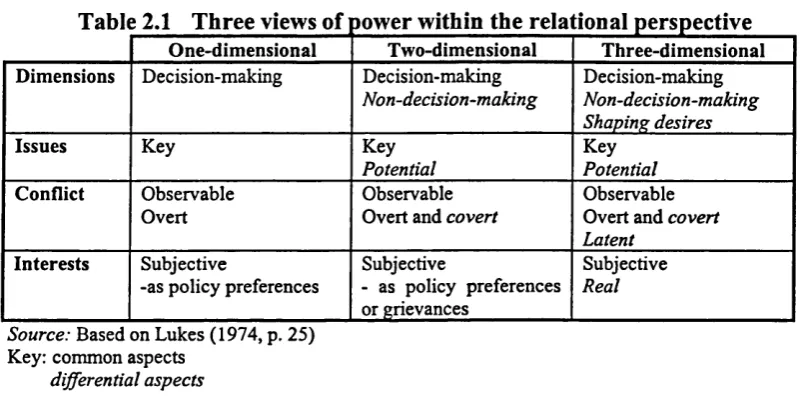
The main formulations o f the three relational views o f power that have been
discussed are summarised in Table 2.1. Those aspects in which the views differ are
shown in italics. The three-dimensional representation offers a more sophisticated
version o f what can occur in situations in which social actors interact. However, it does
carry with it the difficulties of actually observing, measuring or evaluating these
differential aspects (non-decision making, shaping desires, potential issues, latent
conflict, real interests), which are undoubtedly formidable.
Table 2.1 T hree views of power within the relaitional perspective
O ne-dim ensional Two-dim ensional Three-dim ensional
Dimensions Decision-making Decision-making
Non-decision-making
Decision-making Non-decision-making Shaping desires
Issues Key Key
Potential
Key Potential
Conflict Observable
Overt
Observable
Overt and covert
Observable
Overt and covert
Latent
Interests Subjective
-as policy preferences
Subjective
- as policy preferences or grievances
Subjective Real
Source: Based on Lukes (1974, p. 25) Key: common aspects
differential aspects
Studies which embrace either the two- or three-dimensional perspectives on
power necessitate a quite lengthy time-scale. This would be inconsistent with the
inevitable constraints o f doctoral research. Furthermore the sometimes ephemeral
nature o f grassroots organisations (see Chapter 5) places severe limits on the
availability o f either written records or oral history accounts extending over longer
periods. For all these reasons the one-dimensional view o f power will be adopted, as a
reasonable first approximation, in this thesis.
[image:27.595.45.450.302.505.2]2.1.2 Resources fo r power
In this thesis the intention is to explore a hypothesis about empowerment (this
term will be defined more clearly in the process o f these conceptual chapters). It is thus
necessary to adopt a view on what gives social actors power over others.
Implicit in the relational view of power, which has been adopted, is that resources
are the basic sources of power (Dahl, 1961; Wrong, 1995). No two social actors bring
into a relationship or interaction “exactly the same combination of resources” (Wrong,
1995, p.253). The social actor who is able to exercise influence and achieve his/her
preferred outcomes is the more powerful in this situation/relationship. This implies either
that the social actor who has been subjected to this exercise of power did not have
enough resources, or that the combination of resources s/he had was insufficient, to
counteract the power o f the other social actor in the situation. This unequal control over
resources is the basis o f the power relation between social actors. This inequality, or
existence of power differentials among social actors, by definition, affects the extent to
which social actors’ preferences prevail in achieving their preferred outcomes (Dahl,
1961).
In the unlikely event o f social actors having equal resources, there would in
principle be no issue about power. In practice, however, there are always inequalities.
This makes the discussion o f the influence o f resources upon power o f crucial
importance.
Resources are the assets which permit or constrain social actors’ actions and
interactions in their Tifeworld’.11 The meaning o f power-giving resources will be limited
in this thesis to those which are principally and most often used to make a difference in
the ability of social actors to achieve preferred outcomes. There are many alternative
categorisations o f power-giving resources (Dahl, 1961, 1986; Lukes, 1986; Testa,
1986; Lasswell and Kaplan in Dahl, 1986; Galbraith, 1986; Robbins, 1987; Boulding,
1989; Friedmann, 1992; Rosenstone and Hansen, 1993; Davies, 1994; Etzioni in
"Habermas (cited in Love, 1995) defines lifeworld as “the locus o f moral-practical knowledge or relations o f meaning shared in families and workplaces (private) and in political action and opinions (public).”
Wrong, 1995; Wrong, 1995; Harsanyi in Dowding, 1996).12 However, according to
Dahl (1986, p.44), “there is no accepted way o f classifying resources.”
Nevertheless, an analysis o f the lists o f resources proposed in the literature
permits the derivation o f a broad and inclusive categorisation. This has been produced
by analysing the various schemes and looking for overlaps and duplications. In
deriving this categorisation the framework developed by Habermas (Love, 1995;
Mingers, 1997a, 1997b) has been particularly helpful. This distinguishes between the
relationships and interactions which social actors have within three inter-dependent
worlds: material, personal, and social, and the use o f language as the interconnecting
medium between them.
The material world concerns physical space-time, entities and objects. It exists
and “is independent o f human beings” (Mingers, 1997a, p. 10). In this sense, the
material world is characterised by objectivity. Human beings relate to it through
observation and can mould it by their actions.
The second world is the personal which is made up o f each individual’s
thoughts, emotions, feelings, desires, fears, experiences and beliefs. Rather than
observing, as in the material world, individuals experience the personal world. This world is characterised by subjectivity in that it is unique to each individual. It is the
outcome of each individual’s “history o f choices, interactions and structural
couplings” (Mingers, 1997b, p. 424).
The social world is an intricate ‘web’ o f “language, meaning, social practices,
rules and resources that both enables and constrains” the actions o f humans and is
“reproduced through them” (Mingers, 1997a, p. 10). They share and participate in this
world. Its existence is therefore dependent on human beings; although it is “generally
independent o f any particular person” (Mingers, 1997b, p. 424). Human beings
appreciate or interpret the world independently. However, there can be a degree of
intersubjective agreement, if not objectivity, about the nature of the world.
,2Thus Etzioni distinguishes between coercive (instruments o f force), utilitarian (material rewards such as goods and services) and normative (symbols o f legitimacy, prestige or love) assets; Gamson’s typology is constraint, inducement and persuasion resources; Lasswell and Kaplan developed a list o f eight “base values” o f power which correspond to eight “forms o f power and influence”. These are
The capability that individuals have developed for communication and self-
reflection, leads us from the material world to the personal and social ones. The
medium through which humans communicate is language. Its aim is intersubjective
communication (Strong and Sposito, 1995). In general, relationships with these three
worlds and language are comprised or expressed in all human action and inaction.
(Mingers, 1997b). Any situation in the real world can be characterised by the complex
interaction o f these elements.
Habermas’ three worlds together with the language medium can be used to
classify the elements o f the lists of power-giving resources proposed in the literature.
Given that language has communicative purposes it will be taken as part o f a broader
category which will be called communicative resources. Therefore the categories o f
power-giving resources used in this thesis are: material, personal, social,
communicative. Each category is briefly defined below.
Material resources provide the capacity for consumption or acquisition o f goods and services. Personal resources are social actors’ distinctive, unique qualities which are the result o f their life history. These include those qualities which may
enhance or hinder their interactions with others. The bases for the interactions
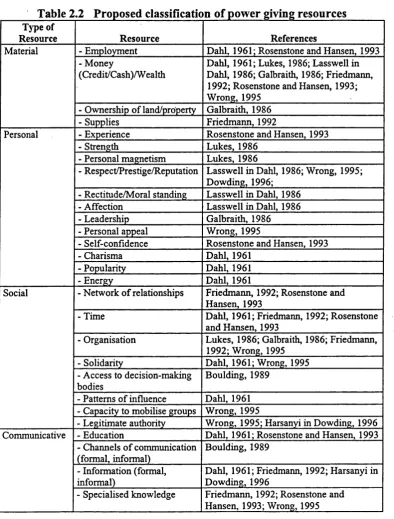
between social actors are provided by social resources. These bases include those which give access to the channels and processes for collective action. Communicative resources provide the necessary elements for the sharing and transmission o f knowledge between social actors about their action-relevant context. The principal
elements falling within each o f these categories are given in Table 2.2.
The discussion o f the more significant o f these resources will be deferred until
the presentation o f our model for empowerment in Chapter 4. However, it will be
useful to discuss some general characteristics o f power-giving resources here; in
particular whether power is a potential capacity or an actual exercise.
power (as a base for more power), respect, rectitude or moral standing, affection, well-being, wealth, skill, and enlightenment.
Table 2.2 Proposed classification of pow er giving resources Type of
Resource Resource References
Material - Employment Dahl, 1961; Rosenstone and Hansen, 1993
- Money
(Credit/ Cash) AV ealth
Dahl, 1961; Lukes, 1986; Lasswell in Dahl, 1986; Galbraith, 1986; Friedmann, 1992; Rosenstone and Hansen, 1993; Wrong, 1995
- Ownership o f land/property Galbraith, 1986
- Supplies Friedmann, 1992
Personal - Experience Rosenstone and Hansen, 1993
- Strength Lukes, 1986
- Personal magnetism Lukes, 1986
- Respect/Prestige/Reputation Lasswell in Dahl, 1986; Wrong, 1995;
Dowding, 1996;
- Rectitude/Moral standing Lasswell in Dahl, 1986
- Affection Lasswell in Dahl, 1986
- Leadership Galbraith, 1986
- Personal appeal Wrong, 1995
- Self-confidence Rosenstone and Hansen, 1993
- Charisma Dahl, 1961
- Popularity Dahl, 1961
- Energy Dahl, 1961
Social - Network o f relationships Friedmann, 1992; Rosenstone and
Hansen, 1993
- Time Dahl, 1961; Friedmann, 1992; Rosenstone
and Hansen, 1993
- Organisation Lukes, 1986; Galbraith, 1986; Friedmann,
1992; Wrong, 1995
- Solidarity Dahl, 1961; Wrong, 1995
- Access to decision-making bodies
Boulding, 1989
- Patterns o f influence Dahl, 1961
- Capacity to mobilise groups Wrong, 1995
- Legitimate authority Wrong, 1995; Harsanyi in Dowding, 1996
Communicative - Education Dahl, 1961; Rosenstone and Hansen, 1993
- Channels o f communication (formal, informal)
Boulding, 1989
- Information (formal, informal)
Dahl, 1961; Friedmann, 1992; Harsanyi in Dowding, 1996
- Specialised knowledge Friedmann, 1992; Rosenstone and
Hansen, 1993; Wrong, 1995
There is an evident difference between having the potential capacity to exercise
power and the actual exercise o f power (Wrong, 1995).13 This difference implies that
there must be an intervening activity in which this potential capacity is transformed
l3In making this distinction, Wrong (1995), following Ryle, refers to the capacity to perform acts o f power as a “dispositional” concept o f power, and the actual exercise o f power in a specific behavioural event as an “episodic” one.
[image:31.595.65.460.114.634.2]into the actual exercise o f power. In this intervening activity, if social actors wish to
make their power effective, then they need to deploy their power-giving resources.
The actual exercise o f power o f social actors thus implies that they have been able to
successfully employ their resources, i.e., transform their potential capacity.
To make their capacity effective, social actors will require various types and
variable quantities o f their power-giving resources. In making their preferences
prevail it is not only the amount which is important but also the types o f power-giving
resources social actors have. They need different combinations in different
circumstances (Goldman, 1986). For example, the combination o f resources deployed
by a rich landowner in a situation o f influencing government policy, are not likely to
be the same as that employed by him in a situation o f purchasing a parcel o f land from
a poor farmer.
Thus, every circumstance has specific characteristics which determine the
nature o f the required resources and their substitutability. These circumstances
include the propensity o f other social actors to exercise the power-giving resources
which they control.
Clearly, though, the less power-giving resources social actors have, the less
powerful these social actors can be. However, they can still be adequately powerful in
some situations while not in others. The reason for success being variable is that it
depends on whether or not other social actors choose to exercise some o f their power.
The knowledge o f less-powerful social actors as to which social actors are
powerful is likely to constrain the actions of the former. If they know that a social actor has the potential to exercise influence over a particular issue, because they are aware o f
the resources s/he has, then this social actor’s reputation for power will restrain the
actions of the less powerful. Their actions will be guided by what they perceive to be the
limitations in their capacity to be influential (Wrong, 1995). For example, a rural peasant
who is aware o f the powerfulness o f other social actors, will avoid undertaking any
actions which might jeopardise “future employment, tenancy, loans, favours or
protections”. This peasant “knows that in the short term accepting powerlessness pays”
(Chambers, 1983).
These issues must be taken into account in any statement made about social
actors’ ability to participate in and have an impact on decision-making processes with
a view to making their preferences prevail. Clearly, the more types and quantities of
resources social actors have, the better in general their chance o f prevailing.
In this section, the relational view o f power has been discussed. From this
perspective resources are seen as determinant in affecting the capacity o f social actors
to interact with others and achieve preferred outcomes. The purpose o f the discussion
has been to provide a conceptual basis for the treatment o f power. However, the
particular focus o f this research is on the ability, not o f people in general, but of
disadvantaged individuals and groups in particular, to maintain or develop effective
control over their own lives. The issue for them is not the extent to which they can
affect the behaviour o f others, but the extent to which they can avoid being the objects
o f such control by others. This capacity, which will be called “self-power” is
discussed in the following section.
2.2 Self-power
The voice o f the poor is generally ignored in the decision-making processes
which have a direct impact on their lives. Their participation, if any, is usually limited
to some form o f tokenism. (The concept of participation will be discussed in Section
3.2.) A possible explanation for this situation is that the poor lack resources. Among
these are those related to the satisfaction o f their ‘basic needs’ (e.g. securing access to
food and shelter, and to services such as health and sanitation). In addition, they also
lack those resources which could provide them with the capacity to articulate their
wants and needs, establish their demands and priorities, defend their interests and
influence decision-making processes.
These latter resources are of especial interest because our concern in this thesis
is to investigate the possible role o f PSMs in working with the poor. The particular
focus given to this concern is to explore how cognitive assistance, through PSMs, can
lead to people having more control over their lives through generating better
understanding. In this section we will develop this argument, and identify the set o f
those resources required for self-power.
In developing the supporting arguments we draw from the literature related to
development, in particular from the work of Sen (1981, 1984, 1985) on capabilities
and functionings, and from Doyal and Gough’s (1991) human needs theory. Each o f
these will be presented in turn.
2.2.1 Sen on capabilities and Doyal and Gough’s human needs
Sen (1984, p .5 11) regards development as “enhancing the capabilities o f
people”. He refers to this development orientation as the capability approach. This
approach is one which can be used to evaluate a person’s well-being, a key aspect on
which improvement o f life is based. The fundamental concepts o f this development
orientation are commodities, characteristics, functionings, capabilities, and
entitlements.
For Sen, a commodity is a good. Many of the examples the author provides are
tangible goods linked to his work on poverty and famine, such as rice (Sen, 1984) or
bread (Sen, 1985), which are quantifiable. Characteristics are the properties o f
commodities. For example, the characteristics o f bread include calorie provision,
nutrition, and meeting demands for festivities.
Functionings are personal features which refer to the achievements o f a person.
Functionings tell us what the person succeeds in ‘doing’ or ‘being’ with the
commodities, through their characteristics, at his/her command (Sen 1984, 1985).
‘Doings’ consist o f activities (e.g. eating, reading, walking, seeing), and ‘beings’ are
states o f existence (e.g. be well nourished, not being ashamed because poorly dressed,
not suffer malaria) (Sen, 1997). With the bread commodity, in combination with other
commodities, a person’s ‘beings’ could be being well nourished, or living without
calorie deficiency. One o f the person’s ‘doings’, contributed by bread, could be
entertaining others. Thus commodities are the means to achieve functionings.
According to Sen, there is a conversion process by which commodities become
functionings.14 Different people achieve different functionings with the same bundle
o f commodities. This is explained by what is referred to as ‘interpersonal variations’
(Sen, 1984).
Interpersonal variations can be illustrated with the bread example. The
nutritional levels attained by different people who have command over bread may be
determined by personal factors such as metabolic rates, body size, nutritional
knowledge and education, medical conditions. Interpersonal variations may also
depend on social factors such as a person’s position in society, or the nature o f social
conventions and norms in force in the society a person lives. This example suggests
that it is not the possession o f commodities per se which determines the well-being of
a person, but rather what the person is able to do with the commodities at his/her
command.
Capabilities are what the person can ‘do’ or ‘b e’ with the commodities s/he has (Sen, 1984). The capabilities of a person depends on two things. One the one hand,
capabilities are determined by the bundle o f commodities over which a person can
establish command (given the person’s income, price of goods, etc.), and choose to
consume or exchange through trade and production (e.g. labour for pay, pay for food).
Sen refers to these bundles o f commodities, which a person has or can obtain, as
entitlements and endowments, respectively15 (for a discussion see Sen, 1981, 1986,
1987; Dreze and Sen, 1989).
On the other hand, a person’s capabilities depend f on the feasible set o f the uses
that the person can actually make o f those commodities. The feasible set is, thus,
made up o f functionings. So according to Sen, a person’s capabilities are the various
alternative functioning bundles from which s/he can choose.
Capability reflects the idea of positive freedom (Sen, 1985). Positive freedom
refers to “what a person can or cannot do, or can or cannot be” (Sen, 1984). In other
14There are other complexities. For example, material resources can be either consumed (like bread) or occupied (like a bicycle). Nevertheless, social resources (such as social networks) are not consumed in this way. There might be advantages to using them but that is a different issue. In this thesis, the simplest version will be used; this is that commodities are consumed.
l5Sen distinguishes between endowments and entitlements. The former refers to the commodities a person has through inheritance and transfer. The latter refers to the commodities acquired through trade, production, claims made on the state (e.g. unemployment benefit) (Sen, 1981).
words, capabilities connote the “the extent o f freedom that people have in pursuing
valuable activities or functionings” (Dreze and Sen, 1989, p.42). In the sense o f this
statement, the authors’ interpretation o f freedom is the positive ability to choose (i.e.
positive freedom). Positive freedom suggests having not only the opportunities for
choice and for action but also “those supportive influences which actually help a
person to do the things s/he wants to do” [or be] (Dreze and Sen, 1995, p.25).
By contrast, an individual’s negative freedom means “not being prevented from
doing certain things” (ibid., p.25).16 In other words, the negative view o f freedom
interprets freedom as not being restricted in one’s capacity, to choose and to act, by
the acts of others. These interpretations o f freedom can be illustrated by the bread
example as follows. If a person chooses to use the bread commodity for the
functioning of entertaining others, then this person has exercised his/her positive
freedom. However, if this same person is prevented by others from using this
commodity to entertain others, even though it is an activity s/he has chosen to carry
out, then this would be a lack o f negative freedom. Thus, if A does not prevent B from carrying out B ’s chosen activity, then B has negative freedom. And if A does prevent B from carrying out B ’s chosen activity, then B ’s negative freedom is curtailed.
Capabilities and functionings are evidently closely related. The difference
between them can be understood as follows. Functionings represent the chosen
patterns of use (the activities or states o f existence) that a person achieves with a
commodity. The capabilities o f a person are the alternative combinations o f possible
functionings - or choice set - that s/he can achieve through choice.17 So possible
functionings are capabilities, and thos